Feeling of Knowing: Teaching Pupils to Judge Their Own Learning
|
March 7, 2026
Learn what the feeling of knowing is, why it misleads pupils during revision, and how to use retrieval practice and calibration to improve metacognitive accuracy.
Feeling of knowing is a metacognitive judgement: It is the sense that you "know something" even when you cannot currently recall it. Pupils experience this constantly during revision and tests.
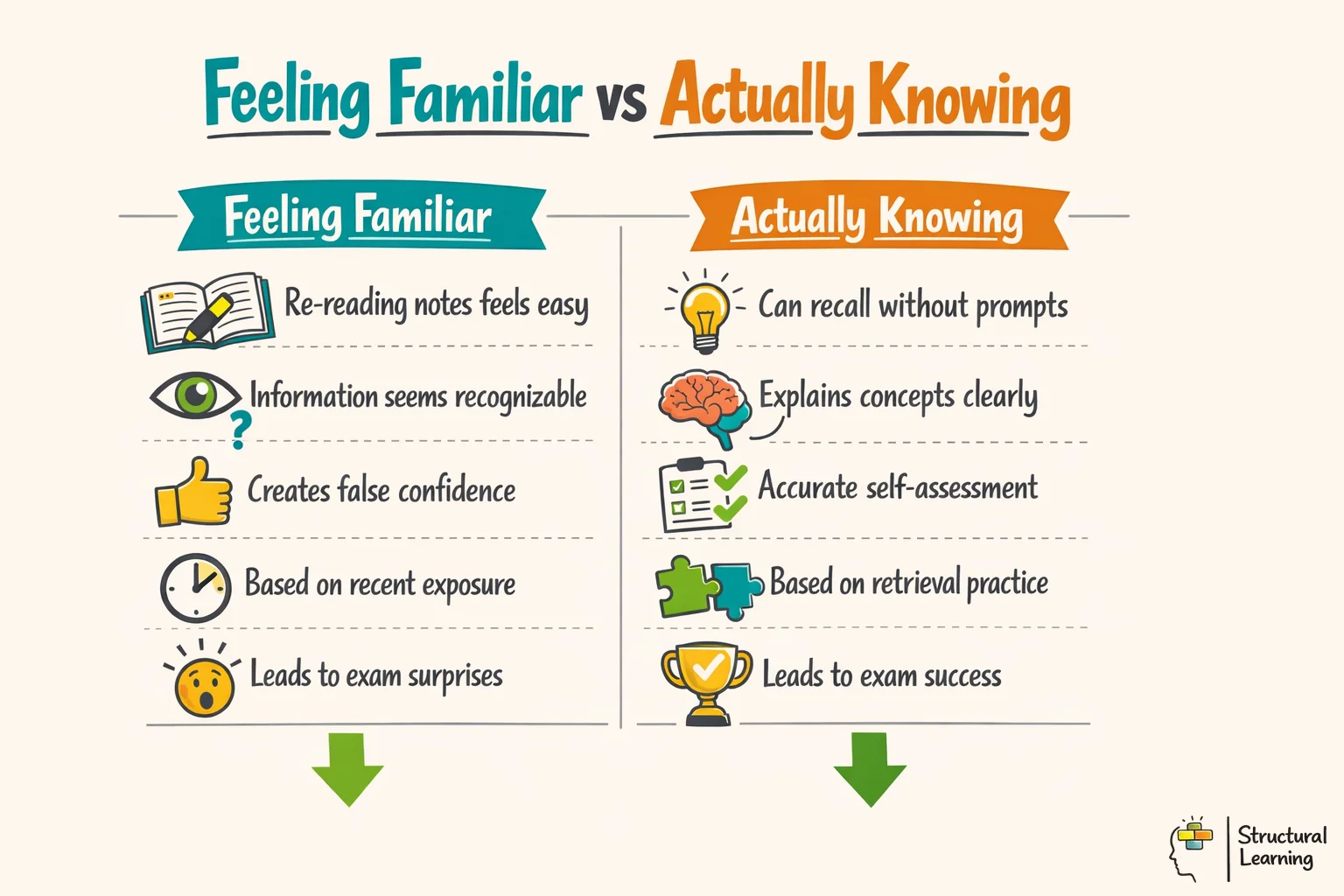
FOK judgements are often inaccurate: Familiarity with material creates a false sense of mastery. Pupils who re-read notes feel they know the content, but retrieval tests reveal gaps.
Calibration improves with practice: When pupils regularly predict their performance before testing themselves, the gap between confidence and actual knowledge narrows over time.
Retrieval practice exposes real understanding: Low-stakes quizzes force pupils to confront what they actually know versus what merely feels familiar, correcting miscalibrated FOK judgements.
Your pupils have all been there. They revise a topic, read through their notes, nod along as each point seems familiar, then walk into the exam and find they cannot recall anything clearly. They felt prepared. The test said otherwise.
That gap between feeling ready and actually being ready has a name in cognitive psychology: the feeling of knowing. Understanding what it is, why it misleads pupils, and how to correct it is one of the most useful things a teacher can do for pupil revision habits. This guide covers the research and gives you concrete strategies to use straight away.
What Is the Feeling of Knowing?
The feeling of knowing (FOK) is a metacognitive judgement: a pupil's prediction that they will be able to recognise or recall information in the future, even when they cannot retrieve it right now. Hart (1965), in the foundational study on this phenomenon, showed that people can accurately predict whether information is stored somewhere in memory even when they cannot currently produce it. If you ask someone a trivia question they cannot answer, they can often still say with confidence, "I know this, it's on the tip of my tongue."
In the classroom, FOK judgements happen constantly. A Year 10 pupil reads through a page of history notes and thinks, "Yes, I know this." A GCSE student flicks through a revision guide and ticks off topics as familiar. A sixth-former skims lecture slides the night before an exam and feels broadly confident. In each case, the pupil is making an FOK judgement: assessing whether their memory holds the relevant material.
The problem is that FOK is triggered by familiarity, not by genuine retrieval ability. Seeing information again feels like knowing it. The two experiences are neurologically distinct, but pupils treat them as the same thing. Nelson and Narens (1990) described this in their influential framework for metamemory: monitoring processes (judging what you know) must be separated from object-level memory (actually knowing). When pupils conflate them, they misjudge their own readiness.
FOK is one of several metacognitive monitoring judgements. Judgements of learning (JOLs), confidence ratings, and ease-of-learning ratings each tap a slightly different aspect of self-assessment. The table below shows how they compare.
Metacognitive Monitoring Judgements: A Comparison
Judgement Type
Definition
When Pupils Use It
Accuracy
Feeling of Knowing (FOK)
Sense that information is stored in memory even when not currently recalled
During retrieval failure ("I know this but can't say it right now")
Moderate; often inflated by mere familiarity
Judgement of Learning (JOL)
Prediction of how well a just-studied item will be remembered later
Immediately after studying a note or worked example
Often overconfident; delayed JOLs are more accurate
Confidence Rating
Assessment of how certain a pupil is about an answer they have just given
After answering a question, in exams or quizzes
Variable; high performers tend to be better calibrated
Ease of Learning (EOL)
Prediction of how quickly new material will be learned before study begins
Before starting a revision session ("This topic will be easy")
Low; highly subjective and prior-knowledge dependent
Why FOK Judgements Often Mislead Pupils
The core issue is that FOK draws on the wrong signal. Koriat (1993) proposed the accessibility model of FOK: pupils base their sense of knowing on how easily related information comes to mind. If a few partial details surface quickly, the brain interprets that ease of access as evidence of stored knowledge. But partial recall is not the same as full recall, and ease of retrieval at one moment does not predict retrieval under exam conditions.
Consider a Year 9 pupil revising the water cycle. She reads through the diagram, recognises 'condensation' and 'evaporation', and feels confident. Two related details surface readily, so her FOK is high. In the exam, asked to explain the full process sequentially, she gets stuck after two steps. The familiarity with individual terms was real; the ability to retrieve and sequence the full explanation was not.
Re-reading makes this problem worse. When a pupil re-reads a chapter, every sentence feels familiar. That familiarity generates a continuously high FOK across the whole chapter. Dunlosky and Metcalfe (2009) describe this as the fluency illusion: processing ease is mistaken for learning. The pupil finishes re-reading and feels they have revised thoroughly, when in fact they have only confirmed what was already superficially visible to them.
There is also a timing effect. Judgements made immediately after study are consistently overconfident. Jacoby and Kelley (1987) demonstrated that the brain conflates current processing fluency with long-term retention. A pupil who reads a worked maths example and then immediately tries to recall the steps will perform better than if asked two days later, yet their FOK at both points might feel equally high. They do not register the decay.
Understanding working memory helps here. When material is still active in working memory immediately after study, retrieval is easy. But that ease evaporates once the session ends. Pupils who monitor their learning only during or immediately after revision will systematically overestimate how much they have retained.
The Illusion of Knowing in the Classroom
Bjork, Dunlosky, and Kornell (2013) coined the phrase 'illusion of knowing' to describe the gap between perceived and actual learning. Their review of self-regulated learning found that students across every age group and ability level routinely overestimate how well they have learned material. The illusion is not a sign of low ability; it is a structural feature of how human memory works.
In practice, you will see this in several recognisable patterns. Pupils copy from the board and tick the learning objective without checking whether they could reproduce the content from scratch. They highlight text during reading, which creates the sensation of active engagement but produces minimal memory encoding. They answer practice questions with their notes open, get most of them right, and conclude they are ready, without realising the notes were doing the cognitive work.
The illusion becomes particularly pronounced with cognitive load. When material is challenging, pupils spend working memory capacity on parsing the content. By the time they reach the end of a paragraph or explanation, the effort of processing feels like the effort of learning. High effort during study creates a strong FOK, even when the material has not been durably encoded. This is one reason why difficult topics in science and maths can generate misplaced confidence: the hard work of understanding feels like the same thing as remembering.
There is a classroom-specific wrinkle worth noting. Pupils who respond correctly during teacher-led questioning in class often take that as evidence that they know the material. But whole-class questioning rarely tests individual retrieval under genuine conditions. A pupil who half-recalls an answer, hears a neighbour provide it first, and nods along has not retrieved anything. Their FOK will still rise. Structuring questioning to require every pupil to commit to an answer before any are shared is a simple way to give more honest feedback to pupils about what they actually know.
Calibration: Matching Confidence to Competence
Calibration describes how closely a pupil's confidence in their knowledge matches their actual performance. A well-calibrated pupil who rates themselves eight out of ten on a topic will score roughly eight out of ten on a test. A poorly calibrated pupil might rate themselves eight out of ten and score four. Improving calibration is one of the most concrete goals you can set for self-regulation in your pupils.
Research consistently shows that weaker pupils are more poorly calibrated than stronger ones. This is sometimes called the Dunning-Kruger effect in popular accounts, but the underlying cognitive explanation is more precise: pupils with limited knowledge also lack the reference points needed to judge the limits of their knowledge. They do not know what they do not know, so their FOK fills the gap with false confidence.
The good news is that calibration is trainable. Kornell and Bjork (2008) showed that pupils who regularly engage in retrieval practice improve their calibration over time. Each retrieval attempt provides feedback: either the answer comes to mind or it does not. That feedback corrects FOK judgements more effectively than re-reading because it directly tests the prediction. When a pupil predicts they know something and then fails to recall it, the mismatch is visceral and memorable. It updates their metacognitive model in a way that passive review does not.
A practical starting point: ask pupils to rate their confidence on a topic before a quiz, then compare ratings to their actual scores afterwards. Do this repeatedly across a half-term and pupils begin to notice their own calibration patterns. Some will discover they are consistently overconfident on topics they find familiar but have not practised recalling. Others will find they are underconfident on topics they know better than they think. Both insights are useful. Formative assessment structured around pre-quiz confidence ratings gives you and your pupils real data on this.
Teaching Pupils to Monitor Their Own Learning
Monitoring is the active process of checking your own understanding as you study. It is distinct from FOK, which is more passive and automatic. Teaching pupils to monitor deliberately is central to developing metacognition and requires specific habits to be built and practised.
The most reliable monitoring technique is self-testing. Rather than asking "Does this feel familiar?", pupils ask "Can I recall this without looking?" The difference seems small but has a large effect on accuracy. A Year 11 pupil revising chemistry can read through her notes on electrolysis and feel confident, or she can close the notes, try to write out the full explanation from scratch, then check. The second approach gives accurate information. The first gives FOK.
Teach your pupils the difference between recognition and recall. Recognition is the ability to identify the correct answer when it is presented: it is what multiple-choice questions test, and it is the basis of FOK. Recall is the ability to retrieve information without cues: it is what essays, short-answer questions, and much of real-world application require. A pupil who revises entirely through re-reading and recognition tasks will have high recognition ability and fragile recall ability. The FOK generated by recognition practice will not transfer to recall performance.
The metacognitive monitoring process also benefits from spacing. When a pupil tests themselves immediately after studying something, their working memory still holds the content and retrieval is artificially easy. Test them 24 hours later and the result is far more diagnostic. Building regular low-stakes testing into lessons and homework routines, rather than relying on end-of-topic tests, gives pupils frequent and accurate feedback on their actual retention. Spaced practice is the structural solution to the timing problem in FOK.
FOK and Retrieval Practice
Retrieval practice is the single most effective intervention for correcting miscalibrated FOK. When pupils attempt to retrieve information without looking at their notes, two things happen. First, they get accurate feedback on whether they actually know something, which updates their metacognitive monitoring. Second, the act of retrieval itself strengthens the memory trace, making future recall more reliable. Bjork (1994) called this a 'desirable difficulty': the effort of retrieval, though harder than re-reading, produces durable learning.
The FOK correction mechanism in retrieval practice works through what Koriat (1993) described as the accessibility model in reverse. When a pupil tries to retrieve information and fails, their brain registers that the information is not accessible, even if it felt familiar during study. That registration updates the FOK for that item. The next time the pupil encounters that topic in revision, their FOK will be lower and more accurate, prompting additional study rather than false confidence.
Low-stakes quizzes are the most accessible form of retrieval practice in the classroom. Start the lesson with five questions on last week's topic. End the lesson with a brief written brain-dump of the key points covered. Set homework as a closed-book question rather than a read-through task. Each of these creates a retrieval event that gives pupils honest feedback on their FOK. A Science teacher who begins every lesson with a five-question retrieval quiz on the previous lesson's content will find, within a few weeks, that pupils' confidence ratings before the quiz begin to match their actual scores far more closely.
There is an important distinction here: retrieval practice corrects FOK, but only if pupils engage with it honestly. If pupils look at their notes before answering, or only attempt questions they are already sure about, the FOK-correction mechanism does not fire. The conditions matter. Notes-away, no-phone, individual retrieval gives accurate self-assessment data. Group discussion or open-book retrieval does not. Retrieval practice structured around genuine retrieval conditions is the key.
Practical Classroom Strategies
1. Confidence-Before-Quiz Routines
Before any low-stakes quiz, ask pupils to rate their confidence for each topic on a simple 1–5 scale. This takes under two minutes. After the quiz, pupils compare their pre-quiz rating to their actual score. Repeat this across several weeks and ask pupils to identify patterns: "Are you consistently overconfident on anything?" A Maths teacher might do this before a retrieval quiz on algebraic manipulation. Pupils who rated themselves four or five but scored two or three have a concrete, personal demonstration of miscalibrated FOK.
2. Closed-Book Brain Dumps
At the end of a lesson or topic, give pupils five minutes to write everything they can remember about the content, without notes or prompts. Then show them the key points and ask them to tick off what they got right and note what they missed. This is more cognitively demanding than a recognition exercise and gives far more accurate FOK feedback. An English teacher finishing a unit on 'An Inspector Calls' might ask pupils to brain-dump the themes, key quotes, and character arcs before revealing a checklist. Pupils are frequently surprised by how much they missed despite feeling confident.
3. Two-Column Revision Audit
Give pupils a list of the key topics in a unit and ask them to sort each into two columns: "Can recall fully" and "Feels familiar but gaps." The second column is where FOK is at work. Any topic that 'feels familiar' but cannot be fully recalled from memory belongs in that column, regardless of how confident it feels. Pupils then use the second column as their priority revision list. This is a direct application of conditional knowledge: knowing when to apply further study versus when to move on. A History teacher preparing pupils for a paper on World War One might use this before a mock, with pupils producing a personalised revision priority list from their two-column audit.
4. Delayed Testing for Calibration
Immediate self-testing after study inflates FOK because working memory is still holding the content. A more accurate picture emerges 24–48 hours later. Set a retrieval homework where pupils study a topic in class, then answer a set of recall questions at home the following evening without re-reading. The gap between study and retrieval removes the working-memory prop and gives an accurate reading of retention. Compare results to pupils' confidence predictions from the study session. A Languages teacher might do this after a vocabulary lesson: pupils rate confidence at the end of the lesson, then test themselves on the vocabulary the next evening. The comparison gives each pupil precise feedback on their FOK accuracy for language learning.
5. Teach the Concept Directly
Pupils who understand what FOK is and why it happens are better placed to correct for it. A ten-minute explanation of the difference between recognition and recall, using a concrete example (reading a name versus generating it from memory), can shift how pupils approach revision. Use the phrase "feels familiar vs can recall" as a shorthand. Once pupils have the vocabulary, you can refer to it when you see the illusion in action: "That feels familiar to you, but can you recall it without looking?" This kind of explicit instruction about learning processes is supported by the EEF's evidence on metacognitive instruction, which assigns it one of the highest effect sizes in their toolkit. Connecting this to growth mindset framing helps pupils see miscalibrated FOK not as a failing but as a target for improvement.
6. Interleaved Practice to Disrupt False Confidence
Blocked revision (studying one topic until it feels mastered before moving on) inflates FOK more than any other revision strategy. When all the practice problems are of the same type, or all the flashcards cover the same period of history, each successful retrieval makes the next one easier, giving a strong but misleading sense of mastery. Interleaving different topics or problem types within a session disrupts this. Pupils find it harder, their success rate drops, and their FOK recalibrates downward, accurately reflecting that they need more practice. The short-term difficulty is the signal that durable learning is occurring.
7. Memory Technique Audits
Some popular revision strategies actively inflate FOK without improving retention. Highlighting, re-reading, and summarising from notes all create strong feelings of familiarity without generating durable retrieval strength. Teach pupils to audit their own revision habits against what research shows about memory. A structured session on this, using Bjork et al.'s (2013) findings on illusions in self-regulated learning, gives pupils the evidence base to question their habits. The most effective memorisation techniques share one feature: they require pupils to produce information rather than simply process it. Production, not processing, is what corrects FOK.
Further Reading: Key Papers on Metacognitive Monitoring
Hart, J.T. (1965). "Memory and the feeling-of-knowing experience."Journal of Educational Psychology, 56(4). The paper that named and defined the FOK phenomenon, using recognition tests to show that people can accurately judge stored but currently unrecallable information.
Dunlosky, J. & Metcalfe, J. (2009). Metacognition. SAGE Publications. A thorough overview of metacognitive monitoring research, covering JOLs, FOK, confidence ratings, and their implications for education.
Nelson, T.O. & Narens, L. (1990). "Metamemory: A theoretical framework and new findings."Psychology of Learning and Motivation, 26. Introduces the object-level/meta-level distinction that remains the dominant framework for understanding monitoring and control in memory research.
Bjork, R.A., Dunlosky, J. & Kornell, N. (2013). "Self-regulated learning: Beliefs, techniques, and illusions."Annual Review of Psychology, 64. Reviews why popular revision strategies create illusions of knowing and identifies which techniques produce durable learning instead.
Feeling of knowing is a metacognitive judgement: It is the sense that you "know something" even when you cannot currently recall it. Pupils experience this constantly during revision and tests.
FOK judgements are often inaccurate: Familiarity with material creates a false sense of mastery. Pupils who re-read notes feel they know the content, but retrieval tests reveal gaps.
Calibration improves with practice: When pupils regularly predict their performance before testing themselves, the gap between confidence and actual knowledge narrows over time.
Retrieval practice exposes real understanding: Low-stakes quizzes force pupils to confront what they actually know versus what merely feels familiar, correcting miscalibrated FOK judgements.
Your pupils have all been there. They revise a topic, read through their notes, nod along as each point seems familiar, then walk into the exam and find they cannot recall anything clearly. They felt prepared. The test said otherwise.
That gap between feeling ready and actually being ready has a name in cognitive psychology: the feeling of knowing. Understanding what it is, why it misleads pupils, and how to correct it is one of the most useful things a teacher can do for pupil revision habits. This guide covers the research and gives you concrete strategies to use straight away.
What Is the Feeling of Knowing?
The feeling of knowing (FOK) is a metacognitive judgement: a pupil's prediction that they will be able to recognise or recall information in the future, even when they cannot retrieve it right now. Hart (1965), in the foundational study on this phenomenon, showed that people can accurately predict whether information is stored somewhere in memory even when they cannot currently produce it. If you ask someone a trivia question they cannot answer, they can often still say with confidence, "I know this, it's on the tip of my tongue."
In the classroom, FOK judgements happen constantly. A Year 10 pupil reads through a page of history notes and thinks, "Yes, I know this." A GCSE student flicks through a revision guide and ticks off topics as familiar. A sixth-former skims lecture slides the night before an exam and feels broadly confident. In each case, the pupil is making an FOK judgement: assessing whether their memory holds the relevant material.
The problem is that FOK is triggered by familiarity, not by genuine retrieval ability. Seeing information again feels like knowing it. The two experiences are neurologically distinct, but pupils treat them as the same thing. Nelson and Narens (1990) described this in their influential framework for metamemory: monitoring processes (judging what you know) must be separated from object-level memory (actually knowing). When pupils conflate them, they misjudge their own readiness.
FOK is one of several metacognitive monitoring judgements. Judgements of learning (JOLs), confidence ratings, and ease-of-learning ratings each tap a slightly different aspect of self-assessment. The table below shows how they compare.
Metacognitive Monitoring Judgements: A Comparison
Judgement Type
Definition
When Pupils Use It
Accuracy
Feeling of Knowing (FOK)
Sense that information is stored in memory even when not currently recalled
During retrieval failure ("I know this but can't say it right now")
Moderate; often inflated by mere familiarity
Judgement of Learning (JOL)
Prediction of how well a just-studied item will be remembered later
Immediately after studying a note or worked example
Often overconfident; delayed JOLs are more accurate
Confidence Rating
Assessment of how certain a pupil is about an answer they have just given
After answering a question, in exams or quizzes
Variable; high performers tend to be better calibrated
Ease of Learning (EOL)
Prediction of how quickly new material will be learned before study begins
Before starting a revision session ("This topic will be easy")
Low; highly subjective and prior-knowledge dependent
Why FOK Judgements Often Mislead Pupils
The core issue is that FOK draws on the wrong signal. Koriat (1993) proposed the accessibility model of FOK: pupils base their sense of knowing on how easily related information comes to mind. If a few partial details surface quickly, the brain interprets that ease of access as evidence of stored knowledge. But partial recall is not the same as full recall, and ease of retrieval at one moment does not predict retrieval under exam conditions.
Consider a Year 9 pupil revising the water cycle. She reads through the diagram, recognises 'condensation' and 'evaporation', and feels confident. Two related details surface readily, so her FOK is high. In the exam, asked to explain the full process sequentially, she gets stuck after two steps. The familiarity with individual terms was real; the ability to retrieve and sequence the full explanation was not.
Re-reading makes this problem worse. When a pupil re-reads a chapter, every sentence feels familiar. That familiarity generates a continuously high FOK across the whole chapter. Dunlosky and Metcalfe (2009) describe this as the fluency illusion: processing ease is mistaken for learning. The pupil finishes re-reading and feels they have revised thoroughly, when in fact they have only confirmed what was already superficially visible to them.
There is also a timing effect. Judgements made immediately after study are consistently overconfident. Jacoby and Kelley (1987) demonstrated that the brain conflates current processing fluency with long-term retention. A pupil who reads a worked maths example and then immediately tries to recall the steps will perform better than if asked two days later, yet their FOK at both points might feel equally high. They do not register the decay.
Understanding working memory helps here. When material is still active in working memory immediately after study, retrieval is easy. But that ease evaporates once the session ends. Pupils who monitor their learning only during or immediately after revision will systematically overestimate how much they have retained.
The Illusion of Knowing in the Classroom
Bjork, Dunlosky, and Kornell (2013) coined the phrase 'illusion of knowing' to describe the gap between perceived and actual learning. Their review of self-regulated learning found that students across every age group and ability level routinely overestimate how well they have learned material. The illusion is not a sign of low ability; it is a structural feature of how human memory works.
In practice, you will see this in several recognisable patterns. Pupils copy from the board and tick the learning objective without checking whether they could reproduce the content from scratch. They highlight text during reading, which creates the sensation of active engagement but produces minimal memory encoding. They answer practice questions with their notes open, get most of them right, and conclude they are ready, without realising the notes were doing the cognitive work.
The illusion becomes particularly pronounced with cognitive load. When material is challenging, pupils spend working memory capacity on parsing the content. By the time they reach the end of a paragraph or explanation, the effort of processing feels like the effort of learning. High effort during study creates a strong FOK, even when the material has not been durably encoded. This is one reason why difficult topics in science and maths can generate misplaced confidence: the hard work of understanding feels like the same thing as remembering.
There is a classroom-specific wrinkle worth noting. Pupils who respond correctly during teacher-led questioning in class often take that as evidence that they know the material. But whole-class questioning rarely tests individual retrieval under genuine conditions. A pupil who half-recalls an answer, hears a neighbour provide it first, and nods along has not retrieved anything. Their FOK will still rise. Structuring questioning to require every pupil to commit to an answer before any are shared is a simple way to give more honest feedback to pupils about what they actually know.
Calibration: Matching Confidence to Competence
Calibration describes how closely a pupil's confidence in their knowledge matches their actual performance. A well-calibrated pupil who rates themselves eight out of ten on a topic will score roughly eight out of ten on a test. A poorly calibrated pupil might rate themselves eight out of ten and score four. Improving calibration is one of the most concrete goals you can set for self-regulation in your pupils.
Research consistently shows that weaker pupils are more poorly calibrated than stronger ones. This is sometimes called the Dunning-Kruger effect in popular accounts, but the underlying cognitive explanation is more precise: pupils with limited knowledge also lack the reference points needed to judge the limits of their knowledge. They do not know what they do not know, so their FOK fills the gap with false confidence.
The good news is that calibration is trainable. Kornell and Bjork (2008) showed that pupils who regularly engage in retrieval practice improve their calibration over time. Each retrieval attempt provides feedback: either the answer comes to mind or it does not. That feedback corrects FOK judgements more effectively than re-reading because it directly tests the prediction. When a pupil predicts they know something and then fails to recall it, the mismatch is visceral and memorable. It updates their metacognitive model in a way that passive review does not.
A practical starting point: ask pupils to rate their confidence on a topic before a quiz, then compare ratings to their actual scores afterwards. Do this repeatedly across a half-term and pupils begin to notice their own calibration patterns. Some will discover they are consistently overconfident on topics they find familiar but have not practised recalling. Others will find they are underconfident on topics they know better than they think. Both insights are useful. Formative assessment structured around pre-quiz confidence ratings gives you and your pupils real data on this.
Teaching Pupils to Monitor Their Own Learning
Monitoring is the active process of checking your own understanding as you study. It is distinct from FOK, which is more passive and automatic. Teaching pupils to monitor deliberately is central to developing metacognition and requires specific habits to be built and practised.
The most reliable monitoring technique is self-testing. Rather than asking "Does this feel familiar?", pupils ask "Can I recall this without looking?" The difference seems small but has a large effect on accuracy. A Year 11 pupil revising chemistry can read through her notes on electrolysis and feel confident, or she can close the notes, try to write out the full explanation from scratch, then check. The second approach gives accurate information. The first gives FOK.
Teach your pupils the difference between recognition and recall. Recognition is the ability to identify the correct answer when it is presented: it is what multiple-choice questions test, and it is the basis of FOK. Recall is the ability to retrieve information without cues: it is what essays, short-answer questions, and much of real-world application require. A pupil who revises entirely through re-reading and recognition tasks will have high recognition ability and fragile recall ability. The FOK generated by recognition practice will not transfer to recall performance.
The metacognitive monitoring process also benefits from spacing. When a pupil tests themselves immediately after studying something, their working memory still holds the content and retrieval is artificially easy. Test them 24 hours later and the result is far more diagnostic. Building regular low-stakes testing into lessons and homework routines, rather than relying on end-of-topic tests, gives pupils frequent and accurate feedback on their actual retention. Spaced practice is the structural solution to the timing problem in FOK.
FOK and Retrieval Practice
Retrieval practice is the single most effective intervention for correcting miscalibrated FOK. When pupils attempt to retrieve information without looking at their notes, two things happen. First, they get accurate feedback on whether they actually know something, which updates their metacognitive monitoring. Second, the act of retrieval itself strengthens the memory trace, making future recall more reliable. Bjork (1994) called this a 'desirable difficulty': the effort of retrieval, though harder than re-reading, produces durable learning.
The FOK correction mechanism in retrieval practice works through what Koriat (1993) described as the accessibility model in reverse. When a pupil tries to retrieve information and fails, their brain registers that the information is not accessible, even if it felt familiar during study. That registration updates the FOK for that item. The next time the pupil encounters that topic in revision, their FOK will be lower and more accurate, prompting additional study rather than false confidence.
Low-stakes quizzes are the most accessible form of retrieval practice in the classroom. Start the lesson with five questions on last week's topic. End the lesson with a brief written brain-dump of the key points covered. Set homework as a closed-book question rather than a read-through task. Each of these creates a retrieval event that gives pupils honest feedback on their FOK. A Science teacher who begins every lesson with a five-question retrieval quiz on the previous lesson's content will find, within a few weeks, that pupils' confidence ratings before the quiz begin to match their actual scores far more closely.
There is an important distinction here: retrieval practice corrects FOK, but only if pupils engage with it honestly. If pupils look at their notes before answering, or only attempt questions they are already sure about, the FOK-correction mechanism does not fire. The conditions matter. Notes-away, no-phone, individual retrieval gives accurate self-assessment data. Group discussion or open-book retrieval does not. Retrieval practice structured around genuine retrieval conditions is the key.
Practical Classroom Strategies
1. Confidence-Before-Quiz Routines
Before any low-stakes quiz, ask pupils to rate their confidence for each topic on a simple 1–5 scale. This takes under two minutes. After the quiz, pupils compare their pre-quiz rating to their actual score. Repeat this across several weeks and ask pupils to identify patterns: "Are you consistently overconfident on anything?" A Maths teacher might do this before a retrieval quiz on algebraic manipulation. Pupils who rated themselves four or five but scored two or three have a concrete, personal demonstration of miscalibrated FOK.
2. Closed-Book Brain Dumps
At the end of a lesson or topic, give pupils five minutes to write everything they can remember about the content, without notes or prompts. Then show them the key points and ask them to tick off what they got right and note what they missed. This is more cognitively demanding than a recognition exercise and gives far more accurate FOK feedback. An English teacher finishing a unit on 'An Inspector Calls' might ask pupils to brain-dump the themes, key quotes, and character arcs before revealing a checklist. Pupils are frequently surprised by how much they missed despite feeling confident.
3. Two-Column Revision Audit
Give pupils a list of the key topics in a unit and ask them to sort each into two columns: "Can recall fully" and "Feels familiar but gaps." The second column is where FOK is at work. Any topic that 'feels familiar' but cannot be fully recalled from memory belongs in that column, regardless of how confident it feels. Pupils then use the second column as their priority revision list. This is a direct application of conditional knowledge: knowing when to apply further study versus when to move on. A History teacher preparing pupils for a paper on World War One might use this before a mock, with pupils producing a personalised revision priority list from their two-column audit.
4. Delayed Testing for Calibration
Immediate self-testing after study inflates FOK because working memory is still holding the content. A more accurate picture emerges 24–48 hours later. Set a retrieval homework where pupils study a topic in class, then answer a set of recall questions at home the following evening without re-reading. The gap between study and retrieval removes the working-memory prop and gives an accurate reading of retention. Compare results to pupils' confidence predictions from the study session. A Languages teacher might do this after a vocabulary lesson: pupils rate confidence at the end of the lesson, then test themselves on the vocabulary the next evening. The comparison gives each pupil precise feedback on their FOK accuracy for language learning.
5. Teach the Concept Directly
Pupils who understand what FOK is and why it happens are better placed to correct for it. A ten-minute explanation of the difference between recognition and recall, using a concrete example (reading a name versus generating it from memory), can shift how pupils approach revision. Use the phrase "feels familiar vs can recall" as a shorthand. Once pupils have the vocabulary, you can refer to it when you see the illusion in action: "That feels familiar to you, but can you recall it without looking?" This kind of explicit instruction about learning processes is supported by the EEF's evidence on metacognitive instruction, which assigns it one of the highest effect sizes in their toolkit. Connecting this to growth mindset framing helps pupils see miscalibrated FOK not as a failing but as a target for improvement.
6. Interleaved Practice to Disrupt False Confidence
Blocked revision (studying one topic until it feels mastered before moving on) inflates FOK more than any other revision strategy. When all the practice problems are of the same type, or all the flashcards cover the same period of history, each successful retrieval makes the next one easier, giving a strong but misleading sense of mastery. Interleaving different topics or problem types within a session disrupts this. Pupils find it harder, their success rate drops, and their FOK recalibrates downward, accurately reflecting that they need more practice. The short-term difficulty is the signal that durable learning is occurring.
7. Memory Technique Audits
Some popular revision strategies actively inflate FOK without improving retention. Highlighting, re-reading, and summarising from notes all create strong feelings of familiarity without generating durable retrieval strength. Teach pupils to audit their own revision habits against what research shows about memory. A structured session on this, using Bjork et al.'s (2013) findings on illusions in self-regulated learning, gives pupils the evidence base to question their habits. The most effective memorisation techniques share one feature: they require pupils to produce information rather than simply process it. Production, not processing, is what corrects FOK.
Further Reading: Key Papers on Metacognitive Monitoring
Hart, J.T. (1965). "Memory and the feeling-of-knowing experience."Journal of Educational Psychology, 56(4). The paper that named and defined the FOK phenomenon, using recognition tests to show that people can accurately judge stored but currently unrecallable information.
Dunlosky, J. & Metcalfe, J. (2009). Metacognition. SAGE Publications. A thorough overview of metacognitive monitoring research, covering JOLs, FOK, confidence ratings, and their implications for education.
Nelson, T.O. & Narens, L. (1990). "Metamemory: A theoretical framework and new findings."Psychology of Learning and Motivation, 26. Introduces the object-level/meta-level distinction that remains the dominant framework for understanding monitoring and control in memory research.
Bjork, R.A., Dunlosky, J. & Kornell, N. (2013). "Self-regulated learning: Beliefs, techniques, and illusions."Annual Review of Psychology, 64. Reviews why popular revision strategies create illusions of knowing and identifies which techniques produce durable learning instead.
{"@context":"https://schema.org","@type":"Article","headline":"Feeling of Knowing: Teaching Pupils to Judge Their Own Learning","description":"Learn what the feeling of knowing is, why it misleads pupils during revision, and how to use retrieval practice and calibration to improve metacognitive accuracy.","author":{"@type":"Person","name":"Paul Main"},"publisher":{"@type":"Organization","name":"Structural Learning","url":"https://www.structural-learning.com"},"datePublished":"2026-03-07","dateModified":"2026-03-07","mainEntityOfPage":{"@type":"WebPage","@id":"https://www.structural-learning.com/post/feeling-of-knowing-classroom-guide"}}