Early Years and Creative Play: EYFS Teaching Strategies and Resources

Updated on  

April 1, 2026

Early Years and Creative Play: EYFS Teaching Strategies and Resources

|

March 31, 2026

Hub for EYFS framework, play-based pedagogy, dialogic reading, helicopter stories, sustained shared thinking, and creative arts in early years.

Early Years and Creative Play: EYFS Teaching Strategies and Resources

Early Years and Creative Play

EYFS Teaching Strategies and Resources

The EYFS Framework and Characteristics of Effective Learning

The EYFS (Early Years Foundation Stage) in England is not a formal curriculum—it's a framework built on principles of child development. It emphasises four characteristics of effective learning:

  1. Playing and Exploring: Learners engage with the environment, investigate materials, try things out, and take risks in a safe space
  2. Active Learning: Learners persist through challenges, concentrate, have confidence to try new things, and show pride in achievements
  3. Creating and Thinking Critically: Learners have ideas, manipulate objects, plan and make decisions, test ideas, and reflect on learning

These three characteristics are observed, not tested. The focus is on learner dispositions (curiosity, resilience, confidence) rather than academic outcomes. A child who asks "What happens if...?" shows creating and thinking critically, even if they haven't yet formed letters.

Why this matters: Research in neuroscience shows that the EYFS years (ages 3–5) are critical for developing executive function (working memory, self-regulation, attention), which predicts later academic success more strongly than early literacy or numeracy (Blair & Razza, 2007).

A play-rich, language-rich EYFS builds these foundations. A formal, curriculum-heavy EYFS risks narrowing learning and reducing the motivation and joy that characterise strong learners.

Play-Based Pedagogy: Why Play Matters

What is Play in the EYFS Context?

Play is not frivolous. Play is the primary mechanism through which young learners construct understanding, develop language, and practise social-emotional skills.

Parten's research (1932) identified types of play that develop in sequence:

  • Solitary play (age 2–3): Playing alone, investigating materials independently
  • Parallel play (age 2–4): Playing alongside peers without direct interaction
  • Associative play (age 3–5): Playing in loose groups, learning turn-taking and cooperation
  • Cooperative play (age 4+): Coordinated play with shared goals, role-play, and social negotiation

What happens in practice: In a well-resourced EYFS, learners move through these stages naturally as they mature. A child learning turn-taking in parallel play at age 3 is developing executive function and social skills—not "just playing."

Types of Play That Develop Thinking

Pretend Play (Imaginative Play): Learners create scenarios, use objects symbolically ("This block is a phone"), and take roles.

Why it works: Pretend play is abstract thinking in action. Using one thing to represent another requires symbolic reasoning, which is foundational for literacy and maths. Research by Russ & Fiorelli (2010) found that children with stronger pretend play skills score higher on divergent thinking and creativity measures.

Rough-and-Tumble Play: Physical play involving movement, chasing, climbing, and risk-taking (in safe environments).

Why it works: Develops gross motor skills, vestibular sense (balance, spatial awareness), and confidence in the body. Also releases stress and builds resilience through safe risk-taking.

Exploratory Play: Investigating materials—pouring sand, mixing paint, building with blocks, experimenting with water.

Why it works: Teaches cause-and-effect, develops scientific thinking ("What happens when I...?"), and builds schema about the physical world.

Constructive Play: Building, creating, making with purpose (blocks, art materials, natural materials).

Why it works: Develops planning, spatial reasoning, problem-solving, and fine motor skills. A child who struggles to build a tower is practising engineering thinking.

Key Approaches to EYFS Teaching

Dialogic Reading

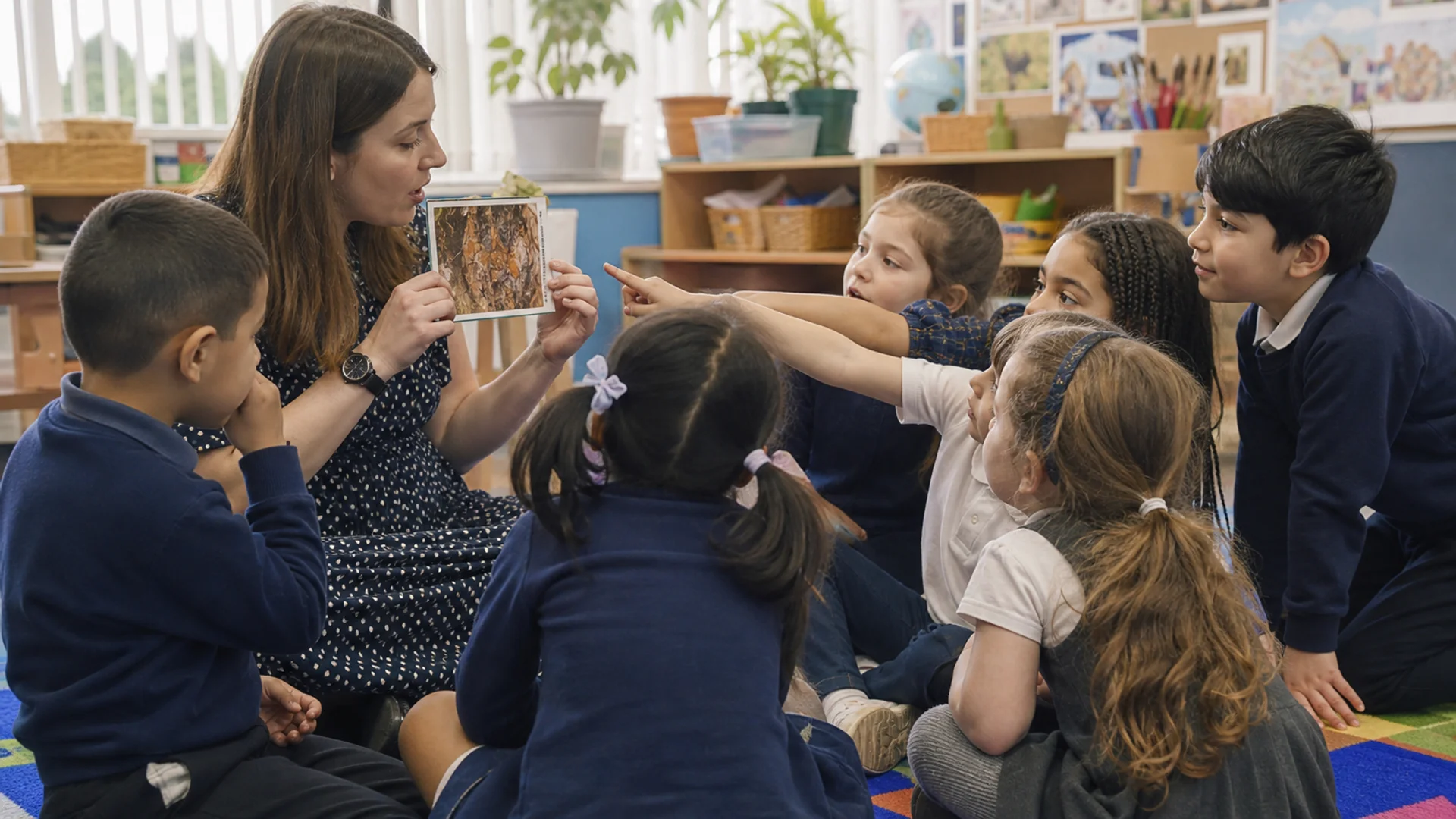
Dialogic reading is shared book reading where the adult asks open-ended questions and follows the learner's lead, rather than simply reading the text.

What happens: Adult reads a picture book with a small group. Instead of reading straight through, the adult pauses frequently: "What do you think happens next?" "Why do you think the character feels sad?" "Have you ever...?" Learners' ideas shape the discussion.

Why it works: Dialogic reading develops language, listening, and inferential thinking—all precursors to reading comprehension. Research shows dialogic reading produces larger language gains than traditional shared reading (Whitehurst et al., 1994).

Key technique—Use PEER questions:

  • Prompt: "What's happening here?"
  • Evaluate: "That's right, the rabbit is hiding."
  • Expand: "Yes, and I think he's hiding because he's scared."
  • Repeat: "Can you say that again? 'The rabbit is hiding because he's scared.'"

Sustained Shared Thinking (SST)

Sustained Shared Thinking occurs when an adult and child (or peers) work together to develop understanding. The adult doesn't direct; instead, they join in the child's thinking and deepen it through gentle questioning.

What happens: A child is building a tower of blocks. It keeps falling. An adult sits nearby and asks, "Why do you think it's falling? What if we made the bottom wider? Let's try together." The adult is not teaching the child how to build—the adult is thinking aloud alongside the child, co-investigating the problem.

Why it works: Sustained Shared Thinking scaffolds thinking without reducing the cognitive demand. The child remains the primary thinker; the adult supports but doesn't take over. This develops problem-solving and resilience.

Characteristics of SST:

  • Both adult and child are engaged
  • There's a shared focus (both looking at/thinking about the same thing)
  • The interaction extends over time (not just a quick comment)
  • Thinking is made explicit through talk
  • Open-ended questions are used, not leading questions

Helicopter Stories

Helicopter stories involve scribing children's oral narratives—an adult writes down or records a story the child tells (verbally or non-verbally), then the child acts it out with peers or props.

What happens: A child draws a picture or describes a scenario. The adult asks, "Tell me about your picture. What's happening?" The child narrates the story. The adult writes it down, reading it back as the child watches. Later, the child and peers act out the story using props or role-play.

Why it works: Helicopter stories honour children's narratives, develop oral language and storytelling, and create a bridge to literacy. They show that children's ideas are valued and that spoken words become written words.

Philosophy for Children (P4C) in the EYFS

P4C principles—enquiry, reasoning, and community of thinkers—can be adapted for young learners. Instead of complex philosophical questions, use stories and scenarios that spark wonderment and simple reasoning.

What happens: After reading The Very Hungry Caterpillar, the adult asks, "Why do you think the caterpillar ate all that food?" or "Do you think the butterfly is happy now?" Young learners share ideas, listen to each other, and learn that different people can have different ideas—and that's okay.

Why it works: P4C develops thinking skills, listening, and respect for diverse perspectives. It's not formal; it's building a culture where questions and thinking are valued.

Creative Arts in Early Years

Art, music, and movement are not "extras" in the EYFS—they are primary learning channels for young brains.

Art and Crafts: Emphasise the process, not the product. Don't show a model and ask learners to recreate it. Instead, provide open-ended materials and let learners explore.

Why: Process-focused art develops creativity, fine motor skills, and problem-solving. Product-focused art (copying a template) reduces creativity and can make learners feel their ideas are "wrong."

Music and Singing: Singing and movement develop language, memory, coordination, and social bonding. Songs are memory aids—learners who struggle to remember words through speech remember them easily through song (rhythm and melody activate different memory pathways).

Dance and Movement: Develops gross motor skills, body awareness, coordination, and creative expression. Also regulates emotion and reduces anxiety.

Creating a Language-Rich Environment

Language is the foundation of all learning. A language-rich EYFS explicitly develops vocabulary and conversation.

Strategies for Language Development

  • Narrate what learners are doing: "You're pouring the sand. It's flowing down. The sand is smooth." This vocabulary input is effortless for learners and builds receptive language.
  • Use talk-to-learn, not learn-to-talk: The goal is not perfect speech. The goal is using talk to think and explore. Accept approximations: "duck" for "duckling" is progress.
  • Sing frequently: Songs are memory aids. Learners who struggle with conversation often learn words through songs.
  • Read repeatedly: Young learners benefit from hearing the same stories many times. Each reading deepens understanding and vocabulary.
  • Small group time: Allocate dedicated time (10–15 minutes daily) for small group conversations. This is where quieter learners feel safe to participate.

Transition from EYFS to Key Stage 1

The transition from play-rich EYFS to formal KS1 is often jarring for young learners. Strong schools maintain play-based principles while introducing structure.

How to ease transition:

  • Maintain shorter, whole-group carpet sessions (10–15 minutes max)
  • Continue outdoor learning and exploratory play daily
  • Use guided group work (small group with adult support) rather than independent worksheets
  • Embed learning in play contexts ("Count the dinosaurs in the sand" rather than abstract counting)
  • Celebrate thinking and effort, not right answers

Why it matters: Learners who experience a gentle transition maintain their curiosity and love of learning. Abrupt shifts to formal, worksheet-heavy Year 1 can dull the joy that characterises strong EYFS learners.

Key Resources and Linked Articles

Core Cluster Articles

  • Characteristics of Effective Learning in the EYFS — How to observe and support playing and exploring, active learning, and creating and thinking critically
  • Helicopter Stories — Using children's narratives to develop language and literacy
  • Sustained Shared Thinking — Co-investigating and deepening thinking with young learners
  • The Power of Dialogic Reading — Shared reading approaches that develop language and comprehension
  • Philosophy for Children (P4C) Adapted for EYFS — Simple enquiry and reasoning with young thinkers
  • Singing in Schools and Early Years — Music as a learning tool
  • Play Therapy and Emotional Wellbeing — Using play to support children's emotional development

Key Research References

Blair, C., & Razza, R. P. (2007). Relating Effortful Control, Executive Function, and False Belief Understanding to Emerging Math and Literacy Ability in Kindergarten. Child Development, 78(2), 647–663. Shows executive function predicts academic outcomes more strongly than early literacy/numeracy.

Whitehurst, G. J., Arnold, D. S., Epstein, J. N., et al. (1994). A picture book reading intervention in day care and home for children from low-income families. Developmental Psychology, 30(5), 679–689. Pioneering research on dialogic reading effectiveness.

Siraj, I., Kingston, D., & Sylva, K. (2015). Researching Effective Pedagogy in the Early Years (REPEY). University of London. Large-scale study finding that "sustained shared thinking" is the strongest predictor of learning gains.

Russ, S. W., & Fiorelli, J. A. (2010). Pretend Play in Childhood: Foundation of Adult Creativity. Psihologijske teme, 19(3), 545–557. Evidence linking pretend play to creativity and divergent thinking.

Key Takeaways

  1. Play is not optional—it's the primary learning mechanism in the EYFS. Through play, children develop executive function (working memory, self-regulation, planning), language, and social-emotional skills that predict later academic success.
  2. Sustained Shared Thinking is more powerful than direct teaching. Adults who join children's thinking—asking open-ended questions and co-investigating—develop deeper understanding and resilience than adults who "teach" from the front.
  3. Language-rich environments are foundational. Vocabulary gaps at age 3 predict reading comprehension gaps at age 7. Prioritise oral language development, dialogic reading, and singing in the EYFS.
  4. Process over product in art and creative play. Focus on open-ended exploration and creative expression, not copying templates. This protects children's creativity and confidence.
Loading audit...
Early Years and Creative Play: EYFS Teaching Strategies and Resources

Early Years and Creative Play

EYFS Teaching Strategies and Resources

The EYFS Framework and Characteristics of Effective Learning

The EYFS (Early Years Foundation Stage) in England is not a formal curriculum—it's a framework built on principles of child development. It emphasises four characteristics of effective learning:

  1. Playing and Exploring: Learners engage with the environment, investigate materials, try things out, and take risks in a safe space
  2. Active Learning: Learners persist through challenges, concentrate, have confidence to try new things, and show pride in achievements
  3. Creating and Thinking Critically: Learners have ideas, manipulate objects, plan and make decisions, test ideas, and reflect on learning

These three characteristics are observed, not tested. The focus is on learner dispositions (curiosity, resilience, confidence) rather than academic outcomes. A child who asks "What happens if...?" shows creating and thinking critically, even if they haven't yet formed letters.

Why this matters: Research in neuroscience shows that the EYFS years (ages 3–5) are critical for developing executive function (working memory, self-regulation, attention), which predicts later academic success more strongly than early literacy or numeracy (Blair & Razza, 2007).

A play-rich, language-rich EYFS builds these foundations. A formal, curriculum-heavy EYFS risks narrowing learning and reducing the motivation and joy that characterise strong learners.

Play-Based Pedagogy: Why Play Matters

What is Play in the EYFS Context?

Play is not frivolous. Play is the primary mechanism through which young learners construct understanding, develop language, and practise social-emotional skills.

Parten's research (1932) identified types of play that develop in sequence:

  • Solitary play (age 2–3): Playing alone, investigating materials independently
  • Parallel play (age 2–4): Playing alongside peers without direct interaction
  • Associative play (age 3–5): Playing in loose groups, learning turn-taking and cooperation
  • Cooperative play (age 4+): Coordinated play with shared goals, role-play, and social negotiation

What happens in practice: In a well-resourced EYFS, learners move through these stages naturally as they mature. A child learning turn-taking in parallel play at age 3 is developing executive function and social skills—not "just playing."

Types of Play That Develop Thinking

Pretend Play (Imaginative Play): Learners create scenarios, use objects symbolically ("This block is a phone"), and take roles.

Why it works: Pretend play is abstract thinking in action. Using one thing to represent another requires symbolic reasoning, which is foundational for literacy and maths. Research by Russ & Fiorelli (2010) found that children with stronger pretend play skills score higher on divergent thinking and creativity measures.

Rough-and-Tumble Play: Physical play involving movement, chasing, climbing, and risk-taking (in safe environments).

Why it works: Develops gross motor skills, vestibular sense (balance, spatial awareness), and confidence in the body. Also releases stress and builds resilience through safe risk-taking.

Exploratory Play: Investigating materials—pouring sand, mixing paint, building with blocks, experimenting with water.

Why it works: Teaches cause-and-effect, develops scientific thinking ("What happens when I...?"), and builds schema about the physical world.

Constructive Play: Building, creating, making with purpose (blocks, art materials, natural materials).

Why it works: Develops planning, spatial reasoning, problem-solving, and fine motor skills. A child who struggles to build a tower is practising engineering thinking.

Key Approaches to EYFS Teaching

Dialogic Reading

Dialogic reading is shared book reading where the adult asks open-ended questions and follows the learner's lead, rather than simply reading the text.

What happens: Adult reads a picture book with a small group. Instead of reading straight through, the adult pauses frequently: "What do you think happens next?" "Why do you think the character feels sad?" "Have you ever...?" Learners' ideas shape the discussion.

Why it works: Dialogic reading develops language, listening, and inferential thinking—all precursors to reading comprehension. Research shows dialogic reading produces larger language gains than traditional shared reading (Whitehurst et al., 1994).

Key technique—Use PEER questions:

  • Prompt: "What's happening here?"
  • Evaluate: "That's right, the rabbit is hiding."
  • Expand: "Yes, and I think he's hiding because he's scared."
  • Repeat: "Can you say that again? 'The rabbit is hiding because he's scared.'"

Sustained Shared Thinking (SST)

Sustained Shared Thinking occurs when an adult and child (or peers) work together to develop understanding. The adult doesn't direct; instead, they join in the child's thinking and deepen it through gentle questioning.

What happens: A child is building a tower of blocks. It keeps falling. An adult sits nearby and asks, "Why do you think it's falling? What if we made the bottom wider? Let's try together." The adult is not teaching the child how to build—the adult is thinking aloud alongside the child, co-investigating the problem.

Why it works: Sustained Shared Thinking scaffolds thinking without reducing the cognitive demand. The child remains the primary thinker; the adult supports but doesn't take over. This develops problem-solving and resilience.

Characteristics of SST:

  • Both adult and child are engaged
  • There's a shared focus (both looking at/thinking about the same thing)
  • The interaction extends over time (not just a quick comment)
  • Thinking is made explicit through talk
  • Open-ended questions are used, not leading questions

Helicopter Stories

Helicopter stories involve scribing children's oral narratives—an adult writes down or records a story the child tells (verbally or non-verbally), then the child acts it out with peers or props.

What happens: A child draws a picture or describes a scenario. The adult asks, "Tell me about your picture. What's happening?" The child narrates the story. The adult writes it down, reading it back as the child watches. Later, the child and peers act out the story using props or role-play.

Why it works: Helicopter stories honour children's narratives, develop oral language and storytelling, and create a bridge to literacy. They show that children's ideas are valued and that spoken words become written words.

Philosophy for Children (P4C) in the EYFS

P4C principles—enquiry, reasoning, and community of thinkers—can be adapted for young learners. Instead of complex philosophical questions, use stories and scenarios that spark wonderment and simple reasoning.

What happens: After reading The Very Hungry Caterpillar, the adult asks, "Why do you think the caterpillar ate all that food?" or "Do you think the butterfly is happy now?" Young learners share ideas, listen to each other, and learn that different people can have different ideas—and that's okay.

Why it works: P4C develops thinking skills, listening, and respect for diverse perspectives. It's not formal; it's building a culture where questions and thinking are valued.

Creative Arts in Early Years

Art, music, and movement are not "extras" in the EYFS—they are primary learning channels for young brains.

Art and Crafts: Emphasise the process, not the product. Don't show a model and ask learners to recreate it. Instead, provide open-ended materials and let learners explore.

Why: Process-focused art develops creativity, fine motor skills, and problem-solving. Product-focused art (copying a template) reduces creativity and can make learners feel their ideas are "wrong."

Music and Singing: Singing and movement develop language, memory, coordination, and social bonding. Songs are memory aids—learners who struggle to remember words through speech remember them easily through song (rhythm and melody activate different memory pathways).

Dance and Movement: Develops gross motor skills, body awareness, coordination, and creative expression. Also regulates emotion and reduces anxiety.

Creating a Language-Rich Environment

Language is the foundation of all learning. A language-rich EYFS explicitly develops vocabulary and conversation.

Strategies for Language Development

  • Narrate what learners are doing: "You're pouring the sand. It's flowing down. The sand is smooth." This vocabulary input is effortless for learners and builds receptive language.
  • Use talk-to-learn, not learn-to-talk: The goal is not perfect speech. The goal is using talk to think and explore. Accept approximations: "duck" for "duckling" is progress.
  • Sing frequently: Songs are memory aids. Learners who struggle with conversation often learn words through songs.
  • Read repeatedly: Young learners benefit from hearing the same stories many times. Each reading deepens understanding and vocabulary.
  • Small group time: Allocate dedicated time (10–15 minutes daily) for small group conversations. This is where quieter learners feel safe to participate.

Transition from EYFS to Key Stage 1

The transition from play-rich EYFS to formal KS1 is often jarring for young learners. Strong schools maintain play-based principles while introducing structure.

How to ease transition:

  • Maintain shorter, whole-group carpet sessions (10–15 minutes max)
  • Continue outdoor learning and exploratory play daily
  • Use guided group work (small group with adult support) rather than independent worksheets
  • Embed learning in play contexts ("Count the dinosaurs in the sand" rather than abstract counting)
  • Celebrate thinking and effort, not right answers

Why it matters: Learners who experience a gentle transition maintain their curiosity and love of learning. Abrupt shifts to formal, worksheet-heavy Year 1 can dull the joy that characterises strong EYFS learners.

Key Resources and Linked Articles

Core Cluster Articles

  • Characteristics of Effective Learning in the EYFS — How to observe and support playing and exploring, active learning, and creating and thinking critically
  • Helicopter Stories — Using children's narratives to develop language and literacy
  • Sustained Shared Thinking — Co-investigating and deepening thinking with young learners
  • The Power of Dialogic Reading — Shared reading approaches that develop language and comprehension
  • Philosophy for Children (P4C) Adapted for EYFS — Simple enquiry and reasoning with young thinkers
  • Singing in Schools and Early Years — Music as a learning tool
  • Play Therapy and Emotional Wellbeing — Using play to support children's emotional development

Key Research References

Blair, C., & Razza, R. P. (2007). Relating Effortful Control, Executive Function, and False Belief Understanding to Emerging Math and Literacy Ability in Kindergarten. Child Development, 78(2), 647–663. Shows executive function predicts academic outcomes more strongly than early literacy/numeracy.

Whitehurst, G. J., Arnold, D. S., Epstein, J. N., et al. (1994). A picture book reading intervention in day care and home for children from low-income families. Developmental Psychology, 30(5), 679–689. Pioneering research on dialogic reading effectiveness.

Siraj, I., Kingston, D., & Sylva, K. (2015). Researching Effective Pedagogy in the Early Years (REPEY). University of London. Large-scale study finding that "sustained shared thinking" is the strongest predictor of learning gains.

Russ, S. W., & Fiorelli, J. A. (2010). Pretend Play in Childhood: Foundation of Adult Creativity. Psihologijske teme, 19(3), 545–557. Evidence linking pretend play to creativity and divergent thinking.

Key Takeaways

  1. Play is not optional—it's the primary learning mechanism in the EYFS. Through play, children develop executive function (working memory, self-regulation, planning), language, and social-emotional skills that predict later academic success.
  2. Sustained Shared Thinking is more powerful than direct teaching. Adults who join children's thinking—asking open-ended questions and co-investigating—develop deeper understanding and resilience than adults who "teach" from the front.
  3. Language-rich environments are foundational. Vocabulary gaps at age 3 predict reading comprehension gaps at age 7. Prioritise oral language development, dialogic reading, and singing in the EYFS.
  4. Process over product in art and creative play. Focus on open-ended exploration and creative expression, not copying templates. This protects children's creativity and confidence.

Structural Learning — Evidence-based teaching strategies for every classroom. Visit the full site.

No Posts found.
Back to Blog