The Bolted-On Concept Trap: Why Your PYP Units Feel Like Traditional LessonsThe Bolted-On Concept Trap: Why Your PYP Units Feel Like Traditional Lessons: practical strategies and classroom examples for teachers

Updated on  

March 24, 2026

The Bolted-On Concept Trap: Why Your PYP Units Feel Like Traditional Lessons

|

March 24, 2026

Why most PYP units are topic-driven with concepts bolted on, and how the Thinking Framework fixes this. A practical guide for PYP coordinators and teachers.


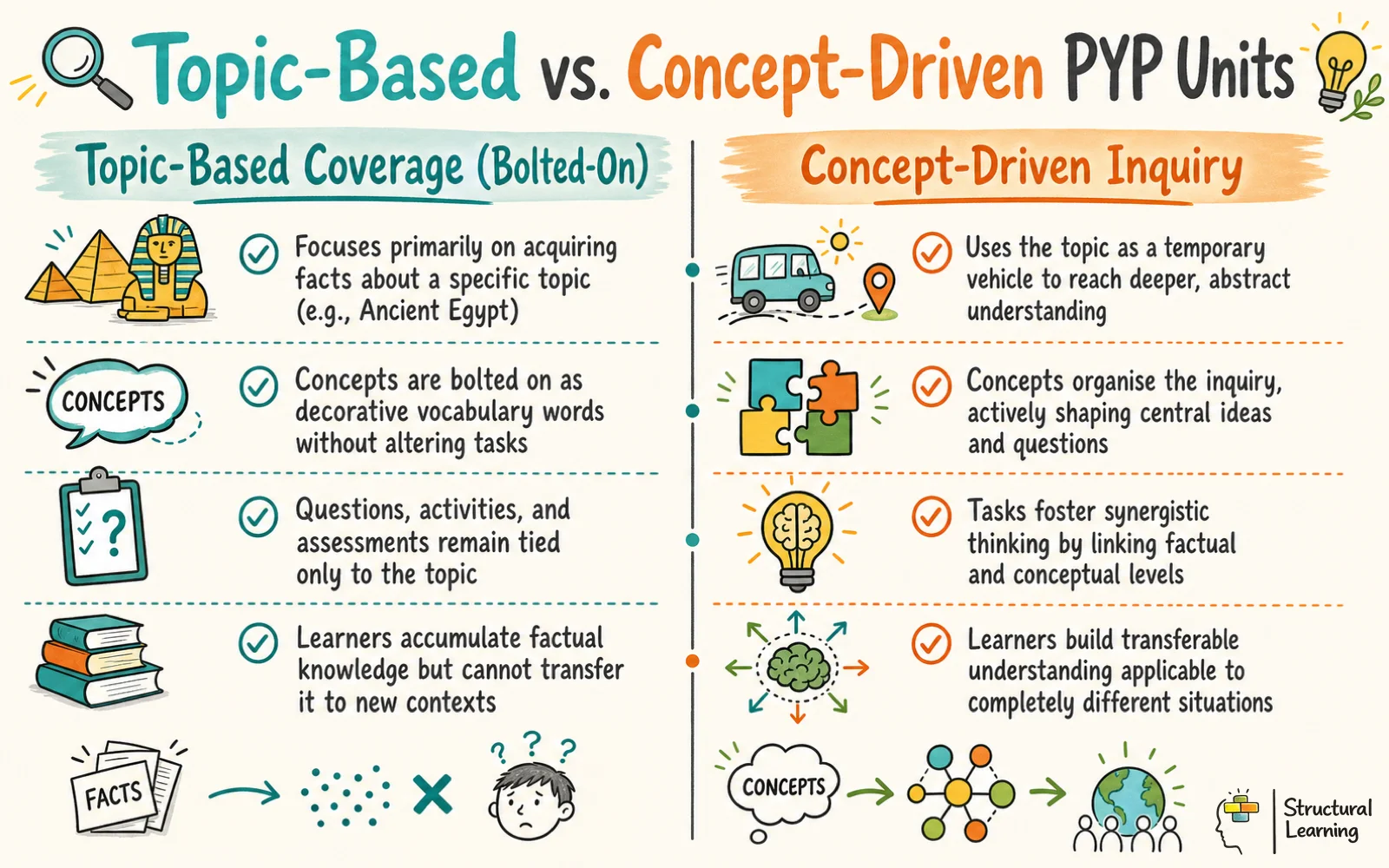
Every PYP coordinator has seen it. A unit planner arrives on their desk. The transdisciplinary theme is "How We Organise Ourselves." The topic is Ancient Egypt. The key concept, written neatly in the relevant box, is "Change." The central idea reads: "Ancient Egyptians built impressive structures that changed their civilisation." The lines of inquiry are: what pyramids looked like, how they were built, and why they mattered.

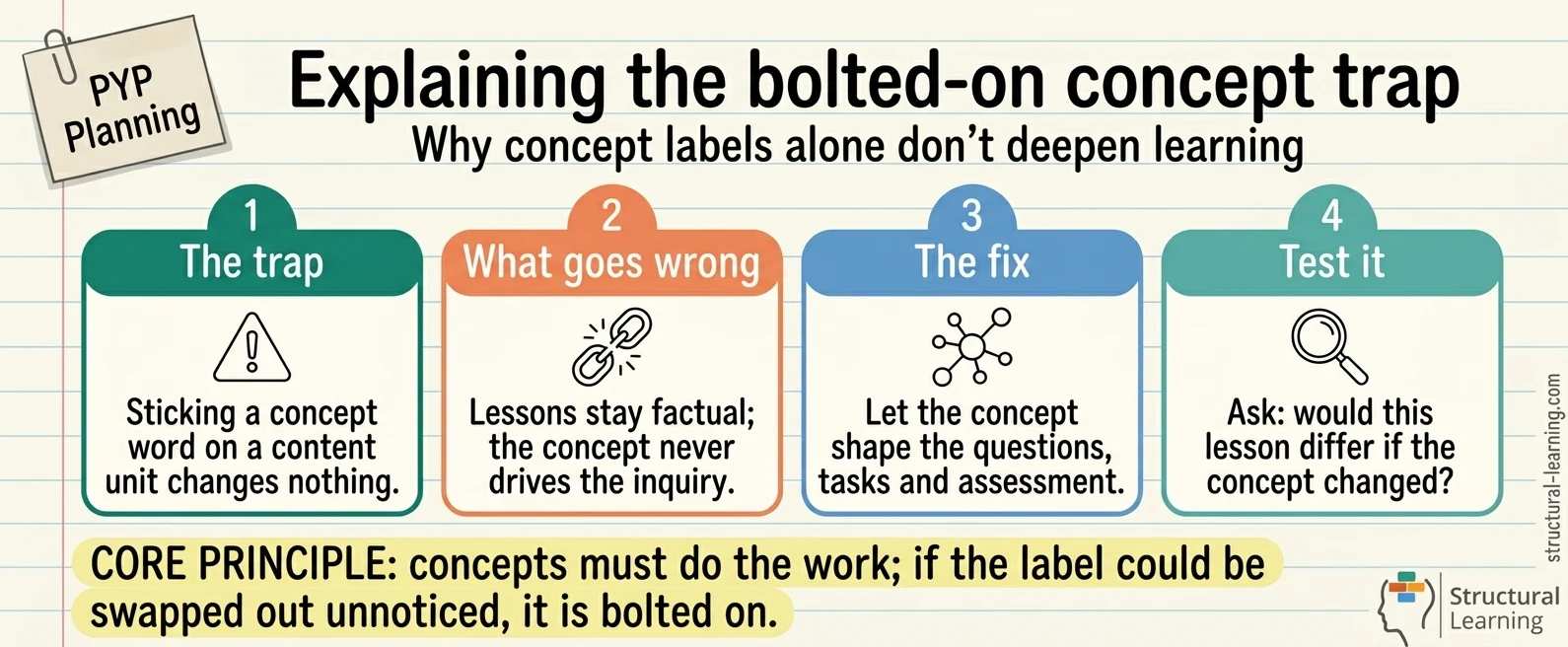
The concept did not drive that unit. It was bolted on afterwards, like a label applied to a box that was already packed. The pupils will spend three weeks learning about Egypt. They will learn about Egypt in English, in art, in maths. The concept of Change will appear on the word wall. It will be referenced in the final reflection. But it will not change how the pupils think. It will not transfer. It will not, in Erickson and Lanning's (2014) terms, produce synergistic thinking: the cognitive interplay between concrete facts and abstract conceptual understanding that separates genuine inquiry from sophisticated topic work.

This article names the problem, diagnoses it with a five-point checklist, and gives you a practical fix using the Thinking Framework's eight cognitive operations as the bridge between abstract concepts and classroom activity.

Key Takeaways

  1. The topic trap is structural, not superficial. Bolted-on concepts are a symptom of two-dimensional curriculum design. The fix is not better vocabulary: it is starting with the conceptual understanding and using the topic as a vehicle to reach it.
  2. Synergistic thinking is the target. Erickson and Lanning (2014) define synergistic thinking as the cognitive interplay between factual and conceptual levels. Without it, pupils accumulate knowledge but cannot transfer it.
  3. The Central Idea formula is diagnostic. A strong central idea follows the pattern: Concept A + Context + Concept B. If yours reads like a topic sentence, it is a topic sentence, not a conceptual statement.
  4. The Thinking Framework makes concepts operational. The eight cognitive operations (Compare, Classify, Sequence, Cause and Effect, Part-Whole, Analogy, Perspective, Systems Thinking) give pupils a procedure for working with abstract concepts, not just naming them.
  5. Transfer is the test. Ask this after any unit: could pupils apply this conceptual understanding to a completely different context? If not, the concept was decorative.

The Two-Dimensional Problem

The phrase "two-dimensional curriculum" comes from H. Lynn Erickson, whose framework underpins the IB's approach to concept-based learning. A two-dimensional curriculum has content and skills. Pupils learn facts; they practise procedures. Both dimensions are necessary. Neither is sufficient.

The third dimension is conceptual understanding: the timeless, transferable generalisations that emerge when pupils use facts as evidence to construct big ideas. Erickson describes the relationship between these levels as the Structure of Knowledge: a hierarchy from concrete (facts and topics) to abstract (concepts, principles, and theories). Learning only happens at transfer level when pupils move up and down this structure fluidly, using known facts to construct new conceptual understanding and using conceptual understanding to interrogate new facts.

Most concept-based learning training focuses on the vocabulary of concepts without addressing the planning architecture that makes them function. Teachers learn the IB's seven key concepts (Form, Function, Causation, Change, Connection, Perspective, Responsibility). They write them into unit planners. But if the planner was already structured around a topic, the concept sits in a box rather than driving the box's contents.

The result is units that pass a checklist inspection but produce topic-level thinking. Pupils who complete an "Ancient Egypt: Change" unit know about Egypt. They do not necessarily understand change in any transferable sense.

What Concept-Driven Actually Means

Erickson and Lanning's (2014) definition is precise: concepts are abstract, timeless, and transferable ideas that transcend any particular example. "Change" qualifies. "The Egyptians changed" does not. The word "change" in the second sentence is functioning as a verb, not as an organising idea. The question that separates concept-driven planning from topic-driven planning is: what understanding about Change will pupils carry with them after they leave Egypt behind?

Genuine concept-driven IB PYP unit planning starts with a central idea that expresses a conceptual generalisation, not a topic description. A generalisation connects two or more concepts to make a claim that is true beyond any single example. "Systems depend on the balanced contribution of their parts" is a generalisation. It is abstract, timeless, and transferable. You could test it against an Egyptian irrigation system, a school community, a rainforest ecosystem, or a national government. The topic is the vehicle. The generalisation is the destination.

This distinction matters because of what Erickson calls synergistic thinking. When a pupil genuinely encounters a concept through a concrete example, they do not simply learn about the example. They refine their understanding of the concept. The facts and the abstraction work on each other. The pupil who uses the concept of Systems to analyse both a pharaoh's court and their school council is thinking at a qualitatively different level from the pupil who knows facts about both.

Wiggins and McTighe's (2005) Understanding by Design framework makes the same point from a different direction. Enduring understandings, their term for the generalisations worth retaining, cannot be assessed with a quiz about facts. They require performance tasks that demand transfer: take what you understood here and apply it there. If you cannot write a transfer task for your central idea, you may not have a central idea.

The 5 Warning Signs Your Unit Is Bolted-On

The following checklist is diagnostic rather than evaluative. Each warning sign points to a specific structural problem that has a specific fix.

Warning sign 1: The central idea reads like a topic sentence. "Ancient Egyptians built pyramids that changed their society" describes a topic. It contains a fact and a concept-word, but it makes a claim only about Egypt, at a specific time, in a specific place. A pupil could not use it to think about anything else. The fix is to rewrite using the Central Idea formula: Concept A + Context + Concept B. "Human societies create structures that reflect and reinforce their values" uses Egypt as one possible vehicle but could equally carry a unit on modern architecture, religious buildings, or digital platforms.

Warning sign 2: Lines of inquiry are activities, not inquiry pathways. "How pyramids were built," "What the pyramids looked like," and "Why they were important" are research questions about Egypt. They are not inquiry pathways into the concept. Inquiry pathways for the generalisation above would look different: "What values do different societies express through their built environment?" and "How do power structures shape what gets built, preserved, or destroyed?" These questions cannot be answered by recalling facts. They require pupils to think with the concept.

Warning sign 3: Assessment measures knowledge recall, not conceptual transfer. If the summative assessment task asks pupils to write about Egypt, it is a topic assessment. A transfer task asks pupils to apply their conceptual understanding to a new context. "Using what you now understand about how societies express values through structures, evaluate a building in your own community" is a transfer task. The Egyptian content is no longer the subject: it is the prior experience from which the pupil draws.

Warning sign 4: The key concept could be swapped without changing the unit. Try this thought experiment: replace "Change" with "Connection" in your unit planner. Does the unit look substantially different? If not, the concept was not doing any structural work. In a genuinely concept-driven unit, the conceptual lens determines which aspects of the topic are foregrounded, which lines of inquiry are pursued, and which transfer tasks are relevant. Swapping the concept should produce a recognisably different unit.

Warning sign 5: Pupils can answer "What did you learn?" but not "What did you understand?" This is the simplest diagnostic. Ask pupils at the end of a unit to complete both sentences. The first invites knowledge recall. The second invites conceptual reflection. In a bolted-on unit, pupils produce detailed answers to the first question and vague or absent answers to the second. "I understood that things change" is not a conceptual understanding. "I understood that societies use physical structures both to maintain power and to signal what they value, and that this pattern shows up in very different times and places" is the beginning of one.

The Central Idea Formula

The most reliable way to diagnose and repair a bolted-on central idea is to apply the formula that emerges from Erickson and Lanning's (2014) work: Concept A + Context + Concept B. The formula does not prescribe specific words, but it requires that the idea make a claim connecting at least two abstract concepts through a relationship that holds across contexts.

Topic-driven version Concept-driven version Why the second works
Ancient Egyptians built pyramids that changed their civilisation. Human societies create structures that reflect and reinforce the values of those in power. Connects Systems and Values; transferable to any built environment across time.
The water cycle describes how water moves around the Earth. Natural systems maintain balance through cyclical processes that distribute resources. Connects Systems and Balance; applies to water cycles, food webs, carbon cycles.
Communities have rules that help people live together. Shared agreements shape the rights, responsibilities, and identity of a community. Connects Agreement, Rights, and Identity; transfers from school rules to national constitutions.
Migration has affected the culture of many countries. When people move, they bring their cultural identity with them, transforming both their new community and themselves. Connects Migration, Identity, and Transformation; applies to historical migration and contemporary displacement.

A practical test for any central idea: replace the specific topic with "people," "systems," or "communities" and check whether the idea still makes sense. If it does, you likely have a generalisation. If it collapses without the specific topic, you have a topic sentence.

Marschall and French (2018) add a useful structural check: strong central ideas avoid the passive voice and contain an active relationship between concepts. "Change is caused by many factors" is weak because it says almost nothing. "Economic pressures accelerate social change more rapidly than political ones" is strong because it makes a specific, debatable claim about how two concepts relate.

The Three-Tiered Questioning Framework

Once a genuine central idea is in place, the lines of inquiry need to scaffold pupils towards it, not around it. Erickson and Lanning's (2014) three-tiered questioning framework gives coordinators a structure for auditing whether their lines of inquiry actually lead to the conceptual generalisation.

Factual questions establish the knowledge base. They have correct answers that can be verified. "Which key concepts does the IB define?" and "What are the six IB PYP transdisciplinary themes?" are factual questions. They are necessary but not sufficient. A unit composed entirely of factual lines of inquiry is a research assignment, not an inquiry.

Conceptual questions push pupils to build generalisations from facts. They cannot be answered by recalling information. They require pupils to connect, compare, or evaluate. "How do the structures a society builds reflect its values?" is a conceptual question. It requires factual knowledge to answer, but the answer is a generalisation, not a fact. These questions are the engine of concept-driven inquiry.

Debatable questions sit at the top of the framework. They are provocative, open-ended, and do not have consensus answers. "Is it ever justified to destroy the physical structures of a past culture?" is debatable. These questions develop the perspective-taking and moral reasoning that are central to the IB Learner Profile. They also signal to pupils that the inquiry matters beyond the classroom.

When auditing a unit's lines of inquiry, check that all three tiers are present and that the conceptual questions are genuinely conceptual, not disguised factual questions with the word "why" added. "Why did the Egyptians build pyramids?" is factual in disguise: it has a conventional historical answer. "Why do powerful groups in every era build monuments?" is genuinely conceptual.

The Thinking Framework Fix

Naming the problem is straightforward. Fixing it in the classroom requires tools that make abstract concepts operational for pupils, not just for curriculum designers. This is where the Thinking Framework enters.

The eight cognitive operations (Compare, Classify, Sequence, Cause and Effect, Part-Whole, Analogy, Perspective, Systems Thinking) are not thinking skills in the general sense. They are cognitive procedures that specify exactly what thinking should happen with a given concept. When a concept is bolted on, pupils receive a label. When a cognitive operation is applied to a concept, pupils receive a procedure.

Consider a Year 4 unit on "How We Organise Ourselves" with the key concept of Function. The bolted-on version: "Let us learn about how communities work. The concept is Function." The Thinking Framework version uses Part-Whole analysis as the cognitive procedure:

"Imagine every adult in our school disappeared for one day. Which roles would the community miss immediately? Which could wait a week? Use the Part-Whole operation to map which functions are essential and which are supporting. Now transfer this: what roles are essential in a hospital? What roles could a hospital survive without for a day?"

The Part-Whole operation gives pupils a cognitive procedure for working with Function as a concept. They are not memorising what function means. They are using it to analyse, and then transferring that analysis to a new domain. The concept is doing structural work.

Each cognitive operation maps naturally onto specific conceptual work:

IB Key Concept Thinking Framework operation What pupils do
Change Sequence + Cause and Effect Map the stages of a change process; identify what triggered each stage; transfer to a different change process.
Connection Systems Thinking + Analogy Map the connections within a system; identify which connections are essential; find analogous systems in different domains.
Causation Cause and Effect + Compare Distinguish proximate causes from underlying causes; compare two events to identify common causal patterns.
Form Classify + Part-Whole Identify the features that define a category; analyse how parts contribute to the defining whole.
Perspective Perspective + Compare Articulate how the same event or object is experienced differently from different standpoints; compare what each perspective reveals and conceals.
Responsibility Perspective + Systems Thinking Map who is affected by a decision and how; evaluate which actors have agency; consider systemic responsibilities beyond individual action.
Function Part-Whole + Analogy Map the role each part plays in the whole; find analogous functional structures in a different domain.

The Thinking Framework also supports the IB Learner Profile in a practical way. Profile attributes such as "thinker" and "reflective" are often as bolted-on as key concepts: stated in the planner, referenced in the assembly, absent from the lesson design. When the cognitive operations are built into learning activities, pupils are enacting thinker and reflective attributes rather than performing them for assessment purposes.

Before and After: Rewriting a Bolted-On Unit

The following example is based on a composite of real planning conversations with PYP coordinators. The original unit is not unusual: it would pass a standard planner review. The rewritten version addresses each of the five warning signs.

Original unit (bolted-on):

Transdisciplinary theme: Sharing the Planet. Topic: Rainforests. Key concept: Change. Central idea: Rainforests are changing because of human activity. Lines of inquiry: what rainforests are, why they are important, how humans are damaging them, what we can do to help. Summative task: create a poster about rainforest conservation.

Rewritten unit (concept-driven):

Transdisciplinary theme: Sharing the Planet. Conceptual lens: Interdependence. Central idea: When human systems disrupt natural systems, the consequences extend beyond the immediate point of impact. Lines of inquiry: (factual) what relationships characterise a rainforest ecosystem; (conceptual) how does removing one element of a system affect the others; (debatable) who has the right to make decisions about shared natural resources? Summative task: identify a local ecosystem, map its interdependencies using the Systems Thinking operation, then present a reasoned argument about one decision that affects it, acknowledging at least two competing perspectives.

The rewritten unit is not more complex for pupils. It is more purposeful. The rainforest is still the vehicle; it is now a vehicle with a defined destination. A pupil who completes the rewritten unit has practised thinking with Systems, Interdependence, and Perspective. They can transfer those thinking procedures to a coral reef, an urban food supply chain, or a local river catchment. The original unit produced rainforest knowledge. The rewritten unit produced transferable thinking.

Notice that the summative task changed fundamentally. The poster asked pupils to recall and present information. The rewritten task asks pupils to map, reason, and argue from multiple viewpoints. This is what Murdoch (2015) means when she writes about inquiry-based learning as a recursive process: the assessment task should require pupils to use the conceptual understanding they have built, not describe the topic they have studied.

The Coordinator's Audit Tool

The following ten questions give PYP coordinators a consistent framework for evaluating unit planners. Each question maps to one of the five warning signs and their associated fixes.

Central Idea audit:

  1. Does the central idea make a claim that holds beyond the specific topic? (Replace the topic with a different example. Does the claim still work?)
  2. Does it connect at least two abstract concepts through an active relationship? (Avoid passive voice and weak connectives like "is affected by.")
  3. Is it free of specific places, people, and dates? (Proper nouns in a central idea usually signal a topic sentence.)

Lines of Inquiry audit:

  1. Is there at least one genuinely factual line of inquiry that establishes necessary knowledge?
  2. Is there at least one genuinely conceptual line of inquiry that cannot be answered by recalling information?
  3. Is there at least one debatable line of inquiry that invites genuine disagreement?

Assessment audit:

  1. Does the summative task require pupils to apply their understanding to a new context, not just report on the topic studied?
  2. Could the task be completed by a pupil who simply researched the topic thoroughly, without ever engaging with the central idea? (If yes, it is not a transfer task.)

Concept audit:

  1. Does swapping the key concept for a different one require a substantially different unit? (If not, the concept is decorative.)
  2. Is there at least one learning activity in each phase that uses a specific cognitive operation to work with the concept, rather than simply referencing it? (See the Thinking Framework mapping table above.)

A unit that scores 8 or higher is genuinely concept-driven. A unit that scores 5 or below has structural issues that no amount of resourcing will solve: the concept will remain bolted on regardless of how many thinking routines are added to lessons.

What Concept-Based Assessment Actually Looks Like

Assessment is where the bolted-on problem becomes most visible. Topic-based assessment is straightforward: recall facts, complete a quiz, produce a piece of writing about the subject. Concept-based assessment is harder to design because it requires pupils to demonstrate understanding rather than knowledge.

Stern, Ferraro and Mohnkern (2017) describe a three-level assessment architecture that maps directly onto the three-tiered questioning framework. Level one assesses factual knowledge: can pupils recall and explain the relevant content? Level two assesses conceptual understanding: can pupils use the central idea to explain a familiar example? Level three assesses transfer: can pupils apply the conceptual understanding to a new and unfamiliar context?

Most PYP units assess levels one and two adequately. Level three is where the bolted-on problem shows up most clearly. If the summative task is about the same topic the class has been studying, it is not a transfer task: pupils are demonstrating knowledge, not conceptual understanding.

A practical approach to transfer assessment is what Wiggins and McTighe (2005) call the GRASPS framework (Goal, Role, Audience, Situation, Product, Standards). Giving pupils a transfer scenario with a role, an audience, and a product specification strips away the option to simply recall: they must use their understanding to do something in a new context.

The Thinking Framework supports concept-based formative assessment throughout the unit. When pupils use the Analogy operation to connect their topic to a different domain, their reasoning reveals the quality of their conceptual understanding in a way that a comprehension quiz cannot. A pupil who produces a rich, specific analogy between an Ancient Egyptian irrigation system and a modern water supply network has demonstrated Systems thinking. A pupil whose analogy is vague ("both involve water") has revealed a gap in conceptual understanding that a teacher can address before the summative task.

Metacognitive reflection is also more productive in a concept-driven unit. "What did I learn about Egypt?" invites recall. "What do I now understand about how systems maintain themselves that I did not understand before?" invites genuine conceptual reflection. The latter question is also a check on whether the concept drove the unit: if pupils cannot answer it, the concept did not do its job.

Macroconcepts and the Thinking Framework

One gap the SERP data reveals clearly is the distinction between macroconcepts and microconcepts. Macroconcepts are the broad, transdisciplinary ideas that provide curriculum breadth: Systems, Change, Connection, Perspective, Responsibility, Form, Function, Causation. These are Erickson's key concepts. Microconcepts are the discipline-specific ideas that sit beneath them: in science, "adaptation" and "ecosystem" are microconcepts that nest within the macroconcept of Systems.

This distinction matters for planning because pupils need both levels of conceptual vocabulary to think clearly. A unit that works only at the macroconcept level stays too abstract to generate meaningful inquiry. A unit that works only at the microconcept level stays too discipline-specific to produce transfer. The Thinking Framework cognitive operations provide the procedure that moves pupils between levels: a Classify operation might work with microconcepts (classifying types of adaptation), while a Systems Thinking operation works with the macroconcept (mapping how adaptations maintain systemic balance).

For PYP coordinators building units from scratch, a useful starting question is: "What microconcepts within this discipline connect to which macroconcepts across disciplines?" The answer reveals which Thinking Framework operations are most relevant and which higher-order thinking skills the unit can genuinely develop. Graphic organisers are particularly effective for making the macro-to-microconcept hierarchy visible: a unit web can map how microconcepts such as "adaptation" or "migration" nest within the macroconcept of Systems or Change, giving pupils a visual reference for their inquiry pathway.

What to Try in Your Next Planning Session

Take the next unit planner you are reviewing. Read the central idea. Ask whether a pupil who completed that unit could transfer the understanding to a completely different context. If not, apply the Central Idea formula: find the two concepts the central idea should connect, identify the relationship between them, and write a new version that makes a transferable claim.

Then take one learning activity from the unit and ask which Thinking Framework operation it is using. If the answer is none, choose the operation that best matches the concept being explored, and rewrite the activity around that operation. One activity rewritten in this way gives you a working example to share with your team.

The Thinking Framework offers an alternative to Bloom's Taxonomy for concept-based planning precisely because its operations specify what type of thinking should happen with a concept, not just at what cognitive level. "Analyse" is a cognitive level. "Compare using two specific criteria" is a cognitive procedure. Procedures produce transferable thinking. Levels describe it after the fact.

Finally, run the coordinator's audit tool against one unit per team, per term. Not as an evaluative exercise: as a planning conversation starter. The question "Does swapping the key concept require a substantially different unit?" is uncomfortable enough to be productive. Most of the time, the answer reveals exactly where the bolting-on happened and gives the team a concrete fix to work on together. Scaffolding the planning conversation itself, using the coordinator's audit tool as a structured protocol rather than a solo checklist, tends to produce faster and more honest diagnoses.

Applying This to the PYP Exhibition

The PYP Exhibition is where the bolted-on concept trap becomes most visible. Year 6 pupils choose their own inquiry topics, and coordinators often allow "topic-first" selection: a pupil picks "pollution" or "endangered animals" and then retroactively assigns a key concept. The result is 25 exhibition projects that are essentially topic reports with a concept label.

The fix: start with the conceptual understanding, not the topic. Ask pupils: "What big idea matters to you?" If a pupil says "fairness," that IS the concept. The topic becomes the vehicle: fairness in school rules, fairness in access to clean water, fairness in how technology is distributed. Use the Thinking Framework's Perspective operation to ensure the pupil examines their concept from at least three stakeholder viewpoints. Use Systems Thinking to map how their concept connects to wider structures.

A coordinator's pre-exhibition check: read each pupil's central idea. If you could swap the concept for any other concept without changing the project, it is bolted on. If removing the concept would collapse the entire inquiry, it is genuinely concept-driven. For a complete week-by-week exhibition scaffolding plan, see our PYP Exhibition blueprint.

Further Reading: Key Research Papers

The following papers and books underpin the frameworks discussed in this article. Each offers practical depth for coordinators who want to move beyond surface-level concept labelling.

Concept-Based Curriculum and Instruction for the Thinking Classroom View study ↗
H. Lynn Erickson, Lois A. Lanning & Rachel French (2017)

The definitive guide to Erickson's Structure of Knowledge and Structure of Process frameworks, including the synergistic thinking model. Provides the conceptual vocabulary and planning tools that sit behind the IB's approach to concept-based curriculum design. Essential reading for any coordinator seeking to move beyond the vocabulary of concepts to their structural function in planning.

Concept-Based Inquiry in Action: Strategies to Promote Transferable Understanding View study ↗
Carla Marschall & Rachel French (2018)

Bridges Erickson's curriculum theory and classroom practice through an inductive inquiry model. Includes the seven-phase Concept-Based Inquiry cycle (Engage, Focus, Investigate, Organise, Generalise, Transfer, Reflect), worked examples from real classrooms, and specific tools for writing central ideas that generate genuine transfer. Particularly useful for primary teachers transitioning from topic-based to concept-driven planning.

Understanding by Design View study ↗
Grant Wiggins & Jay McTighe (2005)

The backward design framework that has most directly influenced IB unit planning practice. Stage one asks designers to identify the enduring understandings they want pupils to retain: the conceptual generalisations, not the topic content. The GRASPS transfer task framework provides a practical template for summative assessments that require genuine conceptual application rather than topic recall.

Learning That Transfers: Designing Curriculum for a Changing World View study ↗
Julie Stern, Krista Ferraro & Juliet Mohnkern (2017)

Provides the three-level assessment architecture (factual, conceptual, transfer) with worked examples across subject areas. Particularly strong on the distinction between academic transfer (applying understanding within a familiar subject) and real-world transfer (applying conceptual understanding to contexts outside school). Includes practical rubric templates for each level that work directly in PYP summative tasks.

The Power of Inquiry: Teaching and Learning with Curiosity, Creativity and Purpose View study ↗
Kath Murdoch (2015)

Murdoch's inquiry cycle framework provides the pedagogical engine that runs inside concept-based units. Her work on teacher facilitation skills, tuning-in strategies, and recursive reflection sits at the classroom level that Erickson's curriculum framework does not reach. Especially useful for teachers who understand the concept-driven planning requirements but are uncertain about how to facilitate inquiry once the unit is planned.

Written by the Structural Learning Research Team. Structural Learning supports schools in implementing evidence-based frameworks for thinking, inquiry, and curriculum design. The Thinking Framework provides the cognitive operations that make concept-based learning operational in the classroom.

Loading audit...

Every PYP coordinator has seen it. A unit planner arrives on their desk. The transdisciplinary theme is "How We Organise Ourselves." The topic is Ancient Egypt. The key concept, written neatly in the relevant box, is "Change." The central idea reads: "Ancient Egyptians built impressive structures that changed their civilisation." The lines of inquiry are: what pyramids looked like, how they were built, and why they mattered.

The concept did not drive that unit. It was bolted on afterwards, like a label applied to a box that was already packed. The pupils will spend three weeks learning about Egypt. They will learn about Egypt in English, in art, in maths. The concept of Change will appear on the word wall. It will be referenced in the final reflection. But it will not change how the pupils think. It will not transfer. It will not, in Erickson and Lanning's (2014) terms, produce synergistic thinking: the cognitive interplay between concrete facts and abstract conceptual understanding that separates genuine inquiry from sophisticated topic work.

This article names the problem, diagnoses it with a five-point checklist, and gives you a practical fix using the Thinking Framework's eight cognitive operations as the bridge between abstract concepts and classroom activity.

Key Takeaways

  1. The topic trap is structural, not superficial. Bolted-on concepts are a symptom of two-dimensional curriculum design. The fix is not better vocabulary: it is starting with the conceptual understanding and using the topic as a vehicle to reach it.
  2. Synergistic thinking is the target. Erickson and Lanning (2014) define synergistic thinking as the cognitive interplay between factual and conceptual levels. Without it, pupils accumulate knowledge but cannot transfer it.
  3. The Central Idea formula is diagnostic. A strong central idea follows the pattern: Concept A + Context + Concept B. If yours reads like a topic sentence, it is a topic sentence, not a conceptual statement.
  4. The Thinking Framework makes concepts operational. The eight cognitive operations (Compare, Classify, Sequence, Cause and Effect, Part-Whole, Analogy, Perspective, Systems Thinking) give pupils a procedure for working with abstract concepts, not just naming them.
  5. Transfer is the test. Ask this after any unit: could pupils apply this conceptual understanding to a completely different context? If not, the concept was decorative.

The Two-Dimensional Problem

The phrase "two-dimensional curriculum" comes from H. Lynn Erickson, whose framework underpins the IB's approach to concept-based learning. A two-dimensional curriculum has content and skills. Pupils learn facts; they practise procedures. Both dimensions are necessary. Neither is sufficient.

The third dimension is conceptual understanding: the timeless, transferable generalisations that emerge when pupils use facts as evidence to construct big ideas. Erickson describes the relationship between these levels as the Structure of Knowledge: a hierarchy from concrete (facts and topics) to abstract (concepts, principles, and theories). Learning only happens at transfer level when pupils move up and down this structure fluidly, using known facts to construct new conceptual understanding and using conceptual understanding to interrogate new facts.

Most concept-based learning training focuses on the vocabulary of concepts without addressing the planning architecture that makes them function. Teachers learn the IB's seven key concepts (Form, Function, Causation, Change, Connection, Perspective, Responsibility). They write them into unit planners. But if the planner was already structured around a topic, the concept sits in a box rather than driving the box's contents.

The result is units that pass a checklist inspection but produce topic-level thinking. Pupils who complete an "Ancient Egypt: Change" unit know about Egypt. They do not necessarily understand change in any transferable sense.

What Concept-Driven Actually Means

Erickson and Lanning's (2014) definition is precise: concepts are abstract, timeless, and transferable ideas that transcend any particular example. "Change" qualifies. "The Egyptians changed" does not. The word "change" in the second sentence is functioning as a verb, not as an organising idea. The question that separates concept-driven planning from topic-driven planning is: what understanding about Change will pupils carry with them after they leave Egypt behind?

Genuine concept-driven IB PYP unit planning starts with a central idea that expresses a conceptual generalisation, not a topic description. A generalisation connects two or more concepts to make a claim that is true beyond any single example. "Systems depend on the balanced contribution of their parts" is a generalisation. It is abstract, timeless, and transferable. You could test it against an Egyptian irrigation system, a school community, a rainforest ecosystem, or a national government. The topic is the vehicle. The generalisation is the destination.

This distinction matters because of what Erickson calls synergistic thinking. When a pupil genuinely encounters a concept through a concrete example, they do not simply learn about the example. They refine their understanding of the concept. The facts and the abstraction work on each other. The pupil who uses the concept of Systems to analyse both a pharaoh's court and their school council is thinking at a qualitatively different level from the pupil who knows facts about both.

Wiggins and McTighe's (2005) Understanding by Design framework makes the same point from a different direction. Enduring understandings, their term for the generalisations worth retaining, cannot be assessed with a quiz about facts. They require performance tasks that demand transfer: take what you understood here and apply it there. If you cannot write a transfer task for your central idea, you may not have a central idea.

The 5 Warning Signs Your Unit Is Bolted-On

The following checklist is diagnostic rather than evaluative. Each warning sign points to a specific structural problem that has a specific fix.

Warning sign 1: The central idea reads like a topic sentence. "Ancient Egyptians built pyramids that changed their society" describes a topic. It contains a fact and a concept-word, but it makes a claim only about Egypt, at a specific time, in a specific place. A pupil could not use it to think about anything else. The fix is to rewrite using the Central Idea formula: Concept A + Context + Concept B. "Human societies create structures that reflect and reinforce their values" uses Egypt as one possible vehicle but could equally carry a unit on modern architecture, religious buildings, or digital platforms.

Warning sign 2: Lines of inquiry are activities, not inquiry pathways. "How pyramids were built," "What the pyramids looked like," and "Why they were important" are research questions about Egypt. They are not inquiry pathways into the concept. Inquiry pathways for the generalisation above would look different: "What values do different societies express through their built environment?" and "How do power structures shape what gets built, preserved, or destroyed?" These questions cannot be answered by recalling facts. They require pupils to think with the concept.

Warning sign 3: Assessment measures knowledge recall, not conceptual transfer. If the summative assessment task asks pupils to write about Egypt, it is a topic assessment. A transfer task asks pupils to apply their conceptual understanding to a new context. "Using what you now understand about how societies express values through structures, evaluate a building in your own community" is a transfer task. The Egyptian content is no longer the subject: it is the prior experience from which the pupil draws.

Warning sign 4: The key concept could be swapped without changing the unit. Try this thought experiment: replace "Change" with "Connection" in your unit planner. Does the unit look substantially different? If not, the concept was not doing any structural work. In a genuinely concept-driven unit, the conceptual lens determines which aspects of the topic are foregrounded, which lines of inquiry are pursued, and which transfer tasks are relevant. Swapping the concept should produce a recognisably different unit.

Warning sign 5: Pupils can answer "What did you learn?" but not "What did you understand?" This is the simplest diagnostic. Ask pupils at the end of a unit to complete both sentences. The first invites knowledge recall. The second invites conceptual reflection. In a bolted-on unit, pupils produce detailed answers to the first question and vague or absent answers to the second. "I understood that things change" is not a conceptual understanding. "I understood that societies use physical structures both to maintain power and to signal what they value, and that this pattern shows up in very different times and places" is the beginning of one.

The Central Idea Formula

The most reliable way to diagnose and repair a bolted-on central idea is to apply the formula that emerges from Erickson and Lanning's (2014) work: Concept A + Context + Concept B. The formula does not prescribe specific words, but it requires that the idea make a claim connecting at least two abstract concepts through a relationship that holds across contexts.

Topic-driven version Concept-driven version Why the second works
Ancient Egyptians built pyramids that changed their civilisation. Human societies create structures that reflect and reinforce the values of those in power. Connects Systems and Values; transferable to any built environment across time.
The water cycle describes how water moves around the Earth. Natural systems maintain balance through cyclical processes that distribute resources. Connects Systems and Balance; applies to water cycles, food webs, carbon cycles.
Communities have rules that help people live together. Shared agreements shape the rights, responsibilities, and identity of a community. Connects Agreement, Rights, and Identity; transfers from school rules to national constitutions.
Migration has affected the culture of many countries. When people move, they bring their cultural identity with them, transforming both their new community and themselves. Connects Migration, Identity, and Transformation; applies to historical migration and contemporary displacement.

A practical test for any central idea: replace the specific topic with "people," "systems," or "communities" and check whether the idea still makes sense. If it does, you likely have a generalisation. If it collapses without the specific topic, you have a topic sentence.

Marschall and French (2018) add a useful structural check: strong central ideas avoid the passive voice and contain an active relationship between concepts. "Change is caused by many factors" is weak because it says almost nothing. "Economic pressures accelerate social change more rapidly than political ones" is strong because it makes a specific, debatable claim about how two concepts relate.

The Three-Tiered Questioning Framework

Once a genuine central idea is in place, the lines of inquiry need to scaffold pupils towards it, not around it. Erickson and Lanning's (2014) three-tiered questioning framework gives coordinators a structure for auditing whether their lines of inquiry actually lead to the conceptual generalisation.

Factual questions establish the knowledge base. They have correct answers that can be verified. "Which key concepts does the IB define?" and "What are the six IB PYP transdisciplinary themes?" are factual questions. They are necessary but not sufficient. A unit composed entirely of factual lines of inquiry is a research assignment, not an inquiry.

Conceptual questions push pupils to build generalisations from facts. They cannot be answered by recalling information. They require pupils to connect, compare, or evaluate. "How do the structures a society builds reflect its values?" is a conceptual question. It requires factual knowledge to answer, but the answer is a generalisation, not a fact. These questions are the engine of concept-driven inquiry.

Debatable questions sit at the top of the framework. They are provocative, open-ended, and do not have consensus answers. "Is it ever justified to destroy the physical structures of a past culture?" is debatable. These questions develop the perspective-taking and moral reasoning that are central to the IB Learner Profile. They also signal to pupils that the inquiry matters beyond the classroom.

When auditing a unit's lines of inquiry, check that all three tiers are present and that the conceptual questions are genuinely conceptual, not disguised factual questions with the word "why" added. "Why did the Egyptians build pyramids?" is factual in disguise: it has a conventional historical answer. "Why do powerful groups in every era build monuments?" is genuinely conceptual.

The Thinking Framework Fix

Naming the problem is straightforward. Fixing it in the classroom requires tools that make abstract concepts operational for pupils, not just for curriculum designers. This is where the Thinking Framework enters.

The eight cognitive operations (Compare, Classify, Sequence, Cause and Effect, Part-Whole, Analogy, Perspective, Systems Thinking) are not thinking skills in the general sense. They are cognitive procedures that specify exactly what thinking should happen with a given concept. When a concept is bolted on, pupils receive a label. When a cognitive operation is applied to a concept, pupils receive a procedure.

Consider a Year 4 unit on "How We Organise Ourselves" with the key concept of Function. The bolted-on version: "Let us learn about how communities work. The concept is Function." The Thinking Framework version uses Part-Whole analysis as the cognitive procedure:

"Imagine every adult in our school disappeared for one day. Which roles would the community miss immediately? Which could wait a week? Use the Part-Whole operation to map which functions are essential and which are supporting. Now transfer this: what roles are essential in a hospital? What roles could a hospital survive without for a day?"

The Part-Whole operation gives pupils a cognitive procedure for working with Function as a concept. They are not memorising what function means. They are using it to analyse, and then transferring that analysis to a new domain. The concept is doing structural work.

Each cognitive operation maps naturally onto specific conceptual work:

IB Key Concept Thinking Framework operation What pupils do
Change Sequence + Cause and Effect Map the stages of a change process; identify what triggered each stage; transfer to a different change process.
Connection Systems Thinking + Analogy Map the connections within a system; identify which connections are essential; find analogous systems in different domains.
Causation Cause and Effect + Compare Distinguish proximate causes from underlying causes; compare two events to identify common causal patterns.
Form Classify + Part-Whole Identify the features that define a category; analyse how parts contribute to the defining whole.
Perspective Perspective + Compare Articulate how the same event or object is experienced differently from different standpoints; compare what each perspective reveals and conceals.
Responsibility Perspective + Systems Thinking Map who is affected by a decision and how; evaluate which actors have agency; consider systemic responsibilities beyond individual action.
Function Part-Whole + Analogy Map the role each part plays in the whole; find analogous functional structures in a different domain.

The Thinking Framework also supports the IB Learner Profile in a practical way. Profile attributes such as "thinker" and "reflective" are often as bolted-on as key concepts: stated in the planner, referenced in the assembly, absent from the lesson design. When the cognitive operations are built into learning activities, pupils are enacting thinker and reflective attributes rather than performing them for assessment purposes.

Before and After: Rewriting a Bolted-On Unit

The following example is based on a composite of real planning conversations with PYP coordinators. The original unit is not unusual: it would pass a standard planner review. The rewritten version addresses each of the five warning signs.

Original unit (bolted-on):

Transdisciplinary theme: Sharing the Planet. Topic: Rainforests. Key concept: Change. Central idea: Rainforests are changing because of human activity. Lines of inquiry: what rainforests are, why they are important, how humans are damaging them, what we can do to help. Summative task: create a poster about rainforest conservation.

Rewritten unit (concept-driven):

Transdisciplinary theme: Sharing the Planet. Conceptual lens: Interdependence. Central idea: When human systems disrupt natural systems, the consequences extend beyond the immediate point of impact. Lines of inquiry: (factual) what relationships characterise a rainforest ecosystem; (conceptual) how does removing one element of a system affect the others; (debatable) who has the right to make decisions about shared natural resources? Summative task: identify a local ecosystem, map its interdependencies using the Systems Thinking operation, then present a reasoned argument about one decision that affects it, acknowledging at least two competing perspectives.

The rewritten unit is not more complex for pupils. It is more purposeful. The rainforest is still the vehicle; it is now a vehicle with a defined destination. A pupil who completes the rewritten unit has practised thinking with Systems, Interdependence, and Perspective. They can transfer those thinking procedures to a coral reef, an urban food supply chain, or a local river catchment. The original unit produced rainforest knowledge. The rewritten unit produced transferable thinking.

Notice that the summative task changed fundamentally. The poster asked pupils to recall and present information. The rewritten task asks pupils to map, reason, and argue from multiple viewpoints. This is what Murdoch (2015) means when she writes about inquiry-based learning as a recursive process: the assessment task should require pupils to use the conceptual understanding they have built, not describe the topic they have studied.

The Coordinator's Audit Tool

The following ten questions give PYP coordinators a consistent framework for evaluating unit planners. Each question maps to one of the five warning signs and their associated fixes.

Central Idea audit:

  1. Does the central idea make a claim that holds beyond the specific topic? (Replace the topic with a different example. Does the claim still work?)
  2. Does it connect at least two abstract concepts through an active relationship? (Avoid passive voice and weak connectives like "is affected by.")
  3. Is it free of specific places, people, and dates? (Proper nouns in a central idea usually signal a topic sentence.)

Lines of Inquiry audit:

  1. Is there at least one genuinely factual line of inquiry that establishes necessary knowledge?
  2. Is there at least one genuinely conceptual line of inquiry that cannot be answered by recalling information?
  3. Is there at least one debatable line of inquiry that invites genuine disagreement?

Assessment audit:

  1. Does the summative task require pupils to apply their understanding to a new context, not just report on the topic studied?
  2. Could the task be completed by a pupil who simply researched the topic thoroughly, without ever engaging with the central idea? (If yes, it is not a transfer task.)

Concept audit:

  1. Does swapping the key concept for a different one require a substantially different unit? (If not, the concept is decorative.)
  2. Is there at least one learning activity in each phase that uses a specific cognitive operation to work with the concept, rather than simply referencing it? (See the Thinking Framework mapping table above.)

A unit that scores 8 or higher is genuinely concept-driven. A unit that scores 5 or below has structural issues that no amount of resourcing will solve: the concept will remain bolted on regardless of how many thinking routines are added to lessons.

What Concept-Based Assessment Actually Looks Like

Assessment is where the bolted-on problem becomes most visible. Topic-based assessment is straightforward: recall facts, complete a quiz, produce a piece of writing about the subject. Concept-based assessment is harder to design because it requires pupils to demonstrate understanding rather than knowledge.

Stern, Ferraro and Mohnkern (2017) describe a three-level assessment architecture that maps directly onto the three-tiered questioning framework. Level one assesses factual knowledge: can pupils recall and explain the relevant content? Level two assesses conceptual understanding: can pupils use the central idea to explain a familiar example? Level three assesses transfer: can pupils apply the conceptual understanding to a new and unfamiliar context?

Most PYP units assess levels one and two adequately. Level three is where the bolted-on problem shows up most clearly. If the summative task is about the same topic the class has been studying, it is not a transfer task: pupils are demonstrating knowledge, not conceptual understanding.

A practical approach to transfer assessment is what Wiggins and McTighe (2005) call the GRASPS framework (Goal, Role, Audience, Situation, Product, Standards). Giving pupils a transfer scenario with a role, an audience, and a product specification strips away the option to simply recall: they must use their understanding to do something in a new context.

The Thinking Framework supports concept-based formative assessment throughout the unit. When pupils use the Analogy operation to connect their topic to a different domain, their reasoning reveals the quality of their conceptual understanding in a way that a comprehension quiz cannot. A pupil who produces a rich, specific analogy between an Ancient Egyptian irrigation system and a modern water supply network has demonstrated Systems thinking. A pupil whose analogy is vague ("both involve water") has revealed a gap in conceptual understanding that a teacher can address before the summative task.

Metacognitive reflection is also more productive in a concept-driven unit. "What did I learn about Egypt?" invites recall. "What do I now understand about how systems maintain themselves that I did not understand before?" invites genuine conceptual reflection. The latter question is also a check on whether the concept drove the unit: if pupils cannot answer it, the concept did not do its job.

Macroconcepts and the Thinking Framework

One gap the SERP data reveals clearly is the distinction between macroconcepts and microconcepts. Macroconcepts are the broad, transdisciplinary ideas that provide curriculum breadth: Systems, Change, Connection, Perspective, Responsibility, Form, Function, Causation. These are Erickson's key concepts. Microconcepts are the discipline-specific ideas that sit beneath them: in science, "adaptation" and "ecosystem" are microconcepts that nest within the macroconcept of Systems.

This distinction matters for planning because pupils need both levels of conceptual vocabulary to think clearly. A unit that works only at the macroconcept level stays too abstract to generate meaningful inquiry. A unit that works only at the microconcept level stays too discipline-specific to produce transfer. The Thinking Framework cognitive operations provide the procedure that moves pupils between levels: a Classify operation might work with microconcepts (classifying types of adaptation), while a Systems Thinking operation works with the macroconcept (mapping how adaptations maintain systemic balance).

For PYP coordinators building units from scratch, a useful starting question is: "What microconcepts within this discipline connect to which macroconcepts across disciplines?" The answer reveals which Thinking Framework operations are most relevant and which higher-order thinking skills the unit can genuinely develop. Graphic organisers are particularly effective for making the macro-to-microconcept hierarchy visible: a unit web can map how microconcepts such as "adaptation" or "migration" nest within the macroconcept of Systems or Change, giving pupils a visual reference for their inquiry pathway.

What to Try in Your Next Planning Session

Take the next unit planner you are reviewing. Read the central idea. Ask whether a pupil who completed that unit could transfer the understanding to a completely different context. If not, apply the Central Idea formula: find the two concepts the central idea should connect, identify the relationship between them, and write a new version that makes a transferable claim.

Then take one learning activity from the unit and ask which Thinking Framework operation it is using. If the answer is none, choose the operation that best matches the concept being explored, and rewrite the activity around that operation. One activity rewritten in this way gives you a working example to share with your team.

The Thinking Framework offers an alternative to Bloom's Taxonomy for concept-based planning precisely because its operations specify what type of thinking should happen with a concept, not just at what cognitive level. "Analyse" is a cognitive level. "Compare using two specific criteria" is a cognitive procedure. Procedures produce transferable thinking. Levels describe it after the fact.

Finally, run the coordinator's audit tool against one unit per team, per term. Not as an evaluative exercise: as a planning conversation starter. The question "Does swapping the key concept require a substantially different unit?" is uncomfortable enough to be productive. Most of the time, the answer reveals exactly where the bolting-on happened and gives the team a concrete fix to work on together. Scaffolding the planning conversation itself, using the coordinator's audit tool as a structured protocol rather than a solo checklist, tends to produce faster and more honest diagnoses.

Applying This to the PYP Exhibition

The PYP Exhibition is where the bolted-on concept trap becomes most visible. Year 6 pupils choose their own inquiry topics, and coordinators often allow "topic-first" selection: a pupil picks "pollution" or "endangered animals" and then retroactively assigns a key concept. The result is 25 exhibition projects that are essentially topic reports with a concept label.

The fix: start with the conceptual understanding, not the topic. Ask pupils: "What big idea matters to you?" If a pupil says "fairness," that IS the concept. The topic becomes the vehicle: fairness in school rules, fairness in access to clean water, fairness in how technology is distributed. Use the Thinking Framework's Perspective operation to ensure the pupil examines their concept from at least three stakeholder viewpoints. Use Systems Thinking to map how their concept connects to wider structures.

A coordinator's pre-exhibition check: read each pupil's central idea. If you could swap the concept for any other concept without changing the project, it is bolted on. If removing the concept would collapse the entire inquiry, it is genuinely concept-driven. For a complete week-by-week exhibition scaffolding plan, see our PYP Exhibition blueprint.

Further Reading: Key Research Papers

The following papers and books underpin the frameworks discussed in this article. Each offers practical depth for coordinators who want to move beyond surface-level concept labelling.

Concept-Based Curriculum and Instruction for the Thinking Classroom View study ↗
H. Lynn Erickson, Lois A. Lanning & Rachel French (2017)

The definitive guide to Erickson's Structure of Knowledge and Structure of Process frameworks, including the synergistic thinking model. Provides the conceptual vocabulary and planning tools that sit behind the IB's approach to concept-based curriculum design. Essential reading for any coordinator seeking to move beyond the vocabulary of concepts to their structural function in planning.

Concept-Based Inquiry in Action: Strategies to Promote Transferable Understanding View study ↗
Carla Marschall & Rachel French (2018)

Bridges Erickson's curriculum theory and classroom practice through an inductive inquiry model. Includes the seven-phase Concept-Based Inquiry cycle (Engage, Focus, Investigate, Organise, Generalise, Transfer, Reflect), worked examples from real classrooms, and specific tools for writing central ideas that generate genuine transfer. Particularly useful for primary teachers transitioning from topic-based to concept-driven planning.

Understanding by Design View study ↗
Grant Wiggins & Jay McTighe (2005)

The backward design framework that has most directly influenced IB unit planning practice. Stage one asks designers to identify the enduring understandings they want pupils to retain: the conceptual generalisations, not the topic content. The GRASPS transfer task framework provides a practical template for summative assessments that require genuine conceptual application rather than topic recall.

Learning That Transfers: Designing Curriculum for a Changing World View study ↗
Julie Stern, Krista Ferraro & Juliet Mohnkern (2017)

Provides the three-level assessment architecture (factual, conceptual, transfer) with worked examples across subject areas. Particularly strong on the distinction between academic transfer (applying understanding within a familiar subject) and real-world transfer (applying conceptual understanding to contexts outside school). Includes practical rubric templates for each level that work directly in PYP summative tasks.

The Power of Inquiry: Teaching and Learning with Curiosity, Creativity and Purpose View study ↗
Kath Murdoch (2015)

Murdoch's inquiry cycle framework provides the pedagogical engine that runs inside concept-based units. Her work on teacher facilitation skills, tuning-in strategies, and recursive reflection sits at the classroom level that Erickson's curriculum framework does not reach. Especially useful for teachers who understand the concept-driven planning requirements but are uncertain about how to facilitate inquiry once the unit is planned.

Written by the Structural Learning Research Team. Structural Learning supports schools in implementing evidence-based frameworks for thinking, inquiry, and curriculum design. The Thinking Framework provides the cognitive operations that make concept-based learning operational in the classroom.

No Posts found.
Back to Blog