Updated on
September 23, 2026
Microlearning
Discover the benefits of microlearning for enhanced knowledge retention. Explore effective microlearning content for efficient and engaging learning.

Updated on
September 23, 2026
Discover the benefits of microlearning for enhanced knowledge retention. Explore effective microlearning content for efficient and engaging learning.
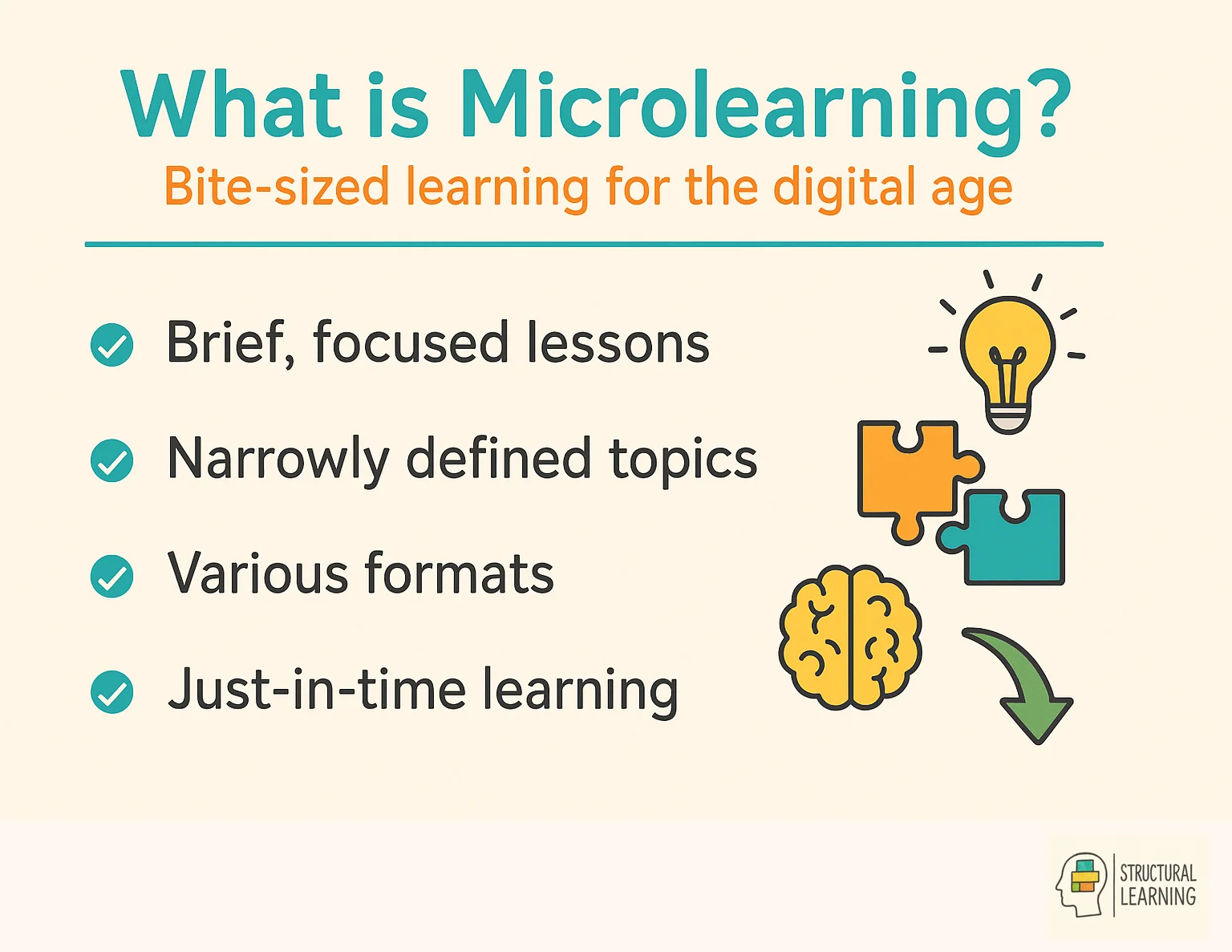
Microlearning is an effective and effective approach to learning that has gained popularity in recent years. It is characterised by delivering bite-sized and focussed content to learners, typically through the use of technology. Unlike traditional forms of learning, which are often time-consuming and require significant dedication, microlearning provides learners with concise and targeted information that can be quickly consumed and applied.
Microlearning is a modern approach to learning that focuses on breaking down information into small, easily digestible units called microsteps. These microsteps are then presented in the form of learning modules, often in digital media environments such as apps or web-based platforms. The goal is to make learning more accessible and convenient by incorporating it into daily routines.
One unique aspect of microlearning is its push technology approach. Instead of requiring learners to actively seek out information, microlearning pushes the content to them through notifications or reminders. This reduces cognitive load by eliminating the need for learners to remember to engage with the content on their own. Instead, they are prompted at regular intervals to engage with short, bite-sized pieces of information.
By focusing on microsteps and utilising push technology, microlearning addresses several challenges associated with the learning process. One challenge is overcoming information overload, as learners are bombarded with an endless amount of information in today's digital age. Microlearning helps to manage this overload by breaking down complex topics into manageable chunks.
Another challenge is learner engagement and retention. Microlearning modules are designed to be highly engaging and interactive, using multimedia elements and gamification techniques. This increases learner motivation and helps to improve memory retention.
Overall, microlearning is a powerful tool for learning and development in the digital age. Its focus on microsteps, push technology, and addressing challenges makes it an effective and convenient approach to acquiring knowledge and skills.
Microlearning benefits
In today's fast-paced world, the demand for efficiency, productivity, and adaptability has never been greater. With rapid advancements in technology and an increasingly globalized and interconnected society, individuals and organisations alike are constantly pressured to perform at their best and achieve more in less time. This is where the importance of addressing the Next Heading comes into play. See also adaptive learning in education. See also instructional design.
Addressing the Next Heading refers to effectively managing time, information, and resources in order to maximise productivity and achieve desired outcomes. In a world that is constantly changing and evolving, being able to adapt and stay ahead is crucial for success. By addressing the Next Heading, individuals and organisations can stay agile and responsive to the demands of their environment.
Effective time management is essential as it allows individuals to allocate their time wisely and prioritise tasks. With limited time available, identify and focus on the most critical activities that contribute to personal and professional growth. Maintaining attention on these priority tasks becomes especially challenging in our distracted world. Additionally, efficient information management ensures that individuals have access to the right information when they need it, enabling informed decision-making and better problem-solving that often requires critical thinking skills.
Proper resource management is also significant as it maximises productivity and minimises wastage. By improving the use of resources, individuals and organisations can achieve more with fewer inputs, which ultimately leads to cost savings and increased efficiency. This approach is particularly important when supporting learners with special educational needs, where targeted interventions and feedback must be efficiently delivered. The principles of retrieval practice can also be incorporated into microlearning designs to enhance long-term retention, while considering the broader context of social emotional learning for complete student development.
Microlearning is a modern approach to learning that focuses on delivering short, bite-sized content to learners. It is designed to provide targeted and relevant information in a concise and easily digestible format. This method has gained popularity in recent years due to its numerous benefits. The key benefits of microlearning and how it can enhance the learning experience.
Microlearning is designed to be highly engaging, capturing the learner's attention from the start. The content is presented in a dynamic and interactive format, incorporating multimedia elements such as videos, animations, and interactive quizzes. This keeps learners interested and motivated, leading to better retention of information. Microlearning also makes use of gamification techniques to further enhance engagement, making the learning experience fun and rewarding.
One of the key advantages of microlearning is its ability to improve knowledge retention. By breaking down complex topics into smaller, easily digestible chunks, microlearning makes it easier for learners to absorb and remember information. The use of spaced repetition and reinforcement techniques further enhances retention. Spaced repetition involves revisiting the content at regular intervals, reinforcing the knowledge and preventing it from being forgotten. Reinforcement techniques, such as quizzes and assessments, help to solidify the learning and ensure that learners have a solid understanding of the material.
Microlearning is highly flexible and accessible, allowing learners to access the content whenever and wherever they want. The modules are designed to be completed in short bursts, making it easy to fit learning into busy schedules. Microlearning can be accessed on a variety of devices, including smartphones, tablets, and computers, making it convenient for learners to engage with the content on the go. This flexibility and accessibility make microlearning an ideal solution for individuals with limited time and resources.
Microlearning enables a more personalised learning experience by tailoring the content to meet the specific needs and interests of the learner. Learners can choose the modules that are most relevant to them, focusing on the areas where they need the most improvement. This targeted approach ensures that learners are not wasting time on irrelevant information, making the learning experience more efficient and effective. Personalised feedback and support can also be provided to learners, helping them to address any gaps in their knowledge and skills.
Microlearning is a cost-effective solution for organisations looking to train their employees. By delivering content in short, focussed modules, microlearning reduces the time and resources required for training. It also eliminates the need for expensive classroom-based training sessions, saving on travel and accommodation costs. Microlearning can be easily updated and modified, ensuring that the content remains relevant and up to date. This makes it a sustainable and affordable solution for organisations of all sizes.
Microlearning stands out as a powerful and adaptable approach to education in our rapidly evolving world. Its emphasis on concise, engaging content, coupled with its flexibility and accessibility, makes it an ideal solution for learners of all ages and backgrounds. By addressing the challenges of information overload and learner engagement, microlearning paves the way for more effective and efficient knowledge acquisition.

As educators, embracing microlearning principles can lead to transformative changes in the way we design and deliver instruction. By breaking down complex concepts into manageable microsteps, incorporating interactive elements, and providing personalised feedback, we can create learning experiences that resonate with students and creates a deeper understanding of the subject matter. The integration of push technology further enhances engagement, ensuring that learning becomes a smooth part of daily routines.
Ultimately, microlearning is not just a trend but a fundamental shift in the way we approach education. By harnessing its potential, we can helps learners to take control of their own learning journeys and thrive in a world that demands continuous adaptation and growth.
Microlearning is an educational approach that breaks down complex topics into small, manageable units of information. Each unit focuses on a single, specific learning outcome to prevent cognitive overload. This method allows students to digest content quickly and apply their new knowledge immediately.
Teachers can use short retrieval practice quizzes or five minute instructional videos to introduce new concepts. It is also effective to distribute digital learning cards that students can review during transitions or short breaks. These small steps help to build a consistent habit of learning without overwhelming the students.
The short format keeps learners focussed and reduces the fatigue often associated with long, traditional lessons. It provides a sense of achievement as students complete multiple small modules in a single session. This approach also makes it easier for teachers to track progress and identify specific areas where a child might need more support.
Scientific evidence shows that chunking information into smaller pieces helps the brain to process and store data more effectively. Research into the spacing effect indicates that frequent, short sessions lead to better long term retention than one long period of study. This method supports the natural way the human brain manages its limited working memory capacity.
A frequent error is creating content that is too brief to provide any meaningful depth or context. Some teachers also forget to include interactive elements, which are essential for maintaining the student attention. Finally, failing to align each small module with the broader curriculum can result in a disjointed learning experience.
For further academic research on this topic:
For those wishing to examine deeper into the research underpinning microlearning, the following academic papers offer valuable insights: