Updated on
September 9, 2026
Singapore Maths: A Complete Guide to the Mastery Approach
Explore the Singapore Maths mastery approach, focusing on bar modelling and the CPA method, and learn how schools effectively implement these strategies.


Updated on
September 9, 2026
Explore the Singapore Maths mastery approach, focusing on bar modelling and the CPA method, and learn how schools effectively implement these strategies.
Singapore Maths stresses understanding over rote learning. The mastery approach helps learners grasp concepts before moving on. Singapore achieved top maths rankings using this systematic method. It uses concrete-pictorial-abstract sequences for solid foundations. This builds thinking skills and confidence, instead of rushing. How can teachers use it well? (Researchers like Jerome Bruner (1966), Richard Skemp (1976), and Zoltan Dienes (1960s) support such approaches.)
Singapore Math interests teachers and parents (since its start). It works well in classrooms and at home. The method highlights visualisation, real-world maths, and solid foundations. Dimensions Math and Primary Mathematics offer learners varied engagement (Berinderjeet Kaur, 2021; Kho Tek Hong, 2018; Yeap Ban Har, 2010).
Singapore Math's methods and results are examined. The article reviews its problems and successes. It shows how the approach boosts learners' maths skills (Kim, 2005). Understanding this helps gauge Singapore Math's worth as a learning strategy (Lee, 2010).
Singapore Math builds strong maths skills (Singapore). It uses Concrete-Pictorial-Abstract (CPA) so learners understand maths reasons. Learners gain both skills and deeper maths knowledge (research supports this).
Singapore Math is popular with US home educators; resources like Math in Focus are common. It often moves a year faster, so learners start a year behind. This approach prepares them well (Hogan & Ginsburg, 1988; Geary, 2006).
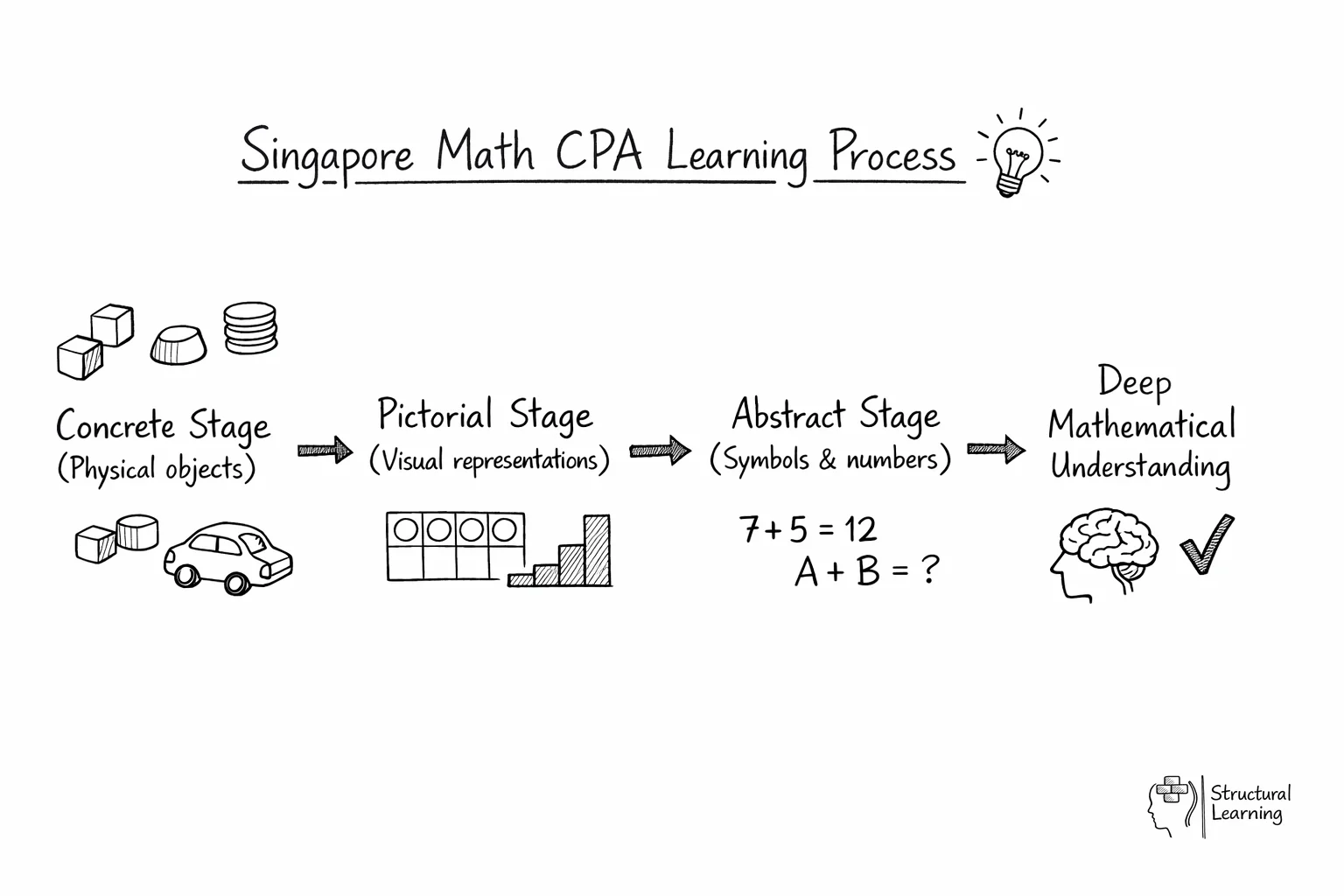
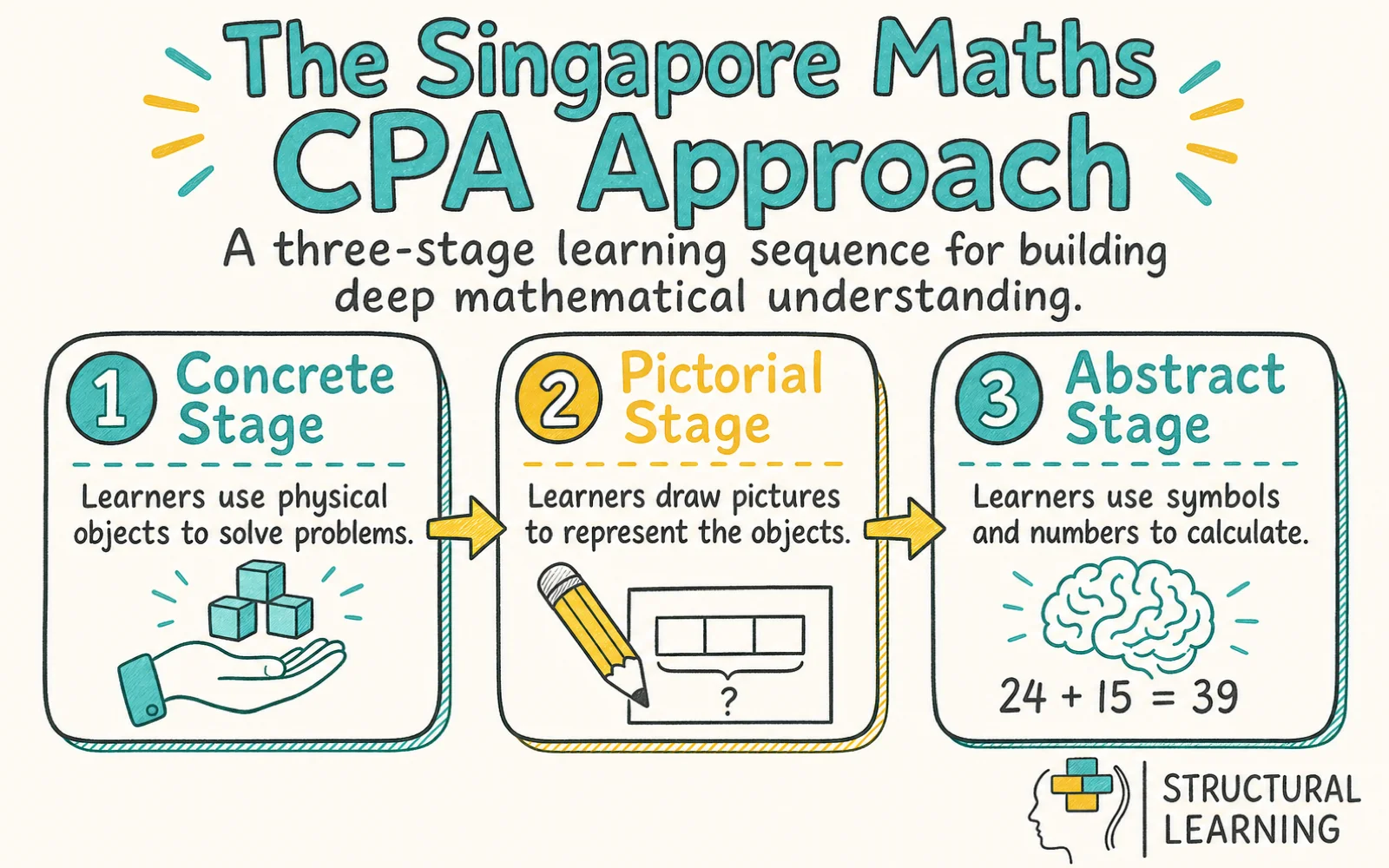
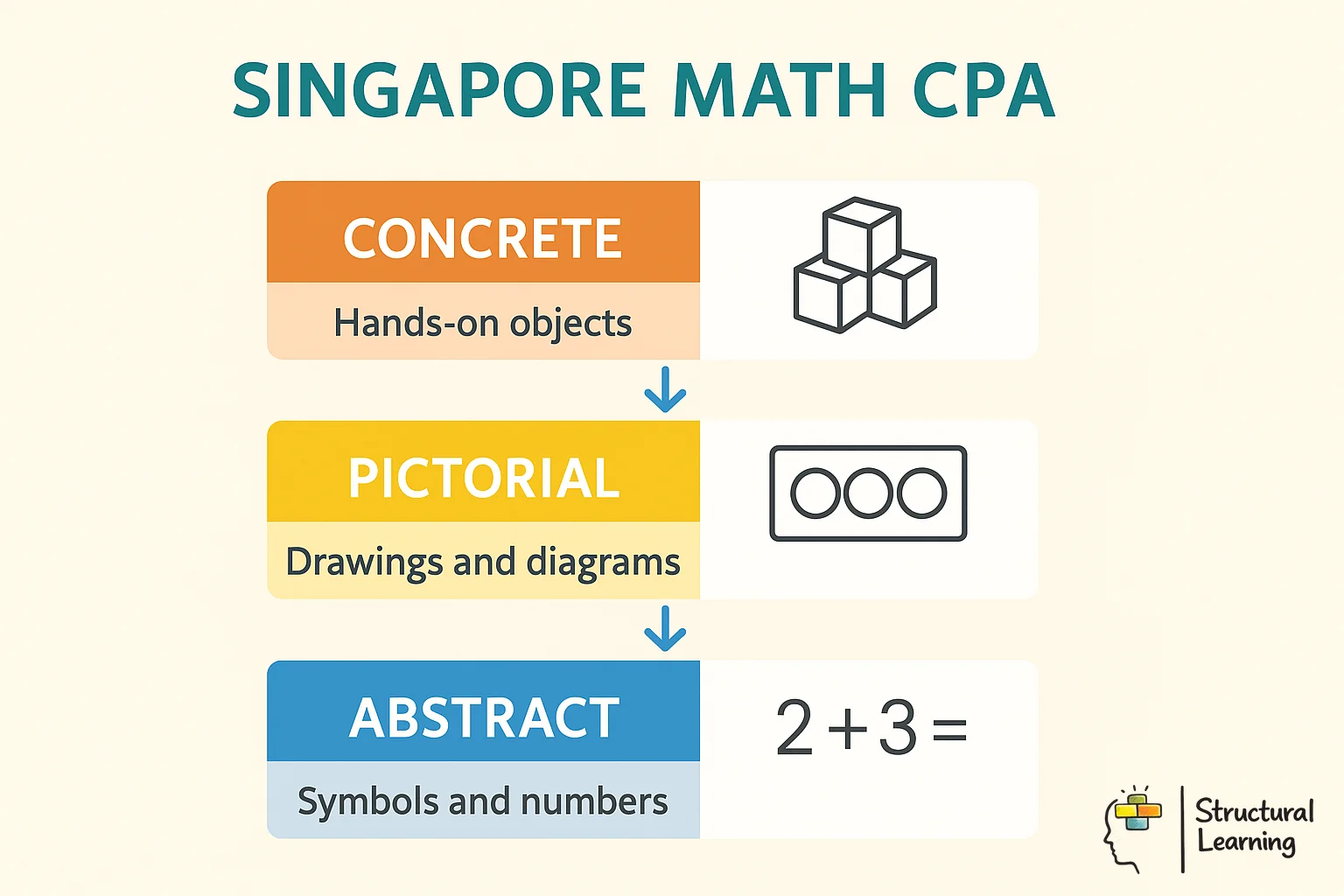
Singapore Math uses the Concrete-Pictorial-Abstract (CPA) approach. This involves three learning steps. Learners first use objects. Then, they use pictures to visualise problems. Finally, learners use symbols, as described by Jerome Bruner.
Singapore Math teaches multiplication and division of fractions early. Learners build skills in basic maths and strengthen understanding. Bar models are key in Singapore Math. These help learners visualise tricky problems, improve number sense and solve problems well. (Researchers such as Beckmann, 2018, and Yeap Ban Har, 2010, support this.)
Singapore Math uses activities and talk to help learners engage actively. This builds mental maths skills. The approach creates an interactive space. This improves learners' understanding of maths (Kim, 2005) and their problem-solving skills (Lee & Tan, 2011).
Bar models use rectangles to show quantities so learners picture maths problems. This method helps systematically solve word problems (Singapore Math). It turns number problems into visual diagrams for easier understanding. For example, "John has 5 apples, Mary has 3." Learners draw bars for each, then combine them.
Research shows visuals help learners struggling with abstract maths. Visuals make mathematical connections easier to grasp (Bruner, 1966). This improves understanding and problem-solving skills (Willingham, 2009). A strong foundation prepares learners for harder maths (Boaler, 2015).
Bar models help learners compare, see parts and wholes, and do multiplication. Woodward (2006) found learners quickly spot what they know and need to know. Bruner (1966) and Skemp (1971) suggest bar modelling is good for maths. It improves a learner's maths knowledge.
Singapore Math focuses on understanding concepts, aiding long-term memory and strong problem-solving. The CPA approach, (Bruner, 1966) builds solid foundations using objects, then visuals, then abstract ideas. Bar modelling gives learners a powerful visual tool, (Boesen et al., 2014) improving number skills and fluency.
Singapore Math can challenge learners and teachers at first (Lee & Koh, 2015). Mastering concepts takes time, which could frustrate some learners (Perry, 2019). Teachers may need extra methods beyond bar models (Ginsburg, 2011).
Singapore Math builds a strong base but lacks advanced content. Teachers should add resources for broader maths learning. (Ginsburg, 1997) A balanced approach addresses challenges and supports each learner's needs. (Boaler, 2009; Dweck, 2006)
Train educators in CPA (Concrete-Pictorial-Abstract) and bar modelling. Give teachers time to practise and support each other. Adapt lessons to fit what your learners need. Support struggling learners and challenge those who excel. (See research by Bruner, 1966; Skemp, 1971; and Wood, Bruner & Ross, 1976).
Collaborative learning helps learners explain their methods and learn from peers. Hands-on activities with objects build an inclusive classroom. Regular assessments help you spot learning needs. Targeted interventions address misconceptions and celebrate progress. This promotes positive attitudes and growth (Boaler, 2016; Dweck, 2006).
Singapore Math resources support teaching. Textbooks, workbooks, and online tools help with lessons and homework. Ensure learners access the resources and explore them together. Customise and commit to efficiently use Singapore Math, creating a stimulating maths learning space.
Parents using Singapore Math need structure (Lee, 2016). Create a daily timetable for regular work, but be flexible for each learner. Start with real objects before pictures, then move to abstract ideas (Bruner, 1966). This builds firm understanding (Skemp, 1976).
Showing real-world maths helps learners see its worth. Use items at home for sums, like baking ingredients or budgeting. Get help from online groups or tutors to tackle problems. Learners will get good support.
Track learner progress often and adjust teaching as needed. Celebrate successes and foster a maths love with encouragement. Structured lessons and practice, plus support, make Singapore Math effective (Wong, 2012; Kaur, 2017).
Singapore Math uses CPA and bar modelling to help learners grasp maths (Jerome Bruner, 1966). This builds problem-solving skills and strong foundations. Initial training and adapting the method are key (Richard Skemp, 1976). Singapore Math is a useful resource for teachers and parents (Jean Piaget, 1954).
Teachers can use these strategies to improve maths learning with Singapore Math. Learners gain confidence and skills with its principles (Boaler, 2016). This approach helps learners face challenges in school and life (Hattie, 2008; Dweck, 2006).
This approach fosters critical thinking and problem-solving skills. Learners achieve mastery through exploration. Singapore Maths uses visual and practical learning. Educators enable learners to build firm maths foundations. It focuses on understanding, not just memorising.
Teachers use objects like counters to show new ideas. Learners then use pictures such as bar models, building on the physical understanding. Finally, learners solve problems with maths symbols, deepening comprehension.
Bruner (1966) showed visual aids support learning. Bar models help learners picture maths problems easily. They clarify relationships between numbers for learners. These diagrams aid learners who find maths hard, according to Willis (2010).
This approach helps learners achieve high maths scores (international assessments). Research shows mastery builds fluency and number sense, not just memorisation. Moving from concrete to abstract boosts retention (Bloom, 1956; Bruner, 1966; Skemp, 1976).
Teachers often rush topics, hindering learner mastery of key concepts. They may skip concrete stages, expecting learners to grasp abstract symbols rapidly. Bar models should visualise problems, not become memorised procedures.
For further academic research on this topic:
Ban Har Yeap (2018) explores teaching through problem solving. Anne Watson, Mike Askew, and colleagues (2012) explain variation theory. Carol Dweck (2006) discusses growth mindset in learners. Jo Boaler (2009) presents research on mathematical mindsets. These authors offer key insights for teachers.
Effective teaching boosts learner maths skills (EEF). This supports key stages 2 and 3. NCETM provides further mathematics resources for all learners. Use these references to support your teaching practices.