Updated on
September 9, 2026
Exploring Blended Teaching and Learning Methods
Explore effective blended teaching and learning methods, combining online and in-person strategies for enhanced educational outcomes.


Updated on
September 9, 2026
Explore effective blended teaching and learning methods, combining online and in-person strategies for enhanced educational outcomes.
Blended teaching and learning represent an instructional approach that seeks to harness the capacity of digital tools while maintaining the irreplaceable value of face-to-face interaction. It is an approach designed to forge synchronisation between online digital strategies and the traditional, time-honoured practices found within the regular classroom. At its core, this way of teaching is focussed on combining an indispensable human element with technological advancements to enrich the learning experience.
In practical terms, blended instruction might manifest itself through a variety of models. For some, it entails incorporating an online component wherein students engage in tasks or review materials outside of class time, returning to the classroom for in-depth discussion and hands-on activities that build upon the online learning. This approach promises not only to augment the traditional learning model but also to cultivate a more individualized and differentiated learning path for each student.
The thriving nature of blended learning in the educational landscape, particularly within university settings, indicates a shift towards a versatile and customised learning experience. The objective remains constant: to deliver superlative student outcomes, enhanced by the engagement and myriad possibilities facilitated by digital tools, in concert with the tried-and-true methods of traditional education.
This article will unfold the multilayered aspects of blended teaching and learning, from its conception to current practices in both academic and corporate settings. Understanding its models and methodologies, we will weigh its benefits against its drawbacks, and review its implications on the educational landscape. Join us as we navigate through the intricate world of blended learning, a domain where tradition meets innovation to create a uniquely modern educational process.
Within the discourse, terms like 'blized learning' and 'hybrid learning' are becoming increasingly entrenched. These expressions point to the confluence of the educational and technological realms, where online materials and activities are brought together with the more conventional modes of face-to-face pedagogy. This collaboration between what is learnt digitally and what is experienced personally is aimed at enhancing student learningand widening the scope of educational opportunities.
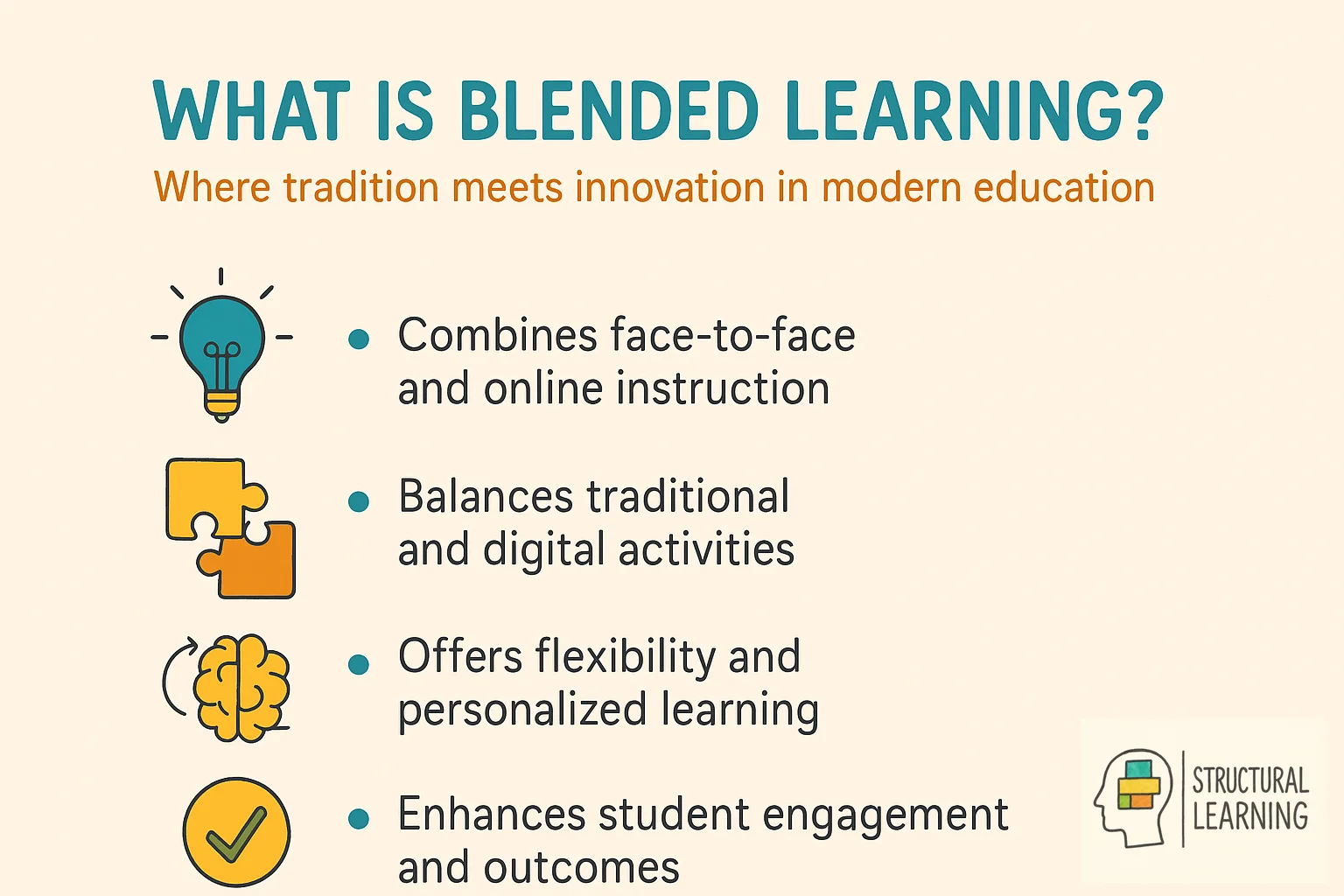
The term 'blended teaching' specifically underscores the pedagogical strategies that involve using digital means alongside the formative practices characteristic of the classroom. This duality seeks to improve traditional teaching by intertwining it with the multifaceted possibilities that modern educational technologies offer. Consequently, the blended learning environment becomes a composite, dynamic space where different modalities and tools coalesce to shape the learning process.
Blended teaching and learning have gradually surfaced as keystones inmodern education, combining time-honoured pedagogical practices with modern digital possibilities. This shift signifies a pedagogical evolution from the conventional to a boundary-blurring approach, where the digital and physical realms of learning coalesce.
Historically, the genesis of the blended learning model can be traced back to the early days of integrating online and on-campus learning. This phased introduction allowed educational institutions to explore the potential benefits of digital platforms while maintaining the established structure of in-person learning. As technology became more entrenched in our daily lives, the flexibility offered by blended teaching started to dissolve the constraints previously posed by physical locations, offering learners unprecedented access to education.
The arrival of blended learning marked a turning point, further spotlighted by the unforeseen circumstances brought about by the COVID-19 pandemic. The pandemic served as a catalyst, accelerating the adoption of predominantly online formats, and underlining the significance of blended learning approaches in maintaining the continuity of education. In this milieu, blended teaching has been understood to encompass the employment of digital strategies, as a supplemental tool and as a foundational element alongside traditional classroom engagement that promotes active learning.
This evolution has been characterised by a gradual shift from viewing technology as an auxiliary component to recognising it as an integral part of the educational framework. The transformation has been particularly pronounced in higher education institutions, where the flexibility of blended models has enabled institutions to cater to diverse student populations, including working professionals and distance learners who require more adaptable scheduling options.
Today's educational landscape demonstrates a widespread embrace of blended learning methodologies across various institutional contexts. Research indicates that schools implementing blended approaches report increased student satisfaction rates and improved academic outcomes, particularly in subjects requiring both theoretical understanding and practical application. The current trend shows a move towards more sophisticated integration of digital platforms that support metacognitive strategies development and self-directed learning skills.
Contemporary blended learning implementations often feature learning management systems that enable smooth transition between online and offline activities. These platforms facilitate real-time progress tracking, personalised effective feedback mechanisms, and collaborative projects that span both digital and physical learning environments. The emphasis has shifted from simply combining online and offline elements to creating cohesive learning experiences that use the unique strengths of each modality.
Understanding the various models of blended learning is crucial for educators seeking to implement effective strategies within their teaching practice. These models provide structured frameworks that guide the integration of digital and traditional instructional methods, each offering distinct advantages depending on the learning objectives and institutional context.
The rotation model represents one of the most widely adopted approaches to blended learning, characterised by students rotating between different learning modalities on a fixed schedule. Within this framework, learners alternate between online learning, small group instruction, and independent work stations. This model proves particularly effective in primary and secondary education settings, where structured transitions help maintain engagement whilst providing opportunities for differentiated instruction.
Station rotation, a subset of this model, involves students moving between different learning stations within a single classroom, with at least one station dedicated to online learning activities. This approach enables teachers to provide targeted support to small groups whilst other students engage with digital content independently. The laboratory rotation model extends this concept by incorporating dedicated computer labs or technology-rich environments for the digital component of instruction.
The flex model positions online learning as the primary delivery method, with face-to-face instruction providing supplementary support as needed. This approach offers maximum flexibility for learners, allowing them to progress through content at their own pace whilst accessing teacher support and collaborative activities when required. The model proves particularly effective for advanced learners or those requiring remedial support, as it accommodates varying learning speeds and styles.
In practice, the flex model often involves students working primarily through digital platforms whilst teachers circulate to provide individual guidance and facilitate small group discussions. This approach requires robust digital infrastructure and well-designed online content, but offers significant advantages in terms of personalisation and student autonomy.
The implementation of blended learning approaches yields numerous advantages whilst simultaneously presenting certain challenges that educators must navigate thoughtfully. Understanding both aspects enables more informed decision-making regarding the adoption and refinement of blended teaching strategies.
Blended learning environments demonstrate significant potential for enhancing student engagement through varied instructional modalities that cater to different learning preferences. The integration of digital tools enables immediate feedback mechanisms, allowing students to monitor their progress continuously and adjust their learning strategies accordingly. This real-time assessment capability supports the development of self-regulatory learning skills that prove valuable across academic and professional contexts.
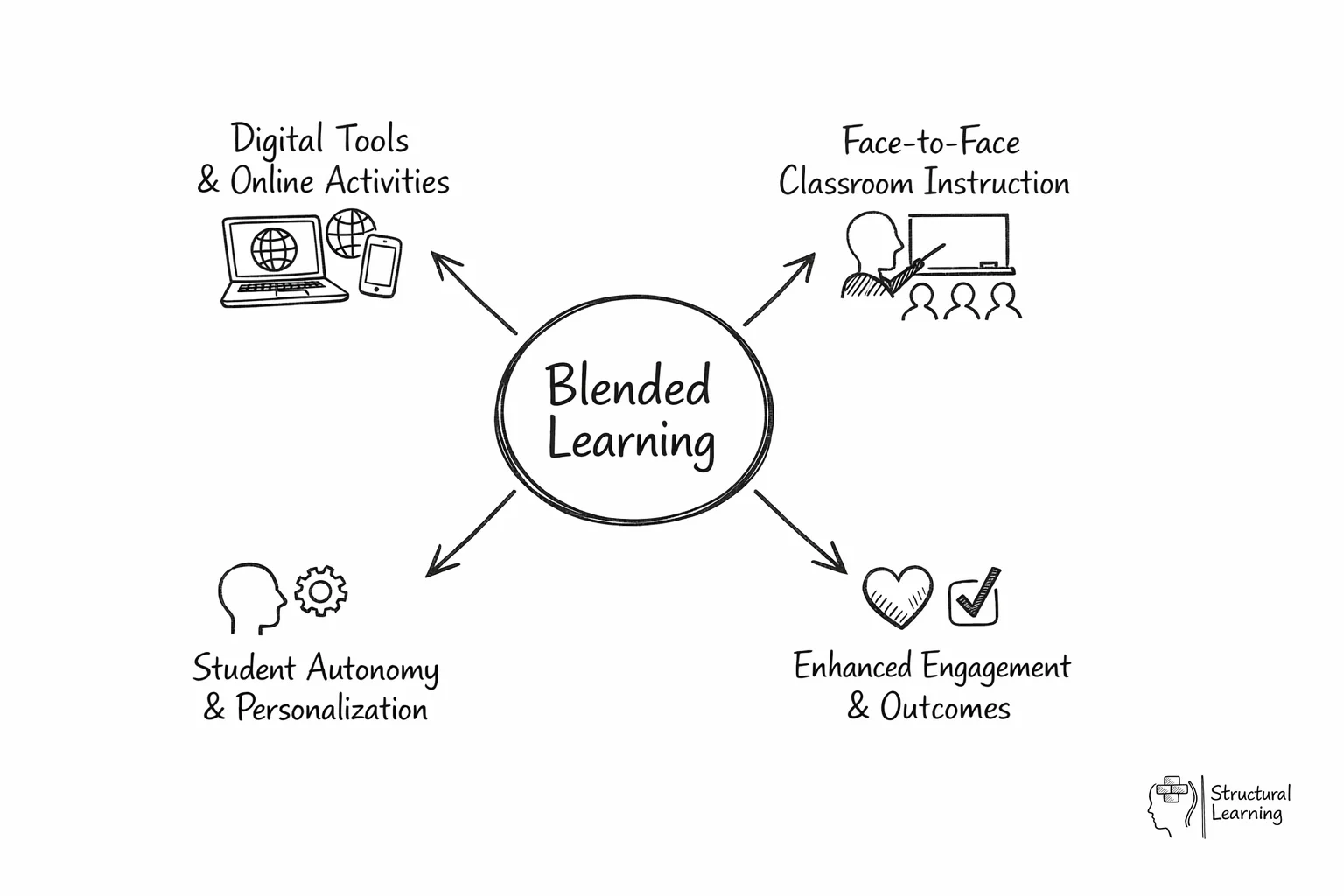
Furthermore, blended approaches facilitate increased accessibility to educational content, enabling students to revisit materials multiple times and engage with resources beyond traditional classroom hours. The asynchronous nature of many digital components allows learners to process information at their optimal pace, whilst synchronous face-to-face sessions provide opportunities for deeper discussion and collaborative problem-solving activities.
Despite the considerable benefits, blended learning implementation faces several significant challenges that require careful consideration. Technical infrastructure requirements can strain institutional resources, particularly in settings where reliable internet access or adequate devices are not readily available. Additionally, the successful implementation of blended models demands substantial professional development for educators, who must develop competencies in both digital tool utilisation and modified pedagogical approaches.
Student readiness represents another critical challenge, as blended learning often requires higher levels of self-direction and digital literacy than traditional instructional methods. Some learners may struggle with the increased autonomy inherent in many blended models, necessitating additional scaffolding and support structures to ensure successful outcomes for all participants.
Blended teaching and learning represent a significant approach to education that effectively bridges traditional pedagogical practices with effective digital technologies. As educational institutions continue to recognise the value of flexible, personalised learning experiences, blended models offer a viable pathway for enhancing student engagement whilst maintaining the essential human connections that characterise effective teaching. The evidence suggests that when implemented thoughtfully, these approaches can significantly improve learning outcomes whilst developing critical 21st-century skills in both students and educators.
The future of blended learning lies not merely in the technological tools themselves, but in the pedagogical innovation that emerges from their thoughtful integration with established educational practices. As institutions continue to refine their approaches and address implementation challenges, the potential for blended learning to democratise access to high-quality education becomes increasingly apparent. For educators considering the adoption of blended methodologies, the key lies in careful planning, ongoing professional development, and a commitment to student-centred design principles that prioritise learning outcomes above technological novelty.
Blended learning is an approach that combines traditional face to face teaching with digital activities and online resources. It aims to use technology to support and extend classroom instruction rather than replacing the teacher. This method allows learners to engage with curriculum content through various formats to suit different learning needs.
One common method is the rotation model, where students move between different stations for independent digital work and direct teacher led instruction. Another strategy is the flipped classroom, which involves learners studying new material at home before applying that knowledge in class. Teachers must ensure that digital tasks are closely aligned with the specific learning objectives of the session.
This model supports differentiated instruction by allowing learners to progress through digital materials at their own speed. It helps to build independent study habits and digital literacy skills that are essential for future academic success. Additionally, the data generated by online platforms can help teachers quickly identify which students require extra support or further challenge.
Evidence suggests that blended approaches can enhance learning when technology is used to improve the quality of interactions between teachers and learners. Research from organisations like the Education Endowment Foundation emphasises that the pedagogical design is more important than the specific devices used. Studies often show that well planned digital integration leads to higher levels of student engagement and better knowledge retention.
A major mistake is using technology for its own sake without a clear link to the curriculum or learning goals. Another issue is assuming that all students have the same level of digital skill or equal access to devices at home. Schools must provide consistent training for staff and clear guidance for learners to ensure the technology facilitates rather than hinders the learning process.
Face to face interaction is vital for providing emotional support, building relationships, and managing classroom behaviour. While digital tools can provide facts and data, teachers are necessary to guide critical thinking, lead discussions, and offer nuanaced feedback. The blended approach works best when technology handles repetitive tasks, leaving more time for meaningful teacher student collaboration.
For further academic research on this topic:
For educators interested in exploring blended learning methodologies in greater depth, the following research provides valuable insights into effective implementation strategies and outcomes:
External References: EEF: Digital Technology in Education | Realising the Potential of Technology in Education (DfE)