A clear, evidence-led guide to student agency, how it differs from choice and voice, and how teachers and SENCOs can design, support and review meaningful learner decisions.
Main, P. (2024, September 16). The Role of Student Agency in Fostering Lifelong Learners. Structural Learning. https://www.structural-learning.com/post/student-agency
What is student agency?
Student agency is a learner's capacity and opportunity to act intentionally and influence learning within a real social and educational context. It can involve setting a goal, proposing a route, asking for support, explaining a decision, using feedback or revising work. Agency is not the same as unlimited choice, independence, confidence, compliance or visible participation. Teachers still protect the curriculum, access, assessment, safety and support. The useful question is not whether a learner 'has agency', but which meaningful decisions the learner can understand, access, make and review in this task.
This guide helps teachers design meaningful decisions without withdrawing instruction or support. It separates agency from nearby ideas, shows what it can look like across subjects, and gives a practical way to review access, action and response in one lesson.
For example, a teacher may fix a reading goal and teach how to use text evidence. A learner then picks one of three events, asks for an evidence frame and chooses which sentence to revise first. The learner shapes the route, while the teacher keeps the goal, fair evidence and support in place. Reeve's three studies of agentic engagement included a three-wave study with 302 middle-school learners (Reeve, 2013).
Student Agency Defined
Student agency means being able and permitted to influence purposeful action in learning. A learner forms or understands an intention, makes a decision that matters, acts within the setting, and can review what happened. Agency depends on the learner and the opportunities, relationships, knowledge, tools and constraints around them. It is therefore contextual rather than a fixed personal quality.
The OECD Learning Compass describes agency through setting goals, reflecting and acting responsibly, and places it beside co-agency with teachers, peers, families and communities (OECD, 2019). This is a useful policy definition, but it is an aspiration rather than proof that one classroom activity produces a particular outcome.
In educational psychology, one narrower idea is agentic engagement. This is the learner's useful input into the teaching they receive. A learner may say that an explanation is not working.
They may ask for an example, suggest a question or explain why a route needs to change. Reeve (2013) developed and tested this idea through three studies. It captures active input, not every form of agency.
Primary example: the teacher sets the reading objective and provides the text. A learner chooses which of three events to analyse, asks to use an evidence frame, explains why that support helps and revises one sentence after feedback. The agency lies in meaningful action within the task, not in choosing whether to learn the objective.
“Student agency” is the established name of the construct, so this article retains it in titles and research discussion. In ordinary classroom prose, we use learner. “Learner agency” is often used as a near-synonym, especially when writers want the idea to apply beyond school or beyond people formally enrolled as students. Neither label supplies one agreed theory or scale.
Student agency belongs within the wider family of theories of learning, motivation and participation. It is best treated as a question about action in context: what is the learner trying to do, what can they influence, which resources and relationships make action possible, and what evidence shows that their contribution affected the learning process?
Student Agency, Choice, Voice and Autonomy
Choice, voice, autonomy support, self-regulation, self-efficacy and engagement can all contribute to agency, but none is a synonym for it. Keeping the terms separate prevents a colourful menu, an enthusiastic response or a learner survey from being presented as proof of agency. It also helps teachers decide what needs teaching, changing or observing.
On a small screen, swipe the table horizontally to compare all columns.
Concept
Plain meaning
What it can contribute
What it does not establish
Student agency
Intentional action that influences learning in a context
A learner proposes, decides, acts, explains, seeks support or revises
A stable trait, unrestricted control or a guaranteed outcome
Choice
Selecting from available options
A decision point when options are meaningful and usable
Agency if all options are trivial, inaccessible or have no consequence
Student voice
Learners express views about matters that concern them
Information and proposals that can influence a response
Influence if adults collect views but do not answer or act
Autonomy support
Adults acknowledge perspective, give rationale and permit appropriate initiative
Conditions in which self-directed action is more possible
The absence of structure, teaching, boundaries or feedback
Self-regulation
Planning, monitoring and adjusting thought, emotion or action
Skills a learner can use while acting towards a goal
Influence over the task or setting by itself
Self-efficacy
Belief about capability for a particular action
Willingness and persistence in some conditions
Permission, opportunity or actual influence
Engagement
Behavioural, emotional, cognitive or agentic involvement
Participation in the learning process
Agency when participation is compliant but offers no meaningful action
OECD's curriculum analysis makes a similar distinction between student choice, student voice and student agency. It also notes that increased choice can create judgement and equity problems when learners have unequal information or prior opportunities (OECD, 2023). More options are not automatically better. Two understandable, valid routes can support more genuine action than ten confusing ones.
Pupil voice becomes relevant to agency when there is a response loop. Tell learners what was heard, what changed, what could not change and why. If the teacher asks which example caused confusion, then alters tomorrow's explanation and shows the class the link, learners can see that their contribution mattered. A suggestion box with no visible response is voice collection, not evidence of influence.
Agency also differs from independence. A learner can act with a peer, interpreter, communication board, teaching assistant or teacher prompt. Co-agency recognises that action is often relational. Requiring a learner to work alone or speak publicly may reduce agency when it removes the support that makes a valid decision possible.
A Practical Model: Agency Without Abandonment
Agency Without Abandonment is a planning heuristic for one lesson or task. It is not a psychological scale or a claim about a learner's character. The teacher fixes the educational and protective boundaries, then designs a decision that changes something meaningful for the learner. Support, feedback and review remain part of the task rather than being withdrawn in the name of independence.
Fix the purpose. State what learners are meant to know, understand or do, and what evidence will show it. A valid agency opportunity does not hide the learning goal.
Name the real decision. Specify what the learner can influence: topic, example, route, tool, sequence, feedback point, support, partner arrangement, question or revision priority.
Make every route valid. Check that each option can address the same purpose in the available time and that the resulting evidence can be interpreted fairly.
Plan for access. Check how each learner will read, compare, use and share the options. Add the right aids before you ask for a choice.
Keep adult duties clear. The teacher still owns core teaching, safety, privacy, fair marking and the support each learner needs.
Include action and explanation. The learner uses the decision and can say, show, select or record why it helped, hindered or needed revision.
Close the response loop. Review the work, route use, help requests and barriers. Keep, change or remove an option based on evidence from this task.
This sequence prevents two opposite errors. One is token choice, such as selecting a font while every important decision is fixed. The other is abandonment, such as asking a novice to choose the objective, source quality, assessment method and deadline without enough knowledge or support. Both can be described as learner-led, yet neither gives a sound account of agency.
Planning test: If two learners use different options, can you still explain how both routes address the same objective, remain accessible and produce usable evidence? If not, refine the options before the lesson.
Teachers do not need a project week to use this model. A short decision can matter. In a direct vocabulary lesson, learners may choose which of two examples to test first.
They may ask for a visual or spoken explanation. They can then choose which error to fix after feedback. Clear teaching and agency can sit in the same lesson.
What Teachers Decide and What Learners Can Decide
Good agency makes each role clear. Teachers set and guard the goal, key facts, safety, access, fair marking and time. Learners can make set choices about how they start, shape, check or improve the task. The line will change with age, knowledge, risk and subject.
On a small screen, swipe the table horizontally to compare teacher duties and learner decisions.
Task element
Teacher decides or protects
Learner may decide
Evidence to review
Purpose
Curriculum objective, essential content and success criteria
Which approved example or question to use
Whether each route reveals the intended learning
Process
Necessary instruction, prerequisites and available time
Order of valid steps, tool or strategy after teaching
Plan, checkpoint, question and completed work
Support
Required adjustments and access to taught supports
Which available support to use and when to request help
Access, use and learner explanation, not independence alone
Product
Comparable assessment evidence and quality criteria
Written, spoken, visual or supported route when each is valid
Evidence of the same knowledge or reasoning
Feedback
Accurate feedback and a feasible revision window
Which criterion to address first or when to seek feedback
Specific change between versions
Privacy and safety
Safeguarding, data protection and no forced disclosure
Use a non-personal example and choose an optional sharing route
Completion without unnecessary exposure
A decision is meaningful when it changes the learner's action or influence while preserving the task's purpose. “Pick red or blue paper” is usually decorative. “Choose which of three teacher-checked claims to investigate, then justify your source selection against the same criteria” affects the intellectual route. The latter still needs source teaching, boundaries and a checkpoint.
The boundary can change during a unit. At the start of secondary science, the teacher may set the method. Safety and sound measures matter.
Once learners know the core skills, they may choose a variable within a safe range. They can suggest a table and say when a reading should be repeated. Knowledge makes informed action more likely.
Classroom Examples of Student Agency
A sound example states four things. It names the fixed goal, the learner's choice, the help on offer and the work to check. A poster, project or class talk is not agentic by default. The examples below use normal lessons.
Each gives the learner one choice that matters, while the teacher still teaches and checks the same goal.
Primary reading
The objective is to explain how a character responds to one event using two details from a shared text. The teacher models one example and keeps the text, evidence requirement and Friday deadline fixed. Learners choose one of three events, decide whether to use an evidence table or oral rehearsal, and select written, captioned audio or a supported conference when each route shows the same reasoning.
The teacher reviews whether every learner could understand and use the options. A learner who selects the conference is not judged less independent. Evidence includes the chosen event, the two details, the explanation and any revision after feedback. The decision has consequence, but it does not replace reading instruction.
Secondary science
The objective is to use evidence to explain how light intensity affects photosynthesis. Safety rules, available equipment, core method teaching and required graph conventions remain fixed. Small groups choose one of two safe variable ranges, assign roles after checking access needs, and propose when a reading should be repeated. Each learner submits an individual explanation.
Agency appears in planning, proposing, monitoring and revising. It is not inferred from who speaks most in the group. The teacher notes whose suggestions changed the method, whether roles gave genuine access and whether each learner can explain the final decision.
Mathematics
The objective is to compare two methods for solving simultaneous equations. After both methods are taught, learners choose which to use first on a matched problem, predict where an error may occur and request either a worked example or a diagnostic question. They then compare efficiency and accuracy. Choosing a method before receiving the necessary teaching would be guesswork rather than informed action.
Writing
The teacher fixes audience, purpose, length range and assessment criteria. Learners choose one of four checked topics, decide whether to outline with a paragraph frame or evidence map, and nominate the criterion on which they want early feedback. After feedback, each learner records one change and why it serves the intended audience. Agency lies in a decision-revision cycle, not topic choice alone.
Formative assessment
During an exit check, learners identify which of three criteria they want the teacher to inspect first and can attach a question. The teacher still makes the assessment judgement. In the next lesson, the teacher shows which common questions changed the explanation. This links formative assessment with agency through an explicit response loop.
Direct instruction
A learner can act during a tightly taught lesson. They may ask for another example, point out a clash or link the new idea to an older model. They may also say that the pace makes accurate notes hard. Mameli and Passini (2019) added peer input and questions about instructions to an agentic engagement measure.
Not every challenge is right, but useful input can change the teaching exchange.
How to Support Student Agency
Support agency by teaching the knowledge and strategies needed for informed action, offering valid decisions, making help available and showing learners how their contributions receive a response. The aim is not to withdraw teaching. It is to create conditions in which learners can understand a purpose, act on it and examine the effect of their action.
Teach before asking for an informed decision
Novices cannot evaluate routes they do not understand. Explain the objective, model relevant strategies and show what makes an option valid. This is where careful instructional scaffolding supports rather than opposes agency. Remove or adapt a scaffold when evidence shows it is no longer needed, not because independence is treated as the goal of every lesson.
Offer a decision with a real consequence
Name what will change. A learner may shape the example, method, way to communicate, group set-up, feedback point or first edit. Avoid options that use time but do not change thought or action. Also avoid false choices.
One route should not be easier, preferred by the teacher or closed to some learners.
Make rationale and constraints discussable
Tell learners why some elements are fixed. “Everyone needs to use these two sources because we are comparing their claims” is more informative than “you have no choice”. Invite proposals that meet the same criteria. A declined proposal can still support agency if the teacher explains the constraint and offers a valid alternative.
Teach planning, monitoring and help-seeking
Agency draws on, but is not identical to, self-regulated learning. Model how to set a short goal, anticipate a barrier, select a strategy, request help and revise after feedback. These processes also connect to metacognitive thinking. A learner who uses a taught support strategically may show more purposeful action than one who refuses all help.
Use feedback as an exchange
Feedback should create a decision. Ask which criterion the learner wants to address first, which comment needs clarification or what evidence would justify a different route. The teacher provides accurate information and keeps the standard visible. The learner's response then becomes observable in the next action or revision.
Review opportunity, not personality
Instead of saying “Sam lacks agency”, ask whether Sam understood the options, had the prerequisite knowledge, could communicate a choice, trusted the response, had enough time and could use the available support. This changes the next teaching decision. A trait label usually hides the part of the environment that adults can improve.
Autonomy support is relevant, but it is not direct evidence about agency. It comes from self-determination theory and related work. Mammadov and Schroeder (2023) pooled 378 effect sizes from 179 samples in 153 studies, with 213,612 people.
Teacher or parent autonomy support was linked with several positive outcomes. The review did not test one agency programme that causes higher marks.
Student Agency, SEND and Equitable Access
Agency is fair only when learners can grasp, share and use the choice. A public spoken choice can shut some learners out. So can a dense menu or a plan with no aid. Needs linked to speech, sense, movement, language or focus can all shape access.
The same options are not fair when they place very different loads on each learner.
The English SEND Code of Practice states that children and young people should participate as fully as possible in decisions and receive the information and support needed to do so (Department for Education and Department of Health, 2015). That principle applies to school planning as well as formal review. It does not shift legal or professional duties from adults to the learner.
Start with a way to share the choice. Give time to think. Use words, signs, symbols, gesture, typed text, drawing or a speech aid.
A trusted adult may record the learner's clear response. Fast speech, eye contact, neat writing and ease in public do not prove agency.
Next, inspect hidden demands. One “creative” product may add motor, software, social or language requirements that are irrelevant to the objective. One collaboration option may expose a learner to sensory overload or unsafe peer dynamics.
One open topic may require background knowledge or home resources that are not equally available. The teacher and SENCO should remove these barriers before comparing learner choices.
CAST's UDL Guidelines 3.0 frame learner agency through purposeful reflection, access, support and action (CAST, 2024). The framework can help teachers inspect variability, but a list of multiple means is not proof that every route is valid. Each option still needs to match the lesson objective and assessment evidence.
Safeguard: Never require a personal disclosure, public leadership role or removal of a necessary adjustment as evidence of agency. A learner can choose a non-personal example, private response or supported route. Adults retain responsibility for safeguarding, reasonable adjustments, curriculum access and assessment fairness.
Culture and power matter too. Some learners have had more practice disagreeing with adults, proposing alternatives or interpreting open tasks. Others may read teacher questions as tests with one hidden correct answer. Teach the discourse of choice explicitly: what is genuinely open, how to propose another route, how disagreement will be handled and how the teacher will report the response.
The special educational needs link is not an invitation to lower the objective. It is a prompt to separate the intended learning from barriers that do not belong to it. Agency may increase when a learner can use a valid support, communicate without unnecessary exposure and see that their response changes the plan.
How to Review Student Agency in a Lesson
Review agency through evidence from a defined task, not a general score for the learner. Combine the designed opportunity, the learner's action, their explanation or communication, the resulting work and any barrier observed. The conclusion should be modest: what happened under these conditions, and what should change next time?
Check the opportunity. What could the learner genuinely influence? Was the decision understandable and consequential?
Check access. Could the learner perceive, compare, communicate and use every offered route with required support?
Check action. Did the learner propose, select, ask, adapt, challenge, seek support, use feedback or revise?
Check the response. Did a teacher, peer or resource respond in a way that let the learner's action influence the process?
Check the learning evidence. Did the route still reveal the intended knowledge or reasoning?
Ask for an explanation. What did the learner intend, what helped, what got in the way and what would they change?
Make a local decision. Retain, adapt or remove the option for the next use. Do not generalise beyond the evidence.
Brandt (2024) reviews self-report measures, performance tasks, portfolios, behavioural checklists, anecdotal records and self- or peer-assessment. The report argues that a complex construct is better examined with multiple sources and in context. Standardised measures are often self-report, while performance and observation can show what a learner does in a particular task.
A short list can help a learner look back. It can say, “I asked for the right help” or “I changed one part after feedback”. Do not add the ticks to give the learner an “agency level”. What we see in one lesson depends on knowledge, chance, speech, drive, culture and trust.
Use learner explanation carefully. Some learners communicate after a delay or through non-speech routes. Some can make a sound decision but find retrospective explanation difficult.
Pair the learner's account with the task design and work evidence. Do not make fluent self-report a condition for recognising action.
What the Evidence Shows
The research leads to a modest view. Agency is useful, but scholars define it in different ways. Some studies test one form called agentic engagement. The task, setting and bond with the teacher all matter.
Support for autonomy is linked with good outcomes. Yet direct tests of one agency programme are rare. We cannot promise broad gains.
Agentic engagement is one researched operationalisation
Reeve made a scale for useful learner input (Reeve, 2013). His studies tested links with drive, marks and felt support for choice. One study tracked change over time. This helps us test which change came first.
The scale still covers just one part of agency. It asks how learners shape the flow of teaching.
Mameli and Passini (2019) grew the scale from five to ten items. Their study had 1,064 Italian high-school learners. New items covered peer input and questions about teacher rules.
The results gave support for one main factor in that group. They did not create one school test for all forms of agency.
Agency is interactive and may include resistance
Mameli et al. (2023) treat agency as social and tied to the setting. They say it can fit with the teacher's plan or resist it. This matters because compliance is not agency. A learner can follow rules but shape nothing.
A fair objection can show an act with purpose. The paper is a review and argument, not a trial.
Autonomy support has a large related evidence base
Mammadov and Schroeder (2023) reviewed felt support for autonomy. They found links with drive, effort, learning goals, self-control, beliefs and marks. The review is large and helps us think about good class conditions. It still does not show that agency raises marks.
Support for autonomy and agency are not the same thing.
Classroom and cultural context cannot be removed
Vaughn (2020) presents agency as multidimensional and shaped by adaptive teaching, cultures, languages, interests and co-created learning contexts. The article provides useful illustrations of teachers responding to learners' ideas. It is a theoretical and practice-oriented contribution, not a controlled estimate of impact.
K-12 intervention and measurement gaps remain
Brandt (2024) found few studies that test a direct agency plan. The review also found no sound age-by-age path for agency. It is hard to split agency from skills, beliefs and the class setting. These gaps call for care.
Teachers can still give real choices, then check what took place in that task.
What the Evidence Does Not Show
The current evidence does not show that a generic agency programme reliably raises marks, improves behaviour or creates lifelong learners. It does not establish one accepted list of dimensions, one developmental sequence or one valid score across subjects and cultures. It also does not show that more choice, less teacher direction or project work is always better.
A result about self-efficacy cannot be presented as an agency effect. A result about autonomous motivation cannot be presented as attainment caused by agency. A scale correlation cannot show that a classroom strategy caused change.
A policy framework cannot supply an effect size. Keeping these boundaries visible makes the article more useful to scholars and prevents teachers from planning around a false promise.
Transfer is especially uncertain. A learner may plan and revise well in art but need much more knowledge and support in algebra. Evidence from one project does not prove a general capacity across subjects, relationships and future settings. The page's former “lifelong learners” promise is therefore removed.
The evidence also does not make teacher direction the enemy of agency. Essential knowledge can expand the range of informed action. A worked example can let a novice detect a later error.
A fixed deadline can protect feedback time. A safety rule can preserve participation. The issue is whether constraints are educationally or ethically justified and whether a meaningful, accessible decision remains.
Finally, no study gives teachers permission to neglect access. A learner who cannot read the option list, tolerate the room, manipulate the tool or trust the public response does not receive an equal opportunity merely because everyone saw the same menu. Review the environment before interpreting behaviour.
Common Mistakes and Better Decisions
Most mistakes come from treating agency as a slogan rather than specifying a decision and its boundary. The repair is usually small: keep the purpose visible, name what can change, teach what learners need, build access and review the response. This is more reliable than adding open-ended choice to every part of a lesson.
Mistake: choice equals agency
Better decision: ask what the option changes and whether each route is valid. Choosing a worksheet colour rarely matters. Choosing which evidence to test first, with a reason and common criterion, can matter.
Mistake: voice equals influence
Better decision: close the response loop. Report what learners said, what changed, what stayed fixed and why. Record unanswered proposals so they do not disappear.
Mistake: agency means less teaching
Better decision: teach the knowledge, language and strategies needed for informed action. Then offer a decision the learner can understand and use. Structure and agency can support one another.
Mistake: independence is the outcome
Better decision: recognise co-agency and strategic support use. A learner who requests a sentence frame, communication aid or peer check is acting on the learning process, not failing it.
Mistake: visible enthusiasm proves agency
Better decision: examine the contribution and its effect. A quiet written correction may influence learning more than animated participation in a task whose important decisions are fixed.
Mistake: every proposal must be accepted
Better decision: test the proposal against purpose, access, evidence, time, safety and policy. Explain a refusal and offer a valid alternative. Agency includes reasoned interaction with limits, not adult withdrawal.
Mistake: one rubric describes the learner
Better decision: use several sources to make a task-specific judgement. Describe the opportunity, action, support and barrier. Decide what to change in the next lesson.
A Worked Classroom Example
A Year 7 history teacher wants learners to explain which factor most affected a local industrial change. The first plan offers a poster, slideshow or speech. The teacher and SENCO realise these are product formats, not equivalent evidence, and that the speech adds an unrelated public-performance demand. They redesign the task around one meaningful evidence decision.
Before the lesson
The teacher fixes the enquiry question, teaches the historical context and models how to compare source usefulness. All learners use the same four checked sources and the same criteria. They may choose which two sources to compare first and whether to record the comparison in a table, captioned audio note or supported conference. Each route must capture provenance, relevant detail and limitation.
The SENCO helps inspect access. One source receives a text-to-speech compatible version. Key vocabulary is pre-taught.
A learner who uses augmentative communication can select source cards and prepare a stored message. No one must disclose a family experience or speak to the class.
During the lesson
After the model, learners pick their first pair of sources and give a reason. The teacher asks one check question: “What does this route help you compare, and what may it hide?” One learner asks to swap from the table to audio. Slow writing is using the time needed for comparison. The teacher agrees because the evidence rule stays the same.
Another learner proposes an online source. The teacher checks it and explains that it cannot be used today because its authorship is unclear and the lesson is testing the shared set. The learner records the proposal for a later source-evaluation activity. The refusal does not erase the contribution; it makes the knowledge and constraint visible.
After the lesson
The teacher reviews the explanations, chosen routes, help requests and one-sentence reflections. Most learners produced comparable evidence. Two misunderstood the audio route as a less detailed option, so the teacher will add a model. The source-pair decision helped reveal reasoning, but the product choice created confusion.
The next lesson retains the source decision and revises the route description.
The conclusion is local: this design supported observable decisions and revisions in this history task. It does not show that any learner has a general level of agency or that the approach caused a long-term outcome.
What Teachers, SENCOs and Leaders Do
Responsibility is shared but not vague. Teachers design and respond to decisions in the lesson. SENCOs help remove access barriers and protect required support. Subject and curriculum leaders check entitlement and assessment validity.
Senior leaders create conditions in which learner contribution can influence practice without transferring adult accountability.
Classroom teacher
State the fixed objective and evidence.
Name one meaningful learner decision.
Teach the knowledge and strategy needed to decide.
Provide valid supports and a response loop.
Review work, route use and barriers.
SENCO or inclusion leader
Check communication and participation routes.
Protect required adjustments and curriculum access.
Identify hidden sensory, motor, language or executive demands.
Help staff avoid independence and public-speech proxies.
Include the learner's supported views in plan-review cycles.
Subject or curriculum leader
Define where curriculum decisions can vary.
Check that options preserve subject integrity.
Moderate evidence from different response routes.
Provide examples of agency within explicit teaching.
Review whether opportunity is distributed fairly.
Senior leader
Keep adult accountability for safety, access and assessment.
Create visible response loops for school-level voice.
Protect teacher judgement and planning time.
Audit who gets consequential decisions and whose proposals are heard.
Avoid using a single agency score for accountability.
Families can add context about communication, prior experiences, interests and support use. Learners remain the best source on what they intended and how an option felt, but their report should not carry the whole evidential load. Work samples, observation and the design of the opportunity also matter.
Limitations and Uncertainty
Student agency has no one agreed meaning. Work in schools, the mind and society uses the term in different ways. Studies may test agentic engagement, self-led work, control, voice or action with others. Do not join their results unless the idea and the test match.
Much of the linked work finds a link, not a cause. It may also test a nearby idea. Support for choice, self-control and belief in skill have large research bases.
Their results are not agency effects by default. Studies differ by age, subject, nation and place. Direct school trials of agency are still few.
It is hard to measure agency. A survey can show what the learner feels, but people may read each item in a different way. A class note can show an act we can see. It may miss a private choice, a late reply or a fair refusal that an adult reads as poor conduct.
Performance tasks provide context-specific evidence but do not readily generalise. A mixed, low-stakes review is therefore more defensible than a universal score.
Agency Without Abandonment is a plan and review aid made for this guide. It draws on the source limits above. It is not a tested scale or school scheme. Its job is to make roles, choices, access and proof easy to check.
Fairness is still a concern. Some learners have had more chances to speak, object, choose and plan. Some know the words that adults in school expect.
A class can reward this past access by mistake. Check whose ideas get a reply. Check that each route keeps the same right to learn, get help and be safe.
Student Agency Study Note and Classroom Resources
These resources turn the article's evidence boundaries into practical decisions. Teachers and SENCOs can use them to plan one accessible agency opportunity, examine what happened and challenge common claims. They are not an agency test, learner profile or intervention programme.
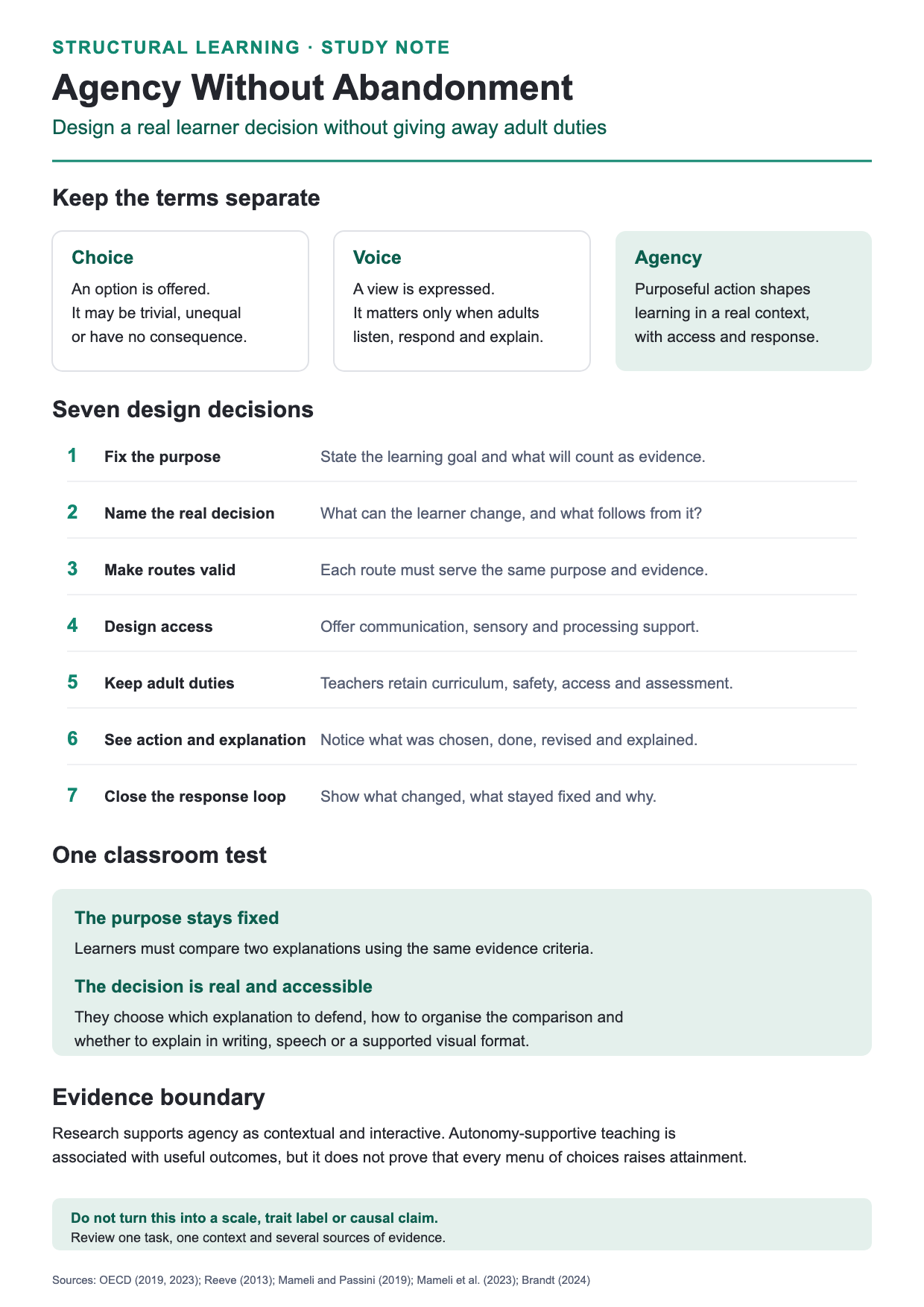
Study note: plan a real learner decision while keeping curriculum, access, assessment, safety and adult responsibility clear. Select the image to open the full-size PNG.Read the study-note transcript
Choice, voice and agency: Choice means an option is offered, but the option may be trivial, unequal or have no consequence. Voice means a view is expressed, but adults need to listen, respond and explain. Agency means purposeful action shapes learning in a real context, with access and response.
Seven design decisions: Fix the learning purpose and evidence. Name the real decision and its consequence. Make every offered route valid. Design communication, sensory and processing access. Keep adult duties for curriculum, safety, access and assessment. Notice what the learner chose, did, revised and explained. Close the response loop by showing what changed, what stayed fixed and why.
Classroom test: A teacher fixes a comparison goal and common evidence criteria. Learners decide which explanation to defend, how to organise the comparison and whether to explain through writing, speech or a supported visual format.
Evidence boundary: Agency is contextual and interactive. Autonomy-supportive teaching is associated with useful outcomes, but this does not prove that every menu of choices raises attainment. Do not use the study note as a scale, trait label or causal claim.
Classroom planning and review record
Two A4 pages for the fixed purpose, meaningful decision, valid routes, access, adult duties and checkpoints, followed by a context-specific review of action, work, explanation and barriers.
Twelve duplex cards for staff learning, coaching or academic study. Each claim is paired with a decision and evidence boundary about choice, voice, instruction, access, measurement or adult responsibility.
The short answers below preserve the article's main boundaries. Student agency concerns meaningful action in context, not unrestricted control or a stable personality score. Teachers can support it during direct teaching, and learners can act with help. Any classroom judgement should remain tied to a defined opportunity and evidence from that task.
What is a simple definition of student agency?
Student agency is a learner's capacity and opportunity to act intentionally and influence learning in a particular context. It may appear when a learner sets or interprets a goal, proposes a route, asks for support, explains a decision, uses feedback or revises work.
Is student agency the same as student choice?
No. Choice is one kind of decision. It contributes to agency only when the options are meaningful, understandable, accessible and consequential. A decorative or false choice does not establish influence over learning.
Is student voice the same as agency?
No. Voice concerns expression and consultation. It can support agency when adults respond and the contribution influences a decision or action. Collecting views without a visible response does not show influence.
Can direct instruction include student agency?
Yes. A teacher can explain and model essential knowledge while learners ask for another example, question an inconsistency, choose a valid practice route, request support or decide which feedback point to address first.
Does agency mean learners work independently?
No. Agency can be relational. A learner may act with a peer, teacher, communication partner, assistive tool or scaffold. Strategic help-seeking can be evidence of purposeful action rather than dependence.
How can teachers measure student agency?
Use low-stakes, context-specific evidence from the designed opportunity, learner action, work, explanation, observation and response. Avoid turning one survey or checklist into a general score for the learner.
Does student agency improve attainment?
The direct claim is not established. Autonomy support and related constructs are associated with several positive outcomes, but student agency is variably defined and direct intervention evidence remains limited. Keep the construct and outcome separate.
How should a SENCO support student agency?
Help staff make each choice easy to grasp and share. Check time to think, speech aids, sense and movement needs, set aids and private routes. Keep the learner's right to the full course. Keep adult duties clear and make sure each view gets a reply.
Further Reading and References
These sources support the article's definitions, evidence boundaries and classroom decisions. Each DOI link identifies the exact journal record, while official reports link to the issuing organisation or public repository.
Paul Main is an educator and metacognition researcher who founded Structural Learning in 2002. With a psychology degree from the University of Sunderland and 22+ years helping schools embed thinking skills, he bridges the gap between educational research and classroom practice. Fellow of the RSA and Chartered College of Teaching, with 128+ Google Scholar citations.