Updated on
September 9, 2026
Tactile Learning: Classroom Activities and Evidence (2026)
Tactile learning uses touch, manipulatives and hands-on activity. See classroom examples, evidence, limitations and ways to plan purposeful practice.

Updated on
September 9, 2026
Tactile learning uses touch, manipulatives and hands-on activity. See classroom examples, evidence, limitations and ways to plan purposeful practice.
What is tactile learning?
Tactile learning uses hands-on, physical activity to build understanding, and it works best when the action maps directly onto the concept being taught. A large meta-analysis found concrete manipulatives improve recall most when teachers explicitly link the object to the abstract idea, then fade it as learners internalise the concept.
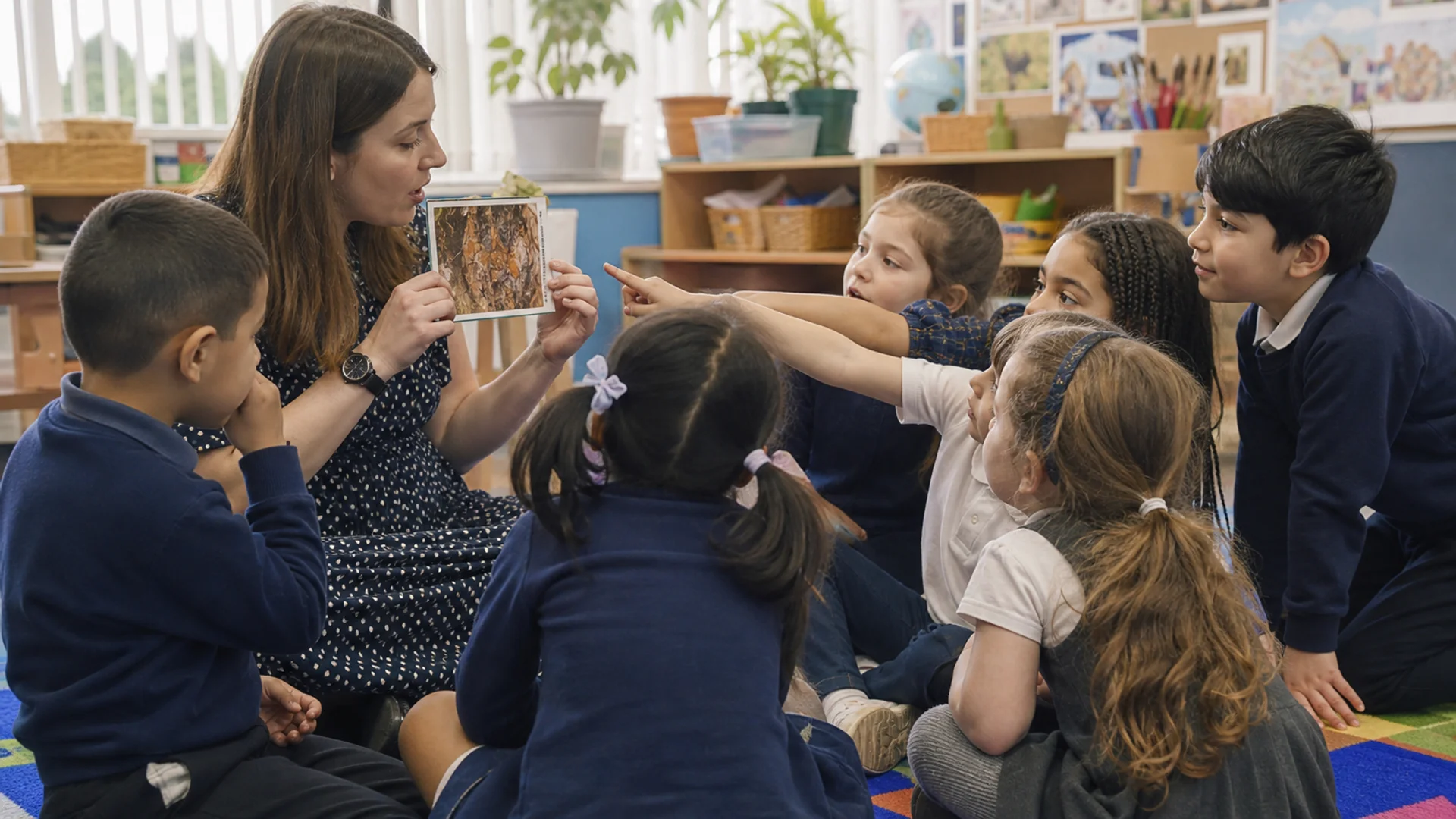
Tactile Learning: How Hands-On Activities Strengthen describes the use of touch, movement and physical materials to help learners connect ideas with concrete experience. In a Year 3 fractions lesson, for example, fraction tiles can help a class compare one half, two quarters and four eighths before they meet the same relationship as abstract notation. Montessori (1912) treated the hand as part of intellectual development, while later cognitive research cautions that materials only help when they are tied tightly to the learning aim.
Tactile learning is a teaching approach where learners use touch, object handling and purposeful movement. They use these experiences to build, test and remember academic concepts. It should not be treated as evidence that a child has one fixed learning style.
The evidence points to a clearer conclusion than the usual learning styles account. Tactile learning does not prove that some children learn best through touch, while others should be taught mainly through visual or auditory routes. Well-designed manipulatives, models, practical demonstrations and simulations can support attention, memory and conceptual change for many learners. However, poorly guided activity can increase cognitive load and reduce learning (Kirschner, Sweller, & Clark, 2006).
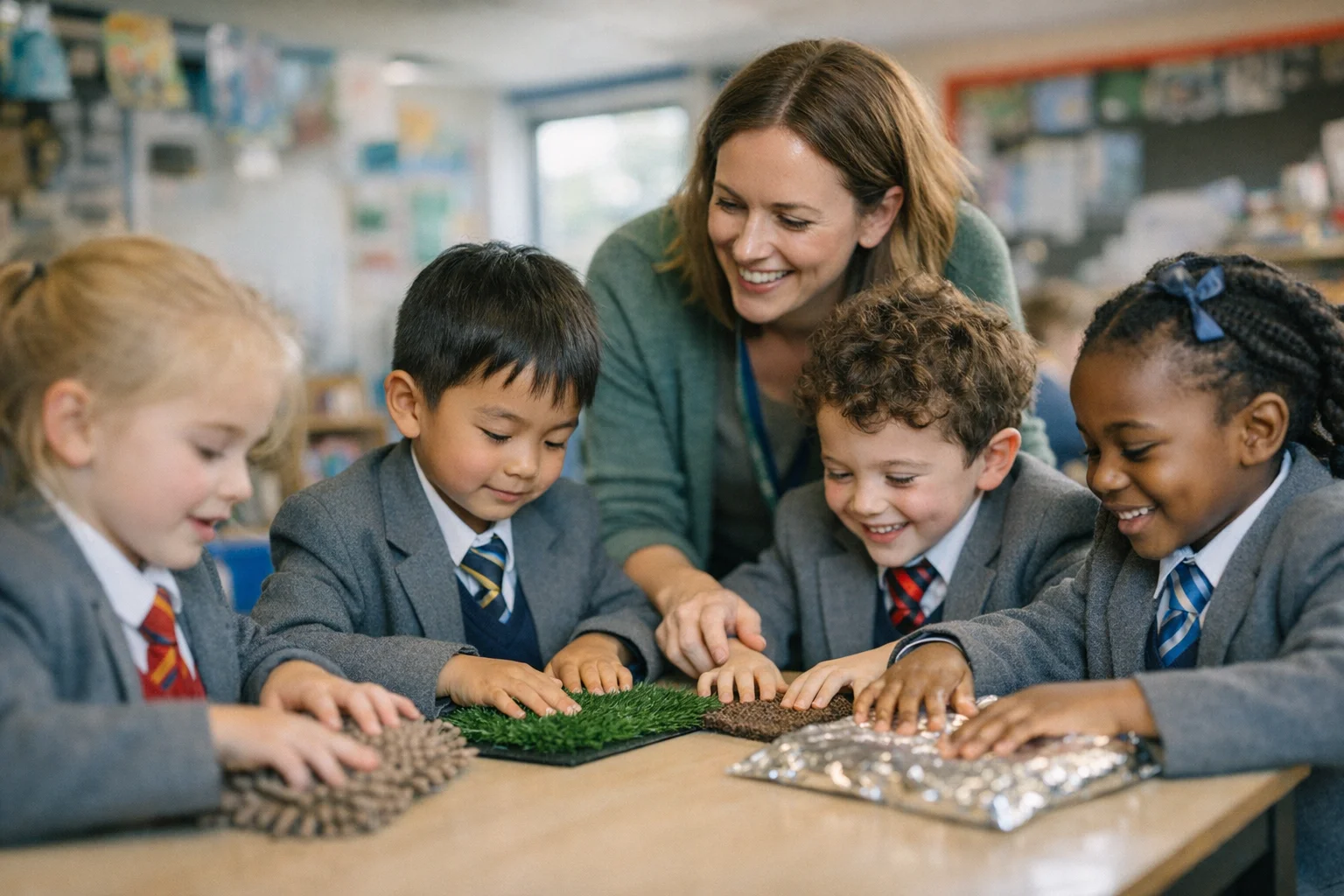
Tactile learning is an approach that engages a learner's sense of touch to explore and understand the world around them. It is grounded in the understanding that sensory experiences are important to cognitive development, particularly in the early years. This learning style involves the direct handling and manipulation of objects, allowing learners to experience concepts with their hands as well as their minds. See also: Hands on learning.
Maria Montessori, an esteemed educator, emphasised, "What the hand does the mind remembers." this points to the intimate link between touch and memory formation. Tactile learning is not limited to young children; it benefits learners of all ages by providing a hands-on, experiential dimension to education. When learners engage with materials through touch, they build connections and understandings that are strong and durable.
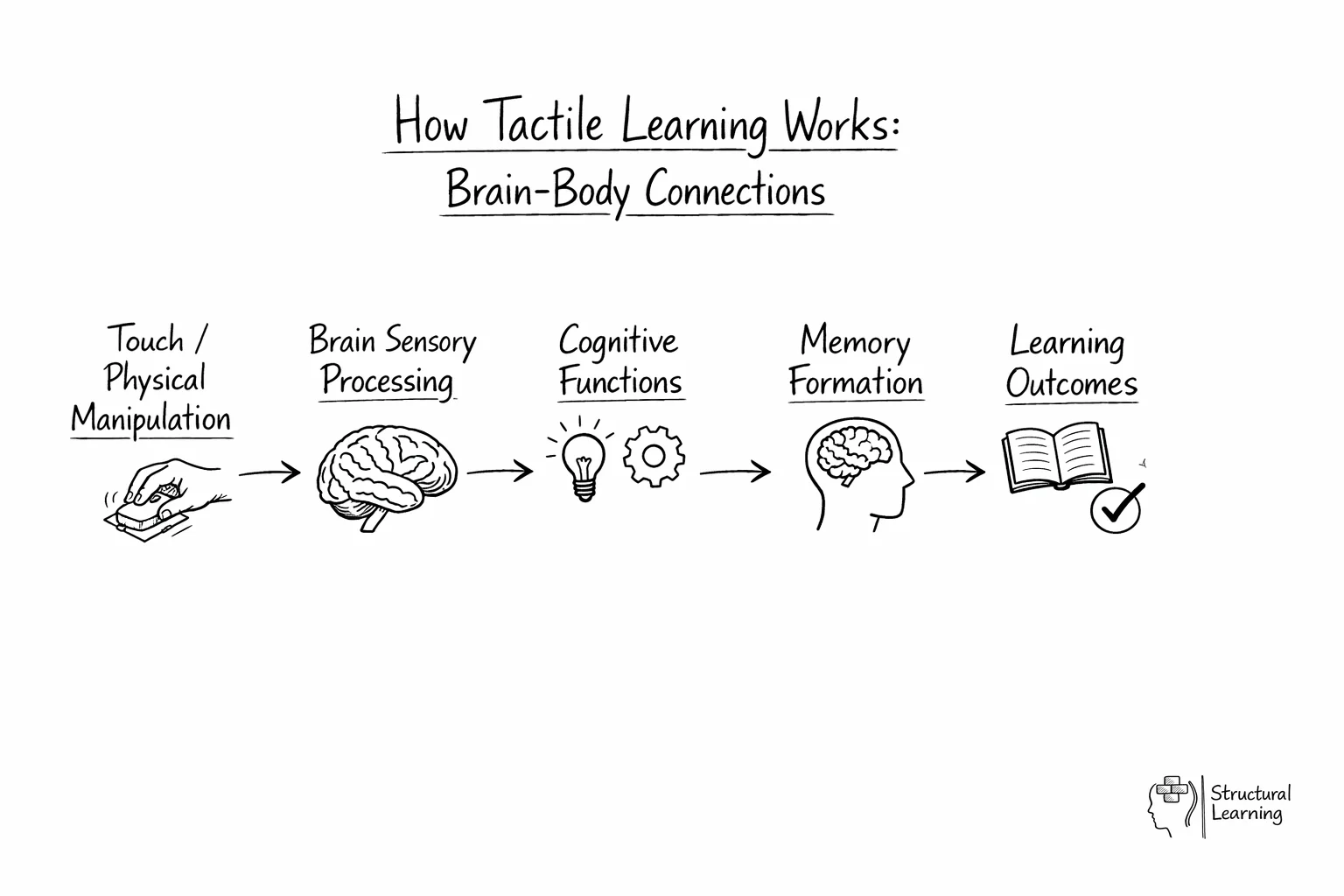
Research shows that learners often understand better when they touch materials. Physical interaction helps turn abstract ideas into real experiences. This process uses sensory skills and can support focus and memory (Lederman, 1987; Kirschner & Karpinski, 2010).
Understanding How Touch Influences Cognitive Development
Tactile experiences stimulate brain areas linked to perception and motor planning (Kontra et al., 2015). In simple terms, touch and movement can help learners notice, plan, and act. This can improve learners' fine motor skills, spatial awareness, and language. For example, manipulating blocks helps learners develop ideas about shape and balance, as well as descriptive language.
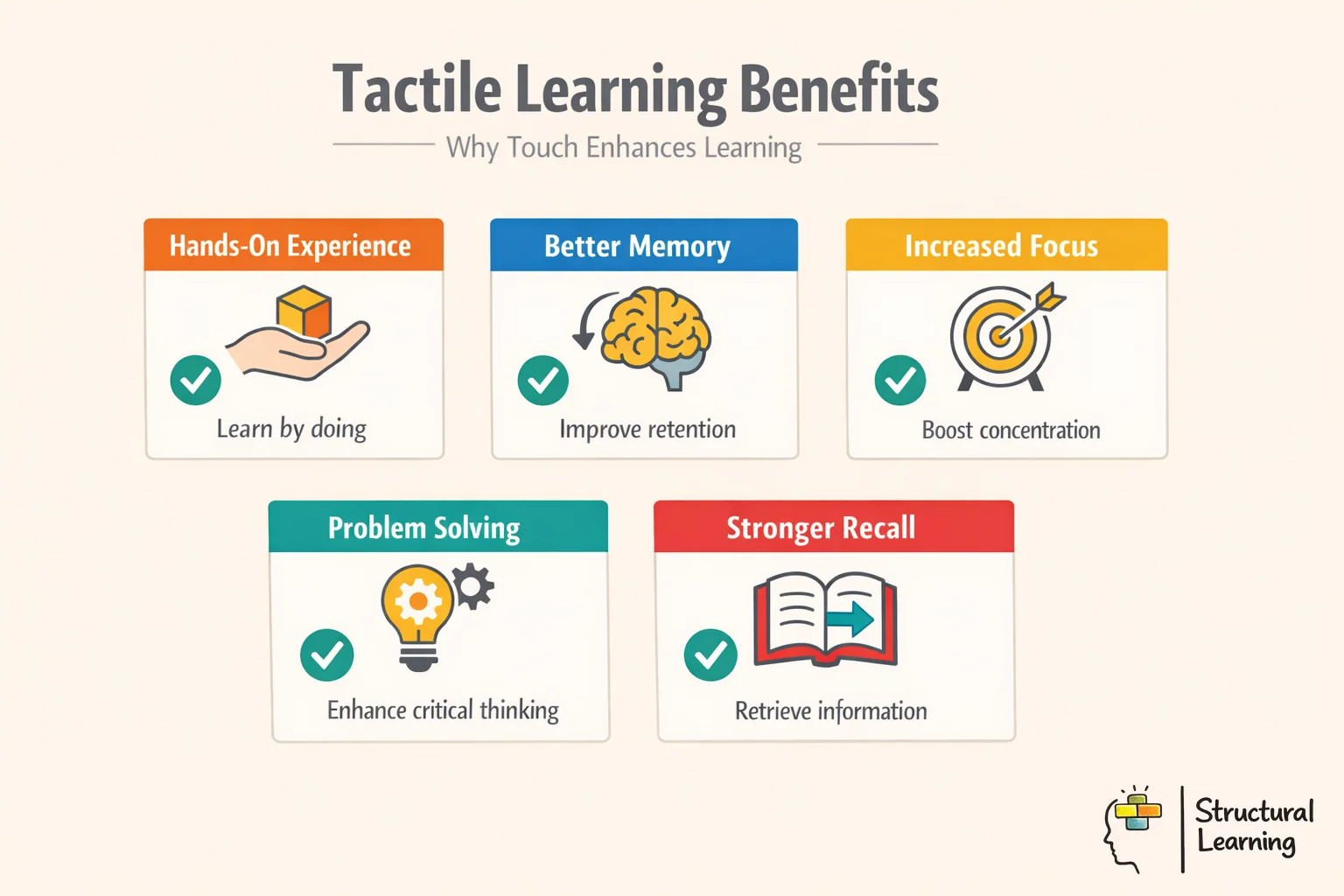
Tactile learning physically supports thinking. It improves learning through touch-based exploration (Bruner, 1966). Teachers can reach different learner styles, as suggested by Dunn and Dunn (1978). It helps tactile learners succeed, building on work by Gardner (1983).
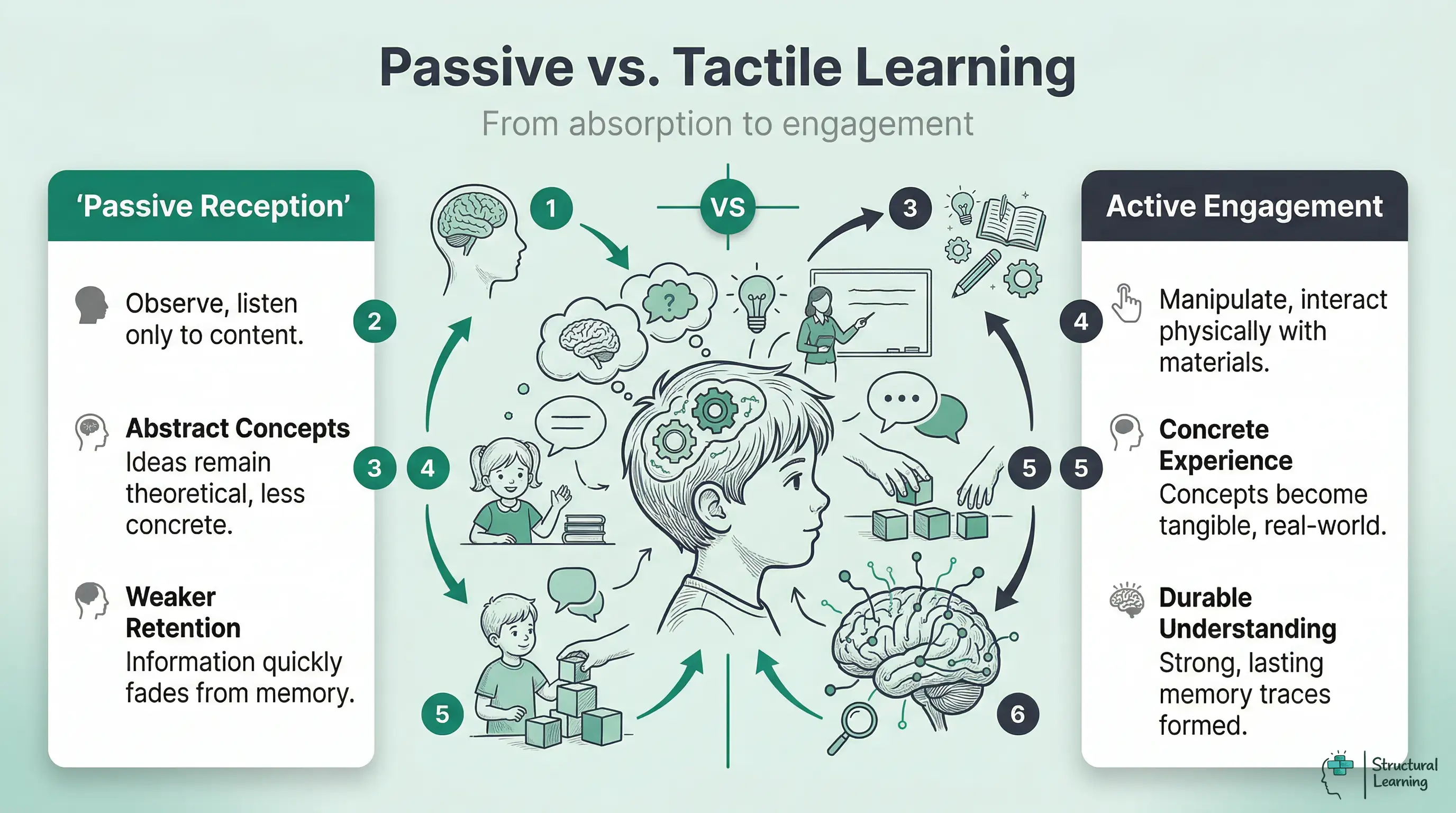
Hands-on education, underpinned by tactile experiences, is a active force in the field of learning. It shifts the focus from passive absorption of information to active learning and discovery. This teaching method creates a deeper engagement with the subject matter, as learners are not mere observers but participants in their learning process.
Research shows that kinesthetic learning can boost achievement. Teachers can use objects in lessons to engage learners. Movement helps learners explore concepts (Vygotsky, 1978). This kind of active learning can support better knowledge retention.
Piaget (1972) found learners understand physics by building models. Vygotsky (1978) showed hands-on work helps learners grasp science ideas. Bruner (1966) proved interactions cement learner knowledge.
Tactile learning helps learners remember things better. Physical activities ask learners to think harder, which can build stronger memories. Active learning improves results (research by e.g., ). However, exact retention rates often lack real evidence.
Thinking is closely linked to what the body does (Wilson, 2002). Embodied cognition and extended mind theory both support this view. Even so, some researchers question learning styles, and warn that categorisation has limits (Coffield et al., 2004).
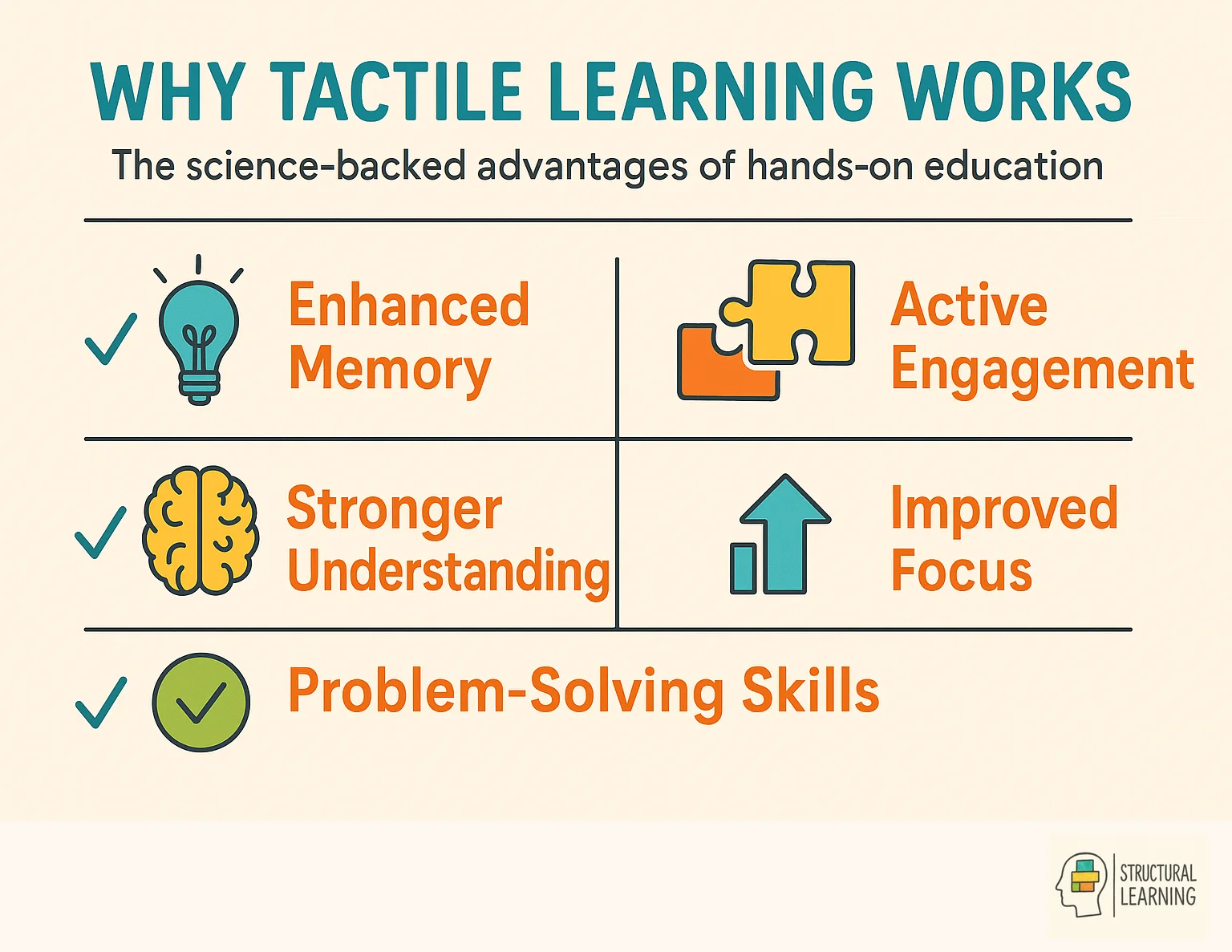
Studies show that hands and minds are connected, which suggests that multisensory learning matters. Labelling learners is not helpful, but teachers can still recognise that sensory experiences benefit them. This supports the use of varied methods that suit human cognition (Fields, 1993; James & Engelhardt, 2010; Lindell & Kidd, 2011).
Dunn and Dunn (1978) suggest using varied senses in learning. Teachers can engage learners through tactile, visual, auditory, and kinesthetic activities. This can create a more inclusive learning environment, noted Pashler et al (2008). Rose and Meyer (2002) agree that this recognises the complex ways learners learn.
Enhancing Engagement and Memory in the Classroom
Tactile learning uses physical activity. Learners take an active role as they handle materials. This can suit varied learning styles (Vygotsky, 1978). It can also help make education better for all learners (Piaget, 1936).
Build It lets learners use their hands to grasp ideas. These practical tasks help learners understand concepts better (Papert, 1980). Construction activities improve a learner's knowledge, according to Ackermann (2006) and Bers (2008).
Manipulatives are hands-on tools that help learners in many subjects. Counting blocks help maths learners understand abstract ideas (Bruner, 1966). These tools make ideas like addition easier to see. They also help learners grasp spatial relationships (Piaget, 1954).
Tactile strategies, like sand tracing, can aid language arts (Suggate, 2010). Textured letters or story maps with pieces help learners (James & Pollard, 2011). These activities use several senses, boosting learning through varied brain routes (Shams & Seitz, 2008). Tactile methods engage learners who struggle (Gunter et al., 2007).
Tactile, or hands-on, strategies help learners understand science. Experiments help learners understand ideas (Piaget, 1970). Building models also helps them learn (Vygotsky, 1978). Physical contact helps learners see cause and effect (Bruner, 1966).
Hands-on learning can support history teaching when learners handle artefacts or models (Bara et al., 2007). Learners can make timeline displays with objects, build historical structures, or use props in role-play.
These approaches help learners connect with history. They support both emotional and intellectual understanding.
Teachers need to plan and prepare carefully when they use tactile learning strategies. They should consider the
Tactile learning needs thought regarding resources and curriculum. Teachers balance hands-on work (Wakefield, 2019) with time and space. Effective planning improves learning for each learner (Bruner, 1966).
Tactile materials at learning stations help learners engage senses. Texture boards and building blocks support subject learning (Piaget, 1936). Regularly change materials to keep learning fresh (Vygotsky, 1978; Bruner, 1966). This supports diverse curriculum topics for all learners (Gardner, 1983).
Tactile learning needs assessment that fits the task. Paper tests may miss what learners gain through practical work. Teachers can use portfolios and demonstrations. Learner explanations can give a fuller view of progress (Hattie, 2012; Black & Wiliam, 1998).
Teachers need professional development to use tactile learning well. Training in tactile principles helps them choose suitable materials and manage the class. Ongoing professional development supports successful use in classrooms (Coffield et al., 2004).
Tactile learning links physical actions to learning. found it boosts memory and focus. You need plans and resources to use tactile learning. It is a good investment for your learners.
Tactile aids can support lessons and help learners remember more (unspecified researchers). Teachers can improve learning by adding tactile experiences (unspecified researchers). This method also helps prepare learners for the modern world (unspecified researchers).
The strongest critique is that tactile learning is often confused with learning styles. Pashler, McDaniel, Rohrer and Bjork (2008) found little evidence for placing learners into fixed visual, auditory or kinesthetic learning styles. They also found little evidence for matching instruction to that label.
This matters because terms such as tactile learners, tactile learner and kinesthetic learners can suggest a stable learner type. The stronger claim is narrower: tactile and kinesthetic modalities can support many learners when the mode fits the content.
A second limit is guidance. Kirschner, Sweller and Clark (2006) argued that discovery tasks with little guidance can overload learners who are new to the topic. This happens because working memory is limited. A practical task in science, mathematics or literacy may look active, but learners may not know which feature matters.
For this reason, worked examples, teacher modelling and clear prompts are part of effective tactile learning. They are not an optional extra.
Third, hands-on work can be narrow in cultural and economic terms. Commercial manipulatives, haptic devices and single-purpose kits often assume Global North levels of classroom budget, storage and buying systems.
Local materials may work just as well if they show the concept accurately and do not distract from it. The method also has research limits, as studies vary by age group, subject, length of intervention and assessment type. For this reason, simple claims about retention need caution.
These critiques do not remove the value of tactile learning. They sharpen it. When teachers link touch, movement and talk to a precise academic aim, the approach remains a durable way to make abstract ideas visible, discussable and testable.
Kirschner, P. (2006). Why minimal guidance during instruction does not work.

Montessori, M. (1912). The Montessori method.
James and Engelhardt (2012) explored handwriting's impact on brain development. Their study in Trends in Neuroscience and Education showed tactile writing helps pre-literate learners.
• Kontra, C., Lyons, D. J., Fischer, S. M., & Beilock, S. L. (2015). Physical experience enhances science learning. Psychological Science, 26(6), 737-749. Research demonstrating how hands-on experiences improve understanding of scientific concepts.
Alibali and Nathan (2012) explored embodiment in maths teaching. They used gestures from learners and teachers as evidence. Their research, published in the Journal of the Learning Sciences, showed movement assists understanding.
• Bara, F., Gentaz, E., & Colé, P. (2007). Haptics in learning to read with children from low socio-economic status families. British Journal of Developmental Psychology, 25(4), 643-663. Evidence for the particular benefits of tactile approaches for disadvantaged pupils.
Wilson (2002) presents six views on embodied cognition in their paper. Wilson's analysis in Psychonomic Bulletin & Review examines embodied learning theory. Tactile experiences support this learning approach, according to Wilson.
Select your subject and age group to see recommended hands-on activities with the materials you need.
Tactile learning refers to an educational approach where learners use their sense of touch to explore and understand new concepts. It is significant because it allows learners to translate abstract ideas into tangible, physical experiences. This direct interaction with materials helps to build mental models that are often more stable than those formed through passive listening.
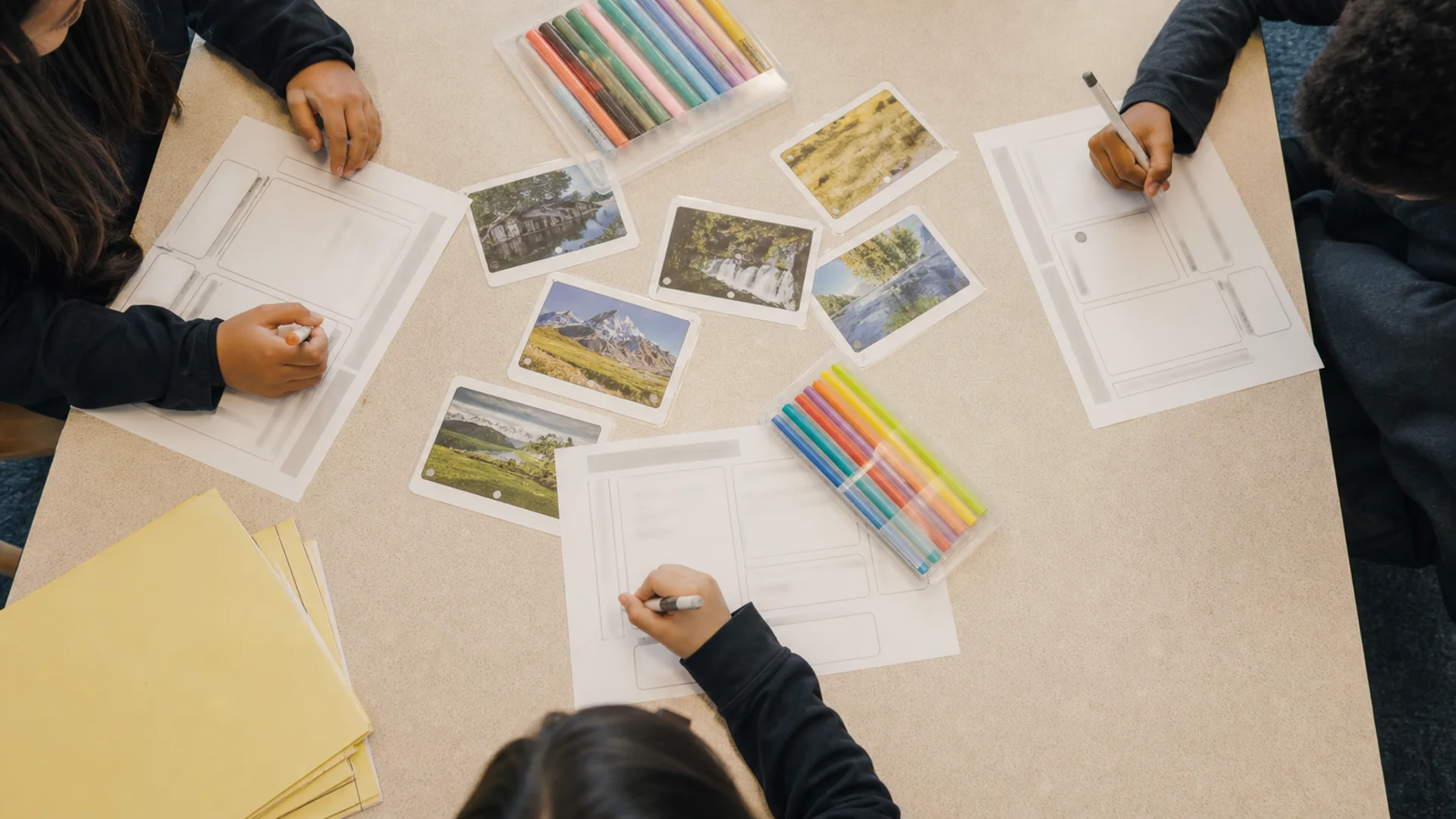
Learners benefit from tactile strategies. Try fraction tiles for maths. Use moveable story maps in literacy. Learners trace textured shapes. Learners build 3D science models. These methods engage learners (Piaget, 1936).
Engaging the sense of touch helps to focus a learner's attention and creates more distinct memory pathways in the brain. When a learner physically manipulates an object, they are creating a multisensory record of the information. This extra layer of sensory data makes it easier for the brain to retrieve the knowledge during future tasks or assessments.
Embodied cognition research shows thinking relies on physical actions. Fixed learning styles are criticised. Multisensory work boosts learner involvement and understanding. Using hands to solve problems lowers mental effort (e.g., Brown et al., 2010).
Teachers often miss linking movement to lesson aims. Tactile tools can be too complex, hindering the learner (Fisher et al., 2019). Ensure materials support learning, not just games (Godwin & Fisher, 2011; Jarus & Henderson, 1996).
Tactile learning helps all learners, no matter their age or needs. Using physical objects benefits secondary learners in maths and science. Touch makes classrooms more inclusive (Jones, 2007; Smith, 2015).
No activities found for this combination yet.
';results.style.display='flex';return;} acts.forEach(function(act){ var card=document.createElement('div'); card.style.cssText='background:white;border:1px solid #b8e0d4;border-radius:10px;padding:16px;'; card.innerHTML='Materials: '+act.materials+'
'+act.desc+'
'; results.appendChild(card); }); results.style.display='flex'; } subj.addEventListener('change',update); age.addEventListener('change',update); });