Updated on
September 24, 2026
Learning Disabilities
Learning disabilities affect how learners acquire and process information. This guide covers UK categories (SpLD, MLD, SLD, PMLD).


Updated on
September 24, 2026
Learning disabilities affect how learners acquire and process information. This guide covers UK categories (SpLD, MLD, SLD, PMLD).
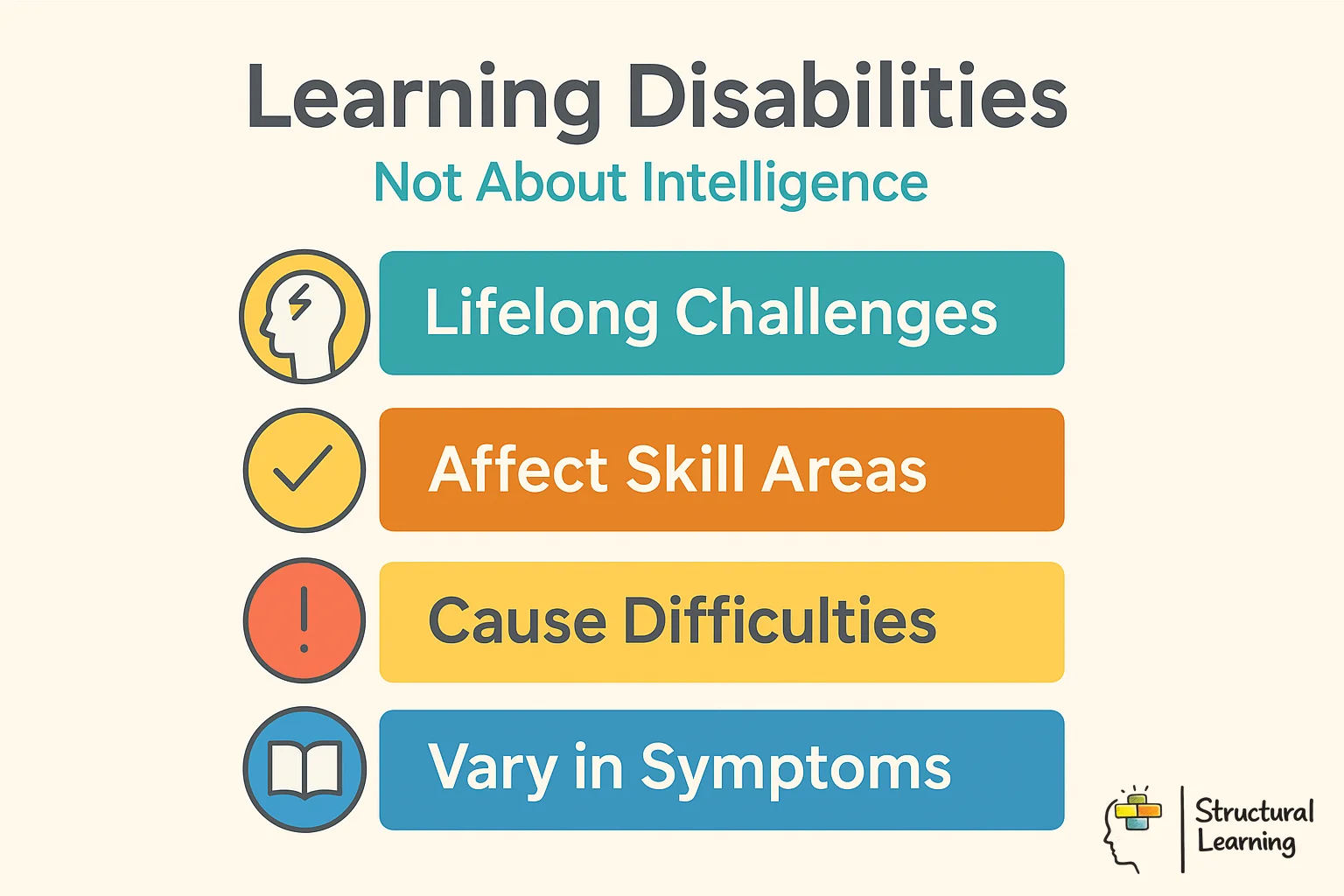
Learning disabilities affect how learners acquire and process information. They do not indicate low intelligence or poor effort. These disabilities reflect brain variations that make learning difficult. UK schools use this term for diverse difficulties, like dyslexia, (Lyon et al., 2003) or PMLD (Frederickson & Cline, 2009), which need intensive support.
Some learners struggle with reading or maths, and others face broader challenges. Identifying special educational needs early helps you support learners well. UK policy separates learning disability and learning difficulty. Learning disability means learners have a reduced ability to understand new information (Royal Mencap Society, 2023).
The SEND system has four learning disability categories. Teachers can use these to better match interventions. A Year 3 teacher might see a learner struggle only with decoding text (SpLD). Another learner may struggle to retain instructions (MLD). (Researchers agree that) These two learners need different support.
SpLD includes dyslexia, dysgraphia, dyscalculia and dyspraxia. Learners show a "spiky profile" (Thomson, 2016), with both strengths and weaknesses. For example, a Year 5 learner with dyscalculia might write well, but struggle with place value (Butterworth, 2010).
SpLD is often missed as learners create workarounds. Learners may memorise words instead of decoding, hiding dyslexia (Frith, 1985) until text becomes harder. Teachers knowing working memory limits (Alloway, 2009) can find these signs sooner (Gathercole & Alloway, 2008).
MLD learners often underachieve in many subjects. Unlike SpLD, their difficulty is general. They may need more time to process instructions. Concrete materials and visuals help them learn. Teachers can differentiate tasks and break down concepts. For instance, in Year 4 science, a teacher could use diagrams (Hodapp et al., 1986) with sentence starters. This helps learners show understanding without lengthy writing.
MLD sometimes overlaps with speech and language difficulties. Learners might struggle to show their knowledge, potentially leading teachers to misjudge their grasp. Assess learners in various ways, like verbal responses, drawings, and practical tasks for a clearer idea.
SLD and PMLD learners need the most support, though they are a smaller group. SLD learners use signs or devices to communicate. They work towards personalised goals (Carpenter et al., 2003) rather than national levels. PMLD learners have complex needs, including severe intellectual disability (Lewis & Norwich, 2005), plus sensory or physical issues (Ware, 2011).
Teachers use intensive interaction (Nind & Hewett, 1994) with learners. They offer objects of reference and sensory environments too. The Engagement Model (Carpenter et al, 2015) measures incremental progress. It assesses exploration, realisation, anticipation, persistence, and initiation, not just attainment (Carpenter, 2020).
See also splds. See also educational access for students with. See also dyslexia assessment and support: what.
Teachers are almost always the first professionals to notice that a learner is struggling differently from their peers. Knowing the common signs across subjects helps you refer at the right time rather than waiting until the gap widens. A reception teacher who notices a child cannot segment sounds after six months of systematic phonics instruction has an important data point. A Year 8 maths teacher who observes a student counting on fingers for single-digit addition has another.
Learners with reading difficulties often struggle with phonics (Lyon et al., 2003). Their reading speed is slower than their classmates, according to Shaywitz et al (2008). Many are reluctant to read aloud and avoid writing (Snowling, 2020). Letter reversals may occur more often than expected (Vellutino et al., 2004). They can spell poorly, even if they know spelling rules (Torgesen, 1998).
For related reading, see moderate learning difficulties.
Geary (2004) found learners struggle with number bonds and recalling times tables, despite practice. They may confuse mathematical symbols and struggle with time or money skills. Butterworth (2010) noted learners also find estimation and assessing answers tricky. Dowker (2004) observed they misunderstand mathematical language like "more than."
Multi-step instructions can be hard for some learners. Poor organisation and inconsistent work are other signs. Slow processing and forgetting tasks are further indicators (Alloway & Alloway, 2009). Social problems and low self-worth are common results of falling behind (Twenge & Campbell, 2003).
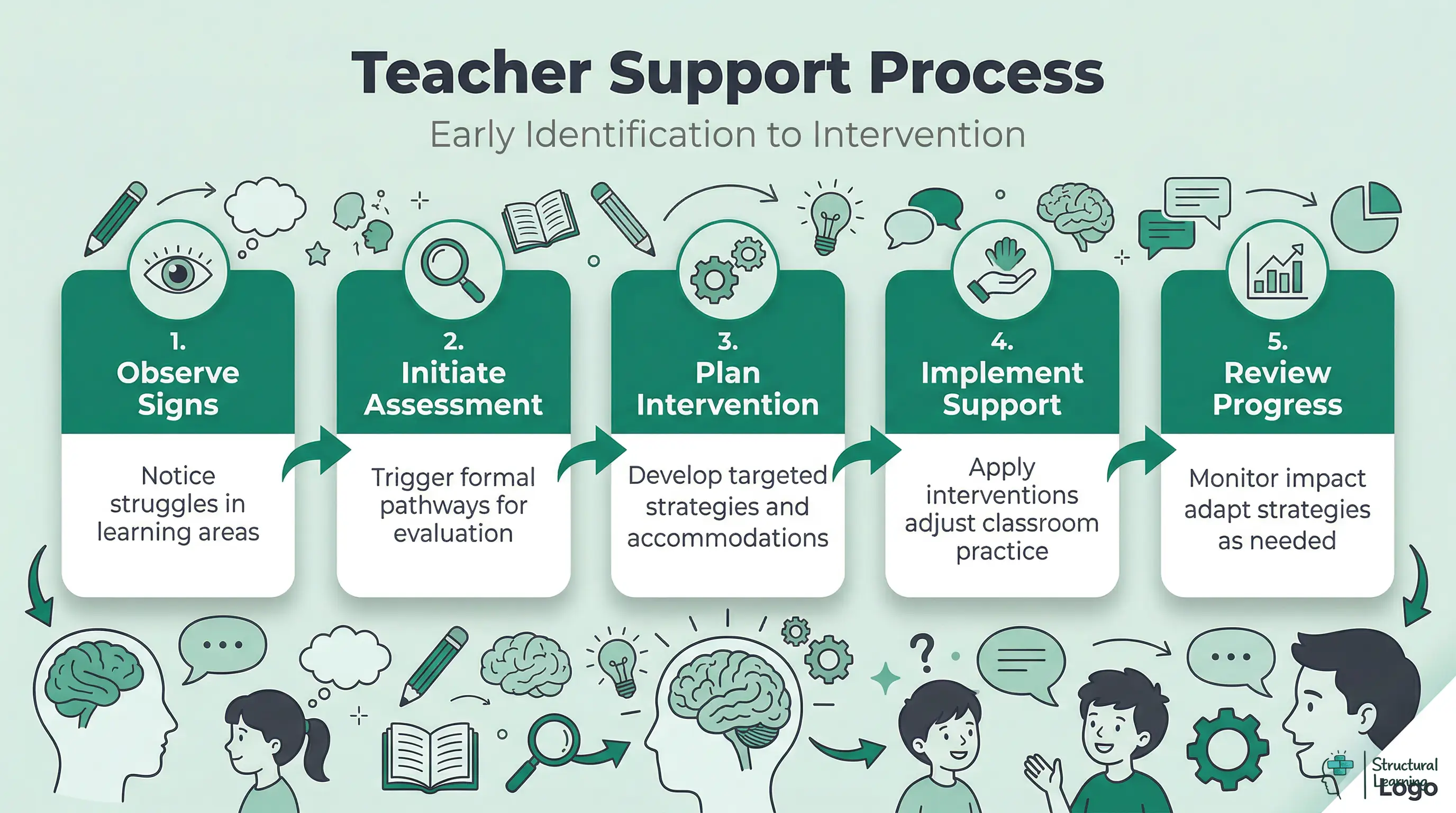
The SEND Code of Practice (2015) guides SEND support in England. It uses "assess, plan, do, review" for learners with disabilities. This cycle makes identification systematic and uses evidence-based support.
| Category | Definition | Prevalence (England) | Typical Support |
|---|---|---|---|
| Specific Learning Difficulty (SpLD) | Difficulty in one or more specific areas (reading, writing, maths) despite average or above-average general ability | ~3.5% of all learners | Targeted intervention, assistive technology, specialist teaching programmes |
| Moderate Learning Difficulty (MLD) | General learning attainment well below age-related expectations across most curriculum areas | ~2.5% of all learners | Differentiated curriculum, small group work, additional adult support, scaffolded tasks |
| Severe Learning Difficulty (SLD) | Significant intellectual disability requiring substantial support for learning and daily living | ~0.4% of all learners | Specialist provision, sensory approaches, communication aids, high staff ratios |
| Profound and Multiple Learning Difficulty (PMLD) | Severe intellectual disability combined with other significant difficulties (sensory, physical, medical) | ~0.1% of all learners | Highly personalised programmes, multisensory stimulation, total communication approaches |
The process typically begins with the class teacher raising a concern, often after Quality First Teaching strategies have been tried and the learner has not made expected progress. The teacher gathers evidence: samples of work, assessment data, observations, and records of any interventions already attempted. This evidence is shared with the school's SENCO, who coordinates the next steps.
SENCOs, teachers, and parents create plans together for learners needing SEN Support. These plans use strategies like small groups or adapted resources. Regularly review progress (e.g., half-termly). If learners don't progress with good support, schools can ask for help from external experts.
Educational psychologists assess learner cognition, attainment, and behaviour. Their reports help decide if a learner needs an Education, Health and Care Plan (EHCP). Parents can request an EHCP assessment; the local authority responds in six weeks.
For related guidance, see emotionally based school avoidance.
Schools use reading tests, like the York Assessment, to check learners' reading accuracy and comprehension. Cognitive tests show differences between a learner's potential and their actual results. Behaviour scales find any conditions, like ADHD, that happen alongside learning issues. The B Squared framework tracks learners working below National Curriculum levels.
Effective support requires matching strategies to the specific profile of each learner rather than applying a one-size-fits-all approach. A learner with dyslexia needs different adjustments from a learner with MLD, even though both may struggle with reading. The strategies below provide a starting point for classroom teachers.
For learners with dyslexia, use structured, multi-sensory phonics programmes (such as Sounds-Write or Read Write Inc.), provide text on coloured paper or with coloured overlays if the learner finds this helpful, allow extra time for reading tasks, and teach explicit comprehension strategies. In a Year 3 reading lesson, the teacher might pre-teach vocabulary before the class reads a new text, give the dyslexic learner a copy with wider line spacing, and pair them with a reading buddy for alternate-paragraph reading.
Concrete-pictorial-abstract methods aid learners with dyscalculia (Numicon, Dienes blocks, bar models). Number lines and multiplication grids help learners. Teach one method per operation. Link maths to real life scenarios. For dysgraphia, use speech-to-text or mind maps. Teach letter formation via multi sensory activities.
Research supports pre-teaching vocabulary to learners with MLD. Break tasks down, structure thinking with organisers, and use worked examples. Immediate feedback helps; think timelines and word banks (Year 6 Tudors).
Routines support learners. Hodapp (2017) found visual timetables ease transitions. Kasari et al. (2016) noted clear instructions reduce worry. Clear instructions encourage learner independence too.
SLD and PMLD teaching uses sensory activities and repeated practice. Staff use total communication, combining speech, signs and symbols. Intensive interaction, described by Hewett and Nind (1998), builds communication. Multi-sensory storytelling engages learners. Progress tracks personal outcomes, as noted by Lacey and Ouvry (1998).
Teachers must identify and support learners with learning disabilities under current law. Three Acts form the legal foundation, helping teachers in their daily practice.
The Code of Practice provides statutory guidance for schools, local authorities, and health services. It establishes the graduated approach (assess, plan, do, review), requires schools to appoint a SENCO with relevant qualifications, sets out the EHCP process, and places the voice of the child and parent at the centre of decision-making. All mainstream schools must have regard to this Code when making provision for learners with SEND.
The Equality Act protects learners with disabilities; schools must make reasonable adjustments. A learning disability qualifies if it notably affects daily life. Adjustments involve more time on tests or changed resources. Schools must treat disabled learners equitably under the Act (Equality Act).
The 2014 Act reformed SEND, replacing Statements with EHCPs for learners aged 0-25. It introduced the Local Offer, detailing area services. Parents gained stronger rights to request personal budgets. The Act created a mediation system for resolving provision disagreements.
Learning disabilities are common. In England, 14.6% of learners have SEND, including cognition and learning needs. Global estimates suggest 5 to 15% may have a learning disability. Dyslexia is the most common specific learning difficulty (5 to 10%).
The prevalence figures are likely low due to assessment access and cultural views. Some learners, especially girls, mask milder learning disabilities, so schools miss them. Teachers increasing their awareness of different presentations would help (Wearmouth, 2005). Training helps identify these learners (Norwich & Kelly, 2005; Farrell, Dyson & Bennett, 2006).
Learners with learning disabilities often struggle outside lessons. Mental health and friendships can be challenging. Research suggests unidentified learning disabilities are linked to anxiety and behaviour problems.
The social impact is significant. Learners who cannot keep up with classroom tasks may avoid group work, withdraw from peer interactions, or develop challenging behaviour as a coping mechanism. In secondary schools, the gap between a learner's ability and the demands of the curriculum can widen rapidly, leading to disengagement and, in some cases, school refusal.
Adults with unmet learning needs may struggle at work and with finances. Proper support helps many learners with disabilities build careers and live well. Early action remains the best way to ensure positive futures (Stanovich, 1986; Shaywitz, 2003).
Research suggests that combining class strategies and individual changes helps learners with disabilities. Good teachers plan for accessibility from the start, not after a learner finds things difficult.
Clear instructions help all learners (Hattie, 2017). Use visuals with your explanations. Check learners understand regularly (Wiliam, 2011). Consistent routines help too (Lemov, 2015). These strategies, known as Quality First Teaching, lower barriers before they appear (EEF, 2021). They are key to a graduated approach.
Learners needing more support may benefit from individual or small group interventions. These interventions should be brief, proven, and monitored closely. Trained staff deliver them. The SENCO organises this with teachers and external experts. Work with parents: share effective strategies for use at home to speed up learner progress.
Choose one learner in your class whose learning profile puzzles you. Spend a week collecting specific evidence: which tasks they find easy, where they struggle, how they respond to different types of support. Share your observations with your SENCO and discuss whether the graduated response cycle needs to begin or adjust. That single conversation is often the starting point for meaningful change.

Kirk (1962) and Hallahan & Kauffman (2006) studied learning difficulties. These impact specific areas like dyslexia; general intelligence remains average. The DCSF (2007) found learners with disabilities struggle to understand and learn. This difference affects the support and legal rights learners get (DfE, 2015).
Teachers can support these learners by breaking complex tasks into smaller steps and using concrete resources to represent abstract ideas. Providing visual prompts, sentence starters, and partially completed diagrams helps to reduce the cognitive load during lessons. It is also effective to allow extra processing time for instructions and to use multiple methods for learners to demonstrate their knowledge.
Schools can quickly help learners with early identification. Targeted help prevents learners falling behind (Equality Act 2010). Research shows timely support improves learning outcomes and avoids social or emotional problems.
According to research, using sight, sound, and touch aids memory. This benefits learners with different needs. For dyslexia, it gives other ways to learn phonics and spelling. Research shows lessons become easier. Learners build stronger understanding of concepts.
Do not assume low ability if a learner struggles. Instead, consider specific difficulties like reading (Rose, 2009). Simplify work less; scaffold it more to keep expectations high (Vygotsky, 1978). Varied teaching prevents excluding learners who process information differently (Gardner, 1983).
The SEND Code of Practice 2015, Equality Act 2010, and Children and Families Act 2014 set out duties for schools. These laws say schools must identify, assess, and support learners. Schools must make reasonable adjustments so learners with disabilities can access learning equally. Teachers benefit from understanding these legal responsibilities.
The following studies offer evidence-based guidance on identifying and supporting learners with learning disabilities.
Dyslexia impacts learners' literacy. Fawcett and Nicolson (2007) researched ways to spot it. Turner et al. (2009) discussed strong teaching practices. Rack, Snowling, and Olson (1992) found what predicts reading problems.
Rose, J. (2009)
The Rose Review is key for UK dyslexia identification. It defined dyslexia in English schools. Rose recommended systematic synthetic phonics first (Rose, 2009). This supports learners best (Rose, 2009).
Annual Research Review: Reading disorders revisited
300+ citations
Snowling, M. J. & Hulme, C. (2021)
Researchers show oral language links to reading issues. They propose dyslexia sits on a spectrum with language disorder (Snowling, 2000; Hulme & Snowling, 2016). This finding should shape how schools assess and support every learner (Catts, Fey, Tomblin, & Zhang, 2002).
Understanding neurocognitive developmental disorders can improve education for all
200+ citations
Butterworth, B. & Kovas, Y. (2013)
Butterworth and Kovas argue that understanding how dyscalculia and dyslexia affect the brain can inform teaching practice for all learners, not just those with diagnosed conditions. The paper makes a strong case for neuroscience-informed pedagogy.
Learning disabilities: From identification to intervention
2,000+ citations
Fletcher, J. M., Lyon, G. R., Fuchs, L. S. & Barnes, M. A. (2019)
Gresham (2017) explains how to spot learning disabilities using response-to-intervention. This method works better than IQ tests. Fletcher and Vaughn (2009) offer key reading for SENCOs and psychologists, too.
SEND Code of Practice: 0 to 25 years
UK statutory guidance
Department for Education (2015)
The statutory guidance that underpins all SEND provision in English schools. Every teacher should be familiar with sections 5 (early years), 6 (schools), and 9 (education, health and care needs assessments and plans).