Updated on
September 2, 2026
12 Cognitive Biases That Affect Learning, With Classroom Examples
What cognitive bias means, 12 worked examples from lessons and marking, and the checks that reduce their effect on how teachers assess learners.


Updated on
September 2, 2026
What cognitive bias means, 12 worked examples from lessons and marking, and the checks that reduce their effect on how teachers assess learners.
A cognitive bias is a systematic pattern in judgement that moves a decision away from its stated goal or standard. In education, it may affect how evidence is selected, how learner work is read or how a school decision is reviewed. A bias is not a diagnosis, and a fast judgement is not always wrong. Teachers improve decisions by setting clear rules, checking other views, using evidence over time and reviewing results. They do not need to guess which hidden bias is inside a person.
The practical question is not, “Who is biased?” It is, “What evidence, criterion or alternative account may this decision be missing?” That question works for a learner checking a claim, a teacher marking work, a SENCO reviewing support and a leader deciding whether to continue a programme.
Tversky and Kahneman (1974) helped build the modern field. A 2025 review then tested education more directly. It found 54 randomised trials with 10,941 people. Training had a small mean effect, so schools need practice and fair systems as well as awareness.
In one sentence: use bias research to strengthen a decision process, never to dismiss a person or explain them from a distance.
In this guide
A cognitive bias is a repeatable pattern in thinking or judgement that departs from a relevant standard. The standard matters. In one task it may be probability theory. In another it may be a marking criterion, a factual prediction or a decision rule agreed before the outcome was known.
Without a goal or standard, “biased” can become a loose word for “different from me”. That is not a sound use of the concept.
Tversky and Kahneman's classic work examined judgements under uncertainty. Participants often used limited cues such as similarity, ease of recall or an initial value. These strategies could be efficient, yet they also produced predictable departures from normative answers in particular tasks. Their 1974 paper helped establish the heuristics-and-biases research programme.
A heuristic is a simple strategy or cue. It can give a quick, useful answer. A bias is the systematic pattern of deviation found when the strategy, information or motivation does not fit the judgement goal. Fast thinking is therefore not a synonym for faulty thinking.
The same boundary applies to school decisions. A teacher may use a learner's recent work as a quick guide because it is available. That judgement may be accurate. The concern arises when the decision is meant to describe attainment over a term but the recent sample displaces stronger, broader evidence.
Nadurak's 2025 analysis defines cognitive bias around a knowledge goal and the use of information that does not fit that goal. Other scholars use broader definitions. No one definition settles every debate. A practical test is to name the goal, name the evidence that should matter and check whether another cue keeps moving the judgement.
Cognitive bias is also not evidence of low intelligence or poor character. West, Meserve and Stanovich found that cognitive sophistication did not remove the bias blind spot. People can know a great deal about reasoning and still see bias more readily in others than themselves.
This is why a school needs fair processes as well as good intentions.
Several terms are often collapsed into “bias”. They ask different questions and need different responses. A learner's wrong answer may be a simple knowledge gap. A distressed thought may belong in a clinical framework.
Discrimination concerns unequal treatment and social power. A logical fallacy concerns an invalid argument. Naming a cognitive bias does not prove any of these things.
Swipe sideways to compare all columns.
| Term | Core question | School example | Safe response |
|---|---|---|---|
| Heuristic | What simple cue or strategy made the judgement manageable? | Using the most recent assessment as an early indication | Check whether the cue fits the decision and evidence window |
| Cognitive bias | Is a cue or process producing a systematic deviation from the stated goal? | Recent incidents repeatedly outweigh the full behaviour record | Compare the judgement with the agreed evidence and an alternative account |
| Ordinary error | Was this an isolated mistake, missing fact or slip? | A learner misreads one item | Check knowledge and conditions before inferring a pattern |
| Cognitive distortion | Is a clinical or therapeutic framework relevant to a distressing pattern of thought? | Not established by one negative statement | Use appropriate pastoral or clinical routes, not a classroom label |
| Implicit or social bias | Do attitudes, stereotypes or structures create unequal treatment? | Marks differ by social category after relevant attainment is considered | Investigate outcomes, process and context; do not reduce inequality to one person's cognition |
| Logical fallacy | Does the conclusion follow from the premises? | Rejecting a claim only because of who said it | Evaluate the argument and source separately |
The distinction from cognitive distortions is particularly important for teachers and SENCOs. A cognitive-bias article is not a mental-health assessment. Anxiety, low mood, trauma, communication difference and distress require their own evidence and support.
The distinction from dual-process theory also matters. Some dual-process accounts contrast fast, intuitive processing with slower, reflective processing. Slow thought can still be poorly informed or motivated, while skilled fast judgement can be accurate. “Slow down” is not a complete debiasing plan.
Observation boundary: a teacher can observe the information used, the reason given and the decision made. A teacher cannot observe a hidden cognitive bias directly. Treat the label as a hypothesis about the process, then test it.
The following twelve patterns are useful because each changes a practical check. They are not a checklist for labelling learners or staff. One decision may fit several descriptions, and the most familiar label may not be the best explanation.
Swipe sideways to compare all columns.
| Pattern | Education example | Evidence to inspect | Structural safeguard |
|---|---|---|---|
| 1. Anchoring | An early predicted grade shapes later marking | Work against criteria without the prior grade visible | Set criteria first; blind identity or prior scores where valid |
| 2. Availability | A vivid recent incident outweighs a term of records | Frequency, duration and context across the full review period | Use a sampling window and written record |
| 3. Confirmation bias | Evidence that fits an initial view of a learner is noticed more readily | Cases that support and cases that challenge the view | Write one disconfirming prediction before reviewing the file |
| 4. Hindsight bias | After a lesson fails, the problem feels as if it should have been obvious | The plan, information and uncertainty known beforehand | Record predictions and risks before the outcome |
| 5. Outcome bias | A good result makes a weak decision process look sound | Decision quality using only information available at the time | Review process and outcome separately |
| 6. Halo or horns effect | One broad impression colours ratings of distinct qualities | Evidence for each criterion independently | Mark one criterion across all work before moving to the next |
| 7. Fundamental attribution error | Incomplete work is explained by effort or character while task and access factors are missed | Instruction, prior knowledge, language, sensory, motor, health and situational evidence | Require at least one learning and one situational account |
| 8. Planning fallacy | A curriculum or intervention plan assumes an unrealistically short timeline | Comparable projects, capacity, dependencies and previous delays | Use reference cases, milestones and contingency time |
| 9. Sunk-cost effect | A weak programme continues mainly because the school has invested in it | Future benefit, cost, transition risk and alternatives | Set review dates and stopping rules before implementation |
| 10. Bias blind spot | A team finds bias in another department but assumes its own decisions are objective | Whether the same audit rule is applied to self and others | Use independent moderation and shared criteria |
| 11. Overconfidence or miscalibration | A learner or adult gives more certainty than the evidence warrants | Confidence alongside later accuracy over several tasks | Use probability ranges, feedback and repeated calibration |
| 12. Representativeness and base-rate neglect | A case that looks like a familiar profile outweighs how common each explanation is | Individual evidence plus relevant prevalence and alternatives | Check base rates without allowing them to erase the individual case |
Anchoring, availability and representativeness come from classic judgement-under-uncertainty research. Confirmation bias has a much wider literature. Hindsight, outcome, attribution, planning and sunk-cost effects were developed in different experimental traditions. Grouping them is useful for a school guide, but it does not mean they share one mechanism.
The safeguards also have limits. Anonymous marking can reduce access to irrelevant identity cues, but it may remove relevant context or be impossible for practical work. Base rates can improve a probability judgement, but they must not be used to deny an individual assessment. Moderation can add another view, but a group can share the same weak assumption.
The aim is to create a better test of the judgement.
Cognitive-bias examples in education usually mix two jobs. One is teaching learners how evidence and probability work. The other is improving adult judgements about attainment, behaviour, support and policy. These jobs need different evidence.
For learner reasoning, the teacher can design a task with a clear rule. A probability task can show whether an answer uses a base rate. A source task can show whether the same check is used for evidence on both sides.
The result concerns work on that task. It does not reveal a stable “biased learner”.
For teacher judgement, accuracy is more complex. Teachers combine attainment, participation, context and professional knowledge across time. Machts and colleagues found that teacher judgements of cognitive abilities were moderately accurate on average, with variation by construct and context. Urhahne and Wijnia's review also treats teacher judgement as a competence that can be studied and improved.
This matters because a crude “teachers are biased” message is neither accurate nor useful. Professional judgement is necessary. The right question is which information should count for this decision, how it was sampled, and what independent check is proportionate.
In formative assessment, the decision is usually what to teach next. A quick judgement can be useful because action is reversible and feedback arrives soon. In a high-stakes grade, placement or referral, the cost of error is larger. The evidence window, moderation and written rationale should be stronger.
Discrimination and cognitive bias overlap but are not the same. Zanga and De Gioannis found that many school-grading studies reported gaps linked to social groups. Some did not, and the methods had limits.
Ferman and Fontes found that classroom behaviour affected some scores in a Brazilian high-stakes setting. These findings support fair checks and review. They do not prove prejudice in one case.
Clear criteria can help. Peter, Karst and Bonefeld found that set criteria reduced the effect of details that should not have shaped a grading task. A rubric still needs sound criteria, examples and moderation. A precise score for the wrong thing is not a fair score.
Assessment decisions can affect grades, grouping, curriculum access and expectations. SEND decisions can affect support, referral and a learner's explanation of their own needs. Leadership decisions can affect workload and opportunity across a school. The more consequential the decision, the less a school should rely on one impression, one score or one meeting.
For assessment, separate the constructs being judged. Accuracy, organisation, subject knowledge, oral fluency and behaviour are not one quality. If behaviour is not part of the attainment construct, do not let it enter the score indirectly. Marking one criterion at a time and using exemplars can reduce halo effects, but the school should still sample marker agreement.
For SEND, start with the concern and the learner's access to the task. A view such as “this is confirmation bias” cannot replace assessment. Check prior teaching, communication, language, attendance, sensory and motor access, health information, learner voice and family knowledge. Preserve the ordinary assess, plan, do and review route.
A SENCO may also need to challenge base-rate errors in both directions. A common need should not be assumed from a familiar profile, and a less common need should not be ruled out merely because it is uncommon. Base rates inform probability. Individual evidence determines what should be assessed and supported.
For school leadership, write the success criteria and stop rule before a programme begins. That makes it easier to distinguish a reasonable implementation period from sunk-cost continuation. Review intended benefits, harms, workload, subgroup outcomes and alternatives. A disappointing result may reflect design, implementation or context rather than staff resistance.
Safeguarding first: if a learner discloses harm or a credible safeguarding concern appears, follow the school's safeguarding procedure. Do not delay action while testing a cognitive-bias hypothesis. Judgement review can happen alongside, never instead of, the required response.
Inclusive decision-making also needs inclusive education principles. Reasonable adjustments, accessible communication and participation are evidence conditions. If a learner could not show what they know, the resulting judgement is not made fair by a sophisticated bias label.
Teaching about cognitive biases can help, but the average effect is not a transformation. Swaryandini and colleagues' 2025 systematic review included 54 randomised controlled trials with 10,941 participants. The meta-analysis used 41 studies and found a small average reduction on measured bias tasks, g=.26.
The result supports careful teaching. It also sets a limit. Effects varied by the bias and the course. The authors called for more proof about use in real life.
A lower error rate on a training task does not always mean fairer grades, better SEND decisions or better choices months later.
Some focused interventions have produced stronger effects. Morewedge and colleagues tested an interactive game and an instructional video aimed at six biases. Performance improved on targeted tasks and some effects remained after delay. This is evidence that training can work under specified conditions, not that a short bias presentation makes a staff team objective.
Older reviews explain why transfer is difficult. Lilienfeld, Ammirati and Landfield noted that psychology had documented many errors but less often shown how to correct them in daily life. Biases differ, motives matter, and a person may fail to notice that the strategy is relevant in a new context.
Awareness alone can also create a trap. The bias blind spot makes it easier to use a new label on other people than on our own judgement. A good lesson therefore asks learners to solve a task, explain the standard, receive feedback and try a new case. A good staff process makes the evidence rule symmetrical across teams.
Metacognition can support monitoring and revision, but reflection needs an external check. “I considered my bias” is not evidence that the result is sound. Pair reflection with criteria, records, comparison cases, outcome data or independent review.
The most defensible approach combines three levels:
Knowledge helps a person notice a risk. Practice develops a usable response. Structure reduces reliance on perfect self-awareness.
This six-stage sequence can be used for a mark, behaviour review, SEND concern, intervention decision or policy choice. It starts with the decision, not the bias label. It asks what must be decided, what facts should count and which other account needs a fair test.
Start with three short questions. “What must we decide?” “What should a sound choice achieve?” “Which facts should count?” Write the answers before one vivid event or strong first view takes over.
For a mark, ask, “Which rule does this part of the work meet?” Then ask, “Which rule does it not meet?” Point to the work. Do not point to the learner's past grade, conduct or style unless that is part of the task.
For a learner concern, ask, “What did we see or hear?” Keep that note apart from the first account of why it took place. Add a learning cause, an access cause and a setting cause that could fit the same facts. Decide what new check could tell them apart.
For SEND, ask whether the learner could see, hear, move, speak, read or write in the way the task required. Ask what support was in place. Keep assessment, health, pastoral and safeguarding routes open while the team checks its view.
For a team review, ask, “What did we think before we knew the result?” Read the old plan. A bad result can teach the team a lot, but it does not make each past choice look foolish. A good result does not make each past choice sound.
Test your first view with one hard question: “What would I expect to see if this view were wrong?” Find a case that could answer it. Ask a colleague to use the same rule without first telling them your answer.
Record the gap if the two views differ. Do not force a quick match. The gap may show that the rule is vague, the work is hard to score or one person had key facts that the other did not have.
End with a choice, reason and date. State how sure the team is. Name the person who will act and the sign that will lead to a new review.
The sequence resembles good cognition and learning practice because it makes information use visible. It is not a score that declares a person unbiased. A judgement may remain uncertain after a fair process.
For a low-stakes lesson decision, the sequence may take two minutes. For a high-stakes placement or school programme, it may require several sources, documented moderation and a later outcome review. Proportionality matters.
School bias checks work best when they change the evidence process. In the primary case, a recent event is weighed against a longer record. In secondary marking, an early grade is hidden. In leadership, future benefit is kept apart from past cost. None of the cases uses a bias label to explain a person.
A teacher is considering whether a learner's peer difficulties have grown. Yesterday's incident is vivid and serious. Availability is one possible risk, but the incident may also be important.
The teacher follows the behaviour and safeguarding policy first. For the wider review, she checks the agreed period, settings, what took place before, learner voice, communication access and staff records. She keeps frequency apart from severity. The final plan can give yesterday's event due weight without letting it replace the rest of the evidence.
A history teacher has seen a predicted grade before marking an essay. That number may anchor the judgement. It may also be a reasonable summary of prior work. The question is whether the current essay is being judged against its criteria.
The department samples essays with names and predicted grades hidden, marks one criterion at a time and compares the result with the original mark. Disagreement leads to criterion clarification and exemplification. The exercise tests the process; it does not accuse the first marker.
A school has invested training time and money in a programme. Early outcomes are weak. Ending it immediately could waste implementation learning, while continuing only because of past investment would be a sunk-cost error.
Leaders return to the pre-agreed goal, minimum implementation conditions, workload and stop rule. They consider future costs and benefits, transition risks and credible alternatives. They set one bounded improvement period with a review date. Past cost is recorded for accountability but does not count as a future benefit.
These examples show why social identity and power sometimes matter. A judgement can affect belonging, status and opportunity. Cognitive-bias language should never make a structural inequality look like a private flaw in one mind.
Bias review is only as good as the evidence available. If a task is not accessible, the judgement may reflect the barrier rather than the learner's knowledge. If a family or learner could not communicate in a usable form, their absence from the record is not neutral.
For SEND, check whether the learner had the communication route, processing time, sensory conditions, motor access and prior teaching needed to participate. A profile may guide questions, but it should not decide the answer in advance. Do not use representativeness to diagnose, and do not use base rates to refuse an individual assessment.
For EAL, separate language demand from the target construct. A concise oral response, written response, drawing or first-language explanation may provide different evidence. An unfamiliar idiom can look like a reasoning error. Check meaning before assigning a thinking pattern.
Culture influences experience, language, trust and which evidence feels credible. It does not give a teacher a script for how an individual will think. Apply the same source and reasoning questions across viewpoints, while recognising that access to institutions and the consequences of error are not equal.
Identity information can be relevant or irrelevant depending on the decision. It may be irrelevant to marking a de-identified answer but essential when auditing unequal outcomes or planning a reasonable adjustment. “Blind everything” is not a universal rule. Decide what the construct requires.
Learner and family voice is evidence, not a courtesy after the decision. Record their account with care, note what is agreed or disputed, and state what further check could help. A disagreement with school staff does not prove confirmation bias, denial or lack of insight.
Safeguarding has a separate threshold and duty. Act on disclosures and concerns through the designated route. A cognitive-bias review may improve later case discussion, but it must not become a reason to delay, minimise or investigate outside the policy.
Cognitive-bias research is large, but the category is not one mechanism. Definitions overlap, named effects come from different theories, and some labels describe the result more clearly than the process. A familiar name can create false explanatory confidence.
Much foundational evidence comes from adult laboratory tasks. Those tasks are valuable because they provide a clear standard and controlled comparison. They do not show how often the same process determines a real classroom decision, where evidence, goals and consequences are more complex.
Measurement is another limit. A discrepancy may come from bias, random error, an invalid criterion, missing information or a real contextual difference. Teacher and test judgements can each contain error. Ofqual's review makes an important point: divergence is not incontrovertible proof of bias.
Intervention evidence also varies by task. The 2025 education meta-analysis supports a small average benefit, not universal correction. A bias may be reduced on the trained measure but return in another context. Long-term school outcomes and transfer remain less certain.
Finally, cognitive bias is not a complete account of discrimination. Rules, curricula, opportunity, resources and institutional practice shape outcomes even when no individual intends harm. Schools should review patterns and structures as well as individual decisions.
The defensible conclusion is practical. Use bias research to ask better questions about evidence. Keep professional judgement, but make its criteria and uncertainty visible. Use safeguards in proportion to the consequence of the decision.
The one-page study note separates heuristic, bias and related terms. It substitutes framing for representativeness, showing how the same evidence checks apply across a broader set of patterns. The two-page record helps staff document evidence, access, alternatives, decisions and review.
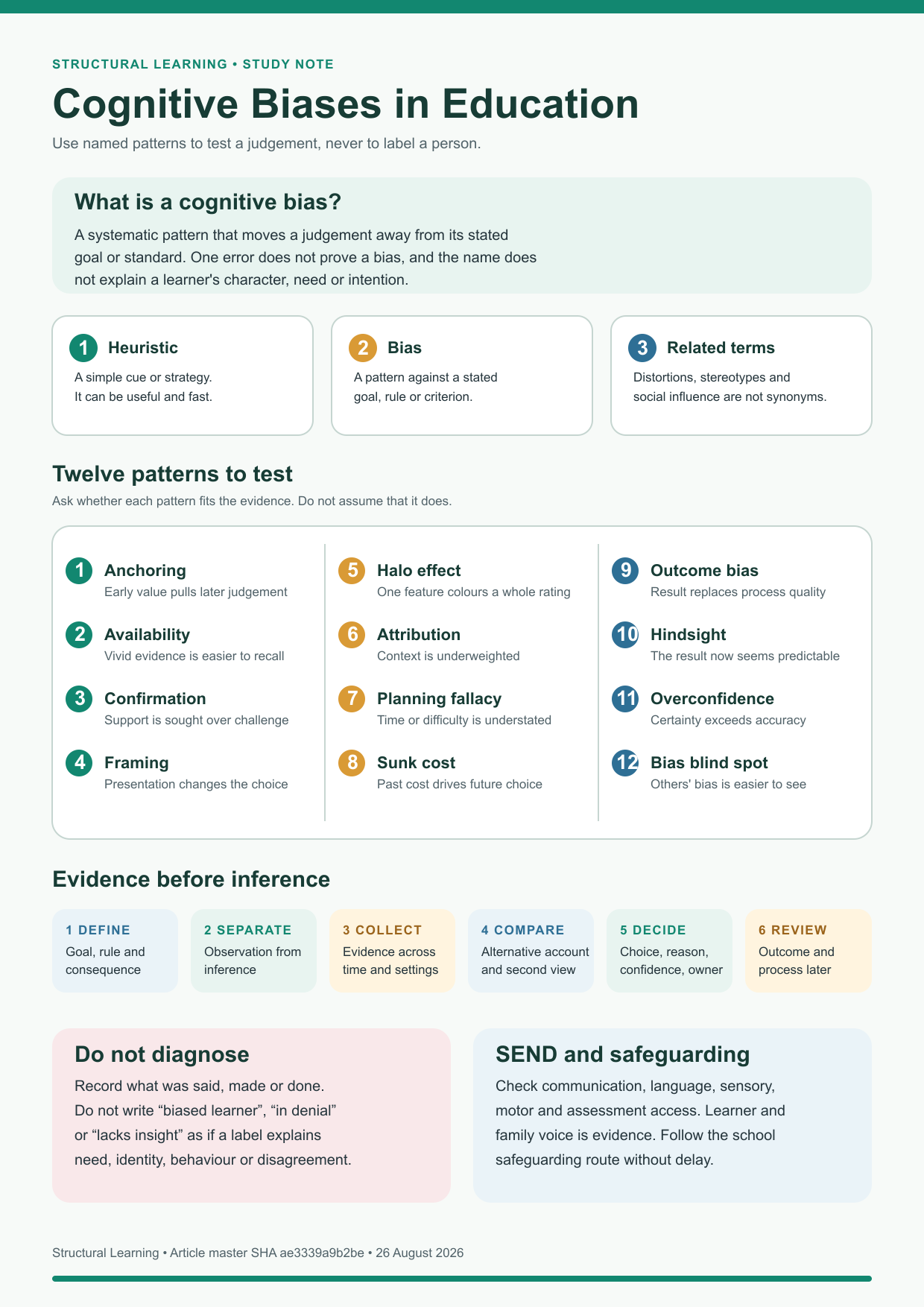
Meaning: a cognitive bias is a systematic pattern against a stated goal or standard. A heuristic is a simple cue that may work well. Distortions, stereotypes and social influence are related but separate ideas.
Patterns to test: anchoring, availability, confirmation, framing, halo effect, attribution, planning fallacy, sunk cost, outcome bias, hindsight, overconfidence and bias blind spot.
Sequence: define the goal and consequence; separate observation from inference; collect evidence across time and settings; compare an alternative account and second view; record the choice, reason, confidence and owner; review the outcome and process.
Boundary: do not diagnose a learner as biased. Check access and learner or family voice. Follow SEND, statutory and safeguarding routes without delay.
Printable evidence-before-inference school judgement record
Use it for assessment, SEND or leadership decisions. The two pages keep evidence, access, challenge, responsibility and review together.
These answers keep the idea practical. A bias is a pattern against a stated standard, not a flaw inside a learner. The answers cover shortcuts, classroom observation, teaching effects, marking, SENCO decisions, disagreement and outcomes. Each one states what the evidence can show and what it cannot.
It is a systematic pattern that moves a judgement away from its stated goal or standard. The standard may be probability, a marking criterion or an agreed decision rule. One mistake does not establish a cognitive bias, and the label does not explain a person's character.
No. A heuristic is a simple strategy or cue. It can be fast and useful. A bias is a pattern that moves the result away from the goal.
The same shortcut may work well in one setting and poorly in another.
Not from one answer or behaviour. Teachers can examine the evidence used, ask for reasoning and compare performance across tasks. A named bias should remain a testable explanation of the process, not a diagnosis of the learner.
Educational interventions reduce measured bias on average, but the 2025 meta-analysis found a small mean effect and uncertain real-world transfer. Strong teaching includes practice, feedback and new cases. Knowing a list of bias names is not enough.
Use valid criteria, exemplars, construct separation, criterion-by-criterion marking and moderation. Hide names or prior grades where that is valid and feasible. Sample agreement and review subgroup outcomes. None of these steps guarantees a fair mark on its own.
Use it to improve the decision process: state the concern, check access, gather several sources, write an alternative explanation and set a review. Never use a bias label to dismiss learner or family voice, avoid assessment or delay safeguarding, health or pastoral action.
No. The person may have different evidence, a different standard or a valid criticism. Ask which observation, source or inference they reject. Apply the same check to evidence supporting your own view.
Yes. Decisions are made under uncertainty. Outcome bias occurs when a known result changes how the earlier process is judged. Review whether the decision used sound information and criteria at the time, then use the outcome to improve the next decision.
For related background, see Structural Learning's Learning Theories guide.