International BaccalaureateGCSE students in navy blazers working on electrical experiments at individual desks in IB science class

Updated on  

February 4, 2026

International Baccalaureate

Revisiting the International Baccalaureate: a rigorous global curriculum that develops critical thinking, creativity and intercultural understanding.

Course Enquiry
Copy citation

Main, P. (2024, March 25). International Baccalaureate. Retrieved from www.structural-learning.com/post/international-baccalaureate

What is the International Baccalaureate?

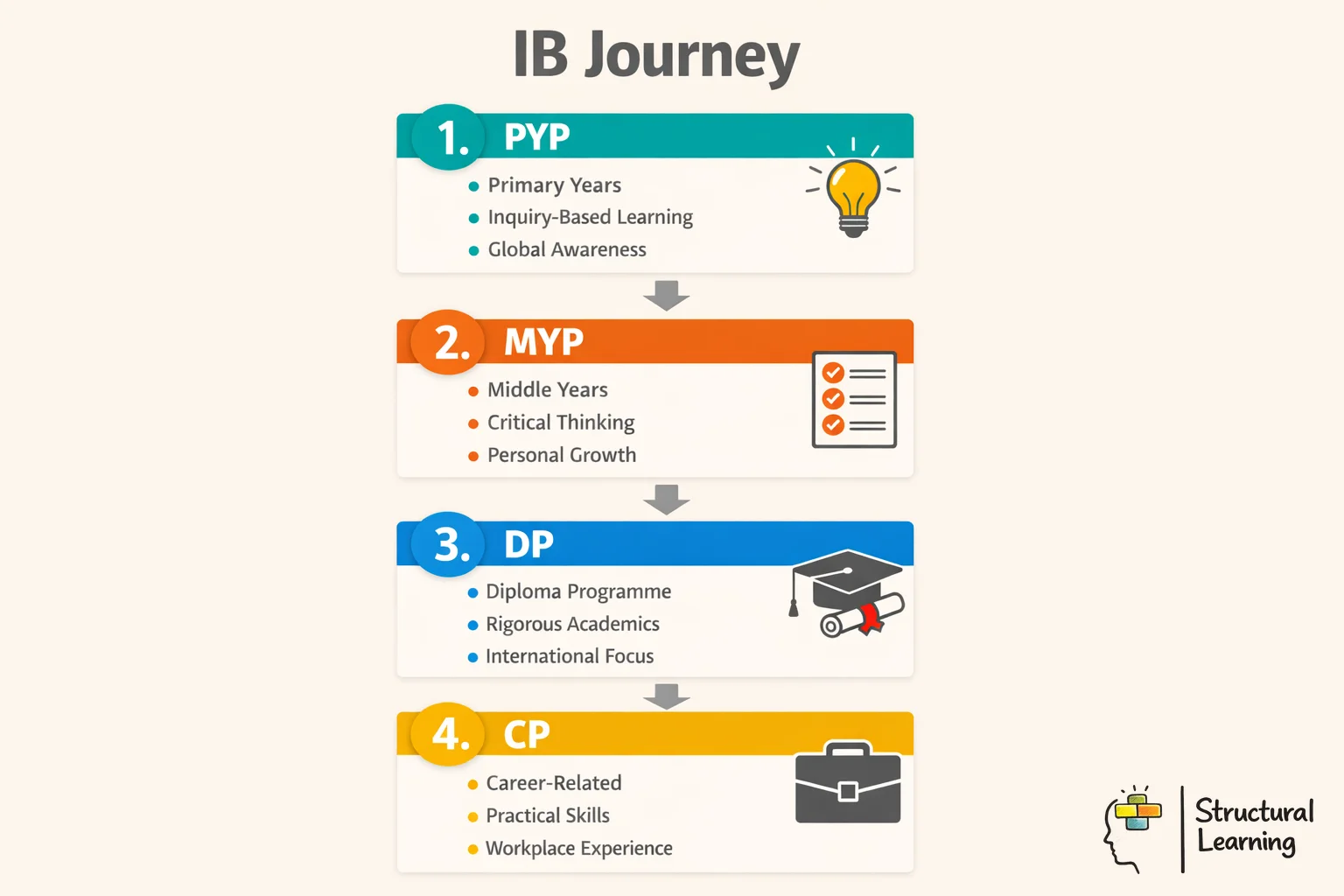
The International Baccalaureate (IB) offers a suite of academic programmes recognised worldwide for their ability to nurture critical and creative thinking among students. Designed to transcend international boundaries, the IB framework caters to learners from three to nineteen years old through four distinct programmes: the Primary Years Programme(PYP), the (MYP), the , and the Career-related Programme (CP).

IB educational continuum showing four programmes from ages 3-19 with timeline and key features
The IB Educational Journey

Each programme is crafted to challenge students, encouraging them to explore a broad spectrum of diploma subjects from science courses to languages, thereby developing a well-rounded education.

Integral to the IB's philosophy is the development of the individual diploma, which prepares students for college credit and university admission. The curriculum places a strong emphasis on , ensuring that students' progress is continually monitored through supported learning approaches. Moreover, the Diploma Programme offers the opportunity to achieve a b ilingual diploma, highlighting the IB's commitment to developing international-mindedness and cultural understanding among its learners.

International Baccalaureate four educational programmes from ages 3-19
IB Journey

International schoolsaround the globe, recognised as IB World Schools, deliver these challenging pro grammes. They are dedicated to providing a challenging yet supportive environment where academic courses and effective teaching strategies stimulate not only academic excellence but also personal growth. Through this comprehensive educational approach, the IB aims to develop inquisitive, knowledgeable, and caring yo ung people who are ready to tackle the challenges of our rapidly changing world.

Key Takeaways

  1. The IB offers four educational programmes designed to creates , preparing students for higher education and global citizenship.
  2. It emphasises a , including science courses and internal assessment, leading to an internationally recognised qualification.
  3. The Diploma Programme provides a pathway to a bilingual diploma, showcasing the IB's emphasis on cultural diversity and .


The Evolving History of the International Baccalaureate

Several educational influencers have played a part in the development, thinking and evolution of the International Baccalaureate from the 1960s. , A.S Neil's ideas around personal freedom and choice, around cognitive thinking and intelligence and J. Bruner's ideas around active learning and discovery.

The IB has shifted in approach from traditional teaching based on memorisation, teacher-centred approaches and norm-referenced to a student-centred approach, which is complete in nature and criterion-referenced.

The International Baccalaureate has continually evolved over the years with the inception of the  Diploma Programme in 1968, the Middle Year Programme then introduced in 1994, the Primary Years Programme starting in 1997 and finally the Careers-Related Programme beginning in 2012.

All these International Baccalaureate programmes were crafted to look at the world through a global lens and designed to be able to be offered throughout the world as internationally recognised programmes and qualifications. The programmes are now offered worldwide.


Exploring the IB Continuum: From PYP to DP

IB World Schools follow a continuum from PYP to DP. Along the continuum, there are connections and progressions within and between the programmes. These IB programmes offer curriculum frameworks that are broad, and balanced but also encourage and prompt young people to use complex cognitive thinking skills.

They utilise conceptual approaches and inquiry-based learning environments. The nature of learning and teaching in the Primary Years Programme like the Middle Years Programme is concept-based, allows for connections across subjects and embeds Approaches to Learning skills (ATLs) which are: Communication, Social, Self-Management, Research and Thinking skills. The IB learner profile (IBLP) attributes are also valued within these programmes.

Primary Years learners like Middle Years learners, encounter key and related concepts. These are progressive and refined as learners move through these IB programmes and continuum. Both the Primary Years Programme and the Middle Years Programme have a clearly defined set of key and related concepts whereas the Diploma Programme has a prescribed syllabus that allows students to further express and develop their conceptual understandings.

The Middle Years programme is also designed to prepare students for the academically rigorous Diploma Programme. Through Approaches to Learning these programmes encourage independence and responsibility for and of learning. Teaching is also planned appropriately for young people with a range of individual learning needs and is differentiated for all learners.

All IB world schools incorporate elements of service in the forms of Action in Primary School, Community Service in Middle School and Creativity, Activity and Service (CAS) as part of the Diploma Programme (DP). IB Schools promote and encourage the philosophy of the International Baccalaureate to nurture inquiring minds and caring young people who are knowledgeable about their world. 

IB Programme of Study

Deciphering IB Qualifications: A Comparative Global Perspective

The nature of having a global perspective gives the International Baccalaureate value as well as its emphasis on developing critical thinking skills and international-mindedness through its comprehensive programmes. Unlike national curriculum systems that may focus on specific cultural contexts, the IB maintains a truly international outlook that prepares students for an interconnected world.

When comparing IB qualifications to other educational systems, several distinctive features emerge. The IB Diploma Programme, for instance, requires students to study six subjects across different disciplines, ensuring breadth of knowledge that contrasts with more specialised systems like A-Levels. This complete approach, combined with the Extended Essay, Theory of Knowledge, and Creativity, Activity, Service components, creates a unique qualification structure.

The assessment methods within IB programmes also differ significantly from traditional examination systems. Rather than relying solely on final examinations, the IB incorporates continuous assessment, internal assessment, and external moderation to provide a more comprehensive evaluation of student achievement. This approach aligns with contemporary educational research highlighting the importance of varied assessment strategies.

Universities worldwide increasingly recognise the rigorous preparation that IB qualifications provide. Many institutions offer advanced standing or course credits for IB Diploma holders, acknowledging the programme's academic depth and the independent learning skills it develops. The bilingual diploma option further enhances students' prospects in an increasingly multilingual global economy.

Implementing IB Programmes: Challenges and Opportunities

Schools considering IB programme implementation face both significant opportunities and challenges. The transition from traditional educational approaches to the IB's inquiry-based, concept-driven methodology requires substantial professional development for educators. Teachers must adapt from content delivery models to facilitation roles, supporting students in constructing their own understanding through guided exploration.

Resource requirements present another consideration for schools. IB programmes demand diverse learning materials, technology integration, and laboratory facilities to support the hands-on, investigative nature of the curriculum. Additionally, the assessment workload increases substantially, as teachers engage in internal assessment moderation and external examination preparation simultaneously.

However, schools successfully implementing IB programmes often report enhanced student engagement and improved learning outcomes. The collaborative learning environment developed by IB methodologies creates dynamic classrooms where students take ownership of their educational journey. Teachers frequently find renewed professional satisfaction in the creative, student-centred approaches that IB programmes encourage.

The international network of IB World Schools provides invaluable support through shared resources, professional development opportunities, and collaborative research initiatives. This global community enables educators to exchange best practices and effective approaches, continuously improving programme delivery and student outcomes.

Conclusion

The International Baccalaureate represents a transformative approach to education that addresses the needs of 21st-century learners. Through its comprehensive continuum from Primary Years to Diploma Programme, the IB successfully combines academic rigour with personal development, preparing students not merely for examinations but for meaningful participation in an interconnected global society.

The programme's emphasis on critical thinking, international-mindedness, and complete development creates graduates who are well-equipped to navigate complex global challenges. As educational systems worldwide grapple with preparing students for rapidly changing career landscapes, the IB's focus on transferable skills and conceptual understanding provides a robust foundation for lifelong learning.

For educators and schools considering IB implementation, the journey requires commitment, resources, and professional development. However, the resulting educational experience offers unparalleled opportunities for both student achievement and teacher professional growth, making the International Baccalaureate a valuable investment in educational excellence and global citizenship.

Further Reading

IB programme research

International curricula

IB effectiveness studies

  1. Hill, I. (2012). "Evolution, revolution or devolution: How do we move from traditional education to student-centred learning in the International Baccalaureate Programmes?" Journal of Research in International Education, 11(2), 185-200.
  2. Saavedra, A. R. (2014). "The academic impact of enrolment in international baccalaureate diploma programs: A case study of Chicago public schools." Educational Evaluation and Policy Analysis, 36(2), 129-145.
  3. Doherty, C., & Shield, P. (2012). "Teachers' work in curricular markets: Conditions of design and implementation work in the International Baccalaureate Diploma Programme." Teachers and Teaching, 18(1), 3-17.
  4. Bunnell, T. (2011). "The International Baccalaureate Middle Years Programme after 30 years: A critical inquiry." Journal of Research in International Education, 10(3), 261-274.
  5. Wright, E., & Lee, M. (2014). "Developing skills for youth in the 21st century: The role of elite International Baccalaureate Diploma Programme schools in China." International Review of Education, 60(2), 199-216.
Loading audit...

What is the International Baccalaureate?

The International Baccalaureate (IB) offers a suite of academic programmes recognised worldwide for their ability to nurture critical and creative thinking among students. Designed to transcend international boundaries, the IB framework caters to learners from three to nineteen years old through four distinct programmes: the Primary Years Programme(PYP), the (MYP), the , and the Career-related Programme (CP).

IB educational continuum showing four programmes from ages 3-19 with timeline and key features
The IB Educational Journey

Each programme is crafted to challenge students, encouraging them to explore a broad spectrum of diploma subjects from science courses to languages, thereby developing a well-rounded education.

Integral to the IB's philosophy is the development of the individual diploma, which prepares students for college credit and university admission. The curriculum places a strong emphasis on , ensuring that students' progress is continually monitored through supported learning approaches. Moreover, the Diploma Programme offers the opportunity to achieve a b ilingual diploma, highlighting the IB's commitment to developing international-mindedness and cultural understanding among its learners.

International Baccalaureate four educational programmes from ages 3-19
IB Journey

International schoolsaround the globe, recognised as IB World Schools, deliver these challenging pro grammes. They are dedicated to providing a challenging yet supportive environment where academic courses and effective teaching strategies stimulate not only academic excellence but also personal growth. Through this comprehensive educational approach, the IB aims to develop inquisitive, knowledgeable, and caring yo ung people who are ready to tackle the challenges of our rapidly changing world.

Key Takeaways

  1. The IB offers four educational programmes designed to creates , preparing students for higher education and global citizenship.
  2. It emphasises a , including science courses and internal assessment, leading to an internationally recognised qualification.
  3. The Diploma Programme provides a pathway to a bilingual diploma, showcasing the IB's emphasis on cultural diversity and .


The Evolving History of the International Baccalaureate

Several educational influencers have played a part in the development, thinking and evolution of the International Baccalaureate from the 1960s. , A.S Neil's ideas around personal freedom and choice, around cognitive thinking and intelligence and J. Bruner's ideas around active learning and discovery.

The IB has shifted in approach from traditional teaching based on memorisation, teacher-centred approaches and norm-referenced to a student-centred approach, which is complete in nature and criterion-referenced.

The International Baccalaureate has continually evolved over the years with the inception of the  Diploma Programme in 1968, the Middle Year Programme then introduced in 1994, the Primary Years Programme starting in 1997 and finally the Careers-Related Programme beginning in 2012.

All these International Baccalaureate programmes were crafted to look at the world through a global lens and designed to be able to be offered throughout the world as internationally recognised programmes and qualifications. The programmes are now offered worldwide.


Exploring the IB Continuum: From PYP to DP

IB World Schools follow a continuum from PYP to DP. Along the continuum, there are connections and progressions within and between the programmes. These IB programmes offer curriculum frameworks that are broad, and balanced but also encourage and prompt young people to use complex cognitive thinking skills.

They utilise conceptual approaches and inquiry-based learning environments. The nature of learning and teaching in the Primary Years Programme like the Middle Years Programme is concept-based, allows for connections across subjects and embeds Approaches to Learning skills (ATLs) which are: Communication, Social, Self-Management, Research and Thinking skills. The IB learner profile (IBLP) attributes are also valued within these programmes.

Primary Years learners like Middle Years learners, encounter key and related concepts. These are progressive and refined as learners move through these IB programmes and continuum. Both the Primary Years Programme and the Middle Years Programme have a clearly defined set of key and related concepts whereas the Diploma Programme has a prescribed syllabus that allows students to further express and develop their conceptual understandings.

The Middle Years programme is also designed to prepare students for the academically rigorous Diploma Programme. Through Approaches to Learning these programmes encourage independence and responsibility for and of learning. Teaching is also planned appropriately for young people with a range of individual learning needs and is differentiated for all learners.

All IB world schools incorporate elements of service in the forms of Action in Primary School, Community Service in Middle School and Creativity, Activity and Service (CAS) as part of the Diploma Programme (DP). IB Schools promote and encourage the philosophy of the International Baccalaureate to nurture inquiring minds and caring young people who are knowledgeable about their world. 

IB Programme of Study

Deciphering IB Qualifications: A Comparative Global Perspective

The nature of having a global perspective gives the International Baccalaureate value as well as its emphasis on developing critical thinking skills and international-mindedness through its comprehensive programmes. Unlike national curriculum systems that may focus on specific cultural contexts, the IB maintains a truly international outlook that prepares students for an interconnected world.

When comparing IB qualifications to other educational systems, several distinctive features emerge. The IB Diploma Programme, for instance, requires students to study six subjects across different disciplines, ensuring breadth of knowledge that contrasts with more specialised systems like A-Levels. This complete approach, combined with the Extended Essay, Theory of Knowledge, and Creativity, Activity, Service components, creates a unique qualification structure.

The assessment methods within IB programmes also differ significantly from traditional examination systems. Rather than relying solely on final examinations, the IB incorporates continuous assessment, internal assessment, and external moderation to provide a more comprehensive evaluation of student achievement. This approach aligns with contemporary educational research highlighting the importance of varied assessment strategies.

Universities worldwide increasingly recognise the rigorous preparation that IB qualifications provide. Many institutions offer advanced standing or course credits for IB Diploma holders, acknowledging the programme's academic depth and the independent learning skills it develops. The bilingual diploma option further enhances students' prospects in an increasingly multilingual global economy.

Implementing IB Programmes: Challenges and Opportunities

Schools considering IB programme implementation face both significant opportunities and challenges. The transition from traditional educational approaches to the IB's inquiry-based, concept-driven methodology requires substantial professional development for educators. Teachers must adapt from content delivery models to facilitation roles, supporting students in constructing their own understanding through guided exploration.

Resource requirements present another consideration for schools. IB programmes demand diverse learning materials, technology integration, and laboratory facilities to support the hands-on, investigative nature of the curriculum. Additionally, the assessment workload increases substantially, as teachers engage in internal assessment moderation and external examination preparation simultaneously.

However, schools successfully implementing IB programmes often report enhanced student engagement and improved learning outcomes. The collaborative learning environment developed by IB methodologies creates dynamic classrooms where students take ownership of their educational journey. Teachers frequently find renewed professional satisfaction in the creative, student-centred approaches that IB programmes encourage.

The international network of IB World Schools provides invaluable support through shared resources, professional development opportunities, and collaborative research initiatives. This global community enables educators to exchange best practices and effective approaches, continuously improving programme delivery and student outcomes.

Conclusion

The International Baccalaureate represents a transformative approach to education that addresses the needs of 21st-century learners. Through its comprehensive continuum from Primary Years to Diploma Programme, the IB successfully combines academic rigour with personal development, preparing students not merely for examinations but for meaningful participation in an interconnected global society.

The programme's emphasis on critical thinking, international-mindedness, and complete development creates graduates who are well-equipped to navigate complex global challenges. As educational systems worldwide grapple with preparing students for rapidly changing career landscapes, the IB's focus on transferable skills and conceptual understanding provides a robust foundation for lifelong learning.

For educators and schools considering IB implementation, the journey requires commitment, resources, and professional development. However, the resulting educational experience offers unparalleled opportunities for both student achievement and teacher professional growth, making the International Baccalaureate a valuable investment in educational excellence and global citizenship.

Further Reading

IB programme research

International curricula

IB effectiveness studies

  1. Hill, I. (2012). "Evolution, revolution or devolution: How do we move from traditional education to student-centred learning in the International Baccalaureate Programmes?" Journal of Research in International Education, 11(2), 185-200.
  2. Saavedra, A. R. (2014). "The academic impact of enrolment in international baccalaureate diploma programs: A case study of Chicago public schools." Educational Evaluation and Policy Analysis, 36(2), 129-145.
  3. Doherty, C., & Shield, P. (2012). "Teachers' work in curricular markets: Conditions of design and implementation work in the International Baccalaureate Diploma Programme." Teachers and Teaching, 18(1), 3-17.
  4. Bunnell, T. (2011). "The International Baccalaureate Middle Years Programme after 30 years: A critical inquiry." Journal of Research in International Education, 10(3), 261-274.
  5. Wright, E., & Lee, M. (2014). "Developing skills for youth in the 21st century: The role of elite International Baccalaureate Diploma Programme schools in China." International Review of Education, 60(2), 199-216.

Curriculum

Back to Blog

{"@context":"https://schema.org","@graph":[{"@type":"Article","@id":"https://www.structural-learning.com/post/international-baccalaureate#article","headline":" International Baccalaureate","description":"Revisiting the International Baccalaureate program: a global, rigorous academic curriculum encouraging critical thinking, creativity, and intercultural...","datePublished":"2024-03-25T15:15:52.464Z","dateModified":"2026-01-26T10:09:32.212Z","author":{"@type":"Person","name":"Paul Main","url":"https://www.structural-learning.com/team/paulmain","jobTitle":"Founder & Educational Consultant"},"publisher":{"@type":"Organization","name":"Structural Learning","url":"https://www.structural-learning.com","logo":{"@type":"ImageObject","url":"https://cdn.prod.website-files.com/5b69a01ba2e409e5d5e055c6/6040bf0426cb415ba2fc7882_newlogoblue.svg"}},"mainEntityOfPage":{"@type":"WebPage","@id":"https://www.structural-learning.com/post/international-baccalaureate"},"image":"https://cdn.prod.website-files.com/5b69a01ba2e409501de055d1/69502e19818e8a3899ce1c2c_zlipor.webp","wordCount":2825},{"@type":"BreadcrumbList","@id":"https://www.structural-learning.com/post/international-baccalaureate#breadcrumb","itemListElement":[{"@type":"ListItem","position":1,"name":"Home","item":"https://www.structural-learning.com/"},{"@type":"ListItem","position":2,"name":"Blog","item":"https://www.structural-learning.com/blog"},{"@type":"ListItem","position":3,"name":" International Baccalaureate","item":"https://www.structural-learning.com/post/international-baccalaureate"}]}]}