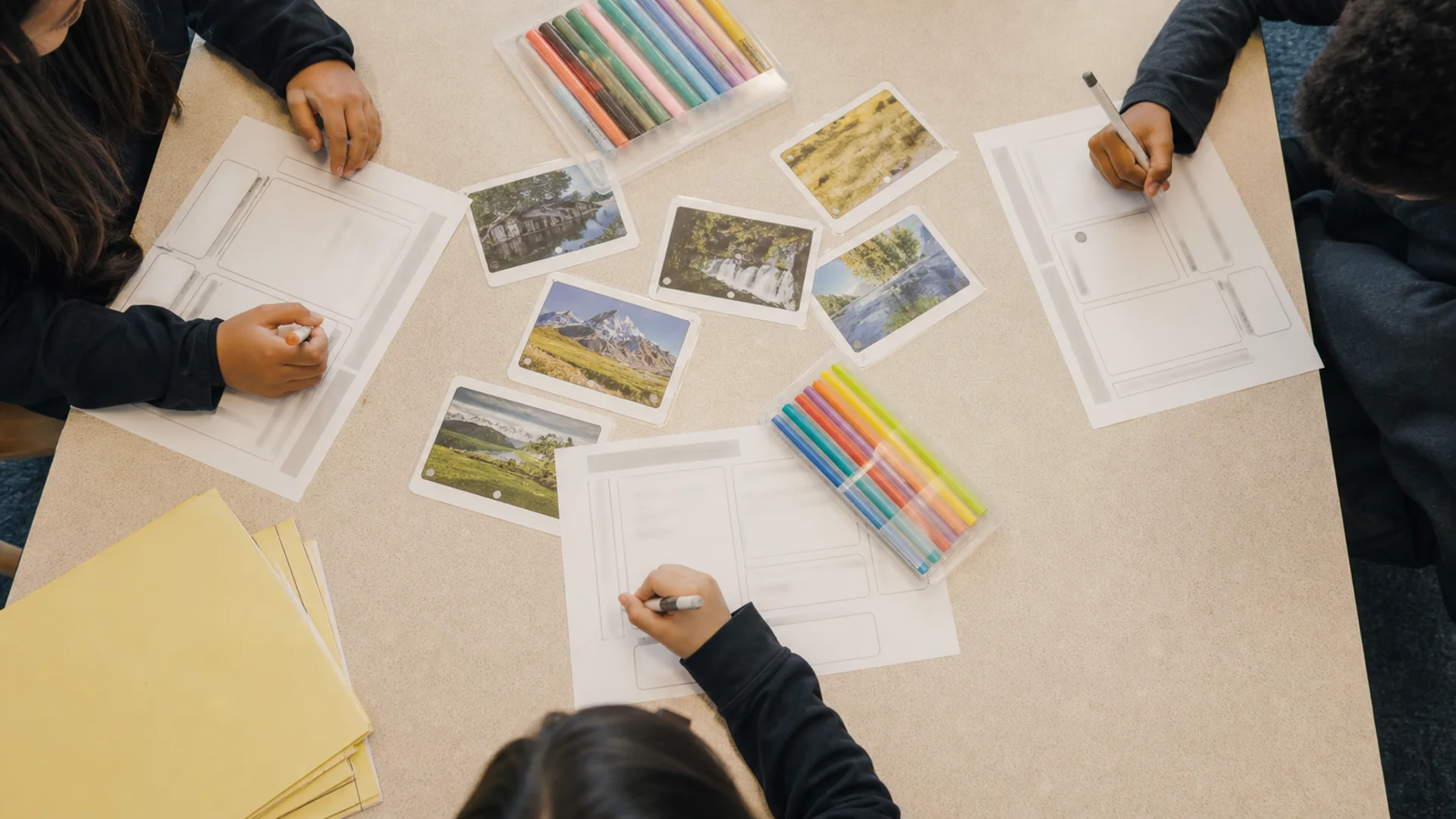
Adaptive teaching guides show how to meet learner needs. Christodoulou (2017) says teachers watch learners and react to their cues. Alexander (2020) finds dialogic teaching helps understand these cues. Wiliam (2011) notes varied classrooms mean lessons may not reach all learners.
Key Takeaways
Formative assessment is the bedrock of effective responsive teaching: Responsive teaching hinges on the continuous gathering and interpretation of learner learning data, a process expertly described as "assessment for learning" (Black & Wiliam, 1998). This ongoing diagnostic approach enables teachers to adjust their instruction in real-time, ensuring it precisely meets the evolving needs of every learner.
High-quality dialogic teaching is crucial for uncovering learner understanding and misconceptions: Responsive teaching thrives on rich classroom talk, where teachers actively engage learners in meaningful dialogue to explore ideas and challenge thinking (Alexander, 2008). This approach moves beyond simple question-and-answer, fostering an environment where learners' voices reveal their current understanding and any areas requiring further support.
Responsive teaching effectively uses principles from cognitive science to scaffold learning: By understanding learners' Zone of Proximal Development, responsive teachers provide targeted scaffolding that supports learners in mastering new concepts they could not achieve independently (Vygotsky, 1978). This deliberate instructional support, rooted in cognitive science, is gradually withdrawn as learners develop greater autonomy and understanding.
Providing timely and specific feedback is a powerful lever in responsive teaching: Responsive teaching integrates effective feedback mechanisms, as feedback is consistently identified as one of the most impactful influences on learner achievement (Hattie, 2009). Teachers must design custom feedback protocols that are actionable and help learners understand their next steps, rather than simply providing grades.
Wiliam (2011) explains learner thinking and memory. Teachers use this knowledge in responsive teaching. They use strategies to involve learners in lessons. Teachers aim to build learners' cultural capital.
Teachers adjust lessons using learner responses in real time. They might change a lesson quickly. Teachers could also add new resources for clarity. Modifying group tasks helps meet diverse learner needs.
Responsive teaching needs flexible, creative teachers with strong subject knowledge. (Berliner, 1986) This method can raise learner engagement and improve results. (Black & Wiliam, 1998; Hattie, 2012)
using Formative Assessment Techniques
Teachers use formative assessment to respond to learners. They collect data on learner understanding and their engagement. Teachers then adjust their strategies as needed (Black & Wiliam, 1998). This helps ensure success for all learners (Hattie & Timperley, 2007).
: This technique involves students writing responses to questions at the end of a lesson, providing instant feedback on their understanding. In responsive teaching, exit tickets offer insights into how well curriculum content has been grasped, guiding teachers in planning learning activities that address gaps or misconceptions.
Think-Pair-Share: Encouraging cooperative learning, students first think-pair-share about a question individually, then discuss their thoughts with a partner, and finally share with the class. This active learning strategy enables teachers to gauge comprehension and adapt instruction to creates deeper understanding among all students, including prior low attaininng ones.
One-Minute Papers: Students spend a minute writing about what they learned or found challenging. This gives teachers immediate insight into student learning, allowing for adjustments in subsequent lessons to ensure key concepts are understood.
Concept Mapping: By asking students to create visual maps of concepts and their connections, teachers can see how students organise and relate knowledge. It aligns with responsive teaching by illustrating students' thought processes, aiding in the customisation of instruction to reinforce or expand on these patterns. Concept maps provide valuable insights into student understanding.
Peer Teaching: Students explain concepts to each other, promoting active teaching and learning. This technique highlights areas where students excel or struggle, enabling teachers to identify topics that require further exploration and to creates a classroom environment where students learn from one another.
Question Storming: Instead of the teacher posing questions, students generate their questions about the lesson content. This technique not only stimulates curiosity but also provides teachers with valuable insight into students' interests and confusions, guiding the direction of future lessons.
Learning Journals: Students keep journals to reflect on their learning experiences. Successful teachers review these reflections to understand individual student processs, tailoring instruction to support personal growth and mastery of the curriculum.
Literacy Development and Responsive Teaching
Responsive teaching adapts literacy strategies to match learner needs. We use observations and literacy knowledge to guide lessons (Dweck, 2006; Fisher & Frey, 2012; Hattie, 2009). This helps teachers create active and varied lessons for each learner.
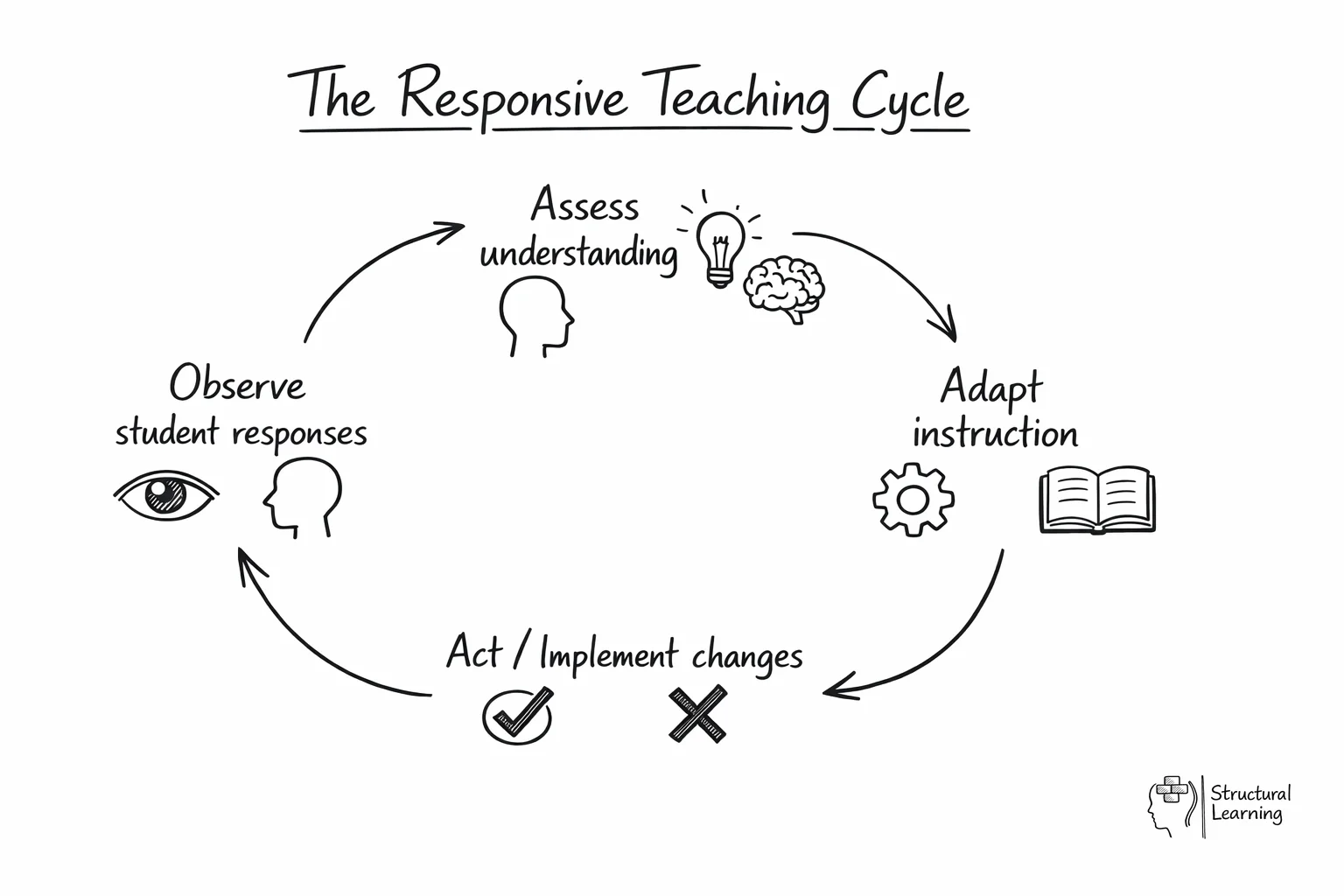
The Responsive Teaching Cycle
Authentic Literacy Experiences and High-Quality Texts:
Offer learning opportunities that connect to students' lives and interests, making literacy instruction more relevant and engaging. This approach recognises that when students see themselves reflected in the texts they read and the activities they complete, their motivation and comprehension naturally increase.
Select high-quality texts that represent diverse voices and experiences, ensuring all students can find connection points that enhance their learning process.
Encourage students to bring their own stories and cultural backgrounds into literacy discussions, creating a classroom environment where every voice is valued.
Differentiated Instruction Based on Reading Levels:
Conduct regular reading assessments to understand each student's current level and specific areas for growth, using this data to inform instructional decisions.
Provide texts at varying complexity levels within the same theme or topic, allowing all students to engage with similar concepts whilst working at their appropriate reading level.
Implement flexible grouping strategies that allow students to work with peers at similar levels for targeted instruction whilst also providing opportunities for mixed-ability collaboration.
Building on Students' Prior Knowledge:
Begin literacy lessons by activating and assessing students' background knowledge, using techniques such as KWL charts or anticipation guides.
Make explicit connections between new learning and students' existing knowledge, helping them build bridges that support deeper understanding.
Encourage students to share their experiences and perspectives, enriching the learning environment for all participants.
Willingham, Roediger and Bjork: The Cognitive Science Behind Calibrated Challenge
Responsive teaching uses cognitive science to help learners' memory. Willingham (2009) showed active thought aids learner recall. Teachers should avoid simplifying tasks too much. Willingham found reduced thinking hurts learning.
Roediger and Butler (2011) found recall boosts memory for learners. Learners remember facts better by actively recalling, instead of rereading information. Despite learners liking rereading, recall works better. Use Roediger and Butler (2011) when planning lessons. Ask learners to recall facts often and vary the task's difficulty.
Bjork and Bjork (2011) call useful challenges "desirable difficulties." These slow learning at first, yet they improve later recall. Spacing, interleaving, and less feedback create such difficulty. Learners might struggle, but learning outcomes get better. Teachers: assess where learners struggle. Bjork and Bjork (2011) say effortful retrieval helps, but knowledge gaps do not.
Begin lessons with retrieval practice; it supports responsive teaching. Give learners time to think about the material; Willingham (2009) calls this "desirable difficulties". Check learners' understanding; do not rush them. Adapt lessons so learners grasp concepts.
Implementing Responsive Teaching in Practice
Responsive teaching links theory and classroom work, prioritising structure. Teachers create helpful learning environments (Darling-Hammond, 2006). This helps learners and teachers adapt (Wiliam, 2011; Hattie, 2012).
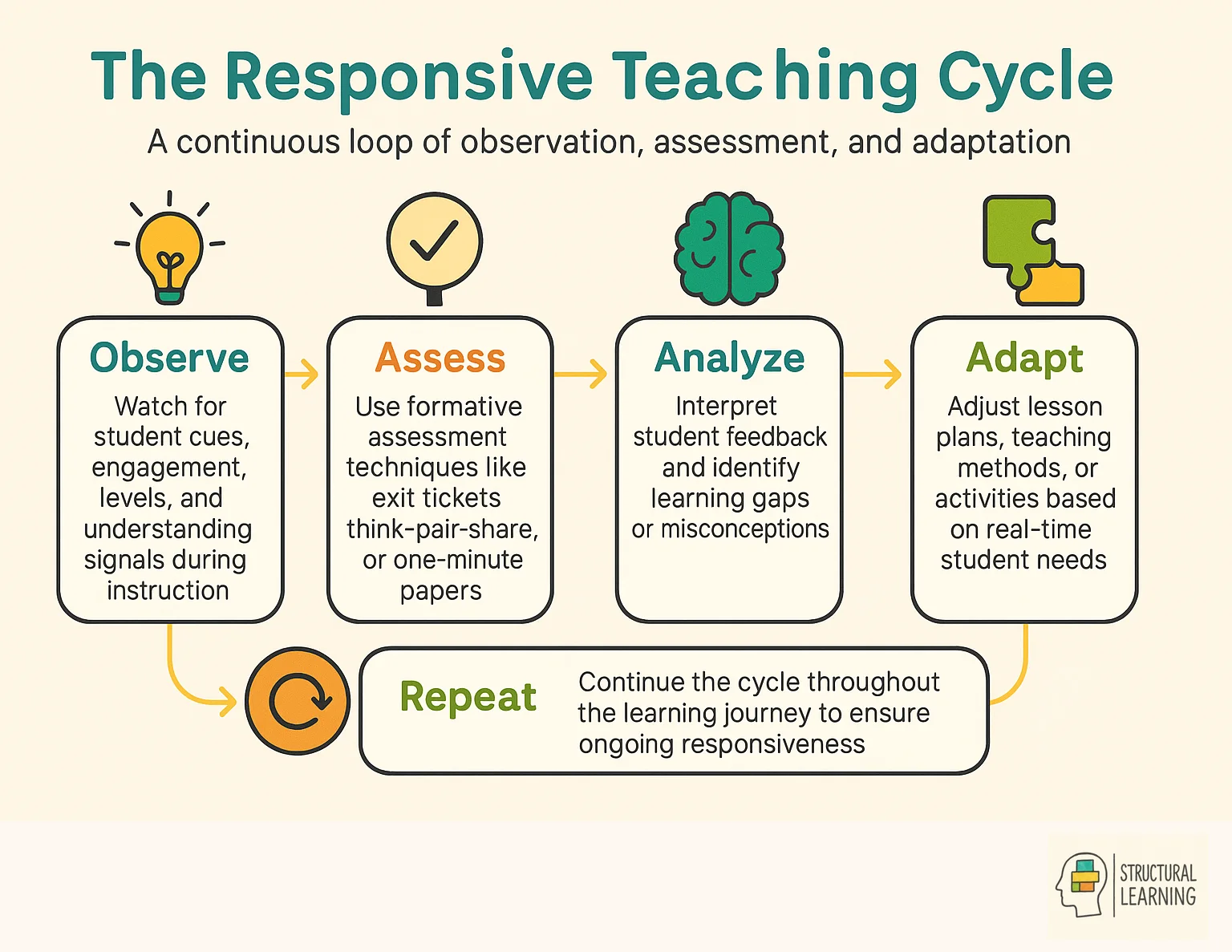
The Responsive Teaching Cycle
Creating a Responsive Classroom Environment:
Establish clear routines that provide structure whilst maintaining flexibility for spontaneous learning opportunities and adjustments based on student needs.
Design physical spaces that can be easily reconfigured to support different types of learning activities, from individual work to collaborative group projects.
creates a classroom culture where mistakes are viewed as learning opportunities, encouraging students to take risks and engage openly in the learning process.
Professional Development and Continuous Learning:
Engage in ongoing professional development focussed on observation techniques, formative assessment strategies, and adaptive instruction methods.
Collaborate with colleagues to share successful responsive teaching strategies and learn from diverse approaches to student-centred instruction.
Regularly reflect on teaching practices through journals, peer observations, or video analysis to identify areas for improvement and celebrate successes.
Technology Integration:
Utilise educational technology tools that provide real-time feedback on student understanding, such as polling applications or digital exit tickets.
Implement learning management systems that allow for differentiated content delivery and personalised learning paths based on individual student needs.
Use data analytics tools to track student progress over time and identify patterns that inform instructional decisions.
Hatano, Inagaki and Berliner: Adaptive Expertise and Teacher Development
Hatano and Inagaki (1986) described routine and adaptive expertise. Routine experts are quick and accurate with typical tasks. Adaptive experts create new answers for fresh problems. Routine expertise suits predictable work, but teaching often varies.
Hatano and Inagaki (1986) showed practice builds routine expertise. Learners require varied problems to gain adaptive expertise. Routine experts find helping new learners hard. Adaptive experts create flexible mental models. This enables responsive teaching when learners surprise you.
Berliner (2001) described five teacher development stages. New learners rigidly follow rules; they lack experience for adaptation. Competent learners plan lessons but need more expertise. Expert teachers read the room and adapt fast. Berliner suggests feedback and practice take five to ten years.
Hatano and Inagaki (1986) showed adaptable skills aid teachers. Lesson study and video analysis make educators' thinking flexible. Collaborative planning boosts understanding for all involved. Teachers discuss learner errors and react to them better. Schools should promote reasoning about lesson outcomes.
Conclusion
Research shows responsive teaching works. Teachers watch learners and change how they teach to suit needs. This makes learning more interesting. Learners then develop in school and as people.
Teachers adapt and learn as they teach, (Darling-Hammond, 2006). Valued learners engage more, boosting motivation. This helps teachers improve learning results, (Black & Wiliam, 1998).
Tomlinson (2014) states teaching should meet learner needs. Teachers use evidence and assessments to track each learner's progress. This approach helps teachers and learners directly. Meaningful outcomes appear in learning (Dweck, 2006; Hattie, 2012).
Written by the Structural Learning Research Team
Reviewed by Paul Main, Founder & Educational Consultant at Structural Learning
Identify Common Learner Misconceptions
Widespread misconceptions appear for your subject with diagnostic questions and teaching tips. Select the subject, topic, and key stage. This helps you target support to each learner.
Misconception Mapper
Surface common learner misconceptions with diagnostic questions and targeted intervention strategies.
General Tips for Addressing Misconceptions
Responsive teaching process
For further reading on this topic, explore our guide to AI for Teachers.
Design a Custom Feedback Protocol
Feedback protocols tailored to subject, time, and type are generated. These contain marking codes, prompt stems, and workload strategies. (Wiliam, 2011; Hattie & Timperley, 2007) show feedback impacts learner progress. Tailored feedback helps learners succeed (Sadler, 1989; Shute, 2008).
Feedback Protocol Designer
Hattie and Timperley highlight the need to consider learner needs in feedback design. Use EEF research to guide your feedback practices. Tailor feedback to boost each learner's understanding.
Hattie & Timperley Focus Levels
Protocol Overview
Feedback Stems
Marking Codes
Workload Management
Common Pitfalls to Avoid
Evidence Base
Frequently Asked Questions
What is responsive teaching in education?
Responsive teaching means teachers change lessons based on what learners show they know. Teachers use assessments to see where learners need help, (Black & Wiliam, 1998). Then, the teacher adjusts their teaching to suit individual learner needs (Christodoulou, 2017). This keeps teaching relevant to each learner's progress (Hattie, 2012).
How do teachers implement responsive teaching in the classroom?
Teachers check learner understanding via tickets, boards, or questions. They re-teach concepts, using examples or extra support, if needed. Acting on lesson feedback helps learners (Wiliam, 2011).
What are the benefits of responsive teaching for learning?
This approach tackles attainment gaps by spotting learning barriers quickly. Learners engage more because support suits their understanding. Making thinking visible helps teachers and learners see progress. You can identify where more practice is needed (Wiliam, 2011).
What does the research say about responsive teaching?
Dylan Wiliam (2011) says formative assessment improves learning. Teachers get better results when they use feedback to adapt lessons. Learners progress when instruction suits their needs. Timely support helps brains retain information best.
What are common mistakes when using responsive teaching?
Teachers often gather data but don't adjust lessons (Black & Wiliam, 1998). Some judge class understanding from just one learner's answer. Good responsive teaching checks all learners' understanding and adapts plans (Christodoulou, 2017).
Why is responsive teaching difficult to use?
Teachers need subject knowledge and skill to predict learner errors and fix them quickly. Lessons should change direction to suit learner needs. Classrooms must accept mistakes as useful data (Wiliam, 2011; Dweck, 2006).
Further Reading
For further academic research on this topic:
Responsive teaching practices
Adaptive teaching research
Wiliam's (2011) work explores responsive teaching approaches. Black and Wiliam (1998) show assessment boosts learner progress. Hattie (2012) ranks effect sizes for various teaching methods. These studies offer practical strategies for teachers.
Wiliam, D., & Thompson, M. (2008). Integrating assessment with learning: What will it take to make it work? In C. A. Dwyer (Ed.), The future of assessment: Shaping teaching and learning (pp. 53-82). Lawrence Erlbaum Associates. This seminal work explores the integration of formative assessment practices within responsive teaching frameworks.
Gay, G. (2018). Culturally Responsive Teaching: Theory, Research, and Practice (3rd ed.). Teachers College Press. A comprehensive examination of how cultural responsiveness enhances educational outcomes and supports diverse learners.
Tomlinson, C. A., & Imbeau, M. B. (2010). Leading and managing a differentiated classroom. ASCD. This research provides practical strategies for implementing differentiated instruction as a key component of responsive teaching.
Hammond, Z. (2015). Culturally responsive teaching and the brain: Promoting authentic engagement and rigor among culturally and linguistically diverse students. Corwin Press. An exploration of the neurological foundations of responsive teaching and its impact on student learning.
Black, P., & Wiliam, D. (1998). Assessment and classroom learning. Assessment in Education: Principles, Policy & Practice, 5(1), 7-74. This foundational research demonstrates the critical role of formative assessment in responsive teaching practices.
Paul Main is an educator and metacognition researcher who founded Structural Learning in 2002. With a psychology degree from the University of Sunderland and 22+ years helping schools embed thinking skills, he bridges the gap between educational research and classroom practice. Fellow of the RSA and Chartered College of Teaching, with 128+ Google Scholar citations.