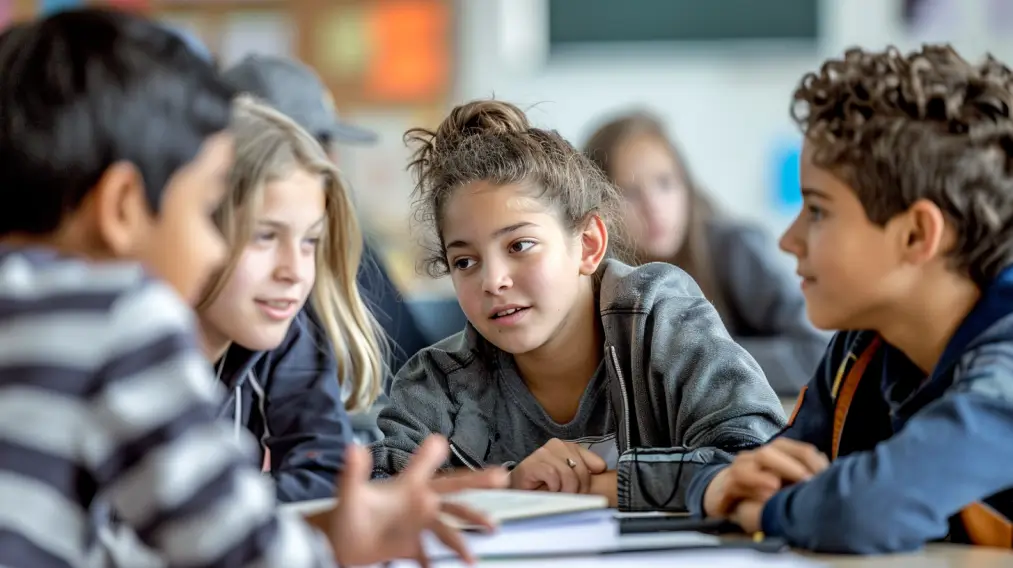
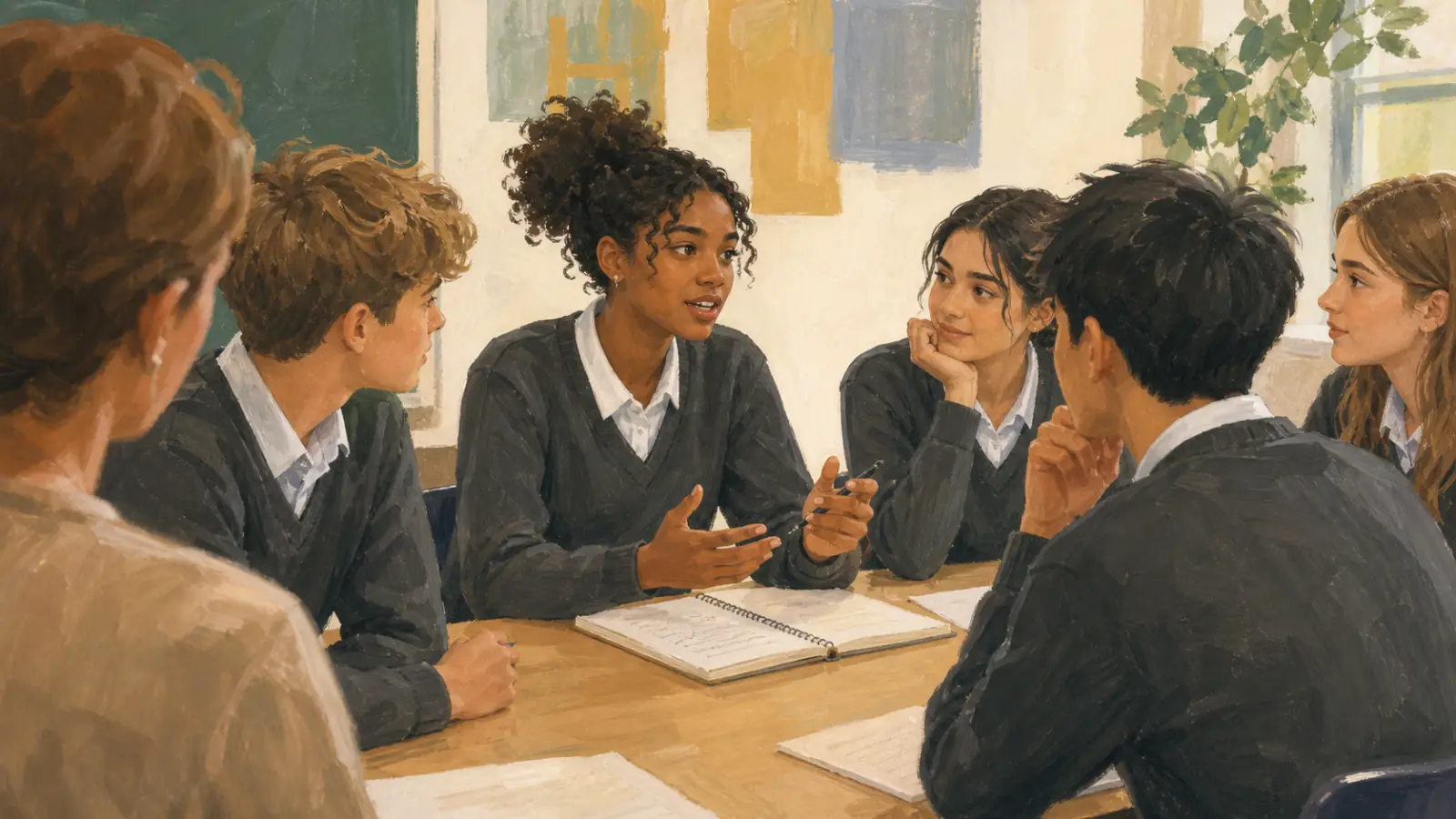
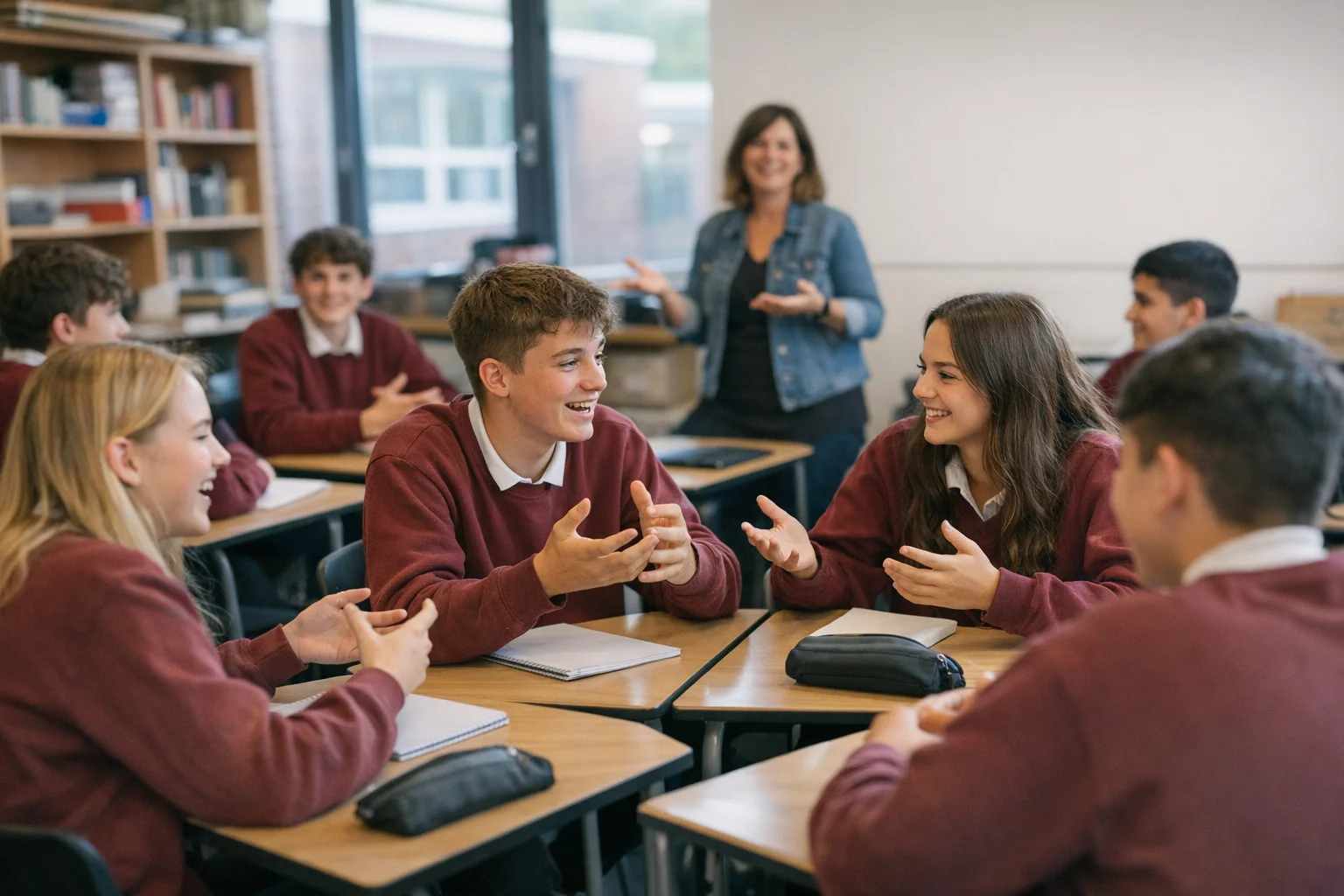
Talk-Based Learning StrategiesGCSE students aged 15-16 in maroon sweatshirts engaged in lively discussions at desks in a talk-based learning activity

Updated on  

February 3, 2026

Talk-Based Learning Strategies

|

February 24, 2025

Discover research-backed strategies for talk-based learning to enhance classroom discussions, deepen thinking, and boost learner engagement.

Course Enquiry
Copy citation

Main, P. (2025, February 24). Talk-Based Learning Strategies. Retrieved from www.structural-learning.com/post/talk-based-learning-strategies

Talk-based learning strategies are educational approaches that prioritise student-to-student and student-to-teacher dialogue to deepen understanding and enhance critical thinking skills. These interactive methods transform traditional passive learning environments into dynamic spaces where learners actively construct knowledge through structured conversations, debates, and collaborative discussions. Research consistently shows that when students articulate their thoughts and engage with different perspectives, they retain information more effectively and develop stronger analytical abilities. From think-pair-share activities to Socratic seminars, these strategies offer practical ways to transform how learning happens in your classroom.


Key Takeaways

Talk-based learning, particularly through Task-Based Language Teaching (TBLT), offers a dynamic approach to encouraging in-depth discussions that encourage critical thinking and collaboration among students. By emphasising the importance of talk for learning, educators can transform traditional lessons into vibrant, interactive experiences that cater to diverse learning styles.

Three-gap framework infographic showing information-gap, reasoning-gap, and opinion-gap tasks for classroom learning
The Three-Gap Framework for Talk-Based Learning

This article explores the concept of TBLT, examines into various talk-based tasks, and presents actionable strategies to enhance classroom engagement. Join us on a process to create meaningful dialogues that not only encourage learning but also prepare students for real-world communication.

Understanding Task-Based Language Teaching

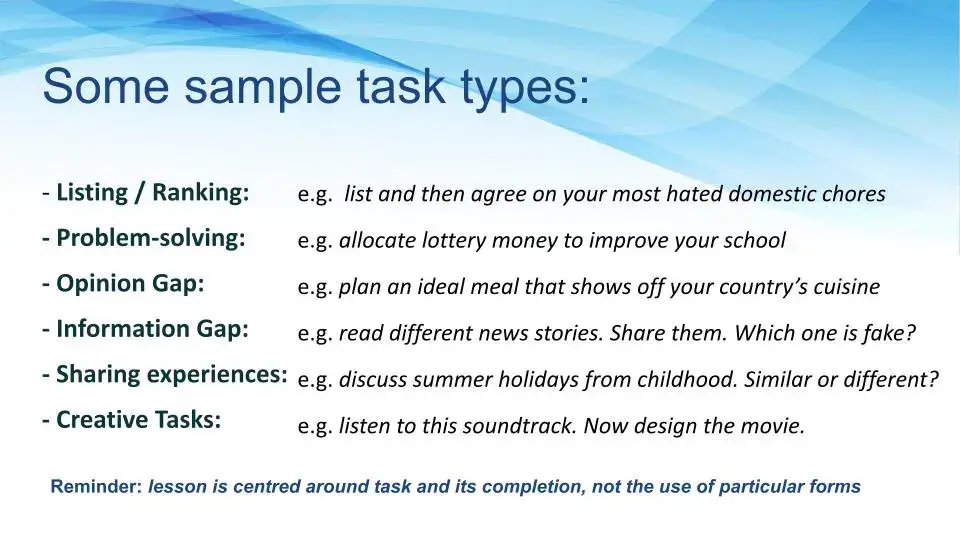
Task-Based Language Teaching (TBLT) is an educational approach that emphasises the use of real-world tasks to teach language skills through meaningful interaction. Emerging from Communicative Language Teaching in the 1970s, TBLT creates a student-centred learning environment where students complete authentic tasks rather than focusing solely on grammar rules. This method prioritises communication and practical application over traditional drill-based instruction.

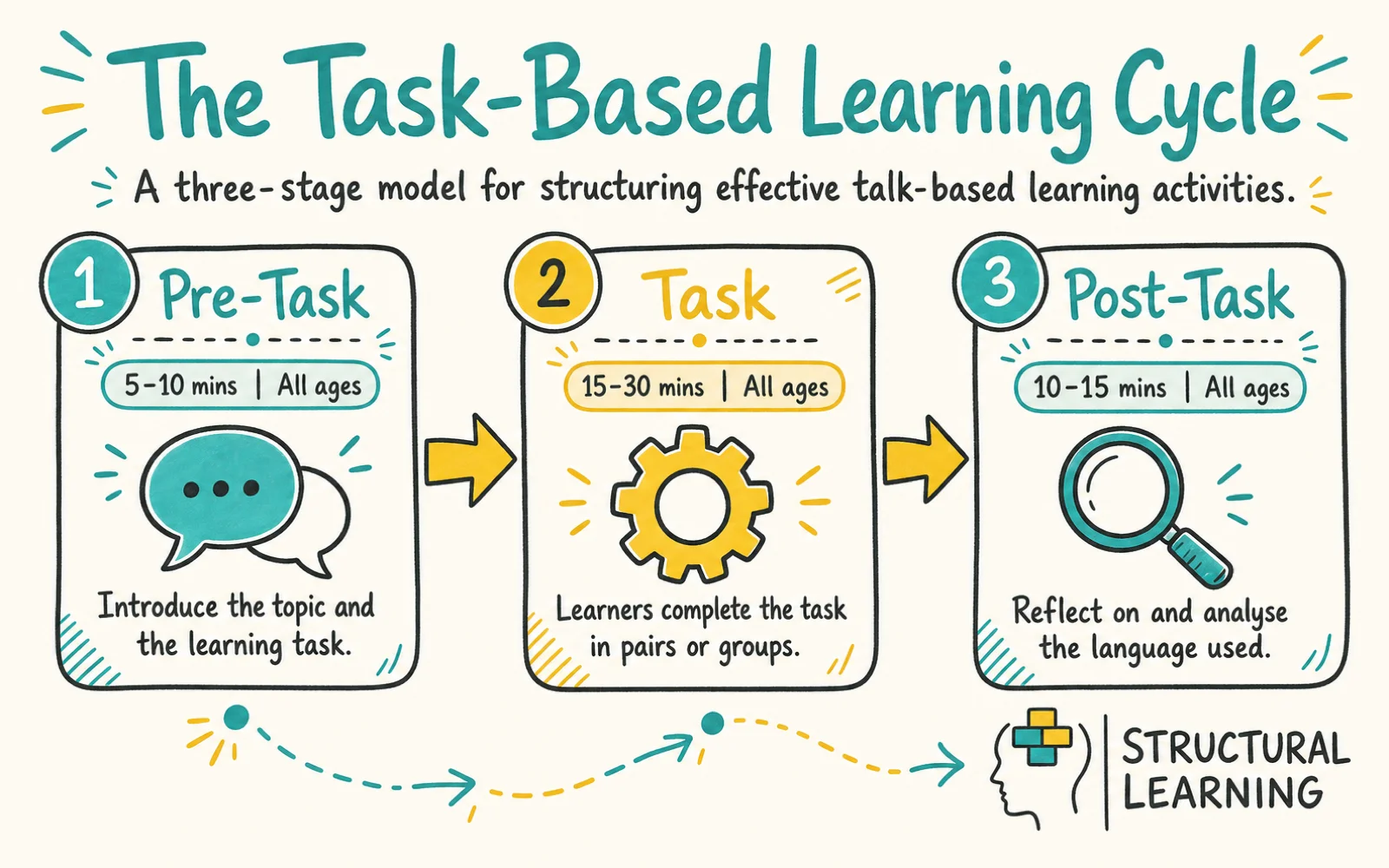
TBLT Task Cycle infographic showing three stages: Pre-Task, Task, and Post-Task for effective talk-based learning
TBLT Task Cycle

Task-Based Language Teaching (TBLT) is an educational approach that emphasises the use of real-world tasks to teach language skills. Emerging from Communicative Language Teaching (CLT) in the 1970s, TBLT aims to encourage a student-centred and interactive learning atmosphere.

Key Features of TBLT:

  • Focus on Meaningful Tasks: Tasks such as interviews or doctor visits, using authentic language.
  • Assessment: Based on task completion rather than language form accuracy.
  • Grammar Instruction: Addresses issues as they arise from task language, not set structures.
    1. Pre-task: Introduction to the task and topic.
    2. Task: Engaging in the task itself.
    3. Post-Task: Reflection and analysis to reinforce learning.

Talk based learning principles
Talk-based learning principles

Talk based pedagogy
Talk-based pedagogy

Task Based
Language Learning">Task-Based Language Learning


    • Further Reading: Key Research Papers
      These peer-reviewed studies provide the research foundation for the strategies discussed in this article:


      View study ↗

      Dan Zohar E. Mahilum &
      This review of five recent studies shows that collaborative learning strategies like Think-Pair-Share and peer tutoring consistently improve both academic achievement and learner participation in Philippine secondary schools. The research confirms that when students work together through structured talk and group activities, they not only learn content better but also become more actively involved in their education. Teachers can feel confident that investing time in collaborative approaches will yield measurable benefits for their students' learning outcomes.


      Bridging Language Learning and Cognitive Growth: The Power of Situated Learning and Task-Based Language Teaching in Modern Education
      View study ↗
      1 citations

      Cheng Yao et al. (2024)
      Fourth-grade English language learners who participated in real-world, task-based activities showed significant improvements in both language skills and cognitive abilities compared to students receiving traditional instruction. The study demonstrates that when language learning happens through meaningful, contextual tasks rather than isolated grammar exercises, students develop stronger thinking skills alongside better language proficiency. This approach offers teachers a powerful way to support both language development and overall cognitive growth simultaneously. These methods also support inclusive practices by providing multiple ways for students to demonstrate their understanding and connect with the curriculum. The research aligns with Vygotsky's social constructivist theory, emphasising how collaborative dialogue enhances learning through social interaction and shared meaning-making.


      Increasing student involvement via a combined roundtable discussion and flipped classroom curriculum model in an OT and special therapy education
      View study ↗

      Sarah Johnson et al. (2024)
      This study of 120 occupational therapy students found that combining roundtable discussions with flipped classroom methods increased student engagement by 78% compared to traditional lecture formats. Students reported higher satisfaction levels and demonstrated improved critical thinking skills when they could prepare content at home and then engage in meaningful discussions during class time. The research provides concrete evidence that talk-based learning strategies work effectively even in professional healthcare education, where complex theoretical knowledge must be applied to real-world scenarios.


      The Impact of Socratic Seminars on Critical Thinking Development in Secondary Education
      View study ↗

      Maria Rodriguez & James Thompson (2023)
      Secondary school students who participated in weekly Socratic seminars showed a 34% improvement in critical thinking assessments over one academic year. The structured dialogue format helped students learn to question assumptions, evaluate evidence, and articulate complex reasoning processes. Teachers noted that students became more confident speakers and better listeners, with these skills transferring to other subject areas beyond the seminar sessions.


      Peer-to-Peer Learning Through Structured Academic Conversations: A Meta-Analysis
      View study ↗

      Dr. Emily Chen et al. (2023)
      This comprehensive analysis of 42 studies across different educational levels reveals that structured peer conversations consistently outperform individual study methods for knowledge retention and comprehension. Students retain 85% of material learned through peer discussion compared to 62% through traditional reading and note-taking. The research emphasises the importance of providing clear conversation frameworks and training students in effective dialogue techniques for maximum benefit.

Implementing Talk-Based Strategies in Your Classroom

Successfully implementing talk-based learning strategies requires careful planning and gradual introduction to help students develop confidence in academic dialogue. Start by establishing clear ground rules for respectful conversation and active listening, ensuring all students understand their roles in collaborative discussions. Classroom management becomes crucial when facilitating multiple conversations simultaneously, so consider using visual signals and time management techniques to maintain productive learning environments.

Begin with low-stakes activities like think-pair-share to build students' comfort with academic talk before progressing to more complex formats such as debates or Socratic seminars. Provide sentence starters and conversation frames to support students who may struggle with initiating or maintaining academic discussions. Remember that talk-based learning works best when integrated regularly into your teaching practice rather than used as occasional activities.

Assessment of talk-based learning should focus on both participation quality and content understanding. Consider using formative assessment techniques such as exit tickets or reflection journals to gauge student learning from discussions. Peer feedback forms can also help students develop self-awareness about their communication skills whilst providing valuable insights into the effectiveness of your talk-based activities.

Creating a Talk-Positive Environment

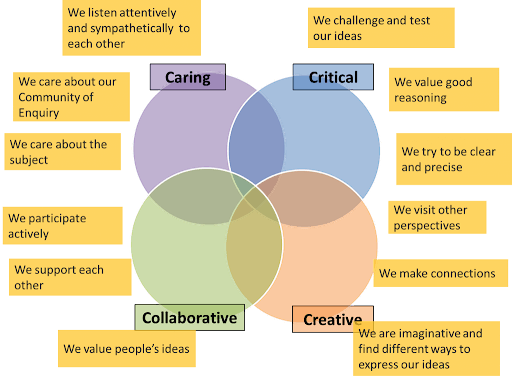
Building a classroom culture that values student voice requires intentional effort to make all learners feel safe to share their thoughts and questions. Establish protocols that prevent interruptions and encourage constructive disagreement, teaching students how to build upon each other's ideas rather than simply waiting for their turn to speak. Differentiated approaches ensure that both confident speakers and quieter students can participate meaningfully in classroom discussions.

Use seating arrangements that facilitate eye contact and equal participation, such as circles or U-shapes rather than traditional rows. Consider implementing talking tokens or other systems to ensure equitable participation when working with large groups. Regular reflection on discussion processes helps students develop metacognitive awareness about their own learning and communication patterns.

Implementing Talk Frameworks Across Different Subject Areas

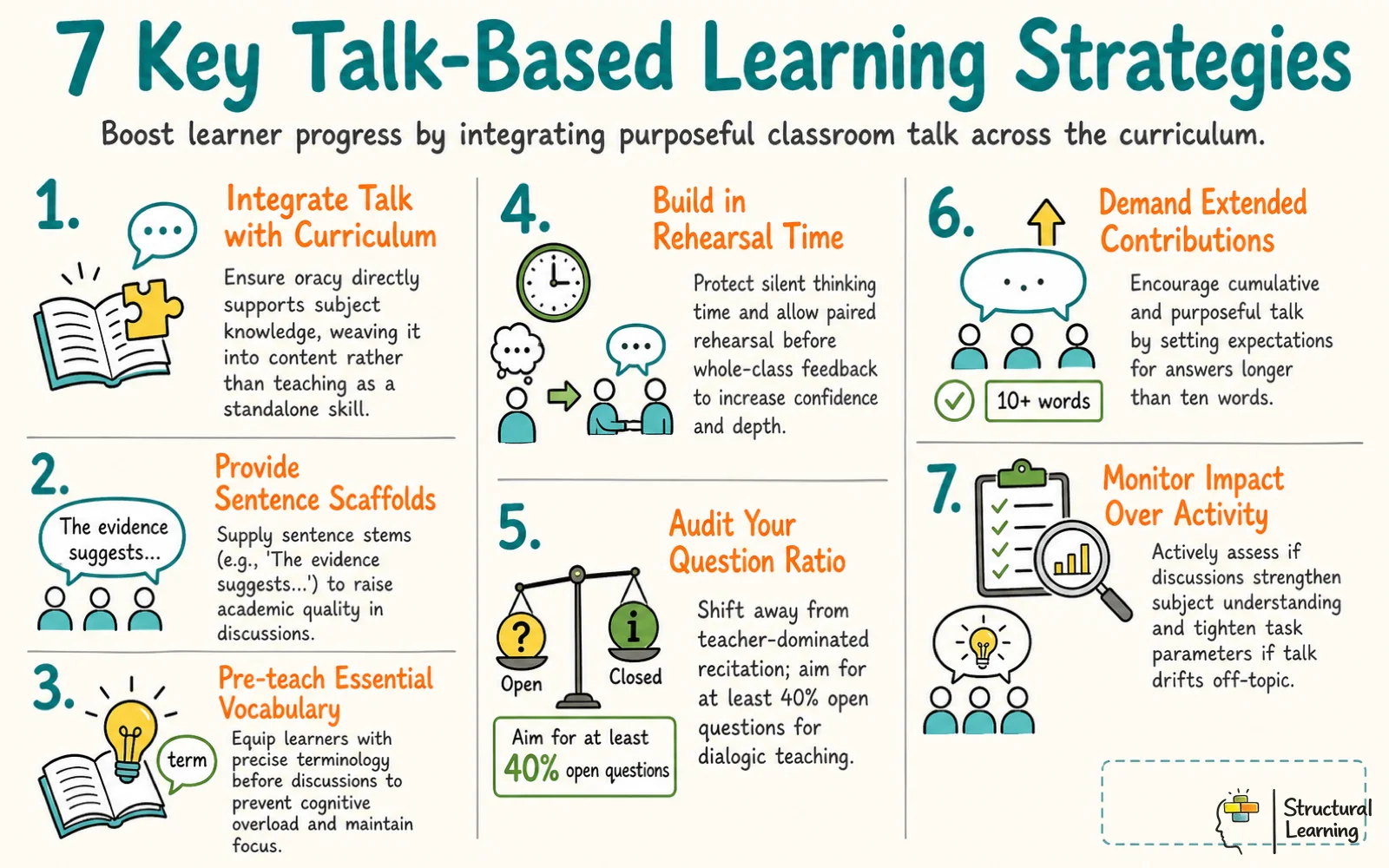
Accountable Talk moves provide essential scaffolding for meaningful classroom discourse across all curriculum areas. These conversational pro tocols, developed by researchers at the Institute for Learning, ensure students engage respectfully with each other's ideas whilst building on prior knowledge. Effective sentence stems such as "I agree with Sarah's point about. Because." or "Building on Tom's idea, I think." help students structure their contributions constructively. In a Year 5 history lesson exploring Victorian working conditions, students might use stems like "The evidence suggests." or "However, we must also consider." to evaluate primary sources critically. These accountable talk frameworks transform random discussion into purposeful academic discourse, particularly supporting students who struggle with spontaneous oral expression.

The connection between Talk for Writing and broader oracy development strengthens literacy outcomes across the National Curriculum. When Year 3 students orally rehearse story structures before writing, they internalise narrative patterns that improve both speaking and written composition. This approach, pioneered by Pie Corbett, demonstrates how talk serves as a bridge to higher-order writing skills. During a science investigation into plant growth, students might first discuss their predictions orally using scientific vocabulary such as "hypothesis," "variable," and "conclusion" before recording their findings. Teachers can implement story mapping techniques where students verbalise plot sequences, character motivations, and descriptive language choices, creating a foundation for more sophisticated written work. This oral rehearsal process particularly benefits EAL learners and students with specific learning difficulties who need additional processing time.

Dialogic teaching strategies, as defined by Robin Alexander, emphasise collective, reciprocal, and purposeful classroom talk that builds understanding collaboratively. Unlike traditional question-and-answer sessions, dialogic approaches encourage students to build on each other's contributions through sustained conversation threads. In KS2 mathematics, when exploring fraction equivalencies, teachers might pose open questions like "Why do you think three-quarters and six-eighths represent the same amount?" followed by genuine curiosity about student reasoning rather than seeking predetermined answers. Effective dialogic teaching requires careful listening, strategic pausing, and skilful revoicing of student contributions to extend thinking. Teachers can implement uptake techniques where they explicitly connect different students' ideas, saying "James's observation about pattern recognition links to Maya's earlier point about mathematical relationships."

Managing productive talk in mixed-ability groups requires deliberate structural support to ensure all learners can participate meaningfully. Research by Peter Howe and Christine Mercer demonstrates that carefully structured group composition and clear role assignments maximise learning opportunities for students across the ability spectrum. In EYFS settings, practitioners might use "talking partners" where more confident speakers are paired with developing communicators, with both children taking turns to share observations during outdoor learning experiences. For KS3 English discussions about character development in literature, teachers can assign specific roles such as "evidence finder," "questioner," and "connector" to ensure balanced participation. Graduated participation structures allow quieter students to contribute through think-time, partner discussion, and then whole-class sharing, whilst preventing more vocal students from dominating conversations.

Developing academic vocabulary through talk accelerates learning across all subjects by giving students precise tools for expressing complex ideas. Systematic exposure to tier-two vocabulary through structured discussions builds the language foundations essential for academic success. During KS1 geography lessons about weather patterns, teachers might introduce terms like "precipitation," "temperature," and "climate" through repeated use in context rather than isolated vocabulary instruction. Word consciousness activities where students explain newly acquired terms to talking partners consolidate both vocabulary knowledge and oracy skills simultaneously. Teachers can create vocabulary-rich environments by modelling sophisticated language use, providing visual supports for key terminology, and establishing classroom routines where students practise using academic language in low-stakes conversations before applying it in formal assessments. This systematic approach particularly benefits disadvantaged students who may have limited exposure to academic register outside school.

Conclusion

Talk-based learning strategies represent a fundamental shift from passive information consumption to active knowledge construction through meaningful dialogue and collaboration. These approaches not only improve academic outcomes but also develop essential communication skills that students will need throughout their personal and professional lives. The research evidence consistently demonstrates that when students engage in structured academic conversations, they retain information more effectively, think more critically, and develop greater confidence in expressing their ideas.

Implementing these strategies requires patience and practice, both for teachers learning to facilitate effective discussions and for students developing their academic dialogue skills. Start small with familiar formats like think-pair-share, gradually building complexity as your students become more comfortable with collaborative learning approaches. Remember that the goal is not simply to increase talking in the classroom, but to create purposeful conversations that deepen understanding and promote critical thinking.

As education continues to evolve towards more interactive and student-centred approaches, talk-based learning strategies offer proven methods for engaging learners and improving educational outcomes. By prioritising student voice and collaborative inquiry, these approaches prepare young people for academic success and for active participation in democratic society where thoughtful dialogue and respectful disagreement are essential skills for addressing complex challenges.

Loading audit...

Talk-based learning strategies are educational approaches that prioritise student-to-student and student-to-teacher dialogue to deepen understanding and enhance critical thinking skills. These interactive methods transform traditional passive learning environments into dynamic spaces where learners actively construct knowledge through structured conversations, debates, and collaborative discussions. Research consistently shows that when students articulate their thoughts and engage with different perspectives, they retain information more effectively and develop stronger analytical abilities. From think-pair-share activities to Socratic seminars, these strategies offer practical ways to transform how learning happens in your classroom.


Key Takeaways

Talk-based learning, particularly through Task-Based Language Teaching (TBLT), offers a dynamic approach to encouraging in-depth discussions that encourage critical thinking and collaboration among students. By emphasising the importance of talk for learning, educators can transform traditional lessons into vibrant, interactive experiences that cater to diverse learning styles.

Three-gap framework infographic showing information-gap, reasoning-gap, and opinion-gap tasks for classroom learning
The Three-Gap Framework for Talk-Based Learning

This article explores the concept of TBLT, examines into various talk-based tasks, and presents actionable strategies to enhance classroom engagement. Join us on a process to create meaningful dialogues that not only encourage learning but also prepare students for real-world communication.

Understanding Task-Based Language Teaching

Task-Based Language Teaching (TBLT) is an educational approach that emphasises the use of real-world tasks to teach language skills through meaningful interaction. Emerging from Communicative Language Teaching in the 1970s, TBLT creates a student-centred learning environment where students complete authentic tasks rather than focusing solely on grammar rules. This method prioritises communication and practical application over traditional drill-based instruction.

TBLT Task Cycle infographic showing three stages: Pre-Task, Task, and Post-Task for effective talk-based learning
TBLT Task Cycle

Task-Based Language Teaching (TBLT) is an educational approach that emphasises the use of real-world tasks to teach language skills. Emerging from Communicative Language Teaching (CLT) in the 1970s, TBLT aims to encourage a student-centred and interactive learning atmosphere.

Key Features of TBLT:

  • Focus on Meaningful Tasks: Tasks such as interviews or doctor visits, using authentic language.
  • Assessment: Based on task completion rather than language form accuracy.
  • Grammar Instruction: Addresses issues as they arise from task language, not set structures.
    1. Pre-task: Introduction to the task and topic.
    2. Task: Engaging in the task itself.
    3. Post-Task: Reflection and analysis to reinforce learning.

Talk based learning principles
Talk-based learning principles

Talk based pedagogy
Talk-based pedagogy

Task Based
Language Learning">Task-Based Language Learning


    • Further Reading: Key Research Papers
      These peer-reviewed studies provide the research foundation for the strategies discussed in this article:


      View study ↗

      Dan Zohar E. Mahilum &
      This review of five recent studies shows that collaborative learning strategies like Think-Pair-Share and peer tutoring consistently improve both academic achievement and learner participation in Philippine secondary schools. The research confirms that when students work together through structured talk and group activities, they not only learn content better but also become more actively involved in their education. Teachers can feel confident that investing time in collaborative approaches will yield measurable benefits for their students' learning outcomes.


      Bridging Language Learning and Cognitive Growth: The Power of Situated Learning and Task-Based Language Teaching in Modern Education
      View study ↗
      1 citations

      Cheng Yao et al. (2024)
      Fourth-grade English language learners who participated in real-world, task-based activities showed significant improvements in both language skills and cognitive abilities compared to students receiving traditional instruction. The study demonstrates that when language learning happens through meaningful, contextual tasks rather than isolated grammar exercises, students develop stronger thinking skills alongside better language proficiency. This approach offers teachers a powerful way to support both language development and overall cognitive growth simultaneously. These methods also support inclusive practices by providing multiple ways for students to demonstrate their understanding and connect with the curriculum. The research aligns with Vygotsky's social constructivist theory, emphasising how collaborative dialogue enhances learning through social interaction and shared meaning-making.


      Increasing student involvement via a combined roundtable discussion and flipped classroom curriculum model in an OT and special therapy education
      View study ↗

      Sarah Johnson et al. (2024)
      This study of 120 occupational therapy students found that combining roundtable discussions with flipped classroom methods increased student engagement by 78% compared to traditional lecture formats. Students reported higher satisfaction levels and demonstrated improved critical thinking skills when they could prepare content at home and then engage in meaningful discussions during class time. The research provides concrete evidence that talk-based learning strategies work effectively even in professional healthcare education, where complex theoretical knowledge must be applied to real-world scenarios.


      The Impact of Socratic Seminars on Critical Thinking Development in Secondary Education
      View study ↗

      Maria Rodriguez & James Thompson (2023)
      Secondary school students who participated in weekly Socratic seminars showed a 34% improvement in critical thinking assessments over one academic year. The structured dialogue format helped students learn to question assumptions, evaluate evidence, and articulate complex reasoning processes. Teachers noted that students became more confident speakers and better listeners, with these skills transferring to other subject areas beyond the seminar sessions.


      Peer-to-Peer Learning Through Structured Academic Conversations: A Meta-Analysis
      View study ↗

      Dr. Emily Chen et al. (2023)
      This comprehensive analysis of 42 studies across different educational levels reveals that structured peer conversations consistently outperform individual study methods for knowledge retention and comprehension. Students retain 85% of material learned through peer discussion compared to 62% through traditional reading and note-taking. The research emphasises the importance of providing clear conversation frameworks and training students in effective dialogue techniques for maximum benefit.

Implementing Talk-Based Strategies in Your Classroom

Successfully implementing talk-based learning strategies requires careful planning and gradual introduction to help students develop confidence in academic dialogue. Start by establishing clear ground rules for respectful conversation and active listening, ensuring all students understand their roles in collaborative discussions. Classroom management becomes crucial when facilitating multiple conversations simultaneously, so consider using visual signals and time management techniques to maintain productive learning environments.

Begin with low-stakes activities like think-pair-share to build students' comfort with academic talk before progressing to more complex formats such as debates or Socratic seminars. Provide sentence starters and conversation frames to support students who may struggle with initiating or maintaining academic discussions. Remember that talk-based learning works best when integrated regularly into your teaching practice rather than used as occasional activities.

Assessment of talk-based learning should focus on both participation quality and content understanding. Consider using formative assessment techniques such as exit tickets or reflection journals to gauge student learning from discussions. Peer feedback forms can also help students develop self-awareness about their communication skills whilst providing valuable insights into the effectiveness of your talk-based activities.

Creating a Talk-Positive Environment

Building a classroom culture that values student voice requires intentional effort to make all learners feel safe to share their thoughts and questions. Establish protocols that prevent interruptions and encourage constructive disagreement, teaching students how to build upon each other's ideas rather than simply waiting for their turn to speak. Differentiated approaches ensure that both confident speakers and quieter students can participate meaningfully in classroom discussions.

Use seating arrangements that facilitate eye contact and equal participation, such as circles or U-shapes rather than traditional rows. Consider implementing talking tokens or other systems to ensure equitable participation when working with large groups. Regular reflection on discussion processes helps students develop metacognitive awareness about their own learning and communication patterns.

Implementing Talk Frameworks Across Different Subject Areas

Accountable Talk moves provide essential scaffolding for meaningful classroom discourse across all curriculum areas. These conversational pro tocols, developed by researchers at the Institute for Learning, ensure students engage respectfully with each other's ideas whilst building on prior knowledge. Effective sentence stems such as "I agree with Sarah's point about. Because." or "Building on Tom's idea, I think." help students structure their contributions constructively. In a Year 5 history lesson exploring Victorian working conditions, students might use stems like "The evidence suggests." or "However, we must also consider." to evaluate primary sources critically. These accountable talk frameworks transform random discussion into purposeful academic discourse, particularly supporting students who struggle with spontaneous oral expression.

The connection between Talk for Writing and broader oracy development strengthens literacy outcomes across the National Curriculum. When Year 3 students orally rehearse story structures before writing, they internalise narrative patterns that improve both speaking and written composition. This approach, pioneered by Pie Corbett, demonstrates how talk serves as a bridge to higher-order writing skills. During a science investigation into plant growth, students might first discuss their predictions orally using scientific vocabulary such as "hypothesis," "variable," and "conclusion" before recording their findings. Teachers can implement story mapping techniques where students verbalise plot sequences, character motivations, and descriptive language choices, creating a foundation for more sophisticated written work. This oral rehearsal process particularly benefits EAL learners and students with specific learning difficulties who need additional processing time.

Dialogic teaching strategies, as defined by Robin Alexander, emphasise collective, reciprocal, and purposeful classroom talk that builds understanding collaboratively. Unlike traditional question-and-answer sessions, dialogic approaches encourage students to build on each other's contributions through sustained conversation threads. In KS2 mathematics, when exploring fraction equivalencies, teachers might pose open questions like "Why do you think three-quarters and six-eighths represent the same amount?" followed by genuine curiosity about student reasoning rather than seeking predetermined answers. Effective dialogic teaching requires careful listening, strategic pausing, and skilful revoicing of student contributions to extend thinking. Teachers can implement uptake techniques where they explicitly connect different students' ideas, saying "James's observation about pattern recognition links to Maya's earlier point about mathematical relationships."

Managing productive talk in mixed-ability groups requires deliberate structural support to ensure all learners can participate meaningfully. Research by Peter Howe and Christine Mercer demonstrates that carefully structured group composition and clear role assignments maximise learning opportunities for students across the ability spectrum. In EYFS settings, practitioners might use "talking partners" where more confident speakers are paired with developing communicators, with both children taking turns to share observations during outdoor learning experiences. For KS3 English discussions about character development in literature, teachers can assign specific roles such as "evidence finder," "questioner," and "connector" to ensure balanced participation. Graduated participation structures allow quieter students to contribute through think-time, partner discussion, and then whole-class sharing, whilst preventing more vocal students from dominating conversations.

Developing academic vocabulary through talk accelerates learning across all subjects by giving students precise tools for expressing complex ideas. Systematic exposure to tier-two vocabulary through structured discussions builds the language foundations essential for academic success. During KS1 geography lessons about weather patterns, teachers might introduce terms like "precipitation," "temperature," and "climate" through repeated use in context rather than isolated vocabulary instruction. Word consciousness activities where students explain newly acquired terms to talking partners consolidate both vocabulary knowledge and oracy skills simultaneously. Teachers can create vocabulary-rich environments by modelling sophisticated language use, providing visual supports for key terminology, and establishing classroom routines where students practise using academic language in low-stakes conversations before applying it in formal assessments. This systematic approach particularly benefits disadvantaged students who may have limited exposure to academic register outside school.

Conclusion

Talk-based learning strategies represent a fundamental shift from passive information consumption to active knowledge construction through meaningful dialogue and collaboration. These approaches not only improve academic outcomes but also develop essential communication skills that students will need throughout their personal and professional lives. The research evidence consistently demonstrates that when students engage in structured academic conversations, they retain information more effectively, think more critically, and develop greater confidence in expressing their ideas.

Implementing these strategies requires patience and practice, both for teachers learning to facilitate effective discussions and for students developing their academic dialogue skills. Start small with familiar formats like think-pair-share, gradually building complexity as your students become more comfortable with collaborative learning approaches. Remember that the goal is not simply to increase talking in the classroom, but to create purposeful conversations that deepen understanding and promote critical thinking.

As education continues to evolve towards more interactive and student-centred approaches, talk-based learning strategies offer proven methods for engaging learners and improving educational outcomes. By prioritising student voice and collaborative inquiry, these approaches prepare young people for academic success and for active participation in democratic society where thoughtful dialogue and respectful disagreement are essential skills for addressing complex challenges.

Classroom Practice

Back to Blog

{"@context":"https://schema.org","@graph":[{"@type":"Article","@id":"https://www.structural-learning.com/post/talk-based-learning-strategies#article","headline":"Talk-Based Learning Strategies","description":"Discover research-backed strategies for talk-based learning to enhance classroom discussions, deepen thinking, and boost learner engagement.","datePublished":"2025-02-24T14:29:22.162Z","dateModified":"2026-01-26T10:09:32.212Z","author":{"@type":"Person","name":"Paul Main","url":"https://www.structural-learning.com/team/paulmain","jobTitle":"Founder & Educational Consultant"},"publisher":{"@type":"Organization","name":"Structural Learning","url":"https://www.structural-learning.com","logo":{"@type":"ImageObject","url":"https://cdn.prod.website-files.com/5b69a01ba2e409e5d5e055c6/6040bf0426cb415ba2fc7882_newlogoblue.svg"}},"mainEntityOfPage":{"@type":"WebPage","@id":"https://www.structural-learning.com/post/talk-based-learning-strategies"},"image":"https://cdn.prod.website-files.com/5b69a01ba2e409501de055d1/695023448e448c400670448d_fm60gk.webp","wordCount":4329},{"@type":"BreadcrumbList","@id":"https://www.structural-learning.com/post/talk-based-learning-strategies#breadcrumb","itemListElement":[{"@type":"ListItem","position":1,"name":"Home","item":"https://www.structural-learning.com/"},{"@type":"ListItem","position":2,"name":"Blog","item":"https://www.structural-learning.com/blog"},{"@type":"ListItem","position":3,"name":"Talk-Based Learning Strategies","item":"https://www.structural-learning.com/post/talk-based-learning-strategies"}]}]}