Updated on
September 24, 2026
Verbal Reasoning: A Teacher’s Classroom Guide
Verbal reasoning is thinking and problem-solving with words. A teacher’s guide to what it is, how to assess it, and how to build it in the classroom.


Updated on
September 24, 2026
Verbal reasoning is thinking and problem-solving with words. A teacher’s guide to what it is, how to assess it, and how to build it in the classroom.
Learners thrive when discussing ideas and analysing texts. Verbal reasoning helps them understand language and solve problems well (Sternberg, 1985). Good language skills boost higher-order thinking in learners (Willingham, 2007; Cain & Oakhill, 2011).
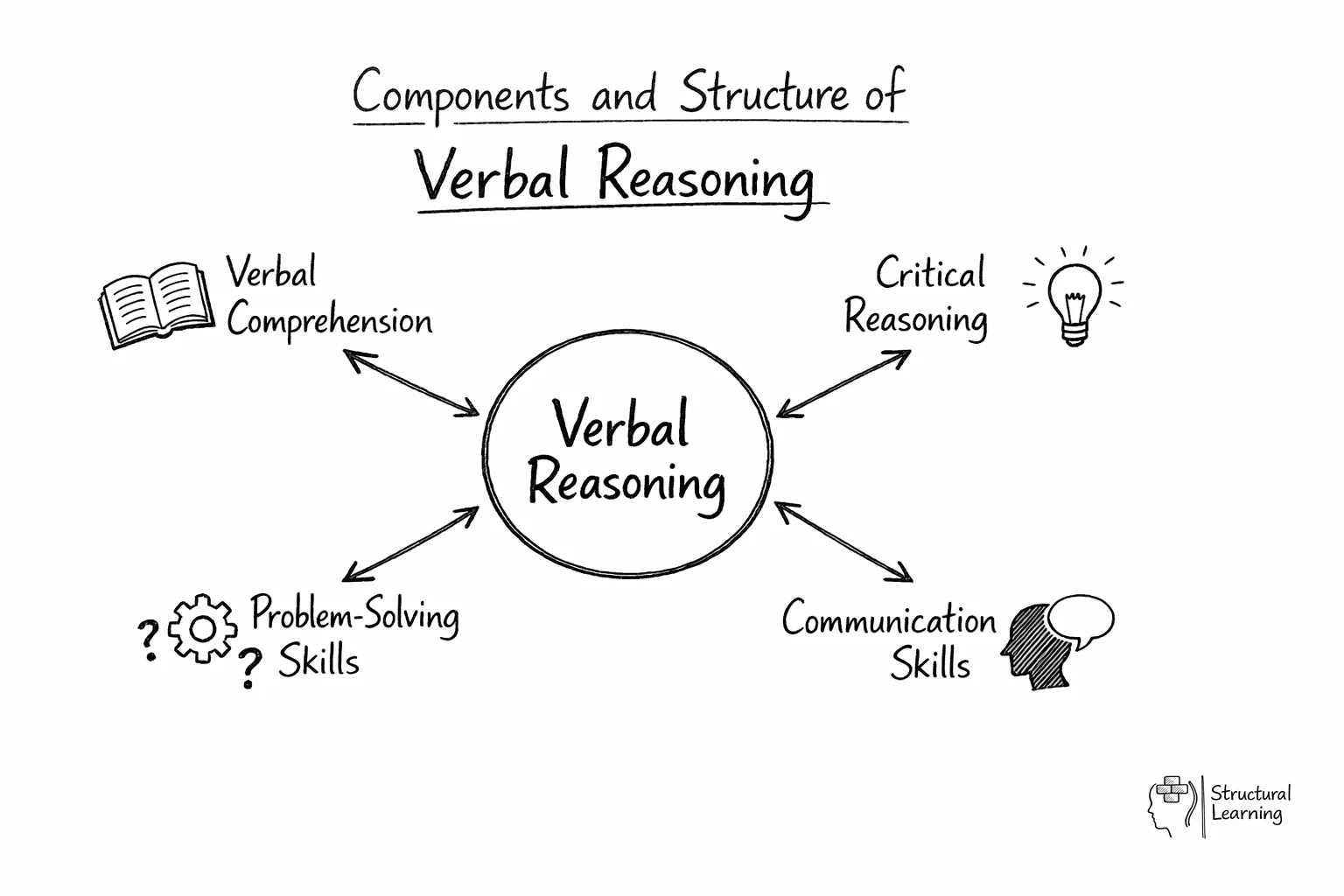
Verbal reasoning means using written or spoken language to understand ideas and solve problems. It draws on comprehension, vocabulary, background knowledge and logical inference, which means working out what follows from the words.
Verbal reasoning means using spoken or written language to understand, analyse and solve problems. It includes drawing inferences, or working out what is implied. It also means spotting assumptions and judging whether claims follow from evidence (Sternberg, 1985; Johnson-Laird, 2010).
Verbal reasoning is key to creating critical thinkers. Research shows it improves learner results. Good verbal skills help learners on tests and in life. Different tests build these skills (Deary et al., 2007).
Verbal reasoning helps learners succeed in education, work and digital judgement. Different tests exist, but classroom practice should have a clear focus. Learners need to reason from evidence, spot weak claims and check AI-generated arguments against the text (Department for Education, 2025).
Verbal reasoning means understanding, analysing and solving problems through written or spoken language. In tests, learners infer meaning, judge claims and reason from words rather than recall facts (Sternberg, 1985; Johnson-Laird, 2010). These tests can predict academic outcomes (Binet & Simon, 1905; Deary et al., 2007), but they are not the same as IQ.
Spearman (1927) linked verbal tasks to general intelligence. Yet Bourdieu (1977) shows that language use also reflects cultural capital. The Social Mobility Commission (2022) warns that family background shapes access to educational advantage. Teachers should treat 11+ and recruitment-style scores as one data point, not proof of fixed ability.
Verbal reasoning helps learners spot patterns and solve problems (Sternberg, 1985). These skills let learners decode and follow directions. Strong verbal reasoning helps learners think clearly. Learners communicate their ideas well too.
Test practice can improve verbal reasoning. Timed tasks help learners build comprehension and analytical skills. Regular practice also strengthens clear thinking and communication.
Verbal reasoning supports critical thinking when learners have enough subject knowledge to reason with. A Year 8 learner can judge a history source more accurately when they know the period, the author's position and the vocabulary in the extract. Working memory limits make generic reasoning lessons weak on their own; Tricot and Sweller (2014) and Willingham (2007) argue that reasoning depends on knowledge stored in long-term memory. In class, teach the words, the context and the argument pattern together.
Word puzzles and vocabulary-rich talk can help, but they work best when they link to a real text or curriculum problem. In science, ask learners to compare "evaporation" and "condensation" before they judge a written explanation. In English, ask them to identify the assumption behind a character's claim. These tasks strengthen reasoning because learners connect language, evidence and background knowledge (Cain & Oakhill, 2011; Deary et al., 2007).
Nisbett (2009) found learners spot assumptions and infer meaning. These questions test a learner's understanding and logic skills. Wason (1968) and Evans (2002) proved this task is hard. Johnson-Laird (2010) states learners judge using given information.
Verbal reasoning tests use complex content. They assess how well a learner can draw conclusions from data. In SHL-style recruitment and GOV.UK Civil Service tests, the key rule is to rely only on the passage. If a claim is not stated, answer "cannot say".
In 11+ practice, providers such as Atom Learning and BOFA 11 Plus use letter codes, word sequences, synonyms, antonyms and hidden words. TargetJobs and Bright Network give similar preparation advice for graduate tests. The test strategy is not guessing. It means reading modifiers such as "always", "never" and "all", then checking whether the wording follows from the text.
Thorndike (1917) found verbal tests check understanding using simple questions. Learners answer 'yes/no' after reading basic text. Multiple choice assesses school text comprehension. Spearman (1904) noted verbal skills are vital for communication and thinking.
Critical reasoning tests use short scenarios to assess a learner's arguments. Learners judge the argument, find assumptions and explain their thinking (Ennis, 1985; Facione, 1990; Halpern, 2003). These tests ask learners to analyse ideas, not just understand them. Common questions ask them to spot strong arguments and clear conclusions.
Researchers (e.g. Ennis, 1985; Facione, 2011) show these tests build learners' analytical skills. Learners use these skills in higher education. They critically assess info, spot bias and make arguments, which are core skills (Paul & Elder, 2007).
Verbal reasoning improves when schools teach it as disciplinary literacy, not as an English add-on. This means helping learners use the language and thinking habits of each subject. Ofsted (2022) links curriculum, vocabulary and spoken language as connected work, and the Voice 21 Oracy Benchmarks (2019) frame talk as a whole-school responsibility. In practice, every subject team should agree the sentence stems, vocabulary checks and evidence rules learners use when they explain, challenge and justify ideas (Willingham, 2007; Mercer & Littleton, 2007).

Socratic seminars let learners practise verbal reasoning through talk. In discussion, they share ideas and question assumptions. They also build arguments and improve logical thinking (Resnick, Asterhan & Clarke, 2015).
Learners improve when they practise often with varied texts. These texts expose them to different reasoning tasks. Non-fiction, opinions, and narratives each need a different kind of analysis (Richland et al., 2010). Teachers should give clear guidance on text structures and reasoning patterns (Duke & Pearson, 2002).
Questioning strengthens verbal reasoning when it asks learners to justify a claim, test a counter-example and change their answer when the evidence changes. Try: "Which word in the source proves that?", "What would make this claim false?" and "What else do we need to know before deciding?" These prompts make reasoning visible without turning the lesson into test practice.
Multiple tools assess verbal skills best (Wiliam, 2011). Multiple-choice tests give some data. Discussions and written work give a better view of learner skills. Problem-solving tasks also show deeper understanding.
Research by Black and Wiliam (1998) shows formative assessment works. Think-alouds and peer discussions let teachers see learner thinking. Teachers can pinpoint struggles and adjust teaching, as Hattie (2009) and Hattie and Timperley (2007) suggest.
Willingham (2007) argues that teachers should check both accuracy and reasoning. A learner can choose the right answer for the wrong reason, or show sound reasoning but miss a detail in the text. Verbal reasoning assessment therefore needs answer checks, explanation checks and quick follow-up questions.
Researchers like Ennis (1993) show verbal reasoning helps learners thrive. We must build critical thinking in the classroom, per Bailin et al. (1999). Teachers integrating verbal reasoning support deeper engagement (Mercer & Littleton, 2007). Learners then question ideas and argue well, like Kuhn (1991) argued.
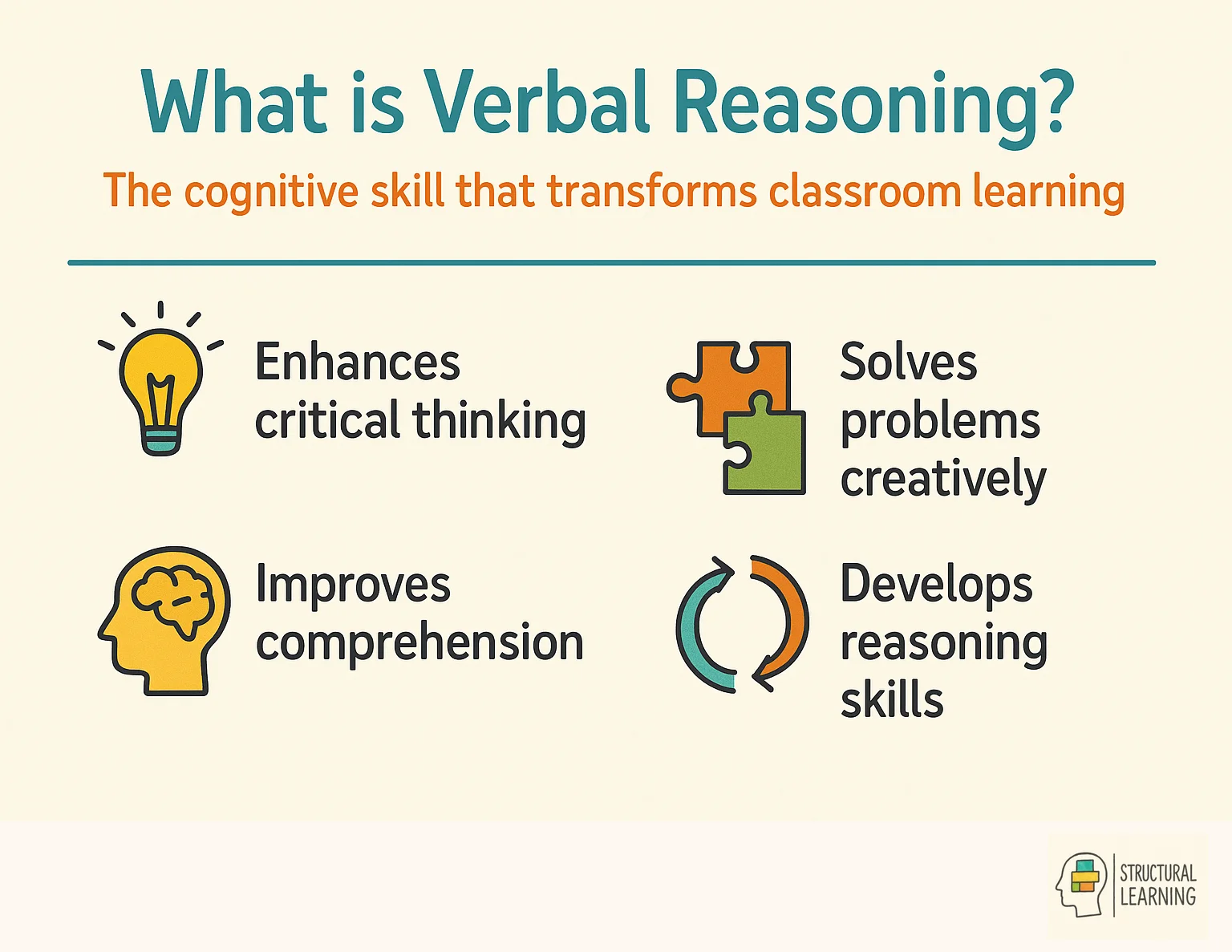
Verbal reasoning helps learners in many subjects. It also prepares them for hard problems. Teachers can build these skills with guided discussion, varied questions and assessment tasks where learners explain their thinking. Meta-analytic evidence on critical thinking instruction supports this planned approach (Abrami et al., 2015).
Verbal reasoning gives learners key skills for today (Paul, 2005). These skills improve test results and build success in school. Confident learners can then analyse a complex world.
Verbal reasoning uses words to understand problems (Deary et al., 2007). Learners interpret text, find patterns, and infer meaning. Teachers assess problem-solving skills with it. Logical conclusions are key.
Classroom debates and word puzzles build skills. Decoding letters and analysing texts helps learners speak clearly. Timed tasks that make learners assess arguments, instead of finding facts, are useful. (Fisher, 2001; Higgins et al., 2005).
Verbal reasoning is linked with later academic outcomes. However, teachers should not treat it as a fixed measure of potential (Deary et al., 2007). Reasoning skills help learners interpret information, follow instructions and explain ideas clearly. This works best when teachers teach vocabulary and background knowledge alongside the task.
Verbal reasoning matters across subjects because learners use language to compare evidence, test claims and explain choices. The link with later outcomes is real but context-bound: background knowledge, cultural experience and access to practice all affect performance (Deary et al., 2007; Bourdieu, 1977).
Learners often confuse reading comprehension with critical reasoning. Comprehension finds information that is stated in the text. Reasoning checks whether a claim follows from that information (Ennis, 2011). A common assessment error is to teach test tricks instead of problem-solving, argument checking and explanation (Willingham, 2007; Abrami et al., 2015).
Statement validity tests check if learners judge claims using only the text. These assessments measure a learner's ability to conclude from complex data. This goes beyond factual recall.
There are limits to how strongly teachers should read verbal reasoning scores. First, Hattie's Visible Learning synthesis is useful for comparing broad influences, but critics question the precision of ranking classroom practices by averaged effect sizes. Slavin (2018) argued that very different studies can be combined in ways that hide context, while Simpson (2017) warned that effect-size tables can give a false sense of certainty. Bergeron (2017) also noted that short research interventions do not always match everyday classroom conditions.
Second, verbal reasoning tests are not culturally neutral. Bourdieu (1977) showed that valued forms of language often reflect cultural capital, or the knowledge and language linked to social background. The Social Mobility Commission (2022) also reported that family background still shapes access to educational advantage. This matters for 11+ preparation, because some learners get lots of practice while others meet the format late.
Third, verbal reasoning cannot be taught well as a general skill. Willingham (2007) and Tricot and Sweller (2014) argue that reasoning depends on background knowledge and the limits of working memory. A learner cannot judge a claim about photosynthesis, empire or algebra without enough subject knowledge to keep the problem in mind.
Finally, standardised verbal tasks can penalise neurodivergent learners. This can happen when items rely on idioms, social inference or unstated pragmatic rules, which are hidden rules about language in context. Milton's double empathy account (2012) shows why a communication mismatch should not be treated as weak reasoning. Used with care, verbal reasoning remains valuable because it makes thinking, evidence use and explanation visible, while reminding teachers to interpret scores cautiously.
Further authoritative guidance on metacognition: Teachers can use these EEF sources to link classroom thinking skills with self-regulation. See the EEF guidance report on metacognition and self-regulation and the EEF Teaching and Learning Toolkit on metacognition and self-regulation.
Hattie, J. (2009). Visible learning.
Verbal reasoning is valuable, but it is not a pure measure of intelligence. Test formats used in 11+ admissions, employment screening and aptitude platforms such as Atom Learning, TargetJobs, Bright Network, Assessment Day, BOFA 11 Plus and Medic Mind often reward speed, familiarity with item types and culturally specific vocabulary. This matters because learners with less exposure to test language, idioms or middle-class forms of speech may be underestimated. Bourdieu (1977) helps explain this as cultural capital, while the UK Social Mobility Commission (2022) warns that selective testing can reproduce social advantage.
There are also cognitive and inclusion limits. Verbal reasoning becomes hard when learners lack the background knowledge needed to interpret a passage, hold details in working memory and compare possible answers. This is why it should be taught through rich subject content, not as a detached skill. Some standardised verbal reasoning tasks may also disadvantage neurodivergent learners when they rely on unstated social assumptions, idiomatic language or neurotypical pragmatics. Good classroom practice therefore combines explicit vocabulary teaching, structured talk, subject knowledge and flexible ways for learners to show their reasoning.
Research by Goswami (2002) and Bowey (2005) gives useful insights. It supports teachers who want to understand verbal reasoning. Read work by Hulme and Snowling (2009) and Cain and Oakhill (2007). It offers strategies for developing each learner's skills, as suggested by Nation (2019).