Updated on
September 24, 2026
Sand Tray Therapy: Evidence, Boundaries and School Use
A critical guide to sand tray therapy, the research evidence, professional boundaries, safeguarding and responsible commissioning in schools.


Updated on
September 24, 2026
A critical guide to sand tray therapy, the research evidence, professional boundaries, safeguarding and responsible commissioning in schools.
What is sand tray therapy?
Sand tray therapy is a psychotherapeutic method in which a client uses sand, miniatures and a bounded tray during work with a trained practitioner. Sandplay usually refers to a particular Jungian or Kalffian tradition, while sandtray is also used more broadly. Ordinary sensory or therapeutic play in school is not the same as psychotherapy.
Sand tray therapy is psychotherapy in which a client uses sand, small objects and a bounded tray with a trained practitioner. The tray gives the client a way to express ideas without relying on speech. It is not a test. No figure, colour or empty space can prove trauma, abuse, attachment style or autism.
The terms are not used in one fixed way. Sandplay often means the Jungian method linked with Dora Kalff. Sandtray is a broader term. Ordinary sensory or therapeutic play in school is not psychotherapy.
The research is promising but mixed. Wiersma et al. (2022) combined 40 studies and found a large pooled effect. Yet the studies used varied methods and groups.
Samples were often small, and results differed widely. The evidence does not prove that one form works for every need.
The field sits beside other theories of learning and psychology, but it is not a classroom method. This guide explains the evidence and role limits.
Key takeaways
Sand tray therapy uses a shallow tray, sand and small objects within psychotherapy. A client may arrange the objects, shape the sand or leave parts of the tray empty. The practitioner holds the setting and its limits. Speech may be used, but it is not the only means of expression.
The tray is not a puzzle with one right answer. Its value lies in the process and in meanings formed within the work. The client may explain a scene, change it or leave it without comment. A qualified practitioner looks at the wider context rather than reading one scene on its own.
The method is part of the wider field of play therapy. Some practitioners draw on Jung. Others use humanistic, psychodynamic, integrative or trauma informed models. This range is one reason why research cannot be treated as proof of one standard treatment.
It appears here because its history draws on theories of symbols, development and change. School interest makes clear terms and role limits vital.
Bradway (1996) used sandtray as the broad term and sandplay for the more specific Jungian or Kalffian method. Later authors do not always follow this split. Some studies combine the labels. Readers must check how each study or service defines its work.
In classical Sandplay, the practitioner offers a free and protected space. Jungian ideas about symbols, archetypes and individuation shape the tradition. Our guide to Carl Jung's archetypes explains their past influence and their contested evidence base.
Broad sandtray work can use the same materials without the full Kalffian model. It may use more speech or direction, based on the model and the client's needs. The name alone does not show what takes place.
Therapeutic play is distinct from Play Therapy. The British Association of Play Therapists (BAPT, 2024) says that play therapy is delivered by a qualified registered therapist. A non-therapist may support ordinary play.
A classroom tray or a tray in a sensory room may support play or regulation. Staff should not call it therapy or claim treatment effects.
The history starts with Margaret Lowenfeld's World Technique and Dora Kalff's later Sandplay method. Lowenfeld used miniature worlds in her work with children in Britain. Kalff linked this practice with Jungian psychology and ideas from her wider intellectual setting.
The Jungian account treats images and symbols as possible signs of processes outside conscious thought. It also proposes shared archetypes. These ideas give practitioners one way to think about images. They do not provide valid rules for decoding a scene.
Current practitioners may use attachment, developmental or relational ideas instead of, or with, Jungian theory. Our guide to child development theories shows why no single model explains all development. Links with attachment theory are often overstated.
A tray cannot establish an attachment type. One observation cannot replace a valid assessment for a clear purpose.
Studies with the same label may differ in training, session length, direction, speech and outcome measures. Claims about effects must fit the form that was tested.
Qualified practice starts before a client touches the sand. The practitioner reviews the referral, consent, needs, communication and risk. They decide whether the method is suitable. They also agree limits on time, privacy, records and confidentiality.
In a session, the client may make a scene or use the materials in another way. The practitioner follows the model in which they were trained. In non-directive work, they do not steer the client towards a preferred story. Ttofa et al. (2026) note that careful Jungian Sandplay does not impose instant symbolic readings.
The relationship is central. A scene must be read beside the client's own views, the course of the work and the practitioner's clinical account. Even then, that account is a working view. It is not proof that a symbol has exposed a hidden fact.
Qualified work also includes supervision and thought about culture. A set of miniatures may favour familiar Western images of family, work, faith and community. A client may not find an object that fits their life. Silence or absence must not be treated as illness.
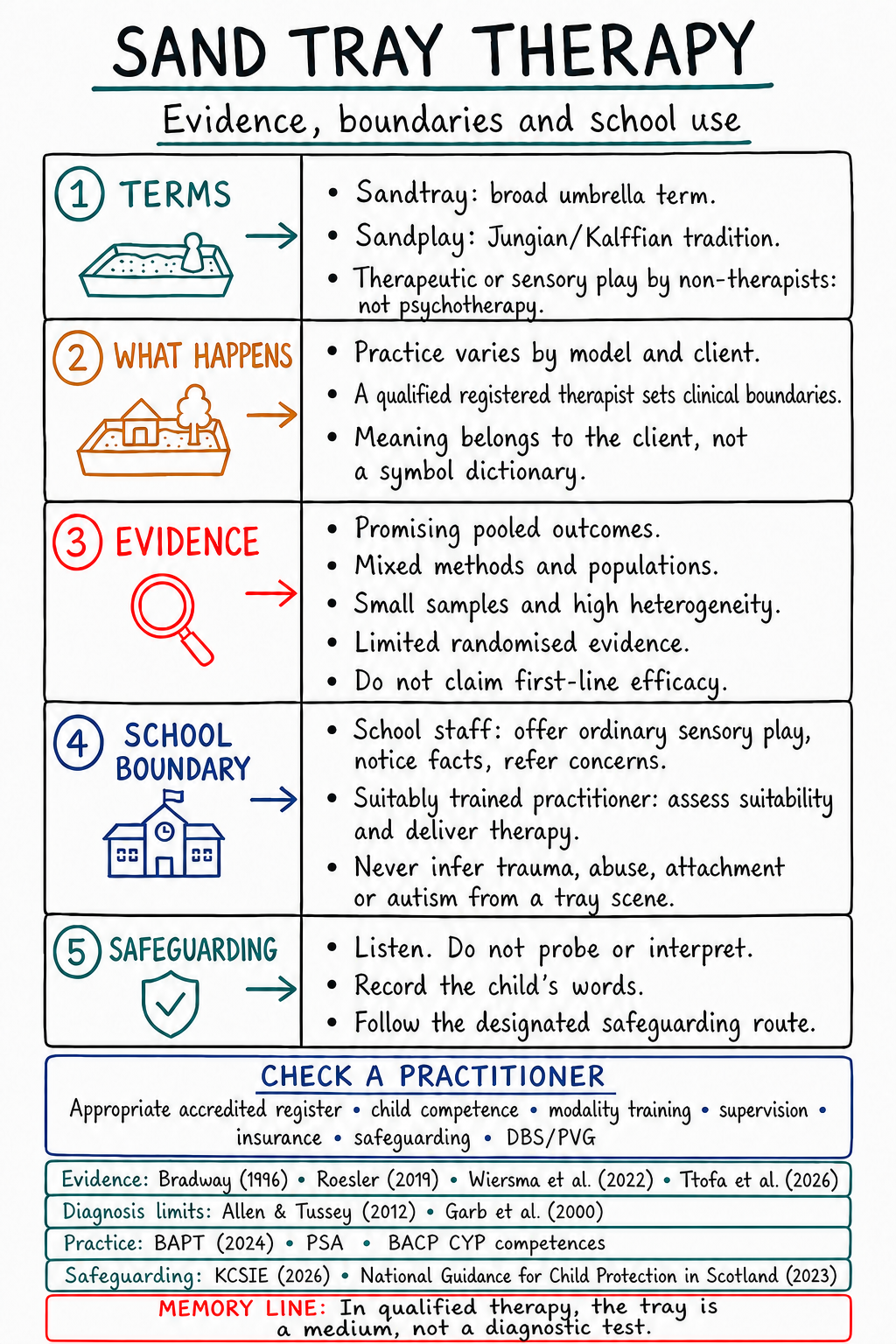
Sandtray is a broad umbrella term. Sandplay refers to a Jungian or Kalffian tradition. Therapeutic or sensory play is not psychotherapy.
In therapy, a client chooses sand and miniatures while a trained practitioner holds boundaries and observes. Meaning belongs to the client, not a symbol dictionary.
Research reports promising pooled outcomes, but methods and populations are mixed. Samples are often small, heterogeneity is high and there are few independent randomised trials. The evidence does not establish first-line efficacy.
School staff may offer ordinary sensory play, notice facts and refer concerns. A qualified practitioner assesses suitability and delivers therapy. No one should infer trauma, abuse, attachment or autism from a tray scene.
When safeguarding concerns arise, listen without probing or interpreting, record the child's words and follow the designated route. When commissioning a practitioner, check their register, child competence, modality training, supervision, insurance, safeguarding and DBS or PVG status.
Key sources are Bradway (1996), Roesler (2019), Wiersma et al. (2022) and Ttofa et al. (2026). A tray is a therapeutic medium, not a diagnostic test.
Roesler (2019) found 16 randomised trials and 17 effectiveness studies in a broad review. Results were promising. Yet the studies covered varied groups and forms of practice. The count does not show that every sand based treatment works for every need.
Wiersma et al. (2022) combined 40 studies and found a large pooled effect, g = 1.10. The review mixed study designs. Some links between measures had to be estimated.
Heterogeneity was high, with I2 = 73.2%. A large mean across unlike studies is not a precise result for a defined school group.
Holliman and a colleague (2023) combined 36 studies and found a large pooled effect, g = 1.165. The review joined Sandplay and sandtray formats. Many samples were small.
The funnel plot was not even, which raised concern about the available record. The result supports more study, not a claim of settled efficacy.
Ttofa et al. (2026) reviewed Jungian Sandplay studies with children and young people. They found 27 studies, but only four randomised trials. All four took place in China.
The methods and outcomes varied too much for a meta-analysis. Positive results sit beside key limits in design, place and fit.
Favourable studies exist, including controlled trials and meta-analyses. Confidence falls for exact questions about the method, client, comparison, provider and risk of bias.
On a smaller screen, swipe across to read all columns.
| Source | Supported use | Boundary |
|---|---|---|
| Outcome review or meta-analysis. | Estimate average change across included studies. | Does not prove one standard treatment or first-line efficacy. |
| Client's account of a scene. | Supports exploration within the therapeutic relationship. | Does not validate a universal symbol meaning. |
| Practitioner's formulation. | Guides professional hypotheses and review. | Is not forensic evidence or a diagnosis from the tray alone. |
| School observation. | Records what was seen or heard and supports referral. | Does not authorise therapy, probing or symbolic interpretation. |
| Professional registration. | Provides a check on standards, complaints and accountability. | Does not prove that the therapy is effective. |
Broad reviews cover emotional, behavioural and social outcomes in children, young people and adults. This breadth can make the field look stronger than the evidence for one referral question. A school should not apply a pooled result to one learner without checking the group, setting, measure and comparison.
Autism shows the problem. Wu et al. (2026) reviewed 12 randomised trials from China and found favourable results. Study quality was suboptimal, and heterogeneity was above 90% in some tests.
This is early evidence from one research set. It is not a broad recommendation for autistic children.
Our guide to autism in schools stresses each learner's communication and sensory needs. Some autistic learners may enjoy sand. Others may avoid it.
A choice of material says nothing about treatment need. A treatment claim needs more than engagement.
Claims about trauma also need care. Alkærsig et al. (2026) reviewed 12 methods for trauma-exposed children aged 12 or younger. They found the most robust evidence for trauma-focused cognitive behavioural therapy.
The controlled Sandplay synthesis contained only three studies. Sand tray therapy should not be called a proven first-line trauma treatment.
Measures also matter. A lower survey score, observed conduct, a client report and attendance are not the same outcome. Follow-up is often short. Studies may report harm and lack of response less often than positive change.
A common myth says that a practitioner can decode a scene. Lists give fixed meanings to animals, bridges, fences, colours or empty areas. Those lists are easy to recall but lack support. The same object may mean safety to one client, danger to another and little to a third.
Even Jungian work views symbols in relation to the client and the course of the work. Ttofa et al. (2026) describe a non directive method that does not impose instant readings. A symbol list lacks diagnostic support and can conflict with the practice it claims to represent.
Projective test research gives a serious warning. Allen and Tussey (2012) reviewed drawings. They found no graphic sign or scoring system with sound repeated evidence for finding physical or sexual abuse. Garb et al. (2000) reached a similar view on projective methods and child sexual abuse.
Those reviews did not test every sand tray method. Applying the result to a tray is an open inference. If signs in drawings cannot detect abuse with enough accuracy, an informal reading of small objects must not be used as a diagnosis or as forensic proof. Safeguarding decisions must rest on facts, reports and proper steps.
Strong faith in an interpretation can cause confirmation bias. An adult may decide that a figure means a parent or that a buried object means trauma. They may then force later details into that story.
Culture adds more risk. The client's own words are safer than symbolic certainty.
A school may offer sand and small objects as ordinary play or sensory materials. Staff may note whether a learner chooses the activity and whether it seems calm or distressing. They can record relevant facts and discuss support through existing pastoral, SEND and safeguarding systems.
Staff should not call this activity sand tray therapy unless a suitably qualified practitioner delivers a defined clinical service. A new name does not give school staff clinical skill, supervision, consent steps or an evidence base.
Teachers and pastoral staff should not ask a learner to build their family, recreate a frightening event or reveal what an object “really means”. They must not score scenes, infer a diagnosis or use a tray to probe a concern. These limits protect the learner and any later professional assessment.
Clear roles also support inclusive education. A learner may choose sensory materials without being singled out for therapy. Support should respond to observed need, communication and choice. It should not rest on an adult's theory about hidden symbols.
If a learner needs mental-health care, the school can use its referral route and involve families and suitable professionals. The decision should consider urgency, better tested options, access, the learner's views and local services.
The title “play therapist” is not regulated by law in the same way as some health roles. UK commissioners must therefore make active checks. The Professional Standards Authority says that accredited registers check governance and professional standards. Its guidance also says that the Authority does not judge whether a treatment works.
Check the person's current entry on a suitable register. Do not rely on a logo or certificate. BAPT has a register for people trained to its standards.
Other practitioners may use another sound professional body. Leaders must check the exact qualification and scope.
Ask about work with children and young people. Check training in the proposed sand method, clinical supervision, insurance, safeguarding and enhanced DBS or PVG status where needed. Confirm how consent, privacy, records, complaints, risk and information sharing will work.
Write down the service terms. State who refers, who decides whether the method fits and what outcomes will be reviewed. Set out what happens if the therapy does not help. Agree what the practitioner may share while protecting private session content.
Compare sound alternatives. A positive meta-analysis does not answer whether the service fits the referral need, whether stronger care is available or whether the learner wants this form of help.
Safeguarding steps do not change because sand is present. If a child says something that raises concern, staff should listen and avoid leading questions. They should record facts and the child's own words. They must report through the designated route without delay.
In England, schools should use Keeping children safe in education 2026, which came into force on 1 September 2026, alongside their own policy (DfE, 2026). Scotland has separate national guidance. Wales and Northern Ireland also use their own systems.
Do not promise full secrecy. Explain the limits in words the child can understand. Do not ask the child to rebuild a scene, repeat a report to several adults or confirm an adult's reading.
The task is to receive and pass on the concern. It is not to investigate.
A scene without a report may still lead to a welfare note, such as clear distress or a sharp change in conduct. Record what took place without giving symbols a meaning. A factual note states what the learner did or said, when it happened and who was there. It does not claim that an object proves a hidden event.
These limits apply to teachers, assistants, pastoral staff and therapists. A therapist may have more duties, but symbols do not become proof of abuse. Local safeguarding rules and statutory agencies set the next step.
The field uses mixed terms and several forms of therapy. Reports do not always give enough detail for others to repeat the work. This makes studies hard to compare and makes one pooled effect hard to read.
Many studies are small. Some lack an active comparison, an independent assessor or long follow-up. A meta-analysis can improve precision but cannot remove flaws in its studies. High heterogeneity shows that results vary beyond what chance alone would predict.
Place is another limit. Recent reviews include many studies from China and few randomised trials from elsewhere. Culture may shape both practice and measures. A set of objects or a way of reading them may not fit a client's family, faith or community.
Blinding is hard in therapy research. Practitioners and clients know which treatment they receive. Loyalty to a method can shape reports. Publication bias is also possible when small positive studies are easier to publish than null results.
We do not yet know how change occurs. It may arise from the relationship, protected time, expression without speech, sensory contact, hope or other shared factors. Improvement after therapy does not prove which part caused the change.
The method needs clear terms, preregistered trials, sound comparison groups, independent outcomes, reports of harm and longer follow-up. For now, “promising but varied” is more accurate than promotion or full dismissal.
Sand tray therapy is psychotherapy, not a classroom technique or a diagnostic test. These answers distinguish Sandplay from broad sandtray work. They also set out the limits of the research and explain why school staff must not infer hidden facts from a scene.
What is sand tray therapy in simple terms?
It is psychotherapy that uses a tray, sand and small objects as a medium within work with a trained practitioner. It may reduce the need for direct speech. The scene is not a test with fixed meanings.
What is the difference between Sandplay and sandtray therapy?
Sandplay often means the Jungian or Kalffian method. Sandtray is often a broad term across several models. Authors use the terms in different ways, so readers should check how each study or service defines its method.
Does research prove that sand tray therapy works?
No single verdict fits the record. Reviews report promising and at times large pooled results. Yet studies differ in design, group and method. Small samples and high heterogeneity limit certainty about specific effects.
Can a sand tray reveal trauma or abuse?
No tray scene can prove that trauma or abuse took place. Fixed symbol readings lack diagnostic and forensic validity. If a child reports a concern, adults should listen, record their words and use the safeguarding route.
Can teachers use sand tray therapy in class?
Teachers may offer ordinary sand or sensory play within their role. They must not call it psychotherapy, direct a learner to recreate distress, read symbols or claim treatment effects. Therapy needs a suitably trained practitioner and proper governance.
Is sand tray therapy recommended for autism?
A 2026 review of 12 Chinese trials found favourable results. Yet study quality was suboptimal, and heterogeneity was very high. This is early evidence and does not support a general recommendation. Decisions should be individual, agreed and weighed against stronger options.
These sources cover terms, pooled evidence, recent reviews, professional limits and safeguarding. Each finding applies to the people, method and study design in its own source. It should not be stretched into a wider treatment claim.
The list below contains every work cited in this guide. DOI details were checked against publisher or Crossref records. No Consensus claim is included because access to the authenticated service was not available.
Allen, B., & Tussey, C. (2012). Can projective drawings detect if a child experienced sexual or physical abuse? Trauma, Violence, & Abuse, 13(2), 97-111. https://doi.org/10.1177/1524838012440339
Alkærsig, M., Banzon, T., Roest, J., Elklit, A., Stein, A. R., Vang, M. L., & Løkkegaard, S. S. (2026). Psychological treatments for young children suffering from trauma-related symptomatology: Systematic review and partial meta-analyses of the current evidence-base for 12 methods. Clinical Psychology Review, 125, 102725. https://doi.org/10.1016/j.cpr.2026.102725
Bradway, K. (1996). Sandplay and sandtray. Journal of Sandplay Therapy, 5(2), 9-11. https://doi.org/10.61711/jst.1996.05.2.282
British Association of Play Therapists. (2024). Statement regarding the difference between Play Therapy and Therapeutic Play.
Department for Education. (2026). Keeping children safe in education 2026: statutory guidance for schools and colleges. GOV.UK.
Garb, H. N., Wood, J. M., & Nezworski, M. T. (2000). Projective techniques and the detection of child sexual abuse. Child Maltreatment, 5(2), 161-168. https://doi.org/10.1177/1077559500005002007
Holliman, R., & Foster, R. D. (2023). The way we play in the sand: A meta-analytic investigation of sand therapy, its formats, and presenting problems. Journal of Child and Adolescent Counseling, 9(2), 205-221. https://doi.org/10.1080/23727810.2023.2232142
Professional Standards Authority. (n.d.). Accredited Registers: FAQs.
Roesler, C. (2019). Sandplay therapy: An overview of theory, applications and evidence base. The Arts in Psychotherapy, 64, 84-94. https://doi.org/10.1016/j.aip.2019.04.001
Ttofa, J., Lancaster, B. L., Blundell, P., Pike, O., Van Hout, M. C., & Silverio, S. A. (2026). The effects of Jungian sandplay therapy on the psychological health of children and adolescents: A systematic review of quantitative studies. Counselling and Psychotherapy Research, 26(2), e70163. https://doi.org/10.1002/capr.70163
Wiersma, J. K., Freedle, L. R., McRoberts, R., & Solberg, K. B. (2022). A meta-analysis of sandplay therapy treatment outcomes. International Journal of Play Therapy, 31(4), 197-215. https://doi.org/10.1037/pla0000180
Wu, X., Zhao, X., Meng, Y., Huang, L., Xie, L., Huang, S., Yang, J., & Song, Y. (2026). The effect of sandplay therapy on children with autism spectrum disorder: A systematic review and meta-analysis. Neuropsychiatric Disease and Treatment, 22. https://doi.org/10.2147/NDT.S579433