Curriculum Design Made EasySecondary students aged 12-14 in maroon sweatshirts collaborating on curriculum design using digital tablets in a classroom.

Updated on  

February 2, 2026

Curriculum Design Made Easy

|

November 11, 2024

Explore curriculum design strategies that create meaningful, connected learning, support critical thinking, and enhance student engagement.

Course Enquiry
Copy citation

Main, P. (2024, November 11). Curriculum Design Made Easy. Retrieved from www.structural-learning.com/post/curriculum-design

Curriculum design can often feel daunting, yet it is a fundamental aspect of effective education. With the right approach and tools, transforming your educational vision into a structured curriculum is not only achievable but also rewarding. Understanding the nuances of curriculum design is essential for educators striving for excellence in teaching.

Key Takeaways

  1. Beyond One-Size-Fits-All: Discover why switching between subject-centered, learner-centered, and problem-centered models transforms engagement, especially for pupils with diverse learning needs
  2. Design vs Development Decoded: Master the critical distinction that determines whether your curriculum stays theoretical or becomes practical classroom magic
  3. The Balance Blueprint: Navigate the breadth versus depth dilemma with coherent instruction strategies that prepare students for real-world complexity
  4. Critical Thinking Integration: Transform passive lessons into active exploration using metacognition and collaborative thinking processes that deepen understanding across subjects

Curriculum design encompasses various definitions, methodologies, and models crucial to delivering an impactful educational experience. Distinguishing between curriculum development and design can significantly affect how educational programs are perceived and implemented. By recognising the importance of different curriculum models, such as subject-centered, learner-centered, and problem-centered approaches, educators can create engaging and responsive learning environments.

This article offers a streamlined guide to mastering curriculum design through practical steps, valuable tips, and evaluation strategies. Whether you are a seasoned educator or just starting, these insights will enable teachers to simplify the curriculum design process and enhance the classroom activities of your students.

What is Curriculum Design?

Curriculum Design Models

ModelKey FeaturesStrengthsConsiderations
Backward DesignStart with end goalsEnsures alignmentRequires clear outcomes
Spiral CurriculumRevisit with increasing depthBuilds on prior learningNeeds careful mapping
Thematic DesignOrganise around themesMeaningful connectionsCan miss key content
Competency-BasedFocus on demonstrated skillsPersonalised paceAssessment challenges
Knowledge-RichPrioritise substantive knowledgeStrong foundationsBalance with skills

Curriculum design is the process of organising educational content, activities, and assessments for a course or class. It involves setting clear learning goals and aligning materials to achieve desired learning outcomes. This structured approach helps meet students' needs through subject-centered, learner-centered, or problem-centered designs.

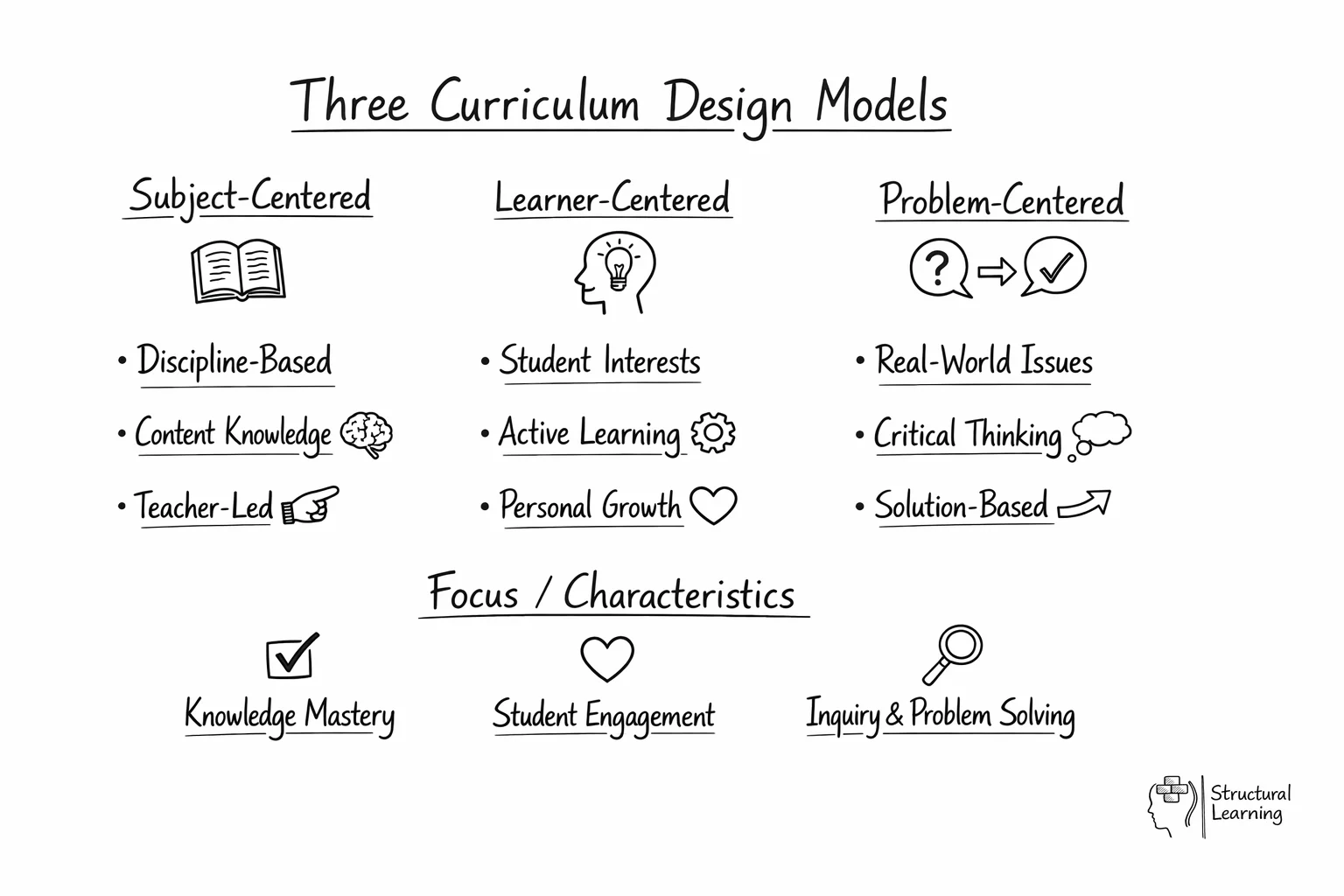
Comparison table showing three curriculum design models and their key characteristics
Side-by-side comparison table: Three Curriculum Design Models

Subject-centered curriculum design primarily focuses on specific subject matter, ensuring that content is thoroughly covered. Learner-centered designs prioritise individual student engagement, tailoring lessons to students' needs and interests. Problem-centered designs emphasise real-world problems, encouraging critical thinking and problem-solving skills.

Curriculum development serves as the framework for an educational program. Curriculum design translates this into practical, actionable formats, facilitating the daily organisation of lessons and instructional materials. This structured method ensures that educators effectively achieve learning objectives, using tailored instructional strategies and technology.

Key goals in curriculum design include a focus on student engagement, continuous improvement, and the clear organisation of activities across whole-school systems and beyond. These elements collectively enhance the educational experience for students, preparing them for future academic or professional endeavors.

Curriculum Design Principles

Differences Between Curriculum Development and Curriculum Design

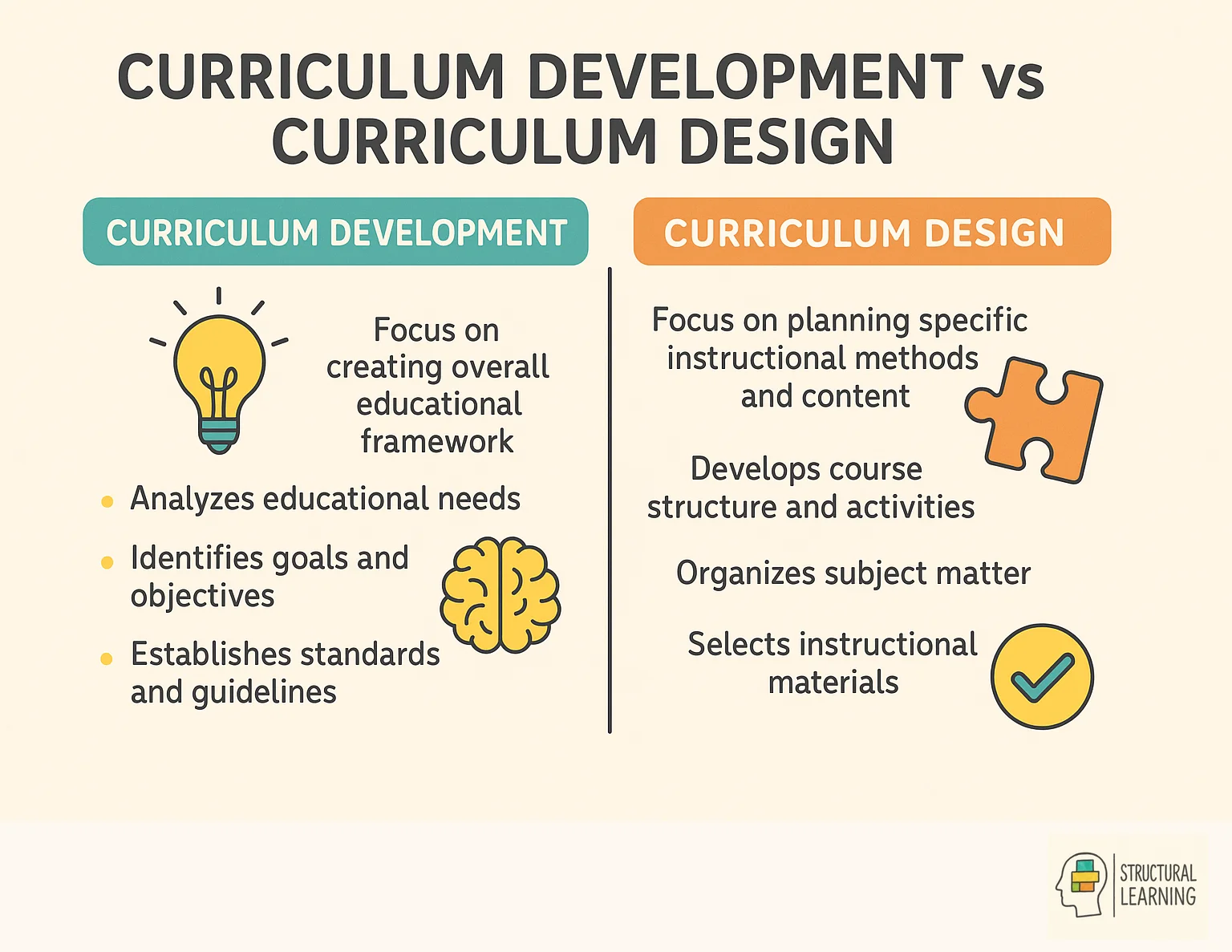
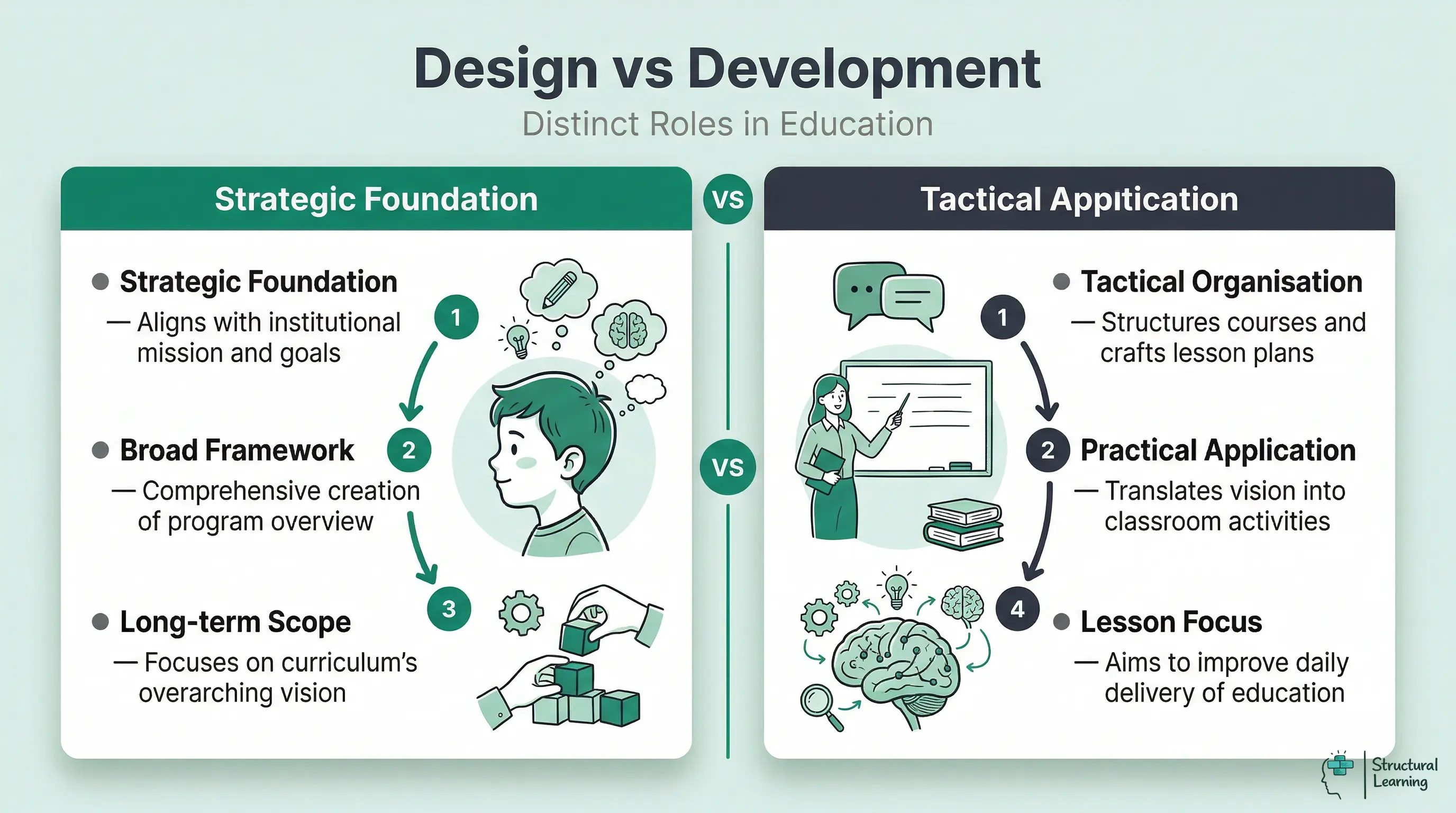
Curriculum development and curriculum design are often used interchangeably but have distinct roles in education. Curriculum development involves the comprehensive creation of a curriculum that aligns with educational goals and the institution's mission. It encompasses planning, implementation, and evaluation phases, focusing on key learning outcomes, content selection, and course sequencing based on learning theories.

Infographic comparing curriculum development versus curriculum design showing key differences
Curriculum Development vs Curriculum Design

On the other hand, curriculum design is more tactical and focuses on the organisational plan for educators. It involves structuring courses and crafting lesson plans to enhance student learning through differentiation strategies. While curriculum development covers the broad conceptual framework, curriculum design aims at improving the delivery of education by considering past and future subjects students will learn.

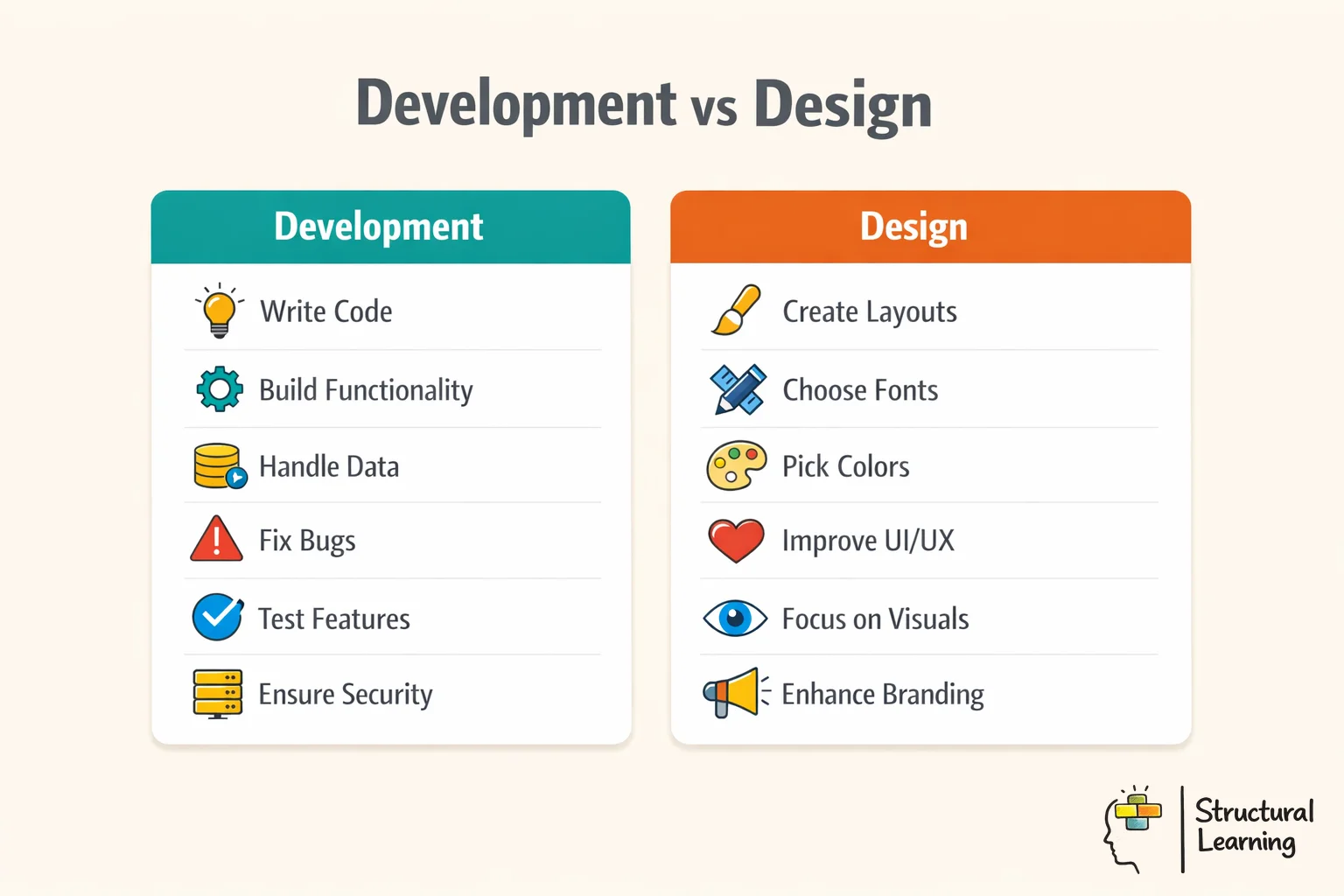
Infographic comparing curriculum development vs design showing strategic vs tactical focus
Development vs Design

curriculum development sets the strategic foundation, whereas curriculum design fine-tunes the educational structure to improve lessons. Both are essential for crafting effective educational programs but operate at different stages of the curriculum process.

Importance of Curriculum Models

Curriculum models provide a structured approach to curriculum design, serving as essential guides for educators during creation and implementation. Prescriptive models target the goals of a curriculum, outlining what curriculum designers should achieve. Descriptive models, conversely, showcase the practical activities and strategies employed during development. These models ensure that elements like content, teaching strategies, summative assessments, and evaluations are cohesively integrated, ultimatelely enhancing the educational experience.

The subject-centred model focuses on delivering a comprehensive understanding of specific subjects, making it suitable for disciplines that require a structured knowledge base. The learner-centred model allows for greater customisation, catering to individual needs and promoting deeper engagement. Meanwhile, the problem-centred model creates practical skills, preparing pupils to tackle real-world challenges through critical thinking and effective solutions.

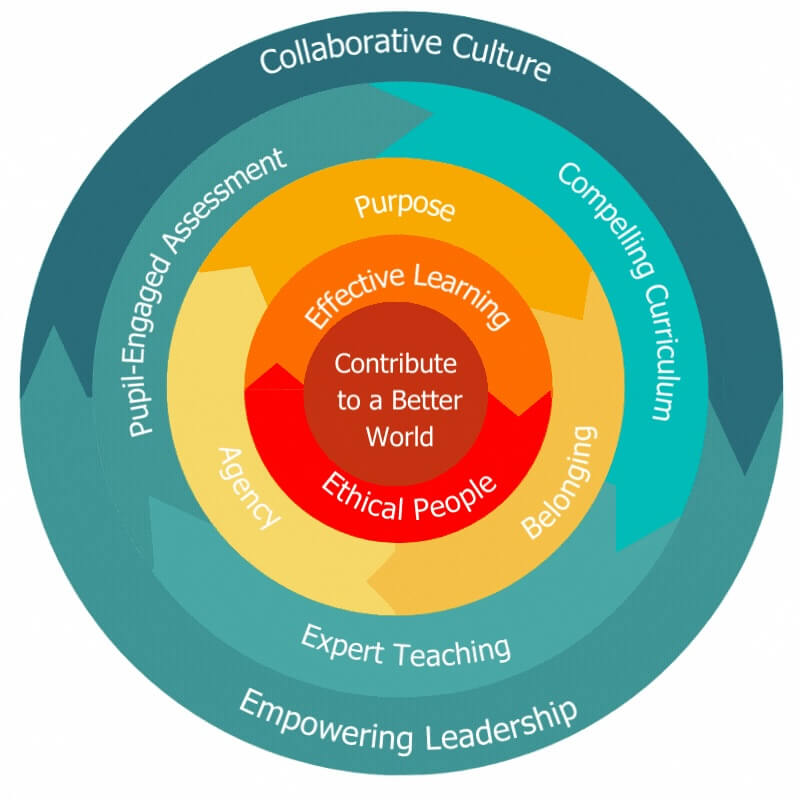
The cyclical model, such as those by Tyler and Taba, offers a systematic and iterative approach, ensuring that the curriculum evolves based on feedback and outcomes. By incorporating such models, educators can ensure that their curriculum is both effective and adaptable, capable of meeting diverse learning needs.

Practical Steps for Effective Curriculum Design

Designing an effective curriculum involves several key steps. Start by clearly defining learning outcomes that align with educational standards and institutional goals. This ensures that the curriculum is purposeful and contributes to the overall educational objectives.

Next, select relevant content that is both engaging and aligned with the learning outcomes. Consider incorporating diverse perspectives and real-world applications to make the content more meaningful for students. Use various instructional strategies to cater to different learning styles, promoting active participation and deeper understanding.

Integrate formative and summative assessments to monitor student progress and evaluate the effectiveness of the curriculum. Use feedback from assessments to make ongoing improvements, ensuring that the curriculum remains responsive to student needs and evolving educational standards.

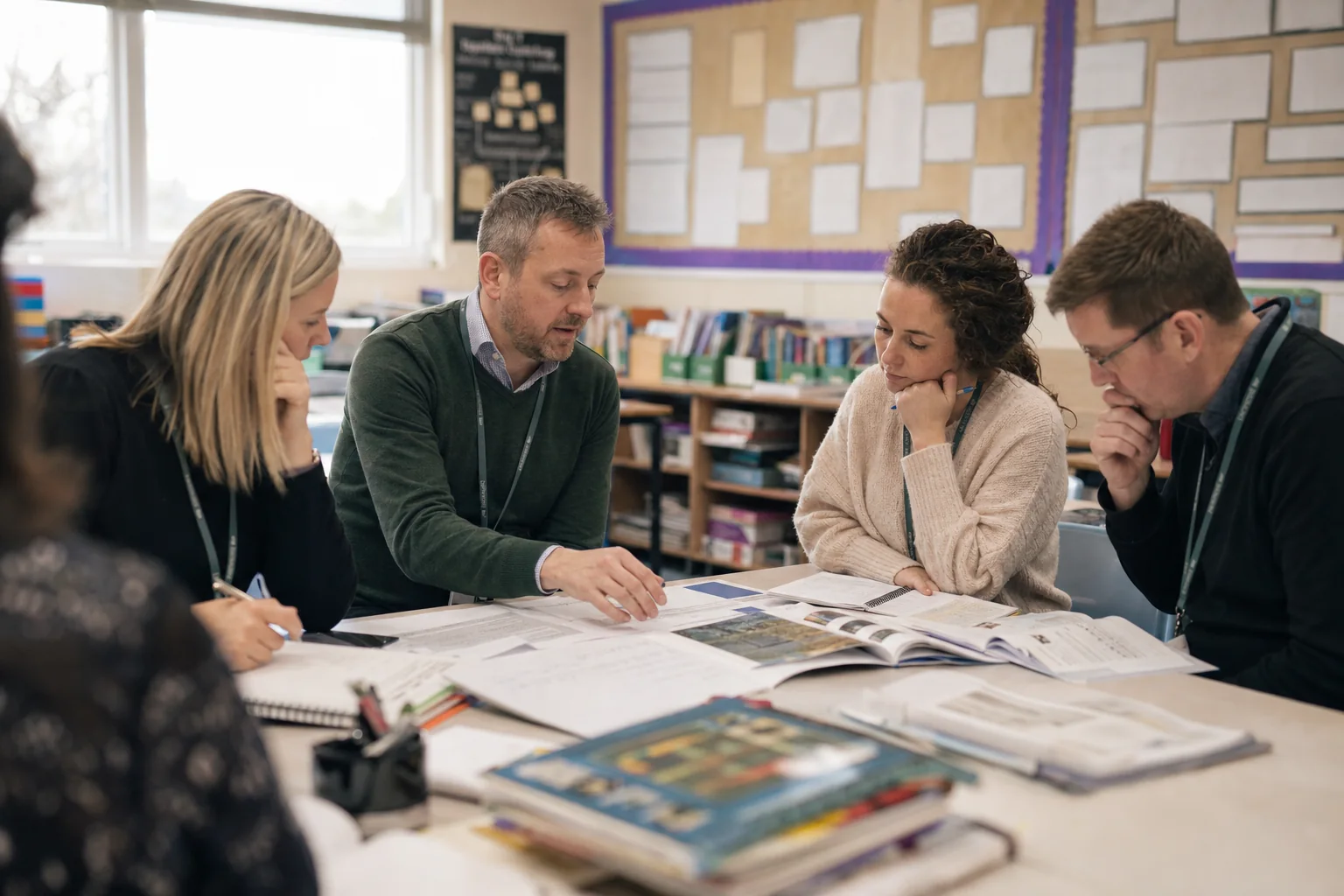
Finally, collaborate with other educators and stakeholders to gather diverse perspectives and ensure that the curriculum is comprehensive and well-rounded. This collaborative approach can lead to a more effective and effective curriculum that benefits all pupils.

How Can Teachers Track Progress Effectively?

Tracking student progress within your curriculum design isn't just about marking assignments. It's about creating a coherent system that reveals learning patterns and informs your teaching decisions. Many teachers find themselves drowning in data without understanding what it actually tells them about their curriculum's effectiveness.

Consider implementing learning checkpoints at regular intervals throughout your units. These aren't formal assessments, but rather quick temperature checks that show you whether students are ready to progress. For instance, a Year 7 science teacher might use exit tickets asking students to explain photosynthesis in their own words. If half the class struggles with this, you know your curriculum pacing needs adjustment before moving to cellular respiration.

The most effective tracking systems connect directly to your curriculum objectives. Rather than simply recording marks, note which specific skills students have mastered and which need revisiting. This approach transforms your gradebook into a diagnostic tool that actively shapes your curriculum delivery. You'll spot trends across the class that might indicate where your curriculum design needs tweaking, perhaps revealing that certain concepts need more scaffolding or different instructional approaches.

What Common Pitfalls Should Teachers Avoid?

The biggest mistake in curriculum design? Trying to cover everything. It's tempting to pack your curriculum with every possible topic, especially when you're passionate about your subject. But this often leads to surface-level learning where students memorise facts without developing deep understanding. A Year 9 history curriculum that races through 500 years in two terms leaves students confused rather than enlightened.

Another common pitfall is designing in isolation. Your brilliant curriculum plan might look perfect on paper, but if it doesn't align with what students are learning in other subjects, you're missing valuable opportunities for reinforcement. When the English department teaches persuasive writing whilst you're covering climate change in geography, that's a natural connection waiting to happen. Regular conversations with colleagues can transform your individual curriculum into part of a coherent whole-school approach.

Inflexibility poses perhaps the greatest threat to effective curriculum implementation. You've spent hours crafting the perfect sequence, but what happens when a global pandemic shifts everything online? Or when half your class struggles with prerequisite knowledge you assumed they'd have? The best curriculum designs include built-in flexibility points where you can adjust pacing, revisit concepts, or explore emerging student interests without derailing your overall objectives.

How Do Different Age Groups Shape Design?

Primary curriculum design requires a fundamentally different approach than secondary planning. Younger learners need more concrete experiences and shorter activity cycles. A Key Stage 1 maths curriculum might include manipulatives for every concept, whilst Key Stage 4 students can handle more abstract thinking. But it's not just about cognitive development - social and emotional readiness plays a crucial role too.

For secondary teachers, the challenge lies in balancing exam preparation with genuine learning. Your GCSE curriculum can't ignore specification requirements, but it shouldn't become a two-year revision course either. Successful secondary curriculum design weaves exam skills naturally throughout the learning journey. Rather than dedicating the final term to exam technique, you might incorporate past paper questions as regular classroom activities, helping students see them as learning tools rather than stress-inducing tests.

Transition points deserve special attention in your curriculum planning. The jump from Year 6 to Year 7, or from GCSE to A-level, often catches students unprepared. Smart curriculum design anticipates these gaps. A Year 7 curriculum might begin with bridging units that explicitly connect to primary learning whilst introducing secondary-level expectations. Similarly, A-level courses benefit from introductory modules that scaffold students from GCSE thinking patterns to more independent analysis.

How Can Teachers Navigate Curriculum Constraints?

Every teacher knows the frustration of trying to innovate whilst juggling statutory requirements, exam specifications, and limited resources. The reality is that curriculum design rarely happens in a vacuum. You're working within national curriculum frameworks, school policies, and perhaps most challengingly, time constraints that seem to shrink each year.

Start by mapping your non-negotiables first. What statutory content must you cover? Which skills are assessed in external examinations? Once you've identified these fixed points, you'll often find more flexibility than initially apparent. For instance, whilst teaching Shakespeare might be compulsory at Key Stage 3, how you approach it isn't. Could students create TikTok-style videos explaining Elizabethan context? Might they redesign the Globe Theatre using Minecraft? The curriculum framework provides the destination, but you're still the navigator choosing the route.

Consider adopting what experienced teachers call the "80-20 approach" to curriculum design. Spend 80% of your planning time on the 20% of content that proves most challenging for students. This doesn't mean neglecting other areas, but rather recognising where your creative energy yields the greatest impact. A Year 9 maths teacher recently shared how she transformed fraction work by linking it to music production and beat-making, maintaining rigour whilst dramatically improving engagement.

What Makes Curriculum Design Stick in Practice?

The best curriculum design crumbles without sustainable implementation strategies. You've probably witnessed brilliant schemes of work gathering dust in departmental folders, victims of over-ambition or under-resourcing. Successful implementation hinges on three often-overlooked factors: teacher workload, student transition points, and assessment alignment.

Begin with what researchers call "curriculum rehearsal" - essentially, teaching the curriculum to yourself before introducing it to students. This isn't about scripting lessons word-for-word, but rather stress-testing your design. Will that ambitious cross-curricular project work when you're marking 120 books? Can your carefully sequenced units survive the reality of a two-week gap for mock exams? Primary teachers often excel at this, regularly walking through activities themselves to spot potential confusion points.

Build in what many schools now term "curriculum breathing spaces" - deliberate pause points where students consolidate learning without new content. These aren't revision lessons or catch-up sessions, but rather opportunities for deeper exploration. A Year 7 history teacher in Manchester schedules "historian days" every half-term, where students apply learned skills to entirely new historical periods. She's found this approach actually accelerates progress, as students develop confidence in transferring knowledge independently.

How Do Different Year Groups Shape Design Decisions?

Curriculum design isn't simply scaled up or down for different ages - it fundamentally shifts based on cognitive development and prior learning. What works brilliantly for Year 2 might bore Year 6, whilst approaches perfect for Year 10 could overwhelm Year 7. Understanding these developmental considerations transforms curriculum design from theoretical exercise to practical tool.

For Key Stage 1, successful curriculum design often centres on concrete experiences and repetition within varied contexts. Teachers report success with "spiral" approaches where core concepts return in increasingly sophisticated forms. One Essex school redesigned their KS1 science curriculum around seasonal changes, with pupils revisiting key concepts every few months but through different lenses - art in autumn, data collection in winter, growing plants in spring.

Secondary curriculum design faces unique challenges around subject specialisation and exam preparation. Here's where vertical alignment becomes crucial. Are your Year 7 students genuinely prepared for GCSE-level thinking by Year 10? Many departments now use "reverse engineering" - starting with Year 11 outcomes and working backwards. This isn't about introducing GCSE content early, but ensuring fundamental skills develop progressively. A languages department in Birmingham mapped every grammatical structure from GCSE specifications back through KS3, identifying exactly when and how each element should first appear. The result? Their GCSE results improved by 23% over two years, with teachers reporting less reteaching needed in Years 10-11.

Evaluating Curriculum Design

Evaluating curriculum design is essential to ensure its effectiveness and alignment with educational goals. Start by assessing whether the curriculum meets the defined learning outcomes. This involves gathering data on student performance, engagement, and satisfaction.

Consider using a variety of evaluation methods, such as surveys, focus groups, and classroom observations, to gather comprehensive feedback from students, teachers, and other stakeholders. This multifaceted approach provides a complete view of the curriculum's strengths and weaknesses.

Use the evaluation results to make informed decisions about curriculum revisions and improvements. Focus on addressing any identified gaps or areas of concern, ensuring that the curriculum remains relevant and effective. Continuous evaluation and improvement are key to maintaining a high-quality educational experience for students.

By following these steps and tips, educators can create and maintain a curriculum that enhances student learning and prepares them for future success. Effective curriculum design is a dynamic process that requires ongoing reflection and adaptation to meet the evolving needs of pupils and the educational landscape.

mastering curriculum design helps educators to transform their educational vision into reality, creating engaging and impactful learning experiences for their pupils. By understanding the nuances of curriculum models, development, and evaluation, teachers can ensure their lessons are not only informative but also inspiring and effective. Embrace these strategies to enhance your teaching and enrich the educational journey for every pupil.

Further Reading

To deepen your understanding of curriculum design, consider exploring these research papers:

  1. Print, M. (1993). *Curriculum Development and Design*. Allen & Unwin. This book provides a comprehensive overview of curriculum development and design principles, offering practical guidance for educators.
  2. Tyler, R. W. (1949). *Basic Principles of Curriculum and Instruction*. University of Chicago Press. A foundational text in curriculum theory, outlining key principles for effective curriculum planning and implementation.
  3. Taba, H. (1962). *Curriculum Development: Theory and Practice*. Harcourt, Brace & World. This book explores the theoretical underpinnings of curriculum development and offers practical strategies for designing effective curricula.
  4. Wiggins, G., & McTighe, J. (2005). *Understanding by Design*. Association for Supervision and Curriculum Development. A guide to designing curricula with a focus on achieving deep understanding and meaningful learning outcomes.
  5. Ornstein, A. C., & Hunkins, F. P. (2017). *Curriculum: Foundations, Principles, and Issues*. Pearson. This text provides a broad overview of curriculum studies, covering historical, philosophical, and social foundations, as well as contemporary issues and trends.

15 Principles for Effective Curriculum Design

  1. 1. Begin with a clear vision of what students should know and do
  2. 2. Identify the powerful knowledge essential to your subject
  3. 3. Sequence content logically, building from simple to complex
  4. 4. Map vertical progression across year groups
  5. 5. Ensure horizontal coherence within each year
  6. 6. Build in regular opportunities for retrieval and review
  7. 7. Design for cumulative learning, not isolated units
  8. 8. Include explicit vocabulary instruction throughout
  9. 9. Plan for addressing common misconceptions
  10. 10. Create clear success criteria for each unit
  11. 11. Build in flexibility for responsive teaching
  12. 12. Ensure representation and diverse perspectives
  13. 13. Align assessment with curriculum intentions
  14. 14. Plan cross-curricular connections where meaningful
  15. 15. Review and refine based on student outcomes data
Loading audit...

Curriculum design can often feel daunting, yet it is a fundamental aspect of effective education. With the right approach and tools, transforming your educational vision into a structured curriculum is not only achievable but also rewarding. Understanding the nuances of curriculum design is essential for educators striving for excellence in teaching.

Key Takeaways

  1. Beyond One-Size-Fits-All: Discover why switching between subject-centered, learner-centered, and problem-centered models transforms engagement, especially for pupils with diverse learning needs
  2. Design vs Development Decoded: Master the critical distinction that determines whether your curriculum stays theoretical or becomes practical classroom magic
  3. The Balance Blueprint: Navigate the breadth versus depth dilemma with coherent instruction strategies that prepare students for real-world complexity
  4. Critical Thinking Integration: Transform passive lessons into active exploration using metacognition and collaborative thinking processes that deepen understanding across subjects

Curriculum design encompasses various definitions, methodologies, and models crucial to delivering an impactful educational experience. Distinguishing between curriculum development and design can significantly affect how educational programs are perceived and implemented. By recognising the importance of different curriculum models, such as subject-centered, learner-centered, and problem-centered approaches, educators can create engaging and responsive learning environments.

This article offers a streamlined guide to mastering curriculum design through practical steps, valuable tips, and evaluation strategies. Whether you are a seasoned educator or just starting, these insights will enable teachers to simplify the curriculum design process and enhance the classroom activities of your students.

What is Curriculum Design?

Curriculum Design Models

ModelKey FeaturesStrengthsConsiderations
Backward DesignStart with end goalsEnsures alignmentRequires clear outcomes
Spiral CurriculumRevisit with increasing depthBuilds on prior learningNeeds careful mapping
Thematic DesignOrganise around themesMeaningful connectionsCan miss key content
Competency-BasedFocus on demonstrated skillsPersonalised paceAssessment challenges
Knowledge-RichPrioritise substantive knowledgeStrong foundationsBalance with skills

Curriculum design is the process of organising educational content, activities, and assessments for a course or class. It involves setting clear learning goals and aligning materials to achieve desired learning outcomes. This structured approach helps meet students' needs through subject-centered, learner-centered, or problem-centered designs.

Comparison table showing three curriculum design models and their key characteristics
Side-by-side comparison table: Three Curriculum Design Models

Subject-centered curriculum design primarily focuses on specific subject matter, ensuring that content is thoroughly covered. Learner-centered designs prioritise individual student engagement, tailoring lessons to students' needs and interests. Problem-centered designs emphasise real-world problems, encouraging critical thinking and problem-solving skills.

Curriculum development serves as the framework for an educational program. Curriculum design translates this into practical, actionable formats, facilitating the daily organisation of lessons and instructional materials. This structured method ensures that educators effectively achieve learning objectives, using tailored instructional strategies and technology.

Key goals in curriculum design include a focus on student engagement, continuous improvement, and the clear organisation of activities across whole-school systems and beyond. These elements collectively enhance the educational experience for students, preparing them for future academic or professional endeavors.

Curriculum Design Principles

Differences Between Curriculum Development and Curriculum Design

Curriculum development and curriculum design are often used interchangeably but have distinct roles in education. Curriculum development involves the comprehensive creation of a curriculum that aligns with educational goals and the institution's mission. It encompasses planning, implementation, and evaluation phases, focusing on key learning outcomes, content selection, and course sequencing based on learning theories.

Infographic comparing curriculum development versus curriculum design showing key differences
Curriculum Development vs Curriculum Design

On the other hand, curriculum design is more tactical and focuses on the organisational plan for educators. It involves structuring courses and crafting lesson plans to enhance student learning through differentiation strategies. While curriculum development covers the broad conceptual framework, curriculum design aims at improving the delivery of education by considering past and future subjects students will learn.

Infographic comparing curriculum development vs design showing strategic vs tactical focus
Development vs Design

curriculum development sets the strategic foundation, whereas curriculum design fine-tunes the educational structure to improve lessons. Both are essential for crafting effective educational programs but operate at different stages of the curriculum process.

Importance of Curriculum Models

Curriculum models provide a structured approach to curriculum design, serving as essential guides for educators during creation and implementation. Prescriptive models target the goals of a curriculum, outlining what curriculum designers should achieve. Descriptive models, conversely, showcase the practical activities and strategies employed during development. These models ensure that elements like content, teaching strategies, summative assessments, and evaluations are cohesively integrated, ultimatelely enhancing the educational experience.

The subject-centred model focuses on delivering a comprehensive understanding of specific subjects, making it suitable for disciplines that require a structured knowledge base. The learner-centred model allows for greater customisation, catering to individual needs and promoting deeper engagement. Meanwhile, the problem-centred model creates practical skills, preparing pupils to tackle real-world challenges through critical thinking and effective solutions.

The cyclical model, such as those by Tyler and Taba, offers a systematic and iterative approach, ensuring that the curriculum evolves based on feedback and outcomes. By incorporating such models, educators can ensure that their curriculum is both effective and adaptable, capable of meeting diverse learning needs.

Practical Steps for Effective Curriculum Design

Designing an effective curriculum involves several key steps. Start by clearly defining learning outcomes that align with educational standards and institutional goals. This ensures that the curriculum is purposeful and contributes to the overall educational objectives.

Next, select relevant content that is both engaging and aligned with the learning outcomes. Consider incorporating diverse perspectives and real-world applications to make the content more meaningful for students. Use various instructional strategies to cater to different learning styles, promoting active participation and deeper understanding.

Integrate formative and summative assessments to monitor student progress and evaluate the effectiveness of the curriculum. Use feedback from assessments to make ongoing improvements, ensuring that the curriculum remains responsive to student needs and evolving educational standards.

Finally, collaborate with other educators and stakeholders to gather diverse perspectives and ensure that the curriculum is comprehensive and well-rounded. This collaborative approach can lead to a more effective and effective curriculum that benefits all pupils.

How Can Teachers Track Progress Effectively?

Tracking student progress within your curriculum design isn't just about marking assignments. It's about creating a coherent system that reveals learning patterns and informs your teaching decisions. Many teachers find themselves drowning in data without understanding what it actually tells them about their curriculum's effectiveness.

Consider implementing learning checkpoints at regular intervals throughout your units. These aren't formal assessments, but rather quick temperature checks that show you whether students are ready to progress. For instance, a Year 7 science teacher might use exit tickets asking students to explain photosynthesis in their own words. If half the class struggles with this, you know your curriculum pacing needs adjustment before moving to cellular respiration.

The most effective tracking systems connect directly to your curriculum objectives. Rather than simply recording marks, note which specific skills students have mastered and which need revisiting. This approach transforms your gradebook into a diagnostic tool that actively shapes your curriculum delivery. You'll spot trends across the class that might indicate where your curriculum design needs tweaking, perhaps revealing that certain concepts need more scaffolding or different instructional approaches.

What Common Pitfalls Should Teachers Avoid?

The biggest mistake in curriculum design? Trying to cover everything. It's tempting to pack your curriculum with every possible topic, especially when you're passionate about your subject. But this often leads to surface-level learning where students memorise facts without developing deep understanding. A Year 9 history curriculum that races through 500 years in two terms leaves students confused rather than enlightened.

Another common pitfall is designing in isolation. Your brilliant curriculum plan might look perfect on paper, but if it doesn't align with what students are learning in other subjects, you're missing valuable opportunities for reinforcement. When the English department teaches persuasive writing whilst you're covering climate change in geography, that's a natural connection waiting to happen. Regular conversations with colleagues can transform your individual curriculum into part of a coherent whole-school approach.

Inflexibility poses perhaps the greatest threat to effective curriculum implementation. You've spent hours crafting the perfect sequence, but what happens when a global pandemic shifts everything online? Or when half your class struggles with prerequisite knowledge you assumed they'd have? The best curriculum designs include built-in flexibility points where you can adjust pacing, revisit concepts, or explore emerging student interests without derailing your overall objectives.

How Do Different Age Groups Shape Design?

Primary curriculum design requires a fundamentally different approach than secondary planning. Younger learners need more concrete experiences and shorter activity cycles. A Key Stage 1 maths curriculum might include manipulatives for every concept, whilst Key Stage 4 students can handle more abstract thinking. But it's not just about cognitive development - social and emotional readiness plays a crucial role too.

For secondary teachers, the challenge lies in balancing exam preparation with genuine learning. Your GCSE curriculum can't ignore specification requirements, but it shouldn't become a two-year revision course either. Successful secondary curriculum design weaves exam skills naturally throughout the learning journey. Rather than dedicating the final term to exam technique, you might incorporate past paper questions as regular classroom activities, helping students see them as learning tools rather than stress-inducing tests.

Transition points deserve special attention in your curriculum planning. The jump from Year 6 to Year 7, or from GCSE to A-level, often catches students unprepared. Smart curriculum design anticipates these gaps. A Year 7 curriculum might begin with bridging units that explicitly connect to primary learning whilst introducing secondary-level expectations. Similarly, A-level courses benefit from introductory modules that scaffold students from GCSE thinking patterns to more independent analysis.

How Can Teachers Navigate Curriculum Constraints?

Every teacher knows the frustration of trying to innovate whilst juggling statutory requirements, exam specifications, and limited resources. The reality is that curriculum design rarely happens in a vacuum. You're working within national curriculum frameworks, school policies, and perhaps most challengingly, time constraints that seem to shrink each year.

Start by mapping your non-negotiables first. What statutory content must you cover? Which skills are assessed in external examinations? Once you've identified these fixed points, you'll often find more flexibility than initially apparent. For instance, whilst teaching Shakespeare might be compulsory at Key Stage 3, how you approach it isn't. Could students create TikTok-style videos explaining Elizabethan context? Might they redesign the Globe Theatre using Minecraft? The curriculum framework provides the destination, but you're still the navigator choosing the route.

Consider adopting what experienced teachers call the "80-20 approach" to curriculum design. Spend 80% of your planning time on the 20% of content that proves most challenging for students. This doesn't mean neglecting other areas, but rather recognising where your creative energy yields the greatest impact. A Year 9 maths teacher recently shared how she transformed fraction work by linking it to music production and beat-making, maintaining rigour whilst dramatically improving engagement.

What Makes Curriculum Design Stick in Practice?

The best curriculum design crumbles without sustainable implementation strategies. You've probably witnessed brilliant schemes of work gathering dust in departmental folders, victims of over-ambition or under-resourcing. Successful implementation hinges on three often-overlooked factors: teacher workload, student transition points, and assessment alignment.

Begin with what researchers call "curriculum rehearsal" - essentially, teaching the curriculum to yourself before introducing it to students. This isn't about scripting lessons word-for-word, but rather stress-testing your design. Will that ambitious cross-curricular project work when you're marking 120 books? Can your carefully sequenced units survive the reality of a two-week gap for mock exams? Primary teachers often excel at this, regularly walking through activities themselves to spot potential confusion points.

Build in what many schools now term "curriculum breathing spaces" - deliberate pause points where students consolidate learning without new content. These aren't revision lessons or catch-up sessions, but rather opportunities for deeper exploration. A Year 7 history teacher in Manchester schedules "historian days" every half-term, where students apply learned skills to entirely new historical periods. She's found this approach actually accelerates progress, as students develop confidence in transferring knowledge independently.

How Do Different Year Groups Shape Design Decisions?

Curriculum design isn't simply scaled up or down for different ages - it fundamentally shifts based on cognitive development and prior learning. What works brilliantly for Year 2 might bore Year 6, whilst approaches perfect for Year 10 could overwhelm Year 7. Understanding these developmental considerations transforms curriculum design from theoretical exercise to practical tool.

For Key Stage 1, successful curriculum design often centres on concrete experiences and repetition within varied contexts. Teachers report success with "spiral" approaches where core concepts return in increasingly sophisticated forms. One Essex school redesigned their KS1 science curriculum around seasonal changes, with pupils revisiting key concepts every few months but through different lenses - art in autumn, data collection in winter, growing plants in spring.

Secondary curriculum design faces unique challenges around subject specialisation and exam preparation. Here's where vertical alignment becomes crucial. Are your Year 7 students genuinely prepared for GCSE-level thinking by Year 10? Many departments now use "reverse engineering" - starting with Year 11 outcomes and working backwards. This isn't about introducing GCSE content early, but ensuring fundamental skills develop progressively. A languages department in Birmingham mapped every grammatical structure from GCSE specifications back through KS3, identifying exactly when and how each element should first appear. The result? Their GCSE results improved by 23% over two years, with teachers reporting less reteaching needed in Years 10-11.

Evaluating Curriculum Design

Evaluating curriculum design is essential to ensure its effectiveness and alignment with educational goals. Start by assessing whether the curriculum meets the defined learning outcomes. This involves gathering data on student performance, engagement, and satisfaction.

Consider using a variety of evaluation methods, such as surveys, focus groups, and classroom observations, to gather comprehensive feedback from students, teachers, and other stakeholders. This multifaceted approach provides a complete view of the curriculum's strengths and weaknesses.

Use the evaluation results to make informed decisions about curriculum revisions and improvements. Focus on addressing any identified gaps or areas of concern, ensuring that the curriculum remains relevant and effective. Continuous evaluation and improvement are key to maintaining a high-quality educational experience for students.

By following these steps and tips, educators can create and maintain a curriculum that enhances student learning and prepares them for future success. Effective curriculum design is a dynamic process that requires ongoing reflection and adaptation to meet the evolving needs of pupils and the educational landscape.

mastering curriculum design helps educators to transform their educational vision into reality, creating engaging and impactful learning experiences for their pupils. By understanding the nuances of curriculum models, development, and evaluation, teachers can ensure their lessons are not only informative but also inspiring and effective. Embrace these strategies to enhance your teaching and enrich the educational journey for every pupil.

Further Reading

To deepen your understanding of curriculum design, consider exploring these research papers:

  1. Print, M. (1993). *Curriculum Development and Design*. Allen & Unwin. This book provides a comprehensive overview of curriculum development and design principles, offering practical guidance for educators.
  2. Tyler, R. W. (1949). *Basic Principles of Curriculum and Instruction*. University of Chicago Press. A foundational text in curriculum theory, outlining key principles for effective curriculum planning and implementation.
  3. Taba, H. (1962). *Curriculum Development: Theory and Practice*. Harcourt, Brace & World. This book explores the theoretical underpinnings of curriculum development and offers practical strategies for designing effective curricula.
  4. Wiggins, G., & McTighe, J. (2005). *Understanding by Design*. Association for Supervision and Curriculum Development. A guide to designing curricula with a focus on achieving deep understanding and meaningful learning outcomes.
  5. Ornstein, A. C., & Hunkins, F. P. (2017). *Curriculum: Foundations, Principles, and Issues*. Pearson. This text provides a broad overview of curriculum studies, covering historical, philosophical, and social foundations, as well as contemporary issues and trends.

15 Principles for Effective Curriculum Design

  1. 1. Begin with a clear vision of what students should know and do
  2. 2. Identify the powerful knowledge essential to your subject
  3. 3. Sequence content logically, building from simple to complex
  4. 4. Map vertical progression across year groups
  5. 5. Ensure horizontal coherence within each year
  6. 6. Build in regular opportunities for retrieval and review
  7. 7. Design for cumulative learning, not isolated units
  8. 8. Include explicit vocabulary instruction throughout
  9. 9. Plan for addressing common misconceptions
  10. 10. Create clear success criteria for each unit
  11. 11. Build in flexibility for responsive teaching
  12. 12. Ensure representation and diverse perspectives
  13. 13. Align assessment with curriculum intentions
  14. 14. Plan cross-curricular connections where meaningful
  15. 15. Review and refine based on student outcomes data

Curriculum

Back to Blog

{"@context":"https://schema.org","@graph":[{"@type":"Article","@id":"https://www.structural-learning.com/post/curriculum-design#article","headline":"Curriculum Design Made Easy","description":"Explore curriculum design strategies that create meaningful, connected learning, support critical thinking, and enhance student engagement.","datePublished":"2024-11-11T16:55:00.211Z","dateModified":"2026-01-26T10:09:32.212Z","author":{"@type":"Person","name":"Paul Main","url":"https://www.structural-learning.com/team/paulmain","jobTitle":"Founder & Educational Consultant"},"publisher":{"@type":"Organization","name":"Structural Learning","url":"https://www.structural-learning.com","logo":{"@type":"ImageObject","url":"https://cdn.prod.website-files.com/5b69a01ba2e409e5d5e055c6/6040bf0426cb415ba2fc7882_newlogoblue.svg"}},"mainEntityOfPage":{"@type":"WebPage","@id":"https://www.structural-learning.com/post/curriculum-design"},"image":"https://cdn.prod.website-files.com/5b69a01ba2e409501de055d1/696a39cd4d3a37e4aaed78fa_696a39c89823bf60014b96f5_curriculum-design-illustration.webp","wordCount":2746},{"@type":"BreadcrumbList","@id":"https://www.structural-learning.com/post/curriculum-design#breadcrumb","itemListElement":[{"@type":"ListItem","position":1,"name":"Home","item":"https://www.structural-learning.com/"},{"@type":"ListItem","position":2,"name":"Blog","item":"https://www.structural-learning.com/blog"},{"@type":"ListItem","position":3,"name":"Curriculum Design Made Easy","item":"https://www.structural-learning.com/post/curriculum-design"}]}]}