Curriculum for excellence: A school guide

Updated on  

February 3, 2026

Curriculum for excellence: A school guide

|

January 4, 2022

Discover how Scotland's Curriculum for Excellence framework empowers teachers with flexibility to develop successful learners aged 3-18 through innovative teaching.

Course Enquiry
Copy citation

Main, P (2022, January 04). Curriculum for excellence: A school guide. Retrieved from https://www.structural-learning.com/post/curriculum-for-excellence-a-school-guide

What is the Curriculum for Excellence in Scotland?

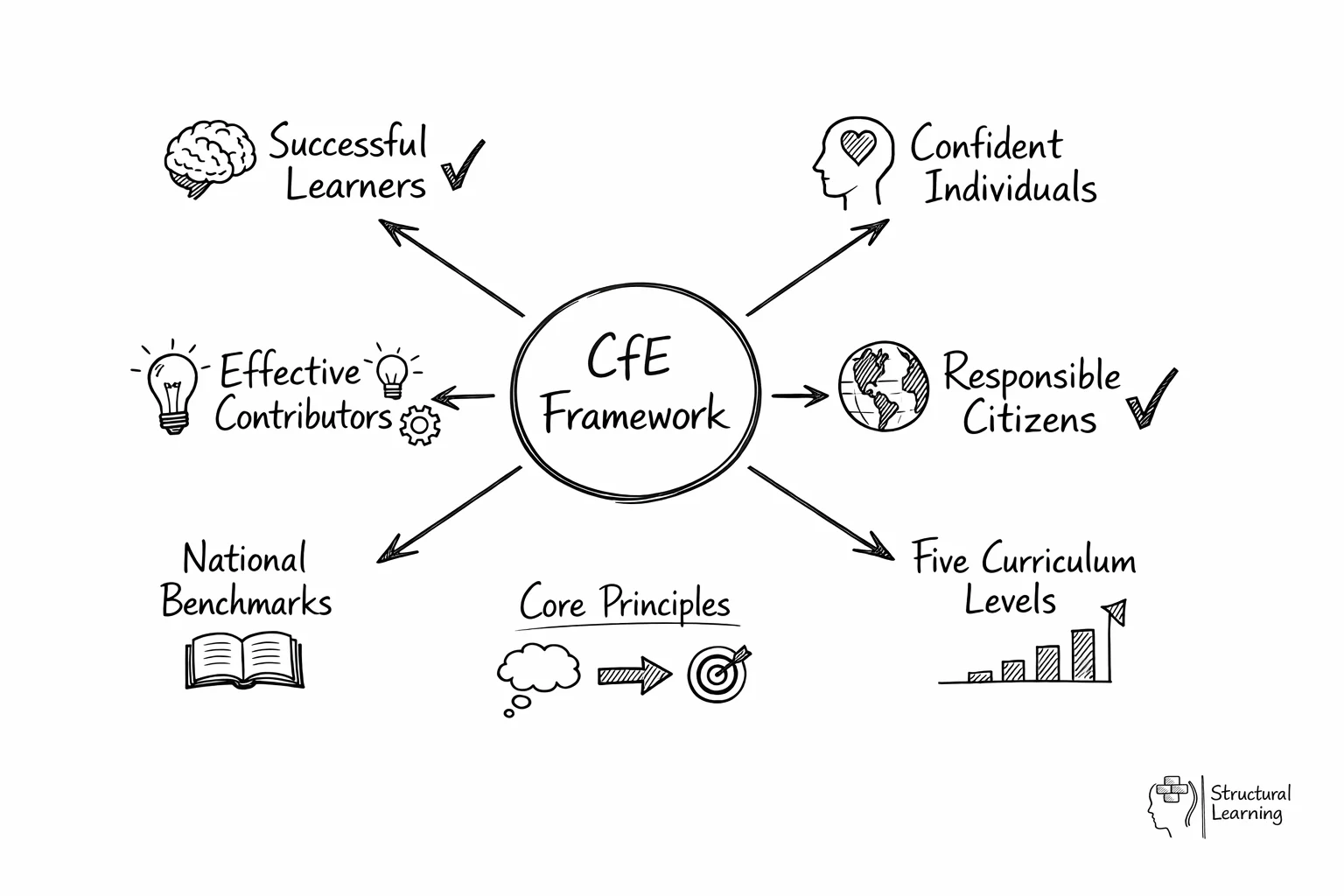
The Curriculum for Excellence (CfE) is Scotland's national curriculum framework for children aged 3-18, introduced to improve teaching quality and prepare young people as lifelong learners. It focuses on developing four capacities: successful learners, confident individuals, effective contributors, and responsible citizens. The curriculum provides teachers with greater autonomy and flexibility to meet individual student needs while maintaining national standards.

Hub diagram showing CfE's four capacities radiating from central framework
Hub-and-spoke diagram: Curriculum for Excellence Framework Structure

The Scottish Government introduced CfE in order to improve the quality of teaching and learning with a specific goal to prepare young people for their future and help them become life-long learners. By overhauling educational standards and practices, the curriculum could help reform the Scottish education system. As leaders continue to search for effective curriculum design models, consider the potential of CfE in allowing greater autonomy for teachers and flexibility for students.
Key Takeaways

  1. Master Scotland's CfE Framework: Navigate the four capacities and five curriculum levels to unlock greater teaching autonomy and flexible learning pathways for your pupils
  2. Beyond Academic Achievement: Discover how CfE's whole-child approach transforms traditional lessons into opportunities for developing confident individuals and responsible citizens
  3. Track Progress Differently: Use learner journey evidence and national benchmarks to create meaningful assessments that capture real development, not just test scores
  4. The Hidden Curriculum Power: Why CfE's emphasis on life skills and active citizenship might be the missing link in preparing pupils for 21st-century challenges

Curriculum policies are the guidelines that allow teachers to have the creative freedom and flexibility to meet the needs of their students. In line with CfE, guidelines for best practices must support student autonomy, peace education, active citizenship, informed decision making, and developing confidence within learners. To ensure that curriculum policies are being followed and making a positive impact on learning outcomes, they should also consider evidence-driven research into educational initiatives.

Curriculum for Excellence (CfE) - Scotland's curriculum helps young people and children belonging to the 3-18 age range, gain the knowledge, attributes, and skills needed to thrive in the 21st century. At Structural Learning, our coherent approach to embedding knowledge-rich curriculum might be an interesting starting point for any school that is currently undertaking curriculum reform. The changes to curriculum practice have been largely welcomed by school leaders. With an emphasis on skills for learning, students will leave school with the essential attributes of a lifelong learner.

The SCE provides a framework for teaching children at primary school level, through to post-16 education. It includes a set of learning outcomes, standards and assessments. These are designed to ensure that every child receives a quality education.

The SCE is based on three core principles:

• Learning should be relevant to life;

• Learning should be challenging;

• Learning should be enjoyable.

The central aim is that these principles underpin everything that is taught to pupils. They help teachers to develop children as individuals, who are able to achieve their full potential. The SCE helps teachers to plan lessons and deliver effective instruction. It ensures that students receive a consistent and well-rounded education.

The Sce is not just about academic achievement. It focuses on developing young people as whole human beings. This means helping them to become independent learners, confident communicators and active citizens

The main purpose of CfE is to enable all the students to become:

  • Confident individuals;
  • Successful learners;
  • Effective contributors; and
  • Responsible citizens.
  • How do National Benchmarks work in the Curriculum for Excellence?

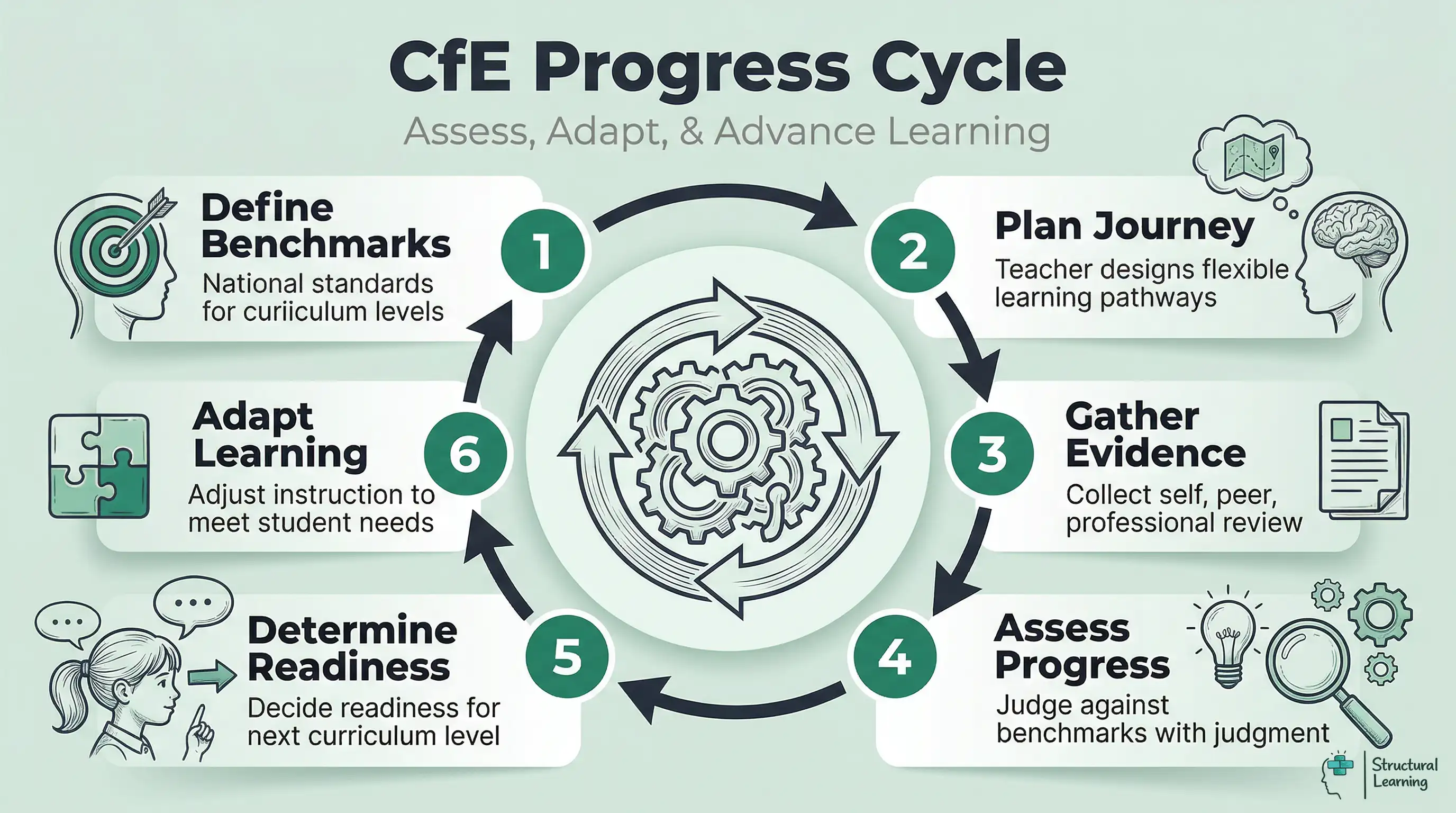
    National Benchmarks in CfE provide clear statements about what learners should know and be able to do at each curriculum level across all subject areas. They help teachers assess progress consistently by outlining specific skills and knowledge expectations for early, first, second, third, and fourth levels. Teachers use these benchmarks alongside professional judgment to determine when a pupil has achieved a level and is ready to progress.

    Curriculum for Excellence Benchmarks has been formulated to clarify the national standards at each coherent curriculum level within each curriculum area.

    Learner journeys provide valuable evidence of progress and achievement for teachers. Learner journeys show the progress of individuals and across learning areas, allowing teachers to assess performance outcomes against identified standards. Learner journey evidence includes self-assessment, peer assessment and professional review. This type of evidence is crucial in improving quality assurance processes and offering personalized learning experiences for different pupils.

    Curriculum for Excellence Benchmarks provide a common framework for teachers and other education professionals to evaluate performance against these standards. This allows for a consistent approach to be taken across the board, regardless of who is assessing the learner journey evidence. The Common Framework also offers a degree of flexibility that can be tailored to different learning contexts and provides teachers with an invaluable resource in helping their pupils reach their full potential.

    Key principles of the Curriculum for Excellence Benchmarks embark clear lines of progression in English, in literacy, mathematics and numeracy, and over other curriculum areas from the Early arly Level to Fourth Level. Curriculum for Excellence Benchmarks are designed to support teachers with professional judgements, exemplification of standards, and approaches to assessment (as well as moderation).

    What are the Levels in the Curriculum for Excellence?

    CfE is structured around five curriculum levels: Early, First, Second, Third, and Fourth. Each level builds upon the previous one, providing a progression of learning experiences appropriate for different age groups and stages of development. While age ranges are associated with each level, progression is based on individual achievement rather than age. Senior Phase covers learning beyond the Fourth Level.

    • Early Level: Nursery to Primary 1
    • First Level: Primary 2 to Primary 4
    • Second Level: Primary 5 to Primary 7
    • Third Level: Secondary 1 to Secondary 3
    • Fourth Level: Secondary 4 to Secondary 6

    The flexibility of these levels allows teachers to personalise learning and set attainable targets for pupils of all abilities. In doing so, this helps to ensure that no child is left behind and that every child can reach their full potential.

    The Curriculum for Excellence framework helps teachers adapt their teaching methods to meet the needs of each individual child. The flexibility of this approach ensures that teachers are able to provide a supportive and stimulating learning environment for their pupils, where they can develop their skills and knowledge in an atmosphere of trust and respect.

    What are the Four Capacities in Curriculum for Excellence?

    The four capacities represent the fundamental purpose of Curriculum for Excellence, defining what we aim to develop in every young person across all learning experiences. These capacities, successful learners, confident individuals, responsible citizens, and effective contributors, work interconnectedly rather than in isolation, creating a complete framework that goes beyond traditional subject-based achievement to encompass the full development of each learner.

    Successful learners demonstrate enthusiasm for learning, determination to reach high standards, and the ability to use literacy, communication, and numeracy skills effectively. Confident individuals have self-respect, pursue a healthy lifestyle, and are self-aware with developing views and opinions. Responsible citizens respect others, commit to participate responsibly in political, economic, social, and cultural life, and develop knowledge of the world and Scotland's place within it. Effective contributors communicate in different ways, work in partnership and teams, solve problems, and take initiative and leadership.

    In practice, these capacities should be explicitly planned for and assessed across all curricular areas and experiences. Teachers can develop learners' capacities through varied learning approaches, collaborative tasks, and real-world problem-solving opportunities that require students to draw upon multiple capacities simultaneously, ensuring experiences and outcomes contribute meaningfully to young people's overall development as rounded individuals.

    Understanding Experiences and Outcomes in CfE

    Experiences and Outcomes form the backbone of Curriculum for Excellence, providing clear statements of what learners should know, understand and be able to do at each stage of their educational journey. These statements are deliberately broad and flexible, allowing teachers to exercise professional judgement in determining how best to achieve them within their unique classroom contexts. Rather than prescriptive content lists, Experiences and Outcomes describe the knowledge, skills and attributes that support learners in developing as successful learners, confident individuals, responsible citizens and effective contributors.

    The structure of Experiences and Outcomes reflects the interconnected nature of learning, with statements organised across curriculum areas and levels from Early through to Fourth Level. Each outcome begins with an active verb, emphasising what learners will do rather than simply what they will know. This approach aligns with constructivist learning theory, recognising that deep understanding develops through active engagement with concepts and skills rather than passive absorption of information.

    In practice, effective use of Experiences and Outcomes requires teachers to identify the key learning intentions within each statement and design learning experiences that allow pupils to demonstrate their understanding in meaningful ways. This might involve clustering related outcomes to create coherent learning sequences, or using a single rich task to address multiple outcomes simultaneously, ensuring personalisation and choice remains central to the learning process.

    Curricular Areas in Curriculum for Excellence

    Curriculum for Excellence organises learning through eight distinct curricular areas, each designed to develop the four capacities whilst providing coherent educational experiences. These areas comprise Expressive Arts, Health and Wellbeing, Languages, Mathematics, Religious and Moral Education, Sciences, Social Studies, and Technologies. Rather than functioning as isolated subjects, these curricular areas work interdependently to create meaningful connections that reflect real-world learning contexts and support authentic learner progression.

    Each curricular area contains carefully structured experiences and outcomes that provide clear expectations whilst allowing scope for personalisation and choice. The framework recognises that effective learning often transcends traditional subject boundaries, encouraging teachers to identify natural links between areas. For instance, a project exploring renewable energy might authentically combine Sciences, Mathematics, Technologies, and Social Studies, creating richer learning experiences that mirror how knowledge operates in practice.

    In classroom application, teachers should view these curricular areas as flexible organising principles rather than rigid compartments. Professional judgement remains crucial in determining when to focus on specific areas and when to create meaningful interdisciplinary connections. This approach enables educators to respond to learner needs whilst ensuring comprehensive coverage of essential knowledge, skills, and understanding across all eight areas.

    Assessment Approaches in Curriculum for Excellence

    Assessment within Curriculum for Excellence requires a fundamental shift from traditional testing towards ongoing evaluation of learner progression across the four capacities. Teachers must develop robust professional judgement to assess not only knowledge acquisition but also skills development, demonstrating how learners are becoming successful learners, confident individuals, responsible citizens, and effective contributors. This complete approach demands multiple assessment strategies that capture the breadth of experiences and outcomes whilst maintaining clear evidence of progression through curriculum levels.

    Effective moderation practices ensure consistency and reliability across schools, with teachers collaborating to develop shared understanding of standards and expectations. Regular moderation meetings, both within departments and across establishments, allow educators to calibrate their professional judgement against agreed benchmarks. Black and Wiliam's research on formative assessment emphasises that meaningful feedback, rather than grades alone, drives learning forward, supporting the Curriculum for Excellence emphasis on personalisation and choice in learning pathways.

    Practically, teachers should maintain diverse evidence portfolios that demonstrate learner achievement across different contexts and subjects. This might include peer assessments, self-evaluations, project work, and collaborative tasks alongside more traditional methods. The key lies in using assessment information to inform next steps in learning, ensuring that evaluation serves learning rather than simply measuring it.

    Planning Effective Learning with CfE

    Effective planning within Curriculum for Excellence requires a fundamental shift from content-driven approaches to learner-centred design that prioritises progression and depth over coverage. Teachers must begin with the experiences and outcomes as their foundation, but resist the temptation to treat these as rigid checklists. Instead, professional judgement should guide the selection of meaningful contexts that allow learners to develop skills, knowledge and understanding across multiple curriculum areas simultaneously.

    The planning process becomes most powerful when teachers work backwards from the four capacities, considering how each learning experience will contribute to developing successful learners, confident individuals, responsible citizens and effective contributors. This approach aligns with Wiggins and McTighe's understanding by design principles, ensuring that assessment opportunities are built into the learning journey from the outset rather than bolted on afterwards.

    In practice, effective CfE planning embraces personalisation and choice through flexible groupings, varied learning pathways and differentiated success criteria that reflect learners' individual starting points. Teachers should plan for regular opportunities to gather evidence of learning, using this to inform next steps and adjust the pace of progression accordingly.

    Conclusion

    The Curriculum for Excellence represents a significant shift in Scottish education, prioritising complete development and lifelong learning skills. By understanding the four capacities, utilising national benchmarks, and embracing the flexibility offered within the framework, educators can helps students to become successful learners, confident individuals, effective contributors, and responsible citizens. The key is to see CfE as a set of guidelines and as a dynamic approach to developing well-rounded individuals prepared for the challenges and opportunities of the 21st century.

    Ultimately, the success of the Curriculum for Excellence hinges on the commitment and creativity of teachers. By embracing the principles of autonomy, flexibility, and continuous improvement, educators can unlock the full potential of CfE and create engaging, relevant, and impactful learning experiences for all students. As the educational landscape continues to evolve, CfE provides a solid foundation for nurturing the next generation of Scottish learners.

    Building meaningful partnerships with parents and the wider community strengthens the implementation of Curriculum for Excellence by creating authentic contexts for learning experiences and outcomes. Schools that actively involve families in understanding learner progression and the rationale behind personalisation and choice find greater support for their approaches. Regular communication about how professional judgement informs assessment decisions helps build trust and understanding of the learning journey.

    Effective planning requires educators to consider the interconnected nature of the four capacities rather than treating them as separate elements. Successful practitioners design learning experiences that naturally develop confident individuals, effective contributors, successful learners and responsible citizens through purposeful activities. This integrated approach ensures that skills development occurs within meaningful contexts whilst maintaining clear sight of progression pathways. Regular reflection on practice, supported by collegiate discussions, enables teachers to refine their approaches and respond to emerging challenges with confidence and creativity.

    Further Reading

    Scottish curriculum framework

    Curriculum reform studies

    Competency-based curriculum

    • Priestley, M., Biesta, G., & Robinson, S. (2015). Teacher agency: An ecological approach. Bloomsbury Academic.
    • Scottish Government. (2009). Curriculum for Excellence: Building the Curriculum 3: A framework for learning and teaching.
    • Hayward, L. (2015). Assessment is of learning: The Scottish approach. Curriculum Journal, 26(2), 187-209.
    • Biesta, G. J. (2009). Good education in an age of measurement: Ethics, politics, democracy. Approach Publishers.
Loading audit...

What is the Curriculum for Excellence in Scotland?

The Curriculum for Excellence (CfE) is Scotland's national curriculum framework for children aged 3-18, introduced to improve teaching quality and prepare young people as lifelong learners. It focuses on developing four capacities: successful learners, confident individuals, effective contributors, and responsible citizens. The curriculum provides teachers with greater autonomy and flexibility to meet individual student needs while maintaining national standards.

Hub diagram showing CfE's four capacities radiating from central framework
Hub-and-spoke diagram: Curriculum for Excellence Framework Structure

The Scottish Government introduced CfE in order to improve the quality of teaching and learning with a specific goal to prepare young people for their future and help them become life-long learners. By overhauling educational standards and practices, the curriculum could help reform the Scottish education system. As leaders continue to search for effective curriculum design models, consider the potential of CfE in allowing greater autonomy for teachers and flexibility for students.

Key Takeaways

  1. Master Scotland's CfE Framework: Navigate the four capacities and five curriculum levels to unlock greater teaching autonomy and flexible learning pathways for your pupils
  2. Beyond Academic Achievement: Discover how CfE's whole-child approach transforms traditional lessons into opportunities for developing confident individuals and responsible citizens
  3. Track Progress Differently: Use learner journey evidence and national benchmarks to create meaningful assessments that capture real development, not just test scores
  4. The Hidden Curriculum Power: Why CfE's emphasis on life skills and active citizenship might be the missing link in preparing pupils for 21st-century challenges

Curriculum policies are the guidelines that allow teachers to have the creative freedom and flexibility to meet the needs of their students. In line with CfE, guidelines for best practices must support student autonomy, peace education, active citizenship, informed decision making, and developing confidence within learners. To ensure that curriculum policies are being followed and making a positive impact on learning outcomes, they should also consider evidence-driven research into educational initiatives.

Curriculum for Excellence (CfE) - Scotland's curriculum helps young people and children belonging to the 3-18 age range, gain the knowledge, attributes, and skills needed to thrive in the 21st century. At Structural Learning, our coherent approach to embedding knowledge-rich curriculum might be an interesting starting point for any school that is currently undertaking curriculum reform. The changes to curriculum practice have been largely welcomed by school leaders. With an emphasis on skills for learning, students will leave school with the essential attributes of a lifelong learner.

The SCE provides a framework for teaching children at primary school level, through to post-16 education. It includes a set of learning outcomes, standards and assessments. These are designed to ensure that every child receives a quality education.

The SCE is based on three core principles:

• Learning should be relevant to life;

• Learning should be challenging;

• Learning should be enjoyable.

The central aim is that these principles underpin everything that is taught to pupils. They help teachers to develop children as individuals, who are able to achieve their full potential. The SCE helps teachers to plan lessons and deliver effective instruction. It ensures that students receive a consistent and well-rounded education.

The Sce is not just about academic achievement. It focuses on developing young people as whole human beings. This means helping them to become independent learners, confident communicators and active citizens

The main purpose of CfE is to enable all the students to become:

  • Confident individuals;
  • Successful learners;
  • Effective contributors; and
  • Responsible citizens.
  • How do National Benchmarks work in the Curriculum for Excellence?

    National Benchmarks in CfE provide clear statements about what learners should know and be able to do at each curriculum level across all subject areas. They help teachers assess progress consistently by outlining specific skills and knowledge expectations for early, first, second, third, and fourth levels. Teachers use these benchmarks alongside professional judgment to determine when a pupil has achieved a level and is ready to progress.

    Curriculum for Excellence Benchmarks has been formulated to clarify the national standards at each coherent curriculum level within each curriculum area.

    Learner journeys provide valuable evidence of progress and achievement for teachers. Learner journeys show the progress of individuals and across learning areas, allowing teachers to assess performance outcomes against identified standards. Learner journey evidence includes self-assessment, peer assessment and professional review. This type of evidence is crucial in improving quality assurance processes and offering personalized learning experiences for different pupils.

    Curriculum for Excellence Benchmarks provide a common framework for teachers and other education professionals to evaluate performance against these standards. This allows for a consistent approach to be taken across the board, regardless of who is assessing the learner journey evidence. The Common Framework also offers a degree of flexibility that can be tailored to different learning contexts and provides teachers with an invaluable resource in helping their pupils reach their full potential.

    Key principles of the Curriculum for Excellence Benchmarks embark clear lines of progression in English, in literacy, mathematics and numeracy, and over other curriculum areas from the Early arly Level to Fourth Level. Curriculum for Excellence Benchmarks are designed to support teachers with professional judgements, exemplification of standards, and approaches to assessment (as well as moderation).

    What are the Levels in the Curriculum for Excellence?

    CfE is structured around five curriculum levels: Early, First, Second, Third, and Fourth. Each level builds upon the previous one, providing a progression of learning experiences appropriate for different age groups and stages of development. While age ranges are associated with each level, progression is based on individual achievement rather than age. Senior Phase covers learning beyond the Fourth Level.

    • Early Level: Nursery to Primary 1
    • First Level: Primary 2 to Primary 4
    • Second Level: Primary 5 to Primary 7
    • Third Level: Secondary 1 to Secondary 3
    • Fourth Level: Secondary 4 to Secondary 6

    The flexibility of these levels allows teachers to personalise learning and set attainable targets for pupils of all abilities. In doing so, this helps to ensure that no child is left behind and that every child can reach their full potential.

    The Curriculum for Excellence framework helps teachers adapt their teaching methods to meet the needs of each individual child. The flexibility of this approach ensures that teachers are able to provide a supportive and stimulating learning environment for their pupils, where they can develop their skills and knowledge in an atmosphere of trust and respect.

    What are the Four Capacities in Curriculum for Excellence?

    The four capacities represent the fundamental purpose of Curriculum for Excellence, defining what we aim to develop in every young person across all learning experiences. These capacities, successful learners, confident individuals, responsible citizens, and effective contributors, work interconnectedly rather than in isolation, creating a complete framework that goes beyond traditional subject-based achievement to encompass the full development of each learner.

    Successful learners demonstrate enthusiasm for learning, determination to reach high standards, and the ability to use literacy, communication, and numeracy skills effectively. Confident individuals have self-respect, pursue a healthy lifestyle, and are self-aware with developing views and opinions. Responsible citizens respect others, commit to participate responsibly in political, economic, social, and cultural life, and develop knowledge of the world and Scotland's place within it. Effective contributors communicate in different ways, work in partnership and teams, solve problems, and take initiative and leadership.

    In practice, these capacities should be explicitly planned for and assessed across all curricular areas and experiences. Teachers can develop learners' capacities through varied learning approaches, collaborative tasks, and real-world problem-solving opportunities that require students to draw upon multiple capacities simultaneously, ensuring experiences and outcomes contribute meaningfully to young people's overall development as rounded individuals.

    Understanding Experiences and Outcomes in CfE

    Experiences and Outcomes form the backbone of Curriculum for Excellence, providing clear statements of what learners should know, understand and be able to do at each stage of their educational journey. These statements are deliberately broad and flexible, allowing teachers to exercise professional judgement in determining how best to achieve them within their unique classroom contexts. Rather than prescriptive content lists, Experiences and Outcomes describe the knowledge, skills and attributes that support learners in developing as successful learners, confident individuals, responsible citizens and effective contributors.

    The structure of Experiences and Outcomes reflects the interconnected nature of learning, with statements organised across curriculum areas and levels from Early through to Fourth Level. Each outcome begins with an active verb, emphasising what learners will do rather than simply what they will know. This approach aligns with constructivist learning theory, recognising that deep understanding develops through active engagement with concepts and skills rather than passive absorption of information.

    In practice, effective use of Experiences and Outcomes requires teachers to identify the key learning intentions within each statement and design learning experiences that allow pupils to demonstrate their understanding in meaningful ways. This might involve clustering related outcomes to create coherent learning sequences, or using a single rich task to address multiple outcomes simultaneously, ensuring personalisation and choice remains central to the learning process.

    Curricular Areas in Curriculum for Excellence

    Curriculum for Excellence organises learning through eight distinct curricular areas, each designed to develop the four capacities whilst providing coherent educational experiences. These areas comprise Expressive Arts, Health and Wellbeing, Languages, Mathematics, Religious and Moral Education, Sciences, Social Studies, and Technologies. Rather than functioning as isolated subjects, these curricular areas work interdependently to create meaningful connections that reflect real-world learning contexts and support authentic learner progression.

    Each curricular area contains carefully structured experiences and outcomes that provide clear expectations whilst allowing scope for personalisation and choice. The framework recognises that effective learning often transcends traditional subject boundaries, encouraging teachers to identify natural links between areas. For instance, a project exploring renewable energy might authentically combine Sciences, Mathematics, Technologies, and Social Studies, creating richer learning experiences that mirror how knowledge operates in practice.

    In classroom application, teachers should view these curricular areas as flexible organising principles rather than rigid compartments. Professional judgement remains crucial in determining when to focus on specific areas and when to create meaningful interdisciplinary connections. This approach enables educators to respond to learner needs whilst ensuring comprehensive coverage of essential knowledge, skills, and understanding across all eight areas.

    Assessment Approaches in Curriculum for Excellence

    Assessment within Curriculum for Excellence requires a fundamental shift from traditional testing towards ongoing evaluation of learner progression across the four capacities. Teachers must develop robust professional judgement to assess not only knowledge acquisition but also skills development, demonstrating how learners are becoming successful learners, confident individuals, responsible citizens, and effective contributors. This complete approach demands multiple assessment strategies that capture the breadth of experiences and outcomes whilst maintaining clear evidence of progression through curriculum levels.

    Effective moderation practices ensure consistency and reliability across schools, with teachers collaborating to develop shared understanding of standards and expectations. Regular moderation meetings, both within departments and across establishments, allow educators to calibrate their professional judgement against agreed benchmarks. Black and Wiliam's research on formative assessment emphasises that meaningful feedback, rather than grades alone, drives learning forward, supporting the Curriculum for Excellence emphasis on personalisation and choice in learning pathways.

    Practically, teachers should maintain diverse evidence portfolios that demonstrate learner achievement across different contexts and subjects. This might include peer assessments, self-evaluations, project work, and collaborative tasks alongside more traditional methods. The key lies in using assessment information to inform next steps in learning, ensuring that evaluation serves learning rather than simply measuring it.

    Planning Effective Learning with CfE

    Effective planning within Curriculum for Excellence requires a fundamental shift from content-driven approaches to learner-centred design that prioritises progression and depth over coverage. Teachers must begin with the experiences and outcomes as their foundation, but resist the temptation to treat these as rigid checklists. Instead, professional judgement should guide the selection of meaningful contexts that allow learners to develop skills, knowledge and understanding across multiple curriculum areas simultaneously.

    The planning process becomes most powerful when teachers work backwards from the four capacities, considering how each learning experience will contribute to developing successful learners, confident individuals, responsible citizens and effective contributors. This approach aligns with Wiggins and McTighe's understanding by design principles, ensuring that assessment opportunities are built into the learning journey from the outset rather than bolted on afterwards.

    In practice, effective CfE planning embraces personalisation and choice through flexible groupings, varied learning pathways and differentiated success criteria that reflect learners' individual starting points. Teachers should plan for regular opportunities to gather evidence of learning, using this to inform next steps and adjust the pace of progression accordingly.

    Conclusion

    The Curriculum for Excellence represents a significant shift in Scottish education, prioritising complete development and lifelong learning skills. By understanding the four capacities, utilising national benchmarks, and embracing the flexibility offered within the framework, educators can helps students to become successful learners, confident individuals, effective contributors, and responsible citizens. The key is to see CfE as a set of guidelines and as a dynamic approach to developing well-rounded individuals prepared for the challenges and opportunities of the 21st century.

    Ultimately, the success of the Curriculum for Excellence hinges on the commitment and creativity of teachers. By embracing the principles of autonomy, flexibility, and continuous improvement, educators can unlock the full potential of CfE and create engaging, relevant, and impactful learning experiences for all students. As the educational landscape continues to evolve, CfE provides a solid foundation for nurturing the next generation of Scottish learners.

    Building meaningful partnerships with parents and the wider community strengthens the implementation of Curriculum for Excellence by creating authentic contexts for learning experiences and outcomes. Schools that actively involve families in understanding learner progression and the rationale behind personalisation and choice find greater support for their approaches. Regular communication about how professional judgement informs assessment decisions helps build trust and understanding of the learning journey.

    Effective planning requires educators to consider the interconnected nature of the four capacities rather than treating them as separate elements. Successful practitioners design learning experiences that naturally develop confident individuals, effective contributors, successful learners and responsible citizens through purposeful activities. This integrated approach ensures that skills development occurs within meaningful contexts whilst maintaining clear sight of progression pathways. Regular reflection on practice, supported by collegiate discussions, enables teachers to refine their approaches and respond to emerging challenges with confidence and creativity.

    Further Reading

    Scottish curriculum framework

    Curriculum reform studies

    Competency-based curriculum

    • Priestley, M., Biesta, G., & Robinson, S. (2015). Teacher agency: An ecological approach. Bloomsbury Academic.
    • Scottish Government. (2009). Curriculum for Excellence: Building the Curriculum 3: A framework for learning and teaching.
    • Hayward, L. (2015). Assessment is of learning: The Scottish approach. Curriculum Journal, 26(2), 187-209.
    • Biesta, G. J. (2009). Good education in an age of measurement: Ethics, politics, democracy. Approach Publishers.

Classroom Practice

Back to Blog

{"@context":"https://schema.org","@graph":[{"@type":"Article","@id":"https://www.structural-learning.com/post/curriculum-for-excellence-a-school-guide#article","headline":"Curriculum for excellence: A school guide","description":"How can the Curriculum for Excellence enhance outcomes for children in Scotland? A classroom guide to better thinking.","datePublished":"2022-01-04T14:04:54.362Z","dateModified":"2026-01-26T10:09:32.212Z","author":{"@type":"Person","name":"Paul Main","url":"https://www.structural-learning.com/team/paulmain","jobTitle":"Founder & Educational Consultant"},"publisher":{"@type":"Organization","name":"Structural Learning","url":"https://www.structural-learning.com","logo":{"@type":"ImageObject","url":"https://cdn.prod.website-files.com/5b69a01ba2e409e5d5e055c6/6040bf0426cb415ba2fc7882_newlogoblue.svg"}},"mainEntityOfPage":{"@type":"WebPage","@id":"https://www.structural-learning.com/post/curriculum-for-excellence-a-school-guide"},"image":"https://cdn.prod.website-files.com/5b69a01ba2e409501de055d1/69454b072078d227bd2c6875_66a782cf4b3a45b1d5a0b075_611d065aebc50d09635d9453_Universal%252520thinking%252520framework.png","wordCount":2501},{"@type":"BreadcrumbList","@id":"https://www.structural-learning.com/post/curriculum-for-excellence-a-school-guide#breadcrumb","itemListElement":[{"@type":"ListItem","position":1,"name":"Home","item":"https://www.structural-learning.com/"},{"@type":"ListItem","position":2,"name":"Blog","item":"https://www.structural-learning.com/blog"},{"@type":"ListItem","position":3,"name":"Curriculum for excellence: A school guide","item":"https://www.structural-learning.com/post/curriculum-for-excellence-a-school-guide"}]}]}