Avoiding Teacher BurnoutPrimary teacher interacting with students in maroon uniforms while another teacher relaxes, promoting teacher self-care

Updated on  

February 7, 2026

Avoiding Teacher Burnout

Discover strategies to reduce teacher burnout, manage stress, and enhance well-being with insights from top books and practical tips for educators.


Course Enquiry
Copy citation

Main, P. (2024, July 29). Avoiding Teacher Burnout. Retrieved from www.structural-learning.com/post/avoiding-teacher-burnout

Recognising "Burn On" vs Teacher Burnout

Teacher burnout affects up to 40% of educators within their first five years, but it doesn't have to be inevitable. The warning signs often creep in gradually: Sunday night dread, constant exhaustion, and that sinking feeling that you're failing your students despite your best efforts. The good news is that burnout is preventable and reversible with the right strategies. Whether you're a newly qualified teacher feeling overwhelmed or a seasoned educator who's lost that spark, there are proven methods to reignite your passion for teaching whilst protecting your wellbeing.

Key Takeaways

  1. Beyond Empty Batteries: Discover the crucial difference between 'burn on' and burnout, and why recognising the warning signs could save your teaching career
  2. The Grey Zone Trap: Learn how technology creates a dangerous 'neither working nor resting' state that's silently exhausting teachers across the UK
  3. When Loneliness Masquerades: Uncover why 25% of exhausted educators are actually lonely, and how toxic school cultures make this invisible crisis worse
  4. Your Early Warning System: Master the seven signs of teacher burnout before it's too late, including the surprising physical symptoms you're probably ignoring

Some of my coaching clients have said this to me very early on in our relationship. They are feeling tired and a tad irritable about their work and their colleagues and staff. This is challenging, as we are all relational creatures. AI tools that reduce administrative burden can support this process.

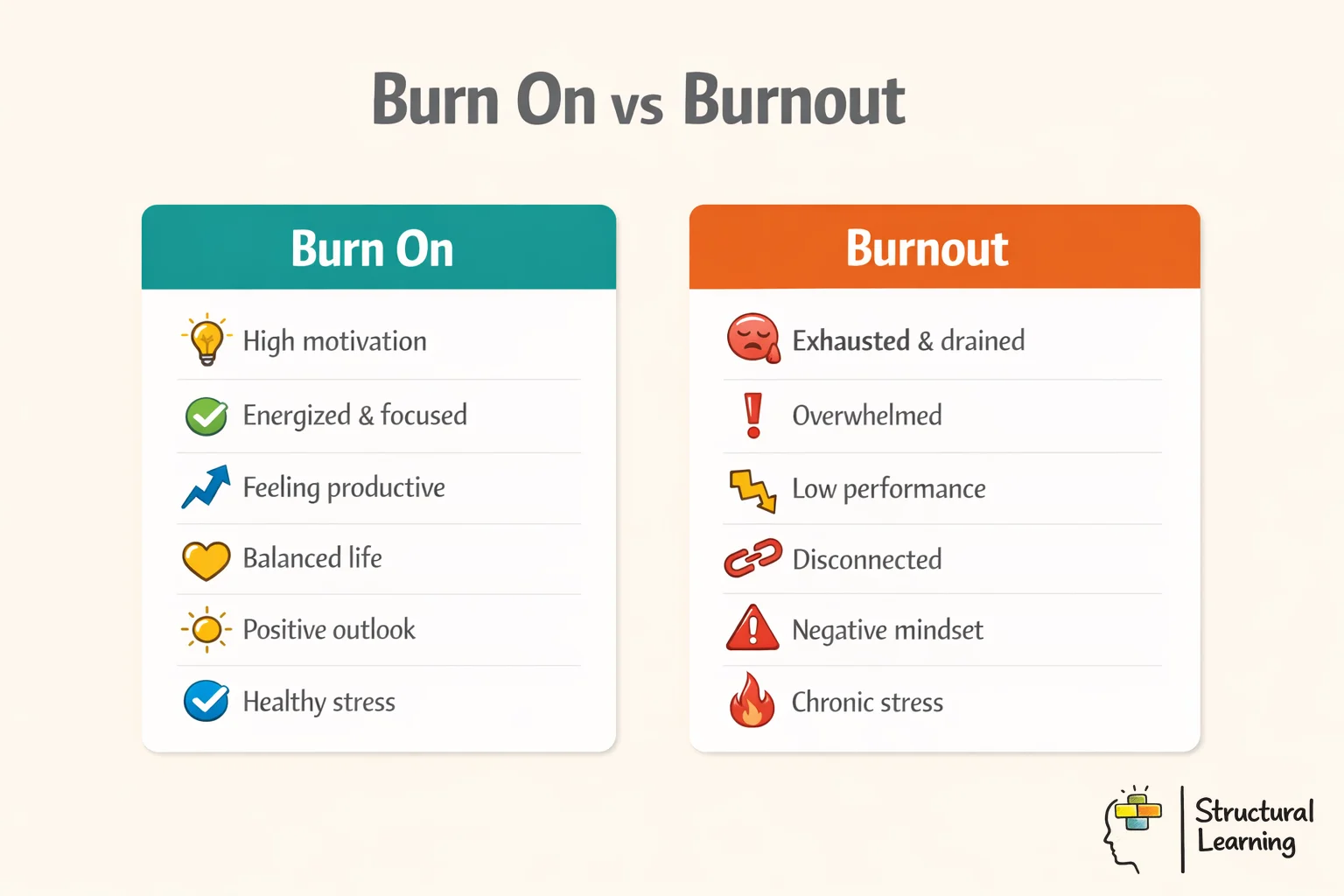
Comparison infographic showing the key differences between burn on and burnout stages for teachers
Burn On vs Burnout

They even have started to depersonalise their feelings, attitudes and responses to others. It's a feeling of heaviness. Some may describe this as "running on empty" or having empty batteries. More of this later. Interestingly they all appear to be functioning well at work and no one has appeared to notice these changes. The standards of output do not appear to have altered…yet!

At this stage they may well be operating on a "burn on" level rather than a "burnout" level. Needs research, should cite medical sources if claiming slurred speech is a burnout symptom, or remove this claim Everything is simply too much.

So what causes us to "burn on"? Continuing to overwork ourselves even when we know we are doing it. It is continuing to feel under pressure for prolonged periods of time to such an extent we cease to find the joy and passion in what we are doing.

We are certainly living in times when work is very highly valued or some may say "overvalued". What you do and how you do it being more important than who you are. You know the scene at a social gathering:

"Hi, I'm Fiona lovely to meet you"

"Hi, I'm David"

And then here it comes…

"What do you do David?"
Your job/ profession/ role gives you a status and a financial worth which others may judge. It is also giving you a platform on which to judge yourself. Your work not only provides a financial reward , it also provides you with status, in Maslow's terms it also provides for self realisation (that sense of fulfillment). It provides opportunities to make connections. If though any of this begins to falter the sense of heaviness can begin to descend. For example what happens when the connections no longer seem positive?

Try asking different questions at the next social occasion you attend. Try some big talk questions ( Kalina Silverman) such as "What do you wish you knew?" or "What do you Value?". These will get a conversation started, and you will get to find out who the person that you are talking to really is. My daughter's favourite question at these events is to ask the person, "What is their favourite potato?". She tells me it always starts a massive debate. This really gets a conversation going without any status pressure.

How Technology Affects Teacher Work-Life Balance

In addition, technology, whilst it can be great in so many ways , is also a contributor to this sense of heaviness. The ability to switch off is harder. Emails on the phone, WhatsApp messages, and other internal comms mechanisms all add to this inability to switch off. It feels like you are on duty constantly.

The current working pattern of home/ office allows us all some great flexibility. As I am typing this I am waiting for the washing machine repair person to arrive. How would I have done that when in the office? However, it can also blur the distance between home and work. When have you really finished? You can end up in that "grey place" as mentioned by Anna Katharina Schaffner in her book, "Exhausted: An A-Z for the Weary". This is where you sit in front of your computer and you are neither working nor resting. The pace required of us today can provide for this languishing to happen. You realise minutes later, sometimes more like hours, that you have neither completed a piece of work but crucially nor have you had the benefit of proper rest.

Understanding Teacher Stress Warning Signs

Burnout in teachers
Burnout in teachers

Toxic School Environments and Burnout

Working in a toxic environment can contribute to this in a very big way. If the culture of where you are working does not allow for errors and is constantly judging how many hours you have worked, the overarching conversation is about how busy everyone is. This can contribute to this sense of heaviness and social isolation. Brene Brown in her book "Dare to Lead" talks about how loneliness can begin to manifest itself as tiredness. When multiple individuals described how tired and exhausted they felt, nearly 25%  when asked whether they were lonely, answered "yes". It takes some bravery to be self-reflective and self-aware to acknowledge this.

Many modern work environments are just beginning to realise that being physically present does not equate to being psychologically safe or emotionally connected. The constant pressure to perform, combined with a lack of genuine support, creates an environment where educators feel increasingly isolated despite being surrounded by colleagues.

When school leadership fails to acknowledge the human cost of unrealistic expectations, or when staff rooms become echo chambers of complaint rather than spaces for genuine support, teachers can find themselves in a particularly vulnerable position. The culture becomes one where admitting struggle is seen as weakness, and seeking help is viewed as incompetence.

Recognising the Seven Warning Signs of Teacher Burnout

Understanding the early warning signs of burnout is crucial for prevention. These symptoms often develop gradually, making them easy to dismiss or attribute to other factors:

1. Physical exhaustion beyond normal tiredness - This goes beyond feeling tired after a long day. You're waking up exhausted despite adequate sleep, experiencing frequent headaches, or finding yourself getting ill more often than usual.

2. Emotional detachment from students and colleagues - You notice yourself becoming cynical about your students' potential, feeling irritated by colleagues, or finding it difficult to celebrate successes that would have previously brought you joy.

3. Decreased sense of accomplishment - Despite working harder than ever, you feel like you're achieving less. Your usual teaching strategies feel ineffective, and you question your professional competence regularly.

4. Sunday night dread - The anticipation of the working week ahead fills you with anxiety. You find yourself checking work emails obsessively or lying awake planning lessons you've taught successfully for years.

5. Increased irritability at home - Your patience with family and friends diminishes, and you find yourself snapping at loved ones over minor issues. Work stress begins to permeate your personal relationships.

6. Loss of creativity and enthusiasm - Lessons that once excited you now feel like a chore. You rely heavily on existing resources rather than creating new ones, and professional development feels overwhelming rather than inspiring.

7. Physical symptoms - Changes in appetite, sleep patterns, or experiencing tension headaches, muscle aches, or digestive issues that seem to correlate with work stress.

Practical Strategies for Prevention and Recovery

The journey back from burnout or preventing its onset requires deliberate action. Start with small, manageable changes rather than attempting a complete lifestyle overhaul. Self-care isn't selfish; for sustainable teaching practice.

Establish clear boundaries between work and personal time. This might mean designating specific hours for lesson planning and sticking to them, or creating a physical ritual that marks the end of your working day. Consider implementing a 'shutdown ritual' where you write down three things you accomplished that day and one priority for tomorrow before closing your laptop.

Seek meaningful connections within your professional community. This doesn't mean more staff meetings or forced team-building exercises. Instead, find one colleague you trust and create space for honest conversations about the challenges you're facing. Often, simply knowing you're not alone in your struggles can provide significant relief.

Remember that asking for help is a professional skill, not a personal failing. Whether this means requesting support with lesson planning, seeking mentorship from experienced colleagues, or accessing professional counselling services, reaching out is a sign of strength and professional wisdom.

Conclusion: Reclaiming Your Teaching Journey

Teacher burnout is not an inevitable consequence of choosing education as your profession, though the current pressures within the system might suggest otherwise. The key lies in early recognition of warning signs, honest self-reflection about your current state, and taking proactive steps to address concerns before they become overwhelming.

The distinction between 'burn on' and burnout matters because it represents the difference between a manageable challenge and a crisis requiring significant intervention. By understanding where you are on this continuum, you can make informed decisions about the support you need and the changes you must implement.

Your wellbeing directly impacts your effectiveness as an educator, but more importantly, it matters because you matter. The teaching profession needs passionate, healthy educators who can sustain their careers whilst maintaining their love for learning and teaching. By taking care of yourself, you're not only preserving your own future but also modelling healthy boundaries and self-respect for the students who look up to you. Remember, the best teachers aren't those who sacrifice everything for their profession, but those who bring their whole, healthy selves to their calling.

Further Reading

Teacher burnout research

Occupational stress in teaching

Burnout prevention strategies

For those seeking to examine deeper into understanding and preventing teacher burnout, the following research provides valuable insights:

Maslach, C., & Leiter, M. P. (2016). "Understanding the burnout experience: Recent research and its implications for psychiatry." World Psychiatry, 15(2), 103-111. This foundational research explores the three dimensions of burnout and provides evidence-based approaches to prevention and recovery.

Skaalvik, E. M., & Skaalvik, S. (2020). "Teacher burnout: Relations between dimensions of burnout, perceived school context, job satisfaction and motivation for teaching." Teachers and Teaching, 26(7-8), 602-616. This study specifically examines how school environment and culture contribute to educator burnout.

Pressley, T. (2021). "Factors contributing to teacher burnout during COVID-19." Educational Researcher, 50(5), 325-327. Recent research examining how unprecedented challenges have accelerated burnout rates among educators.

Madigan, D. J., & Kim, L. E. (2021). "Towards an understanding of teacher attrition: A meta-analysis of burnout, job satisfaction, and teachers' intentions to quit." Teaching and Teacher Education, 105, 103425. This comprehensive analysis examines the relationship between burnout and teacher retention.

Roeser, R. W., et al. (2013). "Mindfulness training and reductions in teacher stress and burnout: Results from two randomized, waitlist-control field trials." Journal of Educational Psychology, 105(3), 787-804. Evidence-based research on practical interventions that can reduce teacher stress and prevent burnout.

Loading audit...

Recognising "Burn On" vs Teacher Burnout

Teacher burnout affects up to 40% of educators within their first five years, but it doesn't have to be inevitable. The warning signs often creep in gradually: Sunday night dread, constant exhaustion, and that sinking feeling that you're failing your students despite your best efforts. The good news is that burnout is preventable and reversible with the right strategies. Whether you're a newly qualified teacher feeling overwhelmed or a seasoned educator who's lost that spark, there are proven methods to reignite your passion for teaching whilst protecting your wellbeing.

Key Takeaways

  1. Beyond Empty Batteries: Discover the crucial difference between 'burn on' and burnout, and why recognising the warning signs could save your teaching career
  2. The Grey Zone Trap: Learn how technology creates a dangerous 'neither working nor resting' state that's silently exhausting teachers across the UK
  3. When Loneliness Masquerades: Uncover why 25% of exhausted educators are actually lonely, and how toxic school cultures make this invisible crisis worse
  4. Your Early Warning System: Master the seven signs of teacher burnout before it's too late, including the surprising physical symptoms you're probably ignoring

Some of my coaching clients have said this to me very early on in our relationship. They are feeling tired and a tad irritable about their work and their colleagues and staff. This is challenging, as we are all relational creatures. AI tools that reduce administrative burden can support this process.

Comparison infographic showing the key differences between burn on and burnout stages for teachers
Burn On vs Burnout

They even have started to depersonalise their feelings, attitudes and responses to others. It's a feeling of heaviness. Some may describe this as "running on empty" or having empty batteries. More of this later. Interestingly they all appear to be functioning well at work and no one has appeared to notice these changes. The standards of output do not appear to have altered…yet!

At this stage they may well be operating on a "burn on" level rather than a "burnout" level. Needs research, should cite medical sources if claiming slurred speech is a burnout symptom, or remove this claim Everything is simply too much.

So what causes us to "burn on"? Continuing to overwork ourselves even when we know we are doing it. It is continuing to feel under pressure for prolonged periods of time to such an extent we cease to find the joy and passion in what we are doing.

We are certainly living in times when work is very highly valued or some may say "overvalued". What you do and how you do it being more important than who you are. You know the scene at a social gathering:

"Hi, I'm Fiona lovely to meet you"

"Hi, I'm David"

And then here it comes…

"What do you do David?"

Your job/ profession/ role gives you a status and a financial worth which others may judge. It is also giving you a platform on which to judge yourself. Your work not only provides a financial reward , it also provides you with status, in Maslow's terms it also provides for self realisation (that sense of fulfillment). It provides opportunities to make connections. If though any of this begins to falter the sense of heaviness can begin to descend. For example what happens when the connections no longer seem positive?

Try asking different questions at the next social occasion you attend. Try some big talk questions ( Kalina Silverman) such as "What do you wish you knew?" or "What do you Value?". These will get a conversation started, and you will get to find out who the person that you are talking to really is. My daughter's favourite question at these events is to ask the person, "What is their favourite potato?". She tells me it always starts a massive debate. This really gets a conversation going without any status pressure.

How Technology Affects Teacher Work-Life Balance

In addition, technology, whilst it can be great in so many ways , is also a contributor to this sense of heaviness. The ability to switch off is harder. Emails on the phone, WhatsApp messages, and other internal comms mechanisms all add to this inability to switch off. It feels like you are on duty constantly.

The current working pattern of home/ office allows us all some great flexibility. As I am typing this I am waiting for the washing machine repair person to arrive. How would I have done that when in the office? However, it can also blur the distance between home and work. When have you really finished? You can end up in that "grey place" as mentioned by Anna Katharina Schaffner in her book, "Exhausted: An A-Z for the Weary". This is where you sit in front of your computer and you are neither working nor resting. The pace required of us today can provide for this languishing to happen. You realise minutes later, sometimes more like hours, that you have neither completed a piece of work but crucially nor have you had the benefit of proper rest.

Understanding Teacher Stress Warning Signs

Burnout in teachers
Burnout in teachers

Toxic School Environments and Burnout

Working in a toxic environment can contribute to this in a very big way. If the culture of where you are working does not allow for errors and is constantly judging how many hours you have worked, the overarching conversation is about how busy everyone is. This can contribute to this sense of heaviness and social isolation. Brene Brown in her book "Dare to Lead" talks about how loneliness can begin to manifest itself as tiredness. When multiple individuals described how tired and exhausted they felt, nearly 25%  when asked whether they were lonely, answered "yes". It takes some bravery to be self-reflective and self-aware to acknowledge this.

Many modern work environments are just beginning to realise that being physically present does not equate to being psychologically safe or emotionally connected. The constant pressure to perform, combined with a lack of genuine support, creates an environment where educators feel increasingly isolated despite being surrounded by colleagues.

When school leadership fails to acknowledge the human cost of unrealistic expectations, or when staff rooms become echo chambers of complaint rather than spaces for genuine support, teachers can find themselves in a particularly vulnerable position. The culture becomes one where admitting struggle is seen as weakness, and seeking help is viewed as incompetence.

Recognising the Seven Warning Signs of Teacher Burnout

Understanding the early warning signs of burnout is crucial for prevention. These symptoms often develop gradually, making them easy to dismiss or attribute to other factors:

1. Physical exhaustion beyond normal tiredness - This goes beyond feeling tired after a long day. You're waking up exhausted despite adequate sleep, experiencing frequent headaches, or finding yourself getting ill more often than usual.

2. Emotional detachment from students and colleagues - You notice yourself becoming cynical about your students' potential, feeling irritated by colleagues, or finding it difficult to celebrate successes that would have previously brought you joy.

3. Decreased sense of accomplishment - Despite working harder than ever, you feel like you're achieving less. Your usual teaching strategies feel ineffective, and you question your professional competence regularly.

4. Sunday night dread - The anticipation of the working week ahead fills you with anxiety. You find yourself checking work emails obsessively or lying awake planning lessons you've taught successfully for years.

5. Increased irritability at home - Your patience with family and friends diminishes, and you find yourself snapping at loved ones over minor issues. Work stress begins to permeate your personal relationships.

6. Loss of creativity and enthusiasm - Lessons that once excited you now feel like a chore. You rely heavily on existing resources rather than creating new ones, and professional development feels overwhelming rather than inspiring.

7. Physical symptoms - Changes in appetite, sleep patterns, or experiencing tension headaches, muscle aches, or digestive issues that seem to correlate with work stress.

Practical Strategies for Prevention and Recovery

The journey back from burnout or preventing its onset requires deliberate action. Start with small, manageable changes rather than attempting a complete lifestyle overhaul. Self-care isn't selfish; for sustainable teaching practice.

Establish clear boundaries between work and personal time. This might mean designating specific hours for lesson planning and sticking to them, or creating a physical ritual that marks the end of your working day. Consider implementing a 'shutdown ritual' where you write down three things you accomplished that day and one priority for tomorrow before closing your laptop.

Seek meaningful connections within your professional community. This doesn't mean more staff meetings or forced team-building exercises. Instead, find one colleague you trust and create space for honest conversations about the challenges you're facing. Often, simply knowing you're not alone in your struggles can provide significant relief.

Remember that asking for help is a professional skill, not a personal failing. Whether this means requesting support with lesson planning, seeking mentorship from experienced colleagues, or accessing professional counselling services, reaching out is a sign of strength and professional wisdom.

Conclusion: Reclaiming Your Teaching Journey

Teacher burnout is not an inevitable consequence of choosing education as your profession, though the current pressures within the system might suggest otherwise. The key lies in early recognition of warning signs, honest self-reflection about your current state, and taking proactive steps to address concerns before they become overwhelming.

The distinction between 'burn on' and burnout matters because it represents the difference between a manageable challenge and a crisis requiring significant intervention. By understanding where you are on this continuum, you can make informed decisions about the support you need and the changes you must implement.

Your wellbeing directly impacts your effectiveness as an educator, but more importantly, it matters because you matter. The teaching profession needs passionate, healthy educators who can sustain their careers whilst maintaining their love for learning and teaching. By taking care of yourself, you're not only preserving your own future but also modelling healthy boundaries and self-respect for the students who look up to you. Remember, the best teachers aren't those who sacrifice everything for their profession, but those who bring their whole, healthy selves to their calling.

Further Reading

Teacher burnout research

Occupational stress in teaching

Burnout prevention strategies

For those seeking to examine deeper into understanding and preventing teacher burnout, the following research provides valuable insights:

Maslach, C., & Leiter, M. P. (2016). "Understanding the burnout experience: Recent research and its implications for psychiatry." World Psychiatry, 15(2), 103-111. This foundational research explores the three dimensions of burnout and provides evidence-based approaches to prevention and recovery.

Skaalvik, E. M., & Skaalvik, S. (2020). "Teacher burnout: Relations between dimensions of burnout, perceived school context, job satisfaction and motivation for teaching." Teachers and Teaching, 26(7-8), 602-616. This study specifically examines how school environment and culture contribute to educator burnout.

Pressley, T. (2021). "Factors contributing to teacher burnout during COVID-19." Educational Researcher, 50(5), 325-327. Recent research examining how unprecedented challenges have accelerated burnout rates among educators.

Madigan, D. J., & Kim, L. E. (2021). "Towards an understanding of teacher attrition: A meta-analysis of burnout, job satisfaction, and teachers' intentions to quit." Teaching and Teacher Education, 105, 103425. This comprehensive analysis examines the relationship between burnout and teacher retention.

Roeser, R. W., et al. (2013). "Mindfulness training and reductions in teacher stress and burnout: Results from two randomized, waitlist-control field trials." Journal of Educational Psychology, 105(3), 787-804. Evidence-based research on practical interventions that can reduce teacher stress and prevent burnout.

Big Ideas

Back to Blog

{"@context":"https://schema.org","@graph":[{"@type":"Article","@id":"https://www.structural-learning.com/post/avoiding-teacher-burnout#article","headline":"Avoiding Teacher Burnout","description":"Discover strategies to reduce teacher burnout, manage stress, and enhance well-being with insights from top books and practical tips for educators.","datePublished":"2024-07-29T14:38:18.670Z","dateModified":"2026-01-26T10:09:32.212Z","author":{"@type":"Person","name":"Paul Main","url":"https://www.structural-learning.com/team/paulmain","jobTitle":"Founder & Educational Consultant"},"publisher":{"@type":"Organization","name":"Structural Learning","url":"https://www.structural-learning.com","logo":{"@type":"ImageObject","url":"https://cdn.prod.website-files.com/5b69a01ba2e409e5d5e055c6/6040bf0426cb415ba2fc7882_newlogoblue.svg"}},"mainEntityOfPage":{"@type":"WebPage","@id":"https://www.structural-learning.com/post/avoiding-teacher-burnout"},"image":"https://cdn.prod.website-files.com/5b69a01ba2e409501de055d1/696f50e46ae732db1f0f32f8_696f50e3eb340e66e31d657c_avoiding-teacher-burnout-infographic.webp","wordCount":4314},{"@type":"BreadcrumbList","@id":"https://www.structural-learning.com/post/avoiding-teacher-burnout#breadcrumb","itemListElement":[{"@type":"ListItem","position":1,"name":"Home","item":"https://www.structural-learning.com/"},{"@type":"ListItem","position":2,"name":"Blog","item":"https://www.structural-learning.com/blog"},{"@type":"ListItem","position":3,"name":"Avoiding Teacher Burnout","item":"https://www.structural-learning.com/post/avoiding-teacher-burnout"}]}]}