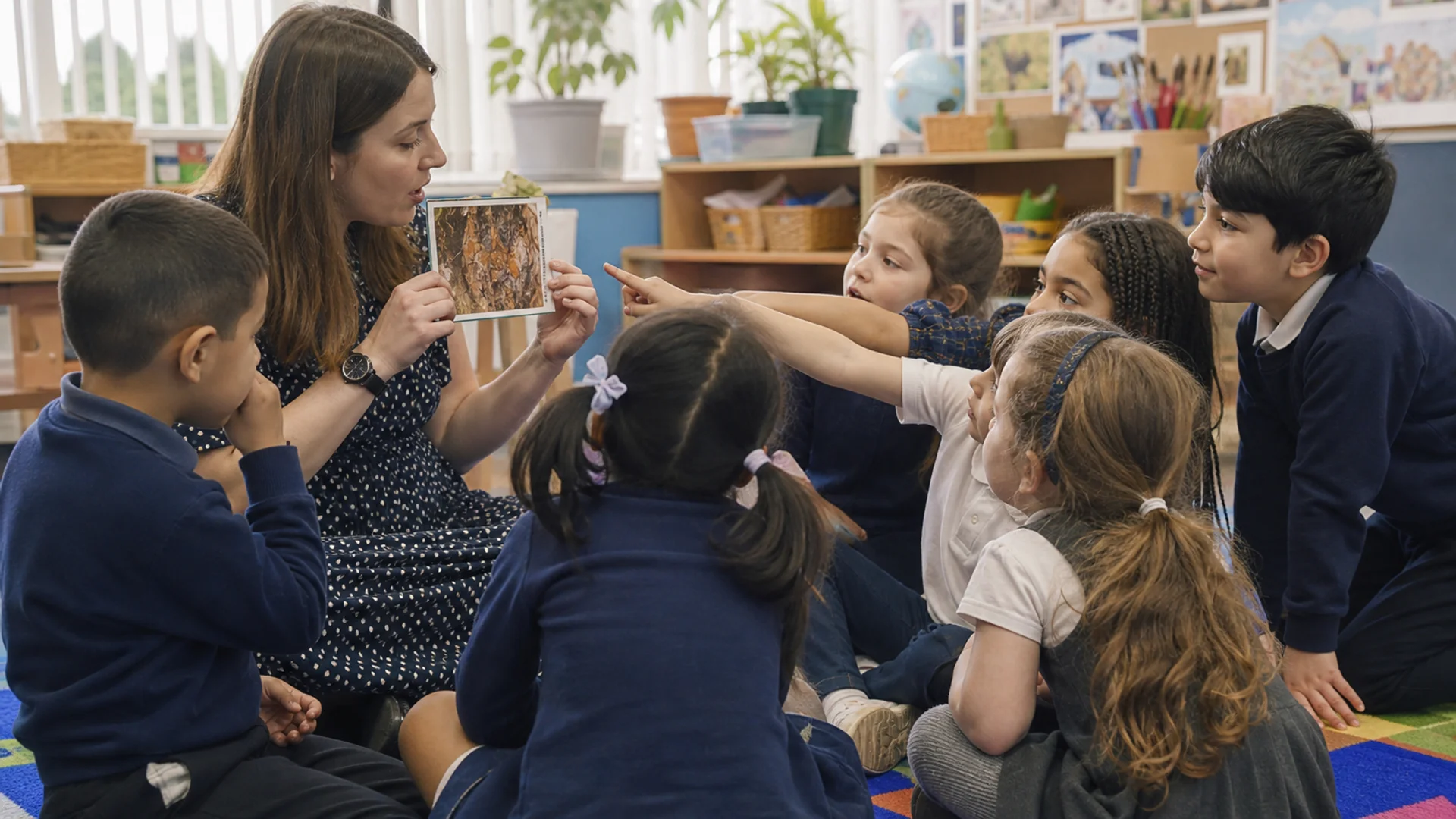
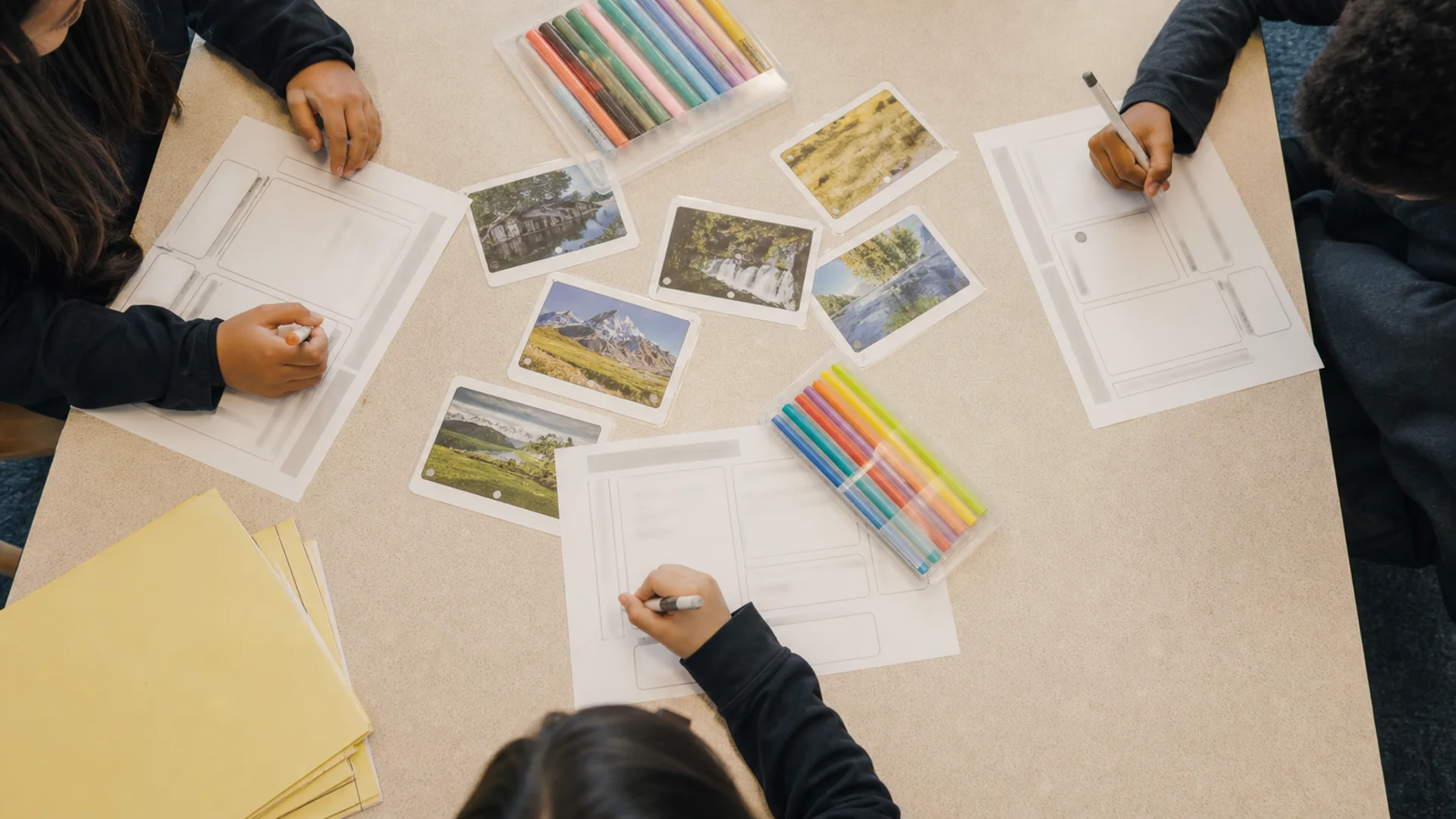
Mastering Bar Models in MathematicsGCSE students in navy blazers with striped ties work on bar models at desks, focused on improving math skills.

Updated on  

February 5, 2026

Mastering Bar Models in Mathematics

|

February 10, 2025

Explore the power of bar modelling in mathematics, its impact on problem-solving, and how it enhances primary students' math mastery.


Course Enquiry
Copy citation

Main, P. (2025, February 10). Mastering Bar Models in Mathematics. Retrieved from www.structural-learning.com/post/mastering-bar-models-in-mathematics

Mastering bar models in mathematics requires a systematic approach that transforms abstract numerical concepts into concrete visual representations students can easily grasp. These powerful diagrammatic tools work by breaking down complex word problems into simple rectangular segments, allowing learners to see mathematical relationships at a glance. Whether you're teaching addition, subtraction, fractions, or algebraic thinking, the key lies in knowing when and how to apply different bar model techniques effectively. Ready to discover the step-by-step strategies that will transform your maths teaching?

Key Takeaways

  1. Visual Learning Revolution: Bar models transform abstract mathematical concepts into concrete visual representations, making complex operations accessible to students who struggle with traditional number-based approaches.
  2. Bridge Between Learning Stages: These models effectively connect the concrete-pictorial-abstract (CPA) learning progression, helping students transition from manipulatives to abstract mathematical notation without losing understanding.
  3. Versatile Problem-Solving Tool: Bar models work across multiple mathematical areas including basic operations, fractions, ratios, and algebraic thinking, making them valuable for Years 4-6 students tackling increasingly complex topics.
  4. Enhanced Number Sense Development: By converting real-life word problems into visual mathematical forms, bar models help students develop deeper number sense and reveal underlying relationships between quantities.

Essential Bar Model Benefits

  1. The Visual Breakthrough: Why bar models succeed where traditional methods fail, especially for students who struggle with abstract number concepts
  2. Beyond Basic Operations: Discover how bar models enable complex topics like ratios and fractions that typically confuse Year 4-6 students
  3. The CPA Sweet Spot: Master the critical transition from concrete manipulatives to abstract notation without losing your struggling learners
  4. Common Misconceptions Exposed: Avoid the bar model mistakes that actually make problem-solving harder and learn which model fits each problem type

Bar models serve as powerful representations of mathematical concepts, allowing learners to visualise relationships between numbers. They are particularly significant in helping students grasp operations like addition, subtraction, multiplication, and division through concrete illustrations.

the importance of bar models in math education, effective strategies for introducing them to students, common misconceptions to address, and their real-world applications. By mastering bar models, both educators and students can enhance their mathematical skills and encourage a long-lasting understanding of the subject.

Why Bar Models Transform Math Education

Bar models are crucial because they provide visual representations that bridge the gap between concrete objects and abstract mathematical concepts. They help students visualise relationships between numbers and understand arithmetical operations such as addition, subtraction, multiplication, and division more deeply. This visual approach is particularly effective for students who struggle with traditional abstract number concepts.

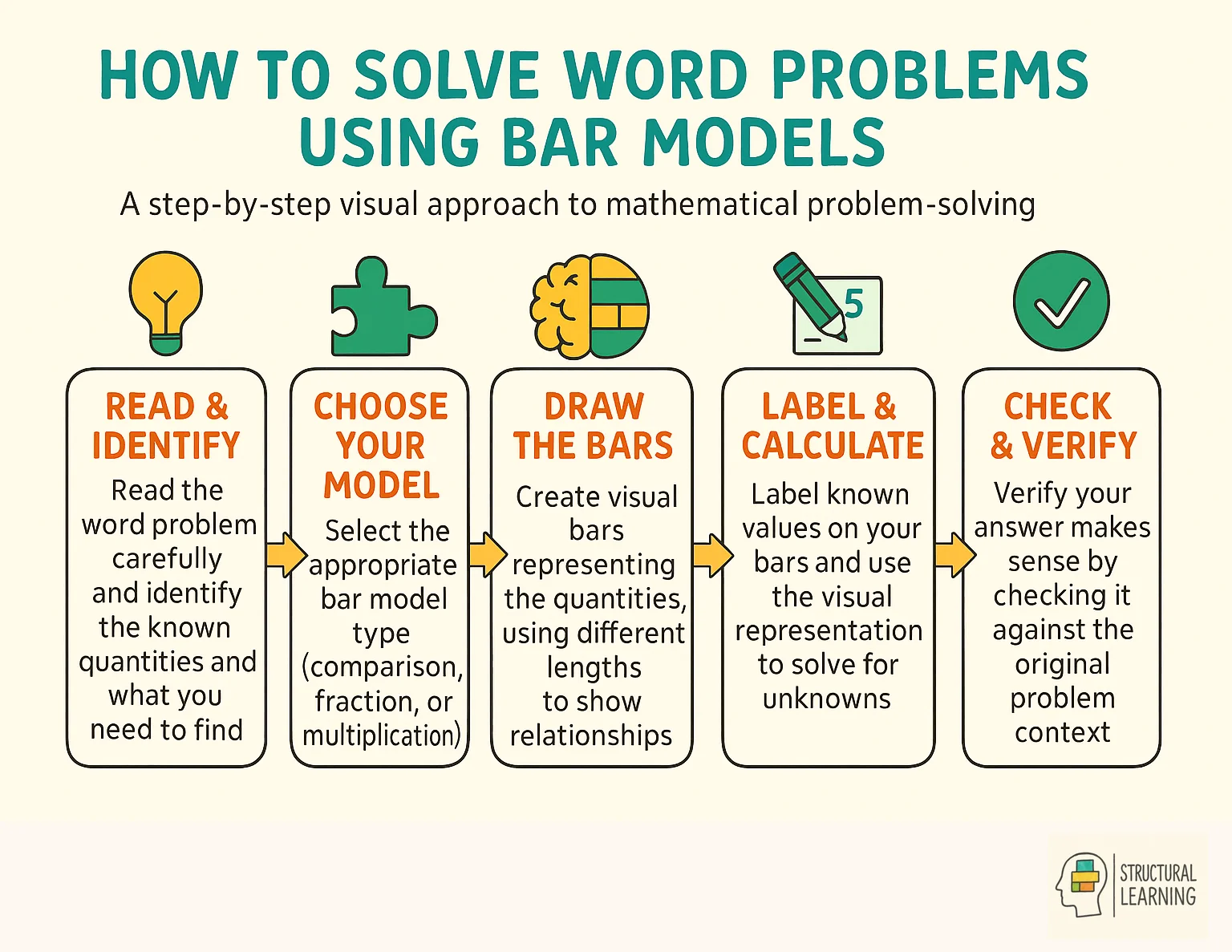
Step-by-step process for solving word problems using bar models in mathematics education
How to Solve Word Problems Using Bar Models

Bar models are powerful tools in math education, offering visual representations that enhance a student's conceptual understanding. They serve as a bridge, connecting concrete objects with abstract mathematical concepts. By doing so, they help students grasp math operations including addition, subtraction, multiplication, and division more deeply.

Benefits of Bar Models:

  • Visualization of Word Problems: Bar models convert real-life problems into mathematical forms, making them easier to solve.
  • Development of Number Sense: They reveal the underlying structure of problems, helping students understand and manipulate unknown quantities.
  • Inspiration for Learning: Incorporating bar models into math lessons can engage reluctant learners, encouraging a love for mathematics and improving engagement.

Bar models come in various types, such as comparison models and fraction bar models, catering to different mathematical concepts and operations. These pictorial diagrams enable students to visualise complex problems and compare different quantities through bar model examples. This approach supports modelling as a key learning strategy while reducing cognitive load for students processing multiple pieces of information simultaneously.

Bar Model Types Usage
Comparison Bar Models Used for comparing quantities and developing higher-order thinking
Fraction Bar Models Particularly effective for students with special educational needs who benefit from visual approaches
Part-Whole Models Support formative assessment by making student reasoning visible
Algebraic Bar Models Enhance thinking skills when transitioning to abstract algebra
Multi-Step Problem Models Promote inclusive education by providing multiple pathways to understanding

When implementing bar models across the curriculum, teachers can boost student motivation by connecting mathematical concepts to real-world scenarios.encouraging them to use bar models to visualise and solve mathematical problems collaboratively.

Strategies for Introducing Bar Models

Introducing bar models to students requires a gradual, step-by-step approach. Start with simple addition and subtraction problems, gradually progressing to more complex concepts like fractions and ratios. It’s essential to ensure students fully understand the basics before moving on to more advanced applications.

  1. Begin with Concrete Examples: Use physical objects to represent numbers before introducing bar models. This helps students make the connection between the concrete and the pictorial.
  2. Model and Demonstrate: Show students how to create bar models for different types of problems. Use a whiteboard or interactive display to model your thinking process.
  3. Encourage Discussion: Ask students to explain their reasoning and justify their solutions using bar models. This promotes deeper understanding and critical thinking.
  4. Provide Practice Opportunities: Offer a variety of word problems for students to practice using bar models. Provide feedback and support as needed.
  5. Use Real-World Contexts: Connect bar model activities to real-world scenarios to make them more relevant and engaging for students.

By integrating these strategies, educators can effectively introduce bar models into their math instruction, developing a more intuitive and visual approach to problem-solving.

Common Misconceptions and How to Address Them

Even with careful instruction, students may develop misconceptions about bar models. Here are some common issues and ways to address them:

  • Incorrect Bar Lengths: Students might not accurately represent the relative sizes of quantities. Emphasise the importance of precise drawing and labelling. Use graph paper to help with proportion.
  • Confusing Part-Whole Relationships: Students may struggle to identify which parts of the bar represent different quantities. Use colour-coding to differentiate parts and clearly label each section.
  • Applying the Wrong Model Type: Students might choose an inappropriate bar model for the problem. Teach them to carefully analyse the problem structure before selecting a model.
  • Relying Solely on the Visual: Encourage students to explain their reasoning and connect the visual representation to the underlying mathematical concepts.
  • By addressing these common misconceptions, teachers can ensure that students use bar models effectively and avoid common pitfalls.

    Real-World Applications of Bar Models

    One of the most effective ways to reinforce the usefulness of bar models is to demonstrate their application in real-world contexts. This can involve presenting word problems that mirror everyday scenarios, helping students see the direct relevance of this mathematical tool.

    • Shopping Scenarios: Use examples involving discounts, sales tax, and budgeting to illustrate how bar models can aid in financial calculations.
    • Cooking and Baking: Present recipes that require adjusting quantities, showcasing how bar models can simplify fraction and ratio problems.
    • Travel Planning: Involve distances, time calculations, and currency conversions, allowing students to visualise and solve complex travel-related problems.
    • Construction and Design: Use measurements and scaling to show how bar models can help in architectural and engineering contexts.
    • These real-world examples not only reinforce the practical utility of bar models but also enhance student engagement by making mathematical concepts more tangible and relatable.

      How Can Teachers Implement Bar Models Across Year Groups?

      Implementing bar models effectively requires careful consideration of students' developmental stages and mathematical readiness. For Year 1-2 pupils, begin with simple part-whole models using familiar contexts like sweets or toys. Use physical manipulatives alongside drawn bars, allowing children to physically move objects before representing them visually.

      In Years 3-4, progress to comparison models for more complex addition and subtraction problems. Introduce the concept of 'units' within bars, helping students understand that each segment represents equal values. For example, when solving "Tom has 24 marbles. Sarah has 8 more than Tom. How many do they have altogether?", students draw two bars with Sarah's bar extended to show the additional 8.

      Years 5-6 students can tackle multiplication, division, and fraction problems using bar models. Introduce ratio bars for problems like "The ratio of boys to girls is 3:5. If there are 15 boys, how many girls are there?" This progression aligns with the National Curriculum's expectations for mathematical reasoning and problem-solving.

      Key Implementation Strategies:

      • Start each lesson with a bar model warm-up using familiar contexts
      • Display anchor charts showing different bar model types around the classroom
      • Use consistent colours (e.g., known values in blue, unknown in red)
      • Encourage students to label their bars clearly with values and question marks
      • Provide bar model templates initially, gradually moving to freehand drawing

      Regular practice with varied problem types ensures students recognise when and how to apply different bar model structures. Create a classroom "bar model bank" where students contribute successful models from their work, building a collaborative resource that reinforces learning across the year.

      What Assessment Strategies Work Best for Bar Model Mastery?

      Effective assessment of bar model skills requires moving beyond simply checking final answers. Teachers need to evaluate students' visual reasoning, problem interpretation, and mathematical communication. Formative assessment plays a crucial role in identifying misconceptions early and adjusting instruction accordingly.

      Diagnostic Assessment Techniques:

      1. Entry tickets: Present a word problem and ask students to draw only the bar model (not solve)
      2. Exit slips: Provide a bar model and ask students to write a matching word problem
      3. Peer assessment: Students exchange models and check for accurate representation
      4. Think-alouds: Have students explain their bar model construction process verbally

      When marking bar model work, use a rubric that addresses multiple components: accuracy of representation, appropriate model choice, clear labelling, and logical progression to solution. Award marks for correct model structure even if calculation errors occur, reinforcing that visualisation is a valuable skill independent of computation.

      Common assessment pitfalls include overemphasising artistic quality or requiring one "correct" model when multiple representations could work. Instead, focus on mathematical reasoning and whether the model accurately represents the problem's relationships. Provide specific feedback like "Your comparison model clearly shows the difference between the two quantities" rather than generic praise.

      For summative assessment, incorporate bar model questions into termly tests but vary the requirements. Sometimes provide the model and ask for interpretation, other times give the problem requiring model creation. This variety ensures students develop flexible thinking rather than memorising patterns.

      How Do Bar Models Support Cross-Curricular Learning?

      Bar models extend beyond mathematics lessons, offering valuable support for problem-solving across the curriculum. In science, students can use bar models to represent data from experiments, such as comparing plant growth under different conditions or showing the proportions of materials in mixtures. This visual approach helps pupils identify patterns and relationships in scientific data more readily.

      Geography lessons benefit from bar models when teaching about population comparisons, resource distribution, or climate data. For instance, when studying UK rainfall patterns, students can create comparison bars showing precipitation levels across different regions, making abstract statistics more tangible and memorable.

      In history, timeline activities can incorporate bar models to show the duration of different historical periods or reigns. When studying the Tudors, students might use bars to compare the length of each monarch's rule, helping them grasp chronological relationships and historical significance.

      Cross-Curricular Implementation Ideas:

      • PE: Use bars to track and compare athletic performance improvements
      • PSHE: Represent time management or budget planning visually
      • English: Analyse story structures by mapping chapter lengths or character appearances
      • Computing: Introduce algorithmic thinking through bar model problem decomposition
      • Art: Explore proportions and ratios in design work

      This integrated approach reinforces that bar models are thinking tools, not just maths techniques. Create a whole-school display showcasing bar models from different subjects, demonstrating their versatility and encouraging students to apply this strategy independently across their learning.

      Conclusion

      mastering bar models is a transformative approach to math education. By converting abstract numerical concepts into tangible visual representations, educators can helps students to develop a deeper, more intuitive understanding of mathematical principles. This method not only aids in solving complex problems but also creates critical thinking and enhances problem-solving skills applicable in various real-world scenarios.

      The effective integration of bar models into the curriculum requires a systematic approach, including a gradual introduction, addressing common misconceptions, and providing ample opportunities for practice. As educators embrace this visual learning tool, they unlock new pathways for student success, cultivating a lasting appreciation and proficiency in mathematics.

      Further Reading

      For further academic research on this topic:

      • Bar model representations
      • Visual mathematical models
      • Ng, S. F. (2018). *Bar Model Method: A Tool for Translating Word Problems into Visual Equations*. Journal of Educational Research in Mathematics, 7(2), 45-62.
    • Pape, S. J. (2004). *Middle school children’s problem-solving behaviour: A cognitive analysis from a reading comprehension perspective*. Journal for Research in Mathematics Education, 35(3), 187-216.
    • Kho, T. H. (1987). *Mathematical word problems: A cognitive analysis*. Educational Studies in Mathematics, 18(3), 229-249.
    • Walkington, C. A. (2013). *Using embodied activity to support mathematical insight*. Journal of Mathematical behaviour, 32(4), 653-667.
Loading audit...

Mastering bar models in mathematics requires a systematic approach that transforms abstract numerical concepts into concrete visual representations students can easily grasp. These powerful diagrammatic tools work by breaking down complex word problems into simple rectangular segments, allowing learners to see mathematical relationships at a glance. Whether you're teaching addition, subtraction, fractions, or algebraic thinking, the key lies in knowing when and how to apply different bar model techniques effectively. Ready to discover the step-by-step strategies that will transform your maths teaching?

Key Takeaways

  1. Visual Learning Revolution: Bar models transform abstract mathematical concepts into concrete visual representations, making complex operations accessible to students who struggle with traditional number-based approaches.
  2. Bridge Between Learning Stages: These models effectively connect the concrete-pictorial-abstract (CPA) learning progression, helping students transition from manipulatives to abstract mathematical notation without losing understanding.
  3. Versatile Problem-Solving Tool: Bar models work across multiple mathematical areas including basic operations, fractions, ratios, and algebraic thinking, making them valuable for Years 4-6 students tackling increasingly complex topics.
  4. Enhanced Number Sense Development: By converting real-life word problems into visual mathematical forms, bar models help students develop deeper number sense and reveal underlying relationships between quantities.

Essential Bar Model Benefits

  1. The Visual Breakthrough: Why bar models succeed where traditional methods fail, especially for students who struggle with abstract number concepts
  2. Beyond Basic Operations: Discover how bar models enable complex topics like ratios and fractions that typically confuse Year 4-6 students
  3. The CPA Sweet Spot: Master the critical transition from concrete manipulatives to abstract notation without losing your struggling learners
  4. Common Misconceptions Exposed: Avoid the bar model mistakes that actually make problem-solving harder and learn which model fits each problem type

Bar models serve as powerful representations of mathematical concepts, allowing learners to visualise relationships between numbers. They are particularly significant in helping students grasp operations like addition, subtraction, multiplication, and division through concrete illustrations.

the importance of bar models in math education, effective strategies for introducing them to students, common misconceptions to address, and their real-world applications. By mastering bar models, both educators and students can enhance their mathematical skills and encourage a long-lasting understanding of the subject.

Why Bar Models Transform Math Education

Bar models are crucial because they provide visual representations that bridge the gap between concrete objects and abstract mathematical concepts. They help students visualise relationships between numbers and understand arithmetical operations such as addition, subtraction, multiplication, and division more deeply. This visual approach is particularly effective for students who struggle with traditional abstract number concepts.

Step-by-step process for solving word problems using bar models in mathematics education
How to Solve Word Problems Using Bar Models

Bar models are powerful tools in math education, offering visual representations that enhance a student's conceptual understanding. They serve as a bridge, connecting concrete objects with abstract mathematical concepts. By doing so, they help students grasp math operations including addition, subtraction, multiplication, and division more deeply.

Benefits of Bar Models:

  • Visualization of Word Problems: Bar models convert real-life problems into mathematical forms, making them easier to solve.
  • Development of Number Sense: They reveal the underlying structure of problems, helping students understand and manipulate unknown quantities.
  • Inspiration for Learning: Incorporating bar models into math lessons can engage reluctant learners, encouraging a love for mathematics and improving engagement.

Bar models come in various types, such as comparison models and fraction bar models, catering to different mathematical concepts and operations. These pictorial diagrams enable students to visualise complex problems and compare different quantities through bar model examples. This approach supports modelling as a key learning strategy while reducing cognitive load for students processing multiple pieces of information simultaneously.

Bar Model Types Usage
Comparison Bar Models Used for comparing quantities and developing higher-order thinking
Fraction Bar Models Particularly effective for students with special educational needs who benefit from visual approaches
Part-Whole Models Support formative assessment by making student reasoning visible
Algebraic Bar Models Enhance thinking skills when transitioning to abstract algebra
Multi-Step Problem Models Promote inclusive education by providing multiple pathways to understanding

When implementing bar models across the curriculum, teachers can boost student motivation by connecting mathematical concepts to real-world scenarios.encouraging them to use bar models to visualise and solve mathematical problems collaboratively.

Strategies for Introducing Bar Models

Introducing bar models to students requires a gradual, step-by-step approach. Start with simple addition and subtraction problems, gradually progressing to more complex concepts like fractions and ratios. It’s essential to ensure students fully understand the basics before moving on to more advanced applications.

  1. Begin with Concrete Examples: Use physical objects to represent numbers before introducing bar models. This helps students make the connection between the concrete and the pictorial.
  2. Model and Demonstrate: Show students how to create bar models for different types of problems. Use a whiteboard or interactive display to model your thinking process.
  3. Encourage Discussion: Ask students to explain their reasoning and justify their solutions using bar models. This promotes deeper understanding and critical thinking.
  4. Provide Practice Opportunities: Offer a variety of word problems for students to practice using bar models. Provide feedback and support as needed.
  5. Use Real-World Contexts: Connect bar model activities to real-world scenarios to make them more relevant and engaging for students.

By integrating these strategies, educators can effectively introduce bar models into their math instruction, developing a more intuitive and visual approach to problem-solving.

Common Misconceptions and How to Address Them

Even with careful instruction, students may develop misconceptions about bar models. Here are some common issues and ways to address them:

  • Incorrect Bar Lengths: Students might not accurately represent the relative sizes of quantities. Emphasise the importance of precise drawing and labelling. Use graph paper to help with proportion.
  • Confusing Part-Whole Relationships: Students may struggle to identify which parts of the bar represent different quantities. Use colour-coding to differentiate parts and clearly label each section.
  • Applying the Wrong Model Type: Students might choose an inappropriate bar model for the problem. Teach them to carefully analyse the problem structure before selecting a model.
  • Relying Solely on the Visual: Encourage students to explain their reasoning and connect the visual representation to the underlying mathematical concepts.
  • By addressing these common misconceptions, teachers can ensure that students use bar models effectively and avoid common pitfalls.

    Real-World Applications of Bar Models

    One of the most effective ways to reinforce the usefulness of bar models is to demonstrate their application in real-world contexts. This can involve presenting word problems that mirror everyday scenarios, helping students see the direct relevance of this mathematical tool.

    • Shopping Scenarios: Use examples involving discounts, sales tax, and budgeting to illustrate how bar models can aid in financial calculations.
    • Cooking and Baking: Present recipes that require adjusting quantities, showcasing how bar models can simplify fraction and ratio problems.
    • Travel Planning: Involve distances, time calculations, and currency conversions, allowing students to visualise and solve complex travel-related problems.
    • Construction and Design: Use measurements and scaling to show how bar models can help in architectural and engineering contexts.
    • These real-world examples not only reinforce the practical utility of bar models but also enhance student engagement by making mathematical concepts more tangible and relatable.

      How Can Teachers Implement Bar Models Across Year Groups?

      Implementing bar models effectively requires careful consideration of students' developmental stages and mathematical readiness. For Year 1-2 pupils, begin with simple part-whole models using familiar contexts like sweets or toys. Use physical manipulatives alongside drawn bars, allowing children to physically move objects before representing them visually.

      In Years 3-4, progress to comparison models for more complex addition and subtraction problems. Introduce the concept of 'units' within bars, helping students understand that each segment represents equal values. For example, when solving "Tom has 24 marbles. Sarah has 8 more than Tom. How many do they have altogether?", students draw two bars with Sarah's bar extended to show the additional 8.

      Years 5-6 students can tackle multiplication, division, and fraction problems using bar models. Introduce ratio bars for problems like "The ratio of boys to girls is 3:5. If there are 15 boys, how many girls are there?" This progression aligns with the National Curriculum's expectations for mathematical reasoning and problem-solving.

      Key Implementation Strategies:

      • Start each lesson with a bar model warm-up using familiar contexts
      • Display anchor charts showing different bar model types around the classroom
      • Use consistent colours (e.g., known values in blue, unknown in red)
      • Encourage students to label their bars clearly with values and question marks
      • Provide bar model templates initially, gradually moving to freehand drawing

      Regular practice with varied problem types ensures students recognise when and how to apply different bar model structures. Create a classroom "bar model bank" where students contribute successful models from their work, building a collaborative resource that reinforces learning across the year.

      What Assessment Strategies Work Best for Bar Model Mastery?

      Effective assessment of bar model skills requires moving beyond simply checking final answers. Teachers need to evaluate students' visual reasoning, problem interpretation, and mathematical communication. Formative assessment plays a crucial role in identifying misconceptions early and adjusting instruction accordingly.

      Diagnostic Assessment Techniques:

      1. Entry tickets: Present a word problem and ask students to draw only the bar model (not solve)
      2. Exit slips: Provide a bar model and ask students to write a matching word problem
      3. Peer assessment: Students exchange models and check for accurate representation
      4. Think-alouds: Have students explain their bar model construction process verbally

      When marking bar model work, use a rubric that addresses multiple components: accuracy of representation, appropriate model choice, clear labelling, and logical progression to solution. Award marks for correct model structure even if calculation errors occur, reinforcing that visualisation is a valuable skill independent of computation.

      Common assessment pitfalls include overemphasising artistic quality or requiring one "correct" model when multiple representations could work. Instead, focus on mathematical reasoning and whether the model accurately represents the problem's relationships. Provide specific feedback like "Your comparison model clearly shows the difference between the two quantities" rather than generic praise.

      For summative assessment, incorporate bar model questions into termly tests but vary the requirements. Sometimes provide the model and ask for interpretation, other times give the problem requiring model creation. This variety ensures students develop flexible thinking rather than memorising patterns.

      How Do Bar Models Support Cross-Curricular Learning?

      Bar models extend beyond mathematics lessons, offering valuable support for problem-solving across the curriculum. In science, students can use bar models to represent data from experiments, such as comparing plant growth under different conditions or showing the proportions of materials in mixtures. This visual approach helps pupils identify patterns and relationships in scientific data more readily.

      Geography lessons benefit from bar models when teaching about population comparisons, resource distribution, or climate data. For instance, when studying UK rainfall patterns, students can create comparison bars showing precipitation levels across different regions, making abstract statistics more tangible and memorable.

      In history, timeline activities can incorporate bar models to show the duration of different historical periods or reigns. When studying the Tudors, students might use bars to compare the length of each monarch's rule, helping them grasp chronological relationships and historical significance.

      Cross-Curricular Implementation Ideas:

      • PE: Use bars to track and compare athletic performance improvements
      • PSHE: Represent time management or budget planning visually
      • English: Analyse story structures by mapping chapter lengths or character appearances
      • Computing: Introduce algorithmic thinking through bar model problem decomposition
      • Art: Explore proportions and ratios in design work

      This integrated approach reinforces that bar models are thinking tools, not just maths techniques. Create a whole-school display showcasing bar models from different subjects, demonstrating their versatility and encouraging students to apply this strategy independently across their learning.

      Conclusion

      mastering bar models is a transformative approach to math education. By converting abstract numerical concepts into tangible visual representations, educators can helps students to develop a deeper, more intuitive understanding of mathematical principles. This method not only aids in solving complex problems but also creates critical thinking and enhances problem-solving skills applicable in various real-world scenarios.

      The effective integration of bar models into the curriculum requires a systematic approach, including a gradual introduction, addressing common misconceptions, and providing ample opportunities for practice. As educators embrace this visual learning tool, they unlock new pathways for student success, cultivating a lasting appreciation and proficiency in mathematics.

      Further Reading

      For further academic research on this topic:

      • Bar model representations
      • Visual mathematical models
      • Ng, S. F. (2018). *Bar Model Method: A Tool for Translating Word Problems into Visual Equations*. Journal of Educational Research in Mathematics, 7(2), 45-62.
    • Pape, S. J. (2004). *Middle school children’s problem-solving behaviour: A cognitive analysis from a reading comprehension perspective*. Journal for Research in Mathematics Education, 35(3), 187-216.
    • Kho, T. H. (1987). *Mathematical word problems: A cognitive analysis*. Educational Studies in Mathematics, 18(3), 229-249.
    • Walkington, C. A. (2013). *Using embodied activity to support mathematical insight*. Journal of Mathematical behaviour, 32(4), 653-667.

Primary Schools

Back to Blog

{"@context":"https://schema.org","@graph":[{"@type":"Article","@id":"https://www.structural-learning.com/post/mastering-bar-models-in-mathematics#article","headline":"Mastering Bar Models in Mathematics","description":"Explore the power of bar modelling in mathematics, its impact on problem-solving, and how it enhances primary students' math mastery.","datePublished":"2025-02-10T12:59:21.809Z","dateModified":"2026-01-26T10:09:32.212Z","author":{"@type":"Person","name":"Paul Main","url":"https://www.structural-learning.com/team/paulmain","jobTitle":"Founder & Educational Consultant"},"publisher":{"@type":"Organization","name":"Structural Learning","url":"https://www.structural-learning.com","logo":{"@type":"ImageObject","url":"https://cdn.prod.website-files.com/5b69a01ba2e409e5d5e055c6/6040bf0426cb415ba2fc7882_newlogoblue.svg"}},"mainEntityOfPage":{"@type":"WebPage","@id":"https://www.structural-learning.com/post/mastering-bar-models-in-mathematics"},"image":"https://cdn.prod.website-files.com/5b69a01ba2e409501de055d1/69512a43279ba59ac58960dd_0t3ci3.webp","wordCount":5192},{"@type":"BreadcrumbList","@id":"https://www.structural-learning.com/post/mastering-bar-models-in-mathematics#breadcrumb","itemListElement":[{"@type":"ListItem","position":1,"name":"Home","item":"https://www.structural-learning.com/"},{"@type":"ListItem","position":2,"name":"Blog","item":"https://www.structural-learning.com/blog"},{"@type":"ListItem","position":3,"name":"Mastering Bar Models in Mathematics","item":"https://www.structural-learning.com/post/mastering-bar-models-in-mathematics"}]},{"@type":"FAQPage","mainEntity":[{"@type":"Question","name":"How Can Teachers Implement Bar Models Across Year Groups?","acceptedAnswer":{"@type":"Answer","text":"Implementing bar models effectively requires careful consideration of students' developmental stages and mathematical readiness. For Year 1-2 pupils, begin with simple part-whole models using familiar contexts like sweets or toys. Use physical manipulatives alongside drawn bars, allowing children to physically move objects before representing them visually."}},{"@type":"Question","name":"What Assessment Strategies Work Best for Bar Model Mastery?","acceptedAnswer":{"@type":"Answer","text":"Effective assessment of bar model skills requires moving beyond simply checking final answers. Teachers need to evaluate students' visual reasoning, problem interpretation, and mathematical communication. Formative assessment plays a crucial role in identifying misconceptions early and adjusting instruction accordingly."}},{"@type":"Question","name":"How Do Bar Models Support Cross-Curricular Learning?","acceptedAnswer":{"@type":"Answer","text":"Bar models extend beyond mathematics lessons, offering valuable support for problem-solving across the curriculum. In science, students can use bar models to represent data from experiments, such as comparing plant growth under different conditions or showing the proportions of materials in mixtures. This visual approach helps pupils identify patterns and relationships in scientific data more readily."}}]}]}