A source-led guide to Festinger's social comparison theory, upward, downward and lateral comparisons, classroom evidence, examples and safe teacher responses.
Main, P. (2023, November 28). Social Comparison Theory: Why Learners Compare Themselves. Structural Learning. https://www.structural-learning.com/post/social-comparison-theory
What is social comparison theory?
Social comparison theory explains how people evaluate an opinion or ability by comparing themselves with others, especially when no clear objective standard is available. Festinger proposed the core theory in 1954. Later research distinguished upward, downward and lateral targets. The direction alone does not decide the result: a comparison can produce contrast or assimilation, motivation or discouragement, depending on the person, target, task and context.
When learners see a peer's mark, model or pace, they may use it to judge their own work. That can help, unsettle or have little effect. Social comparison theory gives teachers a clear way to ask what the peer information means, while avoiding claims about a learner's mind that the evidence cannot support.
Social comparison theory explains how people evaluate an opinion or ability by comparing themselves with others, especially when no clear objective standard is available. Festinger proposed the core theory in 1954. Later research distinguished upward, downward and lateral targets. The direction alone does not decide the result: a comparison can produce contrast or assimilation, motivation or discouragement, depending on the person, target, task and context.
Festinger (1954) framed peers as a source of clues when a clear test is not at hand. In class, the same strong model may give one learner a next step and make another feel the gap is too wide. That split is why a teacher must look at the target, the response and the task.
What Social Comparison Theory Means
A learner finishes a maths problem and looks at a classmate's page. That glance may help answer three questions: Is my method sound? Am I at the right pace? Is this good enough? The peer becomes a quick point of reference and may also suggest what to try next. Social comparison theory deals with this use of another person as evidence about oneself.
The theory does not say that every look at a peer is competitive, or that learners calculate a social rank each time. It describes a family of processes. A person selects or encounters a comparison target, notices a difference or similarity on a relevant dimension, and interprets what that information means. The target can be a close friend, another group, the class average or a worked example produced by a peer.
Three distinctions keep the explanation accurate:
Target direction describes whether the other person appears better, worse or similar on the relevant dimension.
Reaction describes whether the comparison moves self-evaluation towards the target, called assimilation, or away from the target, called contrast.
Outcome describes what changes next, such as effort, confidence, emotion, strategy choice or nothing observable.
These ideas link, but they are not the same. An upward target can be a model or seem out of reach. A downward target can bring calm or cause concern.
A close peer can give a useful clue or spark a sense of threat. Teachers need more than a list of three types.
Festinger's Original Theory
Leon Festinger's first paper began with a problem of self-judgement. People can test some claims objectively by measuring a span or counting correct answers. When opinions and abilities lack such a clear test, Festinger (1954) argued that people may use others as a source of information.
The 1954 account made two linked claims. People seek to judge their opinions and abilities, and they are more likely to compare when no clear objective test is available.
A peer can tell us more when that peer seems like us on the trait in question. Festinger also wrote of a push to agree on views and to move up in skill.
This historical detail matters because many summaries compress later developments into Festinger's first article. The familiar labels upward comparison, downward comparison and lateral comparison are useful modern descriptions, but they should not be presented as one complete three-part model created in 1954. Work on downward comparison under threat, for example, was developed in detail much later by Wills (1981).
Scholarly boundary: Festinger proposed a theory of evaluating opinions and abilities. He did not claim that people possess an innate need to calculate their personal worth, nor did he provide a classroom intervention for raising self-esteem.
Social comparison is wider than a contest. Learners can compare methods while they share a goal, and a league table can prompt comparison with no direct peer talk.
Upward, Downward and Lateral Comparison
Direction is always relative to a particular dimension. A peer may be an upward target for spelling accuracy, a lateral target for reading fluency and a downward target for confidence in public speaking. Calling someone an “upward peer” without naming the dimension turns a specific comparison into a judgement about the whole person.
On a small screen, swipe the table to compare all columns.
Direction
Definition
Classroom example
Possible readings
Upward
The target appears to perform better on the relevant dimension.
A learner studies a stronger peer's paragraph structure.
“That shows me a usable next step” or “I will never reach that standard”.
Downward
The target appears to perform less well on the relevant dimension.
A learner notices that a classmate made more calculation errors.
“My method is working” or “I do not need to improve”. It may also prompt empathy rather than self-enhancement.
Lateral
The target appears similar on the relevant dimension.
Two learners at a similar stage compare revision plans.
“This is a realistic benchmark”, “we can solve this together” or “a small difference feels threatening”.
Direction describes the relative position of the target, not the moral value of the comparison. It also does not identify why the learner compared. Possible motives include gaining accurate information, improving performance, protecting self-evaluation, regulating emotion or deciding whether a goal is attainable.
A large meta-analysis helps to split target choice from response. Gerber, Wheeler and Suls (2018) looked at more than six decades of work. In tests with just an up or down choice, people tended to choose an upward target when not under threat.
Across response tests, contrast was the main result, most of all for skill judgements. These are group trends. They do not tell us how one learner will react in one lesson.
Assimilation and Contrast
Assimilation occurs when self-evaluation moves towards the target. A learner sees a slightly stronger peer use a clear planning strategy and thinks, “That approach is available to people like me.” The peer's success raises the learner's sense of what may be possible.
Contrast occurs when self-evaluation moves away from the target. The same learner sees the same work and thinks, “This proves how far behind I am.” The peer's success lowers the learner's current self-evaluation. With a downward target, contrast can make the learner feel relatively stronger; assimilation can make the learner focus on a shared difficulty.
One target, two reactions: a teacher shares a strong first paragraph from the same year group. One reader spots a step they can use: add one line that names the main claim. That is an assimilative reading.
Another reader sees only the gap from their own draft. That is a contrastive reading. The model did not change. The way each learner read it did.
Several conditions can change the reading:
Similarity: a target who seems relevant and comparable may carry more information than a distant expert.
Attainability: a small, visible next step may support approach, while an unexplained polished product can make the gap look fixed.
Domain relevance: comparison on a valued or identity-relevant task may have a stronger effect.
Perceived control: learners are more likely to invest effort when they believe an action can change the result.
Current goal and state: a learner seeking information may use the target differently from one trying to protect confidence after a setback.
Diel, Grelle and Hofmann (2021) found that the size of the gap and a sense of control helped to explain when an upward view raised effort or led people to stop. Boissicat et al. (2021) found in class tests that a goal to move near or stay clear can change the effect on self-judgement and work.
Neither study gives a fixed rule. Both show why direction does not seal the result.
Worked Classroom Examples
A mark chart, peer model, group label or shared task can all create social comparison. None has one fixed effect. The examples below show how the target and the learner's reading can change, even when the teacher gives the whole class the same cue.
Example 1: A public mark distribution
A teacher shows the spread of marks after a test. The chart gives the class a rank cue even if it has no names. A learner below the mean may use it as a clue, feel the gap is too wide or doubt the test.
A learner above the mean may feel calm, ease off or look at the few marks above theirs. The same chart creates more than one target and more than one meaning.
The teacher cannot infer the response from the score position alone. A safer follow-up is to return attention to task information: which knowledge was secure, which error pattern matters, and what action comes next. This is one reason well-designed formative assessment strategies emphasise evidence and next steps rather than status alone.
Example 2: A peer exemplar
A worked peer response can make success concrete. It can also become a status signal if learners see only a polished endpoint. The teacher can reduce ambiguity by identifying one feature to inspect, explaining why it works and asking learners to adapt that feature in their own way. Multiple exemplars can show that quality has more than one form.
This does not eliminate comparison. It changes the available information from “Who is best?” towards “What does quality look like, and which move can I try?” The shift is a design choice, not proof that every learner will assimilate to the model.
Example 3: Within-class groups
Grouping changes who is nearby and therefore which comparisons are readily available. A learner may compare with others in the same group, with a higher-labelled group or with the class as a whole. Group names, movement between groups, task difficulty and teacher language can all make relative position more or less visible.
Webb-Williams (2021) used mixed methods to study social comparison in within-class ability groups in primary classrooms. Learners described upward, horizontal and downward targets, with patterns varying across groups and measures. This is useful evidence that grouping alters the comparison context. It is not a universal verdict for or against ability grouping, and it does not establish one causal response for every learner.
Example 4: Collaborative problem solving
Collaboration does not remove comparison either. During a shared task, learners still notice fluency, ideas and speed. Good collaborative learning can make those differences useful when roles are meaningful, explanations are expected and the group needs more than one kind of contribution. Poorly structured group work can make one learner's speed the only visible standard.
The practical question is not “comparison or no comparison?” It is “What information does this activity make visible, and what interpretation does the task invite?”
What Classroom Research Shows
Dijkstra et al. (2008) reviewed class research on motives, traits, target choice and effects. The review found that learners often chose a peer who did better but still seemed like them. Such an upward view can aid work yet also bring low mood or a weaker view of one's skill.
The authors did not work out one net effect size. The studies did not all agree. The sound view is that effects depend on the case.
A learner's view of their skill can also depend on the wider class. A mark may feel strong in one room and less strong in the next. This is often called the big-fish-little-pond effect.
Jansen, Boda and Lorenz (2022) found a stable link between a high class mean and a lower view of one's own skill. The case for extra effects from small peer groups was less clear. A named friend is not the whole cause.
Petrak, Möller and Wolff (2026) used short, repeated reports to study academic comparisons in daily life. Peer and within-person comparisons were linked with shifts in academic self-concept, and the setting still mattered. The links do not prove a teacher-led cause.
Evidence summary: comparison is common, upward targets are often selected, contrast is a frequent reaction, and classroom reference groups can shape academic self-concept. The evidence does not support a rule that one comparison direction is always healthy, harmful or motivating.
A wider map of fundamental theories of learning helps place this account. Social comparison deals with relative clues about the self, not all learning or peer influence.
How Teachers Shape the Comparison Context
Social comparison theory is an explanatory lens, not a technique to “use on” learners. Teachers nevertheless influence the cues from which comparison is built. Marks, public praise, grouping labels, exemplars, peer feedback and digital dashboards all make some standards more visible than others.
Make task criteria explicit. An objective or criterion-referenced standard gives learners information that does not depend entirely on relative class position.
Protect individual results. Avoid public ranking or naming learners as the standard unless there is a clear, proportionate educational reason and the possible social cost has been considered.
Use attainable, annotated exemplars. Show the moves that produced quality, not only the finished product. Include more than one route where the task allows it.
Foreground self-referenced progress. Ask learners to compare the current attempt with an earlier attempt, while recognising that temporal comparison serves a different informational purpose from peer comparison.
Structure peer feedback around the work. Prompts should direct attention to criteria, evidence and revision. This reduces the need to translate feedback into a global judgement of the person.
Watch for repeated patterns, then ask. Withdrawal after peer review or persistent checking may justify a conversation. It does not reveal a diagnosis or a hidden motive by itself.
A Short Teacher Check Before Peer Work
Start with the task. Put the signs of good work in plain words. If the class sees a model, point to one part that works and say why. Keep the focus on the line, plan or choice, not on “the best” child.
Check the size of the gap. A polished piece can look far out of reach. Show a first draft and mark the change to the final work. This turns a rank cue into a set of steps.
Give more than one good route. Two brief samples can show the same key trait in two forms. Ask what both do well and which move fits the work in hand.
Keep each mark private. A class can learn from common errors with no names and no rank. Try, “Many of us lost a mark at this step. Let us fix it now.”
Use the learner's own past work. Put an old piece by the new one. Ask for one gain and one next step. This gives more room for learner agency and shows growth that a class rank may hide.
Ask what the peer model says to them. One short prompt can expose the key split. Try, “Does this feel like a clue you can use, or a gap that feels too wide?” The answer may show what to teach next. It may also show that the model needs more notes, a smaller step or a new frame.
Plan the peer talk. A tight prompt is more useful than “What do you think?” Try, “Point to the claim. Name the proof. Give one way to make the link clear.” The talk then stays close to the work.
End with an act. Give time to use the next step at once. A learner may add a fact, test a plan or fix one line. The point of the model was to help the work, not sort people.
These choices fit with strong test and feedback design because they give clear task clues. They also keep a sense of choice. A teacher can ask, “Which part of this model feels within reach?” or “What does your new draft do better than the old one?”
The learner's answer adds facts that sight alone cannot give. It can also shift the talk from a fixed rank to a next step. This is more sound than telling a learner to “use a growth mindset” when the task, model or gap is still unclear.
Where comparison is linked with sustained distress, bullying, eating concerns, school avoidance or a sharp change in participation, use the school's normal pastoral, safeguarding, SEND or health routes. Social comparison theory can help frame a question. It cannot establish a mental-health condition or replace professional assessment. Broader emotional understanding belongs with the school's social and emotional learning and support systems, not with a theory label attached to one behaviour.
Limits and Common Misreadings
The theory explains one source of self-judgement. It does not read a learner's mind, set a fixed effect for each target or explain all peer learning. Later research also changed the field, so a modern guide must not treat every current term as part of Festinger's first model.
The original theory was not the final theory
Festinger's propositions generated a large research field, but later work broadened the motives, targets and consequences under study. Downward comparison, assimilation, contrast, self-enhancement and group-level reference effects cannot all be folded back into one unchanged 1954 model.
Relative position is not objective ability
A learner may misjudge a target, compare on the wrong dimension or see only part of another person's work. Social comparison uses perceived information. It is not an objective measurement merely because another person is involved.
Average effects do not diagnose individuals
A meta-analysis can show that contrast is common across studies. A classroom review can identify recurring patterns. Neither tells a teacher exactly what one learner thought after seeing one peer's mark. The same event can be interpreted differently across learners and across time.
Removing every comparison is neither possible nor desirable
Peers provide useful information. Exemplars, joint explanation and observation can make an unfamiliar task understandable. The aim is not to create a comparison-free classroom. It is to avoid making social rank the only available measure of success and to make the educational purpose of peer information clear.
Social comparison is not a complete motivation theory
The account helps explain self-evaluation and some changes in effort or emotion. It does not by itself explain autonomy, competence support or internalisation, which belong to self-determination theory. It also does not explain how behaviour is learned by observing a model, which is addressed by Bandura's social learning theory.
Social Comparison, Peer Assessment and Social Learning
Social comparison asks what a peer's work means for one's own view of the self. Peer assessment asks learners to judge work against set points and give feedback. It can spark a social comparison, but its stated aim is to give facts about the work.
Competition gives out gains in part by rank. It makes peer rank clear, but people also compare when there is no contest.
Social learning theory concerns learning through observation, modelling and the consequences seen to follow behaviour. A learner may observe a peer's method and reproduce it without making a meaningful judgement about their own standing. Conversely, a learner may compare marks without learning any behaviour from the other person.
These distinctions prevent an explanatory shortcut. If a peer exemplar improves a draft, the change can reflect clearer success criteria, observation of a usable strategy, social comparison, or several processes together. Naming one theory does not isolate the mechanism.
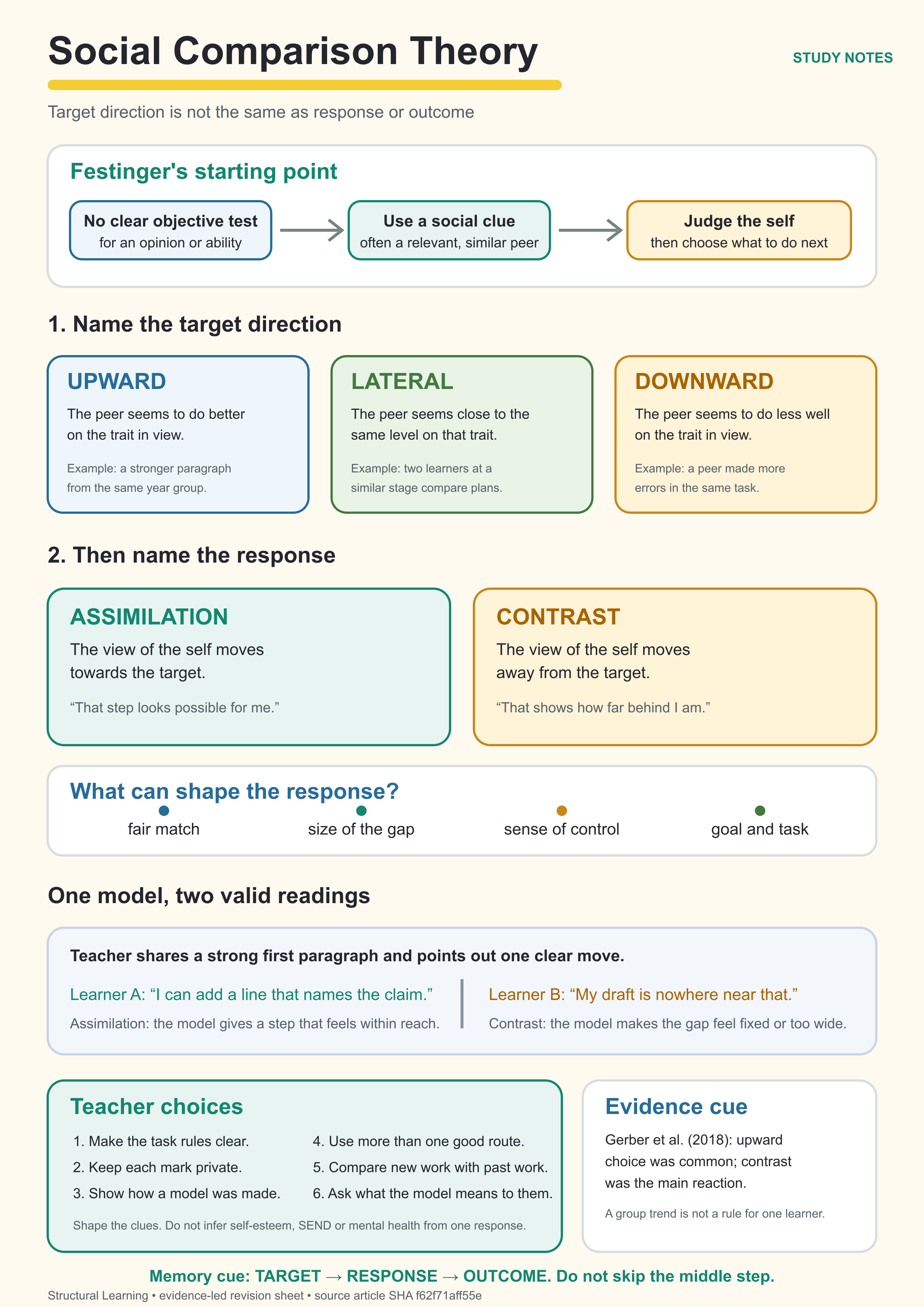
Social Comparison Theory study note: target direction does not fix the response. Open the full-size PNG or use the text guide below.Text guide to the study note
When there is no clear test, a person may use a peer as a clue. An upward target seems to do better on the trait in view. A downward target seems to do less well. A lateral target seems close to the same level.
The response is a new step. In assimilation, the view of the self moves towards the target. In contrast, it moves away.
A clear next step, a sense of control and a fair match can shape the response. No one cue tells a teacher what one learner will feel or do.
For class use, make task rules clear, keep each mark private, show how a model was made, use more than one good route, compare new work with past work, and ask the learner what the peer model means to them.
Print resource: use 12 duplex flashcards to test the split between target, response and effect.
No asset will be sent to Webflow without article-specific approval.
Frequently Asked Questions
These short answers cover the main search questions. Each keeps target direction apart from the learner's response. That is the key safeguard: an upward, downward or lateral target does not, by itself, tell us what a learner will think, feel or do next.
What is an upward social comparison?
An upward comparison uses someone perceived to be performing better on a relevant dimension as the target. It can provide information, inspiration or a manageable next step. It can also produce contrast and discouragement. Similarity, attainability, relevance and perceived control help shape the reaction.
What is a downward social comparison?
A downward comparison uses someone perceived to be performing less well on the relevant dimension. It may protect self-evaluation or offer reassurance, particularly under threat, but that response is not guaranteed. The learner may instead notice shared difficulty, feel concern or learn little about how to improve.
What is a lateral social comparison?
A lateral comparison uses someone perceived to be at a similar level. Such a target can supply a realistic benchmark because the comparison seems relevant. It is not automatically healthier than an upward or downward comparison, and small differences between close peers can still carry strong meaning.
Should teachers stop learners comparing marks?
Teachers cannot remove comparison, and peer information can be useful. They can protect individual results, avoid unnecessary public ranking, clarify task criteria and direct feedback towards an actionable next step. If learners choose to discuss marks, the teacher can help distinguish relative position from evidence about what to learn next.
Does social comparison always damage self-esteem?
No. Research shows a range of effects. A peer view can give a clue, prompt effort, bring calm or cause doubt.
Group trends, such as a frequent contrast response to an upward target, do not set a fixed result. If distress lasts, use the usual school care or health route. Do not base a diagnosis on this theory.
Dijkstra, P., Kuyper, H., van der Werf, G., Buunk, A. P., & van der Zee, Y. G. (2008). Social comparison in the classroom: A review. Review of Educational Research, 78(4), 828-879.
Paul Main is an educator and metacognition researcher who founded Structural Learning in 2002. With a psychology degree from the University of Sunderland and 22+ years helping schools embed thinking skills, he bridges the gap between educational research and classroom practice. Fellow of the RSA and Chartered College of Teaching, with 128+ Google Scholar citations.