Updated on
September 24, 2026
Locus of Control: Internal vs External Explained
Locus of control explained: Rotter's theory, internal and external expectancies, measurement, research evidence, educational relevance and key limitations.


Updated on
September 24, 2026
Locus of control explained: Rotter's theory, internal and external expectancies, measurement, research evidence, educational relevance and key limitations.
What is locus of control?
Locus of control is Julian Rotter's concept for a generalised expectancy about whether reinforcement is contingent on a person's behaviour or attributes, or instead on chance, fate or powerful others. Internal and external are directions on a measured continuum, not fixed types of learner. The construct is associated with some educational outcomes, but it should not be used to label pupils or promise that classroom techniques will make them more internal.
Julian Rotter introduced locus of control as a way to describe beliefs about control. It is a broad expectation about whether outcomes depend on a person's actions or qualities, or instead on chance, fate or powerful others (Rotter, 1966). Internal and external mark points on a measured continuum, not fixed types of learner. The construct is linked with some school outcomes, but it should not be used to label learners or promise that classroom techniques will make them more internal.
The distinction is easy to oversimplify. Locus of control is not a choice between taking responsibility and making excuses. It is also not another name for effort attribution, confidence, autonomy, growth mindset or metacognition.
Rotter's original I-E Scale has 29 items: 23 scored items and six fillers (Rotter, 1966).
Rotter introduced internal versus external control of reinforcement within his social learning theory. The construct concerns an expectation about the link between action and outcome. At the more internal end, a person expects an outcome to depend on their own action or lasting qualities. At the more external end, the outcome is seen as separate from personal action and instead due to luck, chance, fate or powerful others (Rotter, 1966).
This definition is narrower than the everyday question, "Do I feel in control of my life?" It concerns expected links between action and outcome. It does not cover every form of control, agency or causal account. Skinner's review of more than 100 control terms shows why clear language matters. Real control, beliefs about control, felt control, capability, autonomy, choice and causal attribution overlap, but they are not the same (Skinner, 1996).
The construct belongs among theories of personality because it concerns a broad expectation that may differ between people. It also belongs within the history of learning theories because Rotter explained how such beliefs develop through past outcomes. Neither placement turns it into a complete theory of classroom learning.
Rotter later returned to common errors about the construct. He stressed both the setting and differences between people. He also discussed how broad a claim could be and how the construct was measured (Rotter, 1975).
A score can help researchers study a trend across settings. It cannot reveal a person's essence or guarantee what they will believe in one event.
Internal and external control mark directions on a continuum. Someone with a more internal belief is more likely to see outcomes as linked to their own action or qualities. Someone with a more external belief is more likely to see outcomes as controlled by chance, fate or other people. Real responses can combine these positions.
The same person may also have different evidence in different settings.
The terms do not provide a moral ranking. An internal explanation can be inaccurate. A person may blame themselves for an outcome that was largely determined by inaccessible provision or discrimination.
An external explanation can be sound. Marking may be uneven, illness may interrupt study, or a decision-maker may truly control access to an opportunity.
Nor does internal mean controllable. This is where locus of control is often confused with causal attribution. In an attribution framework, effort is usually treated as internal, unstable and relatively controllable.
Ability may also be internal, but it can be seen as stable and beyond control. The location of a cause does not tell us whether it can change (Weiner, 1985).
Later measurement work also challenged a single external category. Levenson separated beliefs about chance from beliefs about control by powerful others. Her 1973 study used three scales with psychiatric inpatients: internality, powerful others and chance.
The sample limits how far the result can apply, but the distinction still matters. Believing that outcomes are random is not the same as believing that a named authority controls them.
These examples show the distinction, but they are starting hypotheses rather than learner labels. In each case, the explanation should be checked against what actually happened (Rotter, 1966).
The useful question is not, "Which type of learner is this?" It is, "What evidence links this outcome to this action or condition, and what remains genuinely controllable?"
Rotter's wider theory linked behaviour to expectancy, reinforcement value and the psychological situation. Expectancy is the judged chance that a given action will be followed by a given reinforcement in that setting. Reinforcement value is how much that result matters. The psychological situation is the person's view of the setting.
A broad expectation matters most when a setting is new or unclear. Past experience can support a wider belief that actions tend to matter, or that control lies elsewhere. When a person knows a given setting well, a belief about that setting may predict more than a general I-E score (Rotter, 1966, 1975).
This point prevents a common error. A general scale is not designed to predict one response in every lesson. A learner may have strong evidence that careful preparation affects one type of task, but weak evidence for another. Those judgements may reflect real differences in task design rather than an unstable personality.
Rotter's theory also differs from Bandura's later account. Both address behaviour, learning and social context. Yet Bandura placed learning from models, self-efficacy, reciprocal causation and human agency in another framework.
Readers can compare that work in Bandura's social learning theory. Shared language does not make the constructs the same.
Rotter's I-E Scale is a 29-item forced-choice measure. Twenty-three items count towards the score and six are fillers. Each scored item asks the person to choose between two statements about control. Rotter designed the scale to measure broad expectations in adolescents and adults, not to diagnose learners in class (Rotter, 1966).
Forced-choice measurement has limits. Respondents must choose between statements that may not express their actual view. A total score can also hide different kinds of external belief.
Later studies asked whether one internal-external dimension captures the construct well. Rotter himself discussed models with one or several dimensions. He also examined what test scores could and could not predict (Rotter, 1975).
Levenson's approach measured internal beliefs, chance and powerful others on separate scales (Levenson, 1973). Nowicki and Strickland made a 40-item yes-or-no research scale for children. They first worked with 152 learners, then tested the scale with 1,017 learners in US Grades 3 to 12.
They reported early evidence on reliability and validity. The sample and period still limit how far the findings apply (Nowicki and Strickland, 1973).
General, academic and subject measures do not ask the same question. A general scale asks about broad expectations. An academic scale narrows the field, while a subject scale narrows it further.
Changing the scale can change the link seen with attainment. Findley and Cooper found stronger achievement links for focused locus-of-control measures than for general ones (Findley and Cooper, 1983).
Reports should name the scale, age group, cultural setting, scoring direction and outcome. A score is evidence from set conditions. It should not become a label such as "external learner", a way to screen a class or a target for informal therapy.
Findley and Cooper reviewed research on locus of control and academic achievement. They found a small-to-medium link between more internal beliefs and higher achievement. The link tended to be stronger for adolescents than for children or adults. It was also stronger for males than females, focused rather than general scales, and standard tests rather than teacher grades (Findley and Cooper, 1983).
These moderators matter as much as the headline link. The result depends partly on who was studied and how both constructs were measured. The reported sex difference is a historical review finding, not a reason to form different expectations of individuals.
The review also does not establish one causal direction. Prior success may shape control expectancies, control expectancies may affect later behaviour, and other factors may affect both.
Stipek and Weisz reviewed personal control and academic achievement across three traditions: social learning, attribution and intrinsic motivation. They found that control terms already had several meanings. They called for studies that could test rival reasons for the link (Stipek and Weisz, 1981). The same warning applies when schools use older findings today.
Some school programmes have changed measured scores, but the evidence is bounded. Rosenbaum and colleagues studied two Year 4 classes in a private girls' school. They reported higher post-programme internal-control scores after a rational emotive education course (Rosenbaum, McMurray and Campbell, 1991).
Manger and colleagues compared social-cognitive training with another condition among 14 and 15 year olds. Girls in the training group recorded more internal scores. Boys in that group and both comparison groups did not (Manger, Eikeland and Asbjornsen, 2002).
These studies do not support one classroom rule for all. They tested given programmes, samples and measures. They do not show that routine praise, choice, goal setting or feedback changes locus of control in a reliable way.
Nor do they show that a change in score causes higher attainment. Claims about a programme need direct evidence for the stated group, practice and outcome.
Adult research links beliefs about control with health and wellbeing, but it also shows the limits of the evidence. Lachman and Weaver found links between mastery, felt limits, health and wellbeing across income groups. They used adult samples at one point in time and an adjacent sense-of-control model. They did not test Rotter's I-E scale as a school programme (Lachman and Weaver, 1998).
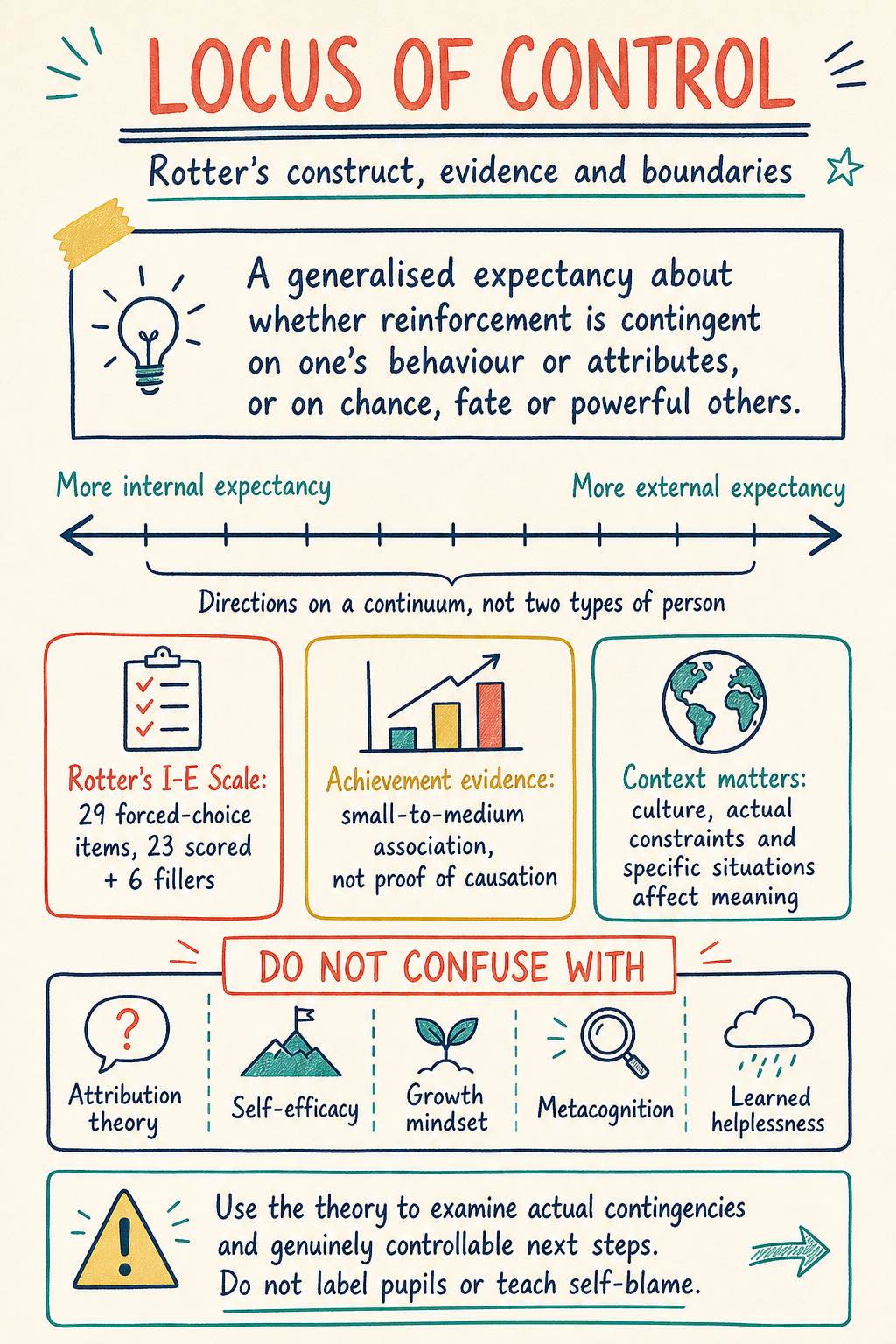
Locus of Control: Rotter's construct, evidence and limits.
A broad expectation about whether outcomes depend on one's actions or qualities, or on chance, fate or powerful others.
The scale runs from more internal to more external beliefs. These are directions on a continuum, not two types of person.
Do not treat locus of control as another name for attribution theory, self-efficacy, growth mindset, metacognition or learned helplessness.
Use the theory to examine actual contingencies and genuinely controllable next steps. Do not label learners or teach self-blame.
Terms about control appear in several fields, but they are not synonyms. Locus of control concerns expected links between action and outcome. Attribution, self-efficacy, autonomy, mindset, metacognition and learned helplessness ask different questions. The table marks the main limits and routes each nearby concept to its own evidence base.
Swipe horizontally to read the full table.
| Construct | Central question | Important boundary |
|---|---|---|
| Locus of control | Do I expect outcomes to depend on my actions or qualities, or on chance, fate or powerful others? | A broad expectation is not a full account of a given outcome. |
| Attribution theory | How is a given success or failure explained by its locus, stability and degree of control? | An internal cause is not necessarily controllable. See the fuller account of attribution theory. |
| Self-efficacy | Do I judge that I can plan and carry out the action needed for this task? | Capability differs from believing that the action would affect the outcome. See the account of social cognitive theory. |
| Autonomy | Do I experience my action as volitional rather than controlled? | Choice may support autonomy without changing a broad belief about control. See self-determination theory. |
| Growth mindset | Are abilities understood as capable of development? | Beliefs about change do not show who or what controls an outcome. See the critical guide to growth mindset. |
| Metacognition | How does a person monitor and regulate cognition and learning? | Planning and monitoring are not measures of internality. See metacognition in the classroom. |
| Learned helplessness | How can experience with uncontrollable outcomes affect later responding? | It has a different history in theory and experiments. It is not another name for external locus of control. |
Skinner's review helps to draw these lines. It separates real conditions from beliefs and felt control. Choice may come before a sense of control.
Autonomy is another source of motivation, while mastery can drive the wish for control. Evidence about one idea cannot prove another (Skinner, 1996).
For the same reason, a broad guide to theories of motivation should compare questions and causes. It should not place all positive beliefs in one package. A person can believe that a strategy would affect an outcome but doubt their ability to use it.
They can feel free to choose while noting a real outside limit. Those beliefs can be consistent.
Studies across cultures cast doubt on the idea that one score has one meaning. Hui reviewed about 70 reports. Results on cultural and ethnic groups were mixed. He asked whether the idea, its role, its dimensions and its measures mean the same thing in each setting (Hui, 1982).
Cheng and colleagues later combined 152 non-clinical adult samples from 18 cultural regions, with 33,224 people in total. External scores had a moderate link with symptoms of depression and anxiety. The evidence was correlational and does not show that external beliefs caused those symptoms. The anxiety link was weaker in collectivist societies than in individualist ones.
The authors warned that external control does not have the same negative meaning in all cultures. A result for a country also cannot be assigned to one person (Cheng et al., 2013).
Weisz, Rothbaum and Blackburn offered another useful distinction. Primary control means trying to change current conditions. Secondary control means adapting to them and seeking a better fit.
Their comparison of American and Japanese views warned against treating one route to control as better for everyone (Weisz, Rothbaum and Blackburn, 1984). These ideas relate to control research, but they are not other scores on Rotter's scale.
Real conditions matter as much as cultural meaning. Income, health, housing, discrimination, rules and access to resources shape a person's chances. Lachman and Weaver found less mastery and more felt limits among adults with lower incomes, along with poorer health.
This does not mean that beliefs cause social inequality. It shows why beliefs and real control need to be studied together (Lachman and Weaver, 1998).
A sound account avoids two mistakes. The first is to assume that every external explanation is an excuse. The second is to assume that noting a limit removes all scope to act.
The evidence may support both a real barrier and a limited action that remains open. Scholars should preserve that point.
Locus of control can help scholars and school leaders examine claims about cause and learning. A cautious school use is analysis, not diagnosis. This is a safeguard drawn from the construct's limits, not a tested locus-of-control programme. When a learner, teacher or policy document explains an outcome, ask whether the stated link is sound, what people could control and whose actions could change the conditions.
Consider a learner who says that an assessment was unfair. The statement should not be coded at once as an external belief. The task, marking and access arrangements need review. If a problem is found, the school needs to act.
If preparation also mattered, that can be discussed without denying the outside condition. The aim is a sound account, not a more internal learner.
Feedback can name a shown link between action and outcome, but it should not invent one. If a given study method improved recall in similar conditions, that evidence can be discussed. If an inaccessible task, illness or uneven marking shaped the outcome, saying that effort set the result would be false and could cause harm.
Schools should not give informal locus-of-control tests, create learner profiles or select teaching on that basis. Research scales need a defined group, clear scoring and sound test evidence. A label can hide change across settings. It may also lead adults to treat distress, disagreement or a request for fairness as a flaw in the person.
This bounded reading also protects nearby practices. Goal setting, choice, reflection and feedback may have value in their own evidence bases. They should not be sold as a package that shifts locus of control. Leaders should also note that a plausible theory of change does not prove that a named construct or attainment outcome has changed.
The construct can be broader than the event being explained. Broad expectations may help in unfamiliar settings, but beliefs about one setting may matter more when a person knows it well. A general score should not overrule evidence from the actual event.
The number of dimensions remains contested. Rotter's scale gives an internal-external score, while later work split chance from powerful others. A single total can hide beliefs with quite different meanings. The measure chosen partly defines the finding.
Self-report has clear limits. Answers depend on the words used, the options given and how a person reads the item. Forced-choice items may create a false split.
Scores from different ages, languages or fields need fresh test evidence. We cannot assume that they mean the same thing.
A link does not prove cause. Achievement may shape later beliefs, while beliefs may shape later acts. Other causes may affect both. Small school studies cannot prove that a programme works for all, especially when results differ by group.
An internal belief is not always sound or helpful. Too much self-blame can make people fault themselves for events they did not control. An external view can support a fair reading, joint action or a request that an institution meet its duties.
Cultural comparisons risk imposing one ideal. Measures made in one setting may not have the same meaning or use elsewhere. Differences between groups must never be used to infer one person's beliefs.
Control terms are crowded. Studies of agency, efficacy, autonomy, attribution, mastery or felt limits may be relevant. Yet they do not by default test Rotter's idea. Reviews must name the concept and scale used for each result.
Locus of control is often confused with effort, responsibility and optimism. These answers explain its origin, its two directions, key limits in the evidence and why schools should not try to change a learner type.
It is a broad expectation about whether outcomes depend on one's own actions or qualities, or instead on chance, fate or powerful others. It is a continuum used in research, not a division of people into two fixed types.
Julian B. Rotter developed the construct within social learning theory. His 1966 monograph set out the internal-external framework and I-E Scale. He later discussed common errors, problems with measures and the history of the variable (Rotter, 1975, 1990).
A more internal belief treats outcomes as linked to personal actions or qualities. A more external belief treats them as controlled by chance, fate or powerful others. These are directions on a continuum, and the sound view depends on the setting.
No. An internal explanation can be wrong and can create unjust self-blame. An external explanation may correctly identify chance, discrimination, illness or another person's authority. The key question is whether the explanation matches the real link between action and outcome.
No. Rotter's construct is a broad expectation about whether reinforcement depends on personal actions or qualities. Attribution theory studies how people explain a given result. It asks where the cause lies, how stable it is and whether it can be changed. An internal cause is not always under personal control.
Some bounded programmes have changed measured scores in given samples, sometimes only for a subgroup. This does not show that routine feedback, choice or goal setting makes learners more internal or raises attainment. Schools should examine real conditions and the actions still open rather than target a learner label.
Cheng, C., Cheung, S. F., Chio, J. H. M., & Chan, M. P. S. (2013). Cultural meaning of perceived control: A meta-analysis of locus of control and psychological symptoms across 18 cultural regions. Psychological Bulletin, 139(1), 152-188.
Findley, M. J., & Cooper, H. M. (1983). Locus of control and academic achievement: A literature review. Journal of Personality and Social Psychology, 44(2), 419-427.
Hui, C. C. H. (1982). Locus of control: A review of cross-cultural research. International Journal of Intercultural Relations, 6(3), 301-323.
Lachman, M. E., & Weaver, S. L. (1998). The sense of control as a moderator of social class differences in health and well-being. Journal of Personality and Social Psychology, 74(3), 763-773.
Levenson, H. (1973). Multidimensional locus of control in psychiatric patients. Journal of Consulting and Clinical Psychology, 41(3), 397-404.
Manger, T., Eikeland, O. J., & Asbjornsen, A. (2002). Effects of social-cognitive training on students' locus of control. School Psychology International, 23(3), 342-354.
Nowicki, S., & Strickland, B. R. (1973). A locus of control scale for children. Journal of Consulting and Clinical Psychology, 40(1), 148-154.
Rosenbaum, T., McMurray, N. E., & Campbell, I. M. (1991). The effects of rational emotive education on locus of control, rationality and anxiety in primary school children. Australian Journal of Education, 35(2), 198-211.
Rotter, J. B. (1966). Generalized expectancies for internal versus external control of reinforcement. Psychological Monographs: General and Applied, 80(1), 1-28.
Rotter, J. B. (1975). Some problems and misconceptions related to the construct of internal versus external control of reinforcement. Journal of Consulting and Clinical Psychology, 43(1), 56-67.
Rotter, J. B. (1990). Internal versus external control of reinforcement: A case history of a variable. American Psychologist, 45(4), 489-493.
Skinner, E. A. (1996). A guide to constructs of control. Journal of Personality and Social Psychology, 71(3), 549-570.
Stipek, D. J., & Weisz, J. R. (1981). Perceived personal control and academic achievement. Review of Educational Research, 51(1), 101-137.
Weiner, B. (1985). An attributional theory of achievement motivation and emotion. Psychological Review, 92(4), 548-573.
Weisz, J. R., Rothbaum, F. M., & Blackburn, T. C. (1984). Standing out and standing in: The psychology of control in America and Japan. American Psychologist, 39(9), 955-969.