Updated on
September 24, 2026
Build It: Thinking with Our Hands
Discover how Build It & Writer's Block help students structure ideas, enhance thinking skills and make learning hands-on in the Structural Learning Toolkit.


Updated on
September 24, 2026
Discover how Build It & Writer's Block help students structure ideas, enhance thinking skills and make learning hands-on in the Structural Learning Toolkit.
Build It lets learners build ideas with materials, making abstract concepts clear. This hands-on approach helps them organise thoughts better than just reading and writing. Learners actively create knowledge, building representations for deeper understanding. This boosts retention; see Bruner (1966) and Papert (1980).
By using Writer’s Block, students actively engage in the physical construction of knowledge, allowing them to visually and tactically experiment with concepts. This method is deeply rooted in cognitive scienceand educational theory, emphasising the power of learning through doing.
Piaget (1964) noted learners make abstract ideas real by touching things. Research shows active work with objects boosts memory and learning (Bruner, 1966; Vygotsky, 1978). This helps learners understand concepts better (Dewey, 1938).
Alongside Build It, the toolkit also includes:
Each of these tools allows teachers to embed thinking skills into their lessons in different ways. Writer’s Block is a flexible option for teachers who want to integrate the Thinking Framework into their classrooms using a collaborative, hands-on exercise. By allowing students to physically move, manipulate, and structure their ideas, Build It turns cognitive processing into an engaging, interactive learning experience.
Build It lets teachers create collaborative, interactive learning. Learners don’t just receive information; they actively build it themselves. Researchers like Piaget (1936) support this approach. Vygotsky (1978) also emphasised learning through social interaction.

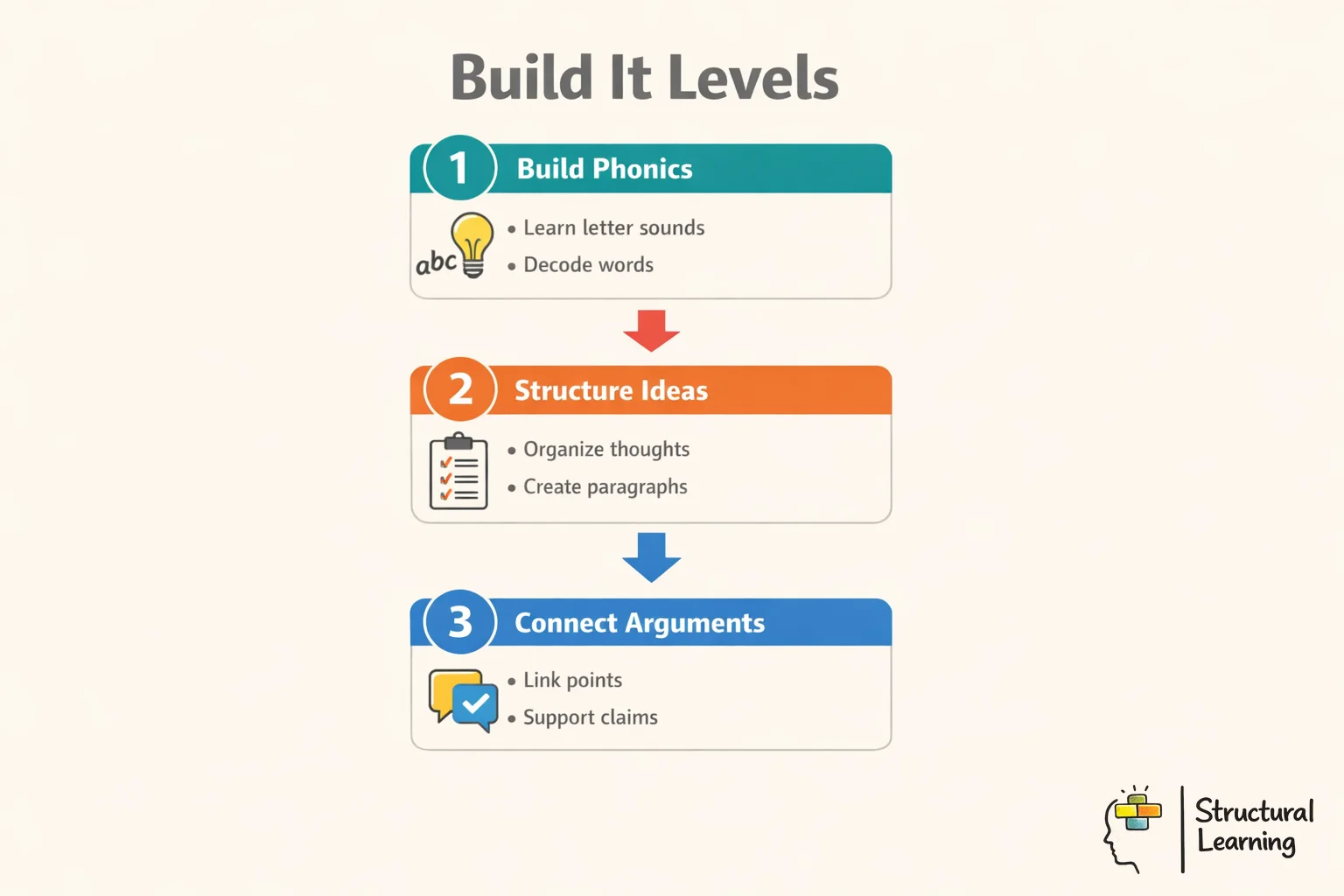
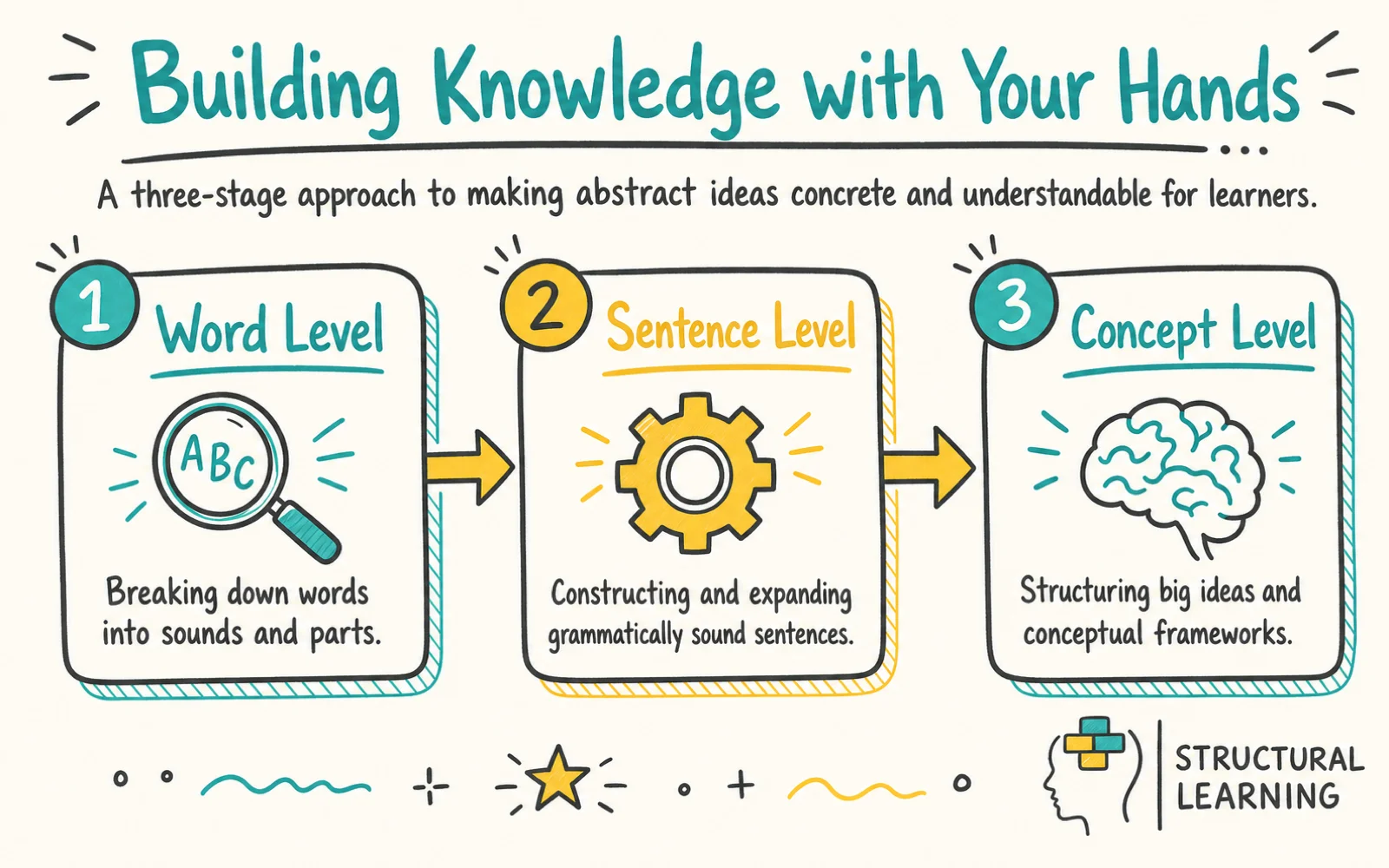
Schools that have embraced Build It as a learning tool typically use Writer’s Block in three key ways: at the word level, sentence level, and conceptual level. These structured approaches help students break down language, build meaning, and think critically across both primary and secondary education.
At the foundational level, students use Writer’s Block to physically manipulate and explore the structure of words. This is particularly useful in phonics, spelling, and vocabulary development, as students learn how words are built.
Primary Applications:

Secondary Applications:

Beyond individual words, Writer’s Block enables students to build grammatically sound and well-structured sentences. It provides a tangible way to experiment with different sentence constructions, connectors, and clauses.
Primary Applications:

Secondary Applications:
At the highest level, Writer’s Block is used to construct conceptual frameworks, helping students organise and connect big ideas. This allows them to see the hierarchy, relationships, and structure of knowledge.
Primary Applications:
Secondary Applications:
Impact Across Education Levels
Writer's Block builds core literacy for younger learners by supporting sentence fluency and categorisation. Older learners use it to structure essays and argumentation, and apply it across subjects for content analysis (Macrine & Fugate, 2021).
This approach also elevates learner engagement, encourages peer collaboration, and allows for more holistic assessment strategies. Studies by Bruner (1966) and Vygotsky (1978) highlight the importance of active learning and social interaction in knowledge construction, while research by Flavell (1979) emphasises the role of metacognition in self-regulated learning. This blended pedagogical approach cultivates essential 21st-century skills and prepares students for future academic challenges. Teachers using Writer's Block give learners a visual, hands-on way to build understanding. This reinforces thinking and self-awareness. Bruner (1966) and Vygotsky (1978) show active learning and teamwork matter. Flavell (1979) highlights self-regulated learning. This method builds important skills.
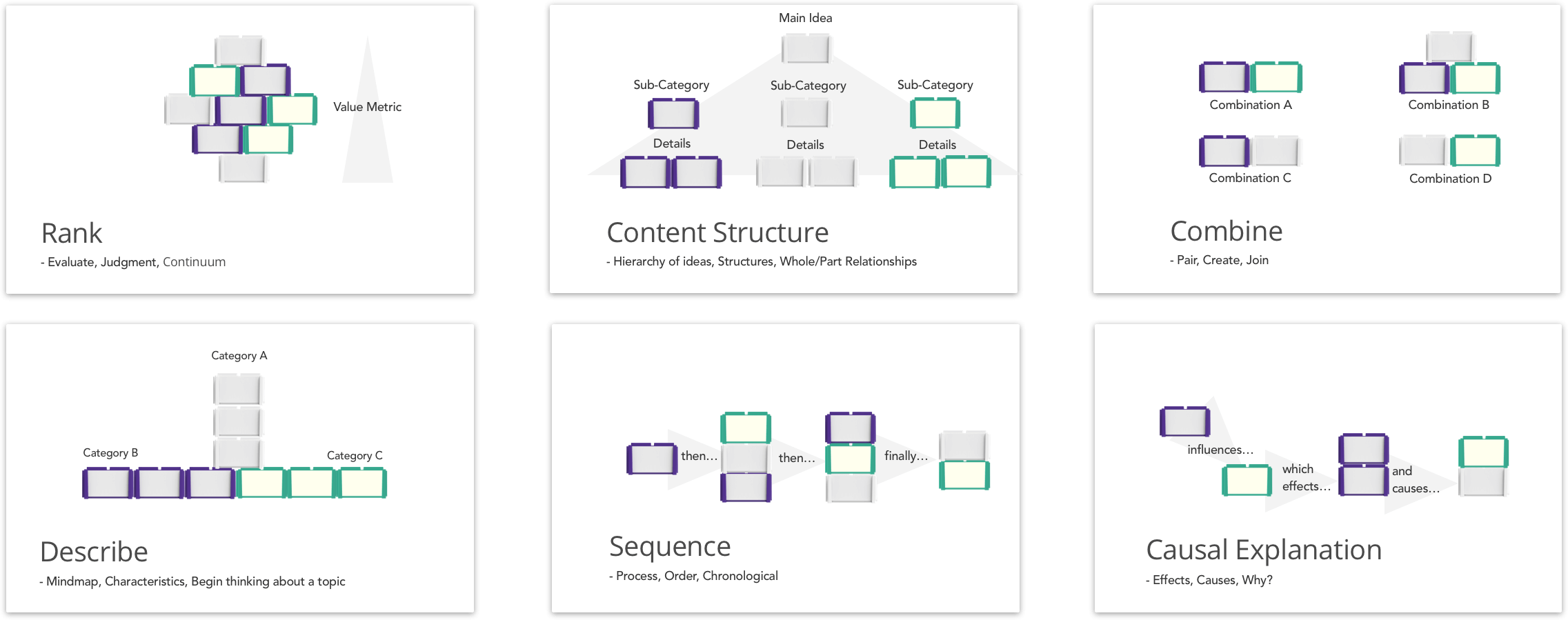
Many students face barriers when it comes to processing, organising, and expressing their ideas. For neurodivergent learners, including those with dyslexia, dysgraphia, ADHD, and other learning differences, these challenges can impact writing, sequencing, and verbal expression. Build It provides a structured, visual, and hands-on approach that helps reduce cognitive overload, improve executive functioning, and make learning more accessible and engaging.
Dyslexia affects a student’s ability to decode and process language, making tasks like reading, writing, and spelling more difficult. Writer’s Block provides a tangible way to physically manipulate words, sentences, and ideas, making abstract concepts easier to grasp.
Key benefits for dyslexic learners include:
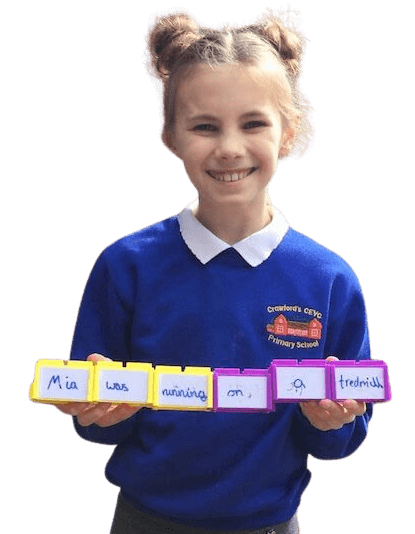
Executive functioning refers to the cognitive processes that help students plan, organise, and regulate their learning. These skills are particularly challenging for students with ADHD, dysgraphia, and other neurodivergent profiles. Writer’s Block provides a structured method to help them organise their ideas before committing them to paper.
How Build It supports executive functioning:
By giving students a physical, visual, and interactive way to structure their thoughts, Build It makes learning more inclusive. Whether a student struggles with processing language, organising sentences, or structuring arguments, Writer’s Block acts as an external cognitive tool, bridging the gap between thinking and writing.
Research shows structured support helps neurodivergent learners. This boosts their confidence and independence. Learners take ownership of learning, according to researchers like . Writing and idea-building become easier .
Gallagher (2004) showed physical tools support learning. Alibali and Nathan (2012) found gestures help learners grasp concepts. Glenberg (2010) showed bodies contribute to cognitive processing. Barsalou (2008) highlighted how experiences shape understanding. Finally, Wilson (2002) explained cognition extends beyond the brain.
and (Lee, 2021) found that embodied cognition boosts learner interest. Learners understand better using manipulative and kinesthetic methods. These approaches engage learners in both primary and secondary schools.
Implementing Build It strategies requires minimal preparation yet delivers maximum impact across all year groups. Start with simple wooden blocks or colourful manipulatives; even everyday items like LEGO bricks or cardboard squares work brilliantly. The key lies not in expensive resources but in structured guidance that transforms these materials into powerful thinking tools.
Year 3 learners can group phoneme blocks to build word families. Learners use blocks of varied size to visualise fractions, making maths concepts clearer. One Year 9 teacher noted writing success after learners arranged argument blocks (Kellogg, 2001).
The approach suits various subjects and abilities well. Learners in science build models; history learners create timelines. Glenberg (2010) showed physical tasks change neural activity. Mixed ability groups gain, as visual learners access more content.
Practical tip: Begin each building session with clear success criteria displayed visually. Students should understand whether they're constructing to demonstrate knowledge, solve problems, or plan future work. Allow five minutes for experimentation before focussed building begins; this exploration phase proves crucial for engagement and reduces anxiety amongst learners who struggle with traditional methods.
Researchers like Dewey (1938) found learners benefit from hands-on activities. The Build It approach helps neurodivergent learners with ADHD, autism, and dyslexia. This method transforms abstract concepts into tangible objects (Bruner, 1966). Learners manipulate these objects, increasing understanding and learning (Piaget, 1954).
Tactile learning engages varied neural pathways (Macrine & Fugate, 2021). This helps learners understand information in different ways. It benefits those finding text or verbal instruction hard.
In practice, a Year 8 student with ADHD might use coloured blocks to physically arrange paragraph components for an essay. Rather than becoming overwhelmed by a blank page, they can experiment with different structures, physically moving topic sentences and supporting evidence until the logic becomes clear. This externalisation of thinking reduces cognitive loadwhilst maintaining engagement through movement.
For autistic learners who excel with visual-spatial reasoning, Build It provides a systematic framework that makes implicit classroom expectations explicit. A teacher might use blocks to demonstrate how arguments connect in history essays, with each colour representing different types of evidence. Students can then replicate and adapt these structures independently, removing the ambiguity that often causes anxiety.
For dyslexic learners, this helps separate ideas from writing. Learners build ideas physically and photograph their work. This lets them show complex thought without processing difficulties. Physical actions aid memory through various senses.
Piaget (1964) showed learners benefit from object manipulation before abstract thought. Research on embodied cognition indicates that physical building activates multiple brain regions, with neural pathways strengthened by sustained manipulation rather than passive note-taking (Glenberg, 2010; Barsalou, 2008).
Research suggests learners using manipulatives can retain more sentence-structure knowledge than those using worksheet-only methods, with effects visible over several weeks (Castro-Alonso et al., 2015). The Education Endowment Foundation showed benefits for learners with working memory difficulties. These learners made two months extra progress in literacy.
In practice, teachers report remarkable transformations. Sarah Mills, a Year 4 teacher in Manchester, observed her struggling writers suddenly "see" how paragraphs connect when physically arranging idea blocks on their desks. "It's like watching a light switch on," she notes. "They'll say things like 'Oh, this bit doesn't fit here' and physically move it to where it makes sense."
The evidence extends beyond literacy. Mathematics teachers using physical building blocks for fraction work report students developing deeper conceptual understanding. When learners can touch, move, and rearrange mathematical concepts, abstract relationships become visible and memorable. This aligns with embodied cognition theory, which suggests our physical interactions with the world fundamentally shape how we think and learn.
Build It is a Research in embodied cognition suggests that physical construction of knowledge can enhance learning retention, though effects vary by context and learner than passive learning methods.
Teachers can use Writer's Block at three levels: word level for phonics and vocabulary development, sentence level for grammar and sentence construction, and conceptual level for organising complex ideas. The blocks work alongside other tools like 'Say It' (verbal discussions) and 'Map It' (visual mapping) to embed thinking skills into lessons through collaborative, hands-on exercises.
Researchers like Bruner (1966) found this helps learners who struggle. It makes thinking visible, simplifying complex concepts into smaller parts. Learners picture thought patterns and fix errors physically. A multi-sensory approach helps understanding (Piaget, 1936; Vygotsky, 1978).
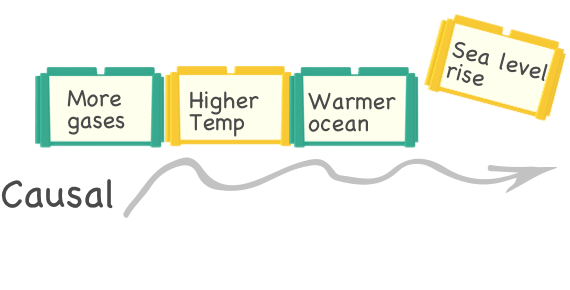
Froebel's gifts and Montessori's sensorial materials provide historical precedents for hands-on early literacy work. Modern classrooms extend these principles, with older learners exploring word origins and sentence structures and building arguments through cause and effect.
Vygotsky (1978) showed learners benefit from collaborative work within their Zone of Proximal Development. Piaget's (1964) Constructivist Theory showed learners actively reorganise knowledge. Embodied Cognition research (date) suggests physical activity improves neural connections. These theories explain why hands-on activities improve understanding and memory.
Build It encourages learners to discuss, challenge, and refine their thinking. Shared exploration fosters critical thinking as learners explain their reasoning (Vygotsky, 1978; Piaget, 1954). Peer interaction with blocks can lead to deeper understanding.
Build It aims to develop critical thinking skills like organising information. The Thinking Framework supports this, along with Say It (verbal skills) and Map It (visual skills). Teachers can use these tools to embed thinking skills, offering learners different ways to learn (Fisher, 2023).
These peer-reviewed studies provide the research foundation for the strategies discussed in this article:
Metacognition boosted self-regulated learning for young learners (Vygotsky, 1978). A science education intervention helped teachers support this (Whitebread et al., 2009). This improved outcomes for learners in early years (Zimmerman, 2000). Researchers highlight the benefits of embedding metacognitive strategies (Flavell, 1979).
Shiyi Chen et al. (2024)
This study with 110 preschoolers and 20 teachers found that when early childhood educators received training in metacognition-based science teaching, their students developed stronger self-regulation skills. The research demonstrates that teaching young children to think about their own thinking processes, especially through hands-on science activities, helps them become more independent learners. For teachers of young children, this suggests that incorporating reflective practices and helping students verbalize their problem-solving strategies can have lasting benefits beyond the science classroom.
Translating Embodied Cognition for Embodied Learning in the Classroom View study ↗
32 citations
Sheila L. Macrine & Jennifer M. B. Fugate (2021)
This research review confirms what many teachers intuitively know: students learn better when their bodies are actively engaged in the learning process. The authors provide scientific backing for movement-based learning activities, showing how physical engagement strengthens memory and understanding across subjects. Teachers can use this research to justify and expand their use of hands-on activities, gesture-based instruction, and kinesthetic learning approaches that get students moving while they learn.
Effects of a VR Mountaineering Education System on Learning, Motivation, and Cognitive Load in Compass and Map Skills View study ↗
Cheng-Pin Yu et al. (2022)
Researchers created a virtual reality system that taught middle school students compass and map reading skills through immersive 3D mountain environments, finding that students learned more effectively and stayed more motivated than with traditional methods. The VR approach reduced cognitive overload by allowing students to practise complex navigation skills in a safe, controlled environment where they could make mistakes without consequences. This study suggests that emerging technologies can make abstract spatial concepts more concrete and accessible, especially for skills that are difficult or dangerous to practise in real-world settings.
Integrating App Inventor 2 and robotics improves learner outcomes (Atmatzidou & Demetriadis, 2016). Research suggests this method boosts learner motivation (Bers, 2008). Studies explore how this approach impacts cognitive load (Sweller, 1988; Chandler & Sweller, 1991).
Using robotic arms helped learners improve computational thinking (Kahn et al., 2011). The hands-on approach boosted learner motivation and engagement (Druin & Hendler, 2007). Visual programming made coding easier to grasp (Resnick et al., 2009). Learners understand coding better with physical outputs (Bers, 2008).
Researchers note digital literacy and self-regulation link to learning (Bandura, 1977; Zimmerman, 1990). Learners with strong self-efficacy use metacognition for better results (Flavell, 1979; Schraw & Dennison, 1994). Digital skills help learners manage their own learning effectively (Kuiper & Xu, 2010).
Digital confidence supports independent learning, and learners with stronger metacognition solve problems more effectively (Kuiper & Xu, 2010). Teach digital skills alongside structured reflection.