Updated on
August 21, 2026
IB Primary Years Programme: A Practical PYP Guide
A practical guide to the IB Primary Years Programme: understand the PYP framework, six themes, inquiry, agency, assessment and school implementation.

Updated on
August 21, 2026
A practical guide to the IB Primary Years Programme: understand the PYP framework, six themes, inquiry, agency, assessment and school implementation.
The IB Primary Years Programme (PYP) is an inquiry-based, transdisciplinary curriculum framework for learners aged 3 to 12. It helps schools connect subject knowledge, concepts and skills through meaningful questions. The PYP is not a fixed syllabus. Schools build a local programme of inquiry while still teaching the knowledge and requirements of their national or local curriculum.
The current framework places learner agency across three connected pillars: the learner, learning and teaching, and the learning community (International Baccalaureate, 2026). For a teacher, that can mean explicitly modelling how to compare two sources, then giving learners a bounded choice of evidence and asking them to revise an explanation. Knowledge and agency work together.
The PYP is the primary phase of the International Baccalaureate. It is designed for the whole school community, not just a set of lessons for children. Its purpose is to develop knowledgeable, thoughtful and internationally minded learners who can use what they know, explain their thinking and take responsible action.
The official framework describes learning as inquiry-based, transdisciplinary and centred on conceptual understanding. Learners make connections across subjects, but this does not make subject knowledge optional. Mathematics, language, science, social studies, arts and personal, social and physical education continue to contribute distinct knowledge and ways of thinking.
A school does not receive a universal sequence of daily lessons. It maps required curriculum content, agrees a programme of inquiry and decides how subjects will contribute. This gives schools flexibility, but it also creates responsibility. Leaders must protect curriculum progression so that an engaging inquiry does not leave gaps in vocabulary, number, reading, writing or disciplinary knowledge.
The PYP sits within the wider International Baccalaureate overview. Schools must complete the IB authorisation process before presenting themselves as an IB World School. A non-authorised school can learn from inquiry and concept-based practice, but it should not claim to offer the PYP.
Key Takeaways
The current PYP framework is organised around three connected pillars: the learner, learning and teaching, and the learning community. Agency runs through all three. This is a more accurate guide to current PYP practice than the older lists of five essential elements that still appear on some school websites.
| Pillar | The practical question | What it looks like |
|---|---|---|
| The learner | What is learning? | Learners build knowledge, conceptual understanding, skills, learner-profile attributes and the confidence to act. |
| Learning and teaching | How do we support learning well? | Teachers use inquiry, explicit instruction, assessment, feedback and carefully chosen subject connections. |
| The learning community | Who enables learning? | Learners, families, teachers, leaders and community partners build shared expectations and responsibility. |
Agency means that learners have voice, choice and ownership. It does not mean children decide every objective or activity. A teacher may define essential knowledge, model a method and set a careful boundary while still inviting learners to ask questions, choose an approach or judge the quality of their work.
The IB describes the framework as a connected whole in which knowledge, concepts, skills and personal attributes support meaningful action (International Baccalaureate, 2026). Schools therefore need to plan both the intended curriculum and the responsive decisions that arise from learner questions and assessment evidence.
Concept-based learning helps teachers move beyond a collection of activities. A concept such as change, connection or perspective can help learners transfer an idea to a new setting. Transfer still depends on secure examples and knowledge. A broad concept without concrete content can become vague discussion.
Six transdisciplinary themes organise the school’s programme of inquiry: Who we are; Where we are in place and time; How we express ourselves; How the world works; How we organise ourselves; and Sharing the planet. They provide global contexts for learning across, between and beyond subjects.
Each school maps how the themes will be explored across age groups. A unit under How the world works can combine scientific observation, measurement, explanatory writing and consideration of human use of resources. The theme creates a reason to connect learning. It should not erase the distinctive methods or progression of science, mathematics or language.
The programme of inquiry should be balanced rather than crowded. Teams need to check which concepts and subject objectives are genuinely strengthened by a connection. If a link is cosmetic, teachers can teach the subject content separately and return to it when a meaningful connection becomes available.
Our guide to the six PYP transdisciplinary themes explains each theme in detail. The separate guide to PYP key concepts helps teams turn a large topic into questions about form, function, causation, change, connection, perspective and responsibility.
Inquiry in the PYP is a purposeful process of noticing, questioning, finding out, organising ideas, explaining and reflecting. Learner questions can change the route, but teachers remain responsible for the quality of the knowledge, materials, discussion and feedback that make inquiry productive.
Agency becomes visible when learners can explain what they are trying to understand, make a meaningful choice and use feedback to improve. Choice may concern a question, source, partner, method or final product. Too many choices can overload younger learners, so the range should match their prior knowledge and independence.
The inquiry cycle is best treated as a flexible thinking routine rather than a rigid sequence. A class may return to an earlier question after finding contradictory evidence. Teachers may pause an investigation to teach vocabulary or demonstrate a procedure. That is responsive inquiry, not a failure of learner agency.
Action is integral to the PYP and can be individual or collective. It can involve changing a classroom routine, sharing a well-supported explanation, helping a community partner or making a more responsible choice. It should emerge from learning and reflection. “Service as Action” is language associated with the MYP, so using that label for all PYP action creates unnecessary confusion.
The UN Sustainable Development Goals can offer useful contexts, especially for questions with a local and global dimension. They are not a universal requirement for every unit or for every PYP Exhibition. The question, evidence and action should fit the learners and community, rather than being forced into an SDG label.
Strong PYP planning begins with the understanding learners should build, not with a display or final activity. Teams connect a transdisciplinary theme, a central idea, lines of inquiry, subject objectives, concepts, approaches to learning and suitable evidence. They then revise the plan as learner questions and assessment reveal what is needed.

A central idea should express a transferable relationship rather than name a topic. “Materials have properties” is factual but limited. “The properties of materials influence how people use them” creates a relationship that learners can test with examples. Lines of inquiry then divide the central idea into manageable directions.
Teachers should identify which knowledge cannot be discovered efficiently or safely. A short explanation, worked example, read-aloud, vocabulary routine or demonstration can prepare learners to investigate well. Explicit teaching and inquiry are not opposites. The choice depends on the learner, the content and the point in the sequence.
The PYP unit planning guide provides a fuller planning route. Teachers can also map Approaches to Learning skills deliberately, rather than assuming that research, communication, thinking, social and self-management skills appear simply because a task is open-ended.
Use the IB learner profile as a language for reflection and community expectations, not a label placed on compliant behaviour. Ask for evidence: What did a learner do that was principled? When did open-mindedness change an interpretation? Which feedback helped the learner become more reflective?
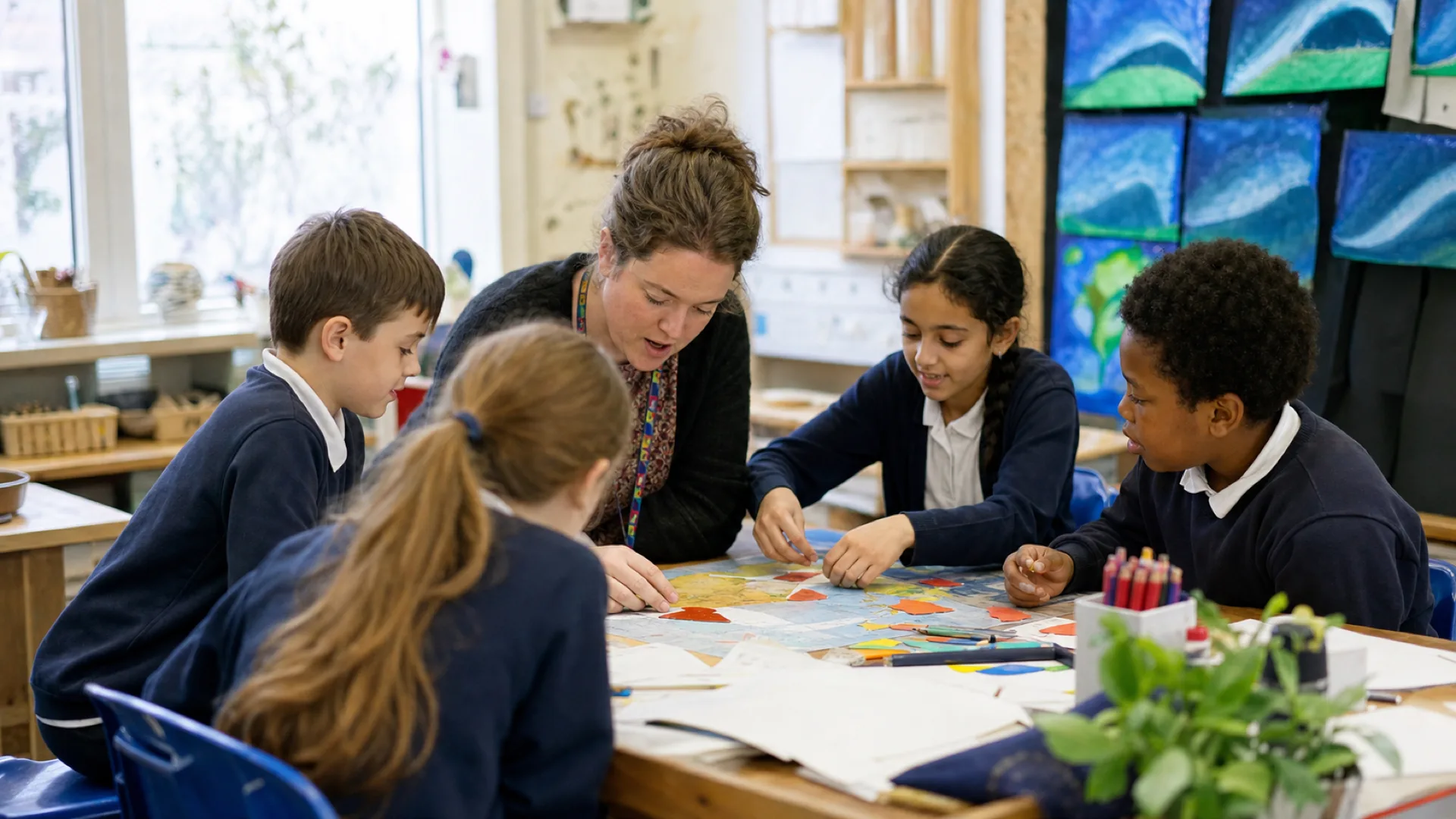
A typical lesson can move between several forms of guidance. A teacher can retrieve earlier knowledge, introduce two essential terms and model how to compare sources. Learners then investigate a bounded question in pairs, record an emerging explanation and decide which evidence challenges it. The teacher listens, prompts and brings the class together when a misconception needs attention.
Learners finish by revising an explanation and naming the next question. This is neither an unstructured discovery lesson nor a continuous teacher presentation. It is a deliberate sequence in which knowledge makes inquiry possible and inquiry gives learners a reason to use, connect and question that knowledge.
Planning should leave room for this responsiveness. Record the non-negotiable understanding, likely misconceptions and useful prompts, but do not script every learner response. After the lesson, note which question opened productive thinking, which support became unnecessary and which knowledge gap stopped progress. Those observations are evidence for the next planning conversation.
PYP assessment is integrated and ongoing. Teachers gather evidence before, during and after learning, then use it to decide what to explain, practise, revisit or extend. The aim is not to replace all tests. It is to use the right evidence for the knowledge, skill or conceptual understanding being judged.
Begin with prior knowledge. A quick concept map, drawing, short explanation or worked problem can reveal both useful starting points and misconceptions. During a unit, use observation, questioning, conferences, retrieval, drafts and peer discussion. These checks should change teaching, not merely produce a folder of evidence.
Conceptual understanding is visible when learners can explain a relationship, support it with examples, distinguish it from a misconception and apply it in a new context. A polished model or poster may hide weak understanding. Ask learners to justify choices and respond to a new case before drawing a conclusion.
Self-assessment supports agency when the success criteria are clear enough to use. Young learners may need annotated examples, sentence stems or a brief conference. Over time, teachers can withdraw these supports. Reporting to families should show subject progress as well as transdisciplinary learning so that important strengths and gaps remain visible.
PYP implementation is a whole-school change. Leaders need to create the time, curriculum structures and shared language that make thoughtful planning possible. Asking individual teachers to “do more inquiry” without these conditions usually produces attractive activities, uneven progression and avoidable workload.
Leaders should also distinguish authorisation evidence from daily quality. A document can satisfy a process and still be difficult for teachers to use. Short planning records, accessible curriculum maps and routine review meetings are often more useful than lengthy templates completed after teaching.
An inclusive PYP gives every learner access to rich ideas, meaningful participation and suitable challenge. Inquiry should not depend on fluent speech, confident group work, strong working memory or access to resources at home. Teachers can preserve the intellectual goal while changing the route, representation or support.
Pre-teach essential vocabulary, show a visual sequence and provide a concrete example before opening a broad question. Offer quiet thinking time before discussion. Let learners record ideas through speech, drawing, objects or assistive technology. Keep routines predictable even when the content and questions remain open.
One common problem is confusing minimal guidance with inquiry. Learners who lack background knowledge may search randomly, copy unreliable material or defer to a confident peer. A better response is to curate sources, model how to judge evidence and reduce support as competence grows.
A second problem is forcing every subject into every unit. This weakens disciplinary progression and increases planning workload. A third is treating voice and choice as unlimited freedom.
Useful choices are bounded, consequential and matched to readiness. A fourth is assessing presentation quality when the intended outcome is scientific, mathematical or conceptual understanding.
Transitions also need planning. Learners moving into or out of a PYP school may know different terminology or have experienced different sequences. The PYP transition guide helps schools identify knowledge and routine gaps without assuming that a learner’s previous curriculum was deficient.
Research on the PYP includes attainment studies, surveys, interviews and school case studies. It can identify patterns and implementation conditions, but it does not justify claiming that the programme automatically causes higher results in every context. School selection, prior attainment, staffing and implementation quality all matter.
A US study found mixed attainment results. It reported a moderate positive finding for third-grade mathematics in Michigan, no third-grade reading effect there, broadly similar fifth-grade outcomes in Michigan, and negative mathematics estimates in North Carolina alongside no detectable reading effects for most groups (Hemelt, 2015). This is a reason for careful curriculum monitoring, not a simple verdict for or against the PYP.
A mixed-method Australian study reported higher well-being in PYP schools than in similar non-PYP schools and linked stronger implementation with more positive school climate, teacher engagement and learner participation (Dix and Sniedze-Gregory, 2020). The design provides useful evidence, but schools should still monitor their own participation, belonging and workload rather than assuming the programme label guarantees these outcomes.
Research on the Exhibition found that participants in seven case-study schools viewed it as valuable for critical thinking, international-mindedness and learner-profile development, with experienced schools better able to manage the process (Medwell et al., 2017). Perceptions and case studies offer depth, but they are not the same as a controlled causal comparison.
The practical conclusion is modest. The framework creates promising conditions for connected learning, agency and reflection. Outcomes depend on curriculum quality, teaching, inclusion, leadership and review. Schools should combine external research with local evidence such as work samples, assessment, learner voice, family feedback and the experience of teachers.
The programme’s flexibility can produce uneven practice when schools lack planning time, subject expertise or stable staffing. Collaborative planning can also increase workload. A California study reported small improvements in several school-climate measures after authorisation, alongside positive case-study accounts, but this does not isolate which features caused the change (Boal and Nakamoto, 2020). Leaders should test claims against local curriculum coverage, attainment, participation and staff workload.
Choose one current unit and run a 30-minute team check. This is small enough to complete, but specific enough to reveal whether the unit is genuinely connected, knowledge-rich and assessable.
If the unit is the final-year Exhibition, use the more detailed PYP Exhibition guide. The Exhibition is a substantial collaborative inquiry and celebration of learning, not a requirement to attach every project to the Sustainable Development Goals.
The PYP is a curriculum framework rather than a script, so sensible implementation questions recur across schools. The short answers below clarify the boundaries that matter most: the role of direct teaching, the place of subjects, the meaning of action and the best starting point for a teacher who is new to the programme.
It is a curriculum framework. It organises inquiry, concepts, skills, learner attributes and transdisciplinary learning, while schools map local or national curriculum content into a coherent programme. Inquiry is a central approach, but teachers use several teaching methods within it.
No. Teachers can explain, model, demonstrate and provide guided practice when these are the clearest ways to build knowledge or skills. Good inquiry uses this knowledge for questioning, investigation, explanation and transfer.
No. Connections should be purposeful. Some subject objectives are strengthened by a transdisciplinary context, while other content needs a separate sequence. Schools should monitor both the programme of inquiry and subject progression.
Not necessarily. PYP action can be a change in understanding, behaviour, participation, advocacy or service. It may be individual or collective. It should be responsible, age-appropriate and connected to learning.
Start with the school’s programme of inquiry, the current unit, required subject outcomes and the evidence the team expects to see. Then clarify the central idea, essential knowledge, learner choices and planned teaching. Avoid trying to master every PYP term at once.
The official IB Primary Years Programme overview, PYP curriculum framework and How the PYP works pages were reviewed in 2026 for current terminology and structure (International Baccalaureate, 2026).