Updated on
September 24, 2026
Metacognitive Reading Strategies: Examples and Think-Alouds
Teach metacognitive reading with a worked passage, repair rules, think-aloud script and prompt-fading worksheet for practical classroom use next lesson.


Updated on
September 24, 2026
Teach metacognitive reading with a worked passage, repair rules, think-aloud script and prompt-fading worksheet for practical classroom use next lesson.
Metacognitive reading strategies are what a reader does when a text stops making sense: notice the exact point where meaning broke, match a repair to the cause (reread, clarify, infer, ask), and test whether the new meaning holds. They never replace decoding or vocabulary teaching.
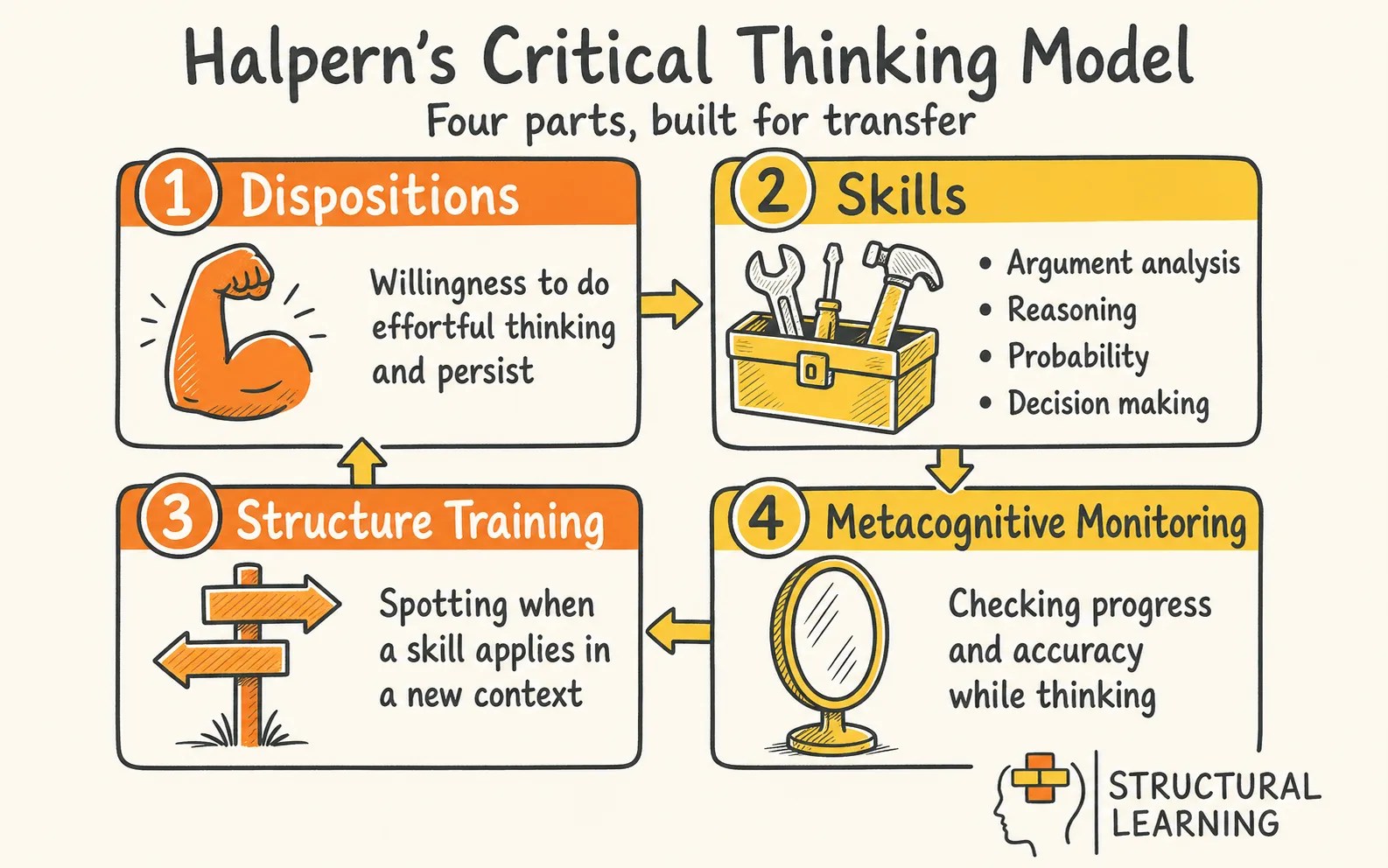
Metacognitive reading strategies are the moves a reader makes to plan how to read, check whether the text still makes sense and choose a repair when meaning breaks down. Flavell (1979) described this monitoring and control as central to metacognition. In reading lessons the aim is not constant self-commentary. It is a usable habit: notice the exact point of confusion, select one repair, then check whether the revised meaning fits the whole passage. The examples and think-alouds below show that habit on a real passage, with the prompts fading as learners take it over.
A teacher pauses after an unclear sentence and says, “I thought the pronoun meant Rosa, but the next line challenges that idea.” A learner rereads, points to the stronger clue, and revises the explanation. The change is visible because the learner can now justify the meaning from the text. This routine complements broader reading comprehension strategies.
Before reading, set a purpose and activate only the knowledge the text will require. Planning supports self-regulated action because learners connect a goal with a suitable method (Zimmerman, 2002). This is different from guessing the whole passage from its title. A prediction can help, but it should remain provisional.
Give learners one purpose, such as “Find out why the town closes the bridge.” Ask for two relevant facts they already know about storms or rivers. A learner says, “Heavy rain can raise the water level.” The teacher records that idea, then adds, “We will test it against the passage.”
Use a three-part prompt: What am I reading for? What could help me? What will I do if I lose the thread? The final question moves planning towards control. For more general planning routines, see developing metacognition and the distinction between metacognition and cognition.
For example, before a science explanation, the teacher says, “Our purpose is to explain evaporation, not list every detail.” The learner circles the key term and chooses a question mark for unclear links. After the first paragraph, both can check whether the marks serve the stated purpose.
During reading, monitoring means comparing the current interpretation with the words on the page. Learners need a clear signal for a breakdown. Signals include losing track of who a pronoun names, meeting an unknown word, or finding that two sentences conflict. Metacognitive awareness can be described and assessed, but reporting a strategy is not the same as using it well (Schraw and Dennison, 1994).
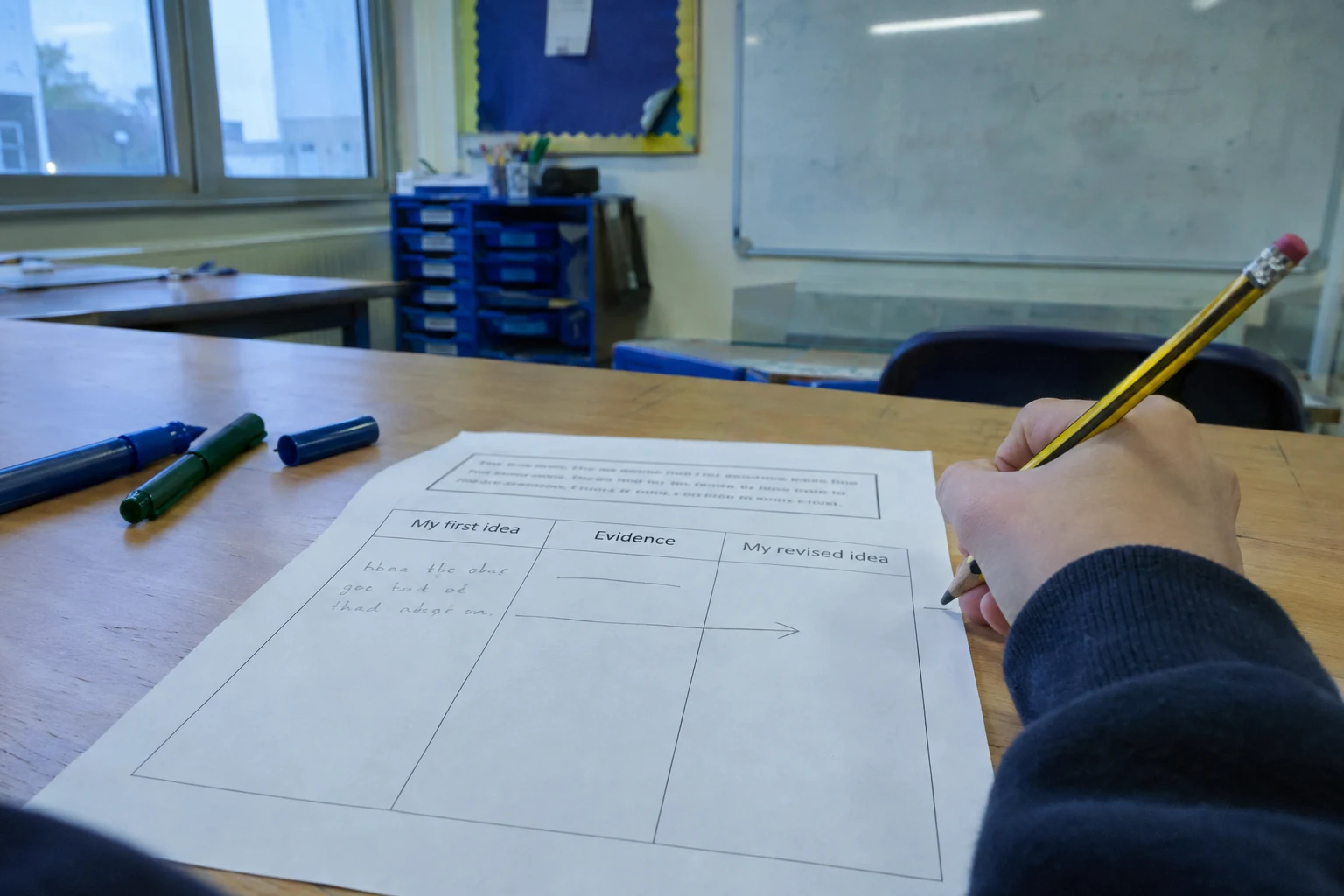
Use this short fictional passage. It contains a deliberate pronoun problem and a later clue that corrects a first impression.
Rosa waited beside the locked greenhouse while Mrs Patel searched the tool shed. The rain tapped faster against the glass. She waved through the misted window, then pointed towards the loose roof panel. Rosa assumed the signal meant that the missing key had been found, so she ran to the door. “Stay there,” Mrs Patel called from inside the greenhouse. “The key is still in my coat. I climbed through the gap because the seedlings are flooding.” Rosa stopped. The wave had not announced success. It had warned her about the water pouring from the bench.
At “She waved”, a learner writes, “Rosa is inside.” The later sentence places Mrs Patel inside and Rosa by the door, so the learner marks a conflict. The teacher asks, “Which sentence proves your first idea cannot stand?” The learner cites the direct speech, revises the pronoun reference, and explains why the wave was a warning.
Monitoring should be light enough to preserve the flow of reading. Ask learners to mark only a genuine break with a question mark or a short note. If every sentence is annotated, the routine can become a second task that competes with meaning. Our guide to metacognitive monitoring offers wider classroom applications.
A repair strategy is a response to a diagnosed problem, not a ritual used after every paragraph. Effective strategy instruction explains when and why a move helps, then gives practice in selecting it (Schraw, 1998). The decision rule matters because rereading cannot supply knowledge that the text assumes.
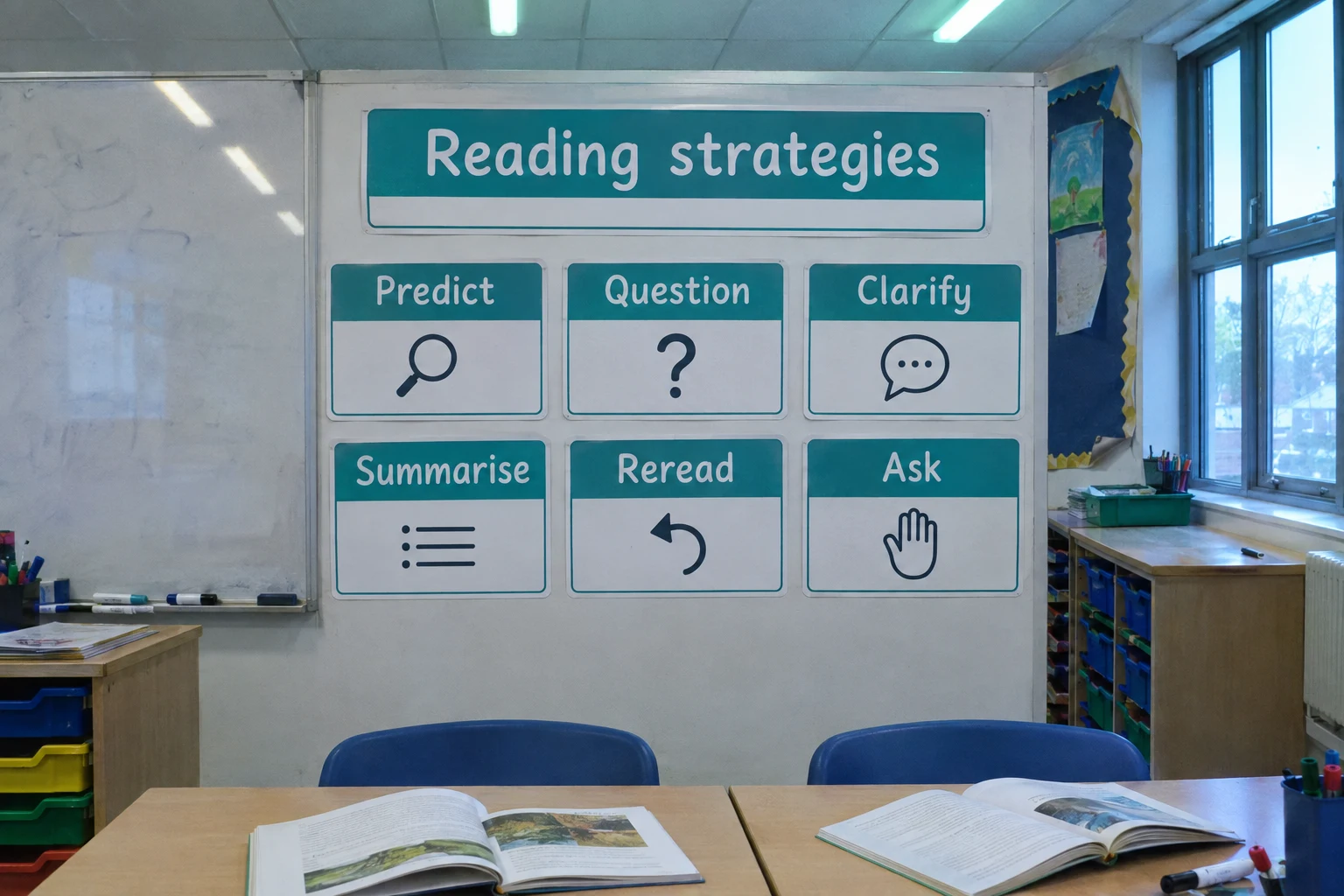
The table below pairs each breakdown signal with the repair that fits it and the check that proves it worked. Read down the first column with a learner and ask which signal they noticed most recently.
| Breakdown signal | Repair | Decision rule | What it looks like |
|---|---|---|---|
| A sentence conflicts with the current interpretation | Reread the sentence before | Use when a link, pronoun or sequence was missed | Underline both clues and state the revised link |
| One unfamiliar word blocks the sentence | Clarify from surrounding words | Use when nearby examples or contrasts give a clue | Substitute a possible meaning and test the sentence |
| The text implies more than it states | Infer from evidence | Use when two or more clues support an explanation | Name the claim, then point to each clue |
| The missing information is not supplied | Seek help | Use after a specific gap has been named | Ask a precise question about the word or idea |
Return to the greenhouse passage. The learner first rereads the sentence before “She waved”, but both people remain possible. The learner then checks the later direct speech and infers that Mrs Patel is inside. The teacher asks, “Does that repair fit every action?” The learner confirms that it fits the door, coat and roof-panel details.
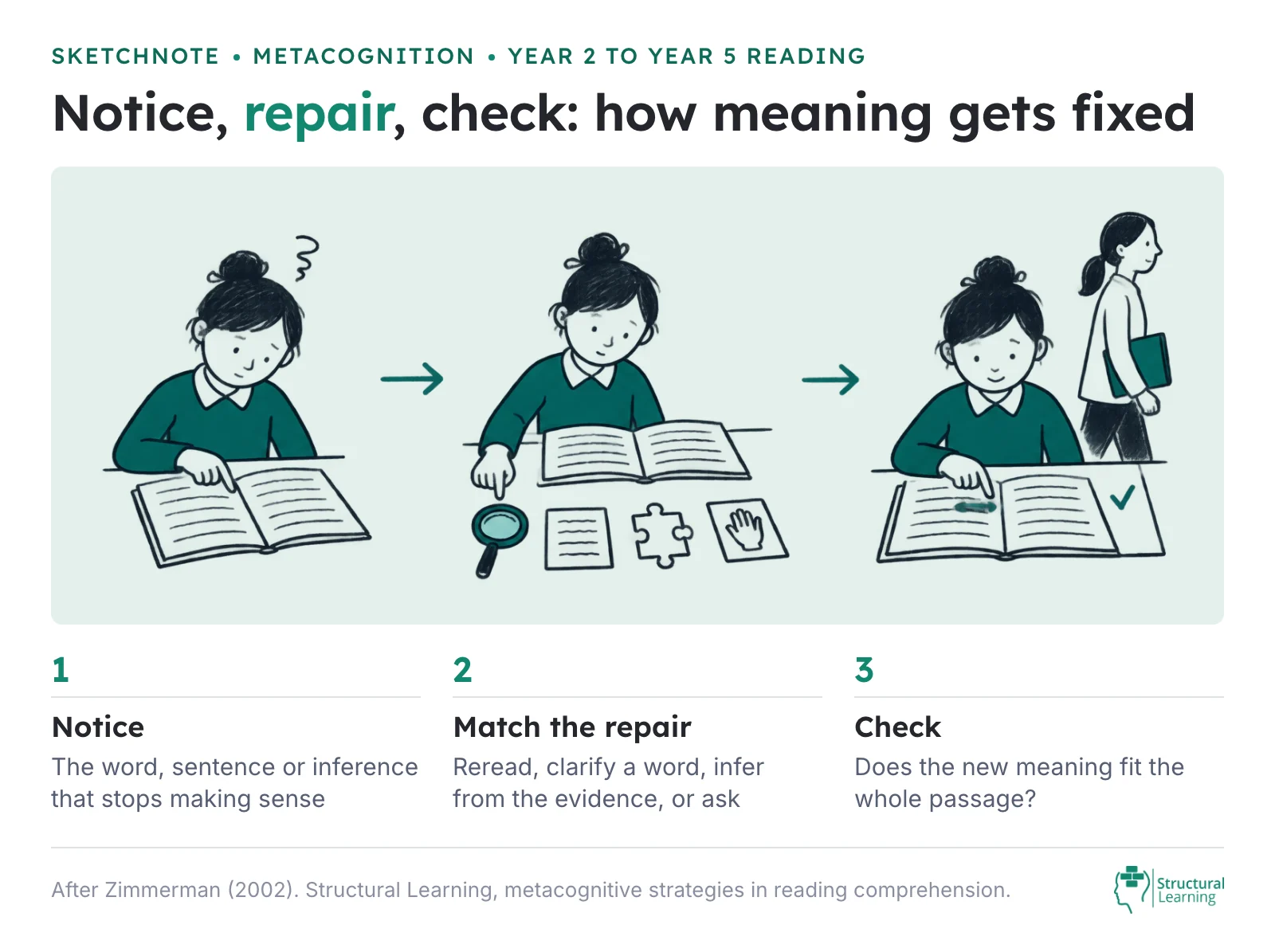
When several repairs seem possible, ask learners to choose the least costly move first. Reread one sentence before rereading a whole page. Test a word meaning before reaching for a dictionary. Seek help when the text lacks a needed explanation, not simply when the work feels effortful.
After reading, evaluation asks whether the final interpretation answers the original purpose and fits the text. It is stronger than “Did you understand?” because that question invites a feeling, not evidence. Learners should retrieve the main explanation, cite a clue, and name the strategy that changed their understanding.
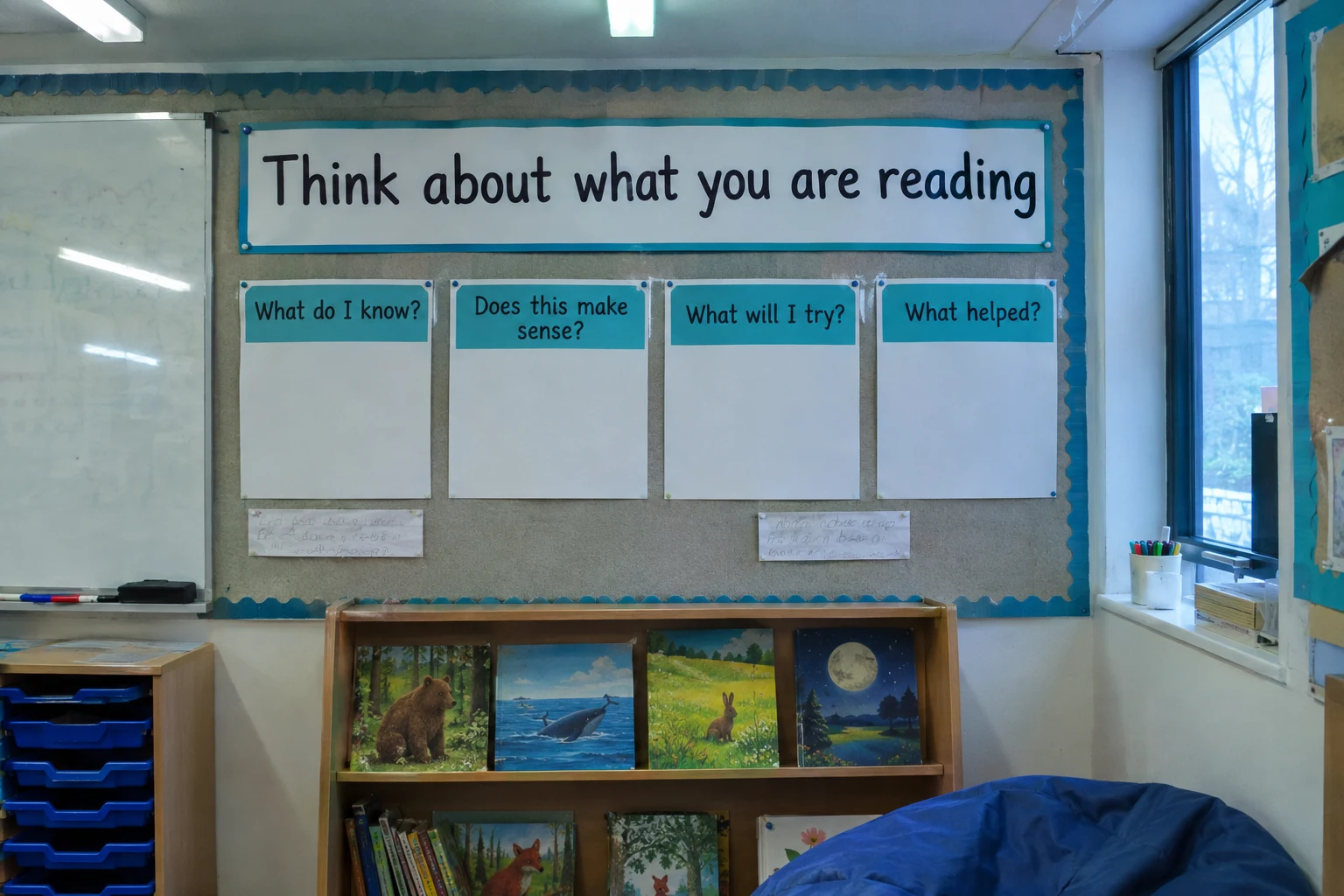
The teacher returns to the bridge question and asks, “Why was the bridge closed, and which line supports your answer?” A learner explains that rising water made the crossing unsafe. The teacher then asks, “Which action helped?” The learner identifies rereading the warning notice, rather than claiming that every strategy helped.
A short written check can expose an illusion of fluency. Feeling familiar with a passage may not mean that it can be explained or recalled accurately (Bjork, 1994). Compare the first interpretation with the final one, then note the evidence that caused the change. This connects with work on fluency illusions.
For example, the learner writes, “I changed my mind because Mrs Patel speaks from inside.” The teacher checks that this clue resolves the pronoun, then asks for one other supporting detail. The learner adds the locked door, showing that the revised reading uses more than one clue.
Teachers on social media describe versions of this routine that a printable cannot show: a fluent shared read before any role card, a fluency check before a strategy lesson, and a named comprehension slot. The table below sets nine of those routines beside what the evidence says.
Nine routines from teachers on social media.
| Routine, as teachers describe it | What you would notice | What the evidence says |
|---|---|---|
| Fluency, then the five roles A shared fluent read first. Then groups take turns to summarise, predict, clarify, question and visualise. UK primary, P6 and P7.
|
The class reading together before anyone is given a role card. Talk starts after the words are in the mouth. | EEF Improving Literacy in Key Stage 2, rec 2 then rec 3: fluent reading frees attention for meaning; then model prediction, questioning, clarifying, summarising and activating prior knowledge. The Reading House (EEF blog, 26 Nov 2021): fluency sits on the word-reading side of a two-pillar model, with language comprehension; the two come together to enable reading comprehension. This lesson is reported, not trialled. |
| Accurate is not fluent Before a strategy lesson, ask whether the reading is automatic. If it is only accurate, keep working on fluency, not on a role card.
|
A learner who can say the words and still cannot spare attention for meaning. The next move is another read, not a summariser badge. | The post’s claim. EEF KS2 rec 2 and the Reading House say the same mechanism. Not a trial of this diagnostic. |
| VIPERS as a vocab session A named VIPERS slot. The photographed work is key vocabulary from the text, not a full monitor-and-repair on a passage.
|
Definitions and synonyms on the tables. The six letters are the timetable brand. | VIPERS is a Literacy Shed content-domain mnemonic, not an EEF programme. EEF rec 3 wants strategies modelled on a text, then faded. Jane Considine’s objection to reverse-engineered SATs lessons sits in the same window. Reported, not trialled. |
| Slow down, reread, self-question Name monitoring as an active job: when meaning breaks, slow down, reread, or ask a question of the sentence. UK thread, on a hard physics article.
|
A pause inside the sentence, not a worksheet after the page. The live article’s repair chooser is this move, already built. | Palincsar and Brown (1984, DOI 10.1207/s1532690xci0102_1): seventh-grade poor comprehenders practised summarising, questioning, clarifying and predicting as comprehension-monitoring activities. EEF rec 3: model, then fade. This thread is a claim, not a trial of the physics article. |
| Do not pre-teach the whole text objection The objection is teaching every word and every fact before the class has read. Strategies cannot replace knowledge, and pre-teaching can remove the reason to read.
|
A vocab list that already contains the passage. Nothing left to notice or repair. | Same thread, 29 Mar 2025. EEF rec 3 includes activating prior knowledge, not emptying the text in advance. Pondiscio (AEI, 15 Sep 2026): a modest amount of strategy teaching helps learners notice that reading should make sense; endless pre-load is not that. Replies did not contradict him on the overboard case. |
| Roles on a science passage US middle-school science. Learners read about rocks and the rock cycle in named roles: summarizer, questioner, clarifier, visualizer. The page names the US variant; the UK row above uses visualise as a fifth turn after a fluent read.
|
A Summarizer card on a science textbook, not an English anthology. The photograph in the post is redrawn elsewhere, not republished. | Palincsar and Brown (1984): the original four are predict, question, clarify, summarise. Visualizer is an add-on. EEF FFT Reciprocal Reading, efficacy: targeted Years 5 and 6, plus two months; whole-class Year 4, zero months. Effectiveness trial 2023 to 24: plus one month, effect size 0.06. This lesson is reported, not those trials. |
| Think-aloud in the read-aloud Name what learners should do before the read-aloud starts. Then model those expectations out loud. US classroom video.
|
The teacher stopping to say the thought, not only the sentence. A short text, not a poster listing what good readers do. | EEF rec 3: model and scaffold, then fade. Pondiscio (AEI): the think-aloud is the visible half of cargo-cult reading if the knowledge the passage assumes is missing. A reply on the same thread renamed it from read-aloud to think-aloud. Reported, not trialled. |
| Learn the volcanoes A US high-school English teacher cheering for Lauren’s take: if the passage is about volcanoes, the goal is volcanoes, not strategy practice. The page names it as the US variant of the UK knowledge fight.
|
A content aim on the board, not a main-idea stem. The repair, if it happens, serves the science. | Pondiscio, What Good Readers Know (AEI, 15 Sep 2026): modest strategy instruction helps; extra practice does not make a general reader. Recht and Leslie (1988, DOI 10.1037/0022-0663.80.1.16): prior knowledge of baseball, not tested reading ability, drove recall of a baseball passage. Ed_Realist replied to Wexler that knowledge-building may not help on unfamiliar topics; that disagreement is live. Not a trial of a volcanoes unit. |
| Dropped because scores did not move objection US former reading-support teacher. Daily highlight-and-why talk using Notice and Note. Admin replaced it with SRA when test scores did not rise.
|
A discussion that every learner joined, then a boxed programme the next year. | The post does not name the test. EEF Toolkit reading comprehension strategies (review Oct 2025): plus seven months is a mean across 184 studies, not a promise that one named routine will move a school’s scores. James A. Furey, in the same US window, called find-the-main-idea and Notice and Note a joy-killer. No study has tested it. |
A think-aloud makes normally hidden decisions audible. It should include uncertainty, a plausible error, a chosen repair and a check. Perfect commentary can mislead learners because it hides the point at which a reader recognises and corrects a mistake. Clear modelling should then move into guided practice (Education Endowment Foundation, 2018).
Read the greenhouse passage aloud and use this script. Pause at the stated point, but keep the pace natural.
Next, the teacher repeats only the first two lines and stops. A learner supplies the breakdown signal and chooses the repair. The teacher asks for the checking sentence before accepting the answer. This avoids rewarding a lucky revision that is not grounded in the passage.
Keep the spoken model concise. Too much commentary can obscure the text and overload working memory. A useful think-aloud names only the decision that learners need to imitate. For broader lesson applications, see classroom metacognition.
Mini app · Build It · Reading
Read the passage, pick the signal a learner would notice, and you get the matching repair, a one-line teacher think-aloud, a question to check it worked, and a printable two-column sheet.
The passage
Mara pushed the boat off the shingle while her aunt held the lantern. The tide was already turning, and the water looked precarious in the half light, all shifting grey and silver. Halfway across the bay the engine coughed and stopped. Her aunt reached for the rope, but Mara had already caught it, and she pulled hard until the knot bit into her palm. On the far shore a light flickered twice, then went out. Nobody had lived in the old cottage for years. Mara looked at her aunt. Neither of them said what they were both thinking.
I lost the thread
Reread the sentence before
Go back one sentence and read it again slowly. Then read the sentence you were stuck on. Pronouns like “she” point back to someone already named.
In the passage: “Her aunt reached for the rope, but Mara had already caught it, and she pulled hard until the knot bit into her palm.”
Teacher think-aloud: I read “she pulled hard” and I cannot say who that is, so I am going back to the sentence before to find out who had the rope.
Check it: Who pulled the rope? Say which words told you, and whether the writer has left it open on purpose.
Reading repair sheet
The passage
Mara pushed the boat off the shingle while her aunt held the lantern. The tide was already turning, and the water looked precarious in the half light, all shifting grey and silver. Halfway across the bay the engine coughed and stopped. Her aunt reached for the rope, but Mara had already caught it, and she pulled hard until the knot bit into her palm. On the far shore a light flickered twice, then went out. Nobody had lived in the old cottage for years. Mara looked at her aunt. Neither of them said what they were both thinking.
| What I noticed | What I tried |
|---|---|
| I lost the thread at “she pulled hard”. I am not sure who “she” is. | Reread the sentence before |
Check it: Who pulled the rope? Say which words told you, and whether the writer has left it open on purpose.
Signal, then repair, then check. Structural Learning.
Modelling, not answering
The think-aloud shows a reader noticing and repairing. It does not give the answer. Say it as yourself, out loud, and let learners hear the pause before the fix.
Four signals, four repairs, all taught before they are chosen. The sheet works once learners can name the signal in their own reading, so start with the passage here and move to their own book.
Teaching the repair is the slow part. The Structural Learning app builds the scaffolded version of the reading lesson for your text and year group. Try it on a free account, no card needed.
Teachers often ask whether summarising, questioning and visualising are metacognitive strategies. They are cognitive strategies: ways of working on the text. The metacognitive layer is the decision about them. Choosing to summarise because the paragraph was long, noticing that the summary missed the last sentence, and going back, is metacognition. The distinction matters because a lesson can teach the moves and never teach the choosing.
A cognitive reading strategy changes what the reader does with the words. Predicting, clarifying a word, asking a question of the text, making a connection, summarising: each produces something, a guess, a meaning, a question, a sentence. Role cards in reciprocal reading hand out these jobs one at a time. Teachers on this page describe classes taking turns to summarise, predict, clarify, question and visualise after a fluent shared read.
A metacognitive reading strategy changes how the reader manages those moves. It asks three questions. Which move does this moment need? Is the move working? Has the meaning now settled?
The greenhouse passage shows all three: the learner chooses to reread rather than reach for a dictionary, notices that rereading alone leaves two candidates for "she", and only accepts the revised meaning when the door, coat and roof panel all fit.
The practical consequence is that a role card is not enough. A learner can be the clarifier for a week and never once decide that clarifying was the right move. To teach the metacognitive layer, add the decision to the job: "You are the clarifier. Before you clarify, say why this word and not another." That one sentence turns a cognitive job into a monitored one.
It also explains why fluency comes first. A reader whose attention is spent on the words has nothing left for either layer. One practitioner on this page makes exactly that point: accurate is not fluent, and if the reading is only accurate the next move is another read, not a strategy lesson. Once the words are automatic, the cognitive moves can be taught. Once the moves are familiar, the choosing can be.
Prompt fading transfers the routine from teacher control to learner control. Keep the text, purpose and success check stable while reducing the prompts. This makes the change in independence easier to observe. Research reviews suggest that explicit strategy teaching works best when learners practise applying strategies within real tasks (Donker et al., 2014).
In the supported version, give four boxes: Where did meaning break?, Which repair will I use?, What is my revised meaning?, and Which words check it?
The teacher points to each box while the learner completes it. If the learner writes a vague problem, the teacher asks for the exact sentence.
In the independent version, keep only two headings: Breakdown and Repair plus evidence. The learner chooses when to record a problem and which repair to use. The teacher samples one decision after reading, then asks, “What made that repair a good choice?”
Use the same worksheet layout for both versions so that fading removes help, not familiarity. A learner who needed four spoken prompts on Monday may use one visual cue on Thursday. The evidence of progress is a sound choice and a text-based check, not a completely filled page. Primary teachers can adapt the examples in primary metacognition, while older classes can use secondary metacognition.
For learners with SEND, use explicit visual cues and shorter prompt sequences. Model one decision at a time, then allow extra processing time before adding another step (Education Endowment Foundation, 2018). The teacher could show only “notice” and “repair” cards. The learner points to a card, says the choice, and checks one sentence before continuing. See metacognition for SEND for further classroom guidance.
Do not fade support because a timetable says it is time. Fade one prompt after the learner uses it accurately across several suitable passages. If selection becomes random, restore the previous cue and model the decision again. This keeps independence tied to successful comprehension rather than quiet task completion.
Five classroom examples show learners reading fluently, summarising, predicting, clarifying and checking improvement.
1 · Process
1 · summarise
2 · predict
3 · clarify
4 · ask questions
5 · visualise
A primary school account ran a fluent shared read first, then five spoken jobs including visualise. Palincsar and Brown did not name visualise as a fourth original role.
EEF Reading House blog, fluency on the word-reading side, then language comprehension. EEF Reading House.
2 · Timeline
1 · Year 5
2 · Mrs Borrill
3 · Clips from the Classroom
4 · Reciprocal Reading
5 · EEF strategies
A named Year 5 teacher is filmed doing reciprocal reading as an EEF strategy. The post does not say whether the group was targeted or whole class.
FFT Reciprocal Reading, plus two months targeted Years 5 and 6, zero months whole-class Year 4. EEF reciprocal reading trial.
3 · Mind map
rocks and the rock cycle
2 · summarizer
3 · clarifier
4 · questioner
5 · visualizer
Mrs Kerrigan’s Earth Science class read the rock cycle on Read Across America Day with four reciprocal roles. Visualizer is an add-on to Palincsar’s original four.
Catlin Tucker walks the same four lenses as I do, we do, fishbowl, then student-led. Catlin Tucker on reciprocal teaching.
4 · Process
1 · A visual is placed on the board
2 · annotate the text learninglaps
A 3rd-grade class annotates while a visual on the board names the job. The exact wording on the board is not in the tweet, so it is not invented here.
5 · Before and after
Before · 10 minutes of free reading
2 · notice and note highlight text
3 · We did this every day
After · didn’t increase test scores the stall
5 · old fashioned SRA
A former reading-support teacher ran free reading then Notice and Note every day. Admin dropped it for SRA because scores did not rise.
School Reading List, whole-class reading buys timetable time and still needs texts, volume, talk and decoding support. Whole Class Reading.
The routine on this page is the same in Key Stage 1 and upper Key Stage 2. What changes is how much of it the teacher carries. Here is the greenhouse routine scaled to a Year 2 guided reading group and a Year 5 whole-class lesson.
Year 2, a guided group of six. The teacher reads the passage aloud while the learners follow with a finger. There is one purpose, said twice: "We are finding out why Rosa ran to the door." There is one signal, taught as a gesture: a hand flat on the table when something stops making sense.
At "She waved", the teacher stops and asks, "Who waved?" Two learners say Rosa, and the teacher does not correct them. The teacher reads on to the direct speech and asks again. The repair is named in two words, read on, and the check is a question the learners can answer from the text: "Where is Mrs Patel?" Nothing is written. The strategy card on the table says notice and read on, with a picture beside each word.
Year 5, whole class. Learners read the passage themselves, marking one question mark at the first point of confusion. The teacher collects the marks on the board, and most sit at the same sentence. The think-aloud is shorter than the script above and stops after the wrong first idea, so a learner supplies the breakdown and chooses the repair.
Pairs then use the four-box sheet: where meaning broke, which repair, the revised meaning, the checking words. The teacher samples three sheets and reads out one revised meaning that used two clues. Homework is a fresh passage with only the two-heading version.
Two things stay fixed at both ages. The signal is taught before the strategy, because a learner who does not notice the break has nothing to repair. And the check is always a question the text can answer. "Does that make sense?" invites a feeling; "Where is Mrs Patel?" invites evidence. A Year 2 learner can point to the answer, and a Year 5 learner can quote it.
What differs is the load. Year 2 carries one signal, one repair and no writing. Year 5 carries a choice of repairs and a written check. If a Year 5 class is losing the passage under the paperwork, borrow the Year 2 version for a week and add the writing back one box at a time.
Metacognitive monitoring is one strand of reading, not a cure for every difficulty. The Simple View distinguishes word recognition from language comprehension (Gough and Tunmer, 1986). A learner may notice that meaning has broken down yet still need direct teaching in decoding, fluency, vocabulary or background knowledge. Scarborough’s Reading Rope also shows skilled reading as coordinated strands, rather than one general strategy.
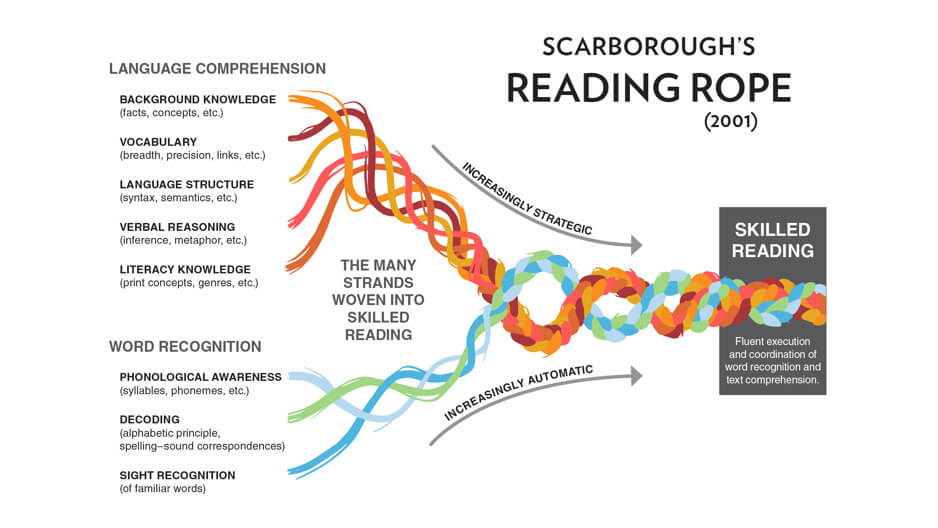
First identify the source of the difficulty. If a learner cannot read several words accurately, the teacher says, “Let us work on these sound-spelling patterns before we analyse meaning.” The learner practises the words in a suitable text. The change sought is more accurate word reading, not a longer reflection sheet.
If decoding is secure but a key word is unknown, teach the word and revisit the sentence. If the passage assumes missing historical knowledge, supply that knowledge directly. If each sentence is understood but the overall account conflicts, a monitoring and repair routine may be appropriate. Learners with specific comprehension difficulties can show adequate word reading alongside weaker meaning-making (Cain and Oakhill, 2006).
| Strategy | Key study | What was measured | What it showed | Limit |
|---|---|---|---|---|
| Planning, monitoring and evaluation | Donker et al. (2014) | Academic performance across strategy interventions | Strategy instruction was associated with improved performance | Studies, subjects and instructional designs varied |
| Sustained metacognitive instruction | de Boer et al. (2018) | Long-term academic outcomes | Positive effects could remain after instruction | Follow-up evidence was smaller and varied |
| Metacognitive awareness | Schraw and Dennison (1994) | Self-reported knowledge and regulation | The study developed a measure of reported awareness | Self-report does not prove effective reading behaviour |
| Diagnosing comprehension difficulty | Cain and Oakhill (2006) | Profiles of reading comprehension difficulty | Reading profiles differed despite adequate word reading | A profile does not prescribe one intervention |
The evidence supports careful instruction, not blanket strategy worksheets. Longer-term effects are promising, but studies vary in age, subject and teaching design (de Boer et al., 2018). The teacher should therefore check whether a learner transfers the routine to a new text. If transfer fails, reteach the decision, not just the strategy name.
Use the questions below to decide whether each reading routine improves comprehension or only adds another set of labels.
question
“...when this has been done at scale, the effect sizes are *far* smaller (e.g. 0.06 in the EEF trial).”
What the replies and the evidence say. The same post says the learners in reciprocal reading trials are selected as adequate decoders with poor comprehension. EEF pages: the 2019 efficacy trial found plus two months for that targeted group in Years 5 and 6, and zero months for whole-class Year 4; the 2023 to 24 effectiveness trial found plus one month, effect size 0.06. FFT’s May 2025 post still used the older plus-two figure. Cite the later trial when you name the programme as a whole-class diet.
question
“Is this the same thing as reciprocal reading - everyone in the group has a role like clarifier or questioner? These are v popular in Scottish primary schools right now and I’ve never found them especially helpful.”
What the replies and the evidence say. This is a reply to James A. Furey and adds its own classroom-adjacent claim. The account describes itself as a writer and artist, not a confirmed classroom teacher. The EEF whole-class Year 4 null result is the independent number that sits nearest the complaint; it does not prove the Scottish roles failed, and it does not licence a four-role worksheet.
question
“Let’s be honest: reverse-engineered SATs lessons won’t build fluent, thoughtful readers. A curriculum built on test questions lacks the depth and purpose of real reading.”
What the replies and the evidence say. School posts in the same window still timetable a VIPERS session and photograph definitions and synonyms. EEF rec 3 wants strategies modelled on a chosen text, then faded, not a content-domain checklist. The live article already refuses to become another stem-question pack; this is the UK reason.
question
“Some educators can go a bit overboard, resulting in children being taught all the vocab/knowledge required to comprehend the text before they've even read it!”
What the replies and the evidence say. Two posts earlier in the same thread: strategies cannot compensate for missing background knowledge. EEF rec 3 includes activating prior knowledge; it does not say pre-teach the passage. Pondiscio (AEI) keeps a short monitor-and-repair habit and puts the knowledge in the unit. No reply defended emptying the text first.
question
“For years, we’ve tried to improve reading by teaching children what good readers do: find the main idea, make inferences, visualize, predict. But reading comprehension depends on what good readers know.”
What the replies and the evidence say. The paper (AEI) still allows a modest amount of strategy teaching so learners notice that reading should make sense, then stop and repair. The replies do not all agree. @Ed_Realist, answering Wexler: “And there's not much evidence that building knowledge improves reading comprehension of unfamiliar knowledge.” Recht and Leslie (1988) showed knowledge of baseball helped recall of a baseball passage; transfer to a new domain is the live dispute, not that result. James Durran and Barbara Bleiman, Lost Queens and Dodos (Bleiman and Durran, 2021), add that a knowledge-rich curriculum still cannot pre-teach every text, and that treating comprehension as decoding plus background knowledge downplays inference from textual and linguistic clues. The tip to that page came from @thecockerill, 16 Sep 2026.
question
“The “reading strategies” approach to literature instruction—find the main idea, notice and note, etc.—is a great way to suck the joy out of reading.”
What the replies and the evidence say. The next line in the same post: “Instead: read, discuss, repeat.” Kimber Byars, in February 2026, described daily Notice and Note talk that produced discussion and was dropped because scores did not rise. The two US posts disagree about whether the named strategies can still be a discussion. They agree that a worksheet of find-the-main-idea is not the point of reading literature.
Metacognitive language can describe a reading problem without resolving it. A learner may say, “I do not understand,” yet lack the vocabulary or knowledge needed to repair meaning. Strategy instruction also adds mental demands. Too many prompts can distract from the passage, especially while word reading is effortful.
Much evidence combines several strategies, teacher modelling and guided practice. It cannot always show which element caused an outcome (Donker et al., 2014). Self-report measures may also capture what learners believe they do rather than what happens during reading (Schraw and Dennison, 1994). Classroom checks should therefore include a new passage and observable evidence use.
A teacher tests transfer with a fresh paragraph and asks only, “Where did meaning change?” The learner identifies a conflict but chooses an unsuitable dictionary check. The teacher models the decision rule again, then asks the learner to compare rereading with vocabulary help. The next step is based on the observed choice, not a general label such as “poor metacognition”.
Try one thing next lesson: read the greenhouse passage aloud, stop after the direct speech, and ask learners to name the breakdown, repair and checking clue.
Metacognitive reading strategies are the deliberate moves a reader uses to manage their own comprehension: setting a purpose before reading, noticing during reading when meaning breaks down, choosing a repair such as rereading or checking a word, and evaluating afterwards whether the final meaning fits the text. They sit above the reading itself. Summarising a paragraph is a reading strategy. Noticing that your summary does not match the last line, and going back, is the metacognitive part. Teach them on a real passage with a teacher think-aloud, then fade the prompts.
Lists vary, and there is no single official seven. The set most often taught is predicting, questioning, visualising, making connections, clarifying, summarising and monitoring, with some lists adding inferring or evaluating. The number matters less than the routine around it. A learner who can name all seven and applies none has a vocabulary, not a strategy. This guide organises the same moves by when they happen: before reading (purpose and prior knowledge), during reading (monitoring and repair) and after reading (evaluation and evidence), because that is the order a reader meets them.
They help a reader who can decode the words but loses the meaning. A learner who notices the exact sentence where understanding broke, and has a repair to hand, spends less time rereading whole pages and less time pretending to have understood. Over time the checks become automatic, which frees attention for the text.
Evidence reviews report positive effects from explicit strategy instruction, with some effects lasting beyond the immediate test (Donker et al., 2014; de Boer et al., 2018). They do not help a learner who cannot yet read the words. That needs decoding teaching first.
For a learner with dyslexia, secure the word reading first, because monitoring cannot repair what was never decoded (Gough and Tunmer, 1986). Then keep the routine short and visual. Use two cards, notice and repair, rather than a four-box sheet. Model one decision at a time and allow extra processing time before the next prompt.
Let the passage be read aloud or listened to, so the check is about meaning rather than effort. The EEF guidance recommends explicit visual cues and shorter prompt sequences for learners with SEND (Education Endowment Foundation, 2018). Ask the SENCO what already works for that learner and build the routine on it.
MARSI is a self-report questionnaire in which readers rate how often they use a set of reading strategies. It groups them into three kinds: global strategies such as setting a purpose and previewing, problem-solving strategies such as rereading and slowing down, and support strategies such as note-taking and underlining.
It was designed for older readers, secondary age and above. It is useful for starting a conversation about what a class thinks it does. It is not a measure of what happens during reading, because self-reports capture beliefs about strategy use rather than use itself (Schraw and Dennison, 1994). Pair it with a new passage and observed evidence.
A metacognitive reading skill is a strategy that has become automatic. A strategy is deliberate: the learner chooses to reread the sentence before a confusing pronoun. A skill is the same move made without deciding, because it has been practised until it runs on its own.
The teaching sequence on this page moves from one to the other. A think-aloud makes the decision visible, guided practice has learners choose it with support, and prompt fading removes the support. The evidence that a strategy has become a skill is a repair made on a new text with nobody prompting it.
Bjork, R. A. (1994). Memory and metamemory considerations in the training of human beings. In J. Metcalfe and A. P. Shimamura (eds), Metacognition: Knowing About Knowing (pp. 185 to 205). MIT Press.
Bleiman, B. and Durran, J. (2021). Lost queens and dodos: reflections on knowledge, comprehension and how we teach reading. National Association for the Teaching of English.
de Boer, H., Donker, A. S., Kostons, D. D. N. M. and van der Werf, G. P. C. (2018). Long-term effects of metacognitive strategy instruction on student academic performance: A meta-analysis. Educational Research Review, 24, 98 to 115.
Cain, K. and Oakhill, J. (2006). Profiles of children with specific reading comprehension difficulties. British Journal of Educational Psychology, 76(4), 683 to 696.
Donker, A. S., de Boer, H., Kostons, D., Dignath van Ewijk, C. C. and van der Werf, M. P. C. (2014). Effectiveness of learning strategy instruction on academic performance: A meta-analysis. Educational Research Review, 11, 1 to 26.
Education Endowment Foundation (2018). Metacognition and Self-Regulated Learning: Guidance Report. Education Endowment Foundation.
Flavell, J. H. (1979). Metacognition and cognitive monitoring: A new area of cognitive-developmental inquiry. American Psychologist, 34(10), 906 to 911.
Gough, P. B. and Tunmer, W. E. (1986). Decoding, reading, and reading disability. Remedial and Special Education, 7(1), 6 to 10.
Palincsar, A. S. and Brown, A. L. (1984). Reciprocal teaching of comprehension-fostering and comprehension-monitoring activities. Cognition and Instruction, 1(2), 117 to 175.
Recht, D. R. and Leslie, L. (1988). Effect of prior knowledge on good and poor readers' memory of text. Journal of Educational Psychology, 80(1), 16 to 20.
Schraw, G. (1998). Promoting general metacognitive awareness. Instructional Science, 26(1-2), 113 to 125.
Schraw, G. and Dennison, R. S. (1994). Assessing metacognitive awareness. Contemporary Educational Psychology, 19(4), 460 to 475.
Zimmerman, B. J. (2002). Becoming a self-regulated learner: An overview. Theory Into Practice, 41(2), 64 to 70.