Updated on
September 24, 2026
Mastering Adaptive Leadership
Learn adaptive leadership skills to navigate uncertainty, build resilient teaching teams, and turn educational challenges into opportunities for growth.


Updated on
September 24, 2026
Learn adaptive leadership skills to navigate uncertainty, build resilient teaching teams, and turn educational challenges into opportunities for growth.
Mastering adaptive leadership requires developing five core competencies that enable you to thrive in uncertainty and guide your organisation through complex change. Unlike traditional leadership approaches that rely on predetermined solutions, adaptive leadership involves diagnosing challenges in real-time, experimenting with new strategies, and mobilising your team to tackle problems they've never faced before. The most effective adaptive leaders don't just react to change, they anticipate it, embrace the discomfort of not having all the answers, and turn ambiguity into opportunity. Ready to transform how you lead when the rulebook doesn't exist?
Adaptive leadership differs from conventional methods by emphasising flexibility and resilience. Unlike solving technical issues, it involves guiding teams through uncharted waters and encouraging innovation. Key principles include emotional intelligence, organisational justice, and a development mindset, which enable leaders to embrace uncertainty and encourage growth in their teams.
This article examines into the intricacies of mastering adaptive leadership. From defining its core characteristics and distinguishing it from technical challenges to exploring its benefits and strategies for effective implementation, we will provide insights to enhance your leadership skills. Whether you lead in healthcare, education, or marketing, understanding adaptive leadership will equip you to thrive in today's dynamic environment.
Adaptive leadership is a dynamic leadership style pioneered by Dr. Ronald Heifetz and Marty Linsky. This approach is designed to help leaders address and overcome adaptive challenges by challenging the status quo. Unlike technical challenges that have clear solutions, adaptive challenges require innovation and flexibility. The adaptive leadership model urges organisations to embrace change and view it as an opportunity for growth. It helps leaders to develop creative solutions by encouraging a culture of experimentation. This approach is particularly valuable in today's fast-paced business environment, where change is constant and complex. By focusing on agility and resilience, adaptive learning approaches equip leaders to navigate through challenging times effectively.
Adaptive leadership is a framework that supports leaders and organisations as they face new and challenging situations. Key characteristics of this style include emotional intelligence, organisational justice, development, and character. Leaders must understand and counteract resistance by aligning changes with stakeholders' core values. Adaptive leaders are open to diverse perspectives and work to involve individuals from different disciplines. By doing so, they can address complex challenges collaboratively. This model emphasises learning and adapting to create strategies for problems without clear solutions. The Leadership Theories that underpin this approach ultimately helps organisations to grow through change, encouraging a culture of innovation and resilience.
Adaptive leadership is crucial in today's ever-changing business world. It helps leaders address challenges by recognising human aspects through empathy. By understanding these elements, adaptive leaders can encourage strong responses and effective solutions. Continuous learning and innovation stand at the core of adaptive leadership. This mindset encourages teams to try new things, even if there is a risk of failure. Such leadership also incorporates organisational justice by promoting transparency and honesty. This enhances employees' sense of fairness and makes them more accepting of change. Adaptive leaders value flexibility and diverse viewpoints, making them well-suited to handle the complexities of today's global environment. They are adept at recognising problems, challenging norms, and driving innovation to create positive changes while upholding core organisational values. Effective classroom management and maintaining engagement are crucial when implementing these leadership principles in educational settings. See also teacher coaching and leadership style. See also developing a social-emotional curriculum. See also ai in education: challenges, opportunities.
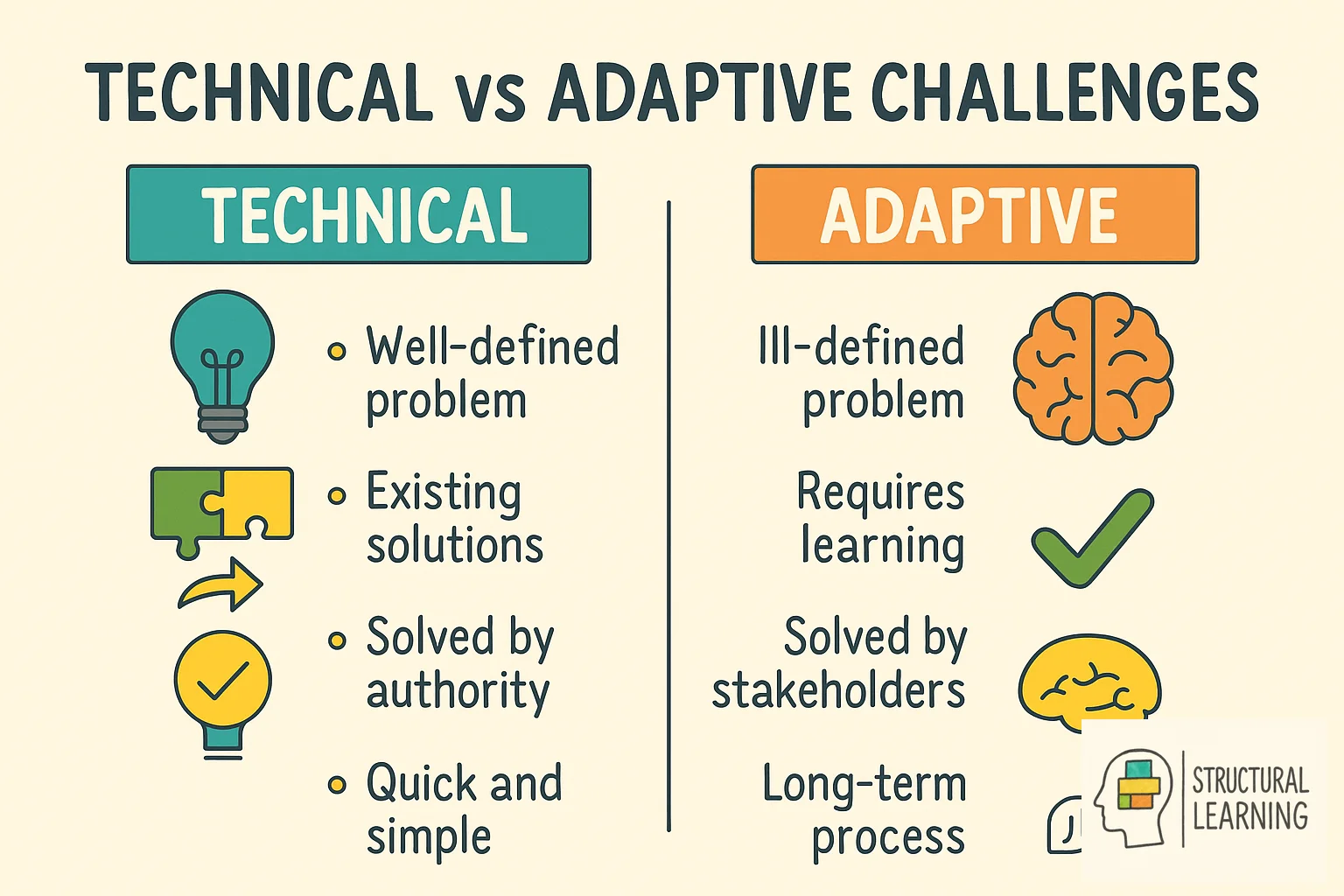
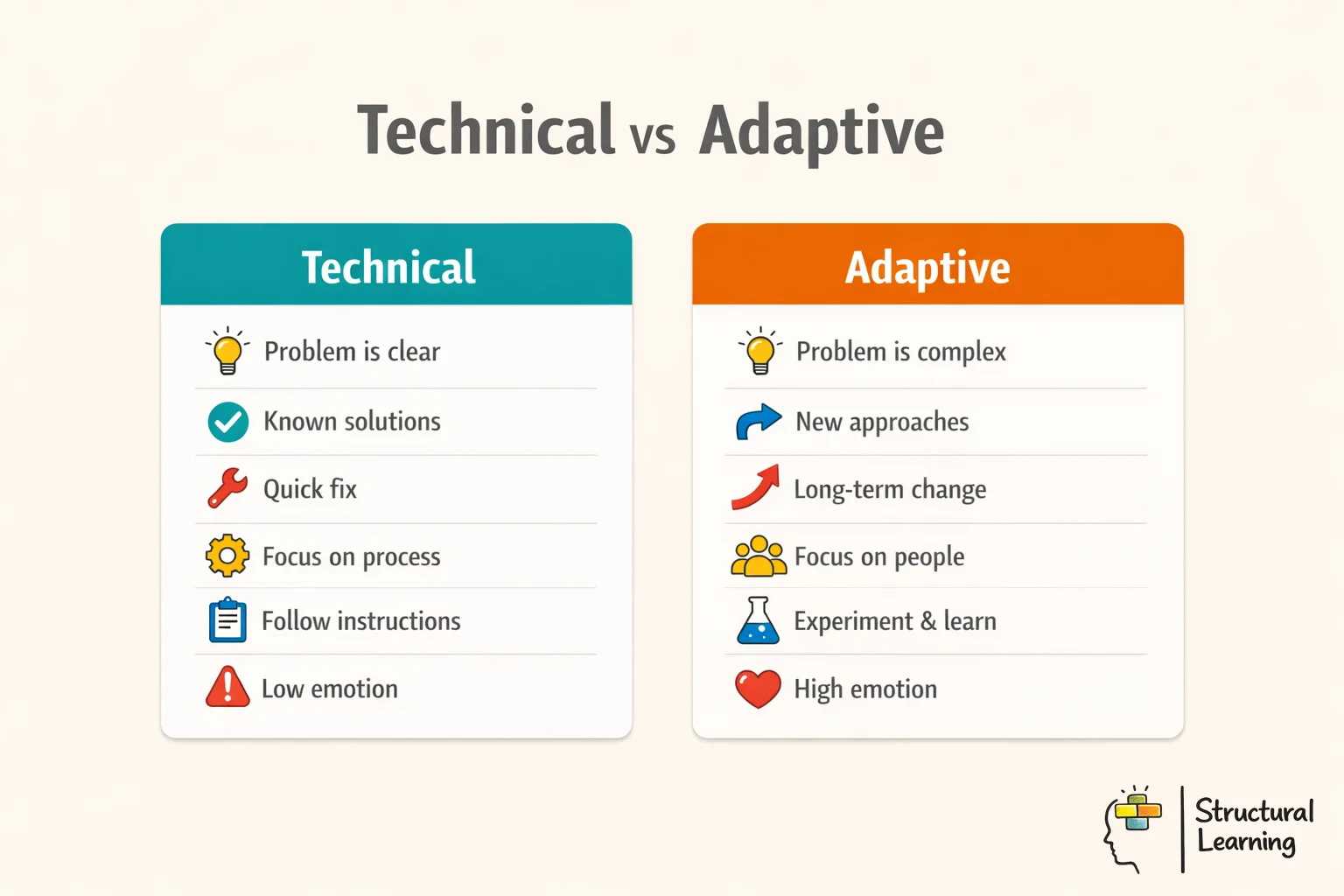
In the dynamic world of leadership, distinguishing between different types of challenges is crucial. Technical challenges are straightforward, easily solved with expert knowledge. On the other hand, adaptive challenges require a significant change in mindset and collective effort. Successful leaders must be adept at recognising these distinctions to apply the most effective strategies. The ability to navigate both technical and adaptive challenges is at the heart of the adaptive leadership framework created by Ronald Heifetz and Marty Linsky. This approach emphasises flexibility and strategic use of leadership styles to address varying complexities. When working with diverse learners, understanding sen requirements becomes essential for creating inclusive solutions.
Technical challenges represent problems that have clear definitions and established solutions. These issues can typically be resolved through expertise, best practices, or proven methodologies. In educational settings, technical challenges might include implementing new software systems, updating curriculum standards, or fixing broken equipment. The solutions are generally straightforward and can be executed by individuals with the appropriate knowledge or training. Technical challenges often have predictable timelines and measurable outcomes, making them easier to manage and evaluate. School leaders dealing with technical challenges can rely on existing protocols, expert advice, or established procedures to achieve successful results. These challenges don't require fundamental changes to organisational culture or individual behaviours.
Adaptive challenges are fundamentally different from technical problems. They involve complex issues that cannot be solved through existing knowledge or authority alone. These challenges require people to change their attitudes, behaviours, and deeply held beliefs. In schools, adaptive challenges might include addressing persistent achievement gaps, transforming school culture, or adapting to rapidly changing educational technologies. Unlike technical challenges, adaptive problems have no clear solutions and often involve competing values or conflicting priorities. They require experimentation, learning from failure, and sustained effort over time. Adaptive challenges demand that leaders mobilise their teams to develop new capacities and ways of thinking. The solutions emerge through collective learning and often challenge the status quo, making them inherently more difficult and potentially threatening to some stakeholders.
Mastering adaptive leadership requires developing specific competencies that enable leaders to navigate uncertainty effectively. These core skills distinguish adaptive leaders from traditional managers and equip them to handle complex organisational challenges. The five essential competencies form the foundation of successful adaptive leadership practice, each building upon the others to create a comprehensive leadership approach. Understanding and developing these competencies is crucial for any leader seeking to guide their organisation through periods of significant change and uncertainty.
Effective adaptive leaders excel at diagnosing complex situations and understanding the interconnected systems within their organisations. This competency involves stepping back from immediate pressures to observe patterns, identify root causes, and recognise the difference between symptoms and underlying problems. Leaders with strong diagnostic thinking can distinguish between technical and adaptive challenges, enabling them to choose appropriate responses. They understand how various elements of their organisation interact and influence each other, allowing them to anticipate unintended consequences of proposed changes. This systems awareness helps leaders identify key stakeholders, understand power dynamics, and recognise where resistance might emerge. Developing this competency requires patience, analytical thinking, and the ability to gather and synthesise information from multiple sources.
Adaptive leadership often involves managing intense emotions, both personal and organisational. Leaders must develop the capacity to regulate their own emotional responses while helping others navigate the anxiety and uncertainty that accompany adaptive challenges. This competency includes maintaining composure during crises, thinking clearly under pressure, and avoiding reactive behaviours that might escalate tensions. Emotionally regulated leaders can create psychological safety for their teams, encouraging open dialogue and honest feedback. They understand that adaptive work naturally generates resistance and conflict, and they remain calm and focussed rather than taking these reactions personally. Developing emotional regulation requires self-awareness, mindfulness practices, and often support from mentors or coaches who can provide perspective during challenging times.
Adaptive leaders embrace experimentation and view failures as learning opportunities rather than defeats. This competency involves designing small-scale pilots, gathering feedback quickly, and iterating based on results. Leaders with an experimental mindset encourage their teams to try new approaches, even when success isn't guaranteed. They create cultures where intelligent risk-taking is rewarded and where teams can learn from both successes and failures. This approach requires tolerance for ambiguity and the ability to make decisions with incomplete information. Learning agility involves rapidly adjusting strategies based on new information and being willing to abandon approaches that aren't working. Leaders must model this behaviour by admitting their own mistakes and demonstrating how to extract valuable lessons from setbacks.
Successfully implementing adaptive leadership requires practical strategies that can be applied in real-world educational settings. These approaches help leaders move beyond theory to create meaningful change within their organisations. Effective implementation involves careful planning, stakeholder engagement, and sustained commitment to the adaptive process. Leaders must be prepared for resistance and setbacks while maintaining focus on long-term organisational learning and growth.
Establishing psychological safety forms the foundation for successful adaptive leadership implementation. Leaders must create environments where team members feel safe to voice concerns, propose unconventional ideas, and admit mistakes without fear of punishment. This involves actively encouraging diverse perspectives, asking open-ended questions, and responding to challenges with curiosity rather than defensiveness. Psychological safety enables the experimentation and risk-taking essential for addressing adaptive challenges. Leaders can creates this environment by sharing their own vulnerabilities, acknowledging uncertainty, and celebrating learning from failures. Regular team reflection sessions and structured feedback processes help maintain this safe space for innovation and growth.
Adaptive challenges cannot be solved by leaders working in isolation. Building collective problem-solving capacity involves engaging stakeholders in identifying problems, generating solutions, and implementing changes together. This strategy requires leaders to resist the temptation to provide quick answers and instead facilitate processes that enable teams to discover solutions themselves. Effective leaders create structured opportunities for collaboration, such as cross-functional teams, design thinking workshops, and collaborative planning sessions. They teach problem-solving frameworks and provide resources that enable teams to tackle complex challenges independently. Building this capacity takes time but creates sustainable change that outlasts individual leadership tenure.
Mastering adaptive leadership represents a fundamental shift from traditional command-and-control approaches to a more nuanced, collaborative style of leadership. Throughout this exploration, we've seen how adaptive leaders distinguish between technical and adaptive challenges, develop crucial competencies like diagnostic thinking and emotional regulation, and implement strategies that build organisational capacity for change. The five core competencies outlined here provide a roadmap for leaders seeking to navigate uncertainty while developing innovation and growth within their teams.
The process towards adaptive leadership mastery requires patience, practice, and a willingness to embrace discomfort. Educational leaders who commit to developing these skills will find themselves better equipped to handle the complex challenges facing modern schools, from technological disruption to changing student needs and evolving pedagogical approaches. By creating psychologically safe environments, building collective problem-solving capacity, and maintaining an experimental mindset, adaptive leaders can transform their organisations into resilient, learning-focussed communities that thrive in the face of uncertainty.
As you begin implementing these adaptive leadership principles, remember that the process itself is adaptive. There's no perfect blueprint for success, only the commitment to continuous learning, reflection, and adjustment. Start with small experiments, engage your stakeholders in the process, and remain open to the insights that emerge along the way. The investment in developing adaptive leadership capabilities will pay dividends not only in your ability to handle current challenges but in building organisational resilience for whatever uncertainties the future may hold.
These peer-reviewed studies form the evidence base for mastering adaptive leadership and its classroom applications. Each paper offers practical insights for teachers seeking to ground their practice in research.
Leadership on the Line: Staying Alive Through the Dangers of Leading." Harvard Business Review Press. This seminal work introduces the core concepts of adaptive leadership and provides practical frameworks for implementation View study ↗
Heifetz, R., & Linsky, M. (2002)
This foundational text helps teachers navigate the complex realities of the modern classroom by distinguishing between easily solved technical issues and deeper, values-based behavioural challenges. It equips educators with practical strategies to lead meaningful change in learner learning while protecting their own wellbeing and professional resilience.
Complexity leadership: Enabling people and organisations for adaptability." organisational Dynamics, 46(1), 9-20. This paper explores how complexity theory informs adaptive leadership practices in modern organisations View study ↗
Uhl-Bien, M., & Arena, M. (2017)
This research highlights that stepping away from rigid control allows teachers to navigate the unpredictable, ever-changing nature of the classroom more effectively. By embracing a flexible approach to classroom management, educators can equip their students to become adaptable and resilient learners who thrive when faced with new challenges.
Adaptive leadership theory: Leading and following as a complex adaptive process." Research in organisational behaviour, 31, 125-150. An academic examination of adaptive leadership through the lens of complex systems theory View study ↗
DeRue, D. S. (2011)
This research highlights that classrooms thrive when viewed as dynamic environments where teachers and learners continuously influence each other rather than relying on rigid, top-down instruction. By embracing this shared approach to leadership, educators can encourage learners to take active ownership of their educational process and collaboratively navigate complex challenges.
Applying adaptive leadership to successful change initiatives in academia." Leadership & organisation Development Journal, 28(4), 325-335. This research specifically examines adaptive leadership applications in educational settings View study ↗
Randall, L. M., & Coakley, L. A. (2007)
This research suggests that when introducing new teaching methods or routines, educators must act as adaptive leaders who guide learners through the underlying challenges of change rather than simply providing technical instructions. In the practical classroom environment, this means creating a supportive space where students are encouraged to grapple with difficult problems themselves, ultimately b
Why flexible and adaptive leadership is essential." Consulting Psychology Journal: Practice and Research, 62(2), 81-93. A comprehensive review of research supporting the importance of adaptive leadership in contemporary organisations View study ↗
Yukl, G., & Mahsud, R. (2010)
This research highlights that the most effective classroom practitioners are those who can rapidly adjust their teaching style and behaviour to suit the unpredictable, changing needs of their learners. By adopting this flexible approach rather than sticking rigidly to a single method, teachers can more successfully manage complex classroom dynamics and support diverse learning requirements throughou
Adaptive leadership is a framework designed to help school leaders and teachers navigate complex problems that lack clear solutions. Instead of relying on established procedures, this approach requires staff to experiment and adjust their strategies in real time. It is particularly useful for managing systemic issues like whole school behaviour changes or curriculum reforms.
Teachers apply this approach by observing their classroom dynamics objectively and remaining open to changing their lesson plans. When faced with a disengaged group, an adaptive teacher will test new instructional methods rather than forcing a predetermined activity. This involves continuous reflection and a willingness to learn alongside the students.
Technical challenges are straightforward problems that can be solved with existing expert knowledge. Adaptive challenges are complex issues that require shifts in values and beliefs, such as improving poor attendance across a year group. Recognising this difference helps school leaders apply the correct problem solving methods.
Research indicates that schools using adaptive leadership models show greater resilience during periods of significant change. Studies highlight that when leaders encourage a culture of experimentation, staff feel more supported and are less likely to experience burnout. This approach builds a strong foundation of trust and psychological safety among teaching teams.
A frequent mistake is treating an adaptive challenge as a technical problem and trying to apply a quick fix. School leaders often rush to implement a new policy without addressing the underlying cultural resistance within their staff. Leaders also sometimes fail to communicate clearly during periods of uncertainty, which can increase anxiety rather than build confidence.