Work-Life Balance for Teachers
Discover practical strategies to achieve a healthy work-life balance in teaching, manage workload, and protect well-being in the education sector.


Discover practical strategies to achieve a healthy work-life balance in teaching, manage workload, and protect well-being in the education sector.
As a certified burnout coach, I often work with individuals who are experiencing burnout or, at the very least, feeling drained, flat, and near exhaustion. Many of these individuals come from the field of education. If you ask AI which fields of employment experience burnout the most, education is consistently at the top.
I recently worked with an Early Career Teacher (ECT) in their first year of teaching who expressed doubts about staying in education. They found the hours overwhelming and the AI tools to reduce workload excessive. This is disheartening for many reasons. First, education is an incredibly rewarding profession. Observing the progress and development of students is inspiring, and being even a small part of that journey can be energizing. Secondly, the education system needs good teachers.
So, how do we ensure that education remains sustainable over the long term? The phrase work-life balance comes to mind, but perhaps it should be reframed as life-work balance or even setting boundaries.
The school day is rigidly structured, lessons begin and end at precise times, and contact time is non-negotiable. This rigidity can feel restrictive, leaving educators with little breathing room between tasks.
Once the contact day ends, the responsibilities continue, planning, marking, assessing, and meetings fill the remaining hours. But when is there time to simply think and reflect? The Education Endowment Foundation (EEF) refers to this as intellectual preparation, moving beyond constant doing and allowing space for thinking.
The demands of education can lead to:
Teaching is more than delivering lessons; it requires emotional labour, supporting students, managing behaviours, and engaging with parents. While this commitment is admirable, it comes at a personal cost if boundaries are not set.
Additionally, empathetic individuals are more susceptible to burnout. Absorbing the worries and stresses of others over time is exhausting and must be managed effectively.

Maintaining a healthy work-life balance is crucial in the education sector, where the demands of lesson planning, marking, and classroom management often extend beyond school hours. Without clear boundaries, the negative impact on mental health can be profound, leading to stress, exhaustion, and even burnout. Teachers, like professionals in other fields, need to establish a sense of balance between their professional responsibilities and personal life to sustain long-term wellbeing.

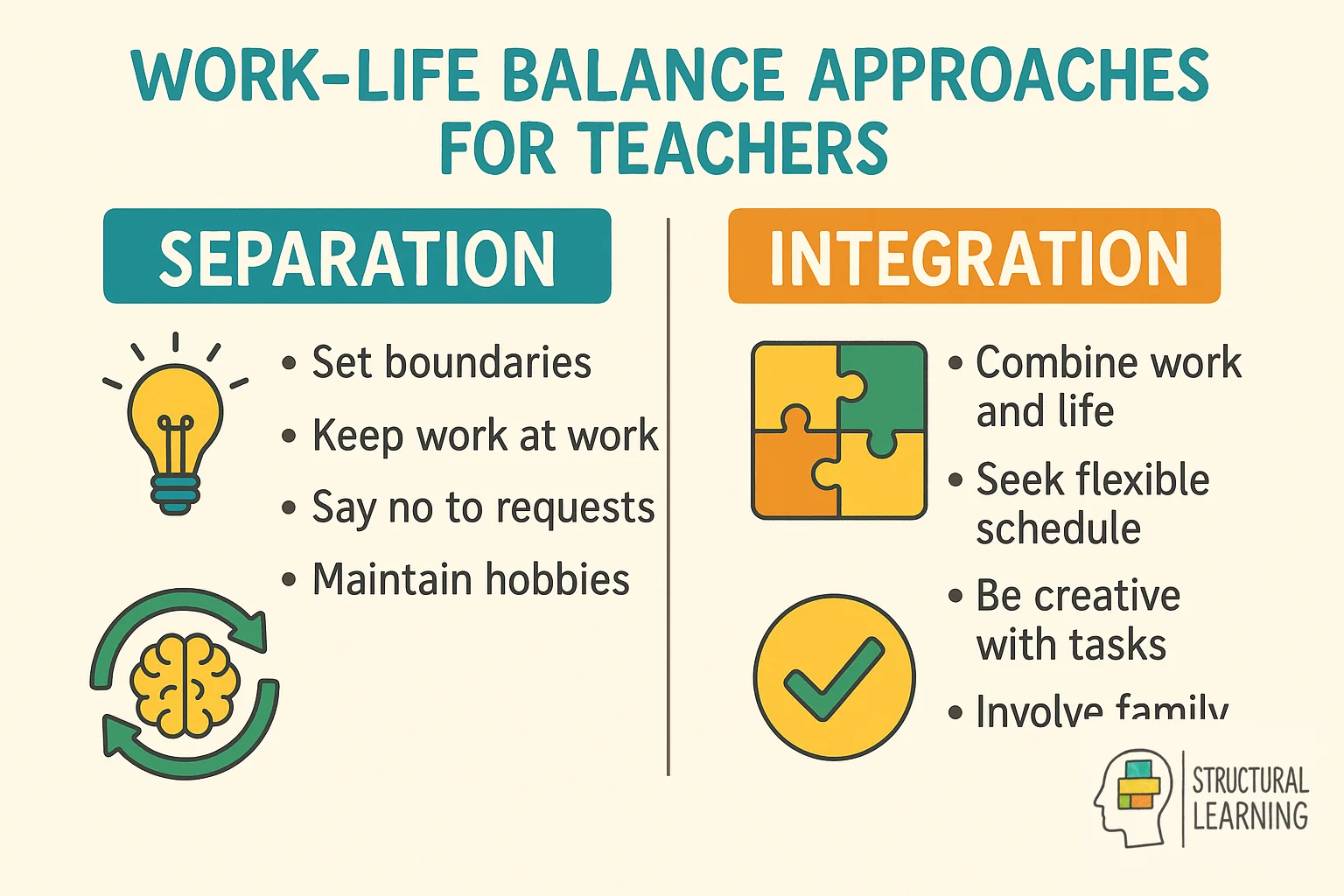
For head teachers and classroom educators alike, managing teacher workload effectively requires both strategic planning and self-awareness. The ability to protect time for rest, hobbies, and a social life not only enhances job satisfaction but also contributes to overall resilience. While some educators prefer a structured separation between work and personal commitments, others integrate both fluidly, shaping a routine that aligns with their unique needs.
Regardless of approach, achieving life balance is about autonomy, knowing when to set firm boundaries and when to allow flexibility. The following strategies provide practical steps for educators to safeguard their time, protect their mental wellbeing, and maintain their passion for education.
Establishing clear boundaries begins with defining specific times when work ends and personal life begins. This might involve:
The key is consistency. Boundaries only work when they are respected consistently, both by yourself and communicated clearly to colleagues and management.
Effective time management in education requires a shift from reactive to proactive planning. Consider implementing:
Remember, saying "no" to additional responsibilities that exceed your capacity is not unprofessional; for maintaining sustainable practice.
No teacher should navigate the challenges of education alone. Building robust support networks involves:
Schools that actively promote collaborative cultures and shared responsibility create environments where individual teachers feel less pressure to carry the entire load alone.
Establishing professional boundaries begins with recognising that saying yes to everything ultimately serves no one well. Research by Christina Maslach on educator burnout reveals that teachers who consistently overextend themselves experience diminished job performance and increased stress-related health issues. The key lies in distinguishing between essential responsibilities and additional requests that, whilst well-intentioned, may compromise your core teaching effectiveness.
Practical boundary-setting starts with creating non-negotiable time blocks for lesson planning, marking, and personal recovery. Establish specific hours when you're unavailable for extra duties or work-related communications, and communicate these clearly to colleagues and leadership. When declining additional responsibilities, offer alternative solutions where possible: "I can't take on the literacy committee this term, but I'd be happy to contribute during the summer holidays when my workload is lighter."
Physical boundaries matter equally to temporal ones. Designate specific spaces at home that remain work-free zones, and resist the urge to check school emails after your predetermined cut-off time. Remember that sustainable teaching requires protecting your energy and mental capacity for your students' benefit, not just your own wellbeing.
Every teacher knows the familiar rhythm of term time pressure: report deadlines looming whilst parent evenings fill the calendar, and examination scripts pile high during assessment periods. The key to surviving these intensive phases lies not in working harder, but in working more strategically. Research from Professor Rob Coe at Durham University demonstrates that sustainable teaching practices during peak periods actually improve both teacher wellbeing and student outcomes over the academic year.
During these demanding weeks, prioritise ruthlessly by identifying the absolute essentials versus the desirable extras. John Sweller's cognitive load theory reminds us that our mental capacity is finite, so focus on core teaching responsibilities whilst temporarily scaling back on additional projects or elaborate lesson preparations. Consider adopting a 'bare minimum Monday' approach during report writing weeks, where lessons utilise reliable, low-preparation activities that still deliver meaningful learning.
Establish clear professional boundaries by setting specific work cut-off times, even during busy periods. Communicate realistic timelines to colleagues and parents, explaining when responses can be expected. Most importantly, schedule recovery time immediately after intense periods, treating this as non-negotiable professional development rather than luxury. This prevents the accumulation of stress that can undermine your entire teaching career.
The digital revolution has transformed countless industries, yet many educators remain trapped in time-consuming analogue workflows that extend their working day unnecessarily. Research from the Education Endowment Foundation consistently shows that teachers who strategically integrate technology report significant reductions in administrative burden whilst maintaining teaching quality. The key lies not in adopting every new platform, but in identifying which digital tools genuinely streamline your most repetitive tasks.
Consider your weekly time audit: where do hours disappear into administrative black holes? Voice-to-text software can transform feedback delivery, allowing you to provide detailed comments whilst walking between lessons. Digital marking tools with pre-set comment banks reduce repetitive typing whilst maintaining personalised feedback. Cloud-based lesson planning platforms enable you to build searchable resource libraries, turning previous work into future time-savers rather than forgotten files gathering digital dust.
Start small with one technology solution per term, allowing yourself time to develop fluency before adding complexity. Focus on tools that address your specific challenges rather than following colleagues' recommendations blindly. Remember, the most sophisticated app is worthless if it adds stress to your routine. Sustainable teaching requires sustainable systems, and the right technology should feel like gaining a teaching assistant, not learning a new subject.
Teaching's unique emotional demands require self-care strategies that go beyond generic wellness advice. The constant "emotional labour" of managing classroom behaviour, supporting struggling students, and navigating challenging parent conversations creates a specific type of exhaustion that conventional relaxation techniques often fail to address. Effective self-care for educators must acknowledge the intensity of these interpersonal dynamics and provide practical relief strategies that work within the constraints of a teaching schedule.
The most successful self-care approaches for teachers focus on micro-recovery moments throughout the school day rather than relying solely on evening wind-down routines. Simple boundary-setting practices, such as designating the first five minutes after students leave as a "reset period" before tackling paperwork, can significantly reduce accumulated stress. Similarly, creating physical boundaries in your classroom space, like keeping one drawer or corner solely for personal items, helps maintain a sense of individual identity within the demanding role of educator.
Research by Christina Maslach on burnout prevention demonstrates that regular reflection practices specifically tailored to teaching challenges prove more effective than generic mindfulness approaches. Consider keeping a brief weekly log of professional wins alongside challenging moments, helping you process the emotional complexity of your teaching career whilst building resilience for sustainable practice.
Teacher burnout rarely appears overnight; it develops gradually through a series of identifiable warning signs that educators can learn to recognise. Physical symptoms often emerge first, including chronic fatigue that doesn't improve with rest, frequent headaches, and increased susceptibility to minor illnesses. Emotional indicators follow closely, manifesting as cynicism towards students or colleagues, feeling overwhelmed by routine tasks, and a growing sense of dread about returning to work each morning.
The behavioural changes associated with burnout can significantly impact your teaching effectiveness and work-life balance. You might find yourself working longer hours yet achieving less, avoiding social interactions with colleagues, or experiencing difficulty making decisions that once felt straightforward. Christina Maslach's seminal research on burnout identifies depersonalisation as a key warning sign, where teachers begin viewing students as problems rather than individuals with unique needs and potential.
Perhaps most concerning is when passionate educators notice their sense of personal accomplishment diminishing despite their continued efforts. If celebrating student successes feels forced or you question your effectiveness as a teacher without objective evidence, these feelings warrant immediate attention. Recognising these warning signs early allows you to implement targeted strategies before burnout compromises your teaching career and personal wellbeing.
Achieving work-life balance as an educator is not a destination but an ongoing journey of self-awareness, boundary setting, and continuous adjustment. The teaching profession will always carry inherent challenges, from heavy workloads to emotional demands, but these challenges need not define your entire experience.
The strategies outlined above, from setting clear boundaries to building support networks, provide a foundation for sustainable practice. However, the most important element is recognising that taking care of yourself is not selfish; . When teachers maintain their own wellbeing, they bring more energy, creativity, and compassion to their classrooms, ultimately benefiting the students they serve.
Remember, the education system needs passionate, committed teachers who can sustain their practice over the long term. By prioritising your own work-life balance, you're not only protecting your personal wellbeing but also contributing to a more sustainable and effective education system. Start small, be consistent, and remember that every step towards better balance is a step towards a more fulfiling and enduring teaching career.
For educators seeking additional research-based insights into work-life balance and teacher wellbeing, the following academic sources provide valuable evidence and practical applications:
As a certified burnout coach, I often work with individuals who are experiencing burnout or, at the very least, feeling drained, flat, and near exhaustion. Many of these individuals come from the field of education. If you ask AI which fields of employment experience burnout the most, education is consistently at the top.
I recently worked with an Early Career Teacher (ECT) in their first year of teaching who expressed doubts about staying in education. They found the hours overwhelming and the AI tools to reduce workload excessive. This is disheartening for many reasons. First, education is an incredibly rewarding profession. Observing the progress and development of students is inspiring, and being even a small part of that journey can be energizing. Secondly, the education system needs good teachers.
So, how do we ensure that education remains sustainable over the long term? The phrase work-life balance comes to mind, but perhaps it should be reframed as life-work balance or even setting boundaries.
The school day is rigidly structured, lessons begin and end at precise times, and contact time is non-negotiable. This rigidity can feel restrictive, leaving educators with little breathing room between tasks.

Once the contact day ends, the responsibilities continue, planning, marking, assessing, and meetings fill the remaining hours. But when is there time to simply think and reflect? The Education Endowment Foundation (EEF) refers to this as intellectual preparation, moving beyond constant doing and allowing space for thinking.

The demands of education can lead to:
Teaching is more than delivering lessons; it requires emotional labour, supporting students, managing behaviours, and engaging with parents. While this commitment is admirable, it comes at a personal cost if boundaries are not set.
Additionally, empathetic individuals are more susceptible to burnout. Absorbing the worries and stresses of others over time is exhausting and must be managed effectively.

Maintaining a healthy work-life balance is crucial in the education sector, where the demands of lesson planning, marking, and classroom management often extend beyond school hours. Without clear boundaries, the negative impact on mental health can be profound, leading to stress, exhaustion, and even burnout. Teachers, like professionals in other fields, need to establish a sense of balance between their professional responsibilities and personal life to sustain long-term wellbeing.

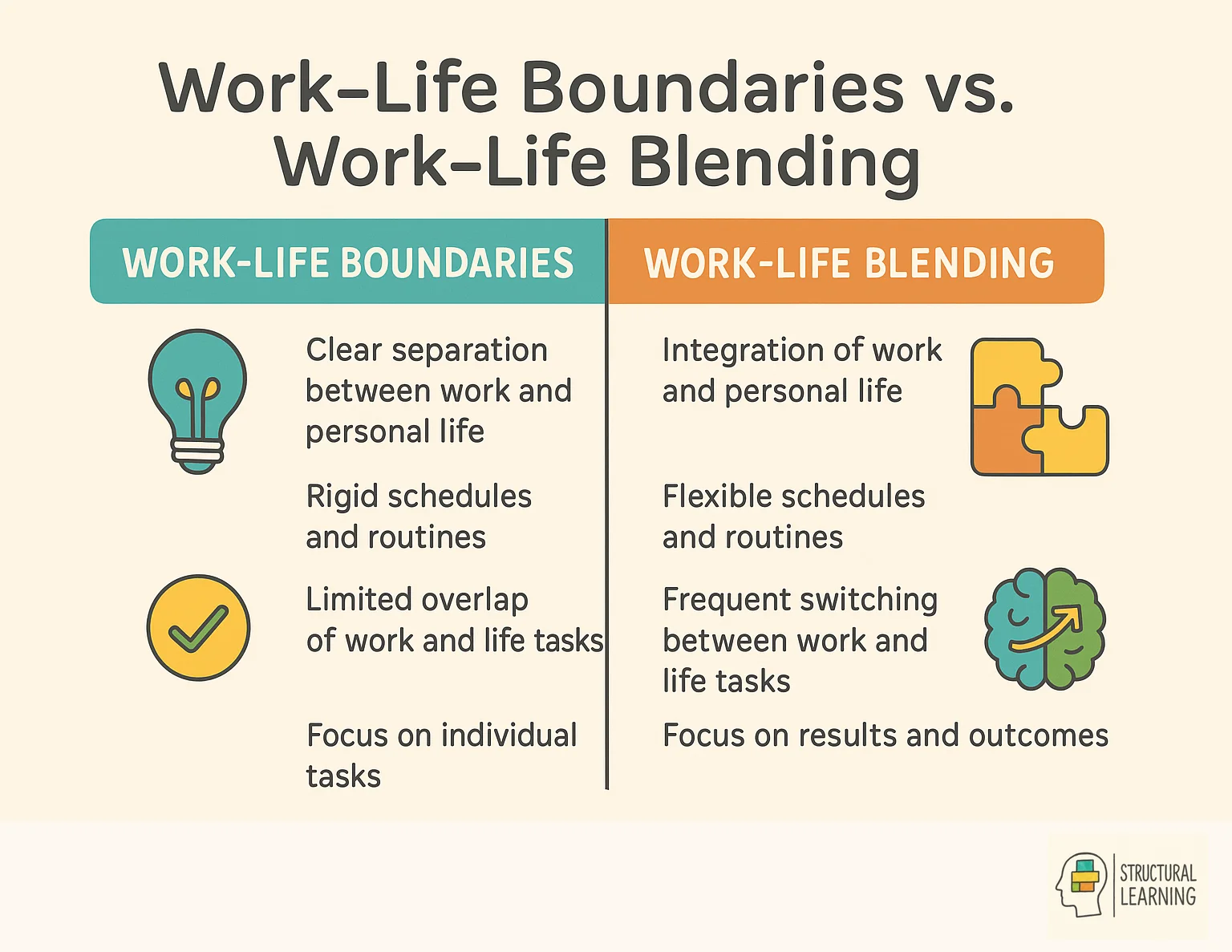
For head teachers and classroom educators alike, managing teacher workload effectively requires both strategic planning and self-awareness. The ability to protect time for rest, hobbies, and a social life not only enhances job satisfaction but also contributes to overall resilience. While some educators prefer a structured separation between work and personal commitments, others integrate both fluidly, shaping a routine that aligns with their unique needs.
Regardless of approach, achieving life balance is about autonomy, knowing when to set firm boundaries and when to allow flexibility. The following strategies provide practical steps for educators to safeguard their time, protect their mental wellbeing, and maintain their passion for education.
Establishing clear boundaries begins with defining specific times when work ends and personal life begins. This might involve:
The key is consistency. Boundaries only work when they are respected consistently, both by yourself and communicated clearly to colleagues and management.
Effective time management in education requires a shift from reactive to proactive planning. Consider implementing:
Remember, saying "no" to additional responsibilities that exceed your capacity is not unprofessional; for maintaining sustainable practice.
No teacher should navigate the challenges of education alone. Building robust support networks involves:
Schools that actively promote collaborative cultures and shared responsibility create environments where individual teachers feel less pressure to carry the entire load alone.
Establishing professional boundaries begins with recognising that saying yes to everything ultimately serves no one well. Research by Christina Maslach on educator burnout reveals that teachers who consistently overextend themselves experience diminished job performance and increased stress-related health issues. The key lies in distinguishing between essential responsibilities and additional requests that, whilst well-intentioned, may compromise your core teaching effectiveness.
Practical boundary-setting starts with creating non-negotiable time blocks for lesson planning, marking, and personal recovery. Establish specific hours when you're unavailable for extra duties or work-related communications, and communicate these clearly to colleagues and leadership. When declining additional responsibilities, offer alternative solutions where possible: "I can't take on the literacy committee this term, but I'd be happy to contribute during the summer holidays when my workload is lighter."
Physical boundaries matter equally to temporal ones. Designate specific spaces at home that remain work-free zones, and resist the urge to check school emails after your predetermined cut-off time. Remember that sustainable teaching requires protecting your energy and mental capacity for your students' benefit, not just your own wellbeing.
Every teacher knows the familiar rhythm of term time pressure: report deadlines looming whilst parent evenings fill the calendar, and examination scripts pile high during assessment periods. The key to surviving these intensive phases lies not in working harder, but in working more strategically. Research from Professor Rob Coe at Durham University demonstrates that sustainable teaching practices during peak periods actually improve both teacher wellbeing and student outcomes over the academic year.
During these demanding weeks, prioritise ruthlessly by identifying the absolute essentials versus the desirable extras. John Sweller's cognitive load theory reminds us that our mental capacity is finite, so focus on core teaching responsibilities whilst temporarily scaling back on additional projects or elaborate lesson preparations. Consider adopting a 'bare minimum Monday' approach during report writing weeks, where lessons utilise reliable, low-preparation activities that still deliver meaningful learning.
Establish clear professional boundaries by setting specific work cut-off times, even during busy periods. Communicate realistic timelines to colleagues and parents, explaining when responses can be expected. Most importantly, schedule recovery time immediately after intense periods, treating this as non-negotiable professional development rather than luxury. This prevents the accumulation of stress that can undermine your entire teaching career.
The digital revolution has transformed countless industries, yet many educators remain trapped in time-consuming analogue workflows that extend their working day unnecessarily. Research from the Education Endowment Foundation consistently shows that teachers who strategically integrate technology report significant reductions in administrative burden whilst maintaining teaching quality. The key lies not in adopting every new platform, but in identifying which digital tools genuinely streamline your most repetitive tasks.
Consider your weekly time audit: where do hours disappear into administrative black holes? Voice-to-text software can transform feedback delivery, allowing you to provide detailed comments whilst walking between lessons. Digital marking tools with pre-set comment banks reduce repetitive typing whilst maintaining personalised feedback. Cloud-based lesson planning platforms enable you to build searchable resource libraries, turning previous work into future time-savers rather than forgotten files gathering digital dust.
Start small with one technology solution per term, allowing yourself time to develop fluency before adding complexity. Focus on tools that address your specific challenges rather than following colleagues' recommendations blindly. Remember, the most sophisticated app is worthless if it adds stress to your routine. Sustainable teaching requires sustainable systems, and the right technology should feel like gaining a teaching assistant, not learning a new subject.
Teaching's unique emotional demands require self-care strategies that go beyond generic wellness advice. The constant "emotional labour" of managing classroom behaviour, supporting struggling students, and navigating challenging parent conversations creates a specific type of exhaustion that conventional relaxation techniques often fail to address. Effective self-care for educators must acknowledge the intensity of these interpersonal dynamics and provide practical relief strategies that work within the constraints of a teaching schedule.
The most successful self-care approaches for teachers focus on micro-recovery moments throughout the school day rather than relying solely on evening wind-down routines. Simple boundary-setting practices, such as designating the first five minutes after students leave as a "reset period" before tackling paperwork, can significantly reduce accumulated stress. Similarly, creating physical boundaries in your classroom space, like keeping one drawer or corner solely for personal items, helps maintain a sense of individual identity within the demanding role of educator.
Research by Christina Maslach on burnout prevention demonstrates that regular reflection practices specifically tailored to teaching challenges prove more effective than generic mindfulness approaches. Consider keeping a brief weekly log of professional wins alongside challenging moments, helping you process the emotional complexity of your teaching career whilst building resilience for sustainable practice.
Teacher burnout rarely appears overnight; it develops gradually through a series of identifiable warning signs that educators can learn to recognise. Physical symptoms often emerge first, including chronic fatigue that doesn't improve with rest, frequent headaches, and increased susceptibility to minor illnesses. Emotional indicators follow closely, manifesting as cynicism towards students or colleagues, feeling overwhelmed by routine tasks, and a growing sense of dread about returning to work each morning.
The behavioural changes associated with burnout can significantly impact your teaching effectiveness and work-life balance. You might find yourself working longer hours yet achieving less, avoiding social interactions with colleagues, or experiencing difficulty making decisions that once felt straightforward. Christina Maslach's seminal research on burnout identifies depersonalisation as a key warning sign, where teachers begin viewing students as problems rather than individuals with unique needs and potential.
Perhaps most concerning is when passionate educators notice their sense of personal accomplishment diminishing despite their continued efforts. If celebrating student successes feels forced or you question your effectiveness as a teacher without objective evidence, these feelings warrant immediate attention. Recognising these warning signs early allows you to implement targeted strategies before burnout compromises your teaching career and personal wellbeing.
Achieving work-life balance as an educator is not a destination but an ongoing journey of self-awareness, boundary setting, and continuous adjustment. The teaching profession will always carry inherent challenges, from heavy workloads to emotional demands, but these challenges need not define your entire experience.
The strategies outlined above, from setting clear boundaries to building support networks, provide a foundation for sustainable practice. However, the most important element is recognising that taking care of yourself is not selfish; . When teachers maintain their own wellbeing, they bring more energy, creativity, and compassion to their classrooms, ultimately benefiting the students they serve.
Remember, the education system needs passionate, committed teachers who can sustain their practice over the long term. By prioritising your own work-life balance, you're not only protecting your personal wellbeing but also contributing to a more sustainable and effective education system. Start small, be consistent, and remember that every step towards better balance is a step towards a more fulfiling and enduring teaching career.
For educators seeking additional research-based insights into work-life balance and teacher wellbeing, the following academic sources provide valuable evidence and practical applications:
{"@context":"https://schema.org","@graph":[{"@type":"Article","@id":"https://www.structural-learning.com/post/work-life-balance-for-teachers#article","headline":"Work-Life Balance for Teachers","description":"Discover practical strategies to achieve a healthy work-life balance in teaching, manage workload, and protect well-being in the education sector.","datePublished":"2025-03-10T11:25:14.852Z","dateModified":"2026-01-26T10:09:32.212Z","author":{"@type":"Person","name":"Paul Main","url":"https://www.structural-learning.com/team/paulmain","jobTitle":"Founder & Educational Consultant"},"publisher":{"@type":"Organization","name":"Structural Learning","url":"https://www.structural-learning.com","logo":{"@type":"ImageObject","url":"https://cdn.prod.website-files.com/5b69a01ba2e409e5d5e055c6/6040bf0426cb415ba2fc7882_newlogoblue.svg"}},"mainEntityOfPage":{"@type":"WebPage","@id":"https://www.structural-learning.com/post/work-life-balance-for-teachers"},"image":"https://cdn.prod.website-files.com/5b69a01ba2e409501de055d1/695021e87b4fbf474fb8a678_y91zxl.webp","wordCount":2470},{"@type":"BreadcrumbList","@id":"https://www.structural-learning.com/post/work-life-balance-for-teachers#breadcrumb","itemListElement":[{"@type":"ListItem","position":1,"name":"Home","item":"https://www.structural-learning.com/"},{"@type":"ListItem","position":2,"name":"Blog","item":"https://www.structural-learning.com/blog"},{"@type":"ListItem","position":3,"name":"Work-Life Balance for Teachers","item":"https://www.structural-learning.com/post/work-life-balance-for-teachers"}]}]}