Updated on
September 11, 2026
Embodied Cognition: How Body and Environment Shape Thought
Embodied cognition explains how the body, senses and environment shape thought. See how movement, gesture and physical objects support classroom learning.


Updated on
September 11, 2026
Embodied cognition explains how the body, senses and environment shape thought. See how movement, gesture and physical objects support classroom learning.
Have you ever thought about how your physical experiences shape your thoughts and choices? This question leads us to embodied cognition. This field studies how the mind and body are connected. Understanding this link can change how we view cognitive processes and our interactions with the environment.
Embodied cognition (Wilson, 2002) says thinking relies on senses and movement. Use movement in class; it helps learning. Learners grasp concepts better with physical actions (Barsalou, 2008).
Gibson (1979) used embodied cognition to link thinking with the environment. Rumelhart & McClelland (1986) used connectionism to show how neural networks connect through experience. Merleau-Ponty (1945) used phenomenology to view learning through lived experience. Together, these theories show that physical experiences shape a learner's cognitive growth.
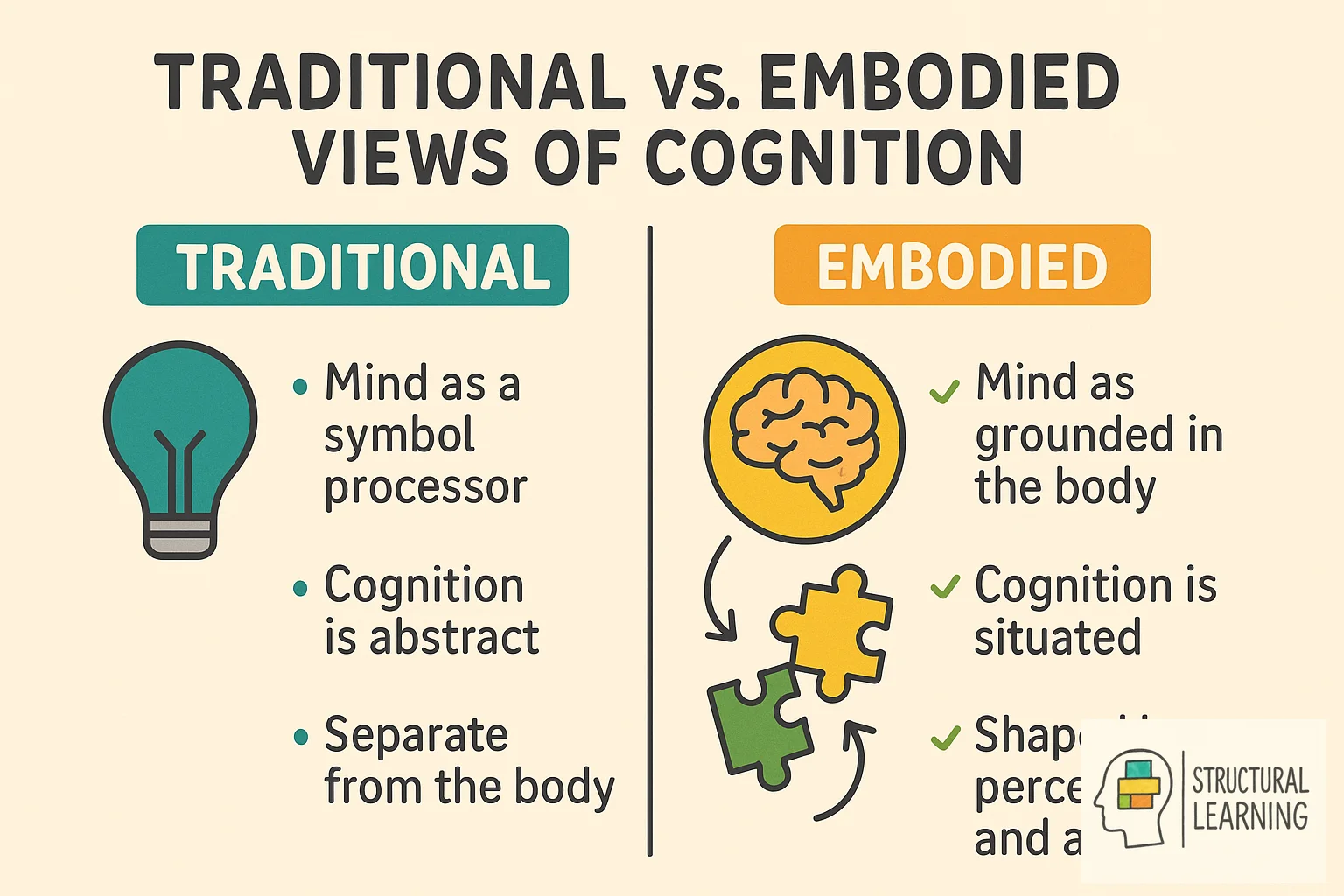
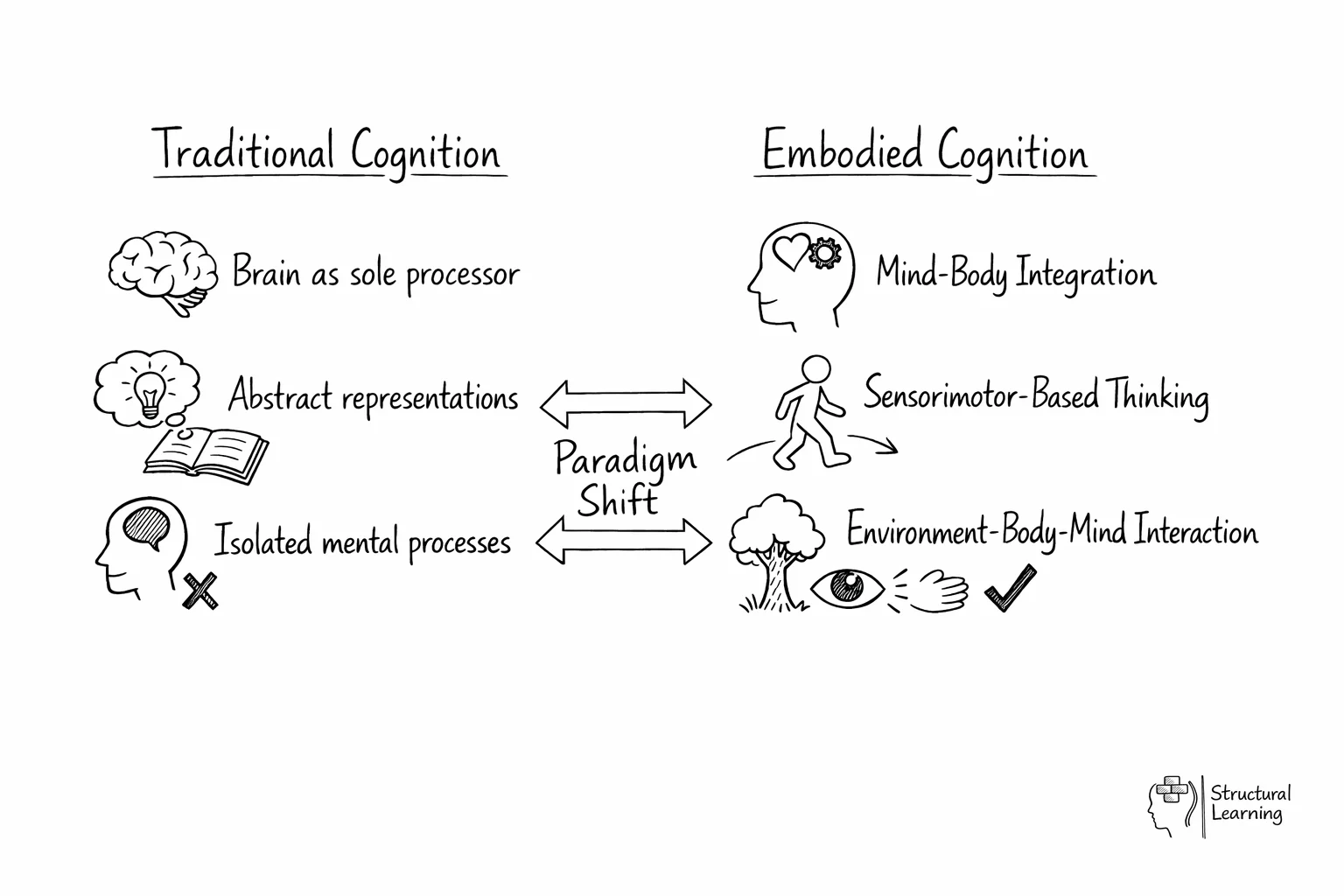
Embodied cognition, a cognitive science idea, sees thinking linked to bodily interaction (Barsalou, 1999). Older views saw the brain as separate from the body. Embodied cognition challenges that view (Varela et al., 1991). It suggests our sensorimotor systems help shape the learner's mind (Lakoff & Johnson, 1999).
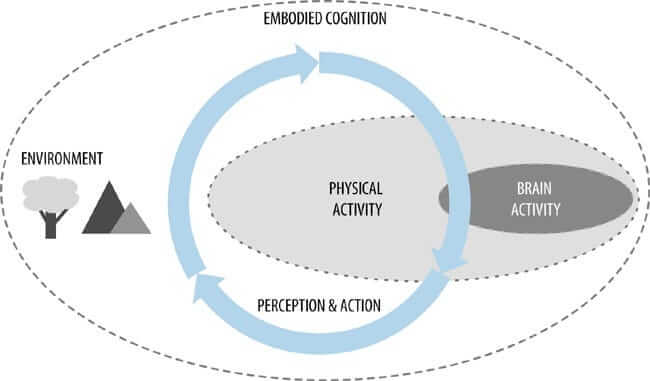
According to embodied cognition, the brain is not the only source of cognitive abilities. Cognition grows from the link between what an organism perceives and what its body does. This means physical actions are not just the result of thinking. They are closely tied to our mental faculties.
Embodied cognition says thinking links to our senses. Humans think using experiences, argue theorists like Barsalou (1999). Our bodies limit our reasoning, remember, and imagine skills. Cognitive science should study bodies, brains, and environments, as researchers like Clark (1997) suggest.
Gibson's ecological psychology sees perception as direct interaction with the environment. Affordances are opportunities for action, and they make this possible (Gibson, date not cited). A chair invites sitting; stairs invite climbing. Gibson says learners perceive these affordances directly, without complex thinking.
Ecological psychology suggests that thinking happens through actions, often without conscious awareness. It moves beyond the idea that cognition is only an internal mental process (Neisser, 1976). We understand cognition better when we study how learners act in their settings (Gibson, 1979; Reed, 1996).
Sensory and motor systems shape cognitive load and memory. Teachers can use clear scaffolding strategies to support learners with special needs. Movement can raise engagement, shift classroom practice, and support inclusion. Embodied approaches use hands-on activities to build critical thinking and improve comprehension across the curriculum, such as reading with gesture. Ecological psychology says thinking happens through action, not only in the mind. Cognition means how organisms act and make sense of their environment.
Sensory and motor systems can affect cognitive load and memory (Engel et al., 2016). Teachers can use scaffolding to support learners, especially those with special needs. Movement can boost engagement and improve classroom inclusivity (Bergethon et al., 2008). Embodied approaches can also improve critical thinking through exploration (Shapiro, 2019), so teachers can use movement across subjects to support understanding (Glenberg, 2010).
Embodied cognition has wide uses, especially in education and robotics. In education, it moves learning away from passive listening. It supports active learning, where learners use their bodies as they think. In robotics, it helps designers create robots that learn and adapt through physical interaction.
Embodied learning uses movement and the senses, rather than only abstract lessons. Movement lessons and role-play can engage learners and improve understanding. Research shows that embodied approaches help learners who struggle with standard teaching (Kontra, Goldin-Meadow & Beilock, 2015). This includes learners with learning difficulties or sensory issues (Glenberg et al., 2004).
Embodied learning uses movement for active learning. This can improve classroom management. Teachers can use physical materials to engage learners better. This approach makes learning more inclusive.
Embodied cognition helps learners grasp science concepts using physical activities. Learners show molecular behaviour by moving like particles. Wave properties become clearer when learners make waves with ropes or arms. Research shows physical modelling boosts understanding.
Embodied learning helps in literature and the humanities. Learners grasp drama better when they act out how characters feel. Historical events are easier to remember when learners recreate scenes or timelines. Movement also helps with essay planning, as learners can build stronger arguments by moving ideas around.
Embodied cognition needs creativity, not vast resources. Teachers, try using gestures when you explain things. Add short movement breaks between learning tasks. Design activities where learners handle objects representing ideas. These techniques work for kinesthetic learners and help others (Wilson, 2002; Beilock, 2003; Glenberg, 2010).
Lakoff and Johnson (1980) showed physical experiences shape abstract thought. Antonio Damasio's (1994) work linked emotion, body, and reason. These studies changed views on learning from mind-as-computer. Cognition is now seen as a whole-body process.
Classroom research backs these ideas. Goldin-Meadow's studies show that learners who use gestures in maths remember more. Embodied maths research also shows that learners understand concepts better when they physically manipulate objects, rather than only use symbols.
Try simple classroom actions. Encourage learners to gesture as they explain concepts. Use movement activities, and let learners physically explore ideas (Goldin-Meadow, Cook & Mitchell, 2009). This raises engagement and helps them understand. Honouring the body in classroom design improves learning (Barsalou, 2008).
Embodied cognition needs careful planning, not extra work. Research shows short movement breaks boost learning (Kontra, Goldin-Meadow & Beilock, 2015). Teachers should find ways to link movement to what they teach. For example, learners use gestures for maths or model science.
Purposeful movement aids learning. Learners can form groups for fractions or shapes for maths. Sweller's cognitive load theory shows this helps learners. Embodied learning provides more processing channels. This makes harder concepts more accessible.
Start with manageable routine changes. Teachers can add gestures to vocabulary lessons. Learners can trace letters in the air for spelling. Use the classroom space for history timelines. These strategies need little prep and boost natural learning (Glenberg, 2010; Kontra et al., 2015; Stephens et al., 2009).
Embodied approaches improve maths learning by making concepts physical. Research shows learners using bodies understand and remember more. They explore shapes and show operations with gestures. Number lines become paths and fractions turn into pizza slices.
Drama lets learners become characters, exploring plots through movement (Wilhelm, 1998). Phonics works better when learners link sounds to actions (Ehri et al., 2001). Physical planning, like story mapping, boosts writing (Berninger et al., 2008). It forges connections between experience and language.
Embodied cognition fits science well; learners model molecules by dancing. They simulate gravity playing outside and explore environments by acting as organisms. Teachers can use these methods instead of demos. Learners remember complex science through experience, not just watching (Lindgren, 2012).
Embodied cognition should suit learners' ages. Children's thinking and movement skills change (Piaget, various dates). Young learners learn through doing, so use physical maths and movement-based literacy in primary school. Older learners benefit from less direct methods as their abstract thought grows.
Embodied learning engages the whole body; use hopscotch for numbers. Teachers adapt it: learners use gestures for maths or timelines (Piaget). Even older learners benefit when they physically represent abstract concepts.
Teachers must check learners' readiness and adapt physical strategies (Berninger et al., 2008). Primary teachers may use mats for fractions. Secondary teachers could use standing talks or active problem-solving. This meets movement needs in age-appropriate ways (Kontra, Goldin-Meadow & Beilock, 2015).
Embodied cognition sees mind, body, and world as linked (Clark, 2008). It questions the old idea of thinking as brain-only. Physical experiences shape what learners think and do (Wilson, 2002).
Embodied learning now uses more technology to build smarter, more flexible systems for learners. (Wilson, 2002) Further research will help us understand thinking more clearly. It may also lead to better learning and interaction.
Researchers suggest educators start by reviewing lessons for movement potential. Learners can explore maths using spatial tasks (Berninger et al., 2008). Literacy skills build through dramatic readings and active storytelling (Gardner, 1983). Science lends itself to experimentation, notes Sousa (2017). Abstract topics gain from material use or gestures, says Howard-Jones (2014).
Embodied learning CPD needs practical strategies, not only theory. Research shows that teachers gain confidence when they experience these methods themselves. Working with colleagues helps them share resources and observe practice. Embodied cognition is a key development because it reflects how people learn. Physical experience can improve engagement and outcomes for all learners.
The move towards embodied cognition began as a challenge to traditional cognitive science. That older view treated the mind as a computer that processes abstract symbols. In the 1970s and 1980s, researchers like James J. Gibson challenged this view with ecological psychology, arguing that perception and action are inseparable. His work on affordances; what the environment offers for action; transformed how we understand learning. For teachers, this means recognising that learners do not just absorb information passively. They actively explore their environment through movement and interaction.
| Strategy | Teacher Action | Learner Experience |
|---|---|---|
| Gesture-based learning | "Show me with your hands how a plant grows." | Learners use hand movements to mimic growth stages or demonstrate concepts. |
| Physical modelling | "Use objects around you to represent a food chain." | Learners arrange items like a pen (sun), a book (plant), and a toy (animal) to build models. |
| Movement breaks | "Let's all stand up and stretch like a tree reaching for the sun." | Learners perform simple, concept-related movements that reinforce learning. |
Merleau-Ponty highlighted the body's role in perception. Varela and Rosch used this for enactivism. Enactivism suggests thinking comes from active environmental interaction. This impacts teaching; learners build knowledge actively. Year 3 learners measuring the playground perimeter embody maths. This creates stronger neural links than written work (Varela & Rosch, dates unknown).
The 1990s saw embodied cognition gain empirical support through studies on gesture, metaphor, and spatial reasoning. George Lakoff and Mark Johnson's work on conceptual metaphors revealed how abstract thinking relies on physical experiences. Consider how we teach time: 'looking forwards' to the future or 'back' at the past. These aren't arbitrary phrases but reflect how our bodies move through space. Smart teachers exploit these connections, having learners physically step along number lines for addition or using arm movements to demonstrate historical timelines.
At first, critics dismissed embodied cognition. They said it did not explain abstract thought well enough. Later, neuroscience research supported the idea, especially mirror neuron studies (Rizzolatti et al., 1996). Today, classrooms use maths manipulatives and drama to show that thinking extends beyond the brain (Lakoff & Johnson, 1980).
At its heart, embodied cognition rests on sensorimotor grounding; the idea that our understanding of abstract concepts is built upon physical experiences. When learners learn about 'up' and 'down', they aren't simply memorising words. Their comprehension is rooted in countless experiences of looking up at the sky, climbing stairs, or dropping objects. This physical foundation extends far beyond spatial concepts, influencing how children understand emotions (feeling 'down'), power dynamics ('higher' positions), and even time (the 'future' ahead, the 'past' behind).
Lakoff and Johnson show that we use physical experience to understand abstract ideas. Learners may 'grasp' concepts or 'carry' burdens, and these phrases reflect cognition. Teachers can use physical metaphors with care and purpose. For example, learners might step through processes (Lakoff & Johnson), or balance equations.
Body-mind links cognition and physiology. Carney, Cuddy, and Yap (2010) reported effects of expansive poses on felt power, hormones, and risk tolerance in a small lab study; later replication work did not support robust behavioural or performance effects. Williams and Bargh (2008) reported that physical warmth influenced interpersonal warmth judgments; later replications made this effect contested rather than established. Schnall, Benton, and Harvey (2008) reported a cleanliness effect on moral judgment; later direct replications did not reliably reproduce the effect. Try power poses before talks or movement breaks to refocus learners. Consider classroom comfort when teaching complex topics.
Embodied cognition can support learning beyond the classroom. It can also help in digital and remote lessons. Teachers can design screen-based tasks that use sensorimotor engagement, where learners learn through movement and touch, to build understanding and memory. This approach recognises that virtual actions can still activate bodily schemas, or mental patterns linked to the body, and support cognitive processing (Barsalou, 2008).
| SEN Profile | Scaffolding Technique | Classroom Example |
|---|---|---|
| ADHD | Movement breaks | Teacher says: "Everyone stand up, do 5 star jumps, then sit down and review the last paragraph." |
| Autistic Learners | Sensory-motor tools | Providing a fidget toy or a wobble cushion during independent work to aid concentration. |
| General SEN | Physical sequencing | Learners physically arrange large cards with steps of a process (e.g., scientific method) on the floor. |
Virtual Reality (VR) and Augmented Reality (AR) offer strong potential for embodied learning. These technologies place learners in simulated environments. Learners can then interact with digital objects and spaces as if they were physically present. For instance, learners studying human anatomy in VR can virtually "dissect" organs, use hand controllers to move them, and experience spatial relationships directly, which grounds abstract concepts in physical action.
User interface (UI) and user experience (UX) design in educational software can also use embodied principles well. Digital affordances, such as drag-and-drop functions, interactive sliders, or virtual manipulatives, invite learners to act on screen content. For example, learners may drag and drop historical events onto a digital timeline. The movement and placing of each item helps them understand chronology and cause-and-effect relationships.
Remote teachers need to adapt embodied strategies for screen-based lessons so learners stay engaged and understand the content. Learners can use gestures, draw ideas, or do short physical tasks during online lessons. These actions keep thinking active and link abstract ideas to bodily experience. For example, a teacher might ask learners to show "expansion" by stretching their arms wide, or "contraction" by drawing their limbs in, even on a video call.
Embodied cognition can give clear benefits to learners with Special Educational Needs (SEN). It can support cognitive and behavioural regulation, which means helping learners manage thinking and behaviour. Adding physical movement and sensory experiences can help with attention, executive function, and sensory processing. These approaches improve access to the curriculum and support better learning outcomes for diverse learners.
For learners with Attention Deficit Hyperactivity Disorder (ADHD), movement can support executive functions. These include sustained attention and impulse control. Planned physical activity, or allowed fidgeting, can help learners manage arousal levels and focus better on academic tasks (Barkley, 1997). For example, a teacher might give a learner a resistance band to stretch under the desk during independent work, so they can channel excess energy in a useful way.
Autistic learners often benefit from sensorimotor grounding. This means using movement and the senses to help manage sensory input and build bodily awareness. Rhythmic activities or deep pressure can give predictable sensory input, which may reduce anxiety and improve focus. A teacher might use short, structured movement breaks, such as pushing against a wall or using a weighted lap pad, to provide calming proprioceptive input.
Specific scaffolding techniques can use movement to support learning across different SEN profiles. These strategies give learners external structures to help them organise thoughts, manage tasks, and process information. The table below shows how different embodied approaches support different needs.
When learning includes physical movement, teachers need to think carefully about how learners show understanding. Traditional assessment methods often miss the cognitive benefits that come from bodily engagement (Barsalou, 2008). Teachers therefore need clear ways to record and assess these embodied demonstrations of knowledge.
| Criterion | Purposeful Movement | Off-Task Behaviour |
|---|---|---|
| Cognitive Link | Directly represents or explores a learning concept. | Unrelated to the learning objective. |
| Intent | Deliberate action to aid understanding. | Unintentional or distracting from the task. |
| Example (Maths) | Physically demonstrating a geometric transformation. | Fidgeting, wandering without purpose. |
A key challenge is telling purposeful, learning-oriented movement apart from off-task behaviour during assessments. Purposeful movement directly supports conceptual understanding. For example, learners might act out a scientific process or model a historical event. Off-task movement does not have this direct cognitive link and distracts from the learning objective.
Rubrics give clear criteria for judging physical modelling and movement-based tasks. They should name the behaviours a teacher can observe and the conceptual understanding those behaviours show. For example, a rubric for modelling plate tectonics might assess how accurately learners use hand gestures to show plate movement. It might also assess the verbal explanation that goes with the gestures.
When teaching about fractions, a teacher might ask learners to physically divide themselves into equal groups to represent fractions like 1/2 or 1/4. The teacher observes how accurately learners form groups and explains their reasoning, using a rubric to assess both the physical action and the verbal justification. This allows for direct measurement of embodied understanding.
Applying embodied cognition principles to adult learning and higher education needs careful thought about context and learner expectations. Adult learners may respond differently from younger learners. At first, they may resist clear physical activities because of ideas about professionalism or social norms in academic or professional settings.
Despite these possible concerns, the link between physical experience and cognitive processing still matters for adults. Cognitive processing means how the mind takes in and works with information. Experiential learning theories, such as those proposed by Kolb (1984), show that adults learn by active engagement, reflection, and concrete experiences. These experiences help adults build knowledge.
Educators can use embodied cognition in ways that fit adult learning settings and goals. This means presenting movement as a thinking tool that supports understanding, not as a break for fun.
For instance, in a university lecture on complex anatomical structures, learners could use gestures to trace pathways. They could also use their hands to physically model how systems interact. In professional development, participants might organise project phases on a large floor map. They could then walk through the process to identify dependencies and bottlenecks.
Embodied cognition suggests that physical experience shapes abstract thought in common ways. However, cultural contexts strongly influence specific conceptual metaphors (Lakoff & Johnson, 1980). For instance, people often link the directionality of time to spatial orientations. These links are not always the same across societies.
| Embodied Strategy | Application in Adult Learning | Learner Outcome |
|---|---|---|
| Subtle Gestures | A lecturer explaining 'expansion' or 'contraction' encourages learners to use corresponding hand movements. | Reinforces abstract concepts through physical representation, aiding memory and comprehension. |
| Spatial Organisation | Participants in a workshop physically arrange concept cards on a timeline or matrix on the floor. | Develops a deeper understanding of relationships and sequences by interacting with information spatially. |
| Role-Playing/Simulation | Medical learners practise patient consultations, adopting specific postures and movements for different scenarios. | Cultivates empathy and practical skills by embodying different perspectives and actions within a simulated context. |
Many Western cultures conceptualise the future as "forward" and the past as "behind", aligning with our typical movement through space. However, some cultures, such as the Aymara people of the Andes, employ an inverse spatial metaphor for time (Boroditsky & Gaby, 2010). For them, the past is "forward" because it is known and visible, while the future is "behind" because it remains unseen and unknown.
Teachers can explore these cultural variations by asking learners to consider how different languages express time. For example, a teacher might present phrases like "looking forward to the future" versus "the past is before us" and ask learners to map these onto a spatial diagram. This activity helps learners recognise that embodied metaphors are shaped by both universal human experience and specific cultural perspectives.
Embodied cognition should not be treated as a complete theory of learning. Wilson (2002) warned that the label covers several different claims about situated, time-pressured, offloaded and body-based cognition. A second criticism is that evidence from fMRI motor cortex activation can be overread. Mahon and Caramazza (2008) argued that neural activity during action-language tasks does not prove that motor systems are necessary for conceptual understanding. For teachers, a scan result is not the same as a classroom intervention.
A further limitation is methodological. Many studies use small lab tasks, short retention intervals or adult samples, so findings may not transfer neatly to Year 7 algebra, early reading or SEND provision. Recent reviews stress boundary conditions such as task complexity, prior knowledge, culture and cognitive load (Abrahamson et al., 2020; Lyu and Deng, 2024).
There is also a cultural and inclusion problem. Prescribing a single correct gesture can reflect Western, neurotypical assumptions about posture, eye contact and acceptable movement. Autistic and dyspraxic learners may use atypical movement, including stimming or self-positioning, as their own form of cognitive offloading. A rigid "arms folded" policy can therefore remove useful thinking supports, especially during explanation or recall.
Finally, embodied cognition is often confused with kinaesthetic learning styles. The stronger claim is not that some learners need movement because they are a type, but that well-aligned action, gesture, tools and environment can support cognition for many learners. The theory remains valuable when used with precision, evidence and professional judgement.
Research shows that embodied cognition links thinking with physical actions and surroundings. It challenges the traditional view that mental processes are separate from the body. Sensorimotor systems, which connect sensing and movement, strongly shape how a learner thinks (Wilson, 2002; Barsalou, 2008; Gibbs, 2005).
Embodied cognition involves physical activities and hands-on learning. Teachers can arrange classrooms to make interaction easier. This supports the body-environment loop, which is central to embodied cognition (Kirsh, 1995). It also encourages learners to use their bodies as thinking tools for concepts (Wilson, 2002; Barsalou, 1999).
Kinesthetic learning uses movement to help learners understand abstract concepts more clearly. It can also support memory formation and improve learning outcomes. This method can be especially helpful for diverse learners (Hannaford, 2005), including those with sensory differences (Ratey, 2008; Medina, 2014).
Teachers often over-use physical games, missing cognitive work. They sometimes forget to tailor tasks to each learner's needs. Balance movement with mental tasks for better learning, as found by researchers.
Evidence suggests this approach is effective because learner engagement improves. Learners also performed better on cognitive tasks. They showed a stronger ability to grasp abstract ideas. Feedback from learners and parents gives helpful understanding of its impact.
Karpicke, J. (2008). The critical importance of retrieval for learning.
Piaget, J. (1952). The origins of intelligence in children.
Sweller, J. (1988). Cognitive load during problem solving.
Vygotsky, L. (1978). Mind in society: The development of higher psychological processes.
These influential studies explore embodied cognition and its implications for teaching and learning.
Six Views of Embodied Cognition 61 citations
Wilson, M. (2002)
Supporting this, research indicates that embodied learning boosts memory (Beilock, 2015). Teachers can use physical activities to help learners grasp complex concepts. This approach also improves engagement and knowledge retention (Glenberg, 2010; Barsalou, 2008). Wilson's (2002) framework shows body experience shapes learner thinking.
Grounded Cognition
61 citations
Barsalou, L.W. (2008)
Research from Barsalou (2008) and Lakoff and Johnson (1999) suggests abstract thought uses sensory and motor skills. This supports using physical objects. Encourage active learning strategies (Bruner, 1966; Piaget, 1936).
Hearing Gesture: How Our Hands Help Us Think
990 citations
Goldin-Meadow, S. (2003)
Research (Goldin-Meadow, 2011) proves gesture helps learners. It spans various subjects and boosts understanding. Work by McNeil (1992) also shows this. Teachers can use gesture in lessons. Incorporate movement into explanations using strategies by researchers like Alibali (2005).
Body in Mind: How Gestures Equip Foreign Language Learning
176 citations
Macedonia, M. & Knösche, T.R. (2011)
Researchers found gestures help learners remember words (Kelly et al., 2009). This benefits subjects needing memorisation (Tellier, 2008; Macedonia & Knösche, 2011). Using actions when teaching new words improves learner recall (Sadoski, 2005; James & Engelhardt, 2016). Consider gesture-based activities for vocabulary learning (Moreno & Mayer, 1999).
Embodiment as a Unifying Perspective for Psychology
370 citations
Glenberg, A.M. (2010)
The research of Lakoff and Johnson (1999) links body and learning. They found hands-on tasks and movement help learners of all ages. Wilson (2002) and Barsalou (2008) suggest this improves understanding.
| Conceptual Metaphor | Typical Western View | Aymara Cultural View |
|---|---|---|
| The Past | Behind us (what we have moved past) | In front of us (what is seen and known) |
| The Future | In front of us (what we move towards) | Behind us (what is unseen and unknown) |