Contextual Teaching and LearningPrimary students in maroon sweatshirts engaging with educational props under teacher guidance in a bright classroom.

Updated on  

February 6, 2026

Contextual Teaching and Learning

|

July 4, 2024

Explore the origins, key figures, and theoretical foundations of contextual teaching and learning, plus its impact on academic lessons and engagement.

Course Enquiry
Copy citation

Main, P. (2024, July 4). Contextual Teaching and Learning. Retrieved from www.structural-learning.com/post/contextual-teaching-and-learning

What Is Contextual Teaching and Learning?

Contextual teaching and learning (CTL) is an instructional approach that aims to provide students with a meaningful and relevant education by making connections between the curriculum and real-life situations. Rooted in brain research, CTL recognises that learning is most effective when it is contextualized and when students are actively engaged in constructing their own understanding.

Key Takeaways

  1. Beyond Real-World Examples: Discover why contextual learning transforms retention rates and how brain research reveals the missing link in traditional teaching approaches
  2. The Seven CTL Strategies: Master practical techniques from role-play to service learning that make abstract concepts stick for diverse learners, including those with SEND
  3. The Vygotsky Connection: Why combining social learning with real-world contexts creates breakthrough moments for students who typically struggle with academic content
  4. Authentic Assessment Revolution: Move beyond traditional testing to discover how real-world demonstrations reveal true student capabilities and inform more effective teaching strategies

The key components of CTL include making meaningful connections, encouraging self- regulated learning and collaboration, promoting critical and creative thinking, nurturing the individual, reaching high standards, and using authentic assessment. Meaningful connections involve integrating new knowledge with students' prior knowledge and experiences to enhance understanding and retention. Self-regulated learning encourages students to take control of their own learning process and become active participants in their education. Collaboration, both between students and with teachers, facilitates a supportive and cooperative learning environment.

Six core components of Contextual Teaching and Learning framework diagram
The 6 Core Components of Contextual Teaching and Learning (CTL)

Critical and creative thinking are essential aspects of CTL. Students are encouraged to think critically, analyse information, and develop their own perspectives. Additionally, creative thinking is nurtured by providing opportunities for students to generate new ideas and solutions. Nurturing the individual entails recognising and responding to students' unique needs, interests, and abilities, ensuring that all students can succeed with a growth mindset. Finally, reaching high standards involves setting ambitious goals for student achiev ement and providing the necessary support to help students reach those goals.
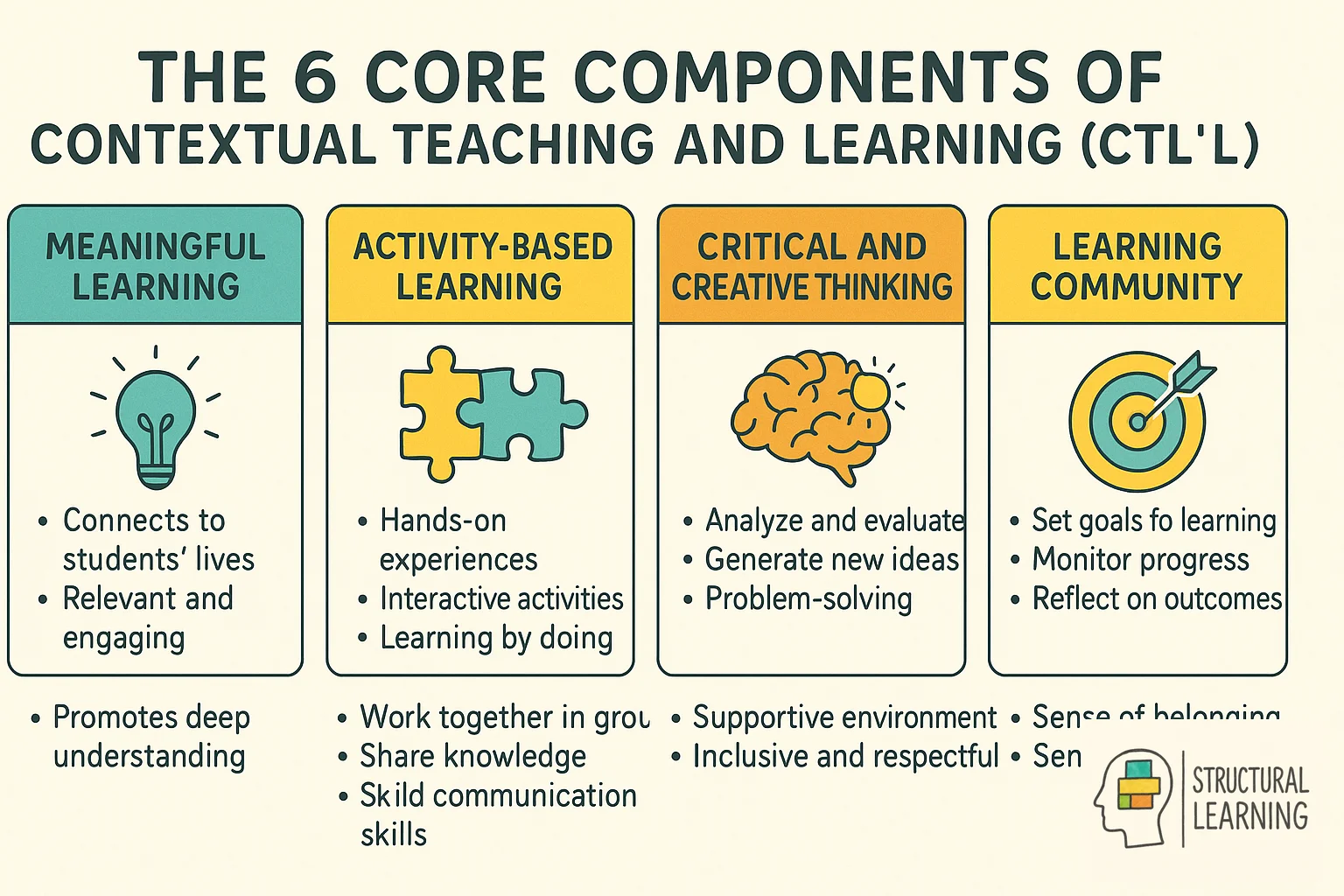
Using authentic assessment is another critical component of CTL. Authentic assessments require students to demonstrate their knowledge and skills in real-world, meaningful ways, providing a more accurate reflection of their abilities through effective feedback mechanisms.

Origins of Contextual Learning Theory

Contextual teaching and learning originated from constructivist learning theories and brain research that showed students learn more effectively when content connects to their experiences. The approach was developed as educators recognised that traditional isolated instruction methods failed to engage students or promote deep understanding. CTL emerged as a response to the need for more meaningful, relevant education that prepares students for real-world applications.

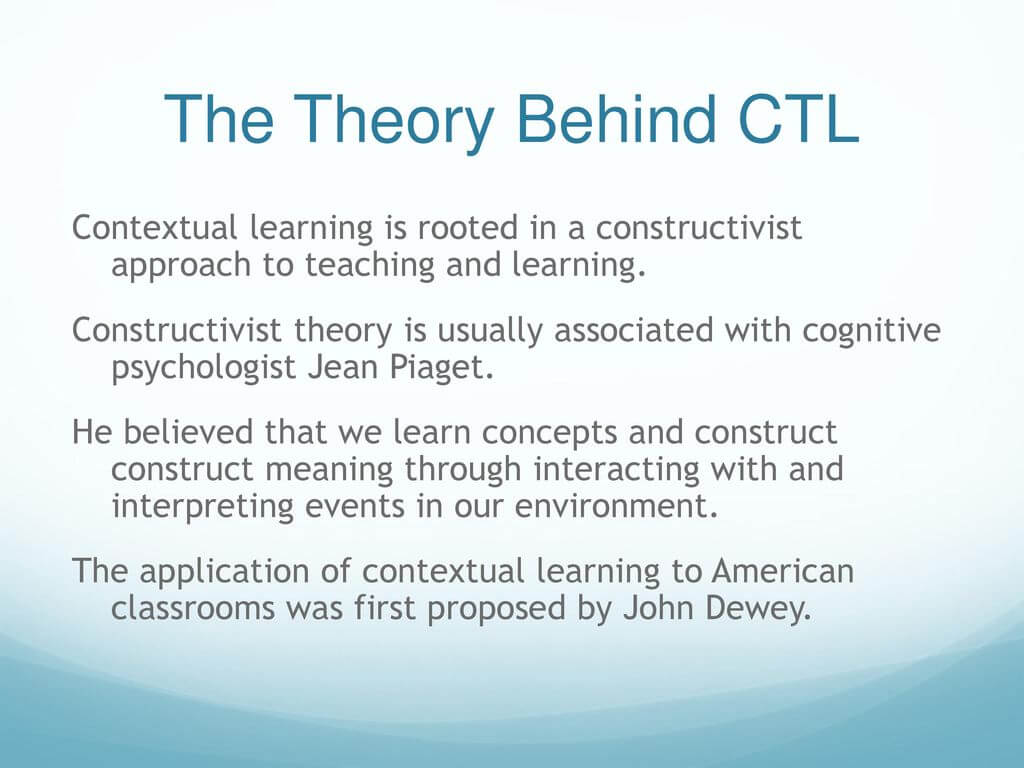
The theory and practise of contextual teaching and learning (CTL) have deep roots in the works of several influential psychologists and educators. Jerome Bruner, a prominent figure in educational psychology, emphasised the importance of scaffolding and the spiral curriculum, where learning builds on previous knowledge through contextual experiences. Jean Piaget's theory of cognitive developmentalso significantly influences CTL, as it highlights how children construct knowledge through interactions with their environment. Piaget's stages of development stress the need for teaching strategies that are developmentally appropriate and contextually relevant.

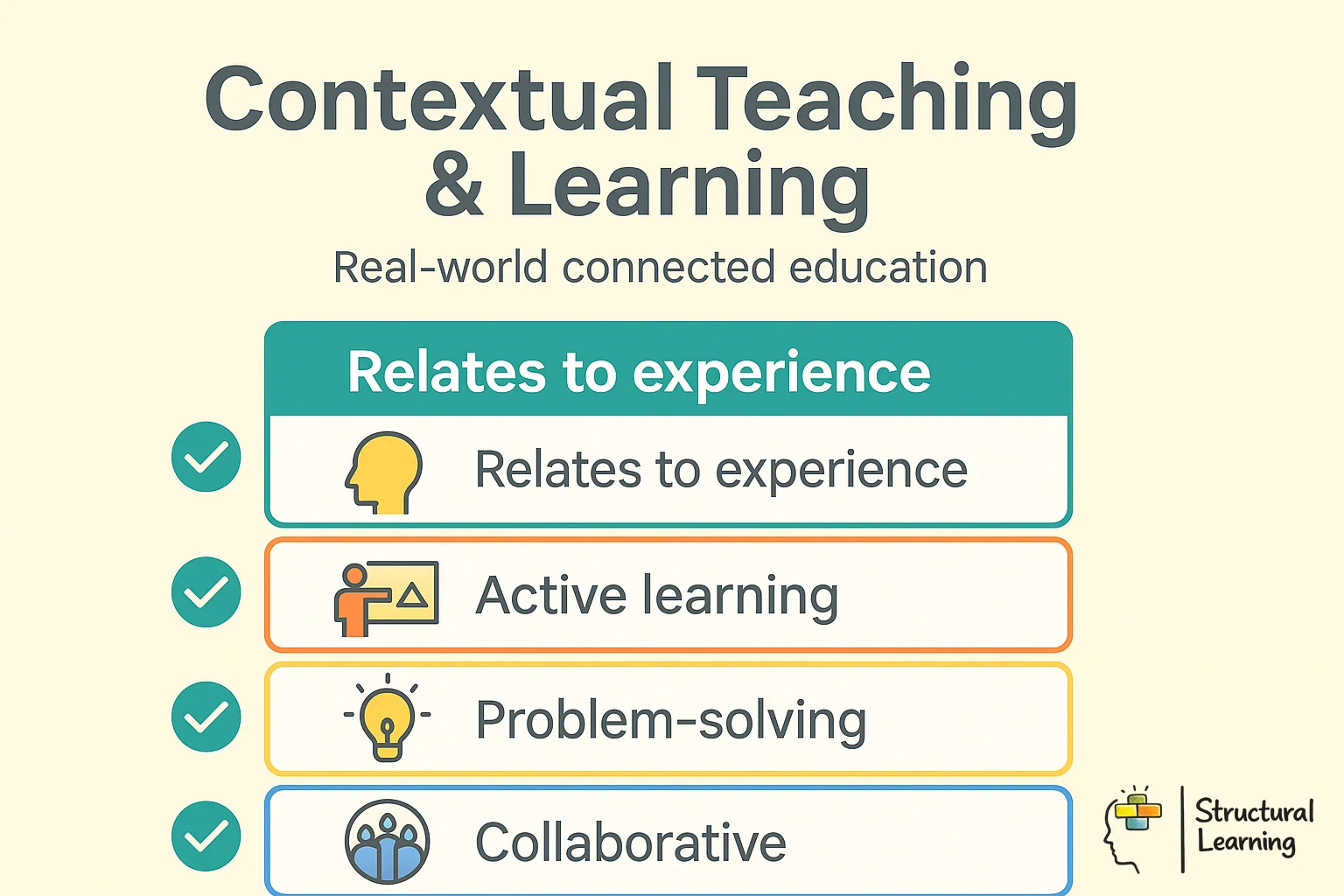
Infographic defining Contextual Teaching and Learning with 5 key characteristics
Contextual Teaching & Learning

Lev Vygotsky introduced the concept of the Zone of Proximal Development ( ZPD) and underscored the role of social interaction in learning. His ideas about learning through cultural and social contexts are foundational to CTL. John Dewey, an advocate of experiential learning, argued that education should be grounded in real-life experiences, promoting the idea that students learn best when they see the connections between knowledge and their own lives.

Albert Bandura's social learning theory, which emphasises observational learning and the importance of modelling, also supports the principles of CTL. Howard Gardner's theory of multiple intelligences en courages educators to use diverse methods to offer multiple ways for students to engage*. Note: While Gardner's Multiple Intelligences theory is popular in educational settings, it lacks strong empirical validation. The theory should be viewed as one perspective rather than established science.

These theorists collectively emphasise the importance of making academic lessons relevant and meaningful by paying attention to context and integrating traditional methods with new, real-world applications. This approach, grounded in learning theories, benefits teachers in kindergarten through higher education, helping students make meaningful connections between knowledge and their daily lives.

CTL Theory
CTL Theory

Connecting Learning to Real-World Applications

Contextual teaching connects abstract concepts to real-world situations by using students' everyday experiences, current events, and practical applications as learning anchors. Teachers present content within familiar contexts that students can relate to, making academic material more understandable and applicable.

For instance, in a maths lesson, rather than just solving abstract equations, students might calculate the cost of ingredients for a recipe or determine the optimal dimensions for building a birdhouse. In science, students could explore the principles of physics by analysing how a bicycle works or investigate the impact of pollution on a local environment. History lessons might involve researching the impact of past events on their own community, allowing students to see the relevance of history in their lives. In language arts, students may analyse persuasive techniques in local advertisements or create their own campaigns addressing community issues.
This active engagement with real-world scenarios not only enhances comprehension but also creates critical thinking, problem-solving, and collaboration skills. By connecting learning to their own experiences, students develop a deeper understanding of the subject matter and its relevance to their lives, increasing their motivation and engagement in the learning process. This will also help with recall. Research has shown that the human brain recalls information more effectively when it is tied to a specific context.

Benefits of Contextual Teaching and Learning

Contextual teaching and learning offers a multitude of benefits for both students and educators. By connecting academic content to real-world applications, CTL enhances student engagement and motivation. Students are more likely to invest in learning when they understand its relevance and see how it applies to their lives. This approach creates a deeper understanding of the subject matter, as students are actively involved in constructing their own knowledge through meaningful experiences.

CTL promotes critical thinking and problem-solving skills, as students are challenged to apply their knowledge to real-world problems and situations. Collaboration and communication skills are also enhanced, as students work together to solve problems and share their ideas. Additionally, CTL supports the development of self-regulated learning skills, as students take ownership of their learning and become active participants in the educational process. By addressing diverse learning styles and needs, CTL creates an inclusive learning environment where all students can succeed. It also prepares students for future success by equipping them with the knowledge, skills, and attitudes necessary to thrive in a rapidly changing world.

Furthermore, contextual learning offers benefits to teachers by encouraging innovation in curriculum design and instructional strategies. Teachers are prompted to be creative and resourceful, seeking out opportunities to connect content to real-world contexts. This approach creates a more dynamic and engaging classroom environment, where teachers and students are partners in the learning process. Ultimately, CTL leads to improved student outcomes, increased teacher satisfaction, and a more relevant and meaningful education for all.

Implementing Contextual Teaching and Learning in the Classroom

Implementing contextual teaching and learning (CTL) in the classroom requires a strategic approach that integrates real-world relevance into the curriculum. Begin by identifying the core concepts you want students to grasp and then brainstorm real-world situations that illustrate these concepts. Design activities that allow students to apply their knowledge in practical settings, such as simulations, case studies, or project-based learning assignments. Encourage collaboration through group projects and discussions, where students can share their perspectives and learn from each other.
Create an environment where students feel comfortable asking questions and exploring different solutions. Use formative assessment strategies to monitor student progress and provide timely feedback. Reflect on your teaching practices regularly and be willing to adapt your approach based on student needs and feedback. By focusing on relevance, engagement, and active participation, you can create a learning environment that helps students to become lifelong learners.

In the classroom, consider these practical examples: instead of merely teaching grammar rules, have students analyse how language is used in persuasive advertising campaigns. Rather than memorising historical dates, ask students to research the impact of a historical event on their local community, or conduct mock trials to debate different perspectives. When teaching fractions, assign them the task of adjusting recipes to serve different numbers of people, reinforcing the concept in a practical context. By making these connections explicit, teachers can transform abstract concepts into relatable, meaningful experiences that resonate with students.

Conclusion

contextual teaching and learning represents a transformative approach to education that prioritises relevance, engagement, and real-world application. By connecting academic content to students' lives and experiences, CTL creates deeper understanding, critical thinking, and problem-solving skills. It encourages collaboration, self-regulated learning, and a growth mindset, ensuring that all students have the opportunity to succeed. As educators embrace CTL principles, they create dynamic, inclusive classrooms where learning is both meaningful and memorable.

To fully integrate CTL, educators should intentionally weave real-world scenarios into their lessons, moving beyond traditional rote memorisation. Students are more motivated and retain information better when they see direct connections between what they learn and their lives. This not only enhances their academic performance but also equips them with the skills and knowledge needed to navigate an ever-changing world. By nurturing these skills, educators helps students to become active, informed citizens who can make valuable contributions to society.

Further Reading

  1. Bransford, J. D., Brown, A. L., & Cocking, R. R. (Eds.). (2000). *How people learn: Brain, mind, experience, and school*. National Academies Press. This seminal work explores the cognitive science behind effective learning, emphasising the importance of prior knowledge and active engagement.
  2. Donovan, M. S., Bransford, J. D., & Pellegrino, J. W. (Eds.). (1999). *How people learn: Bridging research and practice*. National Academies Press. This book connects research on learning with practical classroom applications, offering insights into how teachers can create more effective learning environments.
  3. Herrington, J., Oliver, R., & Reeves, T. C. (2003). Patterns of engagement in authentic online learning environments. *Australasian Journal of Educational Technology, 19*(1), 59-71. This article examines how authentic learning tasks can enhance student engagement and motivation in online learning settings.
  4. Lave, J., & Wenger, E. (1991). *Situated learning: Legitimate peripheral participation*. Cambridge University Press. This foundational text explores the concept of situated learning, arguing that knowledge is best acquired through participation in real-world communities of practice.
  5. Stein, S. J., Isaacs, G., & Franks, L. A. (2000). *The role of context in learning*. Jossey-Bass. This book examines the impact of context on learning, offering strategies for creating learning environments that are relevant and meaningful to students.
Loading audit...

What Is Contextual Teaching and Learning?

Contextual teaching and learning (CTL) is an instructional approach that aims to provide students with a meaningful and relevant education by making connections between the curriculum and real-life situations. Rooted in brain research, CTL recognises that learning is most effective when it is contextualized and when students are actively engaged in constructing their own understanding.

Key Takeaways

  1. Beyond Real-World Examples: Discover why contextual learning transforms retention rates and how brain research reveals the missing link in traditional teaching approaches
  2. The Seven CTL Strategies: Master practical techniques from role-play to service learning that make abstract concepts stick for diverse learners, including those with SEND
  3. The Vygotsky Connection: Why combining social learning with real-world contexts creates breakthrough moments for students who typically struggle with academic content
  4. Authentic Assessment Revolution: Move beyond traditional testing to discover how real-world demonstrations reveal true student capabilities and inform more effective teaching strategies

The key components of CTL include making meaningful connections, encouraging self- regulated learning and collaboration, promoting critical and creative thinking, nurturing the individual, reaching high standards, and using authentic assessment. Meaningful connections involve integrating new knowledge with students' prior knowledge and experiences to enhance understanding and retention. Self-regulated learning encourages students to take control of their own learning process and become active participants in their education. Collaboration, both between students and with teachers, facilitates a supportive and cooperative learning environment.

Six core components of Contextual Teaching and Learning framework diagram
The 6 Core Components of Contextual Teaching and Learning (CTL)

Critical and creative thinking are essential aspects of CTL. Students are encouraged to think critically, analyse information, and develop their own perspectives. Additionally, creative thinking is nurtured by providing opportunities for students to generate new ideas and solutions. Nurturing the individual entails recognising and responding to students' unique needs, interests, and abilities, ensuring that all students can succeed with a growth mindset. Finally, reaching high standards involves setting ambitious goals for student achiev ement and providing the necessary support to help students reach those goals.

Using authentic assessment is another critical component of CTL. Authentic assessments require students to demonstrate their knowledge and skills in real-world, meaningful ways, providing a more accurate reflection of their abilities through effective feedback mechanisms.

Origins of Contextual Learning Theory

Contextual teaching and learning originated from constructivist learning theories and brain research that showed students learn more effectively when content connects to their experiences. The approach was developed as educators recognised that traditional isolated instruction methods failed to engage students or promote deep understanding. CTL emerged as a response to the need for more meaningful, relevant education that prepares students for real-world applications.

The theory and practise of contextual teaching and learning (CTL) have deep roots in the works of several influential psychologists and educators. Jerome Bruner, a prominent figure in educational psychology, emphasised the importance of scaffolding and the spiral curriculum, where learning builds on previous knowledge through contextual experiences. Jean Piaget's theory of cognitive developmentalso significantly influences CTL, as it highlights how children construct knowledge through interactions with their environment. Piaget's stages of development stress the need for teaching strategies that are developmentally appropriate and contextually relevant.

Infographic defining Contextual Teaching and Learning with 5 key characteristics
Contextual Teaching & Learning

Lev Vygotsky introduced the concept of the Zone of Proximal Development ( ZPD) and underscored the role of social interaction in learning. His ideas about learning through cultural and social contexts are foundational to CTL. John Dewey, an advocate of experiential learning, argued that education should be grounded in real-life experiences, promoting the idea that students learn best when they see the connections between knowledge and their own lives.

Albert Bandura's social learning theory, which emphasises observational learning and the importance of modelling, also supports the principles of CTL. Howard Gardner's theory of multiple intelligences en courages educators to use diverse methods to offer multiple ways for students to engage*. Note: While Gardner's Multiple Intelligences theory is popular in educational settings, it lacks strong empirical validation. The theory should be viewed as one perspective rather than established science.

These theorists collectively emphasise the importance of making academic lessons relevant and meaningful by paying attention to context and integrating traditional methods with new, real-world applications. This approach, grounded in learning theories, benefits teachers in kindergarten through higher education, helping students make meaningful connections between knowledge and their daily lives.

CTL Theory
CTL Theory

Connecting Learning to Real-World Applications

Contextual teaching connects abstract concepts to real-world situations by using students' everyday experiences, current events, and practical applications as learning anchors. Teachers present content within familiar contexts that students can relate to, making academic material more understandable and applicable.

For instance, in a maths lesson, rather than just solving abstract equations, students might calculate the cost of ingredients for a recipe or determine the optimal dimensions for building a birdhouse. In science, students could explore the principles of physics by analysing how a bicycle works or investigate the impact of pollution on a local environment. History lessons might involve researching the impact of past events on their own community, allowing students to see the relevance of history in their lives. In language arts, students may analyse persuasive techniques in local advertisements or create their own campaigns addressing community issues.

This active engagement with real-world scenarios not only enhances comprehension but also creates critical thinking, problem-solving, and collaboration skills. By connecting learning to their own experiences, students develop a deeper understanding of the subject matter and its relevance to their lives, increasing their motivation and engagement in the learning process. This will also help with recall. Research has shown that the human brain recalls information more effectively when it is tied to a specific context.

Benefits of Contextual Teaching and Learning

Contextual teaching and learning offers a multitude of benefits for both students and educators. By connecting academic content to real-world applications, CTL enhances student engagement and motivation. Students are more likely to invest in learning when they understand its relevance and see how it applies to their lives. This approach creates a deeper understanding of the subject matter, as students are actively involved in constructing their own knowledge through meaningful experiences.

CTL promotes critical thinking and problem-solving skills, as students are challenged to apply their knowledge to real-world problems and situations. Collaboration and communication skills are also enhanced, as students work together to solve problems and share their ideas. Additionally, CTL supports the development of self-regulated learning skills, as students take ownership of their learning and become active participants in the educational process. By addressing diverse learning styles and needs, CTL creates an inclusive learning environment where all students can succeed. It also prepares students for future success by equipping them with the knowledge, skills, and attitudes necessary to thrive in a rapidly changing world.

Furthermore, contextual learning offers benefits to teachers by encouraging innovation in curriculum design and instructional strategies. Teachers are prompted to be creative and resourceful, seeking out opportunities to connect content to real-world contexts. This approach creates a more dynamic and engaging classroom environment, where teachers and students are partners in the learning process. Ultimately, CTL leads to improved student outcomes, increased teacher satisfaction, and a more relevant and meaningful education for all.

Implementing Contextual Teaching and Learning in the Classroom

Implementing contextual teaching and learning (CTL) in the classroom requires a strategic approach that integrates real-world relevance into the curriculum. Begin by identifying the core concepts you want students to grasp and then brainstorm real-world situations that illustrate these concepts. Design activities that allow students to apply their knowledge in practical settings, such as simulations, case studies, or project-based learning assignments. Encourage collaboration through group projects and discussions, where students can share their perspectives and learn from each other.

Create an environment where students feel comfortable asking questions and exploring different solutions. Use formative assessment strategies to monitor student progress and provide timely feedback. Reflect on your teaching practices regularly and be willing to adapt your approach based on student needs and feedback. By focusing on relevance, engagement, and active participation, you can create a learning environment that helps students to become lifelong learners.

In the classroom, consider these practical examples: instead of merely teaching grammar rules, have students analyse how language is used in persuasive advertising campaigns. Rather than memorising historical dates, ask students to research the impact of a historical event on their local community, or conduct mock trials to debate different perspectives. When teaching fractions, assign them the task of adjusting recipes to serve different numbers of people, reinforcing the concept in a practical context. By making these connections explicit, teachers can transform abstract concepts into relatable, meaningful experiences that resonate with students.

Conclusion

contextual teaching and learning represents a transformative approach to education that prioritises relevance, engagement, and real-world application. By connecting academic content to students' lives and experiences, CTL creates deeper understanding, critical thinking, and problem-solving skills. It encourages collaboration, self-regulated learning, and a growth mindset, ensuring that all students have the opportunity to succeed. As educators embrace CTL principles, they create dynamic, inclusive classrooms where learning is both meaningful and memorable.

To fully integrate CTL, educators should intentionally weave real-world scenarios into their lessons, moving beyond traditional rote memorisation. Students are more motivated and retain information better when they see direct connections between what they learn and their lives. This not only enhances their academic performance but also equips them with the skills and knowledge needed to navigate an ever-changing world. By nurturing these skills, educators helps students to become active, informed citizens who can make valuable contributions to society.

Further Reading

  1. Bransford, J. D., Brown, A. L., & Cocking, R. R. (Eds.). (2000). *How people learn: Brain, mind, experience, and school*. National Academies Press. This seminal work explores the cognitive science behind effective learning, emphasising the importance of prior knowledge and active engagement.
  2. Donovan, M. S., Bransford, J. D., & Pellegrino, J. W. (Eds.). (1999). *How people learn: Bridging research and practice*. National Academies Press. This book connects research on learning with practical classroom applications, offering insights into how teachers can create more effective learning environments.
  3. Herrington, J., Oliver, R., & Reeves, T. C. (2003). Patterns of engagement in authentic online learning environments. *Australasian Journal of Educational Technology, 19*(1), 59-71. This article examines how authentic learning tasks can enhance student engagement and motivation in online learning settings.
  4. Lave, J., & Wenger, E. (1991). *Situated learning: Legitimate peripheral participation*. Cambridge University Press. This foundational text explores the concept of situated learning, arguing that knowledge is best acquired through participation in real-world communities of practice.
  5. Stein, S. J., Isaacs, G., & Franks, L. A. (2000). *The role of context in learning*. Jossey-Bass. This book examines the impact of context on learning, offering strategies for creating learning environments that are relevant and meaningful to students.

Classroom Practice

Back to Blog

{"@context":"https://schema.org","@graph":[{"@type":"Article","@id":"https://www.structural-learning.com/post/contextual-teaching-and-learning#article","headline":"Contextual Teaching and Learning","description":"Explore the origins, key figures, and theoretical foundations of contextual teaching and learning, highlighting its impact on academic lessons and student en...","datePublished":"2024-07-04T15:39:55.524Z","dateModified":"2026-01-26T10:09:32.212Z","author":{"@type":"Person","name":"Paul Main","url":"https://www.structural-learning.com/team/paulmain","jobTitle":"Founder & Educational Consultant"},"publisher":{"@type":"Organization","name":"Structural Learning","url":"https://www.structural-learning.com","logo":{"@type":"ImageObject","url":"https://cdn.prod.website-files.com/5b69a01ba2e409e5d5e055c6/6040bf0426cb415ba2fc7882_newlogoblue.svg"}},"mainEntityOfPage":{"@type":"WebPage","@id":"https://www.structural-learning.com/post/contextual-teaching-and-learning"},"image":"https://cdn.prod.website-files.com/5b69a01ba2e409501de055d1/69502ab2eec84d0e91691183_ktg057.webp","wordCount":4887},{"@type":"BreadcrumbList","@id":"https://www.structural-learning.com/post/contextual-teaching-and-learning#breadcrumb","itemListElement":[{"@type":"ListItem","position":1,"name":"Home","item":"https://www.structural-learning.com/"},{"@type":"ListItem","position":2,"name":"Blog","item":"https://www.structural-learning.com/blog"},{"@type":"ListItem","position":3,"name":"Contextual Teaching and Learning","item":"https://www.structural-learning.com/post/contextual-teaching-and-learning"}]}]}