Personality TheoriesPrimary students aged 7-9 in navy blazers role-playing personality traits in an interactive class activity

Updated on  

February 3, 2026

Personality Theories

|

November 22, 2023

Discover 5 major personality theories and their practical applications in education. Transform your teaching approach to better engage diverse learners.

Course Enquiry
Copy citation

Main, P. (2023, November 22). Personality Theories. Retrieved from https://www.structural-learning.com/post/personality-theories

What Are the Major Personality Theories in Psychology?

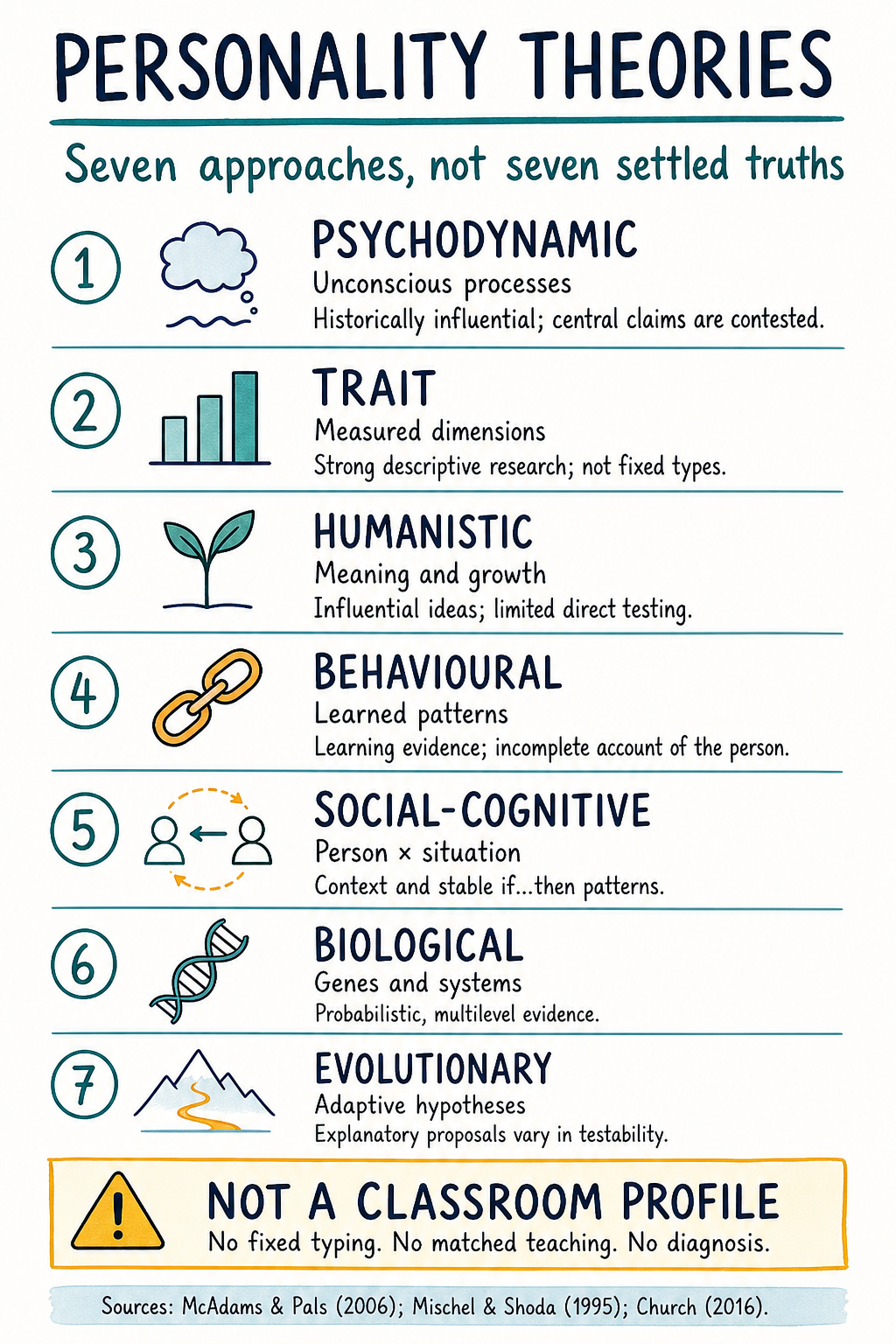
The major personality theories include psychoanalytic (Freud), trait theory (Big Five), humanistic (Maslow/Rogers), behavioural (Skinner), and cognitive approaches. Each theory offers different explanations for how personality develops and manifests, from unconscious drives to learned behaviours. These frameworks help educators understand why students behave differently and how to adapt teaching methods accordingly.

Comparison chart showing 5 personality theories and their practical teaching applications
5 Major Personality Theories: Teaching Applications

Personality psychology is a vibrant field that examines the various components of personality and how they come together to make each individual unique. Understanding personality in learning theory provides educators with crucial insights into how individual differences affect student engagement and academic success. At the heart of this study is the concept of personality, a complex construct that encompasses emotional, cognitive, and behavioural patterns that persist over time and across situations. This article aims to unravel the intricate tapestry of theories that have shaped our understanding of personality.

Key Takeaways

  1. Beyond Surface Behaviours: Why understanding Freud's unconscious mind concept transforms how you interpret pupil actions and emotional outbursts in your classroom
  2. The Big Five Advantage: How recognising personality traits helps you tailor learning approaches and predict which pupils need specific types of support
  3. Self-Actualisation in Practice: What humanistic theory reveals about motivation: why some pupils thrive whilst others plateau, despite similar abilities
  4. Cultural Identity Clash: The overlooked factor affecting BAME pupils: how personality theories built on Western values may misread collectivist family backgrounds

One of the earliest and most influential theories was proposed by Sigmund Freud, who emphasised the role of psychosexual stages in the development of personality. Freud's theory suggests that adult personality is deeply rooted in childhood experiences, highlighting how early life events can have a lasting impact on personality characteristics. His ideas, while controversial, laid the groundwork for many subsequent theories.

Comparison chart showing 5 major personality theories with founders and key focus areas
5 Personality Theories

Behavioral theory, in contrast, focuses on the role of environmental influences, positing that aspects of personality can be learned and shaped through interactions with the environment. This perspective underscores the importance of observable behaviours, rather than internal thoughts and feelings, in understanding personality.

Cognitive theory adds another dimension, emphasising how our thoughts and perceptions shape our emotional experience and behaviour. This approach suggests that our interpretation of events is as important as the events them sel ves in determining our reactions and personality traits.

Comparison chart of five personality theories showing their key principles and applications
Side-by-side comparison chart: Five Major Personality Theories Comparison

Humanistic psychologists, like Carl Rogers, offer a more optimistic view, focusing on the potential for personal growth and self-actualization. Humanistic psychology stresses the importance of individual choice and the innate drive towards personal development.

The evolutionary approach, grounded in evolutionary theory, examines personality through the lens of adaptation and survival. This perspective considers how certain traits may have been advantageous in our evolutionary past, contributing to emotional stability and other personality characteristics.

In exploring these theories, we will examine into the common factors that unite them, as well as the unique contributions each has made to our understanding of personality. By examining the diverse perspectives in personality psychology, we gain a richer, more nuanced understanding of the myriad forces that shape our personalities.

How Does Freud's Theory Explain Personality Development?

Freud's psychoanalytic theory proposes that personality develops through five psychosexual stages in childhood, with unresolved conflicts creating lasting personality traits. The theory emphasises three personality structures: the id (instincts), ego (reality), and superego (morality). Teachers can use this understanding to recognise that student behaviours may stem from unconscious motivations and early childhoodexperiences.

Freud's psychoanalytic theory is a comprehensive model that explores the human mind and behaviour. Central to this theory is the belief in the importance of the unconscious and childhood influences. Freud argued that many aspects of our thoughts, feelings, and behaviours are influenced by unconscious motives and desires, which we are not fully aware of.

According to Freud, psychosexual development is a critical aspect of personality development. He proposed five stages in this process: the oral, anal, phallic, latent, and genital stages. Each stage repre sents a different focus of pleasure and conflict, based on various erogenous zones. Successful compl etion of these stages results in a healthy, well-adjusted individual, whereas disruptions or fixations can lead to psychological issues in later life.

Freud also divided the structure of the mind into three components: the id, ego, and superego. The id represents the instinctual drives and operates on the pleasure principle, seeking immediate satisfaction without considering the consequences. The ego develops as a mediator between the id and the external world, following the reality principle. Lastly, the superego represents internalized societal values and acts as an internal moral compass.

Freud's psychoanalytic theory emphasises the significance of the unconscious mind, childhood development, and the division of personality into the id, ego, and superego. This theory provides valuable insights into human behaviour and has had a profound impact on the field of psychology.

What Are the Big Five Personality Traits?

The Big Five personality traits are Openness, Conscientiousness, Extraversion, Agreeableness, and Neuroticism (OCEAN). Research shows these traits remain relatively stable throughout life and predict academic performance, with conscientiousness being the strongest predictor of success. Teachers can use trait awareness to customise learning approaches, such as providing more structure for low-conscientiousness students.

Trait theory is a psychological perspective that suggests that personality is made up of a set of stable and enduring traits. These traits are believed to be relatively consistent across situations and over time, and they play a crucial role in shaping and influencing individual behaviour. One widely accepted model of trait theory is the Big Five, which consists of five major categories of personality traits: openness, conscientiousness, extroversion, agreeableness, and neuroticism.

Openness refers to an individual's receptiveness to new experiences, ideas, and values. High scorers in openness tend to be imaginative, creative, and curious, while low scorers lean towards tradition, routine, and practicality. Conscientiousness, on the other hand, reflects the level of self-discipline, organisation, and responsibility. Highly conscientious individuals are diligent, reliable, and achievement-oriented, whereas those with lower levels are more impulsive and disorganized.

Extroversion measures the extent to which a person seeks social stimulation and enjoys being in the company of others. Extraverts are typically outgoing, energetic, and sociable, while introverts are more reserved and prefer solitude. Agreeableness captures an individual’s inclination towards empathy, kindness, and cooperation. People high in agreeableness tend to be compassionate, friendly, and trusting, while those low in agreeableness may be competitive, skeptical, or detached.

Neuroticism is associated with emotional stability and the tendency to experience negative emotions. Individuals who score high in neuroticism often display anxiety, self-doubt, and mood swings, while low scorers are more calm, composed, and relaxed. These five traits provide a comprehensive framework to assess and describe individual differences in personality, illustrating how trait theory and the Big Five are interconnected.

Five FactorPersonality Theory" id="" width="auto" height="auto">
Five Factor Personality Theory

How Do Humanistic Theories View Personality Development?

Humanistic theories, developed by Maslow and Rogers, view personality as driven by the need for self-actualization and personal growth. They emphasise free will, personal experience, and the inherent goodness of people seeking to reach their full potential. This perspective helps teachers understand why some students thrive with autonomy while others need more guidance to develop self-confidence.

Humanistic theories of personality place a strong emphasis on free will and individual experience in the development of one's personality. According to these theories, individuals have the ability to shape their own destinies and make choices that impact their personal growth and development. This emphasis on free will suggests that individuals are not simply products of their environment or genetics, but rather active agents in creating their own unique experiences and identities.

At the heart of humanistic theories is the concept of self-actualization, which refers to the innate drive within individuals to reach their fullest potential and become the best version of themselves. Self-actualization is seen as a motivating force that propels individuals to engage in behaviours that creates personal growth, such as pursuing meaningful goals and engaging in activities that align with their values and interests. The pursuit of self-actualization is seen as a fundamental aspect of human nature and is believed to lead to increased well-being and fulfilment.

Key humanist theorists include Carl Rogers and Abraham Maslow. Rogers emphasised the importance of self-awareness, self-acceptance, and empathy in the development of one's personality. He believed that individuals have an innate capacity for growth and self-improvement, but that this growth can be hindered by conditions of worth imposed by society. Maslow, on the other hand, developed the concept of the hierarchy of needs, which identifies a series of innate needs that must be met in order for individuals to reach their full potential.

note that humanistic theories often focus on individualistic cultures, which prioritise individual rights, autonomy, and personal achievement. In contrast, collectivistic cultures place greater emphasis on communal values, group harmony, and interdependence. These cultural differences can have a significant impact on an individual's self-identity, as they shape the values, beliefs, and behaviours that are considered important and desirable.

Types of Personality Theories

How Do Behavioral Theories Explain Personality Formation?

Behavioral theories propose that personality is shaped through learning processes like conditioning and observation of others. Bandura's social learning theoryemphasises that children develop personality traits by watching and imitating role models. Teachers can apply this by modeling desired behaviours and creating environments that reinforce positive personality characteristics.

Behavioral and social learning theories are modern approaches that differ from the previous theories by incorporating cognitive processes. Unlike earlier theories that focused solely on external stimuli, these new theories recognise that internal cognitive processes play a crucial role in learning and behaviour.

One prominent figure in this field is Albert Bandura, who developed the social learning theory. Bandura proposed that learning is not only a result of direct reinforcement or punishment, but also occurs through observation and imitation of others. He argued that individuals learn from the consequences that they observe happening to others, known as vicarious reinforcement or punishment.

This theory bridges the gap between the behaviourist approach (which focuses on external factors) and the cognitive approach (which emphasises internal mental processes).

Bandura's famous Bobo Doll experiment demonstrated his social learning theory. In this study, children were exposed to an adult model who displayed either aggressive or non-aggressive behaviour towards a Bobo Doll. Bandura found that children who observed the aggressive model were more likely to imitate the aggressive behaviour, as compared to children who observed the non-aggressive model.

behavioural and social learning theories incorporate cognitive processes by acknowledging the importance of internal mental processes in learning and behaviour. Albert Bandura's social learning theory and his Bobo Doll experiment serve as key examples in understanding how individuals learn from observing others.

What Role Does Biology Play in Personality?

Biological factors including genetics, brain structure, and neurotransmitter levels significantly influence personality traits, with studies showing 40-60% heritability for major traits. Temperament differences visible in infancy often persist into adulthood as personality characteristics. Understanding biological influences helps teachers recognise that some student behaviours reflect innate tendencies rather than defiance or lack of effort.

Biological influences play a significant role in shaping an individual's personality, and genetics is a key factor in determining personality traits. Our DNA, inherited from our parents, contains the blueprints for the development of various aspects of our biology, including our personality.

Genes are responsible for coding proteins that are involved in the development of the nervous system and the functioning of neurotransmitters, which are essential for regulating mood and behaviour. As a result, genetic variations can influence an individual's predisposition towards certain personality traits.

The concept of heritability helps us understand the degree to which genetics contribute to individual differences in personality. Heritability refers to the proportion of variability in a trait that is attributed to genetic factors. Twin studies have been instrumental in unraveling the link between genetics and personality.

By comparing the similarities and differences between identical (monozygotic) twins, who share 100% of their genetic material, and fraternal (dizygotic) twins, who share just 50% of their genetic material, researchers can estimate the heritability of different personality traits. If identical twins share more similarities in a trait compared to fraternal twins, it suggests a genetic influence on that trait.

Through various twin study findings, researchers have identified specific personality traits that have a higher heritability, such as neuroticism and extraversion. These findings showcase the essential role of genetics in shaping an individual's personality.

Biological Influences on Personality

How Do Cognitive Theories Explain Personality Differences?

Cognitive theories focus on how individual differences in thinking patterns, beliefs, and information processing create distinct personalities. Personal constructs and schemas shape how people interpret experiences and respond to situations. Teachers can use cognitive approaches by helping students identify and modify unhelpful thought patterns that affect their learning and behaviour.

Cognitive approaches to personality focus on the role of internal thoughts, beliefs, and cognitive processes in shaping an individual's personality. These theories emphasise that personality is not solely determined by external factors, but is also influenced by the way a person thinks, perceives, and interprets the world around them.

Cognitive theorists, such as Albert Bandura, emphasise the importance of individuals' perceptions, interpretations, and attributions in their behaviour and personality development. According to Bandura's social cognitive theory, people's thoughts and beliefs about themselves and the world play a critical role in determining how they behave and develop their personality.

For example, if someone has a positive self-perception and believes that they are capable of succeeding in a particular task, they are more likely to engage in behaviours that will lead to success. On the other hand, if someone has a negative self-perception and doubts their abilities, they are more likely to engage in behaviours that will lead to failure or avoidance.

Cognitive theorists also highlight the role of cognitive processes such as attention, memory, and problem-solving in shaping personality. These processes influence how individuals perceive and interpret information, which in turn affects their behaviour and personality development.

What Are Eysenck's Three Personality Dimensions?

Eysenck proposed three fundamental personality dimensions: extraversion-introversion, neuroticism-stability, and psychoticism-normality. His theory links these dimensions to biological factors like arousal levels and genetic inheritance. Teachers can use this framework to understand why introverted students may need quiet spaces while extroverted students thrive in group work.

Eysenck's Personality Theory, developed by Hans Eysenck, provides a comprehensive understanding of human personality through the identification of three major dimensions: extraversion-introversion, neuroticism-emotional stability, and psychoticism.

By exploring these dimensions, Eysenck's theory aims to explain individual differences in behaviour, emotion, cognition, and their underlying biological processes. This theory suggests that personality traits are largely inherited and influenced by genetics, forming a stable and consistent pattern of behaviour throughout a person's life.

Eysenck's Personality Theory has provided significant insights into various aspects of personality, impacting fields such as psychology, education, and organisational behaviour. This guide will examine into each dimension of Eysenck's theory, examine its impact on personality traits and characteristics, and discuss the strengths and criticisms associated with this influential perspective on personality.

Introvert Extrovert Personality Theory

Extraversion and Introversion

Extraversion and introversion are two fundamental personality traits that capture different ways in which individuals engage with the world around them. These concepts, popularized by Swiss psychiatrist Carl Jung, represent the two ends of a continuum along which people can be classified.

Extraverts are characterised by a preference for external stimuli and social interaction. They feel energized by being around people and tend to seek out social situations. Extraverts are typically outgoing, talkative, and expressive. They enjoy being the center of attention and engage in small talk easily. In terms of emotional expression, extraverts often display their emotions openly and are more likely to be extroverted in their behaviour. When it comes to response to stimulation, extraverts typically require higher levels of external stimulation to feel satisfied and engaged.

On the other hand, introverts are more focused on their internal world. They draw their energy from solitude and introspection and often feel drained by excessive social interaction. Introverts are generally seen as reserved and quiet, preferring to spend time alone or with a close-knit circle of friends.

They tend to think deeply before speaking and may find small talk tiring. When it comes to emotional expression, introverts are more likely to keep their feelings hidden and prefer to share them with only a few trusted individuals. In terms of response to stimulation, introverts tend to be more sensitive to external stimuli and may become overwhelmed by excessive noise, crowds, or other forms of stimulation.

Introvert and Extrovert

Neuroticism and Stability

Neuroticism is a personality trait characterised by emotional instability, anxiety, and a tendency to overreact to stimuli. Individuals high in neuroticism have a highly reactive sympathetic nervous system, which means they often respond to even minor stressors with an intense level of emotional arousal. This can lead to a range of negative emotions such as fear, worry, and sadness, and they may find it difficult to calm down once upset.

In contrast, stability is associated with a less reactive nervous system. Individuals who are low in neuroticism tend to have a calm and level-headed response to stressful situations. They are better able to regulate their emotions and stay composed in the face of adversity. Because of this, they are generally more resilient and better able to cope with life's ups and downs.

The main difference between neuroticism and stability lies in how individuals react to external stimuli and their ability to control their emotions. Neurotic individuals are more likely to overreact and experience intense emotional arousal in response to stressors, whereas stable individuals are better able to maintain emotional balance and remain calm.

Understanding the relationship between neuroticism and stability is crucial for both individuals and psychologists. By recognising and understanding their own level of neuroticism and stability, individuals can better manage their emotions and develop effective coping mechanisms.

Psychologists can also utilise this knowledge to create interventions and therapies to help individuals with high neuroticism levels learn ways to regulate and calm their reactive sympathetic nervous system. Overall, the relationship between neuroticism and stability highlights the importance of emotional regulation and self-awareness in maintaining mental well-being.

Neuroticism
Neuroticism

Psychoticism and Normality

Psychoticism is a personality trait that refers to a dimension of human behaviour characterised by aggression, lack of empathy, and social detachment. It is one of the three traits proposed in Eysenck's personality model, along with extraversion and neuroticism. Understanding psychoticism involves considering its relationship with normality.

In terms of normality, individuals with lower levels of psychoticism are generally perceived as "normal" because they exhibit empathy, show concern for others, and maintain harmonious social relationships.

They are more inclined to experience and express emotions, have a sense of responsibility, and engage in activities that benefit both themselves and society. On the other hand, higher levels of psychoticism are associated with a deviation from the norm, as individuals may display anti-social tendencies, demonstrate callousness towards others' feelings, and exhibit aggressive behaviours.

The dimensions of psychoticism highlight the traits associated with it. Lack of empathy is considered a defining characteristic, as individuals with high psychoticism tend to disregard and neglect the emotions and needs of others.

Aggression is also a significant feature, often manifested through hostility, dominance, and an inclination towards violence. Furthermore, the loner aspect emphasises the preference for solitude over social interactions, illustrating the detachment and seclusion commonly observed in individuals scoring high on psychoticism.

It is worth noting that psychoticism has been found to have a connection with testosterone, a hormone predominantly present in men. Several studies have established a positive correlation between higher testosterone levels and increased levels of psychoticism, particularly related to aggressive and anti-social behaviours. However, understand that while psychoticism may be influenced by testosterone levels, it should not be mistaken as a direct indicator of mental illness or psychopathy.

Below is a table that compares and contrasts various approaches to personality theories, highlighting their evolution over time.

Approach Key Proponents Core Ideas Evolution Over Time
Psychoanalytic Theory Sigmund Freud, Carl Jung, Alfred Adler Focuses on unconscious motivations and early childhood experiences. Emphasizes psychosexual stages and defense mechanisms. Evolved with neo-Freudian theories, incorporating social and cultural factors, moving beyond Freud's initial focus on sexuality.
Trait Theory Gordon Allport, Raymond Cattell, Hans Eysenck, The Big Five Concentrates on identifying and measuring individual personality traits. Emphasizes the stability of traits over time. Progressed from early attempts to list traits to sophisticated models like the Big Five, incorporating biological and genetic research.
Behavioral Theory B.F. Skinner, John Watson Views personality as a result of learned behaviour patterns based on a person's environment. Rejects internal thoughts and focuses on observable behaviours. Expanded to include social learning theory (Bandura), emphasising observational learning and cognitive processes.
Humanistic Psychology Carl Rogers, Abraham Maslow Emphasizes individual growth and potential, self-actualization, and subjective experience. Focuses on conscious feelings and the individual's view of the world. Influenced positive psychology, emphasising well-being and personal fulfilment. Expanded to include multicultural perspectives.
Cognitive Theory George Kelly, Aaron Beck, Albert Ellis Highlights how personal beliefs, perceptions, and thoughts influence personality. Focuses on individual cognitive processes. Integrated with neuroscience, leading to cognitive-behavioural approaches that consider thought patterns in personality and psychopathology.
Evolutionary Psychology David Buss, Leda Cosmides, John Tooby Applies evolutionary theory to understand the development of personality traits. Focuses on adaptation, survival, and reproductive success. Gained prominence in recent decades, incorporating genetics and cross-cultural studies to understand universal traits and behaviours.

How Do Researchers Study Personality Theories?

Researchers study personality through methods including longitudinal studies, twin studies, behavioural observations, and standardised assessments. Modern approaches combine self-reports with biological measures like brain imaging and genetic analysis. These research methods help validate which aspects of personality theories accurately predict real-world behaviours and outcomes.

Studying theories of personality aims to provide a deeper understanding of the complexities of human behaviour and individual differences. By exploring the various theoretical frameworks, researchers and psychologists seek to unravel the mysteries behind why individuals think, feel, and behave in unique ways.

These theories offer insights into the fundamental aspects of personality development, including the roles of genetics, environment, and societal influences. Moreover, studying theories of personality enables professionals to develop models and frameworks that can be applied in various contexts such as clinical psychology, counseling, and career counseling.

Through this exploration, individuals gain a broader perspective on human nature and the intricate interplay between personality traits, emotions, and behaviour, ultimately contributing to the advancement of psychology and the betterment of society.


Clinical Research

Clinical research plays a vital role in understanding personality theories, particularly when studying individuals with abnormal behaviour. Personality theories aim to explain the unique patterns of thoughts, emotions, and behaviours exhibited by individuals. However, personalities can be complex, subjective, and multifaceted, making research in this field challenging.

Clinical research provides a systematic approach to investigate abnormal behaviour and its relation to personality theories. By utilising standardised diagnostic tools, such as the Diagnostic and Statistical Manual of Mental Disorders (DSM), researchers can identify and classify different psychological disorders. This allows for the study of specific abnormal behaviour patterns, which can then be analysed in relation to various personality theories.

The subjective nature of personality theories is another aspect that clinical research addresses. Researchers utilise various methods to assess subjective experiences, such as interviews, questionnaires, and self-report measures.

By incorporating these subjective measures into their studies, researchers can gather valuable insights into the unique perceptions and interpretations of individuals with abnormal behaviour. This helps in understanding how personality traits, such as neuroticism or introversion, may interact with abnormal behaviour.


Case Studies

Case studies involve an in-depth analysis of an individual or a small group in order to gain a detailed understanding of a particular phenomenon or situation. Researchers often rely on self-report methods to collect data, such as interviews, questionnaires, and personal documents. These methods allow researchers to obtain rich and detailed information about the experiences, thoughts, and behaviours of the participants.

However, case studies have limitations in terms of subjectivity and generalizability. The reliance on observer interpretations is one of the main challenges. Researchers must interpret and analyse the data, which introduces subjectivity. This subjectivity can be influenced by the researcher's biases, beliefs, or preconceptions, leading to potential misinterpretations or information that may not accurately represent the participants' experiences.

Additionally, generalizability is a concern in case studies. Since case studies focus on a small sample size or even a single individual, it is difficult to generalise the findings to larger populations. The unique characteristics and experiences of the participants may limit the ability to draw broad conclusions about a larger group.

Furthermore, individual memory can be fallible, which can affect the accuracy and reliability of the data collected in case studies. Participants may forget or misremember specific details or events, leading to inaccuracies in the research findings.

Personality Diagram
Personality Diagram

Experimental Methods

Experimental methods are widely used in studying personality, motivations, emotions, and drives. These methods involve the manipulation of variables and the contr ol of extraneous factors to determine cause-and-effect relationships.

One common experimental method used in studying personality is the use of surveys or questionnaires. These instruments allow researchers to gather data on individuals' personality traits, motivations, and emotions. By administering these surveys to a large sample, researchers can identify patterns and trends in how personality traits relate to motivations, emotions, and drives.

Another experimental method used is laboratory experiments. In these experiments, participants are exposed to specific stimuli or situations to observe their reactions and behaviour. For example, researchers might expose participants to various emotional stimuli to examine their emotional responses. Through careful control of variables, researchers can determine the causal relationship between specific stimuli and emotional reactions.

Neuroscientific methods, such as brain imaging techniques like functional magnetic resonance imaging (fMRI), are also used to study personality, motivations, emotions, and drives. These methods allow researchers to observe how different brain areas are associated with specific personality traits, motivations, and emotional responses. By measuring brain activity, researchers can gain insights into the neural mechanisms underlying these psychological phenomena.

experimental methods are crucial in studying personality, motivations, emotions, and drives. Surveys, laboratory experiments, and neuroscientific techniques provide researchers with valuable data to understand the complexities of human behaviour and the underlying psychological processes. These methods allow for the exploration of cause-and-effect relationships, providing deeper insights into our understanding of personality and its various dimensions.

How Are Personality Traits Measured and Assessed?

Personality assessment uses tools like questionnaires (NEO-PI-R), projective tests (Rorschach), and behavioural observations to measure traits. Valid assessments require reliability, standardisation, and evidence of predictive validity for real-world outcomes. Teachers should understand that while assessments provide insights, they represent tendencies rather than fixed characteristics.

Personality assessment and measurement are vital components in understanding an individual's unique characteristics and traits. By studying and analysing various aspects of a person's personality, psychologists can gain insights into their behaviours, motivations, and overall psychological functioning.

There are several methods and tools used to assess and measure personality. One commonly used approach is self-report personality inventories, which consist of a series of questions that individuals answer about themselves. These inventories, such as the Myers-Briggs Type Indicator (MBTI) or the NEO Personality Inventory, provide standardised ways to measure different dimensions of personality, such as extraversion, agreeableness, or openness to experience.

Objective tests are another method used in personality assessment. These tests typically involve multiple-choice questions or rating scales and aim to assess specific personality traits or characteristics objectively. Popular objective tests include the Minnesota Multiphasic Personality Inventory (MMPI) and the Sixteen Personality Factor Questionnaire (16PF).

In contrast, projective tests, such as the Rorschach inkblot test and the Thematic Apperception Test (TAT), rely on individuals' interpretations of ambiguous stimuli. These tests aim to reveal unconscious or hidden aspects of an individual's personality, providing insights into their thoughts, emotions, and motivations.

Hermann Rorschach, a Swiss psychiatrist, developed the Rorschach inkblot test, which became one of the most widely used projective tests in psychology. Henry Murray, an American psychologist, contributed to personality assessment through his development of the TAT and his research on personality needs and motivations.


What Are the Main Problems with Validating Personality Theories?

Key validation issues include cultural bias in Western-developed theories, difficulty measuring unconscious processes, and the challenge of separating nature from nurture. Self-report measures suffer from social desirability bias, while behavioural observations may not capture internal experiences. These limitations mean teachers should use personality theories as guides rather than definitive explanations for student behaviour.

Personality psychology, a field dedicated to understanding the elements of personality and their influence on behaviour, faces several challenges in theory validation. These challenges stem from the complexity of personality itself and the diverse approaches used to study it.

  1. Subjectivity in Theoretical Constructs: Many personality theories, especially psychodynamic theories, rely on subjective interpretations. This subjectivity can lead to biases and difficulties in empirical testing.
  2. Cultural Bias: Theories like Freudian theory, developed primarily by American psychologists, often reflect cultural biases. This limits their applicability across diverse populations.
  3. Operationalization of Constructs: Translating abstract concepts like 'anxiety drive' or 'basic hostility' from Humanist theories into measurable variables is challenging, impacting the validity of research findings.
  4. Reliability of Measurement Tools: Tools used to measure personality traits, such as questionnaires, can vary in reliability. Inconsistent responses over time can question the stability of the personality traits being measured.
  5. Overemphasis on Certain Drives: Some theories, like the drive theory, heavily focus on specific drives like sexual or primary drive, potentially overlooking other important aspects of personality.
  6. Complexity of Environmental Influences: Theories often struggle to adequately account for the vast range of environmental influences, from family dynamics to broader cultural contexts, and their impact on the development of personality.
  7. Genetic vs. Environmental Contributions: While twin studies have helped understand the genetic basis of personality, disentangling the precise contributions of genetics and environment remains complex.
  8. Integration of Different Theories: Integrating insights from various approaches, such as combining elements of cognitive personality theory with the evolutionary approach, is challenging but necessary for a complete understanding.
  9. Predictive Power: A key issue is how well personality theories can predict behaviour. Correlations in personality traits do not always translate into predictable behaviours in different contexts.

While personality theories provide valuable insights into human behaviour, their validation is hindered by issues of subjectivity, cultural bias, operationalization challenges, and the complexity of integrating various environmental and genetic influences. These challenges underscore the need for ongoing research and refinement in the field of personality psychology.


Which Research Papers Are Essential for Understanding Personality Theory?

Foundational papers include Costa and McCrae's work on the Five-Factor Model, Bandura's social cognitive theory studies, and Mischel's person-situation debate research. Recent meta-analyses by Roberts demonstrate personality change across lifespan and links to life outcomes. These papers provide evidence-based insights teachers can apply to understand student personality development.

These studies collectively provide a diverse and in-depth view of personality theory, ranging from foundational models to novel approaches in understanding personality traits and their impact on various life outcomes.

1. Personality: Definitions, Approaches, and Theories

Author: E. Piechurska-Kuciel (2020)

Summary: This study emphasises the two main trends in personality psychology: type theories and trait theories. It highlights the Big Five trait model as the foundational basis for this volume of research, offering a comprehensive look at the different approaches and definitions within the field of personality psychology.

2. Major personality traits that relate to the life outcomes of an individual in the Big Five theory of personality

Author: Daudi Mika Mungure (2021)

Summary: This paper reviews the major personality traits like conscientiousness, openness, agreeableness, and neuroticism, as related to life outcomes like educational achievement and job performance. It also considers other influencing factors such as income, health, and education.

3. Personality and the conduct of everyday life

Author: O. Dreĭer (2011)

Summary: This paper presents a unique theory of personhood based on how individuals conduct their everyday lives. It aims to address core issues in current personality research and enrich our understanding of psychological interventions.

4. Theories of Personality

Authors: Jess Feist and Gregory J. Feist (1991)

Summary: This study focuses on the Post-Freudian Theory, particularly the role of the ego in the development of personality. It expands on Freud's original concept of humanity and its influence on personality formation.

5. Personality Science: Exploring Boldly, Integrating Creatively

Author: B. Little (2010)

Summary: This paper advocates for a bold exploration and creative integration in the study of personality science. It emphasises the importance of understanding human nature, variability, and individuality in personality research.

Frequently Asked Questions

What are the five major personality theories that educators should understand?

The five major personality theories are psychoanalytic (Freud), trait theory (Big Five), humanistic (Maslow/Rogers), behavioural (Skinner), and cognitive approaches. Each theory offers different explanations for personality development, from unconscious drives to learned behaviours, helping educators understand why pupils behave differently and how to adapt teaching methods accordingly.

How can understanding Freud's theory help teachers interpret pupil behaviour in the classroom?

Freud's theory suggests that pupil behaviours may stem from unconscious motivations and early childhood experiences rather than surface-level issues. Teachers can use this understanding to recognise that emotional outbursts or challenging behaviours might have deeper psychological roots, allowing for more empathetic and effective responses to pupil needs.

Which of the Big Five personality traits is most important for academic success?

Conscientiousness is the strongest predictor of academic success amongst the Big Five traits (Openness, Conscientiousness, Extraversion, Agreeableness, and Neuroticism). Teachers can use this knowledge to provide additional structure and support for pupils who score low in conscientiousness, helping them develop better organisation and self-discipline skills.

How can humanistic theory explain why some pupils thrive whilst others plateau despite similar abilities?

Humanistic theory focuses on self-actualisation and individual potential for personal growth, suggesting that pupils' motivation levels vary based on their sense of personal choice and innate drive for development. This explains why some pupils with similar abilities may perform differently, as their internal motivation and sense of autonomy can significantly impact their academic progress.

What challenges might arise when applying Western-based personality theories to pupils from diverse cultural backgrounds?

Personality theories built on Western values may misinterpret behaviours of pupils from collectivist family backgrounds, particularly affecting BAME pupils whose cultural identity may clash with individualistic assumptions. Teachers need to consider cultural context when applying these theories, as behaviours that seem problematic through one lens may be culturally appropriate responses.

How can teachers practically use the Big Five personality traits to customise their teaching approaches?

Teachers can tailor learning approaches by recognising pupils' personality traits, such as providing more structured environments for low-conscientiousness students or offering varied experiences for those high in openness. Understanding these stable traits helps predict which pupils need specific types of support and allows for more personalised teaching strategies.

What is the key difference between behavioural and cognitive approaches to understanding pupil personality?

Behavioural theory focuses on environmental influences and observable behaviours that can be learned and shaped through interactions, whilst cognitive theory emphasises how thoughts and perceptions shape emotional experiences and behaviour. This means behavioural approaches look at external factors affecting pupils, whereas cognitive approaches examine how pupils interpret and process their experiences internally.

Further Reading: Key Research Papers

These peer-reviewed studies provide deeper insights into personality theories and its application in educational settings.

Modeling the relationship between classroom emotions, motivation, and learner willingness to communicate in EFL: applying a complete approach of positive psychology in SLA research View study ↗96 citations

Alrabai et al. (2022)

This study examines how classroom emotions and motivation influence English language learners' willingness to communicate, using positive psychology principles to understand these relationships. Teachers can use these findings to recognise how students' emotional states and personality traits affect their participation in language learning activities and create more supportive classroom environments.

Blending Teacher Autonomy Support and Provision of Structure in the Classroom for Optimal Motivation: A Systematic Review and Meta-Analysis View study ↗12 citations

This meta-analysis investigates how teachers can optimally combine autonomy support (giving students choice and control) with structured guidance to maximise student motivation. The research provides evidence-based strategies for teachers to balance freedom and structure in their classrooms, helping them understand how different personality types may respond to various teaching approaches.

Individual Differences in the Speaking Classroom of English as a Foreign Language: Why Personality Traits, Willingness to Communicate, Self-Efficacy, and Learning Preferences Matter? View study ↗1 citations

Koné et al. (2024)

This research explores how individual personality traits, self-efficacy, and learning preferences affect English language learners' speaking performance and willingness to communicate in classroom settings. Teachers can apply these insights to better understand why some students participate more actively in speaking activities and how to adapt instruction to accommodate different personality types and learning styles.

Teaching Efficacy and Enneagram Personality Types: A Correlational Study Among Pre-Service Early Childhood Educators in Quezon City University View study ↗

This study examines the relationship between Enneagram personality types and teaching effectiveness among future early childhood educators, exploring how different personality patterns relate to confidence in teaching abilities. The findings help current teachers understand how their own personality traits may influence their teaching efficacy and provide insights for professional development and self-reflection.

Inspecting How Different Students’ Personalities Affect Students' Performance in Calculus Practicum Courses Utilizing Peer Teaching Flipped Classroom Model View study ↗1 citations

Ramadoni et al. (2023)

This research investigates how different student personality types perform in calculus courses that use peer teaching and flipped classroom methods. Teachers can use these findings to understand how personality differences affect student success with collaborative learning approaches and adjust their instructional strategies to better support students with varying personality traits.

Loading audit...

What Are the Major Personality Theories in Psychology?

The major personality theories include psychoanalytic (Freud), trait theory (Big Five), humanistic (Maslow/Rogers), behavioural (Skinner), and cognitive approaches. Each theory offers different explanations for how personality develops and manifests, from unconscious drives to learned behaviours. These frameworks help educators understand why students behave differently and how to adapt teaching methods accordingly.

Comparison chart showing 5 personality theories and their practical teaching applications
5 Major Personality Theories: Teaching Applications

Personality psychology is a vibrant field that examines the various components of personality and how they come together to make each individual unique. Understanding personality in learning theory provides educators with crucial insights into how individual differences affect student engagement and academic success. At the heart of this study is the concept of personality, a complex construct that encompasses emotional, cognitive, and behavioural patterns that persist over time and across situations. This article aims to unravel the intricate tapestry of theories that have shaped our understanding of personality.

Key Takeaways

  1. Beyond Surface Behaviours: Why understanding Freud's unconscious mind concept transforms how you interpret pupil actions and emotional outbursts in your classroom
  2. The Big Five Advantage: How recognising personality traits helps you tailor learning approaches and predict which pupils need specific types of support
  3. Self-Actualisation in Practice: What humanistic theory reveals about motivation: why some pupils thrive whilst others plateau, despite similar abilities
  4. Cultural Identity Clash: The overlooked factor affecting BAME pupils: how personality theories built on Western values may misread collectivist family backgrounds

One of the earliest and most influential theories was proposed by Sigmund Freud, who emphasised the role of psychosexual stages in the development of personality. Freud's theory suggests that adult personality is deeply rooted in childhood experiences, highlighting how early life events can have a lasting impact on personality characteristics. His ideas, while controversial, laid the groundwork for many subsequent theories.

Comparison chart showing 5 major personality theories with founders and key focus areas
5 Personality Theories

Behavioral theory, in contrast, focuses on the role of environmental influences, positing that aspects of personality can be learned and shaped through interactions with the environment. This perspective underscores the importance of observable behaviours, rather than internal thoughts and feelings, in understanding personality.

Cognitive theory adds another dimension, emphasising how our thoughts and perceptions shape our emotional experience and behaviour. This approach suggests that our interpretation of events is as important as the events them sel ves in determining our reactions and personality traits.

Comparison chart of five personality theories showing their key principles and applications
Side-by-side comparison chart: Five Major Personality Theories Comparison

Humanistic psychologists, like Carl Rogers, offer a more optimistic view, focusing on the potential for personal growth and self-actualization. Humanistic psychology stresses the importance of individual choice and the innate drive towards personal development.

The evolutionary approach, grounded in evolutionary theory, examines personality through the lens of adaptation and survival. This perspective considers how certain traits may have been advantageous in our evolutionary past, contributing to emotional stability and other personality characteristics.

In exploring these theories, we will examine into the common factors that unite them, as well as the unique contributions each has made to our understanding of personality. By examining the diverse perspectives in personality psychology, we gain a richer, more nuanced understanding of the myriad forces that shape our personalities.

How Does Freud's Theory Explain Personality Development?

Freud's psychoanalytic theory proposes that personality develops through five psychosexual stages in childhood, with unresolved conflicts creating lasting personality traits. The theory emphasises three personality structures: the id (instincts), ego (reality), and superego (morality). Teachers can use this understanding to recognise that student behaviours may stem from unconscious motivations and early childhoodexperiences.

Freud's psychoanalytic theory is a comprehensive model that explores the human mind and behaviour. Central to this theory is the belief in the importance of the unconscious and childhood influences. Freud argued that many aspects of our thoughts, feelings, and behaviours are influenced by unconscious motives and desires, which we are not fully aware of.

According to Freud, psychosexual development is a critical aspect of personality development. He proposed five stages in this process: the oral, anal, phallic, latent, and genital stages. Each stage repre sents a different focus of pleasure and conflict, based on various erogenous zones. Successful compl etion of these stages results in a healthy, well-adjusted individual, whereas disruptions or fixations can lead to psychological issues in later life.

Freud also divided the structure of the mind into three components: the id, ego, and superego. The id represents the instinctual drives and operates on the pleasure principle, seeking immediate satisfaction without considering the consequences. The ego develops as a mediator between the id and the external world, following the reality principle. Lastly, the superego represents internalized societal values and acts as an internal moral compass.

Freud's psychoanalytic theory emphasises the significance of the unconscious mind, childhood development, and the division of personality into the id, ego, and superego. This theory provides valuable insights into human behaviour and has had a profound impact on the field of psychology.

What Are the Big Five Personality Traits?

The Big Five personality traits are Openness, Conscientiousness, Extraversion, Agreeableness, and Neuroticism (OCEAN). Research shows these traits remain relatively stable throughout life and predict academic performance, with conscientiousness being the strongest predictor of success. Teachers can use trait awareness to customise learning approaches, such as providing more structure for low-conscientiousness students.

Trait theory is a psychological perspective that suggests that personality is made up of a set of stable and enduring traits. These traits are believed to be relatively consistent across situations and over time, and they play a crucial role in shaping and influencing individual behaviour. One widely accepted model of trait theory is the Big Five, which consists of five major categories of personality traits: openness, conscientiousness, extroversion, agreeableness, and neuroticism.

Openness refers to an individual's receptiveness to new experiences, ideas, and values. High scorers in openness tend to be imaginative, creative, and curious, while low scorers lean towards tradition, routine, and practicality. Conscientiousness, on the other hand, reflects the level of self-discipline, organisation, and responsibility. Highly conscientious individuals are diligent, reliable, and achievement-oriented, whereas those with lower levels are more impulsive and disorganized.

Extroversion measures the extent to which a person seeks social stimulation and enjoys being in the company of others. Extraverts are typically outgoing, energetic, and sociable, while introverts are more reserved and prefer solitude. Agreeableness captures an individual’s inclination towards empathy, kindness, and cooperation. People high in agreeableness tend to be compassionate, friendly, and trusting, while those low in agreeableness may be competitive, skeptical, or detached.

Neuroticism is associated with emotional stability and the tendency to experience negative emotions. Individuals who score high in neuroticism often display anxiety, self-doubt, and mood swings, while low scorers are more calm, composed, and relaxed. These five traits provide a comprehensive framework to assess and describe individual differences in personality, illustrating how trait theory and the Big Five are interconnected.

Five FactorPersonality Theory" id="" width="auto" height="auto">
Five Factor Personality Theory

How Do Humanistic Theories View Personality Development?

Humanistic theories, developed by Maslow and Rogers, view personality as driven by the need for self-actualization and personal growth. They emphasise free will, personal experience, and the inherent goodness of people seeking to reach their full potential. This perspective helps teachers understand why some students thrive with autonomy while others need more guidance to develop self-confidence.

Humanistic theories of personality place a strong emphasis on free will and individual experience in the development of one's personality. According to these theories, individuals have the ability to shape their own destinies and make choices that impact their personal growth and development. This emphasis on free will suggests that individuals are not simply products of their environment or genetics, but rather active agents in creating their own unique experiences and identities.

At the heart of humanistic theories is the concept of self-actualization, which refers to the innate drive within individuals to reach their fullest potential and become the best version of themselves. Self-actualization is seen as a motivating force that propels individuals to engage in behaviours that creates personal growth, such as pursuing meaningful goals and engaging in activities that align with their values and interests. The pursuit of self-actualization is seen as a fundamental aspect of human nature and is believed to lead to increased well-being and fulfilment.

Key humanist theorists include Carl Rogers and Abraham Maslow. Rogers emphasised the importance of self-awareness, self-acceptance, and empathy in the development of one's personality. He believed that individuals have an innate capacity for growth and self-improvement, but that this growth can be hindered by conditions of worth imposed by society. Maslow, on the other hand, developed the concept of the hierarchy of needs, which identifies a series of innate needs that must be met in order for individuals to reach their full potential.

note that humanistic theories often focus on individualistic cultures, which prioritise individual rights, autonomy, and personal achievement. In contrast, collectivistic cultures place greater emphasis on communal values, group harmony, and interdependence. These cultural differences can have a significant impact on an individual's self-identity, as they shape the values, beliefs, and behaviours that are considered important and desirable.

Types of Personality Theories

How Do Behavioral Theories Explain Personality Formation?

Behavioral theories propose that personality is shaped through learning processes like conditioning and observation of others. Bandura's social learning theoryemphasises that children develop personality traits by watching and imitating role models. Teachers can apply this by modeling desired behaviours and creating environments that reinforce positive personality characteristics.

Behavioral and social learning theories are modern approaches that differ from the previous theories by incorporating cognitive processes. Unlike earlier theories that focused solely on external stimuli, these new theories recognise that internal cognitive processes play a crucial role in learning and behaviour.

One prominent figure in this field is Albert Bandura, who developed the social learning theory. Bandura proposed that learning is not only a result of direct reinforcement or punishment, but also occurs through observation and imitation of others. He argued that individuals learn from the consequences that they observe happening to others, known as vicarious reinforcement or punishment.

This theory bridges the gap between the behaviourist approach (which focuses on external factors) and the cognitive approach (which emphasises internal mental processes).

Bandura's famous Bobo Doll experiment demonstrated his social learning theory. In this study, children were exposed to an adult model who displayed either aggressive or non-aggressive behaviour towards a Bobo Doll. Bandura found that children who observed the aggressive model were more likely to imitate the aggressive behaviour, as compared to children who observed the non-aggressive model.

behavioural and social learning theories incorporate cognitive processes by acknowledging the importance of internal mental processes in learning and behaviour. Albert Bandura's social learning theory and his Bobo Doll experiment serve as key examples in understanding how individuals learn from observing others.

What Role Does Biology Play in Personality?

Biological factors including genetics, brain structure, and neurotransmitter levels significantly influence personality traits, with studies showing 40-60% heritability for major traits. Temperament differences visible in infancy often persist into adulthood as personality characteristics. Understanding biological influences helps teachers recognise that some student behaviours reflect innate tendencies rather than defiance or lack of effort.

Biological influences play a significant role in shaping an individual's personality, and genetics is a key factor in determining personality traits. Our DNA, inherited from our parents, contains the blueprints for the development of various aspects of our biology, including our personality.

Genes are responsible for coding proteins that are involved in the development of the nervous system and the functioning of neurotransmitters, which are essential for regulating mood and behaviour. As a result, genetic variations can influence an individual's predisposition towards certain personality traits.

The concept of heritability helps us understand the degree to which genetics contribute to individual differences in personality. Heritability refers to the proportion of variability in a trait that is attributed to genetic factors. Twin studies have been instrumental in unraveling the link between genetics and personality.

By comparing the similarities and differences between identical (monozygotic) twins, who share 100% of their genetic material, and fraternal (dizygotic) twins, who share just 50% of their genetic material, researchers can estimate the heritability of different personality traits. If identical twins share more similarities in a trait compared to fraternal twins, it suggests a genetic influence on that trait.

Through various twin study findings, researchers have identified specific personality traits that have a higher heritability, such as neuroticism and extraversion. These findings showcase the essential role of genetics in shaping an individual's personality.

Biological Influences on Personality

How Do Cognitive Theories Explain Personality Differences?

Cognitive theories focus on how individual differences in thinking patterns, beliefs, and information processing create distinct personalities. Personal constructs and schemas shape how people interpret experiences and respond to situations. Teachers can use cognitive approaches by helping students identify and modify unhelpful thought patterns that affect their learning and behaviour.

Cognitive approaches to personality focus on the role of internal thoughts, beliefs, and cognitive processes in shaping an individual's personality. These theories emphasise that personality is not solely determined by external factors, but is also influenced by the way a person thinks, perceives, and interprets the world around them.

Cognitive theorists, such as Albert Bandura, emphasise the importance of individuals' perceptions, interpretations, and attributions in their behaviour and personality development. According to Bandura's social cognitive theory, people's thoughts and beliefs about themselves and the world play a critical role in determining how they behave and develop their personality.

For example, if someone has a positive self-perception and believes that they are capable of succeeding in a particular task, they are more likely to engage in behaviours that will lead to success. On the other hand, if someone has a negative self-perception and doubts their abilities, they are more likely to engage in behaviours that will lead to failure or avoidance.

Cognitive theorists also highlight the role of cognitive processes such as attention, memory, and problem-solving in shaping personality. These processes influence how individuals perceive and interpret information, which in turn affects their behaviour and personality development.

What Are Eysenck's Three Personality Dimensions?

Eysenck proposed three fundamental personality dimensions: extraversion-introversion, neuroticism-stability, and psychoticism-normality. His theory links these dimensions to biological factors like arousal levels and genetic inheritance. Teachers can use this framework to understand why introverted students may need quiet spaces while extroverted students thrive in group work.

Eysenck's Personality Theory, developed by Hans Eysenck, provides a comprehensive understanding of human personality through the identification of three major dimensions: extraversion-introversion, neuroticism-emotional stability, and psychoticism.

By exploring these dimensions, Eysenck's theory aims to explain individual differences in behaviour, emotion, cognition, and their underlying biological processes. This theory suggests that personality traits are largely inherited and influenced by genetics, forming a stable and consistent pattern of behaviour throughout a person's life.

Eysenck's Personality Theory has provided significant insights into various aspects of personality, impacting fields such as psychology, education, and organisational behaviour. This guide will examine into each dimension of Eysenck's theory, examine its impact on personality traits and characteristics, and discuss the strengths and criticisms associated with this influential perspective on personality.

Introvert Extrovert Personality Theory

Extraversion and Introversion

Extraversion and introversion are two fundamental personality traits that capture different ways in which individuals engage with the world around them. These concepts, popularized by Swiss psychiatrist Carl Jung, represent the two ends of a continuum along which people can be classified.

Extraverts are characterised by a preference for external stimuli and social interaction. They feel energized by being around people and tend to seek out social situations. Extraverts are typically outgoing, talkative, and expressive. They enjoy being the center of attention and engage in small talk easily. In terms of emotional expression, extraverts often display their emotions openly and are more likely to be extroverted in their behaviour. When it comes to response to stimulation, extraverts typically require higher levels of external stimulation to feel satisfied and engaged.

On the other hand, introverts are more focused on their internal world. They draw their energy from solitude and introspection and often feel drained by excessive social interaction. Introverts are generally seen as reserved and quiet, preferring to spend time alone or with a close-knit circle of friends.

They tend to think deeply before speaking and may find small talk tiring. When it comes to emotional expression, introverts are more likely to keep their feelings hidden and prefer to share them with only a few trusted individuals. In terms of response to stimulation, introverts tend to be more sensitive to external stimuli and may become overwhelmed by excessive noise, crowds, or other forms of stimulation.

Introvert and Extrovert

Neuroticism and Stability

Neuroticism is a personality trait characterised by emotional instability, anxiety, and a tendency to overreact to stimuli. Individuals high in neuroticism have a highly reactive sympathetic nervous system, which means they often respond to even minor stressors with an intense level of emotional arousal. This can lead to a range of negative emotions such as fear, worry, and sadness, and they may find it difficult to calm down once upset.

In contrast, stability is associated with a less reactive nervous system. Individuals who are low in neuroticism tend to have a calm and level-headed response to stressful situations. They are better able to regulate their emotions and stay composed in the face of adversity. Because of this, they are generally more resilient and better able to cope with life's ups and downs.

The main difference between neuroticism and stability lies in how individuals react to external stimuli and their ability to control their emotions. Neurotic individuals are more likely to overreact and experience intense emotional arousal in response to stressors, whereas stable individuals are better able to maintain emotional balance and remain calm.

Understanding the relationship between neuroticism and stability is crucial for both individuals and psychologists. By recognising and understanding their own level of neuroticism and stability, individuals can better manage their emotions and develop effective coping mechanisms.

Psychologists can also utilise this knowledge to create interventions and therapies to help individuals with high neuroticism levels learn ways to regulate and calm their reactive sympathetic nervous system. Overall, the relationship between neuroticism and stability highlights the importance of emotional regulation and self-awareness in maintaining mental well-being.

Neuroticism
Neuroticism

Psychoticism and Normality

Psychoticism is a personality trait that refers to a dimension of human behaviour characterised by aggression, lack of empathy, and social detachment. It is one of the three traits proposed in Eysenck's personality model, along with extraversion and neuroticism. Understanding psychoticism involves considering its relationship with normality.

In terms of normality, individuals with lower levels of psychoticism are generally perceived as "normal" because they exhibit empathy, show concern for others, and maintain harmonious social relationships.

They are more inclined to experience and express emotions, have a sense of responsibility, and engage in activities that benefit both themselves and society. On the other hand, higher levels of psychoticism are associated with a deviation from the norm, as individuals may display anti-social tendencies, demonstrate callousness towards others' feelings, and exhibit aggressive behaviours.

The dimensions of psychoticism highlight the traits associated with it. Lack of empathy is considered a defining characteristic, as individuals with high psychoticism tend to disregard and neglect the emotions and needs of others.

Aggression is also a significant feature, often manifested through hostility, dominance, and an inclination towards violence. Furthermore, the loner aspect emphasises the preference for solitude over social interactions, illustrating the detachment and seclusion commonly observed in individuals scoring high on psychoticism.

It is worth noting that psychoticism has been found to have a connection with testosterone, a hormone predominantly present in men. Several studies have established a positive correlation between higher testosterone levels and increased levels of psychoticism, particularly related to aggressive and anti-social behaviours. However, understand that while psychoticism may be influenced by testosterone levels, it should not be mistaken as a direct indicator of mental illness or psychopathy.

Below is a table that compares and contrasts various approaches to personality theories, highlighting their evolution over time.

Approach Key Proponents Core Ideas Evolution Over Time
Psychoanalytic Theory Sigmund Freud, Carl Jung, Alfred Adler Focuses on unconscious motivations and early childhood experiences. Emphasizes psychosexual stages and defense mechanisms. Evolved with neo-Freudian theories, incorporating social and cultural factors, moving beyond Freud's initial focus on sexuality.
Trait Theory Gordon Allport, Raymond Cattell, Hans Eysenck, The Big Five Concentrates on identifying and measuring individual personality traits. Emphasizes the stability of traits over time. Progressed from early attempts to list traits to sophisticated models like the Big Five, incorporating biological and genetic research.
Behavioral Theory B.F. Skinner, John Watson Views personality as a result of learned behaviour patterns based on a person's environment. Rejects internal thoughts and focuses on observable behaviours. Expanded to include social learning theory (Bandura), emphasising observational learning and cognitive processes.
Humanistic Psychology Carl Rogers, Abraham Maslow Emphasizes individual growth and potential, self-actualization, and subjective experience. Focuses on conscious feelings and the individual's view of the world. Influenced positive psychology, emphasising well-being and personal fulfilment. Expanded to include multicultural perspectives.
Cognitive Theory George Kelly, Aaron Beck, Albert Ellis Highlights how personal beliefs, perceptions, and thoughts influence personality. Focuses on individual cognitive processes. Integrated with neuroscience, leading to cognitive-behavioural approaches that consider thought patterns in personality and psychopathology.
Evolutionary Psychology David Buss, Leda Cosmides, John Tooby Applies evolutionary theory to understand the development of personality traits. Focuses on adaptation, survival, and reproductive success. Gained prominence in recent decades, incorporating genetics and cross-cultural studies to understand universal traits and behaviours.

How Do Researchers Study Personality Theories?

Researchers study personality through methods including longitudinal studies, twin studies, behavioural observations, and standardised assessments. Modern approaches combine self-reports with biological measures like brain imaging and genetic analysis. These research methods help validate which aspects of personality theories accurately predict real-world behaviours and outcomes.

Studying theories of personality aims to provide a deeper understanding of the complexities of human behaviour and individual differences. By exploring the various theoretical frameworks, researchers and psychologists seek to unravel the mysteries behind why individuals think, feel, and behave in unique ways.

These theories offer insights into the fundamental aspects of personality development, including the roles of genetics, environment, and societal influences. Moreover, studying theories of personality enables professionals to develop models and frameworks that can be applied in various contexts such as clinical psychology, counseling, and career counseling.

Through this exploration, individuals gain a broader perspective on human nature and the intricate interplay between personality traits, emotions, and behaviour, ultimately contributing to the advancement of psychology and the betterment of society.


Clinical Research

Clinical research plays a vital role in understanding personality theories, particularly when studying individuals with abnormal behaviour. Personality theories aim to explain the unique patterns of thoughts, emotions, and behaviours exhibited by individuals. However, personalities can be complex, subjective, and multifaceted, making research in this field challenging.

Clinical research provides a systematic approach to investigate abnormal behaviour and its relation to personality theories. By utilising standardised diagnostic tools, such as the Diagnostic and Statistical Manual of Mental Disorders (DSM), researchers can identify and classify different psychological disorders. This allows for the study of specific abnormal behaviour patterns, which can then be analysed in relation to various personality theories.

The subjective nature of personality theories is another aspect that clinical research addresses. Researchers utilise various methods to assess subjective experiences, such as interviews, questionnaires, and self-report measures.

By incorporating these subjective measures into their studies, researchers can gather valuable insights into the unique perceptions and interpretations of individuals with abnormal behaviour. This helps in understanding how personality traits, such as neuroticism or introversion, may interact with abnormal behaviour.


Case Studies

Case studies involve an in-depth analysis of an individual or a small group in order to gain a detailed understanding of a particular phenomenon or situation. Researchers often rely on self-report methods to collect data, such as interviews, questionnaires, and personal documents. These methods allow researchers to obtain rich and detailed information about the experiences, thoughts, and behaviours of the participants.

However, case studies have limitations in terms of subjectivity and generalizability. The reliance on observer interpretations is one of the main challenges. Researchers must interpret and analyse the data, which introduces subjectivity. This subjectivity can be influenced by the researcher's biases, beliefs, or preconceptions, leading to potential misinterpretations or information that may not accurately represent the participants' experiences.

Additionally, generalizability is a concern in case studies. Since case studies focus on a small sample size or even a single individual, it is difficult to generalise the findings to larger populations. The unique characteristics and experiences of the participants may limit the ability to draw broad conclusions about a larger group.

Furthermore, individual memory can be fallible, which can affect the accuracy and reliability of the data collected in case studies. Participants may forget or misremember specific details or events, leading to inaccuracies in the research findings.

Personality Diagram
Personality Diagram

Experimental Methods

Experimental methods are widely used in studying personality, motivations, emotions, and drives. These methods involve the manipulation of variables and the contr ol of extraneous factors to determine cause-and-effect relationships.

One common experimental method used in studying personality is the use of surveys or questionnaires. These instruments allow researchers to gather data on individuals' personality traits, motivations, and emotions. By administering these surveys to a large sample, researchers can identify patterns and trends in how personality traits relate to motivations, emotions, and drives.

Another experimental method used is laboratory experiments. In these experiments, participants are exposed to specific stimuli or situations to observe their reactions and behaviour. For example, researchers might expose participants to various emotional stimuli to examine their emotional responses. Through careful control of variables, researchers can determine the causal relationship between specific stimuli and emotional reactions.

Neuroscientific methods, such as brain imaging techniques like functional magnetic resonance imaging (fMRI), are also used to study personality, motivations, emotions, and drives. These methods allow researchers to observe how different brain areas are associated with specific personality traits, motivations, and emotional responses. By measuring brain activity, researchers can gain insights into the neural mechanisms underlying these psychological phenomena.

experimental methods are crucial in studying personality, motivations, emotions, and drives. Surveys, laboratory experiments, and neuroscientific techniques provide researchers with valuable data to understand the complexities of human behaviour and the underlying psychological processes. These methods allow for the exploration of cause-and-effect relationships, providing deeper insights into our understanding of personality and its various dimensions.

How Are Personality Traits Measured and Assessed?

Personality assessment uses tools like questionnaires (NEO-PI-R), projective tests (Rorschach), and behavioural observations to measure traits. Valid assessments require reliability, standardisation, and evidence of predictive validity for real-world outcomes. Teachers should understand that while assessments provide insights, they represent tendencies rather than fixed characteristics.

Personality assessment and measurement are vital components in understanding an individual's unique characteristics and traits. By studying and analysing various aspects of a person's personality, psychologists can gain insights into their behaviours, motivations, and overall psychological functioning.

There are several methods and tools used to assess and measure personality. One commonly used approach is self-report personality inventories, which consist of a series of questions that individuals answer about themselves. These inventories, such as the Myers-Briggs Type Indicator (MBTI) or the NEO Personality Inventory, provide standardised ways to measure different dimensions of personality, such as extraversion, agreeableness, or openness to experience.

Objective tests are another method used in personality assessment. These tests typically involve multiple-choice questions or rating scales and aim to assess specific personality traits or characteristics objectively. Popular objective tests include the Minnesota Multiphasic Personality Inventory (MMPI) and the Sixteen Personality Factor Questionnaire (16PF).

In contrast, projective tests, such as the Rorschach inkblot test and the Thematic Apperception Test (TAT), rely on individuals' interpretations of ambiguous stimuli. These tests aim to reveal unconscious or hidden aspects of an individual's personality, providing insights into their thoughts, emotions, and motivations.

Hermann Rorschach, a Swiss psychiatrist, developed the Rorschach inkblot test, which became one of the most widely used projective tests in psychology. Henry Murray, an American psychologist, contributed to personality assessment through his development of the TAT and his research on personality needs and motivations.


What Are the Main Problems with Validating Personality Theories?

Key validation issues include cultural bias in Western-developed theories, difficulty measuring unconscious processes, and the challenge of separating nature from nurture. Self-report measures suffer from social desirability bias, while behavioural observations may not capture internal experiences. These limitations mean teachers should use personality theories as guides rather than definitive explanations for student behaviour.

Personality psychology, a field dedicated to understanding the elements of personality and their influence on behaviour, faces several challenges in theory validation. These challenges stem from the complexity of personality itself and the diverse approaches used to study it.

  1. Subjectivity in Theoretical Constructs: Many personality theories, especially psychodynamic theories, rely on subjective interpretations. This subjectivity can lead to biases and difficulties in empirical testing.
  2. Cultural Bias: Theories like Freudian theory, developed primarily by American psychologists, often reflect cultural biases. This limits their applicability across diverse populations.
  3. Operationalization of Constructs: Translating abstract concepts like 'anxiety drive' or 'basic hostility' from Humanist theories into measurable variables is challenging, impacting the validity of research findings.
  4. Reliability of Measurement Tools: Tools used to measure personality traits, such as questionnaires, can vary in reliability. Inconsistent responses over time can question the stability of the personality traits being measured.
  5. Overemphasis on Certain Drives: Some theories, like the drive theory, heavily focus on specific drives like sexual or primary drive, potentially overlooking other important aspects of personality.
  6. Complexity of Environmental Influences: Theories often struggle to adequately account for the vast range of environmental influences, from family dynamics to broader cultural contexts, and their impact on the development of personality.
  7. Genetic vs. Environmental Contributions: While twin studies have helped understand the genetic basis of personality, disentangling the precise contributions of genetics and environment remains complex.
  8. Integration of Different Theories: Integrating insights from various approaches, such as combining elements of cognitive personality theory with the evolutionary approach, is challenging but necessary for a complete understanding.
  9. Predictive Power: A key issue is how well personality theories can predict behaviour. Correlations in personality traits do not always translate into predictable behaviours in different contexts.

While personality theories provide valuable insights into human behaviour, their validation is hindered by issues of subjectivity, cultural bias, operationalization challenges, and the complexity of integrating various environmental and genetic influences. These challenges underscore the need for ongoing research and refinement in the field of personality psychology.


Which Research Papers Are Essential for Understanding Personality Theory?

Foundational papers include Costa and McCrae's work on the Five-Factor Model, Bandura's social cognitive theory studies, and Mischel's person-situation debate research. Recent meta-analyses by Roberts demonstrate personality change across lifespan and links to life outcomes. These papers provide evidence-based insights teachers can apply to understand student personality development.

These studies collectively provide a diverse and in-depth view of personality theory, ranging from foundational models to novel approaches in understanding personality traits and their impact on various life outcomes.

1. Personality: Definitions, Approaches, and Theories

Author: E. Piechurska-Kuciel (2020)

Summary: This study emphasises the two main trends in personality psychology: type theories and trait theories. It highlights the Big Five trait model as the foundational basis for this volume of research, offering a comprehensive look at the different approaches and definitions within the field of personality psychology.

2. Major personality traits that relate to the life outcomes of an individual in the Big Five theory of personality

Author: Daudi Mika Mungure (2021)

Summary: This paper reviews the major personality traits like conscientiousness, openness, agreeableness, and neuroticism, as related to life outcomes like educational achievement and job performance. It also considers other influencing factors such as income, health, and education.

3. Personality and the conduct of everyday life

Author: O. Dreĭer (2011)

Summary: This paper presents a unique theory of personhood based on how individuals conduct their everyday lives. It aims to address core issues in current personality research and enrich our understanding of psychological interventions.

4. Theories of Personality

Authors: Jess Feist and Gregory J. Feist (1991)

Summary: This study focuses on the Post-Freudian Theory, particularly the role of the ego in the development of personality. It expands on Freud's original concept of humanity and its influence on personality formation.

5. Personality Science: Exploring Boldly, Integrating Creatively

Author: B. Little (2010)

Summary: This paper advocates for a bold exploration and creative integration in the study of personality science. It emphasises the importance of understanding human nature, variability, and individuality in personality research.

Frequently Asked Questions

What are the five major personality theories that educators should understand?

The five major personality theories are psychoanalytic (Freud), trait theory (Big Five), humanistic (Maslow/Rogers), behavioural (Skinner), and cognitive approaches. Each theory offers different explanations for personality development, from unconscious drives to learned behaviours, helping educators understand why pupils behave differently and how to adapt teaching methods accordingly.

How can understanding Freud's theory help teachers interpret pupil behaviour in the classroom?

Freud's theory suggests that pupil behaviours may stem from unconscious motivations and early childhood experiences rather than surface-level issues. Teachers can use this understanding to recognise that emotional outbursts or challenging behaviours might have deeper psychological roots, allowing for more empathetic and effective responses to pupil needs.

Which of the Big Five personality traits is most important for academic success?

Conscientiousness is the strongest predictor of academic success amongst the Big Five traits (Openness, Conscientiousness, Extraversion, Agreeableness, and Neuroticism). Teachers can use this knowledge to provide additional structure and support for pupils who score low in conscientiousness, helping them develop better organisation and self-discipline skills.

How can humanistic theory explain why some pupils thrive whilst others plateau despite similar abilities?

Humanistic theory focuses on self-actualisation and individual potential for personal growth, suggesting that pupils' motivation levels vary based on their sense of personal choice and innate drive for development. This explains why some pupils with similar abilities may perform differently, as their internal motivation and sense of autonomy can significantly impact their academic progress.

What challenges might arise when applying Western-based personality theories to pupils from diverse cultural backgrounds?

Personality theories built on Western values may misinterpret behaviours of pupils from collectivist family backgrounds, particularly affecting BAME pupils whose cultural identity may clash with individualistic assumptions. Teachers need to consider cultural context when applying these theories, as behaviours that seem problematic through one lens may be culturally appropriate responses.

How can teachers practically use the Big Five personality traits to customise their teaching approaches?

Teachers can tailor learning approaches by recognising pupils' personality traits, such as providing more structured environments for low-conscientiousness students or offering varied experiences for those high in openness. Understanding these stable traits helps predict which pupils need specific types of support and allows for more personalised teaching strategies.

What is the key difference between behavioural and cognitive approaches to understanding pupil personality?

Behavioural theory focuses on environmental influences and observable behaviours that can be learned and shaped through interactions, whilst cognitive theory emphasises how thoughts and perceptions shape emotional experiences and behaviour. This means behavioural approaches look at external factors affecting pupils, whereas cognitive approaches examine how pupils interpret and process their experiences internally.

Further Reading: Key Research Papers

These peer-reviewed studies provide deeper insights into personality theories and its application in educational settings.

Modeling the relationship between classroom emotions, motivation, and learner willingness to communicate in EFL: applying a complete approach of positive psychology in SLA research View study ↗96 citations

Alrabai et al. (2022)

This study examines how classroom emotions and motivation influence English language learners' willingness to communicate, using positive psychology principles to understand these relationships. Teachers can use these findings to recognise how students' emotional states and personality traits affect their participation in language learning activities and create more supportive classroom environments.

Blending Teacher Autonomy Support and Provision of Structure in the Classroom for Optimal Motivation: A Systematic Review and Meta-Analysis View study ↗12 citations

This meta-analysis investigates how teachers can optimally combine autonomy support (giving students choice and control) with structured guidance to maximise student motivation. The research provides evidence-based strategies for teachers to balance freedom and structure in their classrooms, helping them understand how different personality types may respond to various teaching approaches.

Individual Differences in the Speaking Classroom of English as a Foreign Language: Why Personality Traits, Willingness to Communicate, Self-Efficacy, and Learning Preferences Matter? View study ↗1 citations

Koné et al. (2024)

This research explores how individual personality traits, self-efficacy, and learning preferences affect English language learners' speaking performance and willingness to communicate in classroom settings. Teachers can apply these insights to better understand why some students participate more actively in speaking activities and how to adapt instruction to accommodate different personality types and learning styles.

Teaching Efficacy and Enneagram Personality Types: A Correlational Study Among Pre-Service Early Childhood Educators in Quezon City University View study ↗

This study examines the relationship between Enneagram personality types and teaching effectiveness among future early childhood educators, exploring how different personality patterns relate to confidence in teaching abilities. The findings help current teachers understand how their own personality traits may influence their teaching efficacy and provide insights for professional development and self-reflection.

Inspecting How Different Students’ Personalities Affect Students' Performance in Calculus Practicum Courses Utilizing Peer Teaching Flipped Classroom Model View study ↗1 citations

Ramadoni et al. (2023)

This research investigates how different student personality types perform in calculus courses that use peer teaching and flipped classroom methods. Teachers can use these findings to understand how personality differences affect student success with collaborative learning approaches and adjust their instructional strategies to better support students with varying personality traits.

Psychology

Back to Blog

{"@context":"https://schema.org","@graph":[{"@type":"Article","@id":"https://www.structural-learning.com/post/personality-theories#article","headline":"Personality Theories","description":"Master personality theories in education. Practical tips for 21st-century learning.","datePublished":"2023-11-22T13:16:15.264Z","dateModified":"2026-01-26T10:09:32.212Z","author":{"@type":"Person","name":"Paul Main","url":"https://www.structural-learning.com/team/paulmain","jobTitle":"Founder & Educational Consultant"},"publisher":{"@type":"Organization","name":"Structural Learning","url":"https://www.structural-learning.com","logo":{"@type":"ImageObject","url":"https://cdn.prod.website-files.com/5b69a01ba2e409e5d5e055c6/6040bf0426cb415ba2fc7882_newlogoblue.svg"}},"mainEntityOfPage":{"@type":"WebPage","@id":"https://www.structural-learning.com/post/personality-theories"},"image":"https://cdn.prod.website-files.com/5b69a01ba2e409501de055d1/69513ad40761a66898c7a263_kyuhj6.webp","wordCount":5862},{"@type":"BreadcrumbList","@id":"https://www.structural-learning.com/post/personality-theories#breadcrumb","itemListElement":[{"@type":"ListItem","position":1,"name":"Home","item":"https://www.structural-learning.com/"},{"@type":"ListItem","position":2,"name":"Blog","item":"https://www.structural-learning.com/blog"},{"@type":"ListItem","position":3,"name":"Personality Theories","item":"https://www.structural-learning.com/post/personality-theories"}]},{"@type":"FAQPage","@id":"https://www.structural-learning.com/post/personality-theories#faq","mainEntity":[{"@type":"Question","name":"What are the five major personality theories that educators should understand?","acceptedAnswer":{"@type":"Answer","text":"The five major personality theories are psychoanalytic (Freud), trait theory (Big Five), humanistic (Maslow/Rogers), behavioural (Skinner), and cognitive approaches. Each theory offers different explanations for personality development, from unconscious drives to learned behaviours, helping educator"}},{"@type":"Question","name":"How can understanding Freud's theory help teachers interpret pupil behaviour in the classroom?","acceptedAnswer":{"@type":"Answer","text":"Freud's theory suggests that pupil behaviours may stem from unconscious motivations and early childhood experiences rather than surface-level issues. Teachers can use this understanding to recognise that emotional outbursts or challenging behaviours might have deeper psychological roots, allowing fo"}},{"@type":"Question","name":"Which of the Big Five personality traits is most important for academic success?","acceptedAnswer":{"@type":"Answer","text":"Conscientiousness is the strongest predictor of academic success amongst the Big Five traits (Openness, Conscientiousness, Extraversion, Agreeableness, and Neuroticism). Teachers can use this knowledge to provide additional structure and support for pupils who score low in conscientiousness, helping"}},{"@type":"Question","name":"How can humanistic theory explain why some pupils thrive whilst others plateau despite similar abilities?","acceptedAnswer":{"@type":"Answer","text":"Humanistic theory focuses on self-actualisation and individual potential for personal growth, suggesting that pupils' motivation levels vary based on their sense of personal choice and innate drive for development. This explains why some pupils with similar abilities may perform differently, as thei"}},{"@type":"Question","name":"What challenges might arise when applying Western-based personality theories to pupils from diverse cultural backgrounds?","acceptedAnswer":{"@type":"Answer","text":"Personality theories built on Western values may misinterpret behaviours of pupils from collectivist family backgrounds, particularly affecting BAME pupils whose cultural identity may clash with individualistic assumptions. Teachers need to consider cultural context when applying these theories, as "}}]}]}