Updated on
September 9, 2026
Moderate Learning Difficulties: Signs and Classroom Support
Learn the signs of moderate learning difficulties across literacy, numeracy, memory and attention, differences from SLD and SpLD, and classroom support.


Updated on
September 9, 2026
Learn the signs of moderate learning difficulties across literacy, numeracy, memory and attention, differences from SLD and SpLD, and classroom support.
MLD challenges UK teachers and parents. Learning difficulties affect information processing. Genetics, neurology, or environment can cause these (National Center for Educational Statistics). A significant proportion of learners struggle. Many adults need workplace and school support.
Understanding learner needs helps teachers. Complex special needs exist. Early checks can stop exclusions. Identification works well but sometimes misses learners (Hodkinson, 2009). This harms their feelings.
mild, moderate, severe, and profound (Mitchell, 2008). Assessment should identify a learner's needs (Gross, 2015). Effective teaching strategies can then address these specific needs (Westwood, 2017). Some learners may need extra help from specialists (Lewis & Norwich, 2005). Teachers must work with parents to support learners (Ainscow, 2020).
The main focus of this article will be on moderate learning difficulties. We'll define MLD and learn about the symptoms as well as supported strategies.
Understanding MLD, SpLD, and SLD differences helps teachers identify learners correctly. These categories get mixed up, but learners require targeted support (Hallahan & Kauffman, 2006).
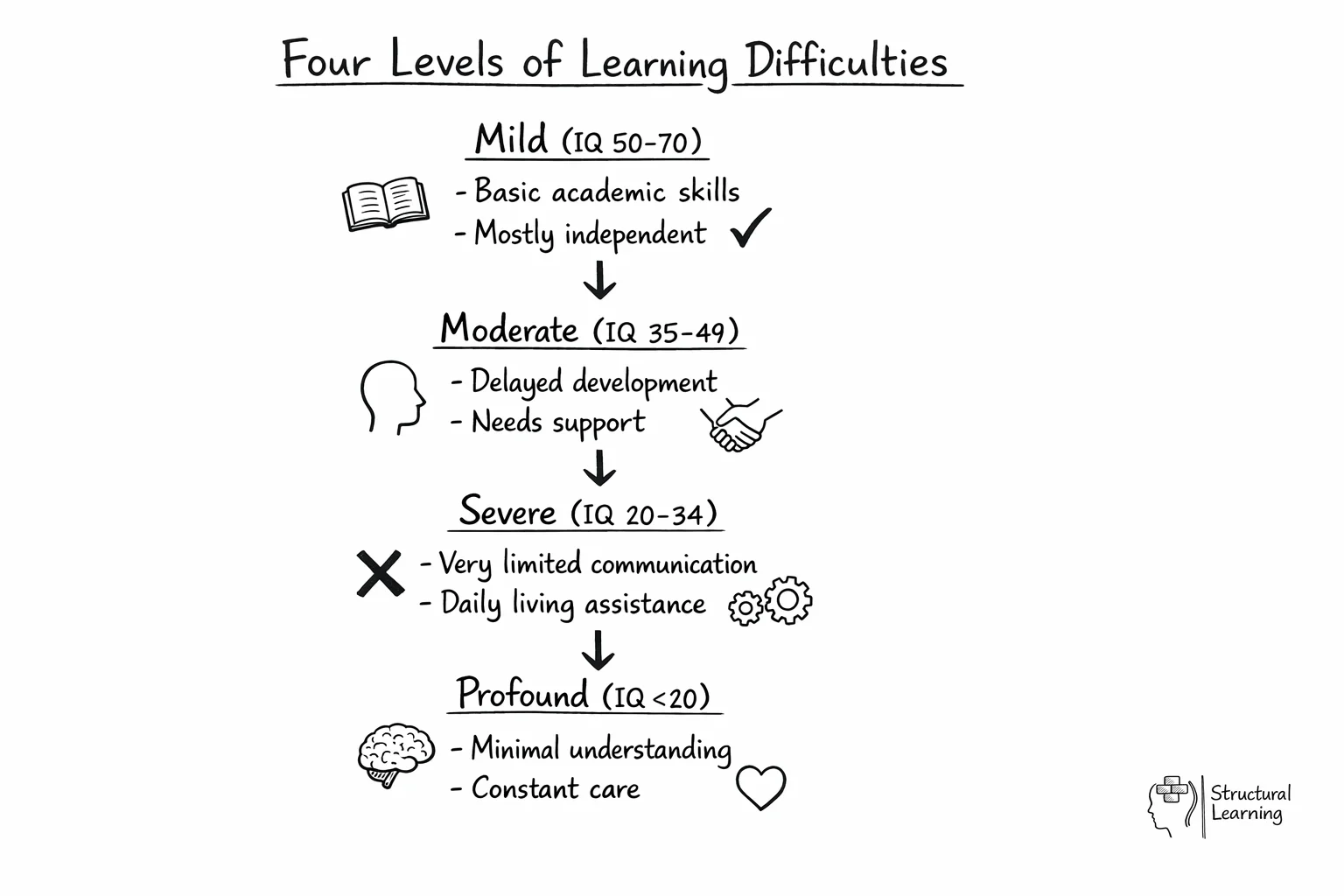
MLD impacts learning across all subjects. Learners with MLD often attain below average grades. A modified curriculum with practical tasks aids learners.
This can create frustration and impact their confidence. Understanding individual learner strengths is vital for effective support (Rose & Florian, 2022). Tailored teaching approaches can address learner needs (Hattie, 2008). Adjustments can make learning more accessible and foster success (Tomlinson, 2014).
Research shows SLD learners have below-average cognitive skills impacting daily life. These learners need specialist help and much adult support during school hours.
GDD (Global Developmental Delay) is included because it is the term typically used for children under five who are not yet old enough for a formal MLD or SLD assessment. Many children who receive a GDD label in early years go on to be identified as having MLD once they reach school age. For related reading, see understanding learning disabilities.
MLD affects how a notable proportion of learners process information. Diagnosis is based on a holistic assessment of needs and functioning rather than a single IQ score. Genetic factors, neurological issues, or trauma can cause these challenges. Learners need support for academic skills, memory, and social interaction.
Bear in mind that learning difficulties exist on a spectrum. They range in severity from mild to moderate and severe. (Hallahan et al., 2017; Kauffman & Landrum, 2018).
All of the learning challenges have an impact on the child's ability to learn new abilities in other areas of life as well as in non-maintained special schools. It makes it harder to grasp new skills and information while also making it challenging to cope independently with previously taught skills. A child with MLD, for example, may have difficulty putting on his own clothes.
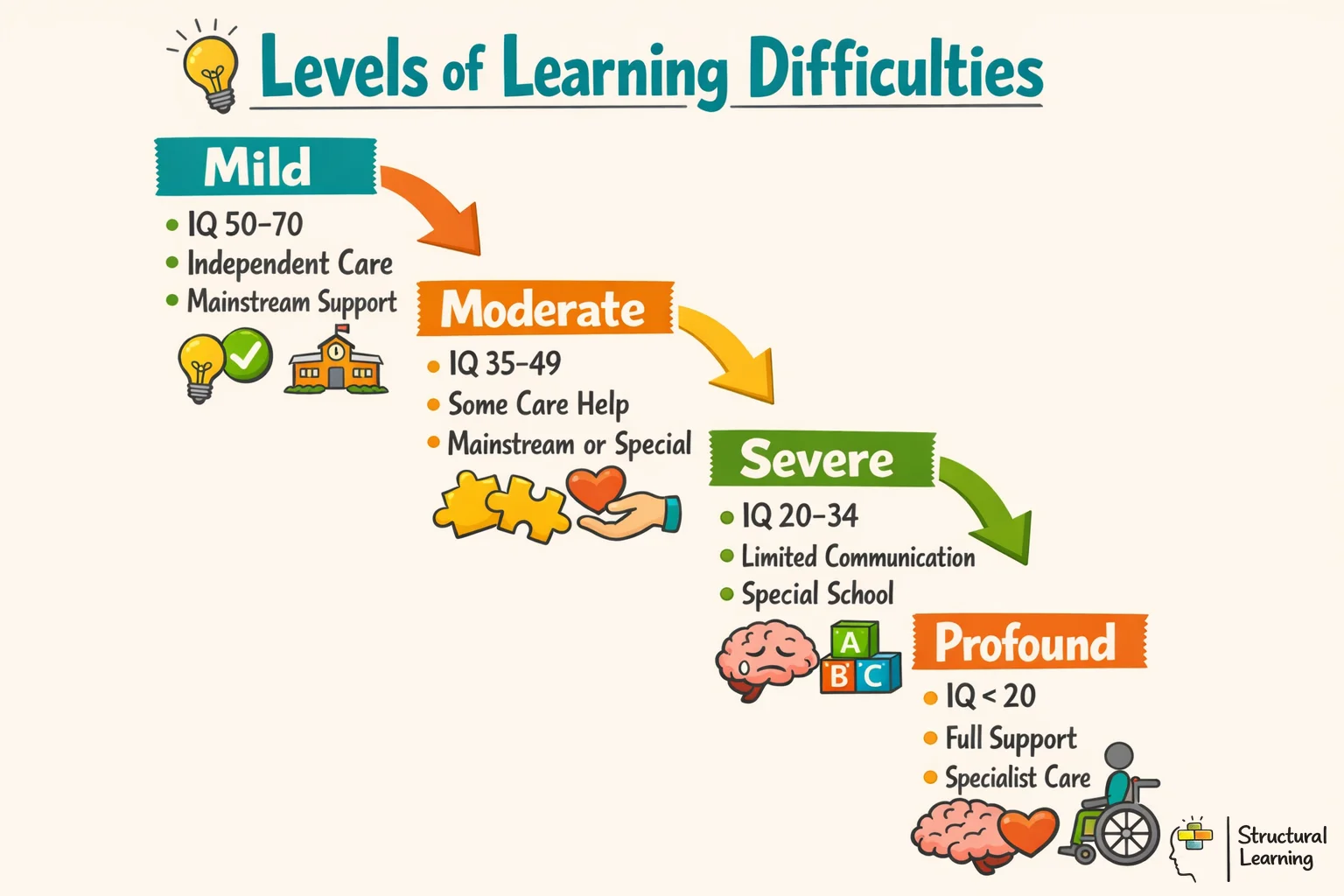
| Category | IQ Range | Communication | Daily Living Skills | Educational Setting |
|---|---|---|---|---|
| Mild Learning Difficulties | 50-70 | Effective communication with others | Independent in most daily tasks | Mainstream with targeted support |
| Moderate Learning Difficulties | 35-49 | Some difficulty with communication | Can manage personal care with support | Mainstream or special provision |
| Severe Learning Difficulties | 20-34 | Limited communication skills | Requires significant assistance | Special school provision |
| Profound Learning Difficulties | Below 20 | Very limited or non-verbal | Full support required in all areas | Specialist provision with high staffing |
Research shows learners with moderate difficulties struggle in special schools (Rose & Shevlin, 2010). They find it hard to reach age-related expectations (Farrell, Dyson & Ainscow, 2002). This can impact learning across all curriculum areas (Lewis & Norwich, 2005).
Learners with moderate learning difficulties may also have dyspraxia or Down syndrome. This is sometimes called intellectual disability. MLD means learners have general learning problems.
MLD connects to a learner's IQ score falling below the usual range. Educational psychologists should assess learning disabilities. A learner's IQ is often below average. Sometimes it's average, but dyspraxia affects progress.
Education includes learners with physical, mental, or emotional disabilities. Physical disabilities affect sight, hearing, or movement (Kirk, 1962). Mental disabilities involve intellect, attention, or autism (Hallahan & Kauffman, 2006). Anxiety and depression are emotional disabilities (Hinshaw, 2002).
Learning disabilities impact how the brain processes information. Specific Language Impairment (SLI) is a common learning difficulty. Learners with SLI struggle to understand and use language effectively. This affects their speech, reading, writing, and listening skills.
d="">t can also affect their ability to learn new skills.
Formal diagnosis of MLD is carried out by an educational psychologist, but classroom teachers are almost always the first to notice that a child is not keeping pace with their peers. The signs of MLD are often subtle in the early years and become more apparent as curriculum demands increase in Key Stage 2 and beyond.
The table shows indicators teachers report, organised by subject. If a learner struggles in several areas, talk to your SENCO. Consider starting the graduated approach (SEND Code of Practice, 2015).
It is worth noting that many of these indicators overlap with other conditions, including SpLD, ADHD, and attachment difficulties. The critical distinction with MLD is that the difficulties are present across the curriculum rather than in a single domain. A thorough assessment will consider the child's profile of strengths as well as their areas of need.
The signs of moderate learning difficulties will vary from child to child, and early identification is key for academic progress. But look for the following:
Assess learners needing maths help, do not label them quickly. Educational psychologists and SENCOs should assess learners. They use tools and observation to understand learning difficulties. Educators, parents, and specialists collaborate to meet needs (Butterworth, 2003; Dowker, 2004; Chinn, 2017).
Effective teaching helps all learners, including those with MLD, according to the Education Endowment Foundation. The SEND Code of Practice agrees. Consistently apply key teaching principles.
Break complex tasks into small, clearly defined steps. Present one instruction at a time rather than giving a sequence of three or four. Use scaffolding frameworks such as modelling, guided practice, and independent practice to gradually release responsibility to the learner. Visual task boards showing each step of an activity help learners with MLD to track their own progress.
Learners with MLD need more time using concrete learning stages. They need this before moving to pictures and abstract ideas. In maths, use Numicon and blocks longer than peers do. For literacy, use story maps and role play before extended writing is expected.
Frequent, low stakes retrieval practice helps learners with MLD. Working memory can be weak, so revisit information often (Gathercole & Alloway, 2008). Use daily review activities and spaced repetition (Cepeda et al., 2008). Include retrieval starters in lessons. Remember skills learned Monday might be lost by Friday (Rohrer, 2006).
Visual timetables and word mats ease working memory load, offering independent reference points. Concept maps and writing frames structure overwhelming tasks for the learner. Consistent visual aids across the week help learners become familiar with them.
Pre-teaching vocab boosts learners with MLD, research shows (Marzano, 2004). Brief previews with support staff improve engagement (Hattie, 2009). Focus on tier-two and tier-three words for lessons. Use pictures, actions, or objects to fix meanings.
Explicitly teach learners how to plan, monitor, and evaluate their own learning. Learners with MLD often lack the self-regulation skills that their peers develop incidentally. Use thinking skills frameworks to make the learning process visible, and model your own thought processes aloud so that learners can see what good thinking looks like.
Do not permanently group learners with MLD. The EEF found mixed-ability groups help lower attainers if tasks are differentiated. Use flexible grouping that changes with the task. Give learners with MLD regular chances to contribute to discussions.
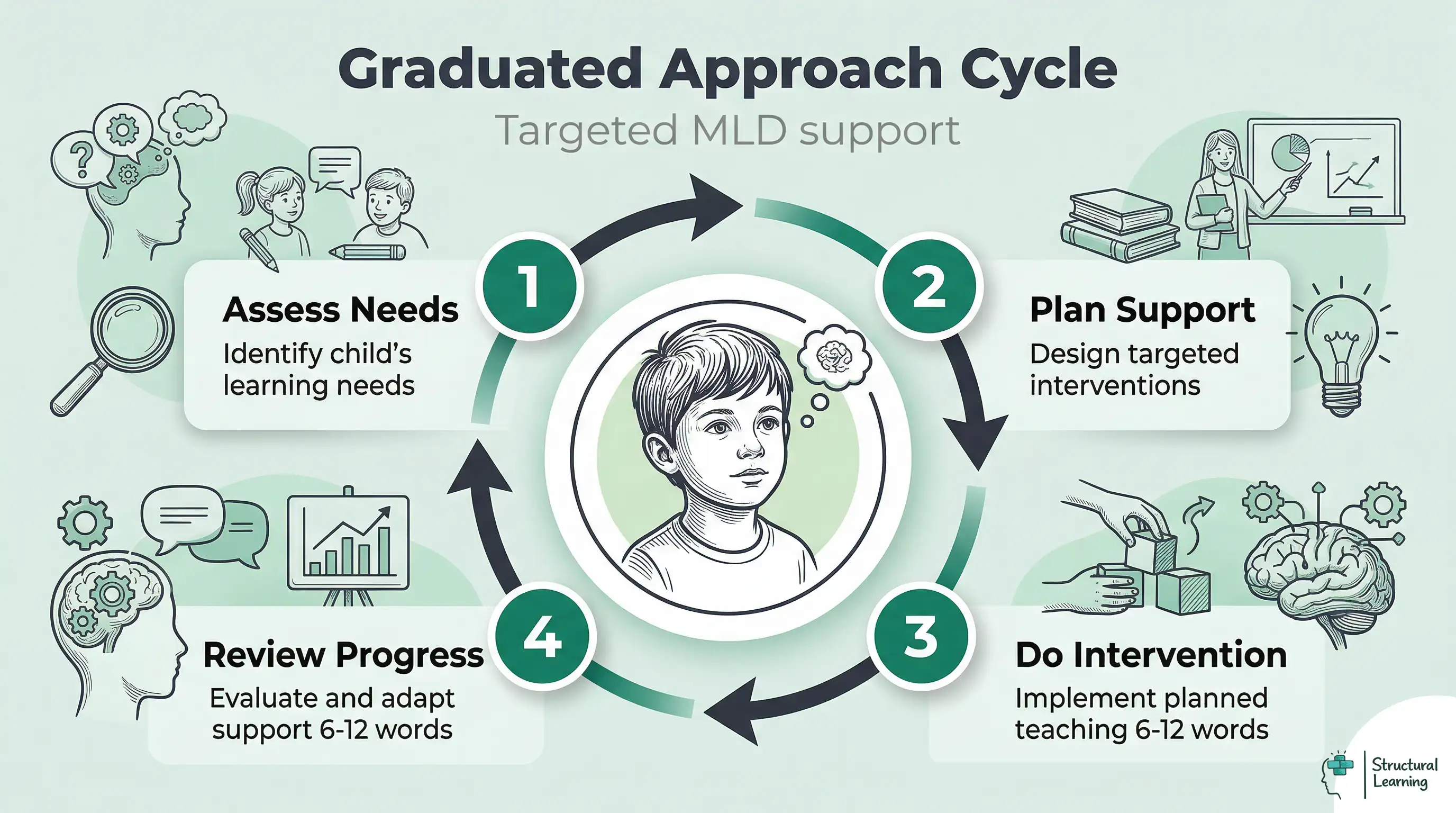
The Graduated Approach (Assess, Plan, Do, Review) supports learners with SEND, including MLD, as stated in the SEND Code of Practice 2015. This cyclical framework ensures regular monitoring and adaptation of provisions.
Use observations, assessments, tests, and feedback from parents and teachers to gather information. SENCOs might seek extra help from psychologists for learners with possible MLD. Assessment aims to clarify a learner's strengths and needs, not just apply a label.
Use the assessment information to set specific, measurable targets. Agree on the interventions and adjustments that will be put in place, who will deliver them, and how progress will be measured. Record this in a provision map or individual education plan. Involve the learner and their parents in this planning so that expectations are shared and consistent.
Follow the agreed plan. The class teacher is responsible for learner learning, even with TA support. Good teaching is key; interventions cannot fix poor lessons. Apply adjustments consistently; all adults should know the plan.
Check learner progress against targets at each review (half-termly or termly). If progress is good, slowly reduce support. If progress is limited, review the assessment to ensure targets were right. Also check the intervention and support delivered. This review informs the next assessment cycle.
| Feature | MLD | SpLD (e.g. Dyslexia) | SLD | GDD |
|---|---|---|---|---|
| IQ range | 50-70 | Average or above | 20-34 | Variable (under 5s) |
| Curriculum impact | Across all subjects | Specific area only | Across all subjects + daily living | Multiple developmental domains |
| Typical setting | Mainstream with SEN support | Mainstream with adjustments | Special school | Varies; under assessment |
| Key support need | Modified curriculum, concrete tasks | Targeted intervention in weak area | High staffing, specialist input | Multi-agency early intervention |
| Diagnosed by | Educational psychologist | Specialist assessor / EP | Clinical psychologist / paediatrician | Paediatrician |
Learners with moderate learning difficulties show delayed cognitive development. They often find curriculum areas challenging. These learners typically have IQs of 50 to 70. Gaining literacy and numeracy skills proves difficult for them. MLD is a common category of special educational need in England. A modified teaching approach benefits them.
Consider this when planning lessons for learners. Break instructions down into smaller steps and use visual aids to aid comprehension. Concrete materials and real world examples make abstract concepts more practical. Regular retrieval practice and overlearning help learners remember information (Brown et al., 2014; Agarwal et al., 2021).
Effective assess, plan, do, review cycles track learner progress, research shows. The Education Endowment Foundation (EEF) found good teaching and support boost results. The EEF also found useful skills and real learning help learners succeed.
Researchers like Hodapp & Dykens (1993) found visual supports ease working memory load. Visual aids help learners organise work and follow routines, say Mesibov & Shea (2011). Symbols and checklists improve curriculum access and learner confidence.
Teachers often mistake MLD for specific learning difficulties like dyslexia. Dyslexia only affects one learning area. Teachers sometimes give work that is too abstract (Hulme & Snowling, 2016). They may also rely on complex verbal instructions (Swanson & Sachse-Lee, 2000). Not enough repetition means learners quickly forget new skills (Baddeley, 2003).
Schools use observations and tests to identify learners' needs. The SEND Code of Practice (2015) helps teachers spot attainment gaps. Early challenge recognition ensures learners receive needed support.
Learners with Moderate Learning Difficulties need support. Early identification helps learners progress. Hodkinson (2004) notes MLD impacts thinking skills. Lewis & Norwich (2005) suggest using teaching strategies tailored to need.
Supporting learners' strengths and providing backing helps them achieve, as per Students with pmld. Collaboration between schools, families, and specialists aids progress. Remember, small steps are wins, and positivity matters to learners.
| Subject Area | Observable Indicators |
|---|---|
| Literacy | Significantly below age-related expectations in reading and writing; difficulty decoding unfamiliar words; limited vocabulary; struggles to sequence ideas in writing |
| Numeracy | Difficulty with number bonds and times tables despite repeated practice; relies on concrete apparatus longer than peers; struggles with word problems and multi-step calculations |
| Science | Difficulty forming hypotheses or making predictions; limited ability to record findings independently; struggles to transfer knowledge from one topic to another |
| Social Skills | Difficulty reading social cues; may appear immature compared with peers; struggles to maintain friendships; may be vulnerable to manipulation by others |
| Working Memory | Forgets multi-step instructions quickly; loses track of what they were doing; needs frequent repetition; benefits significantly from visual prompts |
| Executive Function | Poor organisational skills; difficulty planning and sequencing tasks; struggles to self-monitor and check work; finds transitions between activities challenging |