Updated on
September 24, 2026
Oak National Academy: Free Resources for Every Teacher
Complete 2025 guide to Oak National Academy: 10,000+ free DfE-funded lessons, full curriculum sequences, and practical implementation tips for teachers.

Updated on
September 24, 2026
Complete 2025 guide to Oak National Academy: 10,000+ free DfE-funded lessons, full curriculum sequences, and practical implementation tips for teachers.
Oak National Academy offers free curriculum-linked resources. UK teachers designed the platform with 10,000+ lessons and videos. It helps you save planning time and deliver quality lessons. Access materials easily without subscriptions (Oak National Academy, undated).
Oak National Academy is an online teaching and learning platform built by teachers, for teachers. Originally launched in 2020 in response to the disruption caused by the COVID-19 pandemic, it quickly grew into a widely used curriculum support hub for schools across England. Designed for learners aged 4 to 16, Oak provides a growing library of high-quality resources including video lessons, quizzes, worksheets, and lesson slides, that align with the national curriculum.
The platform is managed by the Reach Foundation and was created to help schools keep learning going during lockdowns. But its long-term purpose goes further: to help improve learner outcomes, reduce workload, and close the disadvantage gap by offering every school access to a comprehensive set of resources. With over 10,000 resources spanning subjects from phonicsand early maths to GCSE science and history, Oak gives teachers a reliable, time-saving way to plan, adapt, and deliver engaging lessons.
One of Oak's major strengths is its flexibility. Teachers use it in a variety of ways: to support effective teaching strategies with proven pedagogical approaches, to deliver structured remote learning, and, for over 80 percent of users, to set cover lessons with minimal preparation time. Because the platform is built by educators who understand the real classroom context, it offers practical solutions rather than generic content.
Crucially, Oak doesn't aim to replace teacher autonomy. Instead, it supports it. Teachers are encouraged to build from Oak's materials and adapt them to the needs, interests, and aspirations of their learners whether that's through enrichment, scaffolding, or creative extension.
Three key things to know:
Oak Academy videos offer clear explanations. Experienced teachers pre-record these lessons with helpful visuals. Videos usually run 5-20 minutes. Worksheets, quizzes, and slides come with each video. Teachers can adapt materials for their learners (Oak Academy, n.d.).
Oak Academy provides English, maths, science, and humanities for Reception to Year 11. Computing, art, and languages are also available. Lessons, organised by year, term, and topic, systematically cover national curriculum aims.
This task requires them to provide engaging and effective learning experiences for their learners. Teachers need to critically evaluate different methods and adapt instruction to meet diverse learner needs within the classroom. Effective assessment strategies also help inform teaching practices.
Oak Academy provides resources for educators. It aims to build teacher confidence and subject knowledge. These resources support learners across the curriculum (Oak Academy, 2020).
These resources aim to uplift learner outcomes. Research by Hattie (2008) and Black & Wiliam (1998) confirms the impact of quality curriculum on learner progress. Oak Academy works with publishers to create curriculum packages for classrooms.
These packages offer teachers numerous resources. They help with curriculum demands. These curriculum-aligned packages help teachers manage planning workload. Learners benefit from consistent, sequenced teaching materials.
Oak Academy helps teachers with curriculum. It covers planning to assessment. The platform is easy to use. Teachers integrate interactive content for effective learning. This helps diverse learners.
Teachers, use education technology and Oak Academy's resources to help learners succeed. The platform provides project-based learning and improves metacognitive skills.
Teachers can access all Oak Academy resources immediately by visiting the website and browsing by subject, year group, or topic without creating an account. Simply navigate to the desired lesson, click to view materials, and download any worksheets, slides, or teaching notes directly to your device for immediate classroom use.
Oak offers free lesson sequences, including videos and resources, for teachers. These lessons support vocabulary and literacy skills, (Oak National Academy, 2020). They use formative assessment and address learners' social-emotional needs, (Oak National Academy, 2020).
Oak National Academy provides free educational resources on their website. These materials support teaching and learning (Oak National Academy, n.d.). Learners can access a wide range of helpful content.
Oak National Academy saves teacher planning time. It provides good, curriculum-matched content. Adaptable materials support diverse learner needs. The platform encourages consistent teaching. It helps close attainment gaps with excellent resources for all schools (Slavin, 2008; Hattie, 2009).
The advantages of using Oak Academy extend beyond simple time-saving. The platform offers:
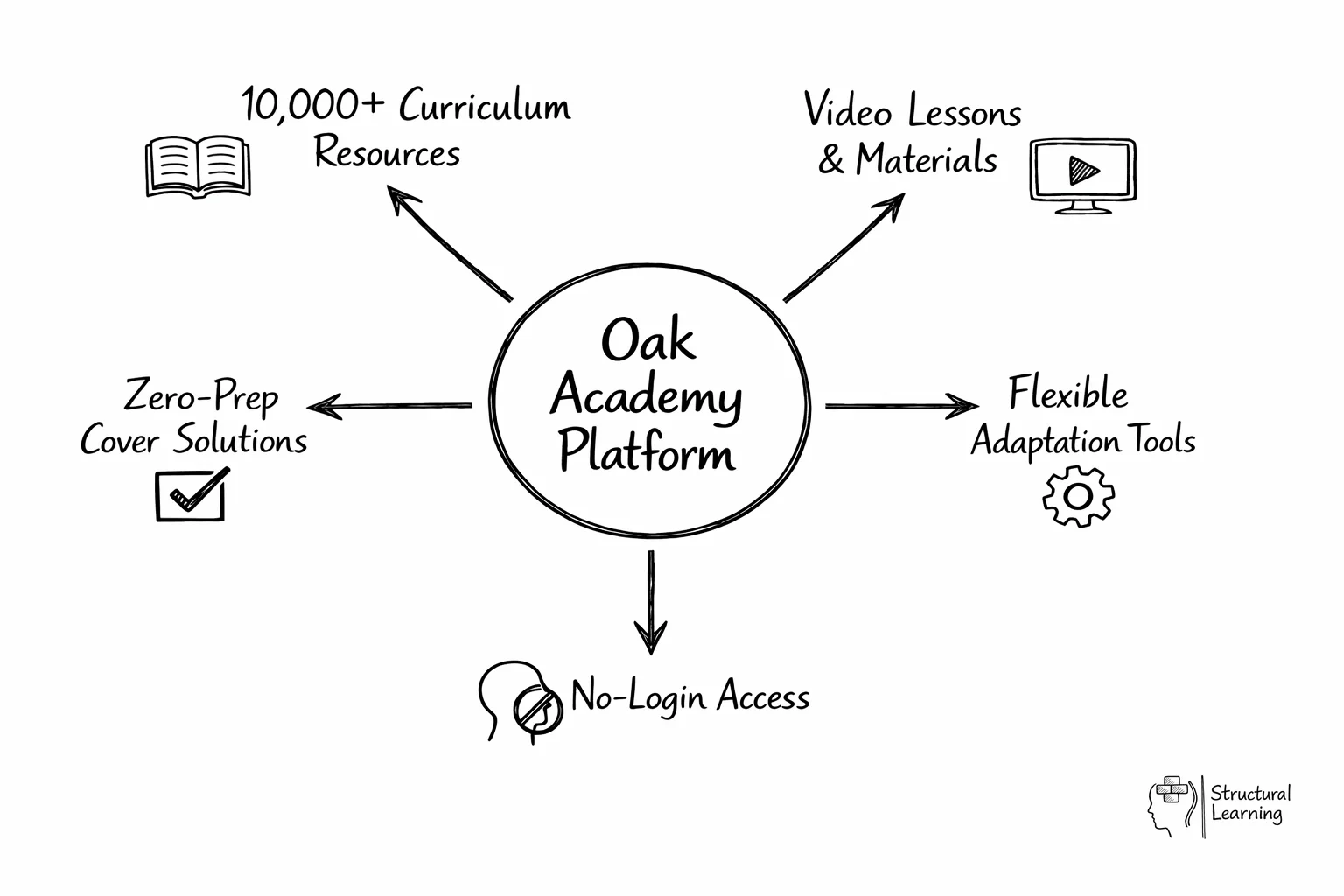
Oak Academy resources support learners across the curriculum, helping teachers refine their practice and contributing to a fairer education by widening access to high-quality materials.
Oak National Academy resources suit learners with SEND. Teachers use flexible resources for differentiated instruction and support. Adapt worksheets, adjust video pace, and add visuals. This helps learners with SEND access the curriculum fully.
Teachers often face challenges using Oak resources in class. Technical issues, adapting content for different learners, and keeping learners engaged are common. Overcoming these issues can improve Oak's video lessons' impact (Oak National Academy, n.d.).
Connectivity issues frustrate teachers. Download Oak videos beforehand or use academy resources. For device problems, learners can help each other. Keep spares charged and have printed options. Use Oak's slides for lessons when videos fail.
Adapt Oak content for SEN learners with good planning; this gives great results. Use Oak's pause-and-discuss tactic every few minutes to check learners' understanding. Screenshot key diagrams from Oak lessons for visual aids for learners. Extend Oak content for gifted learners with extra research like (Tomlinson, 2001). Oak's objectives help teachers spot learners needing pre-teaching (Vygotsky, 1978; Piaget, 1936).
Engage learners with Oak videos using active tasks, not just watching. Before starting, ask learners to predict content based on the title. During pauses, use 'think-pair-share'. Have learners take Cornell notes with questions, as suggested by the Education Endowment Foundation. Research supports interactive video learning with tasks, making Oak effective.
Teachers should strategically align Oak National Academy, avoiding full scheme replacement. Audit current plans to find gaps where Oak resources strengthen curriculum delivery. Oak lessons support learners needing concepts retaught, useful for intervention. Challenge materials extend higher attainers, saving teacher planning time.
Oak's quizzes give instant feedback, helping you spot learner errors (Oak National Academy). Adjust lessons quickly to address misconceptions. Use Oak's exit tickets regularly to build learner portfolios. This aids feedback and informs teaching decisions across the class. Standardised assessments allow comparison between years and subjects.
Teach support staff Oak resources in structured sessions. TAs and supply staff use the platform with teachers. Focus on accessing lesson materials and understanding structure. Simple guides highlight subject resources and assessments. This helps supply staff maintain lesson quality. Offer regular drop-ins for sharing practices and problem-solving.
Successful Oak use involves gradual integration, beginning with one subject or year group. Staff gain confidence and find what works best for them. Plan together, sharing adaptations of Oak resources to build examples.
Teachers can plan weekly using Oak resources. Review Oak lessons for your year group each Sunday (30 mins). Find videos/activities matching your curriculum. Download and adapt worksheets for learners' needs. Add extension questions or simplify vocabulary. This saves prep time while keeping your autonomy.
Oak National Academy helps teachers plan lessons. It offers free, curriculum-linked resources (designed by teachers) that save time. Teachers can adapt resources for diverse learner needs, creating effective inclusion. (Oak National Academy, 2020).
As education continues to evolve, platforms like Oak National Academy play a crucial role in supporting teachers and improving learner outcomes. By using these resources, educators can focus on what matters most: inspiring a love of learning and helping the next generation to reach their full potential.
Oak National Academy is a free online classroom and resource hub created by teachers to support schools in England. It provides thousands of high quality lesson videos, slides, and worksheets for learners aged 4 to 16. The platform is designed for teachers, teaching assistants, and home educators who need materials aligned with the curriculum without any subscription costs.
Teachers can use Oak resources to support lesson planning, set cover work, or provide additional scaffolding for specific learners. The materials are flexible; educators often download the slides to adapt them for their own classes or use recorded videos for remote learning. Because no login is required, students can also access the interactive quizzes and videos independently to practise their skills.
The primary benefit is the significant reduction in planning time, allowing teachers to focus on tailoring delivery to their students' needs. It ensures that every school has access to high quality, evidence based resources that follow a logical curriculum sequence. The platform also helps to close the disadvantage gap by providing free instruction led by experts to all learners regardless of their background.
Teachers are using the platform to manage workload. The platform provides a reliable curriculum baseline. Structured resources help maintain consistent standards across schools, which can reduce teacher preparation stress.
One common mistake is using the resources as a direct replacement for teacher interaction rather than as a tool to support it. Teachers should avoid simply playing videos without pausing for discussion or checking for understanding. It is also important to adapt the generic slides to fit the specific context and prior knowledge of the individual classroom to ensure the content remains relevant.
The platform provides comprehensive coverage for core subjects including English, maths, and science from Early Years through to Key Stage 4. It also offers materials for foundation subjects like history, geography, and languages. Each subject is organised into clear sequences that align with the national curriculum objectives for every year group.