Updated on
September 24, 2026
EHC Plans Explained: A Step-by-Step Guide
Everything teachers need to know about Education, Health and Care Plans. The EHCP process explained step by step, from initial request to annual review.


Updated on
September 24, 2026
Everything teachers need to know about Education, Health and Care Plans. The EHCP process explained step by step, from initial request to annual review.
EHC Plans Explained: A Step-by-Step Guide describes how Education, Health and Care plans work in England. An EHCP is a statutory document. It records a child or young person's special educational needs, the outcomes sought, and the education, health and social care provision that must be arranged (Department for Education and Department of Health, 2015).
For teachers, the test is practical. If Year 4 learner Amir has speech and language targets, sensory breaks and 20 hours of specified adult support, the plan should shape Monday's vocabulary pre-teaching, Wednesday's guided talk and Friday's review notes. A good EHCP is not just paperwork for the SENCO; it is a legal route for turning assessed need into classroom provision, reviewable evidence and shared accountability.
EHC plans are legal documents for learners aged 0-25 with complex needs. The Children and Families Act 2014 requires local authorities to provide these plans. This happens when school support is not enough to meet learner needs.
The plan is not a wish list. It specifies outcomes (what the child should achieve), the provision required to reach those outcomes, and who is responsible for delivering each element. For more on this topic, see Ordinarily available provision.
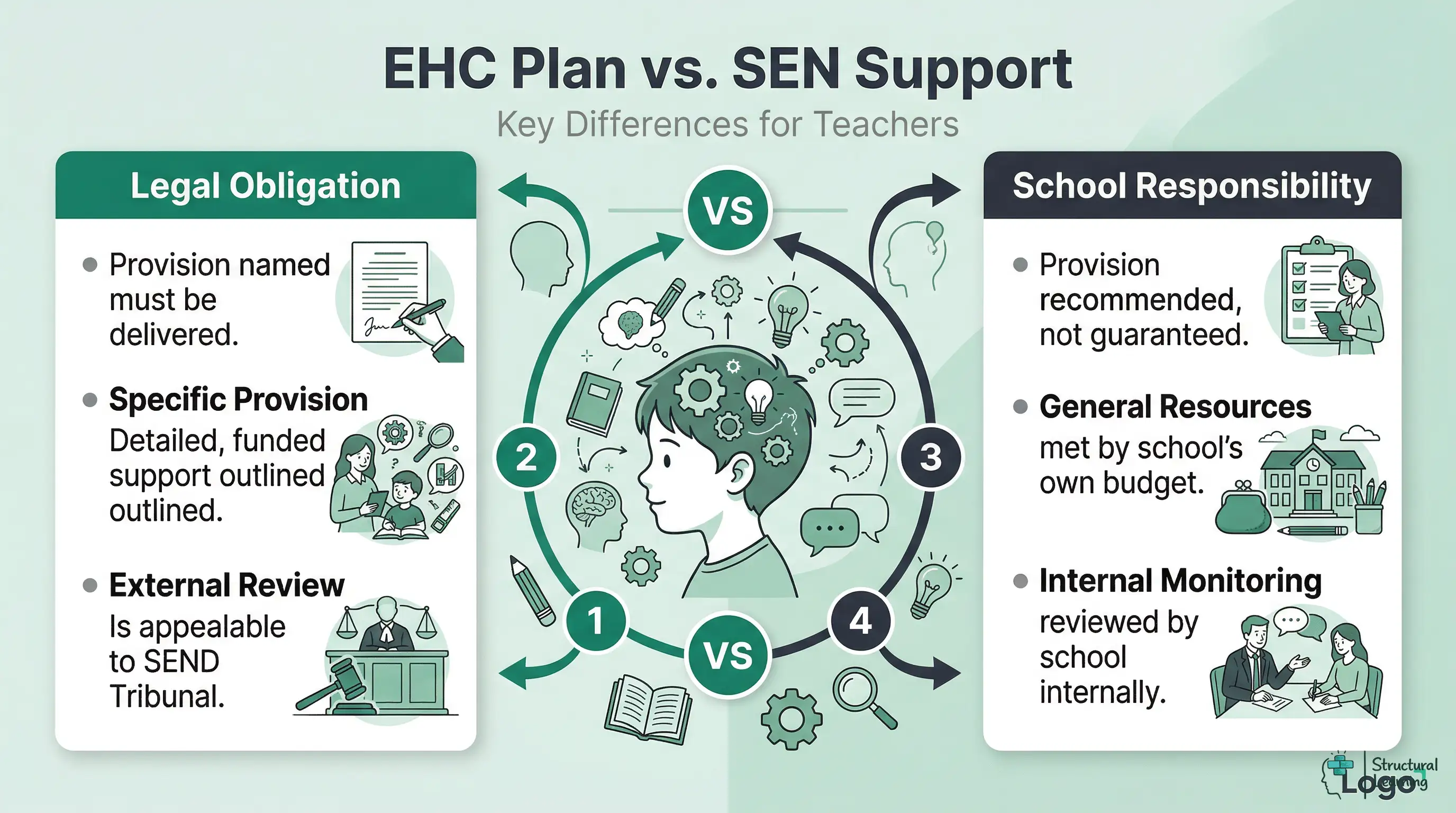
If the local authority names a type of provision in the plan, they are legally obliged to arrange it. This legal enforceability is what distinguishes an EHC plan from SEN Support, where provision is recommended but not guaranteed.
A Year 3 teacher with a learner on an EHCP will see the practical effect: the plan may specify 15 hours of one-to-one support, weekly speech and language therapy, and access to a sensory room. The school receives funding to deliver this. Without the plan, the same learner may receive whatever the school can afford, which in many cases is significantly less.
EHCPs support learners with complex needs that go beyond standard school support. Most learners with SEN have their needs met through high-quality teaching and SEN Support as part of the graduated approach (SEND Code of Practice, DfE and DHSC, 2015). They do not require the more intensive support of an EHCP (Norwich & Nash, 2011).
Schools consider an EHC plan if the graduated approach (assess, plan, do, review) hasn't worked. They show their best efforts, like interventions and adjustments, before requesting assessment. .
EHC plans address education, health, and care needs. Learners only needing health or care support won't meet criteria. These plans cover ages 0 to 25. They start in early years and continue through further education.
Teachers may request EHCPs when SEN support fails to help learners catch up. The gap between the learner and peers grows each term. Complex needs strain the school's SEN budget.
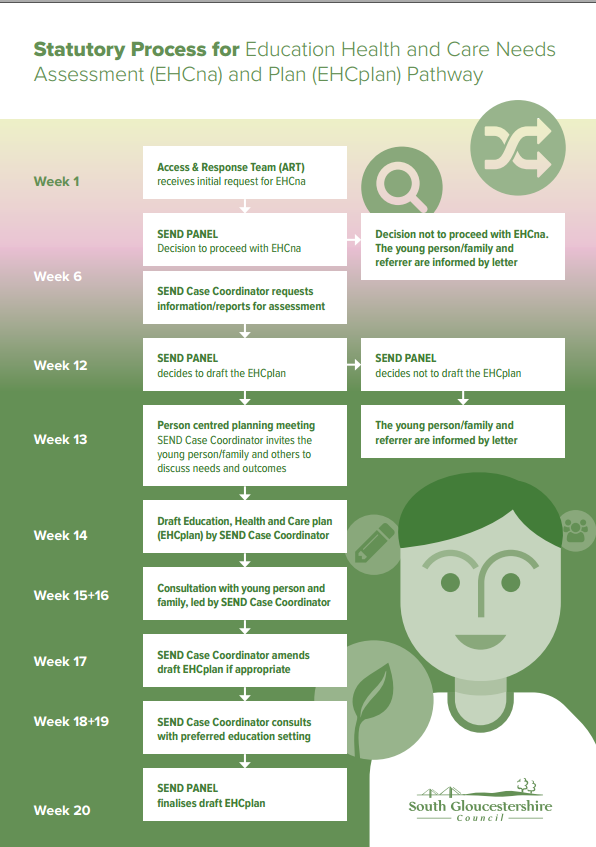
The statutory assessment process follows a 20-week timeline set out in the SEND Code of Practice (2015). Understanding each stage helps teachers prepare the right evidence at the right time.
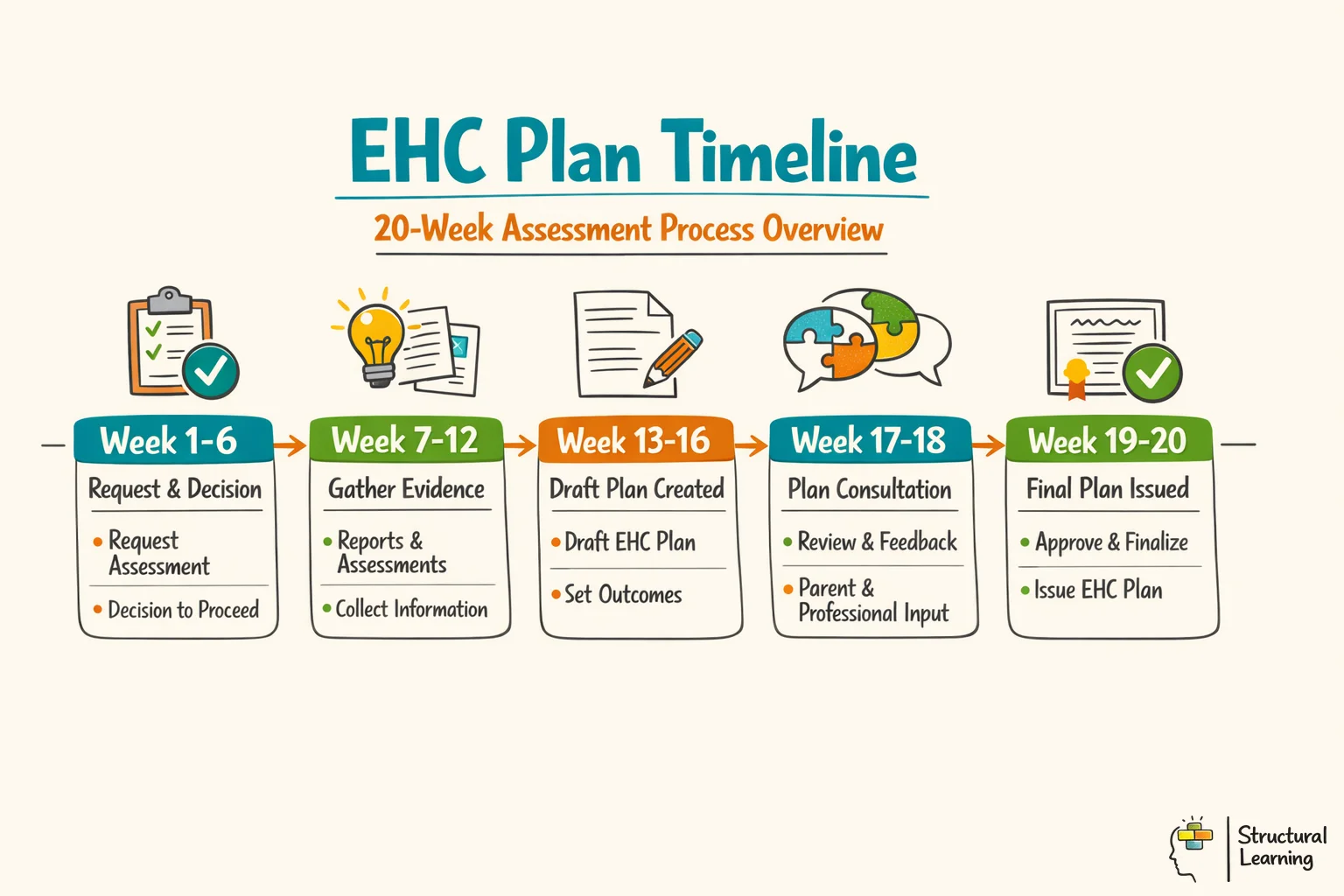
Weeks 1 to 6: Request and decision. A parent, the young person (if over 16), or the school can request an EHC needs assessment from the local authority. The LA has six weeks to decide whether to carry out the assessment.
They will consider whether the child has or may have SEN, and whether the school has already taken reasonable steps. If the LA refuses, parents can appeal to the SEND Tribunal.
Weeks 6 to 16 focus on gathering evidence. The LA collects information from various sources, and teacher evidence is important here. Provide attainment data, progress against targets, and intervention details. Include professional reports and the learner's views (Weeks 6-16).
Weeks 16 to 20: Draft and finalisation. If the LA decides to issue a plan, they send a draft to parents within 16 weeks. Parents have 15 days to comment, request a meeting, and express a preference for a school placement.
The final plan must be issued by week 20. The plan names a specific school or type of school, and the LA must consult with that school before finalising.
The SENCO requests assessment in September (Year 2). The LA agrees by late October. November sees the educational psychologist visit. Teachers give evidence in December.
January brings a draft plan. Parents review and finalise this (February), with provision starting (as in Ainscow & Booth, 2000; Florian, 2014).
Teachers should know EHC plan sections (SEND Code of Practice). Knowing these sections helps teachers contribute usefully across initial plans and reviews, in line with the SEND Code of Practice (2015).
Sections B and F carry the most weight for teachers. Section B must describe the learner's needs in specific, observable terms, not generalities. "Struggles with reading" is weak. "Reads at a level equivalent to a 5-year-old despite being 9; cannot decode unfamiliar CVC words; loses place when reading aloud; avoids independent reading tasks" is strong. Section F must specify exactly what provision is needed, including hours, frequency, and type of professional.
Teachers are not bystanders in the EHCP process. In many cases, the quality of teacher evidence determines whether a plan is issued at all.
Building the evidence base. Before a request is submitted, the school needs to show that the graduated approach has been followed. This means documenting each cycle of assess, plan, do, review with specific details: what was the concern, what intervention was tried, how long it ran, what data was collected, and what the outcome was.
Vague records ("we tried some extra reading support") weaken the application. Specific records ("12 weeks of daily phonics intervention using Read Write Inc, delivered by trained TA, learner moved from Phase 2 to Phase 3 but remains 18 months behind peers") strengthen it.
Write advice using behaviours and data. Describe learner needs with what you see and measure. Give attainment levels using scores if you have them.
Show progress rates versus peers. State what differentiation strategies you use. Explain what helps and hinders learners. Note the gap between current and desired learning levels.
Class teachers implement Section F of the EHCP (education plan). This includes adapting materials and working with therapists.
TAs may help. Teachers track progress in Section E. The SENCO oversees, but the class teacher delivers.
A practical example. Ms Chen teaches Year 4. Her learner Amir has an EHCP specifying 20 hours of TA support, weekly speech and language therapy, and access to a visual timetable system.
Ms Chen's daily practice includes: briefing the TA on learning objectives each morning, adapting worksheets to include visual prompts, scheduling Amir's therapy sessions so they do not clash with core teaching, and recording fortnightly progress notes against his EHCP outcomes. At the annual review, she presents a one-page summary showing which outcomes were met, which were partially met, and what should change.
The distinction matters because many teachers assume an EHCP is simply "more support." It is, but it is also a different legal framework. A learner on SEN Support whose school removes an intervention has limited recourse.
A learner whose EHCP specifies speech therapy every Tuesday has a legal right to receive it. If the school or LA fails to deliver, parents can take the matter to tribunal. This is why the specificity of Section F matters so much.
Understanding common EHC plan issues saves time for teachers and SENCOs. Spotting these problems early helps learners avoid wasted effort. Local-area SEND inspections by Ofsted and the Care Quality Commission have repeatedly flagged the same recurring weaknesses in EHC plan quality.
Vague outcomes. An outcome that reads "learner will make progress in reading" is unenforceable. Good outcomes are specific and time-bound: "By July 2026, learner will decode unfamiliar CVC words with 80% accuracy in a structured assessment, measured using the school's phonics screening tool." If the outcomes in a draft plan are vague, teachers should push back during the consultation period.
Section F needs more detail about support for learners. It mentions "adult support" but lacks specifics like hours. This offers councils flexibility, but it can leave the learner exposed.
Teachers should fight for clear provision. For instance, aim for "15 hours of TA support, delivered by a Level 3 trained TA".
Annual reviews must move beyond form-filling. Schools should see them as real evaluations. A good review shows progress against outcomes.
It also analyses what worked and did not. Add updated data and the learner's views (scaffolded if needed). Finally, include specific provision changes.
Delays in the system. Many local authorities exceed the 20-week statutory timeline. The SEND Tribunal's annual report consistently shows that delays are the most common complaint from parents. Teachers can help by submitting their evidence promptly when requested and by keeping meticulous records that can be provided quickly.
Assuming the plan covers everything. An EHCP only covers what is written in it. If a learner needs something not specified in the plan (for example, a piece of assistive technology that becomes available mid-year), the school can provide it from their own budget, but they cannot assume the LA will fund it without amending the plan. Request an early review if circumstances change significantly.
Teachers need practical strategies, beyond just knowing EHCP details.
Every EHC plan must be reviewed at least once per year. For children under five, local authorities should consider reviewing an EHC plan at least every three to six months, alongside the statutory annual review. The school coordinates the review, but the local authority makes the final decision on any amendments.
Review meetings include the teacher, SENCO, parents, learner and relevant professionals. Schools should send a report two weeks prior. This report covers progress, updated data, and provision changes.
After the meeting, the LA has four weeks to decide whether to maintain, amend, or cease the plan. If they decide to amend, parents have the right to negotiate changes and express preferences about provision or placement.
Annual review reports with specifics really help learners. A report showing "progress" is not helpful. Report if the learner "read CVC words at 80% (up from 45% in September)".
Note whether they "use 3-word sentences in activities, not free play". Recommend increasing speech therapy, if needed.
For full guidance on running effective annual reviews, see our EHCP annual review guide for teachers.
The SENCO leads EHCPs, but teachers are key (DfE, 2014). SENCO tasks include assessment requests and gathering evidence. They also chair annual reviews and ensure plan delivery. SENCOs support teachers with implementation (Hodkinson, 2009).
In practice, the most effective SENCOs act as translators between the legal language of the EHCP and the daily reality of classroom practice. They help teachers understand what "access to a modified curriculum" actually looks like in a Year 5 maths lesson, and they help the LA understand what "15 hours of support" means when the TA is absent for training.
An Education, Health and Care plan is a legal document for children and young people aged 0 to 25 with special educational needs. It specifies the extra support required that a school cannot provide through its standard budget and resources. The local authority is legally obliged to fund and organise the provision named in the final version of the document.
Teachers deliver planned support during lessons. They track learner progress against set objectives and gather evidence for annual reviews. This process adapts the curriculum so it can meet individual needs (DfE, 2014). Graduated approach guidance also helps (Hodkinson, 2009; Farrell, 2003).
The primary benefit is that the support is legally protected and cannot be removed due to school budget changes. It ensures that education, health, and social care needs are addressed in a coordinated way to support the child. This provides consistency as the learner moves between different schools or transitions into further education and training.
Effective EHC plans need strong teamwork between schools, parents, and councils, research shows. Classroom intervention records inform required learner support. Set clear, measurable goals and review them regularly to track learner progress.
Schools often omit SEN Support interventions (DfE, 2015). Show Assess, Plan, Do, Review cycles without progress. Applications must include the learner's views (SEN Code of Practice, 2015).
The entire statutory process must be completed within a maximum of 20 weeks from the date the request is made. There are specific deadlines for each stage, including a 6 week period for the local authority to decide whether to carry out the assessment. Any delays beyond this timeline can be legally challenged by parents or carers.
First, EHCPs can turn broad social and classroom barriers into individual deficits. Norwich's dilemma of difference warns that a label can secure support. It can also narrow how adults see the learner (Norwich, 2014).
| Section | Content | Teacher's Role |
|---|---|---|
| Section A | Views, interests, and aspirations of the child and parents | Contribute observations of learner preferences and strengths |
| Section B | Special educational needs | Provide detailed assessment data and classroom observations |
| Section C | Health needs related to SEN | Report any health-related observations that affect learning |
| Section D | Social care needs related to SEN | Flag any social or emotional concerns observed in school |
| Section E | Outcomes sought (education, health, care) | Help write SMART outcomes grounded in classroom reality |
| Section F | Special educational provision required | Specify what works: hours of support, types of intervention, resources needed |
| Section G | Health provision | Coordinate with health professionals on in-school delivery |
| Section H | Social care provision | Liaise with family support workers where relevant |
| Section I | Placement (name and type of school) | Provide evidence of how the school can meet the learner's needs |
| Section J | Personal budget arrangements | Understand how funding is allocated to the learner's provision |
| Section K | Appendices (professional reports, assessment data) | Submit all relevant evidence, including work samples and progress data |
Tomlinson argues that SEND systems often medicalise poverty, curriculum pressure and behaviour policy. As a result, a plan can describe a child as the problem when the setting also needs to change (Tomlinson, 2012).
Second, access is not neutral. Families with time, confidence and money can pay for private reports and make appeals. Parents facing poverty, language barriers or insecure work are less able to challenge weak decisions.
The National Audit Office describes the SEND system as financially unsustainable, and the Sutton Trust reports a class divide in who can secure stronger support (National Audit Office, 2024; Sutton Trust, 2025). Race also matters: Strand and Lindorff found ethnic disproportionality in identification, including overrepresentation of Black Caribbean learners in SEMH categories (Strand and Lindorff, 2021).
Third, the evidence base behind many plans is uneven. Some EHCP outcomes are vague, long term or hard for a class teacher to turn into daily teaching. The Children's Commissioner found wide variation in plan accessibility and outcome quality (Children's Commissioner for England, 2022).
AI-assisted drafting brings a newer risk: faster paperwork can lead to repeated wording, weak detail and hidden bias unless professionals check every provision line. Even with these limits, the EHCP framework keeps its value because it gives families, schools and local authorities a shared legal record of need, provision and accountability.
DfE (2014).
DfE (2015).
Florian (2014).
Hodkinson (2009).
Norwich (2013).
| Feature | SEN Support | EHC Plan |
|---|---|---|
| Legal status | School-level decision; follows Code of Practice guidance | Legally binding document; enforceable at SEND Tribunal |
| Who decides | School SENCO with parental involvement | Local authority after statutory assessment |
| Funding | School's own SEN budget (Element 1 and 2) | Additional top-up funding from LA (Element 3) |
| Provision specified | Interventions chosen by school; flexible and changeable | Named provision with hours, frequency, and type specified |
| Review process | Termly review cycles (assess, plan, do, review) | Statutory annual review; can also be reviewed at transition points |
| Right of appeal | Parents can complain but no tribunal right | Parents can appeal to SEND Tribunal on content, placement, or refusal to assess |
| Age range | School age (typically 5 to 16) | 0 to 25 years |
| Typical needs level | Moderate; can be met with school resources and adjustments | Severe, complex, or long-term; requires provision beyond school budget |
Norwich (2008).
Norwich (2014).
Ofsted (2014).
Strand and Lindorff (2021).
Tomlinson (2012).
The SEND Code of Practice (DfE, 2015) details legal duties. It guides creating and using Education, Health and Care (EHC) plans. This framework supports learners with special educational needs in schools.
SEND Code of Practice: 0 to 25 Years
Department for Education and Department of Health (2015).
The statutory guidance that all schools, local authorities, and health bodies must follow when working with children and young people with SEND. Chapter 9 covers EHC plans in detail, including the assessment process, plan content, and annual reviews. This is the primary reference document for any question about EHCP procedures.
Independent Provider of Special Education Advice (IPSEA).
IPSEA offers free legal advice on SEND and creates guides for each EHCP stage. These resources help understand parental rights and tribunal appeals. Teachers should know this when advising families (IPSEA, n.d.).
Nasen: SEND Assessment and Planning Guide
National Association for Special Educational Needs (Nasen).
Nasen's guides help with the graduated approach and EHCP advice. They also help teachers implement provision in classrooms. These resources connect legal requirements to daily teaching, supporting learners. (Nasen, various dates).
Children and Families Act 2014: Part 3 (SEND)
UK Government Legislation.
Part 3 of the Children and Families Act is the primary legislation underpinning EHC plans. It establishes the legal duties of local authorities, the rights of parents and young people, and the framework for the SEND Tribunal. Understanding this legislation helps teachers appreciate why EHCPs carry legal weight that SEN Support does not. See also: Ehcps.
The Rochford Review: Final Report
Rochford, D. (2016). Department for Education.
The Rochford Review (n.d.) shaped progress measurement for learners with complex needs. Though about assessment, not EHCPs, it impacts annual reviews. Teachers use its engagement scales and pre-key stage standards (Rochford, 2016).