Updated on
September 24, 2026
CBT in the Classroom: Cognitive Behavioural Strategies
Cognitive behavioural theory in education: how teachers use the thoughts-feelings-behaviour link to support learner wellbeing and self-regulation.


Updated on
September 24, 2026
Cognitive behavioural theory in education: how teachers use the thoughts-feelings-behaviour link to support learner wellbeing and self-regulation.
Cognitive Behaviour Theory indicates that people's emotions, thoughts, behaviour and body sensations, are linked to each other and that whatever people do and whatever they think, affects how they feel. Also, changes in one of these will cause changes in the others. When a person feels distressed or worried, they can fall into thinking patterns and emotional responses that can exacerbate any negative feelings. This theory, alongside Vygotsky's social learning approach, outlines how an individual's mental processes play a critical role in cognitive development and their emotional state.
What does the research say? Hofmann et al.'s (2012) review of 106 meta-analyses found the strongest evidence for CBT in anxiety disorders, somatoform disorders, bulimia, anger control problems and general stress. In education, Mychailyszyn et al.'s (2012) review of school-based CBT programmes showed significant reductions in anxiety symptoms. The EEF reports that social and emotional learning interventions, many based on CBT principles, add +4 months of academic progress on average.
From a therapist's perspective, if we can change the way a person thinks through critical thinkingskills, then we can change the way they interpret the world around them. This type of approach, rooted in systems theory, can help address unhelpful thinking styles and form an initial approach for the trea tment of neurotic symptoms.
Building on established cognitive development theory, unhelpful thinking styles are mental blocks that prevent us from achieving our goals. They're often unconscious and hard to recognise because we've been conditioned to believe them over time.
Examples of this type of thinking include beliefs such as "People who fail at things must be lazy." "I'm not smart enough to succeed." "I'm too young/old/different/unqualified to succeed." "I won't ever find a job."
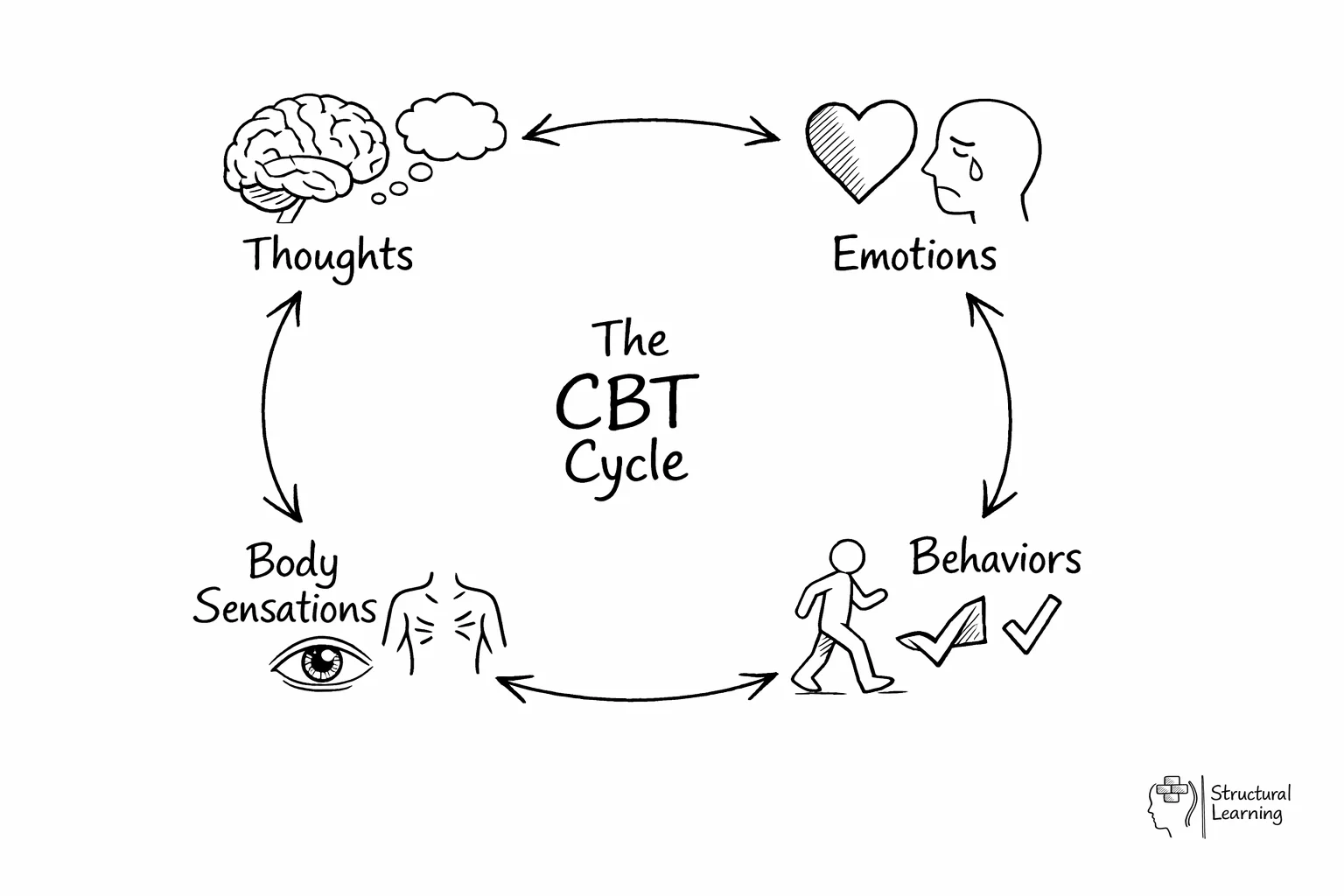
These thoughts are called cognitive distortions because they distort reality. If we can acknowledge and begin to transform unhelpful thinking styles, we have a good chance of changing our behaviour. These types of metacognitive beliefs provide us with a more significant, equipping us with a greater capacity for positive change.
CBT helps learners identify negative thought patterns and behaviours. This therapy is an effective treatment approach (Beck, 1976). It allows learners to change unhelpful habits (Butler et al., 2006). Research shows CBT improves well-being (David et al., 2018).
CBT is an effective therapy that helps people recognise and explore how their thoughts and emotions can affect their actions. After noticing such patterns, people may start learning how to build new coping strategies, behavioural techniques and change their behaviours.
Cognitive Behaviour Therapy helps learners change thinking and behaviour (Beck, 1976). This therapy includes strategies that target problematic patterns (Clark, 1999). Learners feel better when they address these issues (Butler et al, 2006).
CBT helps learners manage pain, anxiety, insomnia, and depression, studies suggest (Beck, 1976). Evidence shows it changes thinking patterns and behaviour (Burns, 1980). Many find CBT useful for improving their wellbeing (Butler et al., 2006).
Cognitive Behaviour Therapy works well for all learners. This includes young learners, adolescents, adults, and older adults. The therapy is flexible; researchers have proven it can be self-help, online, or face-to-face.
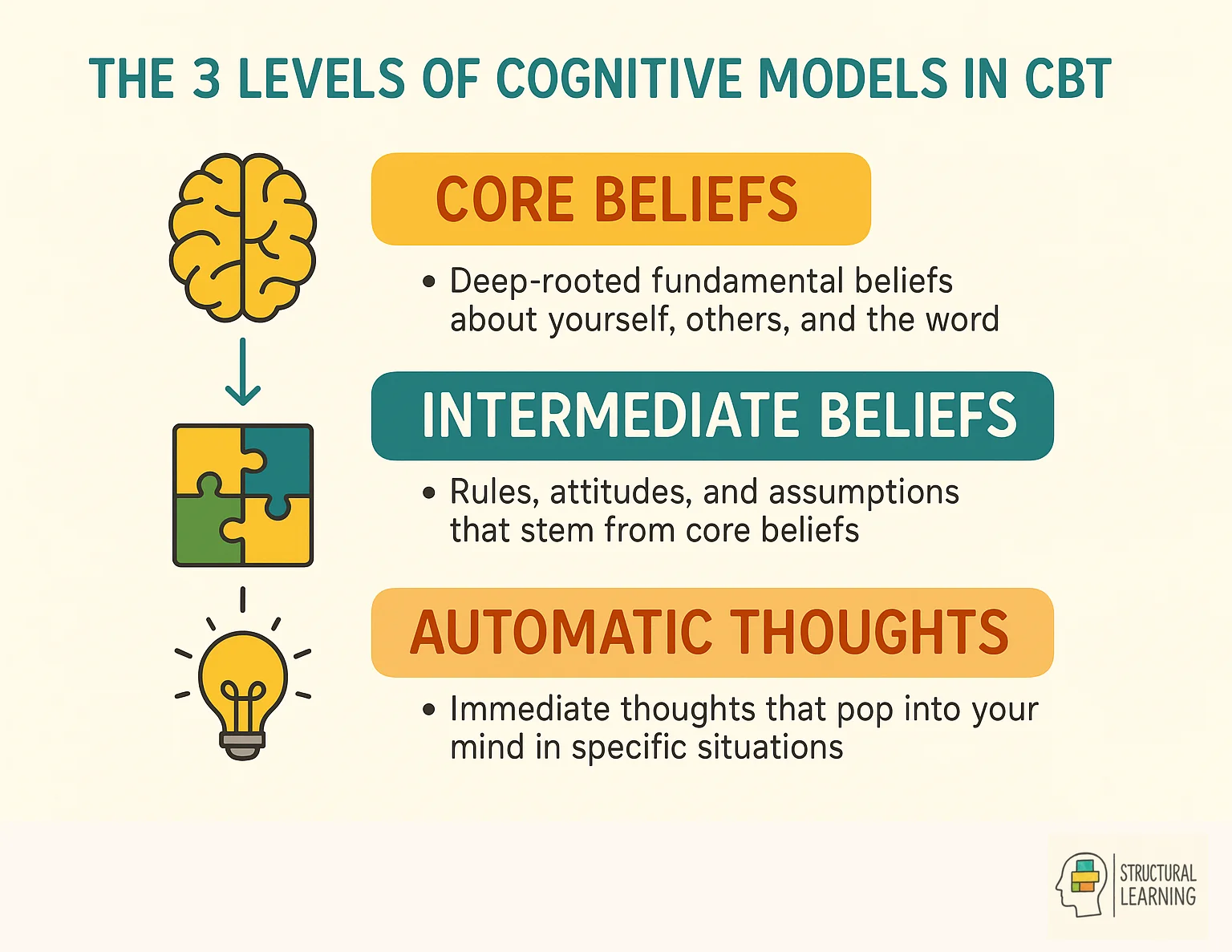
Therefore, we can assume that the classroom setting may not be effectively regulated if cognition is not considered at all. Researchers like Beck (1976) and Ellis (1962) presented cognitive-behavioural theory. This theory posits thinking shapes behaviour and feelings. Behavioural therapy suggests cognition impacts learning (Beck, 1976; Ellis, 1962). Ignoring cognition may hinder classroom management.
Different levels of the cognitive model are as follows:
Beck (1967) created the Cognitive Triad studying depression. It shows three negative thought patterns that worsen mood. Learners may view themselves negatively, like believing "I am worthless". They often see experiences negatively, confirming failures. They also expect a bleak future, feeling suffering is endless.
Beck (1979) found three components create a self-feeding cycle. A learner's negative view of themselves affects how they interpret experiences. This then shapes their expectations for the future. Beck (1979) said targeting these patterns gives quicker results than exploring the unconscious. Dobson's (1989) research confirmed CBT was better than drugs for depression.
Beck's triad helps teachers understand learners (Beck, 2011). Learners may dismiss praise, see errors as awful, and expect failure. Thought-records help: learners note the situation, thought, and a new view. These worksheets directly use Beck's model and have strong support.
Albert Ellis developed Rational Emotive Behaviour Therapy (REBT) in 1955, predating Beck's CBT by roughly a decade and establishing several of its foundational principles. Ellis (1962) proposed that emotional disturbance does not arise directly from events but from the irrational beliefs people hold about those events, captured in the ABC model. A stands for the Activating event (a low test mark), B for the Belief about it ("I must never fail; failing makes me worthless"), and C for the emotional and behavioural Consequence (shame, avoidance of further tests).
Beck used evidence to test beliefs. Ellis's REBT (1962) challenged irrational "musts" and "shoulds". Learners may demand approval or comfort. They might globally self-rate after one failure. Ellis added Disputing and Effective beliefs for classroom use.
Engels, Garnefski, and Diekstra (1993) showed REBT cuts irrational beliefs and anxiety in teenagers. The ABC model helps teachers in pastoral chats. Ask, "What did you tell yourself?". This helps learners spot mediating beliefs, a first change step.
Some effective techniques in Cognitive Behaviour Theory are as follows:
This process involves recognising and challenging negative thought patterns. Learners are encouraged to identify their automatic thoughts, evaluate the evidence for and against them, and develop more balanced and realistic perspectives. This can be particularly helpful for students struggling with anxiety or self-doubt.
This technique focuses on increasing engagement in activities that are enjoyable or meaningful. By encouraging learners to participate in positive experiences, teachers can help them improve their mood and sense of accomplishment. This is especially useful for addressing feelings of low mood or apathy.
This involves gradually exposing learners to feared situations or stimuli in a safe and controlled environment. This can help reduce anxiety and avoidance behaviours. For example, a student with social anxiety might start by practising conversations with a trusted teacher before engaging in larger group discussions.
Learners gain coping skills for tough situations. We teach problem-solving, assertiveness, and relaxation. This helps them manage emotions, say researchers (e.g., Lazarus & Folkman, 1984; Linehan, 1993; Kabat-Zinn, 1990). Teachers give learners practical tools for better behaviour.
Cognitive Behaviour Theory techniques can be easily applied in the classroom to provide support to learners.
Here are some key strategies for teachers to consider:By incorporating these practical strategies into their teaching practice, teachers can create a supportive and helping learning environment that promotes emotional well-being and academic success. This approach helps students develop resilience and equips them with the tools they need to thrive both inside and outside the classroom.
Cognitive behavioural strategies need structure but also flexibility (Beck, 1976). Adapt your approach for different learners and contexts. Teachers, foster emotional awareness and metacognitive thinking (Flavell, 1979).
The Five-Step Implementation Framework:
Story methods with characters' emotions work well for Key Stage 1 learners. "Worry Monsters" turn abstract thoughts into activities. Integrate CBT principles into PSHE for older Key Stage 3-4 learners. Use exam stress and social pressures as relevant scenarios.
Cross-curricular links can reinforce CBT principles in everyday lessons. In English, learners can analyse characters' thoughts and the consequences for their behaviour. In PE, discuss negative self-talk and how it affects performance. Science lessons exploring brain-body links can reinforce the same ideas.
Learners benefit when teachers model flexible thinking. Share your thinking out loud; for example, "I thought the lesson was failing. Then I realised lively discussion showed learning."
Several structured programmes translate CBT principles into school-ready curricula with robust evidence behind them. The FRIENDS programme, developed by Barrett (2004) and endorsed by the World Health Organisation, uses a group-based CBT format across ten sessions to build emotional resilience in children aged 4–12. The acronym stands for Feelings, Relaxation, I can do it, Explore solutions, Now reward yourself, Don't forget to practise, and Stay calm. A meta-analysis by Fisak, Richard, and Mann (2011) found FRIENDS produced significant reductions in anxiety symptoms with a moderate effect size (d = 0.43) compared with control conditions.
Coping Cat (Kendall, 1990) helps anxious learners aged 7–13, using 16 sessions. Sessions blend education, body awareness, thinking skills, and gradual exposure. Kendall et al. (1997) found 64% of treated learners recovered, versus 13% on a waiting list. Coping Koala, a UK version, had similar success in primary schools. Think Feel Do, based on CBT, is used widely in English schools.
MoodGYM reduces depressive symptoms for secondary learners (Calear et al., 2009). Teachers see better results when they use programme manuals (Durlak and DuPre, 2008). Schools should ask Educational Psychology for programme advice. Consider your learners and staff capacity.
CBT supports learner wellbeing, but teachers face classroom barriers. Understanding these issues and having solutions helps successful practice.

Time Constraints and Curriculum Pressure
Teachers struggle to find time in the busy curriculum. They must cover content, but also address learner wellbeing. Integrate CBT into existing lessons instead of adding extra tasks. Use starters for thought awareness (Beck, 1979), and plenaries for reflection (Ellis, 1962; Linehan, 1993).
Learner Resistance and Stigma
Learners might see emotional work as 'therapy' and resist it. Normalise language about thoughts and feelings to help. Frame activities as 'brain training' or 'mental fitness'. Share examples of successful people, like athletes, using these techniques. This makes them aspirational, not remedial.
Limited Training and Confidence
Teachers often feel unprepared for emotional discussions. They can use CBT basics safely with boundaries, (Beck, 1976). Set clear guidelines: focus on learning thoughts and actions. Ensure referral routes are ready for serious issues, (Burns, 1989). Maintain support and professional boundaries, (Dryden, 2017).
Practical Solutions:
In education, this theory focuses on the connection between a learner's thoughts, feelings, and actions. It suggests that by helping children recognise unhelpful thinking patterns, teachers can assist them in changing their responses to classroom challenges. This approach is often used to support emotional regulation and academic resilience.
Teaching learners to spot thinking traps during tough tasks is key. Cognitive restructuring helps learners check evidence for negative thoughts (Beck, 1979). Use behavioural activation to boost learner engagement in positive activities (Martell et al., 2010; Leahy, 2018).
These techniques help learners develop metacognition, allowing them to monitor and manage their own mental processes. By breaking the cycle of negative thoughts, students often show improved focus and a greater willingness to attempt challenging work. This leads to better academic progress and improved social interactions within the school.
Research indicates that CBT-based interventions in schools significantly reduce symptoms of anxiety and depression. Meta-analyses show large effect sizes for these programmes, while the Education Endowment Foundation notes that social and emotional learning can add four months of additional progress. The evidence suggests these strategies are effective across all age groups.
One frequent error is treating these strategies as a quick fix for complex behaviour issues without considering the underlying core beliefs. Another mistake is assuming that positive thinking is the same as cognitive restructuring, which actually requires a more rigorous evaluation of reality. Teachers should also ensure they do not overcomplicate the language when explaining these concepts to younger children.
Automatic thoughts are involuntary mental responses that occur in specific situations, such as a child thinking they are not smart enough after a difficult test. These thoughts can create significant barriers to learning by causing learners to withdraw from tasks or display avoidant behaviour. Recognising these patterns is the first step in helping a student build more balanced perspectives.
Cultural and Individual Differences
Learners' comfort with expressing feelings varies (Markus & Kitayama, 1991). Be culturally aware. Use relatable examples (Spencer-Oatey, 2000). Learners can express themselves artistically, in writing, or through movement (Gardner, 1983).
Remember that resistance often indicates where the work is most needed. Persistent, gentle integration of these practices, combined with visible teacher modelling, gradually builds a classroom culture where examining thoughts becomes as natural as checking one's work.
The third wave of cognitive behavioural therapies, which emerged in the 1990s and 2000s, shifted the therapeutic goal from eliminating negative thoughts to changing a person's relationship with those thoughts. Acceptance and Commitment Therapy (ACT), developed by Hayes, Strosahl, and Wilson (1999), argues that attempting to suppress or reason away unhelpful thoughts frequently intensifies them, a phenomenon Hayes termed "cognitive fusion." The alternative is "defusion": learning to observe thoughts as passing mental events rather than literal truths. A learner practising defusion might label an intrusive thought: "There goes the 'I'm going to fail' thought again", rather than treating it as fact.
ACT is built around six core psychological processes: acceptance, defusion, present-moment awareness, self-as-context, values clarification, and committed action. In educational research, Livheim et al.'s (2015) randomised trial of a school-based ACT programme found significant reductions in stress and mental health difficulties among Swedish adolescents. A systematic review by Swain, Hancock, Dixon, and Bowman (2015) identified ACT as a promising approach for adolescent anxiety and depression, noting that its emphasis on values, asking learners "what kind of student do you want to be?" rather than "how do you feel?", which can be particularly engaging for teenagers who resist emotion-focused work.
Segal, Williams, and Teasdale (2002) created MBCT, mixing mindfulness and CBT to help with depression. Kuyken et al. (2013) found the ".b" programme improved learner wellbeing in schools. Crane (2009) advises teachers start with short exercises, like breathing, after practising mindfulness themselves.
CBT helps us understand how thoughts, feelings, behaviours, and body sensations link. Teachers can use this to help learners challenge negative thoughts. Learners can develop coping strategies and build resilience (Beck, 1976; Ellis, 1962). This supportive environment boosts well-being and learning.
Integrating Cognitive Behaviour Theory into educational practices helps learners to take control of their mental and emotional health. By teaching them to recognise and manage their thoughts and feelings, educators can equip them with the skills they need to navigate challenges, build strong relationships, and achieve their full potential. Embracing CBT principles creates a culture of self-awareness and resilience that benefits the entire school community.
External References: EEF: Improving Behaviour in Schools | APA: Behavioural Science Research