Updated on
September 24, 2026
Zones of Regulation: A Teacher's Guide to Self-Regulation
A guide to the Zones of Regulation: the four zones with classroom examples, age-appropriate activities, adaptations for additional needs, and check-ins.


Updated on
September 24, 2026
A guide to the Zones of Regulation: the four zones with classroom examples, age-appropriate activities, adaptations for additional needs, and check-ins.
Use Leah Kuypers' (2011) Zones of Regulation to help learners manage feelings. This framework uses colours to teach self-regulation strategies that work daily. Support learners after breaks or during lessons using activities. Build a calmer classroom where every learner thrives with emotional learning.

This framework can improve emotional awareness, especially for learners struggling with regulation. (Brackett & Rivers, 2014; Izard, 2010; Russell, 2003). Each zone is a group of emotional and physical feelings, not just one feeling. Knowing this stops you from easily labelling emotions "good" or "bad".
A Year 2 teacher might introduce each zone over four consecutive weeks. During Blue Zone week, she reads "The Colour Monster" and asks learners to draw what Blue Zone feels like in their bodies. One child draws heavy arms; another draws closed eyes. The teacher says: "Those are both Blue Zone feelings, and that is completely normal. Sometimes we all feel tired or sad. The important thing is knowing what might help us." This normalisation prevents learners from hiding emotions they think are "wrong."
The Green Zone is often described as the "learning zone," but teachers should avoid calling it the "best" zone. A learner celebrating a birthday is in Yellow Zone, and that excitement is entirely appropriate. A firefighter in Red Zone during an emergency is using that heightened state effectively. The skill is matching your zone to the situation, not permanently residing in Green.
Select a learner's current zone and their sensory or emotional profile to receive three targeted regulation strategies, each with a ready-to-use teacher script. A practical companion to the four zones explained above.
The framework blends cognitive behaviour therapy, executive function, and sensory integration. The Zones teach practical self-regulation skills, not just rule following. Learners check their emotions and choose useful coping strategies. Blair and Raver (2015) review self-regulation as foundational for school readiness; Duckworth and Seligman (2005) found self-discipline predicted adolescent academic outcomes more strongly than IQ.
Interoception means noticing internal body signals, such as a racing heart. When learners do not notice these signals, they may find it hard to name their feelings. Kuypers built the Zones framework on interoception. This helps explain why some learners, especially those with autism, struggle to identify emotions.
Before teaching the four zones, spend two weeks on body awareness activities. Ask learners to place their hand on their chest after running on the spot. "What do you notice? Is your heart fast or slow? Are your muscles tight or loose?" These concrete physical observations build the sensory vocabulary learners need to later connect body states to emotional zones. A Year 4 teacher describes this as "giving children a dashboard for their own body, like the instruments in a car."
Murphy et al. (2019) found learners with better interoception regulated emotions well and had fewer issues. This makes interoception training essential, not extra. Try breathing with a hand on the belly (Murphy et al., 2019). Learners can squeeze and release fists, noting tension differences (Murphy et al., 2019). They can also drink cold water and sense it (Murphy et al., 2019).
The Zones framework can work in every education phase. However, the activities must match how learners develop. Reception learners need physical, sensory experiences, (Kuypers, 2011). Year 9 learners need metacognitive challenges, which help them think about their own thinking, and practical applications, (Kuypers, 2011).
Young children think in concrete terms. Use picture books, puppets, and role-play rather than abstract discussion. Read "The Colour Monster" by Anna Llenas, then sort emotion pictures into zone-coloured boxes. Create a "feelings weather forecast" where children move their name peg to sunny (Green), cloudy (Blue), windy (Yellow), or stormy (Red) each morning. The teacher models this first: "I am in Yellow Zone this morning because I am a bit worried about our assembly. I am going to take three deep breaths to help me move towards Green."
Sensory regulation tools for Early Years include playdough, water play, rocking chairs, weighted lap pads, and quiet corners with cushions. Keep regulation stations visible and accessible so children learn to self-select tools without adult prompting.
Learners at this stage can begin naming specific emotions within each zone and connecting triggers to zone changes. Use "zone detective" activities where learners identify characters' zones in stories. Create class zone charts where learners place their photo card each morning. Introduce simple regulation strategies: belly breathing, counting to ten, asking for a break, drawing feelings.
A Year 1 teacher describes a successful routine: "Every Monday, we do 'Weekend Zones.' Children share one moment from their weekend and identify which zone they were in. Last week, Amara said she was in Yellow Zone when her baby brother cried all night. We talked about what helped her cope. The other children offered suggestions from their toolboxes. It builds empathy alongside self-awareness."
Older primary learners can handle more sophisticated metacognitive work. Introduce the concept of "expected" versus "unexpected" behaviours in different contexts. A learner in Yellow Zone (excited) at a football match is expected; the same state during a library session is unexpected. This builds social awareness without shaming emotions.
Use zone journals where learners track their zones across a week, identifying patterns and triggers. Many discover that certain subjects, times of day, or social situations reliably shift their zones. A Year 5 learner might notice: "I always go to Yellow before maths tests, but breathing exercises move me back to Green by question three." This evidence-based self-awareness is powerful.
Activities include: creating comic strips showing zone transitions, designing posters of regulation strategies, peer coaching ("I noticed you looked Yellow Zone during group work. Would you like to use a strategy?"), and whole-class discussions about managing zones during SATs preparation.
Teenagers often resist programmes they see as childish. Frame Zones in terms of performance, resilience, and real-world use. Athletes use zone awareness to manage nerves before competition.
| Blue Zone | Green Zone | Yellow Zone | Red Zone |
|---|---|---|---|
| Sad, tired, bored, sick, withdrawn | Calm, focussed, happy, content, ready to learn | Frustrated, anxious, excited, silly, nervous | Angry, terrified, out of control, elated, aggressive |
| Body signals: Slumped posture, slow movements, yawning, heavy limbs | Body signals: Relaxed muscles, steady breathing, upright posture, eye contact | Body signals: Fidgeting, rapid speech, bouncing, tight jaw, butterflies | Body signals: Clenched fists, racing heart, shaking, tears, shouting |
| Classroom example: A learner arrives Monday morning after a disrupted weekend, head on desk, not engaging | Classroom example: A learner listens to instructions, begins work independently, asks for help when stuck | Classroom example: A learner who has just been told about a surprise trip cannot sit still, calling out excitedly | Classroom example: A learner throws their book across the room after struggling with a maths problem |
Surgeons regulate their zones during high-pressure operations. Musicians shift from Yellow Zone excitement backstage to Green Zone focus onstage.
Use case studies and discussion rather than worksheets. Explore how social media affects zones, how exam stress creates Yellow-to-Red spirals, and how sleep deprivation keeps learners stuck in Blue. Connect Zones to GCSE PSHE content on mental health and wellbeing. Secondary learners can also mentor younger children in Zones work, reinforcing their own understanding through teaching.
The toolbox is where Zones moves from theory to practise. Each learner creates a personalised collection of strategies that help them shift between zones. The key word is "personalised": what calms one child may agitate another. Deep breathing works for many learners but can increase anxiety in some children with trauma histories.
In practice, a Year 3 teacher gives each learner a laminated toolbox card that lives inside their tray. When a learner feels themselves shifting zones, they check their card and choose a strategy. The teacher says: "I have noticed you are looking a bit Yellow Zone, Jayden. Would you like to check your toolbox?" Over time, learners begin checking independently, which is the ultimate goal: self-initiated regulation without adult prompting.
Sensory tools are important because they help learners manage their bodies and attention. Sensory circuits structure activities through alerting, organising, and calming inputs.
Weighted blankets, fidgets, resistance bands, and chew necklaces can all help learners self-regulate. (Occupational therapists advise on individual sensory profiles). These are functional tools to support learning, not rewards.
Kuypers (2011), the creator of The Zones of Regulation, presented a curriculum for teaching self-regulation; current official materials state that the framework supports neurodivergent and neurotypical learners. Teachers may need to adjust standard implementation. A single approach won't suit every learner's needs (Kuypers, 2011).
Alexithymia affects many autistic learners, making it hard to name feelings. Colour-coded visuals can help, but they must not become a demand to perform "normal" emotion. Milton's (2012) double empathy account reminds teachers that communication mismatch is shared; adults should adapt as well as learners.
A neurodiversity-affirming version of Zones does not define Green as sitting still, looking at the adult and staying quiet. A learner may be regulated while rocking, doodling, using ear defenders or avoiding eye contact. Hull et al. (2020) show that autistic masking can carry social and mental health costs, so do not reward learners for hiding distress.
Sensory processing overload can look like emotional dysregulation, but the response is different. A learner who is hyposensitive to proprioceptive input might need heavy work, such as carrying books or wall push-ups. A learner who is hypersensitive to sound may need ear defenders, a quieter seat or warning before noisy transitions. Work with the learner and family to identify what helps in real classrooms.
Learners with ADHD often cycle rapidly between zones and may struggle to notice zone changes before reaching Red. Build in more frequent check-in points (every 15 minutes rather than twice daily) and use visual timers so learners can anticipate transitions, which are common zone triggers. Movement-based regulation strategies, such as a brief walk, chair push-ups, or standing desks, work well because they address the physiological need for stimulation.
Executive function difficulties mean that ADHD learners may know their strategies but fail to access them in the moment. Visual cue cards on desks, regulation strategy posters at eye level, and teacher prompts ("Which zone are you in right now?") provide the external scaffolding until internal regulation develops. Scaffolding should be gradually faded as the learner builds independent regulation skills.
Learners with anxiety may appear to be in Green Zone (quiet, compliant) while internally experiencing Yellow or Red. Teach these learners to attend to internal body signals rather than relying on behavioural observation alone. A learner with social anxiety might report: "My stomach feels tight and my hands are sweaty, so I think I am actually in Yellow Zone even though I look calm." This interoceptive honesty is a significant achievement.
The Zones framework can support learners with SEMH needs. It avoids public shaming and helps learners reflect on their own emotions. Use Zones alongside emotional literacy work and EHCP strategies. If Zones difficulties persist, address them through SEND support using Assess-Plan-Do-Review. (Kuypers, 2011)
Consistent routines turn Zones from a one-off lesson into an embedded habit. Do not assume Green is the default starting state. In England, persistent absence remains above pre-pandemic levels, and the Children's Commissioner for England (2025) links attendance concerns with wider stress, SEND and support pressures.
Use check-ins to decide the first teaching move, not to collect labels. A class with many Blue or Yellow responses may need movement, a quiet entry routine or a lower task demand before new content.
Morning check-in (2 minutes): As learners enter, they move their name card or peg to their current zone on a class display. The teacher briefly acknowledges: "I can see we have a few people in Blue Zone this morning. That is completely fine. Let us do a quick stretch to help us all move towards Green." No learner is singled out; the focus is on collective awareness.
After-break check-in (1 minute): Learners hold up zone-coloured cards or use a hand signal (1 finger = Blue, 2 = Green, 3 = Yellow, 4 = Red). The teacher scans the room and offers targeted support: a quiet word with the learner showing Red, a regulation strategy suggestion for those in Yellow.
End-of-day reflection (3 minutes): Learners record their zone process in a simple journal. "I started in Blue, moved to Green during art, went to Yellow when we had the fire alarm, and ended in Green." Over time, these journals reveal patterns that inform individual support plans and provision mapping.
If your school tracks Zones implementation, record baseline behaviour incidents, ELSA referrals and attendance concerns before rollout. Review the same measures each half-term and pair them with staff notes and learner voice. Avoid presenting local reductions as proof that Zones caused the change unless other factors, such as staffing, timetable changes and additional SEND support, have been considered.
Learners need co-regulation before self-regulation. Attuned adults model calm and validate emotions. Vygotsky (1978) argued that social support helps learners work within their zone of proximal development. Over time, they internalise these shared regulation routines and use them with less adult support.
In practice, co-regulation starts with the adult's state. A Year 1 learner enters Red Zone after a playground conflict. The teacher does not say "Calm down", because that dismisses the feeling and rarely works.
Instead, she says: "I can see you are really angry. That is Red Zone. I will sit here while your body calms. Let us breathe together." After 2-3 minutes, the learner's breathing slows. The teacher then says: "You are moving towards Yellow. When you are ready, we can talk about what happened."
The "validate, co-regulate, reflect" sequence supports Zones success.
As learners develop, adults provide regulatory support.
Zones works best as a whole-school approach rather than isolated classroom practice. In a Multi-Academy Trust, this does not mean every school uses the same poster. It means every adult uses the same principles: no bad zones, private check-ins, co-regulation before reflection, and age-appropriate language.
Primary schools may use colour displays. Secondary schools may use a 1-10 regulation dial, exam stress check-ins or subject examples. The shared policy should protect dignity while giving staff a common script.
Phase 1 (Term 1): Foundation. Train all staff in the four zones, body signals, and regulation strategies. Display zone posters in every classroom, corridor, dining hall, and playground. Introduce morning check-ins across all year groups. Send parent information packs home explaining the zone language.
Phase 2 (Term 2): Deepening. Teach the full 18-lesson curriculum during PSHE time. Create regulation stations in classrooms and begin personal toolbox development.
Introduce zone journals for KS2. Train lunchtime supervisors and teaching assistants in co-regulation techniques, which are ways adults help learners calm and organise themselves.
Phase 3 (Term 3): Embedding. Integrate zone language into behaviour policies, provision maps, and EHCP targets. Use zone data to inform pastoral support. Train learner "zone ambassadors" who model and support peers. Review and refine based on staff and learner feedback.
Schools often lose momentum when they rush implementation and try to cover everything in a half-day INSET. Staff may start with enthusiasm, but practice can soon become uneven. Sustainable change needs a phased rollout, with ongoing coaching and reflection. Use at least one staff meeting each half-term to share successes, solve problems and maintain momentum.
Start with the principle that there are no bad zones. Delahooke (2019) warns that behaviour is often a stress signal, not a simple choice to defy an adult. If staff use the display to push learners "back to Green", the framework becomes compliance management and Red or Yellow starts to feel shameful. Use zone language to ask what support is needed, not to rank learners' behaviour.
Mistake 1: Treating zones as behaviour management. Zones is a self-awareness curriculum, not a public traffic-light system. Do not ask, "Why are you in Red?" across the room or require a learner to move their name back to Green before they can rejoin learning. Instead, ask privately, "What is your body telling you, and what support would help?" That keeps Yellow and Red as valid states rather than labels for poor behaviour.
Mistake 2: Ignoring the Blue Zone. Schools tend to focus on Yellow and Red because these zones create visible classroom disruption. Blue Zone, characterised by withdrawal, sadness, and low energy, is equally important but easier to overlook because Blue Zone learners are quiet. A child who spends most of their day in Blue Zone may be experiencing depression, bereavement, or neglect. Check in with quiet learners as diligently as you respond to loud ones.
Mistake 3: One-size-fits-all toolboxes. Giving every learner the same list of regulation strategies misses individual differences. Deep breathing helps most children, but it can trigger panic in some trauma-affected learners.
Fidget spinners help some learners focus, but they distract others. Each learner's toolbox should be built through trial and observation.
Mistake 4: Adults not modelling zone awareness. Learners learn more from what teachers do than what they say. When a teacher says "I am feeling Yellow Zone because the photocopier has jammed again, so I am going to take three breaths before I deal with it," learners see that adults experience zone changes too and that regulation is a lifelong practise, not something only children need to learn.
Mistake 5: Rushing the curriculum. The 18 lessons are designed to be taught over a term, not crammed into a week. Each concept needs time for practise, discussion, and consolidation. Learners need to experience zone changes in real situations and practise their strategies before moving to the next concept. Spaced practice applies to emotional learning just as it does to academic content.
Measuring self-regulation progress needs different tools from academic assessment. Standardised tests cannot show if a learner who used to throw chairs when frustrated now asks for a break instead. Teachers need both qualitative and quantitative approaches.
Zone frequency tracking: Record how often each learner enters Yellow and Red zones across a week. Over a half-term, a decreasing trend indicates developing regulation skills. This data also identifies triggers: if a learner consistently enters Yellow Zone on Thursday afternoons, investigate what happens at that time.
Strategy use observation: Note which regulation strategies learners select and whether they use them independently or with prompting. A learner who initially needed adult direction to use belly breathing but now reaches for their fidget tool unprompted has made significant progress.
Self-assessment scales: KS2 learners can rate their own regulation skills termly using simple scales: "How well can you identify your zone? How often do you use your toolbox without being reminded? How quickly can you return to Green Zone?" These develop metacognitive self-awareness alongside providing assessment data.
| Zone Shift Needed | Calming Strategies (to Green) | Alerting Strategies (to Green) |
|---|---|---|
| Red to Green | Safe space, cold water on wrists, heavy work (pushing against wall), counting backwards from 20 | N/A (Red always needs calming first) |
| Yellow to Green | Belly breathing, fidget tools, drawing, listening to music, talking to a trusted adult | N/A |
| Blue to Green | N/A | Stretching, a drink of water, a short walk, talking to a friend, a quick game, crunchy snack |
Check behaviour logs before and after Zones work, but report the data carefully. A fall in serious incidents may reflect better co-regulation, but it may also reflect timetable changes, staffing, exclusions or recording practice. Use the figures as a prompt for review, not as a stand-alone claim of impact.
Learner progress meetings, EHCP reviews, and Boxall Profile assessments can use this data. It gives clear evidence of social-emotional growth. This evidence supports academic tracking efforts.
Self-regulation skills transfer best when home and school use consistent language and approaches. Share the zone framework with parents through workshops, leaflets, or short videos. Many parents find Zones helpful for their own emotional awareness, not just their child's.
Practical suggestions for parents include: using zone language during everyday moments ("You seem a bit Blue Zone after school today. Would a snack and some quiet time help?"), creating a home regulation corner with favourite calming items, and avoiding zone language as a criticism ("Stop being so Red Zone!"). The family car is an excellent place for zone check-ins because the reduced eye contact makes emotional conversation easier for many children.
Send home a simple "Zones at Home" card listing the four zones with suggested family-friendly strategies. Parents report that shared zone language reduces conflict because it depersonalises emotions. Instead of "You are being naughty," a parent can say "I think we are both in Yellow Zone right now. Let us find a way to get back to Green together." This reframes the interaction from confrontation to collaboration.
Leah Kuypers developed the Zones of Regulation from four areas of practice and research. These are occupational therapy practice, cognitive behaviour therapy, sensory integration theory, and executive function research. The official 2024 materials now link the curriculum with neurodiversity-affirming language and flexible regulation supports (The Zones of Regulation, 2024).
The wider evidence for social and emotional learning is stronger than the direct evidence for this specific programme. The Education Endowment Foundation (2021) reports an average gain of four months for social and emotional learning interventions in primary schools. Cipriano et al. (2023) also reviewed 424 universal school-based SEL studies across 53 countries.
For the Zones programme itself, Mason, Leaf and Gerhardt (2024) warn that many schools have adopted it before strong peer-reviewed outcome evidence is in place. Schools should therefore use local behaviour logs, ELSA referrals and staff reports with care. Treat them as evidence of implementation, not as proof that the programme alone caused improvement.
Use the evidence honestly. It is best to describe Zones as a shared language for interoception, co-regulation and choosing strategies. Treat Vygotsky as a key theorist of social support and internalisation. Do not present him as a direct researcher of the Zones curriculum.
AI tools should not be used to infer a learner's zone from face scans or biometric monitoring as a routine classroom practice. Emotional state is contextual and should be discussed with the learner, not inferred by a dashboard.
Low-risk AI use is different. A teacher might use a planning tool to draft age-appropriate zone scenarios, translate a parent leaflet, or summarise anonymous whole-class check-in trends. The human decision remains with staff who know the learner.
For SEND learners, biometric monitoring adds consent and privacy risks. If a school uses wearable data for an individual plan, it should be agreed with parents, the learner and relevant professionals, with a clear purpose and review date. In most classrooms, paper check-ins, observation and trusted adult relationships are safer.
The strongest use of technology is to reduce teacher workload around planning and reflection. It should not replace co-regulation or turn emotion into surveillance.
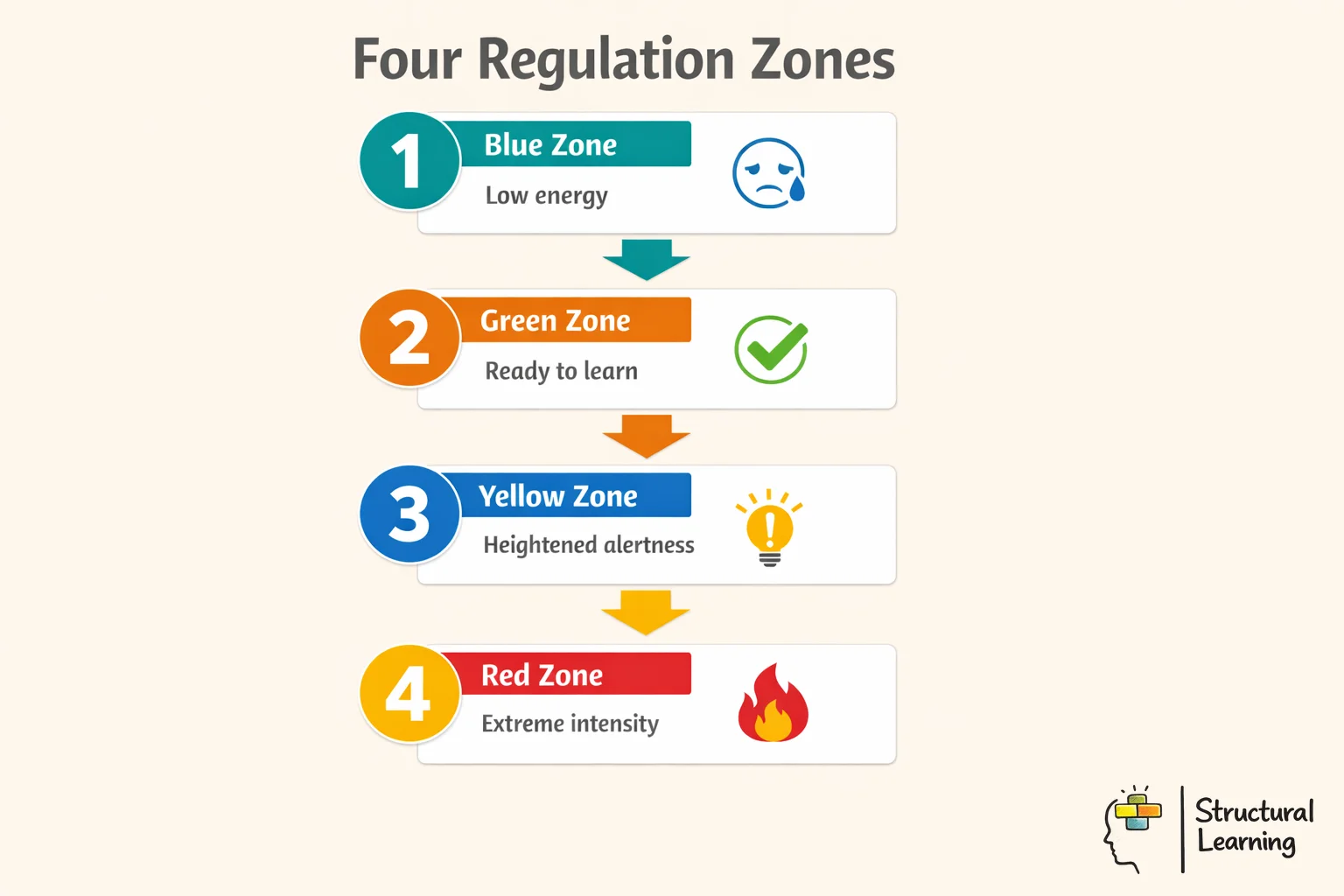
Kuypers' framework sorts emotions and states of alertness into four colour-coded zones: Blue, Green, Yellow and Red. Blue means low energy, Green means ready for learning, Yellow means raised alertness with some control, and Red means very high arousal or overwhelm. The point is not to stay Green all day. The point is to notice the state and choose a strategy.
The Blue Zone represents low states of alertness where learners feel tired, sad, bored, or unwell. You might notice a child in the Blue Zone slumped at their desk, moving slowly, or struggling to engage with learning activities. The Green Zone is the optimal state for learning; learners feel calm, focussed, happy, and ready to work. This is where we want children to be during most academic tasks.
The Yellow Zone indicates heightened states of alertness and raised emotions. Learners might feel excited, nervous, frustrated, or silly; they're still in control but need support to avoid escalating. A child bouncing in their seat before PE or becoming increasingly fidgety during a challenging maths problem is likely in Yellow. The Red Zone represents extremely heightened states where learners experience intense emotions like anger, terror, or elation that feel out of control.
Barrett (2017) argues that emotions are built from body signals, language, context and past experience. This creates a useful caution for teachers: the zones are a starting map, not a full account of emotion. Pair colour language with specific words such as jealous, disappointed, proud, ashamed, frightened and overstimulated.
Jealousy, for example, is not always one zone. It may sit in Yellow when a learner feels unsettled, Red when it becomes rage, or Blue when it turns into withdrawal. Ask, "How strong is it, where do you feel it in your body, and what would help?"
Before learners can regulate their own emotions, they need to experience co-regulation through your calm, attuned presence. When a Year 3 learner storms into your classroom in the Red Zone after a playground dispute, your regulated nervous system becomes their external anchor. This biological process, grounded in polyvagal theory, shows how children literally 'borrow' your calm state through mirror neurons and shared breathing patterns.
Co-regulation looks different across age groups. With Reception learners, you might sit at their eye level, match their breathing pace, then gradually slow your own breaths whilst narrating: 'I can see you're feeling really big feelings right now. Let's take three rainbow breaths together.' For older primary learners, standing alongside them whilst looking at a Zones display provides connection without overwhelming eye contact: 'I'm noticing your body looks quite Yellow right now; your shoulders are up by your ears. Shall we do some wall push-ups together?'
The most powerful co-regulation happens during ordinary moments, not just crisis points. When reading a story, pause to model Zone awareness: 'This character seems to be moving from Green to Yellow. I wonder what's happening in their body?' During transitions, narrate your own regulation: 'I'm feeling a bit Blue after lunch, so I'm going to do five star jumps to help my brain wake up.' These micro-moments teach learners that adults also move through zones and actively choose strategies.
Research by Dr. Bruce Perry emphasises that children need thousands of repetitions of co-regulation before developing independent skills. Track your co-regulation moments using simple tally marks in your planner, aiming for at least ten brief connections daily with learners who struggle most with self-regulation.
Zones displays are working resources, not just posters. Many teachers first meet the framework through Twinkl resources, Salmons Brook School examples, Thomas Whitehead CE Academy materials, The West Park Academy guidance or YouTube clips. Treat those as starting points. Your display still needs local examples, learner language and strategies that match your school.
A working Zones display usually has four clear layers. These are zone posters, which are colour-coded and show the four emotional states, emotion vocabulary cards, which give words for each zone, strategy cards, which show techniques learners can use, and self-check strips, which are quick visual scales for daily reflection.
Instead of using one large poster, consider a modular display with A4 laminated cards. You can rearrange these cards as part of your teaching. This keeps the display interactive. It also helps stop it becoming visual wallpaper that learners ignore after week three.
Zone Posters (Colour-Coded): Each of the four zones, Blue (low arousal), Green (optimal regulation), Yellow (raised arousal), and Red (high arousal), should have its own clearly labelled poster featuring colour, visual metaphors, and age-appropriate imagery. For younger learners (EYFS and KS1), use simple illustrations: a sleeping animal for Blue, a focused learner for Green, a busy bee or traffic light for Yellow, and an exploding volcano for Red. For older learners (KS2 and KS3), include more precise images: learners might appear tired but safe in Blue, confident and ready in Green, slightly fidgety in Yellow, and overwhelmed or angry in Red. These posters should remain static and serve as reference points for the other display elements.
Emotion Vocabulary Cards: Create laminated cards (A6 or A5 size) listing emotions that belong in each zone. This is important because many learners, particularly those with language processing difficulties or on the autism spectrum, struggle to name their feelings with precision. Your Blue zone might include: tired, sleepy, bored, withdrawn, daydreaming, stuck. Your Green zone: calm, focused, happy, ready, confident, safe. Your Yellow zone: frustrated, impatient, excited, worried, annoyed, energetic. Your Red zone: furious, terrified, overwhelmed, panicked, destructive, out of control. Update these cards as you discover words that resonate with your specific learner group. Teachers often add sticky notes with phrases learners have used: "my brain feels fuzzy" (Blue), "my stomach feels tight" (Yellow), "my heart is racing" (Red).
Strategy Cards: These are the most practical component of your display. For each zone, create 4, 6 strategy cards showing concrete, named techniques. Blue strategies might include: drink water, move around, stretch, listen to upbeat music, do a dance. Green strategies: deep breathing, problem-solving, focusing work, helping a friend. Yellow strategies: take three deep breaths, count backwards from ten, go for a walk, do five star jumps, squeeze a stress ball. Red strategies: step outside, ask for help, take a break, write or draw about feelings, press palms together hard. Include simple line drawings or photographs showing each strategy in action, a picture of a child stretching, someone drinking water, a breathing visual. Laminate these and display them prominently; many learners will look at the strategy cards before approaching you for help, creating independence in their regulation.
Self-Check Strips: Create a small visual strip, a colour scale or thermometer, that learners can point to or place a peg on to indicate their current zone. This takes 10 seconds and gives you real-time insight into classroom emotional weather. Some teachers use a simple four-colour strip stuck to a clipboard near the door; learners point to their zone as they enter. Others create individual strips in each learner's folder or visual timetable. Self-check strips work best when used consistently: "Before we start, show me your zone on the strip" becomes a quick daily ritual.
Use a regulation station near your Zones display. Learners can independently use strategy cards there. Include items like stress balls and quiet music. Learners in Yellow or Red zones use it without asking. This makes regulation proactive, not reactive. Shanker and Barker (2016) argue in Self-Reg that reducing stressors and using self-regulation strategies can help children manage dysregulation.
Teachers often report that linking the Zones framework to Pixar's Inside Out films greatly increases learner engagement and vocabulary recall. In Inside Out, Riley has five emotions shown as characters: Joy (Yellow/excited), Sadness (Blue/withdrawn), Anger (Red/explosive), Disgust (Yellow/frustrated), and Fear (Red/anxious). The Zones framework uses four zones, but these characters give learners, especially those aged 6-12, familiar and memorable anchors.
You can create display cards with Inside Out characters alongside Zones vocabulary. Place Joy near Green (joy = calm focus), Sadness near Blue (sadness = low energy), Anger near Red (anger = high arousal), and Fear near both Yellow and Red (fear can be excited nervousness or panic). Many teachers find that saying, "Right now, you're in your Anger (Red zone), like how Anger feels in the film when things go wrong" helps learners understand straight away. The Inside Out link also helps conversations with parents: "We're learning about the Zones, just like in Inside Out" is language most families recognise and can reinforce at home.
Effective displays are updated, not static. Every 4, 6 weeks, review your strategy cards and remove any that learners aren't using; replace them with new ones based on your observations. Add new emotion words as learners expand their vocabulary. If you notice a particular strategy working well for a learner or group, photograph it in action and add it to your display. This keeps the display responsive to your learner group's actual needs rather than a generic template. Involving learners in creating and updating the display, asking them to draw their own zone pictures, suggest new strategy ideas, or redesign the emotion word cards, deepens their ownership and understanding of the framework.
Printable activities help learners identify their zone and practise strategies. These five activities require no prep.
What it is: A card-sorting activity where learners match emotion words, scenario cards, or behaviour images to the four zones. This builds foundational recognition of the framework and practises the vocabulary repeatedly in a game format that feels low-stakes.
How to use it: Print two sets of cards: one set shows the four zones (colour-coded), the second shows emotion words, scenario descriptions, or pictures of learners in different states. Laminate both sets. Shuffle the emotion/scenario cards and place them face-up on the table. Learners take turns picking a card and placing it under the correct zone. For example, they might sort "daydreaming" under Blue, "excited" under Yellow, "angry" under Red. KS1 learners can use picture-based cards (a tired face, a focused child, a frustrated child, an angry child); KS2 learners work with emotion words and written scenarios ("Your friend didn't include you at lunch" or "You just won a race"). Play in pairs or small groups; the learner with the most correct sorts wins. This activity typically takes 10, 15 minutes and can be repeated monthly with new or shuffled cards to maintain engagement.
Zone targets: All four zones. This activity builds recognition without requiring learners to self-identify their own zone yet, a important stepping stone.
Learners use a visual scale (1-10 or colours) to show emotion intensity. It is a key skill for self-advocacy ("I'm very upset, I need help").
| Age Group | Display Focus | Key Elements | Vocabulary Complexity |
|---|---|---|---|
| EYFS (Nursery & Reception) | Colour and pictures first, words second | Large, bright zone posters; animal or character metaphors (sleeping bear for Blue, busy bee for Yellow); simple strategy pictures (water bottle, movement, music); physical regulation station essential | Single-word labels: tired, happy, excited, angry. Heavy reliance on gesture and action rather than naming. |
| KS1 (Year 1, 2) | Colour + emotion words + strategies | Colour-coded posters with emotion words; strategy cards with pictures and one-word labels; self-check strip; Inside Out character cards as reference | 3, 5 words per zone; familiar, concrete emotions: sleepy, calm, silly, sad, cross, scared. Begin naming physical sensations: "my body is calm" vs. "my body is wiggly". |
| KS2 (Year 3, 6) | Vocabulary richness + strategy choice + reflection | Emotion vocabulary cards with 6, 10 words per zone; strategy cards with more complex techniques (journalling, breathing patterns with counts, problem-solving steps); self-check thermometer; reflection prompts ("What zone am I in? What got me here? What will help?") | More precise words: frustrated, anxious, determined, content, overwhelmed. Include intensity markers: "a tiny bit frustrated" vs. "very frustrated". Begin exploring how the same event triggers different zones in different learners. |
| KS3+ (Year 7+) | Self-awareness + metacognition + peer support | Emotion words with synonym webs (show relationships: calm ↔ peaceful ↔ serene); strategy cards including cognitive techniques (reframing thoughts, identifying triggers, planning); self-check scale with intensity ratings (1, 10); visual showing links between physical sensations and emotions | Complex, contextual language: apprehensive, restless, exhilarated, resigned, panicked. Explicitly teach that the same feeling word means different things in different zones (e.g., "excited" in Green = motivated; "excited" in Yellow = can't focus). |
How to use it: Print a large thermometer image showing the four zones, with numbers 1, 10 or colour intensity markers. Laminate it and display it, or print individual copies for learners' folders. Use this daily: "Point to your thermometer. Show me where you are right now." Some learners will use it to self-check; others will use it when you ask. Over time, learners begin voluntarily saying, "I'm a 7 on the thermometer, I'm getting frustrated" without being prompted. This shifts responsibility for noticing regulation from teacher to learner. Include a simple recording sheet: three columns (Time, Zone, Thermometer Rating, What Helped). Learners fill this in once or twice daily, building a personal record of their patterns. After 2, 3 weeks, review the sheet together: "Look, every time you play football, you end up in Yellow at a 6. What happens? What could we try?" This creates evidence-based conversations about regulation rather than reactive responses to behaviour.
Zone targets: All four zones. This activity is particularly useful for Yellow and Red zones, where learners often lack awareness of intensity until they are dysregulated.
What it is: A printable activity that teaches four different breathing techniques, each tagged to a specific zone as a regulatory tool. Breathing is the most accessible self-regulation strategy and works across all ages and abilities.
How to use it: Print a sheet showing four simple breathing techniques: Sleepy Breaths (slow, long exhales, for Blue/low energy), Calm Breaths (4-count in, 6-count out, for Green/maintenance), Alert Breaths (quick sniffs, for Yellow/rebuilding focus), and Reset Breaths (forceful exhales, for Red/releasing tension). Each technique includes a simple visual: a sleeping face for Sleepy Breaths, a balanced scale for Calm Breaths, a focused face for Alert Breaths, and a relaxed face for Reset Breaths. Teach learners how to practise each one during calm moments, so they have a familiar tool when dysregulated. Create a laminated reference card for your regulation station or each learner's desk. Practise the breaths as a whole class during transition times (before lunch, before quiet work) so they become automatic.
Zone targets: All four zones. Blue (energy boost), Green (maintenance), Yellow (refocus), Red (release).
What it is: A simple printable template that learners use to record an event when they moved between zones, reflect on what triggered the change, and identify what helped them regulate. This builds metacognitive awareness, understanding their own regulation patterns, over time.
How to use it: Print a one-page template with sections: "What happened?" (space to draw or write), "What zone did I start in?" (colour options), "What zone did I end up in?" (colour options), "What helped me?" (list of strategies), "What will I try next time?" (reflection). Learners complete one entry per week, or more frequently if you have a small group working on regulation as a specific target. The journal is not punishment, it is reflection. Use it in calm moments, not immediately after dysregulation when the learner is still upset. After 4, 5 entries, review the journal together and look for patterns: "Every time we have to wait, you get frustrated. What's happening? What could help?" This activity builds learner agency and gives you invaluable insight into individual regulation triggers and preferred strategies. Some teachers photograph completed journals and send them home to parents: "Look at what [name] is learning about their zones," which creates home-school consistency.
Zone targets: Primarily Yellow and Red (transitions between zones), though it can also capture Green to Yellow shifts when learners are beginning to dysregulate.
What it is: A whole-class daily ritual where every learner indicates their current zone on a shared visual thermometer. This creates a quick emotional weather report for your classroom and helps you identify who might need support before the day begins.
How to use it: Print a large four-zone thermometer or wheel and laminate it. Each morning (or at a transition point like after lunch), display it and ask learners to point to or place a sticky dot on their current zone. Do not force accuracy, a learner in Red might refuse to engage, and that's okay. The goal is to make zone-checking a visible, normalised part of classroom life. Review the thermometer quickly: "I see we have lots of Green this morning, two in Yellow, and one in Blue. Blue, that's you, do you need anything? Yellow friends, great energy, let's use that." This takes 2 minutes but signals that emotional states are normal, visible, and that you are responsive. Over time, learners begin reading the class thermometer themselves: "Miss, we're quite a Yellow class today, can we do some movement?" This shifts from teacher-directed regulation to learner awareness of collective emotional needs. Keep a simple record: sticky dots from each day in a folder, or a tally chart. After 4 weeks, you can see trends: "We're always more Yellow on Friday. What's happening? Is it excitement about the weekend? Does Friday's timetable need a tweak?"
Zone targets apply across the board. The activity helps learners get to know the framework and builds emotional awareness (Brackett, Rivers & Salovey, 2011).
Print activities on card stock if possible (more durable than paper). Laminate everything except reflection journals (use laminate sheets, not a machine, so you can add sticky dots and write on them with dry-wipe pens). Store activities in a labelled folder or box near your regulation station for easy access. Create multiple copies of card-sorting games so you can run them simultaneously in small groups. Update activities termly: retire ones that aren't used, refresh worn lamination, add new emotion words or strategies based on your learner group's needs. The most successful classrooms treat these resources as living tools, not one-time lessons. They appear regularly in transitions, small-group work, and individual check-ins throughout the year, building cumulative familiarity and automaticity.
Most Zones of Regulation resources were designed for primary-aged children. Colour-coded posters, cartoon faces and simple language can work well for five-year-olds. But a fourteen-year-old in a Pupil Referral Unit may switch off as soon as they see them.
SENCOs in secondary schools and alternative provision settings often report the same issue. The framework itself is sound, but the materials can feel patronising for teenagers (Humphrey and Wigelsworth, 2016).
The underlying neuroscience does not change with age. Adolescents still experience the four zones. What changes is their self-awareness, their social context and their willingness to engage with anything that feels childish. Successful secondary implementation requires stripping back the visual scaffolding and rebuilding it with age-appropriate language, real-world scenarios and learner ownership.
Three factors explain why ZoR materials made for primary learners can backfire in KS3 and KS4. First, adolescent identity development means learners often actively reject anything linked with younger children (Yeager, Dahl and Dweck, 2018). A Year 9 learner told to use a "feelings thermometer" will refuse on principle.
Second, teenagers are more aware of how peers see them. Naming your emotional state in public with cartoon zones can feel exposing in front of classmates. Third, learners in PRUs have often had repeated behavioural interventions, so they may arrive with deep scepticism about any new programme.
The solution is not to abandon the framework. Instead, present it as a performance tool rather than an emotional support tool. Athletes monitor their arousal levels, and musicians manage stage nerves. When regulation is framed as something high-performers do, the stigma is removed entirely.
Replace cartoon visuals with a regulation dial. Design a simple 1-10 dial graphic (or use a phone-style battery icon) where learners self-rate without needing to name a colour zone publicly. A Year 10 teacher might say: "Before we start this exam practice, rate yourself on the dial. If you are below 3, take two minutes with headphones. If you are above 8, use the breathing protocol on the wall." Learners respond to this because it feels practical, not therapeutic.
Use anonymous check-ins. Instead of a public "zone board", use a digital form or a slip of paper dropped into a box at the door. One PRU in Manchester introduced a three-question entry slip: "Energy level (1-5)", "Focus level (1-5)", "What I need right now (space / movement / quiet / nothing)." Staff reported that 78% of learners completed it honestly within the first fortnight, compared to 30% engagement with the previous traffic-light poster system.
Build regulation into subject content. In English, analyse how characters regulate (or fail to regulate) their emotions. In PE, discuss arousal control in sport. In science, explore the stress response as biology. A GCSE PE teacher could ask: "Mo Farah described his final lap as moving from controlled focus to near-panic. Which zones did he pass through, and what brought him back?" This embeds regulation vocabulary without any learner feeling singled out.
Learners in Pupil Referral Units often arrive with complex histories. Many have experienced trauma, several school moves and repeated exclusion. Standard emotional regulation approaches can make some learners defensive.
Three approaches work consistently in PRU settings:
Co-create the language. Instead of imposing zone labels, work with learners to develop their own vocabulary. One PRU in Birmingham ran a workshop where learners replaced Green/Yellow/Red/Blue with their own terms: "Locked in", "Buzzing", "Done" and "Flat." When learners own the language, they use it. When it is imposed, they resist it.
Use regulation as a negotiation tool. Before any learning task, give learners a genuine choice based on their current state. "You have told me you are at a 7 right now. You can start the written task and I will check in after ten minutes, or you can do five minutes of drawing first and then start. Your call." This respects autonomy while still moving towards learning.
Build micro-routines, not whole-school systems. PRU learners often distrust systems. Instead, build tiny regulation habits into routines that already exist. Use a two-breath pause before answering questions, or a hand signal that means "I need a minute."
A designated walk route can help when energy peaks. Over time, these micro-routines build up without triggering the resistance that larger programmes can provoke.
Humphrey and Wigelsworth (2016) found that social and emotional learning programmes had much smaller effects in secondary schools than in primary schools. This was mainly due to implementation fidelity, which means how closely staff follow the programme, and learner resistance to materials seen as childish. Yeager, Dahl and Dweck (2018) showed that adolescents respond better when interventions focus on status and respect, not compliance and feelings. Their research found that framing behaviour expectations as chances for autonomy raised engagement by 34% compared with traditional regulation approaches.
For your next lesson: replace one visual ZoR resource with a simple 1-10 self-rating dial and an anonymous check-in slip. Observe which learners engage who previously refused the colour-coded system. That data will tell you whether to expand the approach across your setting.
The main limitation is evidential. Mason, Leaf and Gerhardt (2024) argue that Zones of Regulation is widely used in schools, but has a small base of rigorous, peer-reviewed outcome studies. Much school evidence relies on staff reports, behaviour logs or local implementation data, so claims about impact should be framed as promising rather than settled.
A second concern is construct validity. Barrett (2017) argues that emotions are constructed from context, language, body state and prior experience, not sorted into fixed natural categories. Colour zones can help younger learners start a conversation, but rigid use may flatten emotional granularity. Jealousy, excitement or grief can sit in different zones depending on intensity and context.
There are also neurodiversity and trauma concerns. Delahooke (2019) warns that behaviour often signals nervous system distress, not wilful defiance. Hull et al. (2020) show that autistic masking can carry social and mental health costs. If adults treat Green as sitting still, quiet and compliant, autistic and ADHD learners may learn to suppress stimming or self-protection rather than regulate safely.
Cultural norms matter too. What counts as an "appropriate" emotional response varies across families and communities. The framework retains value when teachers use it as a shared language for co-regulation, not as a universal test of good behaviour.
The four zones are Blue (low energy, sad, tired, bored), Green (calm, focussed, happy, ready to learn), Yellow (frustrated, anxious, excited, silly), and Red (angry, terrified, out of control, elated). All zones are normal human experiences. The goal is not to stay in Green permanently but to recognise which zone you are in and choose appropriate strategies to regulate.
The framework suits learners aged 4+, spanning early years to secondary. Its colour-coded visuals help younger learners, while metacognition challenges older learners. Activities adapt to developmental stages. It is effective for learners with SEND, including autism and ADHD.
Begin by teaching the four zones using visual displays and picture books. Introduce one zone per week, using role-play and discussion to explore emotions in each zone. Set up a daily check-in routine where learners identify their current zone. Create a calm-down area with regulation tools. Build personal toolboxes where each learner identifies strategies that help them return to Green. The full curriculum has 18 structured lessons designed to be delivered over a term.
This framework draws on cognitive behaviour therapy, sensory integration research, and executive function development theory. It also builds emotional literacy, interoception, and self-regulation, which all have strong support. Diamond (2011) and Blair and Raver (2015) offer useful psychology research for the learner.
The most common mistake is treating Red and Yellow as "bad" zones. All zones are valid emotional states. Other mistakes include rushing through the curriculum without giving learners time to practise, not modelling your own zone changes as a teacher, failing to adapt activities for neurodivergent learners, and using zones as a behaviour management punishment rather than a self-awareness tool.
Vygotsky, L. (1978). Mind in society: The development of higher psychological processes.
These peer-reviewed studies provide the evidence base for self-regulation frameworks and their classroom applications.
Interventions Shown to Aid Executive Function Development in Children 4 to 12 Years Old
2,758 citations
Diamond, A. & Lee, K. (2011)
Research shows some interventions help learners' executive function (Diamond & Lee, 2011). Combining physical activity, mindfulness, and social skills boosts self-regulation and thinking skills. These findings from researchers (Diamond & Lee, 2011) directly support Zones of Regulation work.
School Readiness and Self-Regulation: A Developmental Psychobiological Approach
1,025 citations
Blair, C. & Raver, C.C. (2015)
Blair and Raver show self-regulation predicts later academic success. This holds true from early years all the way to secondary school. Their research confirms that teaching emotional control is key, not extra (Blair & Raver).
Executive Functions
6,374 citations
Diamond, A. (2013)
The review links executive functions, self-regulation, and grades. Diamond (2012) says you can train executive function skills. School programmes can improve outcomes long-term, she argues. This underpins structured learning, like the Zones framework.
Interoception, awareness of the body’s state, is vital for learning. Cameron & Miller (1999) showed its link to emotional regulation. Critchley & Harrison (2013) found interoception affects decision making. Farb et al (2015) connected it to self awareness.
Craig, A.D. (2002)
Craig (2002) found body awareness aids emotional regulation. Learners who sense inner signals recognise emotions easier. Interoception training helps learners use Zones of Regulation well.
Emotion regulation changes constantly. Thompson (1994) showed this process develops over time. Learners gain skills to manage feelings (Cole et al., 2004). Difficulties can lead to dysregulation (Cicchetti et al., 1991).
Cole, P.M., Michel, M.K. & O'Brien, L. (1994)
Vygotsky's work (1978) shows learners move from co-regulation to self-regulation. Older learners need less support. Studies by Thompson (1994) and Cole et al. (2004) confirm that co-regulation helps emotional management.