Updated on
September 24, 2026
Pedagogy Explained: Definition, Examples and 5 Approaches
Pedagogy is how teachers teach, and why. A clear definition, the five main pedagogical approaches with classroom examples, and how to choose between them.


Updated on
September 24, 2026
Pedagogy is how teachers teach, and why. A clear definition, the five main pedagogical approaches with classroom examples, and how to choose between them.
What is pedagogy?
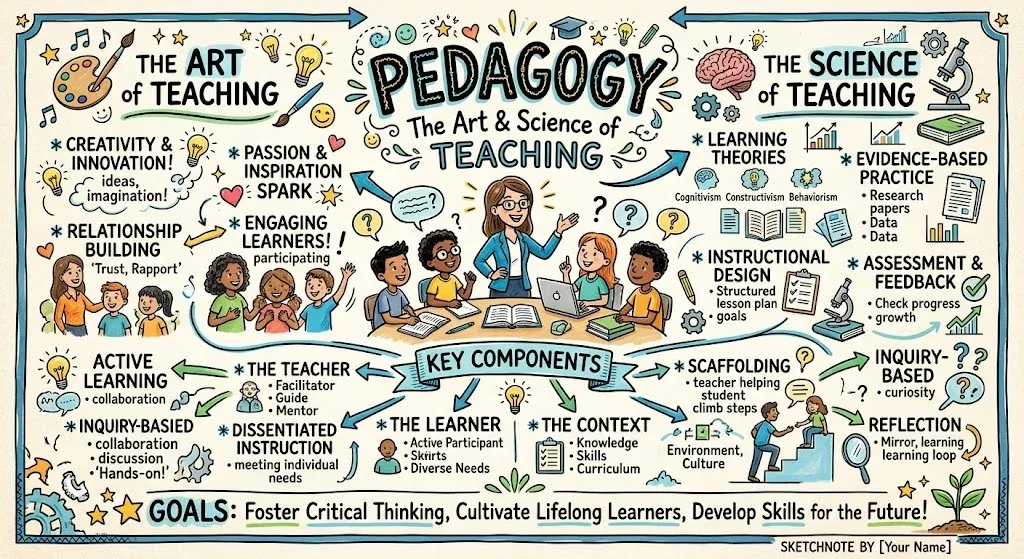
Pedagogy is the art and science of teaching, the planned choices teachers make about explanation, questioning, feedback, practice, and assessment to help learners build understanding. Effective pedagogy is evidence-informed, drawing on approaches such as Rosenshine's principles and Ofsted's focus on how knowledge is taught, sequenced, and checked, not just what is covered.
Pedagogy is the art and science of teaching: the planned choices teachers make about explanations, questioning, feedback, practice and assessment to help learners build understanding. This guide explains five UK teaching approaches through the lens of the ITTECF, Ofsted's current inspection focus and classroom evidence such as Rosenshine's principles of instruction (Rosenshine, 2012). For example, a Year 7 maths teacher might model a worked example, check understanding with mini-whiteboards, then move learners into guided practice before independent questions.
Pedagogy is the art and science of teaching. Teachers make key choices to help learners learn well. This includes ordering content and giving helpful feedback (Shulman, 1986). Good pedagogy creates true learning, rather than just delivering facts (Alexander, 2008; Hattie, 2009). Read our science pedagogy article for more details (Wiliam, 2011).
Effective teaching involves careful planning based on what learners already know. Teachers use varied approaches to engage all learners. They provide regular feedback to support improvement. For example, science teachers can use experiments to teach, not just lectures.
Bruner (1960) said we should revisit topics in deeper detail over time. Freire (1970) saw teaching as either passing facts or having a dialogue. Learners are not empty vessels. Instead, they actively build their own knowledge. Read our article to learn more about decolonising the curriculum.
Pedagogical Content Knowledge means knowing how to make topics clear to learners. PCK helps you explain a subject well to others. It goes beyond simply knowing the facts, formulas, or dates.
Shulman named seven teacher knowledge categories. These cover content, teaching, curriculum, PCK, and learners. Also included are contexts and educational goals. Magnusson et al. (1999) placed PCK where subject knowledge meets teaching knowledge. It's understanding how to adapt topics for varied learner needs.
Teachers explain concepts using PCK. A maths teacher uses pizza slices to explain fractions. History teachers use sources; learners analyse events (Shulman, 1986). This transforms subject matter into accessible learning for each learner (Cochran et al., 1993).
Evidence-based teaching methods are instructional approaches supported by research evidence and judged by their impact on learner outcomes. This work showed which factors most improve learner outcomes. We can use effect sizes to compare the impacts of teaching methods, according to Hattie (2009).
Hattie's research shows feedback (d=0.73) boosts learning. Good teacher-learner relationships (d=0.72) also help, alongside metacognitive strategies (d=0.69), in Hattie's 2009 synthesis. These factors matter more than smaller classes. Rosenshine (2012) gives ten principles based on research. The principles guide lesson structure using explicit teaching.
The Education Endowment Foundation (EEF) maintains the Teaching and Learning Toolkit as a living evidence summary for teachers. It is updated as new evidence is reviewed, so avoid treating a single 2021 snapshot as current. Nuthall (2007) explored the "hidden lives of learners," showing how individual experiences shape learning. The key is to check what actually causes learning for each learner.
Teacher-led and learner-centred methods are contrasting approaches that shape how responsibility for learning is shared in lessons. Both influence results for learners. Rosenshine (2012) supports teacher-led lessons with review and aims. Worked examples aid learners. Guided practice and independent work follow.
Learner-centred approaches promote active learning. This idea comes from constructivism. Vygotsky (1978) described the ZPD as the space where scaffolding helps learners move beyond what they can do alone. Piaget (1952) explained cognitive growth through assimilation and accommodation. Kirschner, Sweller, and Clark (2006) found that novices learn less with little support.
Hmelo-Silver et al. (2007) argue that well-designed problem-based learning can be beneficial, but the evidence does not support leaving novice learners to discover key ideas by themselves, a practice Coe et al. (2014) identify as unsupported by research evidence. The better question is when to guide, when to scaffold and when to release responsibility. For example, a teacher might use direct instruction to introduce a new maths concept, then use problem-based learning so learners can apply it to a realistic problem.
Five teaching approaches act as key models for the classroom. They plan lessons around different aims, tasks, and learning steps. Your choice depends on aims, learners and the context (Hattie, 2012). Key methods include direct instruction and constructivist learning (Bruner, 1961). Socratic questioning, cooperative learning, and problem-based learning are also useful (Vygotsky, 1978; Dewey, 1938). Each approach has its own pros and cons (Bloom, 1956).
Rosenshine (2012) says direct instruction means explicit teaching, modelling and practise. Piaget (1952) and Bruner (1961) suggest learners build understanding through exploring. Bloom (1956) says Socratic questions boost critical thought. Johnson and Johnson (1989) encourage learners to work together. Barrows (1986) has learners solve real problems.
Direct instruction works well when you teach a new grammar rule. Cooperative learning helps learners research history. Socratic questioning builds critical thinking about novels (Paul & Elder, 2007). Teachers choose and mix these different methods.
Teaching methods in primary schools are age-appropriate approaches that balance play, structure, engagement, and early skill development. Activities build learners' social, emotional and thinking skills. Key Stages 1 and 2 use more structured teaching. We still focus on keeping learners engaged.
Bruner's CPA approach (1966) uses concrete aids like counters in maths. Learners move to pictures, then abstract symbols. Snow (1991) says language matters; teachers use stories to build skills.
Researchers (e.g., EEF) show that hands-on methods can work. Learners can use counters for addition. Storytelling can inspire writing, and artefacts can engage learners in history. Evidence also supports phonics and parent involvement.
Secondary school teaching methods focus on specific subjects. These approaches help manage complex and abstract ideas. They also meet growing mental demands. Subject pedagogy matters as teaching methods change (Chi, 2006). Think about expert and novice differences when teaching secondary learners (Bransford et al., 2000).
This means they must recognise that their deep understanding of the subject can make it difficult to appreciate the challenges faced by novice learners. A maths teacher, for example, needs to break down complex equations into smaller, manageable steps, explaining each step clearly. An English teacher needs to scaffold essay writing, providing clear structures and sentence starters. Formative assessment is a core pedagogical tool (Wiliam, 2011).
Karpicke (2008) showed that retrieval practice improves learner recall. Regular topic review strengthens learning. Teachers should adapt lessons for different learner needs.
| Approach | When to Use | Strengths | Limitations |
|---|---|---|---|
| Direct Instruction | Introducing new concepts; building foundational skills | Efficient; clear; ensures all learners receive the same information | Can be passive; may not cater to individual learning styles |
| Constructivist/Discovery Learning | Deepening understanding; encouraging exploration | Promotes engagement; develops problem-solving skills | Time-consuming; can be inefficient for novices |
| Socratic Questioning | Encouraging critical thinking; challenging assumptions | Develops reasoning skills; promotes active participation | Requires careful planning; can be intimidating for some learners |
| Cooperative Learning | Developing teamwork skills; exploring diverse perspectives | Promotes collaboration; builds social skills | Requires careful group management; potential for unequal participation |
| Problem-Based Learning | Applying knowledge to real-world contexts; developing problem-solving skills | Highly engaging; promotes application of knowledge | Requires significant planning; can be challenging for learners |
Technology is useful, but not a quick fix for teaching. Hattie (2009) showed that tech, on its own, only slightly boosts learning. How you use technology in lessons is what really matters. Digital pedagogy supports good teaching with technology.
The SAMR framework by Puentedura (2006) helps teachers plan how to use technology. Learners start with Substitution. This simply swaps out older methods. Next is Augmentation, which uses tech to improve tasks (Puentedura, 2006). Modification then changes the tasks. Finally, Redefinition allows completely new activities (Puentedura, 2006).
Learners first type their essays for Substitution. Grammar checkers then help them for Augmentation. Next, they work together to give feedback for Modification. Finally, learners build websites for research for Redefinition. Retrieval practice and teamwork help them learn. Mayer (2009) warns to avoid extra multimedia details.
Culturally responsive teaching is an approach that values each learner's culture as an asset within the classroom. Validate cultures as assets, say Gay (2000). This builds respect in the learning area.
CRP exists in every teaching choice, not as an add-on. Teachers use varied texts that show different learners' lives. Maths uses real-world problems from the learners' own communities. Teachers adapt wait time and class talks for communication needs. Ladson-Billings (1995) calls this culturally relevant pedagogy.
Banks (2015) suggests teachers use varied literature. This helps build identity and belonging. Wiliam (2011) shows local business examples help. They make it easier for learners to understand percentages. Gay (2018) found that cultural inclusion improves learner engagement and results. Hattie (2008) says this makes teacher and learner connections stronger.
Teaching practice improves through the deliberate practice of specific skills. This is supported by coaching, feedback and reflection. Teachers should focus on these specific skills. Learners also need coaching and reflection to actively improve their skills.
A five-step framework can help teachers develop their pedagogical practice. First, observe an expert teacher with a specific focus, such as questioning techniques. Second, try one new technique in your next lesson. Third, record what happened, noting what worked well and what could be improved. Fourth, get coached feedback from a mentor or colleague. Fifth, iterate, repeating the process to refine your skills.
PLCs and lesson study (Lewis, 2002) help teachers collaborate. Plan, teach, watch, and discuss lessons together. Review your teaching: What works best? What do you avoid? How do you adapt for each learner? What needs improvement?
Five pedagogical approaches describe the main traditions teachers use to explain how learners learn and how teaching should respond. Each offers a different answer to a practical classroom question, how do learners learn best, and what should the teacher do next? In reality, most effective teaching blends these traditions, but knowing the labels helps you choose strategies with more precision.
Behaviourism links to Pavlov (1927) and Skinner (1953). It focuses on observable behaviour and the power of repetition, cues and reinforcement. In the classroom, this appears through clear routines, guided practice and immediate feedback. A short retrieval quiz at the start is one example. Praise linked to a specific rule is another. This is useful when learners meet new content because it helps them build secure habits, accurate recall and strong attention.
Cognitivism focuses on what happens inside the mind. It uses theory about processing facts and cognitive load. This reminds teachers to chunk their explanations into small parts. Teachers should model steps clearly. They must avoid overloading the working memory of learners. A worked maths example is a good cognitivist strategy. Partly finished questions should follow this step. Constructivism links to Piaget, Bruner and Vygotsky. It asks learners to actively build their own understanding. They do this through class discussion and group work.
Humanism, influenced by Carl Rogers (1969), focuses on motivation, relationships and personal growth. This matters when teachers offer choice in a writing task. It also matters when using reflection journals. Teachers must create a safe classroom climate. Liberationism, linked to Paulo Freire, goes further. It treats education as a route to critical awareness. In practice, this means asking whose voices are missing from a history source. You can also use project work and structured discussion to connect ideas.
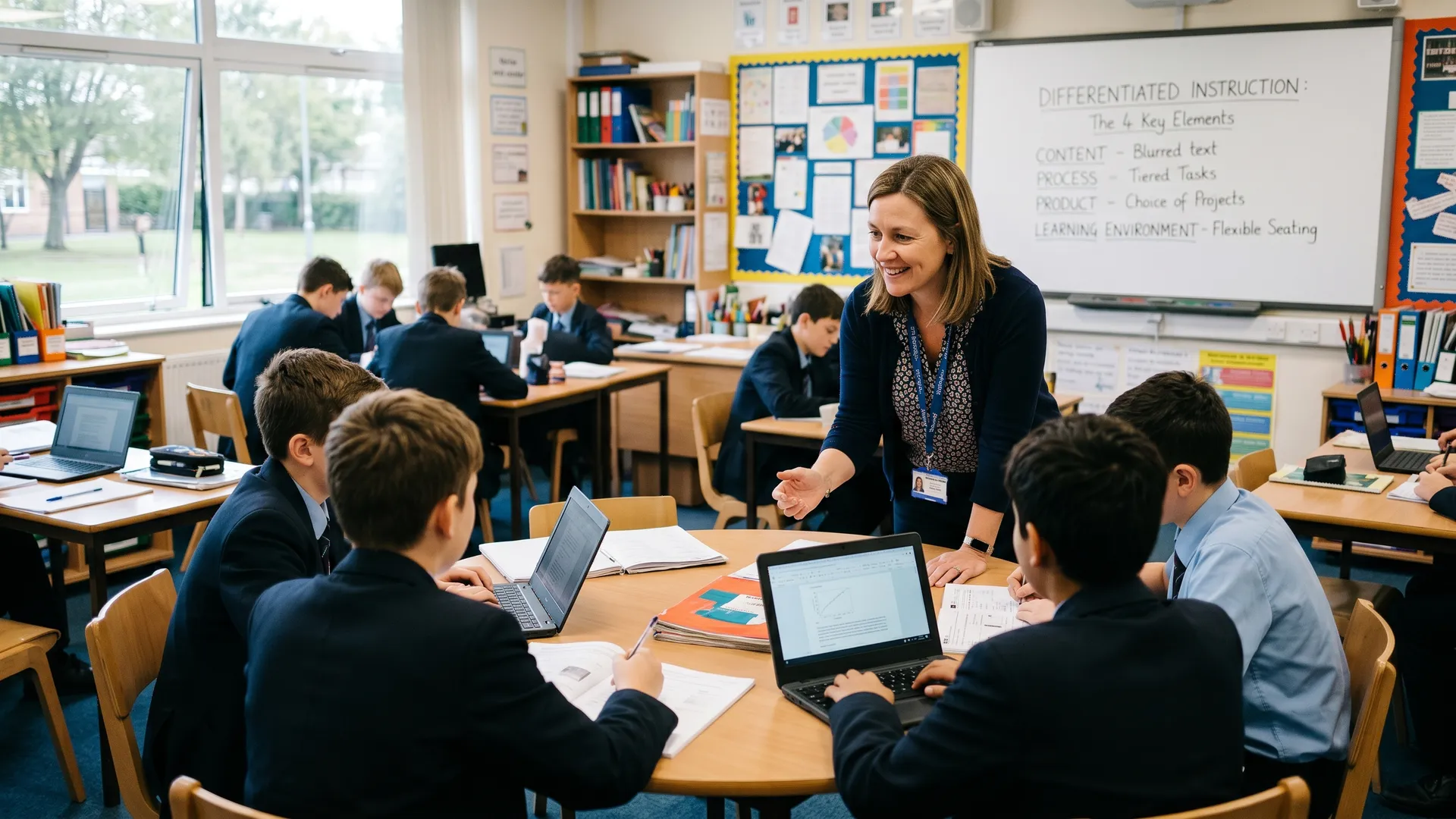
Adaptive teaching is a responsive approach. It keeps high expectations while adjusting support, so all learners can access the same ambitious curriculum. In England, the Initial Teacher Training and Early Career Framework (ITTECF) now sets the shared training entitlement for trainee and early career teachers from September 2025 (Department for Education, 2024). It expects teachers to adapt lessons responsively, offer targeted support and avoid separate lower-expectation tasks. The aim is one curriculum with sensible routes into it, not three worksheets for three groups.
This matters because inclusive teaching starts with high expectations for everyone. All learners work towards the same core idea. The teacher adjusts their explanations and pacing. They also change their questioning, grouping and support. This removes barriers without lowering the challenge. Florian and Black-Hawkins (2011) support this idea. They say inclusion means offering standard work to everyone. It does not mean planning a lesser curriculum for some learners.
In a Year 8 science lesson on particle models, the teacher sets one goal: explain why gas pressure changes when temperature rises. She models a full answer, pre-teaches tier 3 vocabulary to a small group, gives sentence stems and a labelled diagram to learners who need them, then says, “Everyone is explaining the same idea. If you are stuck, start with the diagram and use the stem.” Learners are thinking about the same concept and producing the same paragraph explanation or exit ticket, but the scaffold is matched and temporary.
Recent EEF guidance keeps reinforcing this pattern. High-quality teaching for learners with SEND should include scaffolding and flexible grouping. It also needs explicit instruction and checks for understanding. These must be part of everyday classroom practice, not extra paperwork (EEF, 2020; EEF, 2024). For busy teachers, the rule is simple. Keep the task ambitious and diagnose the barrier. Then, you can adapt the route. That is adaptive teaching. It is a much sharper idea than old-style differentiation.
Universal Design for Learning (UDL) is a framework for planning lessons so more learners can access the same ambitious curriculum from the start. Developed by CAST, it asks teachers to identify likely barriers before the lesson, then plan flexible routes into the same content (CAST, 2018).
In practice, this might mean combining a clear explanation with a diagram, vocabulary support and more than one way for learners to show understanding. UDL is not a lower standard or a separate plan for a few learners. It is advance planning for access, participation and assessment.
The first core principle of UDL is Multiple Means of Engagement, which addresses why learners choose to take part, persist and regulate their attention. Teachers can support this by offering purposeful options that connect with learners' interests without changing the learning goal.
For example, a history teacher might let learners research the same historical event through an essay, a short documentary or an interactive timeline. The choice changes the route into the task, not the standard expected.
Social Emotional Learning (SEL) is a pedagogical approach that builds learners' social and emotional skills alongside academic knowledge. It shows that emotional regulation, empathy, and clear communication are key skills for learning and life. These skills affect achievement, behaviour, and overall well-being.
The Collaborative for Academic, Social, and Emotional Learning (CASEL) offers a widely used framework for SEL. It sets out five core competencies learners need to develop. These are self-awareness, self-management, social awareness, relationship skills, and responsible decision-making.
Self-awareness means understanding your own emotions, thoughts, and values. It also means knowing how they influence behaviour. A teacher
High-Impact Practices (HIPs) are learning activities identified by the Association of American Colleges and Universities (AAC&U). They have a strong effect on learner learning and development. These practices ask learners to spend real time and effort, work with teachers and peers, meet diverse experiences, and get frequent feedback (Kuh, 2008). Using HIPs helps learners learn in more depth, build key skills, and engage more with the curriculum.
HIPs are effective because of how they are designed. They move learners beyond simply receiving knowledge and help them actively build understanding. Learners apply knowledge in authentic contexts, reflect on their learning, and interact meaningfully with others. This fits with cognitive science principles such as active recall, elaboration, and spaced practice, which support secure knowledge retention and transfer (Dunlosky et al., 2013).
One example of a HIP is a first-year seminar. In a secondary school, this might be a structured induction programme for Year 7 learners. The programme could help learners build study skills, learn organisational strategies, and develop a sense of belonging in the school community. Similarly, learning communities involve groups of learners taking several subjects together. This encourages cross-curricular projects and steady peer collaboration, such as Year 9 learners exploring a historical event through literature and art.
Service-learning combines community service with teaching and reflection. It lets learners apply classroom learning to real-world problems. For instance, a geography class might research local environmental issues, then design and run a community awareness campaign. Capstone projects are final projects that ask learners to bring together knowledge and skills built over time, such as a Year 13 learner completing an extended project on a topic of their choice.
ePortfolios are another powerful HIP. In them, learners build digital collections of their work to show learning and growth over time. A learner might choose their best essays, art pieces, or project reports from across subjects, then add reflections on how they learned and developed skills. Collaborative assignments and projects, such as a science class planning and carrying out a group experiment, require teamwork, communication, and shared problem-solving, which prepares learners for future academic and professional challenges.
By bringing these practices together, teachers can create rich learning environments. These environments support critical thinking, resilience, and a stronger link with the curriculum. HIPs encourage learners to take ownership of their learning, build metacognitive awareness, and develop transferable skills. They show a commitment to learning experiences that both challenge and support learners.
Backward Design, also known as Understanding by Design (UbD), is an instructional planning framework developed by Grant Wiggins and Jay McTighe. This approach advocates for planning curriculum, instruction, and assessment with the end in mind, rather than starting with activities or textbooks. Teachers begin by clearly defining what learners should understand and be able to do by the end of a unit or course (Wiggins & McTighe, 2005).
The framework sets out three clear stages for effective instructional design. In Stage One, teachers identify the desired results or learning outcomes, with a focus on "enduring understandings" that learners should grasp deeply. In Stage Two, teachers decide what acceptable evidence of learning will look like, including how learners will show their understanding through assessments. Finally, Stage Three focuses on planning learning experiences and instruction that will help learners achieve those results and perform well on the assessments.
A core concept within Backward Design is the identification of enduring understandings. These are the big ideas, principles, or processes that learners should remember long after the unit ends. An enduring understanding goes beyond factual recall. It is a transferable concept that learners can apply in new situations, such as "Historical events are shaped by multiple, interconnected causes and effects."
Consider a Year 5 history teacher planning a unit on Ancient Egypt. Using Backward Design, the teacher first identifies the enduring understanding: "Civilisations develop complex systems (e.g., social, political, economic, religious) to meet their needs and adapt to their environment." Next, the teacher decides what acceptable evidence would look like. This might be a project where learners design their own ancient civilisation and explain its systems and adaptations. Only after that does the teacher plan lessons, activities, and resources, such as research on pharaohs, mummification, or the Nile River, all aimed at showing that enduring understanding.
This approach ensures that all teaching and learning activities are purposeful and aligned with clear learning goals. It helps teachers avoid "activity-driven" instruction, where lessons might be engaging but lack a clear connection to significant learning outcomes. By focusing on understanding and transfer, Backward Design supports deeper learning and helps learners see the relevance of what they are studying (Wiggins & McTighe, 2005).
The SAMR Model for Technology Integration gives teachers a way to judge how digital tools change or improve teaching and learning. Developed by Ruben Puentedura, the model sets out four levels of technology use: Substitution, Augmentation, Modification, and Redefinition (Puentedura, 2006). These levels help educators move beyond simply replacing old tools with new ones. Instead, they support real improvements to pedagogical practises.
The first level, Substitution, occurs when technology acts as a direct tool substitute with no functional change. For instance, learners might type an essay in a word processor instead of writing it by hand. The core task of producing a written piece remains identical, merely shifting the medium.
At the Augmentation level, technology still acts as a direct tool substitute, but with functional improvements. Consider the same essay task where learners use a word processor with built-in spell check, grammar suggestions, and a thesaurus. The technology enhances the writing process by providing immediate feedback and resources, improving the quality of the final output.
The Modification level means that technology makes a major redesign of the task possible. Instead of writing separate essays, learners might work together in a shared online document, such as a cloud-based word processor. They can edit each other's work in real time, add comments, and build the text together. This changes the social and cognitive processes involved in the task.
Finally, Redefinition means creating new tasks that learners could not do before without technology. For example, learners could make a multimedia digital story or an interactive presentation. They might use video editing software, animation tools, and voiceovers to show their understanding of a historical event. This goes beyond a written or oral presentation, giving learners richer ways to express ideas and engage with the content.
Teachers can use the SAMR model to reflect on how they use technology. It can also help them plan lessons that move towards higher levels of integration over time. Moving from Substitution to Redefinition requires a change in pedagogical thinking, with a focus on how technology can support deeper learning and more complex tasks. This planned approach means digital tools are not just present, but actively change or improve the learning experience for learners.
Pedagogy is more than delivering lessons. It also includes strong classroom management. Classroom Management Frameworks give teachers a clear way to create a classroom where learners can learn. They use preventative strategies, clear behaviour expectations, and ways to recognise positive conduct. This protects teaching time, reduces disruption, and helps all learners access the curriculum.
A key part of these frameworks is setting up preventative routines. Teachers plan and clearly teach procedures for common classroom activities, such as entering the room, moving between tasks, or submitting work. For instance, a teacher might model and practice with learners how to enter silently, place their bags under their desks, and immediately begin the starter activity displayed on the board. Teaching routines in this deliberate way reduces ambiguity and limits chances for off-task behaviour, as highlighted by Kounin's work on 'withitness' (Kounin, 1970).
Alongside routines, clear classroom norms help create a productive learning environment. These are shared expectations for behaviour, often built with learners so they understand what responsibility looks like in practice.
At the start of the year, a teacher might ask, "What does respectful listening look like when someone else is speaking?" or "How do we show we are ready to learn?" Displaying the agreed norms gives learners and teachers a visible reference point.
Effective frameworks also use positive reinforcement to encourage good behaviour and build a positive classroom culture. This means noticing and praising learners who follow agreed routines and norms. For example, a teacher might use specific praise, saying, "I noticed how quickly and quietly you all transitioned to your group work, that shows excellent teamwork and respect for learning time," rather than general praise. Regular positive feedback makes expectations clear, helps learners keep high standards, and builds their sense of belonging.
Secure and well-supported Classroom Management Frameworks work best when linked closely to teaching. They are vital for learner success. When learners know what is expected, feel safe, and receive steady positive reinforcement, they are more open to new ideas and hard tasks. This helps teachers focus on high-quality instruction, checking understanding, and giving targeted feedback, which improves learning for all. A well-managed classroom is not just quiet; it has clear structure, positive relationships, and purposeful work with the curriculum.
Robert Marzano's research identified nine instructional strategies linked to better learner achievement (Marzano, Pickering, & Pollock, 2001). These strategies give teachers practical methods to improve learning across subjects and age groups. When teachers use these high-yield approaches, learners can process information more clearly and show deeper understanding, not just surface-level comprehension.
One powerful strategy is identifying similarities and differences. This means learners look closely at concepts to spot what is the same and what is different. Teachers guide learners to compare, contrast, classify, and create analogies, which supports deeper thinking. For instance, a science teacher might ask learners to compare plant and animal cells using a Venn diagram. Learners would identify shared organelles and distinct features, making their understanding of biological organisation more secure.
Another highly effective strategy is utilising nonlinguistic representations. This means presenting and working with information without relying only on words. It includes creating graphic organisers, drawing pictures, or constructing
Culturally Responsive Teaching (CRT), as articulated by Zaretta Hammond (2015), goes beyond surface-level cultural celebrations. It asks teachers to understand how culture shapes the brain's learning processes. This approach recognises that learners from diverse backgrounds may have different schemas and prior experiences, which affect how they process new information. Effective CRT helps teachers build learners' cognitive capacity by using these cultural assets rather than ignoring them.
Hammond stresses the need to create a safe, trusting classroom so the brain's threat response is lower. When learners feel psychologically safe, their amygdala is less active. This lets the prefrontal cortex take a fuller role in higher-order thinking. Teachers support this by showing genuine care and building strong relationships, which signals safety and belonging.
A core tenet of Hammond's framework is to develop learners' cognitive capacity through productive struggle. This means giving learners challenging tasks that stretch their thinking, while also providing appropriate scaffolding. The goal is to strengthen neural pathways and build learners' ability to take part in complex academic work. Over time, this helps move them from dependent to independent learners.
The "warm demander" is a central teaching stance within Hammond's framework. A warm demander teacher sets high academic expectations and gives steady personal support and affirmation. This helps learners feel both challenged and cared for, which builds resilience and motivation.
For instance, a Year 5 teacher might support a learner struggling with a maths problem by saying, "I know this is tough, and I believe you can work it out. Let's look at the first step together, then I want you to try the next part on your own."
| UDL Principle | Description | Classroom Application |
|---|---|---|
| Multiple Means of Representation | Present information and content in different ways. | Teachers use visual aids, audio recordings, text, and real-world examples to explain a concept. Learners access digital textbooks with text-to-speech options. |
| Multiple Means of Action & Expression | Provide varied ways for learners to demonstrate what they know. | Learners can write an essay, create a presentation, build a model, or give an oral report to show understanding of a historical event. |
| Multiple Means of Engagement | Stimulate interest and motivation for learning. | Teachers offer choices in project topics, provide opportunities for collaborative group work, and connect learning to learners' personal interests and experiences. |
The teacher offers support without lowering expectations. A later check-in might say, "Remember how you persevered with that problem yesterday? You are capable of that kind of thinking."
By combining neuroscience with culturally responsive practises, teachers can design learning that respects learners' cultural backgrounds. At the same time, they can build learners' cognitive muscles, or thinking skills. This approach helps close achievement gaps by developing the independent learning skills and academic mindsets learners need to succeed. It moves the focus from simply allowing for differences to actively building intellectual growth in all learners.
The TPACK Framework (Technological Pedagogical Content Knowledge) helps teachers understand how to use technology well in teaching. It says that effective technology use depends on three linked areas of knowledge: Content Knowledge (CK), Pedagogical Knowledge (PK), and Technological Knowledge (TK) (Mishra & Koehler, 2006).
These three core knowledge types combine to form seven clear domains. Content Knowledge (CK) means a teacher's understanding of the subject matter, such as historical facts or mathematical concepts. Pedagogical Knowledge (PK) means general teaching strategies, classroom management, and assessment methods, whatever the subject content.
Effective pedagogy depends on teachers understanding different assessment models and using them well. Diagnostic assessment takes place before teaching begins. It shows what learners already know, what skills they have, and which misconceptions are common. For instance, before a new unit on fractions, a Year 5 teacher might give a short quiz asking learners to identify equivalent fractions or define numerator and denominator. This helps the teacher shape the first lessons around clear learning gaps.
Formative assessment is an ongoing process during teaching. It helps teachers check learner learning and give quick feedback. Teachers use questioning, observation, and mini-whiteboards to check understanding during a lesson. When a teacher asks learners to explain their reasoning for a maths problem, the answer gives real-time information, so the teacher can adapt teaching or give targeted support (Wiliam, 2011).
In contrast, summative assessment evaluates learner learning at the end of a specific instructional period, such as a unit, term, or academic year. These assessments measure overall achievement against learning objectives and often result in a grade or score. An example includes a Year 9 end-of-unit test on the causes of World War I, where learners demonstrate their accumulated knowledge and analytical skills.
Finally, benchmark assessments are typically administered periodically, for example, at the start, middle, and end of a school year, to measure progress against specific learning standards or goals. These assessments help track learner growth over time and can inform future instructional planning or interventions. A school might use a standardised reading comprehension test each term to gauge learners' progress against national expectations, providing a broader view of attainment than a single lesson's formative check.
Cognitive Load Theory (CLT) says that human working memory has limited capacity. This means it can only process a small amount of new information at one time (Sweller, 1988). When teaching materials present too much information at once, learners can face cognitive overload, which makes learning harder. Teachers need to design lessons that manage this load, so new ideas feel manageable.
One effective way to reduce extraneous cognitive load is to use worked examples. Instead of asking learners to solve complex problems on their own straight away, teachers show fully solved problems first. They make each step clear. For instance, in a maths lesson, a teacher might display a multi-step algebra problem with every calculation and explanation written out, saying, "Observe how I substitute the value here, then simplify this term."
Teachers can also break complex problem-solving into manageable steps, especially when they introduce new procedures or skills. For example, when teaching essay writing, a teacher might first focus only on thesis statement construction. They might then teach paragraph structure, and finally evidence integration, instead of expecting learners to master every element at once. This step-by-step approach helps learners practise and secure each part before combining them in a larger task.
Metacognitive strategies help learners understand and control their own learning processes. In simple terms, learners think about how they think, learn, and solve problems. When learners build strong metacognitive skills, they get better at self-regulated learning. They can manage their cognitive processes more actively to reach learning goals (Dunlosky et al., 2013).
Teachers explicitly teach learners how to monitor, evaluate, and regulate their own comprehension. This includes demonstrating effective study skills such as summarising key information, elaborating on new concepts, and utilising spaced practice. Learners learn to ask themselves questions like, "Do I understand this concept fully?" or "What strategy should I use next?"
For instance, a science teacher might model how to approach a complex problem by verbalising their thought process: "First, I need to identify the known variables. Then, I'll consider which formula applies. If I get stuck, I'll re-read the question and break it down further." Learners then practise this self-questioning process, reflecting on their own understanding and adjusting their approach as needed. This deliberate practice helps learners develop independent learning habits.
Universal Design for Learning (UDL) is an educational framework that guides the design of learning environments and instructional goals to meet the diverse needs of all learners. It aims to remove barriers to learning by providing flexible ways for learners to access content, demonstrate understanding, and engage with material (CAST, 2018).
UDL is built upon three core principles: providing multiple means of representation, multiple means of action and expression, and multiple means of engagement. These principles ensure that instruction is accessible and challenging for every learner, regardless of their learning style or background.
For example, when teaching fractions, a teacher using UDL might present ideas with visual models, manipulatives, and verbal explanations. Learners could then show their understanding by drawing diagrams, writing explanations, or describing their reasoning aloud. This gives learners a choice of methods that fit their strengths and learning preferences.
These approaches should not be treated as a recipe. Hattie's synthesis has been criticised for combining studies with different designs, measures and contexts, making some effect-size comparisons unstable (Terhart, 2011; Simpson, 2017). The EEF-commissioned review of cognitive science also warns that principles such as retrieval practice and worked examples have stronger evidence in controlled conditions than in busy classrooms (Perry et al., 2021).
A second limitation is that debates between direct instruction and discovery learning are often overstated. Kirschner, Sweller and Clark (2006) make a strong case against minimal guidance for novices, but Hmelo-Silver, Duncan and Chinn (2007) argue that well-designed inquiry is not unguided. In practice, the issue is the quality of scaffolding, prior knowledge and task design.
There are also cultural and developmental limits to consider. Piaget's stages drew heavily on small Western samples. Rogoff (2003) shows that learning practices vary across communities. Vygotsky (1978) remains valuable, but teachers need to interpret his ideas carefully for their local setting, rather than transfer them straight into every classroom.
Finally, teachers can misuse both behaviourist and humanist traditions. Reinforcement can narrow learners' attention if they start chasing rewards, a concern linked to motivation research by Deci and Ryan (1985). Rogers' learner-centred tradition values relationships, but it can give less clear guidance on curriculum sequencing. Used with care, these theories still give teachers useful language for planning, explaining, questioning and adapting teaching.
Bloom, B. (1956). Taxonomy of educational objectives.
Bruner, J. (1960). The process of education.
Hattie, J. (2009). Visible learning.
Karpicke, J. (2008). The critical importance of retrieval for learning.
Kirschner, P. A., Sweller, J., & Clark, R. E. (2006). Why minimal guidance during instruction does not work.
Pavlov, I. (1927). Conditioned reflexes.
Piaget, J. (1952). The origins of intelligence in children.
Rogers, C. (1969). Freedom to learn.
Rosenshine, B. (2012). Principles of instruction.
Skinner, B. F. (1953). Science and human behavior.
Vygotsky, L. (1978). Mind in society: The development of higher psychological processes.
These peer-reviewed studies provide the research foundation for the strategies discussed in this article.
Gore, J., Lloyd, A., Smith, M., Bowe, J., Ellis, H., & Lubans, D. (2017), Teaching and Teacher Education
Quality Teaching Rounds, a form of professional development, demonstrably improves teaching quality. This research, based on a randomised controlled trial, suggests that investing in such approaches can positively impact classroom practice.
Effective classroom instructions for primary literacy: A critical review of the causal evidence
10 citations
See, B. H., Gorard, S., & Siddiqui, N. (2020), International Journal of Educational Research
Effective literacy instruction in primary schools lacks strong causal evidence, according to this review. this shows or this means the need for teachers to critically evaluate the evidence base behind popular literacy strategies. It also encourages educators to focus on approaches with demonstrated positive impacts.
promising or new Pedagogies of the Future: An Evidence-Based Selection
128 citations
Herodotou, C., Sharples, M., Gaved, M., Kukulska-Hulme, A., Rienties, B., Scanlon, E., & Whitelock, D. (2019), Frontiers in Education
Herodotou et al. (2019) identified ten promising future pedagogies based on evidence of their potential impact. Understanding these promising or new approaches can help teachers broaden their practice and prepare students for the evolving demands of education and the workplace.
Evidence-Based Effective Pedagogy in Primary Schools
5 citations
Li, H. (2022), ECNU Review of Education
Li's 2022 paper identifies effective pedagogical approaches in primary schools based on empirical evidence. Understanding these strategies can help teachers improve their practice, and ultimately enhance learning outcomes for pupils in the classroom.
A meta-analysis to gauge the impact of pedagogies employed in mixed-ability high school classrooms
3 citations
Santhosh, M., Alsageer, N., Farooqi, H., Bhutta, Z., & Alamri, N. (2024), Humanities and Social Sciences Communications
Mixed-ability classrooms benefit from varied teaching approaches, according to this meta-analysis. The research highlights the importance of teachers adapting their pedagogy to effectively engage all students, a key consideration for both OFSTED inspections and Early Career Framework implementation.
Start with a clear learning goal, then decide which parts need direct explanation and which parts allow for discussion, practise or independent thinking. Use scaffolds such as worked examples, sentence stems and guided groups so all pupils can access the task. A strong approach is to teach key content to the whole class first, then vary support and challenge during practise.
Look for evidence in pupils' responses, not just whether the lesson felt busy or calm. Use quick checks such as mini whiteboards, exit tickets and hinge questions to see what pupils have understood during the lesson. If many pupils are making the same error, adjust your explanation or model the task again.
Yes, and most effective lessons do. You might begin with explicit teaching, move into paired discussion, then finish with independent practice or reflection. The key is to make each phase purposeful so the teaching method matches the learning task.
Focus on a few high-impact habits such as clearer modelling, better questioning and more frequent checks for understanding. Tighten instructions, show pupils what success looks like and build in short pauses to review learning. Small changes to delivery often improve lessons more than creating brand new resources.
Behaviour often improves when teaching is clear, well-paced and matched to pupils' level of understanding. Confusion, long periods of passive listening and tasks that are too hard or too easy can all increase low-level disruption. Strong pedagogy keeps pupils thinking, participating and knowing what to do next.
This site treats classroom pedagogy as a connected whole rather than a list of isolated techniques. Each article below drills into one element of evidence-based teaching practice. Read them in any order; they cross-reference each other where the ideas overlap.
Curriculum is what you teach: content and subjects. Pedagogy is how you teach it: methods and approaches. The curriculum might say Year 7 learners understand photosynthesis. Pedagogy decides if you use direct teaching or group work. Both are vital; even the best curriculum needs good pedagogy.
Five core pedagogical approaches dominate modern teaching:
Developing effective pedagogy requires three steps:
Teachers must be intentional and responsive, using evidence (Hattie, 2009). Effective teaching isn't one perfect method; it adapts to the learner. Consider research from authors such as Wiliam (2011) and Black and Wiliam (1998).
PCK means teachers expertly blend subject knowledge with teaching skills. You know common learner misconceptions and effective analogies (Shulman, 1986). Expert teachers have deeper PCK. This improves learner results. Subject knowledge alone is not enough. Teachers must make the content accessible to everyone.
Pedagogy directly impacts three outcomes:
Andragogy teaches adults, while pedagogy teaches learners. Adult learners are self-directed and bring experiences (Knowles, 1980). They want to use new skills right away and find relevance motivating (Knowles, 1980). Good teaching like spaced retrieval works for all ages (Rohrer & Pashler, 2007). Scaffolding and feedback also help every learner (Vygotsky, 1978).
Effective pedagogical strategies include:
In 2026, three shifts are reshaping pedagogy:
Educational research highlights core principles. Clarity, practise, feedback, spacing, and retrieval matter (Kirschner, Sweller & Clark, 2006). Teachers now use data to adapt these for each learner (Black & Wiliam, 1998). Personalised teaching improves learning outcomes (Hattie, 2008).