Updated on
September 24, 2026
Special Educational Needs: The Complete SENCO Toolkit (2026)
Go beyond definitions. This SENCO toolkit covers SEND categories, legal duties, IEP targets, provision mapping, and 12 classroom strategies, all in one place.


Updated on
September 24, 2026
Go beyond definitions. This SENCO toolkit covers SEND categories, legal duties, IEP targets, provision mapping, and 12 classroom strategies, all in one place.
Special Educational Needs: The Complete SENCO Toolkit (2026) is a practical guide to identifying, planning and reviewing support for learners who need provision that is additional to, or different from, the support normally available in school. In England, the SEND Code of Practice places responsibility on class teachers as well as SENCOs (DfE and DoH, 2015), and DfE's 2025 data records over 1.7 million learners with SEN.
For example, when a Year 4 learner can explain a science idea orally but cannot record it in writing, the first step is not a label. The teacher gathers evidence, adjusts the task with a word bank or voice note, reviews impact, and records what changed. That everyday assess, plan, do, review cycle is what turns SEND from paperwork into classroom access.
Every learner has strengths, barriers and conditions that affect how they access the curriculum. A neurodiversity-aware classroom treats those differences as part of normal human variation while still naming real access needs. Historical figures from Warnock are useful context, but current DfE data should guide 2026 planning: 14.2% of learners were recorded with SEN support and 5.3% with an EHC plan in England in 2025 (DfE, 2025).
B Squared assessment tracks learners below expectations, mapping to EHCP outcomes. This gives SENCOs proof of progress when gains are small (B Squared). Standardised tests may miss this progress, but B Squared shows it clearly..
A learner has Special Educational Needs (SEN) when a learning difficulty or disability means they need extra or different support from usual classroom provision. Needs may affect reading, writing, communication, movement, attention, sensory processing or emotional regulation. Conditions such as ADHD, dyspraxia, autism and dyslexia can create barriers to access. Some learners may need education health care plans to secure specified support.
Knowing SEND acronyms like EHCP and SALT helps. This saves time in meetings and paperwork (APDR, OT, EP). Learning this quickly benefits all busy teachers (Rose & Shevlin, 2010; Farrell, 2003; Norwich, 2008).
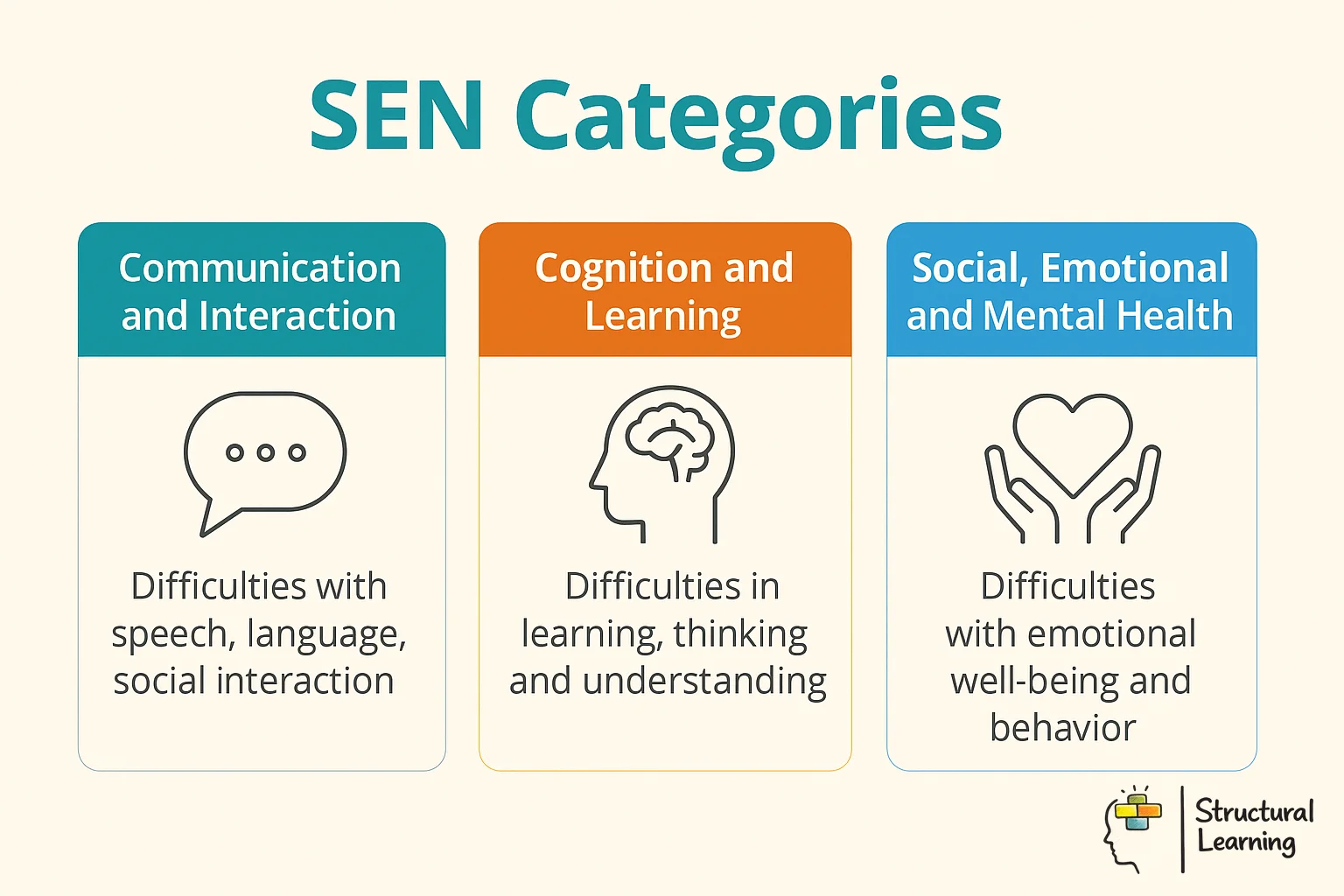
Inclusive education means planning classrooms so learners can reach the curriculum without being taken away from the main lesson where possible. This article covers common areas of need, the graduated approach, teaching adjustments, assessment evidence and SENCO coordination. The class teacher and SENDCo work together. However, daily barriers often show first in lessons: a learner avoids writing, misses spoken instructions, copies slowly or becomes overloaded by noise.
SEN often includes dyslexia and dyscalculia. Autism spectrum disorder (ASD), ADHD, and hearing or visual impairments also fall under this umbrella. Many learners have needs that cross more than one category. Understanding the full range, not just one label, helps you support them well, as proposed by Vygotsky (1978) and later inclusive education researchers (Hallahan & Kauffman, 2006; Norwich, 2013).
According to the SEND Code of Practice (DfE and Department of Health, 2015), SEN needs are generally considered across four broad areas: communication and interaction; cognition and learning; social, emotional and mental health; and sensory and/or physical needs.
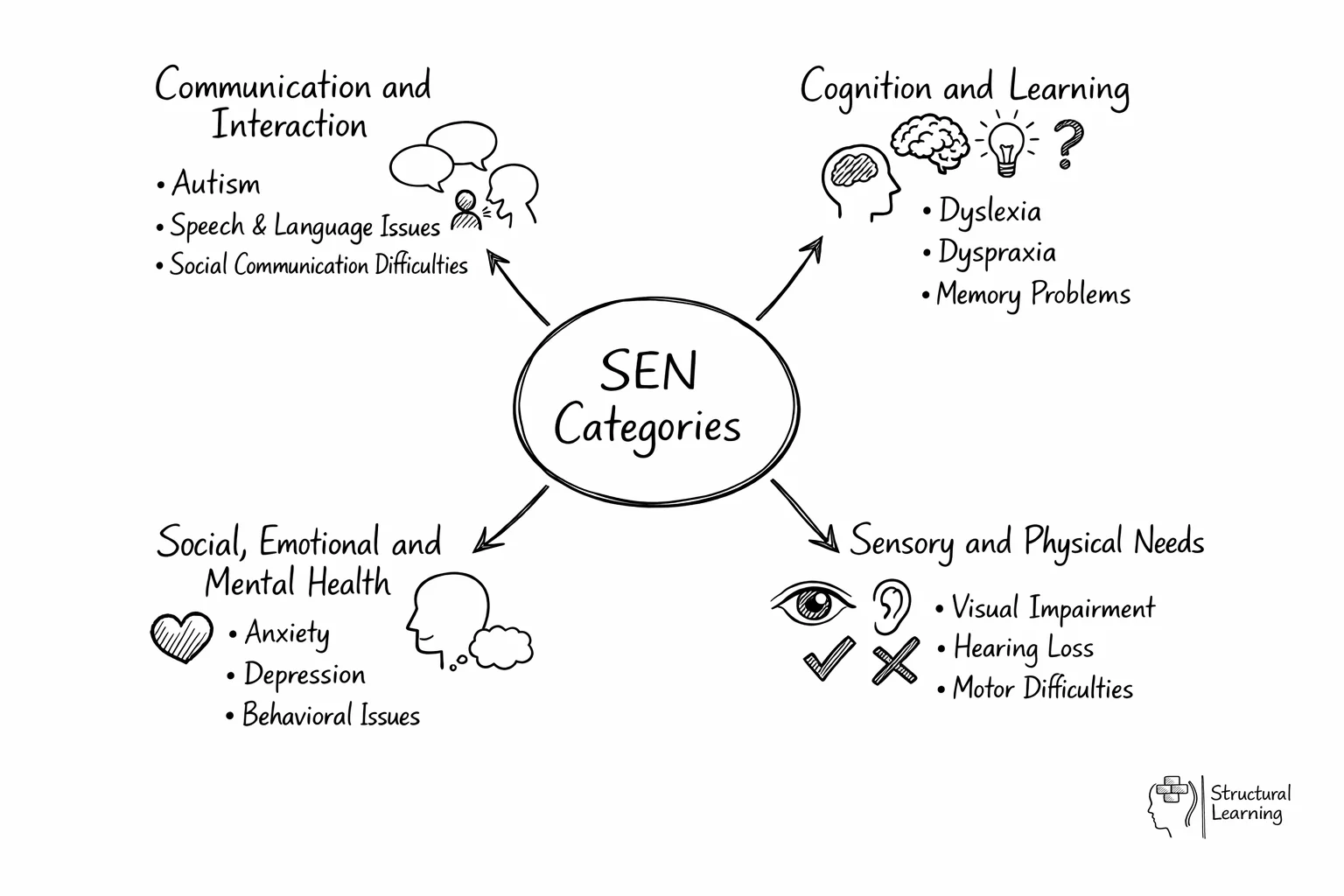
Learners with speech and language needs or autism may struggle in class. They may find it hard to interact with others and respond to what is happening (Communication and Interaction). Spoken language can also be hard for these learners to understand (Communication and Interaction).
Cognition and learning needs can present curriculum challenges. Dyslexia affects reading and spelling. Dyscalculia affects maths skills.
Dyspraxia affects coordination. Dysgraphia affects writing. These needs may require tailored support like one-to-one help, or group work.
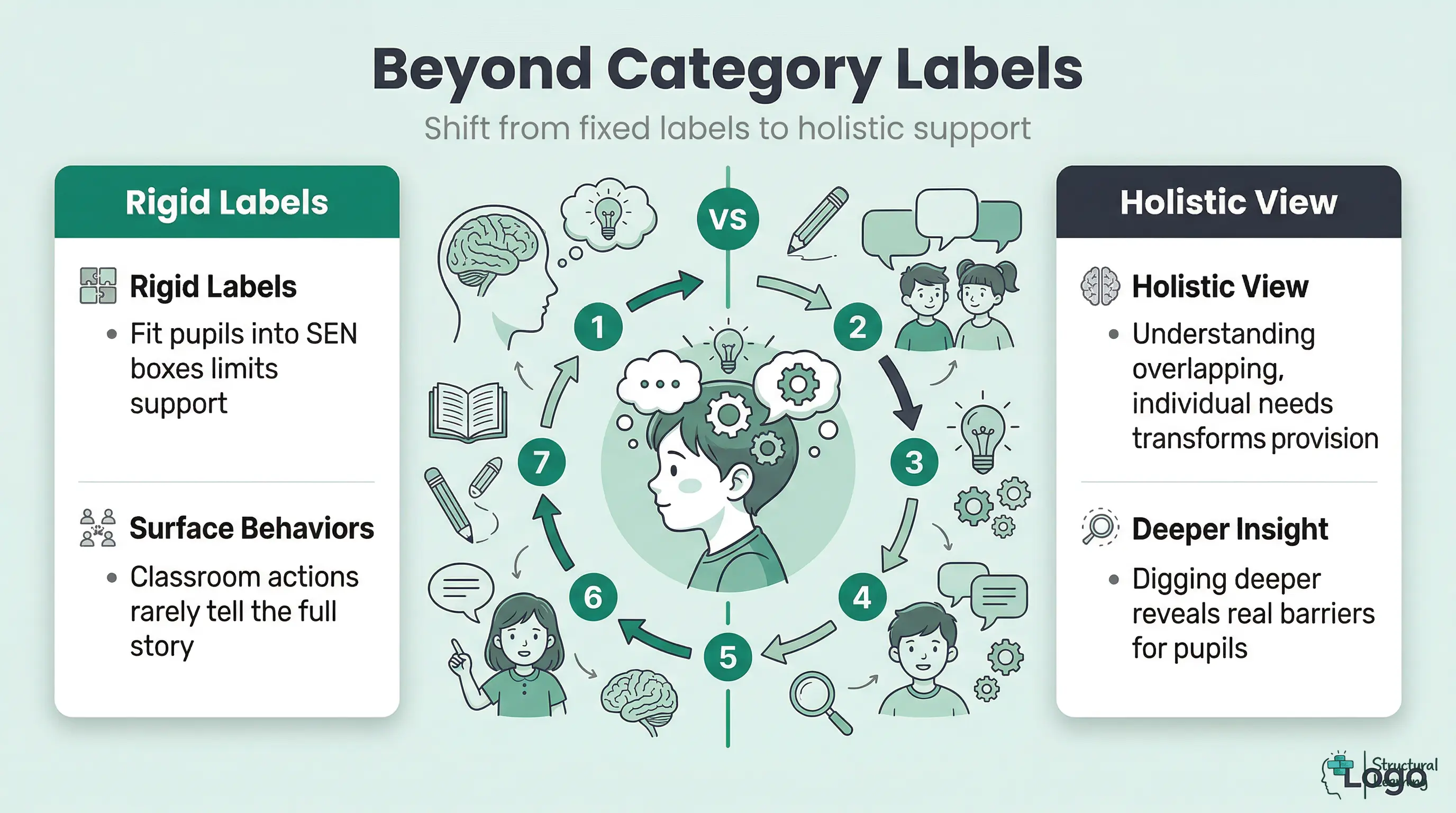
Learners with ADHD or autism may need support with attention, sensory regulation and emotional regulation. SEMH presentations can also reflect hidden trauma, anxiety or unmet communication needs. Teachers should therefore record triggers, patterns and what helps. This is better than treating behaviour as a stand-alone problem.
Learners may have sensory or physical needs. These include visual impairment (VI) and hearing impairment (HI). Other examples are multi-sensory impairment (MSI) or physical disability.
Some learners need SEN support, including those seen as 'gifted and talented'. Graphic organisers and clear feedback can help all learners take part. Special educational needs include both extra support and advanced learning (Vygotsky, 1978; Piaget, 1936).
Teachers support learners with SEN by removing barriers during the lesson. This does not mean lowering expectations. Useful strategies include:
These strategies help learners take part in the main lesson and show what they know. Review them regularly, using work samples, short observations and learner voice, so support changes when the barrier changes.
Inclusive classrooms need thoughtful spaces and resources. Seat learners to reduce distractions, ensuring access to materials and peers. Use visual timetables and clear labels.
Offer quiet spaces for learners who feel overwhelmed. Consistent routines and advance notice of changes help learners feel secure.
Relationships with parents are key for SEN support. Communicate regularly through diaries or meetings so everyone understands learner needs.
Parents offer insights on home strategies. Teachers share classroom approaches. This partnership boosts learning in all settings (Epstein, 2011; Hornby, 2014; Christenson, 2004).
Identifying special educational needs means using observation, data, and judgement. Teachers often first see when a learner struggles, even with good teaching. Focus on barriers, not labels, and make sure assessment leads to support (Ainscow, 2020; Florian, 2014).
The SEN Code details a graduated approach to assessment. Teachers assess learners using varied sources (assessments, work, parents, learners). Collaborate with the SENCo; they interpret data. Specialist assessments may be necessary (SEN Code of Practice, 2015).
Formative assessment helps teachers spot learning needs, not just formal tests. Teachers should record struggles and effective teaching methods (Black & Wiliam, 1998).
Keep records of support given and the results achieved. This helps tailor special support to the learner's needs. Hattie (2009) also emphasises regular review of impact.
The graduated approach is the cycle schools use to identify, plan and review provision for learners with special educational needs. The SEND Code of Practice describes it as assess, plan, do, review (DfE and DoH, 2015). It starts before diagnosis. The class teacher gathers observation, curriculum data, learner voice and parent views, then forms a working explanation of the barrier to learning.
The planning stage turns that explanation into specific, time-limited provision. A useful plan says what the teacher will change, what extra support will be provided, and what outcome should be visible within a term. For example, replace 'support in English' with 'pre-teach vocabulary before each text, use graphic organisers, and check comprehension through low-stakes oral questioning'. Gascoigne (2012) found that clear SEND reviews depend on precise planning; vague plans produce vague evidence.
The review stage asks whether provision produced the expected outcome, and if not, why not. Schools should separate three possibilities: the plan was not delivered consistently, the plan was delivered but did not work, or the learner's needs are more complex than first thought. Wearmouth (2017) warns that reviews often fail when schools repeat the same support without testing the original assessment. If reading intervention has not worked for three terms, ask what the non-response is telling you.
The graduated approach also connects to person-centred planning. The Code gives weight to the learner's views, so review meetings should not make decisions about provision without them wherever this is developmentally appropriate. A one-page profile is a practical tool: the learner helps record what matters to them, what support helps, and what every teacher needs to know across subject classrooms.
Create a professional learner passport in minutes. Fill in your learner's details, strengths, support strategies, and communication preferences, then print a clean A4 document ready for your SEND folder, supply teachers, or parent meetings.
The Children and Families Act 2014 and the SEND Code of Practice remain the legal base for SEN support. A 2026 toolkit also needs to address the SEND and Alternative Provision Improvement Plan. This plan proposed national standards, digital EHCPs and clearer responsibilities across education, health and care (Department for Education, 2023).
SEN support is often described as a tiered model: high-quality teaching first, targeted help next, and specialist provision where needed. That model is useful, but it can also be misused. Webster (2022) shows that learners with high-level SEND can be physically present in mainstream classrooms while receiving a diluted or segregated education.
Schools should not let Quality First Teaching become a reason to delay statutory assessment when evidence shows that SEN support is not enough. Headteachers also need defensible records that balance legal duties with high-needs budget pressure.
Teachers adapt lessons and assess learners. SENCOs support this work when needed. Legal duties shape classroom inclusion, while Rosenshine (2012) gives teachers a practical model for clear explanation, guided practice and checking understanding. Teachers should understand legal frameworks so they can support learners and meet requirements.
Hattie and Timperley (2007) show effective feedback boosts learner progress. Wiliam (2011) provides formative assessment plans that support learners well in class.
The Special Educational Needs and Disability Code of Practice, updated in 2015 after the Children and Families Act 2014, governs how schools in England identify, assess and provide for learners with SEND. It covers children and young people from birth to age 25. Maintained schools, academies and free schools must have regard to the Code when making SEND decisions (DfE and DoH, 2015). In practice, this is statutory guidance, not a loose suggestion.
The Code has four SEND areas: communication and interaction; cognition and learning; social, emotional and mental health; sensory and physical needs. These areas describe needs, not fixed identities (DfE and DoH, 2015). Many learners sit across categories, and barriers can compound when SEND overlaps with poverty, EAL or care experience. Use the framework for planning, not labelling.
The EHCP replaced Statements, combining education, health, and social care needs. EHCPs cover further education and work, unlike Statements.
Families gained rights to request settings. Norwich (2014) saw a shift to a life-course approach. Teachers use the one-page profile to quickly see learner support needs.
The Code places responsibility on class teachers rather than locating SEND work solely with the SENCO. Teachers remain accountable for progress even when a learner works with a teaching assistant or specialist (DfE and DoH, 2015). This matters because support can become extraction: the learner sits beside an adult, completes a different task and misses direct teaching. A Year 10 teacher meets the duty by knowing the learner's barriers, planning access from the start and using support staff to build independence.
Family involvement improves learner results. Learners achieve more when families engage academically, socially, and behaviourally. This collaboration helps learners with special educational needs. Parents also provide key insights into a learner's strengths and challenges.
Communicate regularly, honestly, and focus on solutions, not just crises. Set up dialogue using termly reviews, quick chats, and shared books or platforms.
When discussing worries, frame talks around learner progress and next steps. Acknowledge parent expertise alongside your observations. This builds trust (Epstein, 2001) and keeps education responsive.
Use visual progress summaries for parents (Epstein, 2011). Offer flexible meeting times to suit work schedules. Explain school interventions clearly.
Ask parents to share home strategies; adapt these for class. Avoid educational jargon; use accessible language (Comer, 1996). Focus on the learner's progress, not failings (Noddings, 2003).
Assess learners thoroughly and plan together with teachers, parents, and specialists for good IEPs. Focus IEPs on specific, measurable outcomes instead of general hopes; set clear, monitorable targets. Research on individual education plans shows they work best when goals link directly to classroom work.
Track progress and review plans every 6-8 weeks. This keeps learning relevant. Teachers need monitoring for academic and social growth.
Special needs impact various learning areas. Break yearly aims into smaller steps. This makes lesson plans and support easier.
IEPs work best when everyone involved communicates clearly. Use regular assessment data to adapt teaching. Weekly meetings with teaching assistants and monthly chats with parents can help. Individual planning should keep changing so it meets each learner's needs.
The learning environment affects learners with special needs. Check lighting, acoustics, seating and displays. This can reduce distractions and improve learner learning.
Classrooms must consider sensory needs. Fluorescent lights may upset learners with autism. Natural light is better.
Too many displays can overwhelm learners with ADHD. Use fewer visuals. Carpets help learners with hearing issues.
Use flexible furniture and clear paths for learners who need support with mobility. Quiet spaces can help learners self-regulate when they feel stressed. Varied seating can meet different needs. Audit your classroom often with learner input, so changes meet individual needs (Florian & Black-Hawkins, 2011).
One of the biggest challenges for teachers is recognising which condition a learner may have when so many share similar characteristics. A child with ADHD can look like a child with autism in some situations. PDA and ODD share surface-level behaviours but require very different responses. This comparison table, adapted from the SENsible SENCO community resources, shows exactly where symptoms overlap and where they diverge.
| Symptom | ASD | PDA | ODD | ADHD | SpLD |
|---|---|---|---|---|---|
| Social Interaction Difficulties | ✓ | ✓ | Mild | Mild | , |
| Communication Challenges | ✓ | ✓ | , | ✓ | ✓ |
| Repetitive Behaviours | ✓ | , | , | , | , |
| Restricted Interests | ✓ | ✓ | , | , | , |
| Sensory Sensitivities | ✓ | ✓ | , | ✓ | Mild |
| Difficulty with Changes | ✓ | ✓ | ✓ | ✓ | , |
| Emotional Regulation Challenges | ✓ | ✓ | ✓ | Varies | ✓ |
| Intellectual Abilities (Varies) | Varies | , | , | , | , |
| Unusual Eating or Sleeping Habits | ✓ | ✓ | , | ✓ | , |
| Vindictiveness | , | , | ✓ | , | , |
| Argumentative or Defiant Behaviour | , | , | ✓ | ✓ | ✓ |
SENsible SENCO resources give a guide using these labels: ✓ present, mild,, not typical. Presentations can differ, so get professional assessments for formal identification. (SENsible SENCO)
The world of special educational needs is full of acronyms that can be confusing for teachers, parents and support staff alike. The following glossary provides a quick-reference guide to the most common SEND acronyms used in UK schools, along with a brief explanation of each term. Bookmark this table for easy reference during EHCP meetings, SENCO reviews and multi-agency discussions.
| Acronym | Full Term | Brief Explanation |
|---|---|---|
| ADD | Attention Deficit Disorder | A condition affecting concentration and focus, without the hyperactivity component seen in ADHD. |
| ADHD | Attention Deficit Hyperactivity Disorder | A neurodevelopmental condition characterised by inattention, hyperactivity and impulsivity that affects learning and behaviour. |
| ASD | Autism Spectrum Disorder | A developmental condition affecting social interaction, communication and behaviour. Presents differently in every individual. |
| BSL | British Sign Language | The primary sign language used by deaf people in the United Kingdom. Recognised as an official language since 2003. |
| CAMHS | Child and Adolescent Mental Health Services | NHS services that assess and treat children and young people with emotional, behavioural or mental health difficulties. |
| DCD | Developmental Coordination Disorder (Dyspraxia) | A condition affecting physical coordination and motor planning. Previously known as dyspraxia in everyday language. |
| EAL | English as an Additional Language | Refers to learners whose first language is not English. EAL is not itself a special educational need but may overlap with SEND. |
| EHCP | Education, Health and Care Plan | A legally binding document for children aged 0 to 25 with significant SEND, outlining the support they must receive across education, health and social care. |
| EP | Educational Psychologist | A specialist who assesses children's learning and emotional development and advises schools on appropriate interventions and support. |
| FASD | Foetal Alcohol Spectrum Disorder | A range of conditions caused by prenatal alcohol exposure, affecting physical development, behaviour and learning. |
| GDD | Global Developmental Delay | A diagnosis used when a child under five is significantly delayed in two or more areas of development (motor, speech, cognition, social). |
| HI | Hearing Impairment | Partial or total loss of hearing that can affect speech, language development and access to the curriculum. |
| IEP | Individual Education Plan | A document setting out specific, measurable targets for a learner with SEN, reviewed regularly by the SENCO and class teacher. |
| IPSEA | Independent Provider of Special Education Advice | A charity offering free legally based advice to families of children with special educational needs in England. |
| LA | Local Authority | The council responsible for education, social services and SEND provision in a given area. Responsible for issuing EHCPs. |
| LSA | Learning Support Assistant | A member of staff who provides in-class support for learners with additional needs, working under the direction of the class teacher. |
| MLD | Moderate Learning Difficulties | Learners who learn at a slower pace than their peers and may need support across most areas of the curriculum. |
| MSI | Multi-Sensory Impairment | A combination of visual and hearing impairments that requires specialist support for communication and learning. |
| NASEN | National Association for Special Educational Needs | A UK charity that supports schools and education professionals with SEND policy, practice and training resources. |
| NDCS | National Deaf Children's Society | A UK charity supporting deaf children and their families with information, technology and campaigning for better services. |
| ODD | Oppositional Defiant Disorder | A behavioural disorder characterised by persistent defiance, hostility and uncooperative behaviour towards authority figures. |
| OT | Occupational Therapy | Therapy that helps children develop fine motor skills, sensory processing and daily living skills to access learning more effectively. |
| PDA | Pathological Demand Avoidance | A profile on the autism spectrum characterised by an anxiety-driven need to avoid everyday demands and expectations. |
| PMLD | Profound and Multiple Learning Difficulties | Learners with severe intellectual disability alongside other significant difficulties such as physical or sensory impairments. |
| PRU | pupil referral Unit | An alternative education setting for learners who have been excluded from mainstream school or who cannot attend for medical or behavioural reasons. |
| SALT | Speech and Language Therapy | Specialist therapy to support children with speech, language and communication difficulties, often delivered by NHS therapists in schools. |
| SEMH | Social, Emotional and Mental Health | A category of SEND covering conditions such as anxiety, depression, attachment difficulties and behavioural challenges that affect learning. |
| SEN | Special Educational Needs | A legal term for children who need additional support to access education due to a learning difficulty or disability. |
| SENCO | Special Educational Needs Coordinator | The designated teacher in a school responsible for coordinating provision for learners with SEN, liaising with parents and external agencies. |
| SEND | Special Educational Needs and Disabilities | The overarching term used in UK education policy to describe children and young people who need additional support due to learning difficulties or disabilities. |
| SLCN | Speech, Language and Communication Needs | Difficulties with speaking, understanding language or social communication that affect a learner's ability to access the curriculum. |
| SLD | Severe Learning Difficulties | Significant intellectual impairment requiring a highly differentiated curriculum and specialist support across all areas of learning. |
| SpLD | Specific Learning Difficulties | An umbrella term covering dyslexia, dyscalculia, dysgraphia and dyspraxia, where specific cognitive processes are affected while general ability remains intact. |
| SSS | Specialist Support Service | Local authority teams providing specialist advice and outreach support to schools for learners with specific types of SEND. |
| TA | Teaching Assistant | A member of school staff who supports the class teacher, often working directly with learners who have additional learning needs. |
| TAF | Team Around the Family | A multi-agency approach bringing together professionals from education, health and social care to support a family with identified needs. |
| VI | Visual Impairment | Partial or total loss of sight that affects access to learning. Learners may need enlarged text, assistive technology or a specialist VI teacher. |
Source: Structural Learning SEND Acronyms Glossary. This list covers the acronyms most often used in UK SEND provision. You may also see other acronyms, depending on your local authority and your learners' specific needs.
Build a Section 504 accommodation plan by condition and need
This tool helps you select appropriate Section 504 accommodations based on the learner's condition and classroom needs. Filter by condition, category, and setting to build a comprehensive accommodation list.
(Section 504 of the Rehabilitation Act, 1973; OCR, 2020)
Step 1, Select a condition
Selected Accommodations

The Children and Families Act (2014) sets out four areas of need. These are: communication and interaction; cognition and learning; social, emotional, and mental health; sensory/physical needs. Knowing these categories helps teachers plan support. Learners often have conditions that overlap.
Differentiation means teachers change instruction, resources, or classrooms for learners' diverse needs. Teachers may break down tasks or use visual aids. They aim to keep high expectations and ensure curriculum access for every learner.
Research shows inclusive classrooms help learners with special needs. They learn with their peers, improving social skills and learning ( Kalambouka et al., 2007). This reduces stigma and helps learners accept differences ( Norwich, 2013). Teachers who adapt lessons benefit everyone ( Florian & Black-Hawkins, 2011).
Good classroom teaching matters, but evidence-based strategies still need care with SEND. Karpicke (2008) showed the value of retrieval practice in controlled conditions, but these studies do not reflect every learner with complex SEND. In class, try oral recall, visual cues, less writing or extra thinking time before you judge whether retrieval, feedback or explicit instruction has worked. Targeted interventions should add to core lessons, not replace them.
Do not focus only on labels. Instead, look for the barriers that stop learning. Teachers can rely too much on support staff, which can cut learners off from direct instruction. The class teacher must take responsibility for each learner's academic progress (Vygotsky, 1978).
Singer (1998) introduced 'neurodiversity' to show that differences in the brain are natural. It is not a set of disorders that need fixing. Singer argued that autism, dyslexia and similar profiles are different ways of experiencing the world, not flawed versions of a "normal" type.
Armstrong (2010) said schools disadvantage learners who think differently because they suit a narrow neurological style. Neurodiversity also accepts that some neurological profiles cause real difficulties, and that difficulty exists between a person and their environment, not just in the brain.
Walker (2014) compares neurodiversity with a pathology model. A pathology model sees neurological differences as disorders to fix. It also measures learners against a narrow norm.
Neurodiversity sees variation as natural and non-judgemental. In class, this means changing tasks, environments and communication before assuming the learner must change their behaviour.
Neurodiversity research shows focusing on learner strengths is beneficial. Hidi and Renninger (2006) showed interest-based learning boosts motivation.
For instance, map analysis can help learners with dyslexia in history. Learners with ADHD can excel when you link interests to lessons. These adjustments help learners show their knowledge, not lower standards.
Critics raise key concerns about neurodiversity in schools. Some worry that it can play down the real difficulties faced by learners with high support needs. Armstrong (2010) said it needs individual support, not reduced provision.
Kapp et al. (2013) found acceptance was higher amongst autistic adults with average or above average ability. Teachers should recognise that neurological variation shapes learning, and they should address strengths as well as difficulties.
Choose one learner whose provision is stuck and run a clean assess, plan, do, review cycle this half term. Check the observed barrier, adjustment tried, evidence of impact and learner voice. Where EBSA, chronic absence or EHCP paperwork is delaying support, use AI only to draft summaries from verified school records, then have staff check accuracy before anything is shared (Education Committee, 2025).
The aim is to make a clearer decision: continue, adapt, escalate or request statutory assessment. Inclusive practice stays with the class teacher. The SENCO leads coordination, quality assurance and external advice.
Rate your school across the five EEF SEND recommendation domains and receive a visual provision map with priority actions.
Consider how you deploy TAs and how this matches EEF guidance. Use these recommendations to identify priority areas for improvement. Research shows that effective TA use can boost learner outcomes (Sharples et al., 2015; Allen & Rowan, 2017; Education Endowment Foundation, 2021). Review TA impact using the data you already have (Hattie, 2012; Tymms & Wilson, 2016).
Hattie, J. (2009). Visible learning.
Karpicke, J. (2008). The critical importance of retrieval for learning.
Rosenshine, B. (2012). Principles of instruction.
Vygotsky, L. (1978). Mind in society: The development of higher psychological processes.
These peer-reviewed studies provide the research foundation for the strategies discussed in this article.
Is inclusive education for children with special educational needs and disabilities an impossible dream?
8 citations
Woolfson, L. (2024), British Journal of Educational Psychology
Woolfson (2024) explores the challenges of fully inclusive education for learners with SEND. The paper highlights the complexities involved, suggesting that achieving truly inclusive practices remains difficult. This is important for teachers to consider when striving to meet the diverse needs of all learners in mainstream classrooms.
Garrote, A., Dessemontet, R. S., & Opitz, E. M. (2017), Educational Research Review
Garrote, Dessemontet, and Opitz (2017) reviewed school-based interventions and found that structured activities and peer support systems effectively improve social participation for learners with special educational needs in mainstream schools. This research highlights the importance of proactive, inclusive strategies that SENCOs can implement to build positive social interactions and belonging for all learners.
Effects of inclusion on the academic achievement and adaptive behaviour of children with intellectual disabilities
236 citations
Dessemontet, R. S., Bless, G., & Morin, D. (2012), Journal of Intellectual Disability Research
Dessemontet, Bless, and Morin (2012) found that inclusive education can positively impact both the academic performance and adaptive behaviour of children with intellectual disabilities. This suggests that SENCOs should consider inclusive placements as a potentially beneficial strategy for these learners.
Academic and Social Effects of Inclusion on Students without Disabilities: A Review of the Literature
94 citations
Kart, A., & Kart, M. (2021), Education Sciences
Kart and Kart's 2021 review found that the inclusion of students with disabilities generally has neutral or positive academic and social effects on their non-disabled peers. This suggests that inclusive practices, when implemented effectively, do not negatively impact the progress of other students in the classroom.
Coates, J. K., Harris, J., & Waring, M. (2020), British Educational Research Journal
Coates, Harris, and Waring (2020) found that special school placements improved trainee teachers' confidence in teaching learners with SEND. This suggests that practical experience in specialist settings can be a valuable component of teacher training, better preparing them for inclusive classrooms.