White Rose Maths: An In-Depth Teacher Review

Updated on  

February 11, 2026

White Rose Maths: An In-Depth Teacher Review

|

March 3, 2022

Explore White Rose Maths for UK primary schools. Mastery approach with small steps to enhance classroom impact. Free and premium options available.

Course Enquiry
Copy citation

Main, P (2022, March 03). White Rose Maths: A teacher's guide. Retrieved from https://www.structural-learning.com/post/white-rose-maths-a-teachers-guide

What is White Rose Maths?

White Rose Maths is a mastery-based teaching approach that focuses on deep understandingof mathematical concepts through small, carefully sequenced steps. It uses a concrete-pictorial-abstract progression where students first work with physical objects, then move to visual representations, and finally to abstract mathematical symbols. The programme provides comprehensive resources for ages 3-18, emphasising problem-solving skills over rote memorization.

White Rose Maths is a pioneering educational initiative that emphasises a comprehensive understanding of mathematics. It's a pedagogical approach that has been embraced by both primaryand secondary schools to enhance maths skills and problem-solving skills.

Key Takeaways

  1. Beyond Rote Learning: Discover how White Rose's mastery approach transforms maths from memorisation to deep understanding through carefully sequenced progression
  2. The Small Steps Revolution: Learn why White Rose's carefully sequenced progression fills learning gaps other curricula miss, without overwhelming time-pressed teachers
  3. Free vs Premium Decoded: Navigate White Rose's resource options: which free materials deliver impact and when the £30-£72 premium investment transforms outcomes
  4. Early Years to Post-16: See how one coherent approach spans ages 3-18, using concrete-pictorial-abstract progression that supports diverse learners

The core of White Rose Maths is the maths mastery approach, which focuses on depth rather than acceleration, ensuring that key concepts are fully grasped before moving on. This approach aligns with the Learning Objectivesof a range of school years, providing a coherent and connected curriculum.

For example, in primary schools, White Rose Maths might introduce fractions through visual representations and hands-on activities before progressing to more abstract concepts. This ensures that students have a concrete understanding before moving on.

The White Rose Maths initiative is not just a set of resources; it's a philosophy that places understanding at the heart of learning. It's about nurturing a love for mathematics and equipping students with the tools they need to succeed in a subject that is often seen as challenging. It's a fresh perspective that is reshaping how mathematics is taught and understood.

  • Maths Skills: White Rose Maths emphasises understanding over rote learning.
  • Problem-Solving Skills: The approach creates deep thinking and application.
  • Primary and Secondary Schools: It's applicable across a range of school years, focusing on mastery.
  • White Rose Maths Core Goals

    White Rose Maths aims to develop fluency, reasoning, and problem-solving skills by ensuring students fully understand each concept before progressing. The curriculum prioritises depth over speed, focusing on mastery learning rather than rushing through topics. Its core goal is building mathematical confidencethrough deep understanding of mathematical concepts.

    White Rose Maths aims to make teaching mathematics easier and more effective.

    The White Rose Maths curriculum is designed to provide students with a solid foundation in mathematics. Students will gain a deep understanding of mathematics and enjoy solving mathematical problems with this course. The primary curriculum puts a significant emphasis on mathematical skills, curriculum content has to be well sequenced in order to promote a depth of understanding.

    Many schools don't have the time to develop the learning resources to fill the learning gaps. Developing maths learning materials like any other subject requires a lot of time the schools don't always have. The White Rose resources are well suited to curriculum integration. The programme comes with a plethora of problem-solving questions and randomly generated questions that are designed to really stretch pupils abilities.

    This programme is not just about teaching maths, it is about developing mathematical thinking skills. The aim of this programme is to ensure that students are able to think mathematically and solve problems with confidence.

    "Our aim is for young mathematicians to become:

    • Confident and able to recall and apply mathematical knowledge in different contexts
    • Able to explain their methods and thinking processes and apply skills in context
    • Fluent in different areas of maths
    • Efficient in applying problem-solving and reasoning skills
    • Independent thinkers
    • Making number work fun Maths
    • Aware of the Maths/ concepts/ process they are doing"

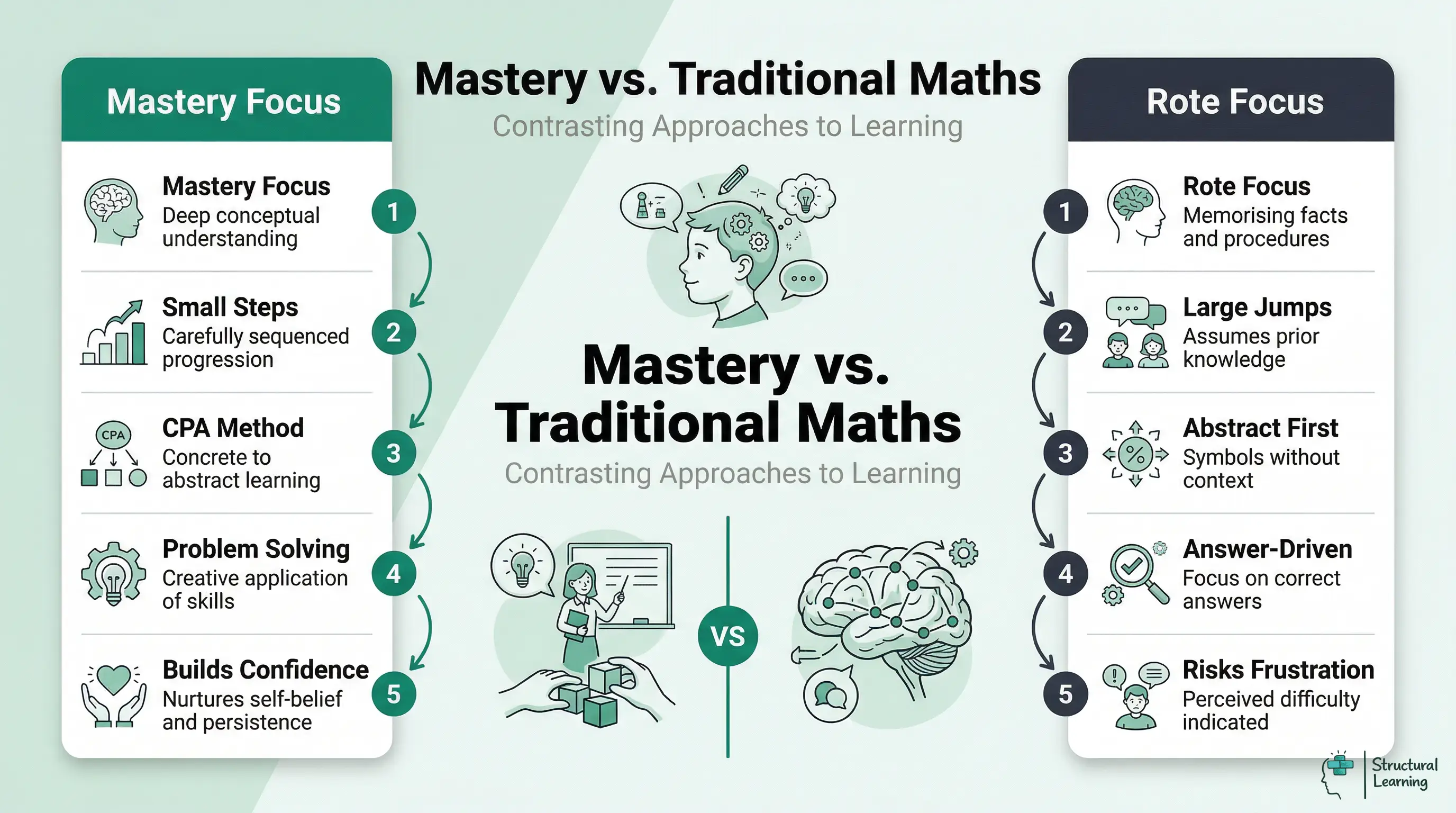
    Traditional maths teaching has been criticised for being too abstract and difficult to grasp by many young learners. The mastery method is based on the idea that learning mathematics should be fun and enjoyable. It focuses on developing deep understanding rather than memorisation. This means that it helps children develop self-belief, persistence and resilience.

    White Rose Maths offers a 'small steps' progression and yearly frameworks, which allow children to learn at their ownpace while still achieving high standards.

    White Rose Maths helps children develop their conceptual understanding of mathematics by using concrete objects, pictorial representations and abstract thinking. This inclusive approach is based on the principles of cognitive psychology and child development.

    https://www.structural-learning.com/post/what-is-numicon-and-does-it-work
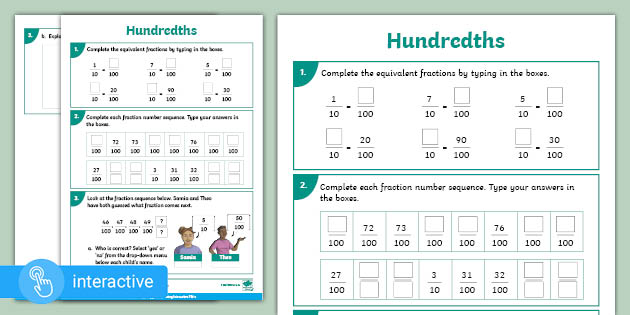
    Interactive White Rose Resources

    Year-by-Year Curriculum Structure

    White Rose Maths structures learning from ages 3-18 across Early Years Foundation Stage, Key Stages 1-4, and Post-16. Each year group follows carefully sequenced small steps that build upon previous learning. The programme ensures mathematical concepts progress logically through concrete, pictorial, and abstract representations.

    White Rose Maths organises content into small sequential steps across Early Years (ages 3-5), Primary (ages 5-11), and Secondary (ages 11-18) levels. Each year group follows a coherent progression with topics revisited and built upon throughout the academic year. The curriculum aligns with national standards while providing flexibility for teachers to adapt pacing to their students' needs.

    The White Rose Curriculum is ingeniously structured to cater to a wide spectrum of learners, ranging from Early Years (ages 3-5), Years 1-11, Post 16, and Mixed Age. This comprehensive approach is divided into three distinct terms: Autumn, Spring, and Summer, each reflecting a progression in complexity and depth.

    Focusing on the Early Years students, the curriculum's design is both intricate and thoughtful. Each term is further divided into three to six sub-terms, comprising up to 15 sessions each. These sessions are not merely a sequence of lessons but a carefully crafted process that begins with a scheme and is supported by worksheets for each session. The availability of both free and premium resources ensures accessibility while maintaining quality.

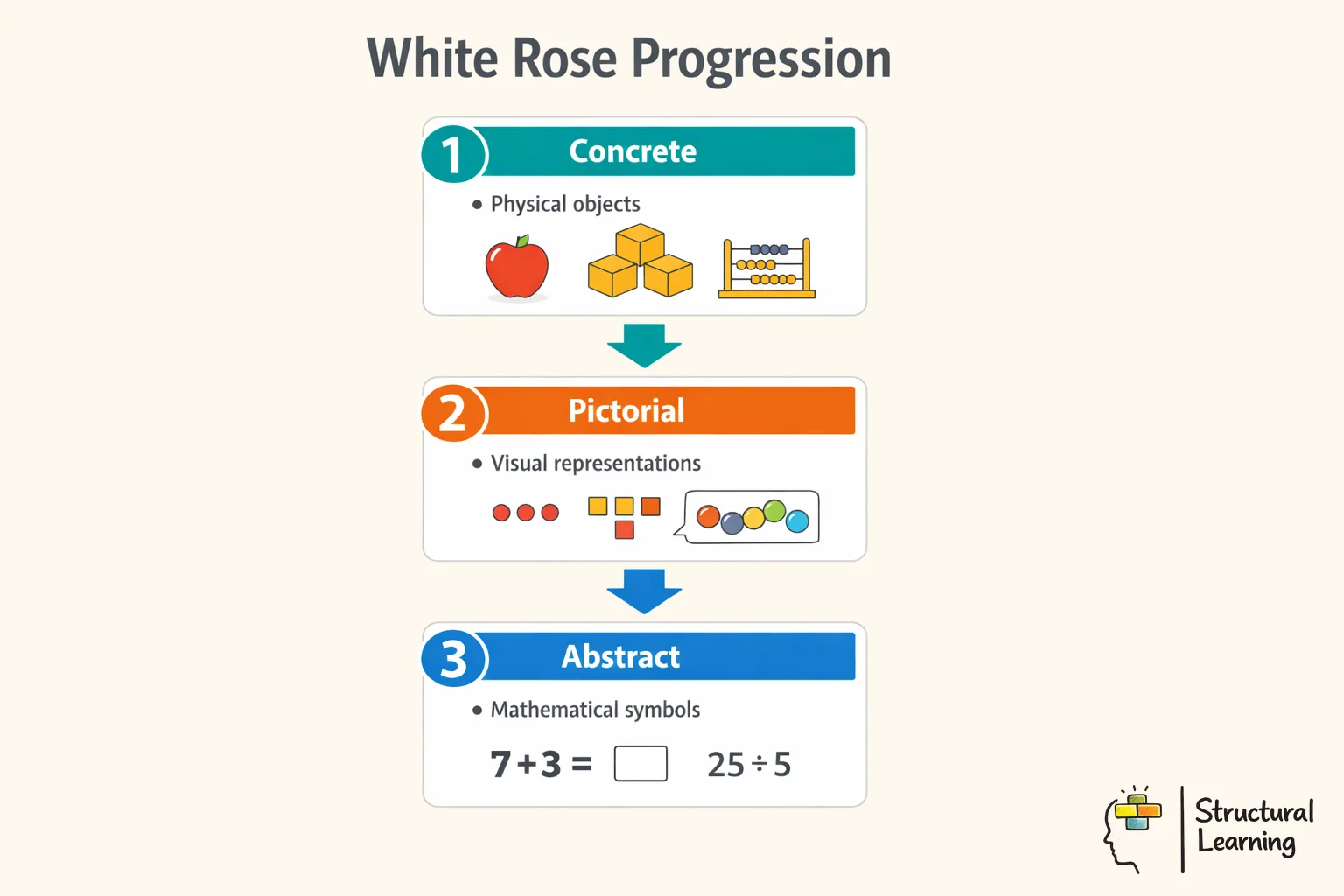
    White Rose Maths progression infographic showing three learning stages from concrete to abstract
    White Rose Progression

    For example, a sub-term might begin with a scheme focused on understanding shapes. The corresponding worksheets would then guide the students through various activities, from recognising basic shapes to understanding their properties, developing a deep and intuitive understanding of the concept.

    The White Rose Curriculum's structure is a testament to a complete approach to learning. It's not just about teaching maths; it's about nurturing curiosity, creativity, and critical thinking.

    The ability to download resources directly from their website adds a layer of convenience, allowing educators to integrate these materials smoothly into their teaching practices.

    the White Rose Curriculum's structure is a well-orchestrated blend of pedagogical insight and practical application. It's a model that recognises the multifaceted nature of learning and seeks to engage students in a meaningful and transformative educational experience.

    Key Insights and Important Facts:

    • Three Levels of Learning: Early Years (ages 3-5), Years 1-11, Post 16 and Mixed Age.
    • Three Terms: Autumn, Spring, and Summer, each with specific focus and progression.
    • Sub-Terms with Sessions: Each term is divided into sub-terms with up to 15 sessions, starting with a scheme and supported by worksheets.
    • Availability of Resources: Many sessions have free worksheets, and some are available as premium resources, downloadable directly from their website.
    • complete Approach: The curriculum creates curiosity, creativity, and critical thinking in mathematics.

    Premium Resources: Are They Worth It?

    White Rose Maths premium resources cost £30-£72 annually and provide detailed lesson plans, assessment materials, and differentiated activities. Premium subscriptions offer enhanced planning tools and additional practise materials beyond the free schemes of learning. Schools report improved outcomes with premium access.

    Premium resources (£30-£72 annually) include detailed lesson slides, differentiated worksheets, assessment materials, and intervention tools not available in free versions. Teachers report these resources save 3-5 hours of AI-assisted planning weekly and provide ready-made differentiation for diverse learners. The investment typically pays off through improved student outcomes and reduced teacher workload.

    White many White Rose Maths resources are offered completely free of charge, there are some resources that can be obtained for a nominal yearly access fee.

    Premium resources for each school year can be availed for £30 for one year of access. This is great for parents who have chosen to homeschool their children.

    Schools can buy the premium resources for their teachers in three bundles: Infant resources, Primary Maths resources and Secondary Maths resources. Each bundle is offered for £72 for a year's access.

    We recommend the whole year package. This is by far the best offer. You can purchase a full set of workbooks for each term in the primary scheme of learning, including the autumn, spring and summer terms.

    Each term has been designed to cover the same content and assessment requirements as the previous term. The workbooks are available in two formats, print and digital. Print books are delivered via post within 5 working days of ordering. Digital books are delivered instantly via email.
    CPD support through White Rose Hubs
    CPD support through White Rose Hubs

    Implementing White Rose in Your Classroom

    White Rose Maths implementation begins with downloading free schemes of learning and adapting lesson sequences to your class needs. Teachers introduce concrete manipulatives first, progress to pictorial representations, then abstract concepts. Training materials support the transition to mastery-based teaching approaches.

    Teachers should start by familiarizing themselves with the small steps progression and using the free scheme of learning to map their year. Implement the concrete-pictorial-abstract approach consistently, allowing students time to explore concepts with manipulatives before moving to abstract work. Use the built-in assessment checkpoints to identify gaps and adjust pacing rather than rushing to complete all content.

    The teachers notes are designed to help teachers address common misconceptions, vocabulary and commands, and prompt students to think critically about problems. The notes are available in English.

    Teachers can print the PDF files and use them with their students. Or they can order the more cost-effective printed workbooks.

    The workbooks contain all the required maths worksheets for the whole term. They come in a handy format so that you can easily carry them around. The worksheets are printed in full colour and are easy to read.

    The workbooks are designed to be used by both teachers and students. They contain exercises, lessons and activities that cover a wide range of mathematical topics, including fractions, decimals, algebra and more.

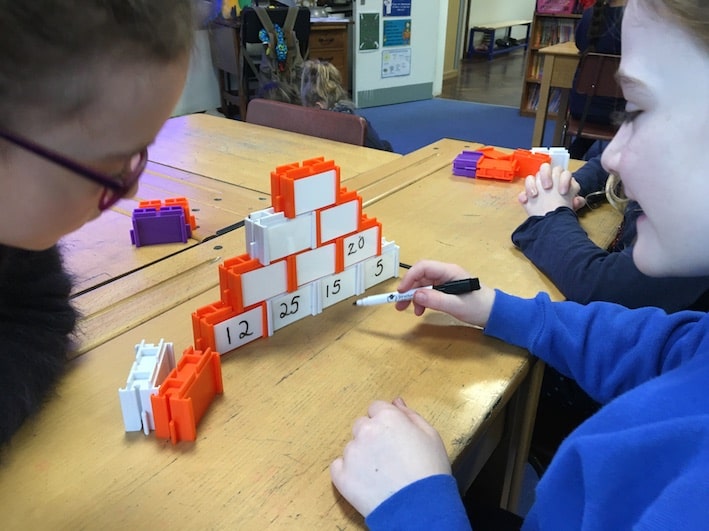
    Using our specially designed blocks to make Maths less abstract
    Using our specially designed blocks to make Maths less abstract

    White Rose Maths for Homeschooling Parents

    White Rose Maths provides free parent resources including video tutorials, worksheets, and guidance for home learning. Homeschooling families access age-appropriate materials through the official website. The structured approach supports parents with clear progression pathways and daily lesson plans.

    White Rose provides free home learning videos and worksheets aligned with each small step in the curriculum, making it accessible for parent educators. Parents can follow the structured sequence without needing extensive maths knowledge, as videos explain concepts clearly. The resources include answer keys and guidance notes to help parents support their children's mathematical development effectively.

    A lot of parents are wondering how to help their kids with their math education. There is a lot of information out there, and it can be difficult to know where to start. White Rose Maths has created a roadmap that will help you through the complicated learning steps and blocks of learning.

    White Rose Maths is an online resource for parents looking for advice on how to support their child's math education. The site provides a roadmap with all the crucial learning steps and blocks of learning so you can understand what your child should be doing at each stage in order to succeed in math.

    Homeschooling families have many challenges to face when trying to get their child(ren) ready for the first day of school. These challenges include finding suitable materials, getting organised and keeping up with the changing demands of the curriculum.

    With White Rose Maths, this is no longer an issue. You can simply download the relevant workbook for the current term and start using it straight away.
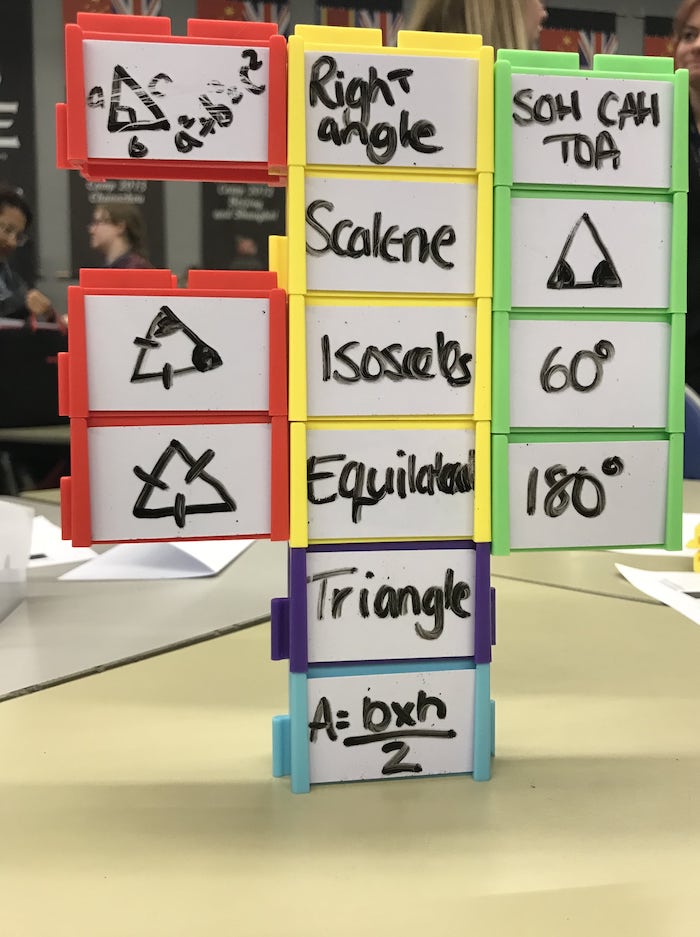
    Make Maths Visual
    Make Maths Visual

    White Rose Educational Theory Explained

    White Rose Maths bases its approach on Singapore-style mastery learning and Bruner's concrete-pictorial-abstract theory. The programme incorporates research from cognitive loadtheory and spaced practise principles. Mathematical concepts develop through careful sequencing that prevents cognitive overload whilst building deep understanding.

    White Rose Maths is built on mastery learning theory and cognitive load theory, emphasising deep understanding through carefully managed progression. The app roach draws from Singapore Math and Shanghai teaching methods, using variation theory to help students recognise patterns and connections. The methodology emphasises concrete-pictorial-abstract progression to support conceptual understanding.

    The White Rose Maths curriculum is not just a set of instructions; it's a philosophical approach that intertwines with various educational theories and concepts. Here's an expanded list of potential conceptual links:

    • Metacognitive Awareness: White Rose encourages students to think about their thinking, developing self-awareness and reflection. It aligns with the principles of metacognition, enabling students to understand their learning processes.
    • Retrieval Practise: Through consistent practise and review, students are encouraged to retrieve info rmation, reinforcing memory and understanding.
    • Dialogic Pedagogy: The curriculum promotes dialogue between teachers and students, developing a collaborative learning environment that echoes the principles of dialogic pedagogy.
    • Constructivist Approach: White Rose aligns with constructivist theories, encouraging students to build knowledge through exploration and inquiry.
    • Higher Order Thinking Skills: The curriculum promotes critical thinking and problem-solving, aligning with gestalt psychology's focus on understanding systems as a whole.
    • John Dewey Theory: Emphasising experiential learning, White Rose resonates with Dewey's emphasis on learning through doing.
    • Webb's Depth of Knowledge: The curriculum's complexity aligns with Webb's levels, guiding students from basic recall to higher-order thinking.
    • Schemes of Learning: White Rose's structured approach aligns with the national curriculum, providing a coherent framework for class teaching across a range of topics.
    • Subject Knowledge: The curriculum enhances teachers' subject knowledge, supporting effective instructional design.
    • Asynchronous Learning: White Rose's resources can be adapted for asynchronous learning, providing flexibility in teaching and learning.

    The White Rose Maths curriculum is a rich tapestry that weaves together various educational theories and practices. It's a dynamic approach that recognises the multifaceted nature of learning and offers a strong framework for engaging students in meaningful educational experiences.

    White Rose Maths Pricing 2025

    White Rose offers extensive free resources including schemes of learning and home learning materials, with premium subscriptions ranging from £30 for individual teachers to £72 for small schools annually. Larger schools pay based on student numbers, typically £150-£300 per year for full access. The premium subscription includes assessment tools, intervention resources, and ready-to-use lesson materials that free users cannot access.

    White Rose Maths offers both free and premium resources, making it accessible for schools of all budgets.

    Free Resources

    The White Rose Maths Scheme and structured small steps progression is free for all primary schools to use.

    Premium Subscription Pricing

    • School subscription: From £210 for 1-10 primary maths users (12 months)
    • Individual subscription: £42 (inc. VAT) for single year-group access (12 months)
    • Entry-level access: From £96 (inc. VAT) for basic 12-month access

    What Premium Includes

    • Teaching slides (fully adaptable)
    • End of block and end of term assessments
    • Home learning videos
    • Online CPD courses
    • High-quality maths worksheets

    Visit White Rose Education for current pricing based on your school size.

    Complementary Resources

    White Rose Global Usage Guide

    White Rose Maths operates in over 15 countries including Australia, New Zealand, and international British schools worldwide. The programme adapts to different curriculum requirements whilst maintaining its core mastery principles. International schools report significant improvements in mathematical achievement using White Rose approaches.

    White Rose Maths is used in over 70% of UK primary schools and has expanded to international schools across Europe, Asia, and the Middle East. The curriculum adapts well to different educational systems due to its focus on universal mathematical concepts and visual learning approaches. Schools report successful implementation regardless of local curriculum requirements, as the mastery approach translates across cultural and linguistic boundaries.

    Yes. White Rose Maths has been developed by a team of educational experts and teachers to be used in any country. Even if you follow a different scheme in your country or curriculum, you will still be able to use the same books.

    White Rose Maths is a flexible, standalone resource that can be used with any curriculum or teaching style. It can be used as additional support for teaching and learning, wherever you are in the world.

    The White Rose Maths workbooks have been developed to make it easier for children to learn maths at home, while still being able to use their school textbooks.

    White Rose Maths Pricing: Free vs Premium Resources 2025

    Understanding White Rose Maths pricing structure helps teachers maximise their department budgets whilst accessing quality resources. The programme offers a substantial collection of free materials alongside premium subscriptions, allowing schools to choose options that suit their financial constraints and teaching needs.

    The free resources include downloadable teaching slides, home learning videos, and basic planning documents for each year group. These materials cover the full curriculum and provide enough content for teachers to deliver complete lessons. For example, a Year 4 teacher can access free PowerPoints for teaching column multiplication, complete with visual representations and practise questions. The accompanying videos, originally created during lockdown, remain freely available and offer additional support for pupils who need reinforcement at home.

    Premium subscriptions range from £30 for individual teacher accounts to £72 for whole-school access, providing significant additional value. Premium members receive editable worksheets differentiated at three levels, detailed assessment materials, and ready-to-use intervention resources. A Year 6 teacher preparing for SATs, for instance, gains access to diagnostic assessments that identify specific gaps in understanding, plus targeted practise materials to address these areas. The premium package also includes parent workbooks and additional reasoning and problem-solving activities that extend learning beyond basic fluency.

    Many schools adopt a hybrid approach, using free resources for daily teaching whilst purchasing premium subscriptions for specific year groups or intervention programmes. This strategy proves particularly effective for schools with limited budgets; they might invest in premium resources for Years 2 and 6 where national assessments occur, whilst relying on free materials for other year groups. The cost per pupil typically works out between £0.50 and £2.00 annually, making it considerably more affordable than traditional textbook schemes.

    White Rose Maths Curriculum Structure by Year Group

    White Rose Maths organises its curriculum into distinct blocks across each year group, providing teachers with a clear progression path from Reception through to Year 13. Each academic year is divided into approximately 12-14 teaching blocks, with autumn, spring and summer terms carefully mapped to the National Curriculum requirements whilst allowing flexibility for school-specific needs.

    In Reception and Key Stage 1, the blocks focus on number sense and place value, taking up roughly 50% of teaching time. For instance, Year 1 autumn term begins with 'Place Value within 10', dedicating four weeks to ensure pupils develop secure foundations. This transitions into 'Addition and Subtraction within 10', where concrete resources like counters and ten frames support understanding. By Year 2, these concepts expand to numbers within 100, maintaining the same careful progression.
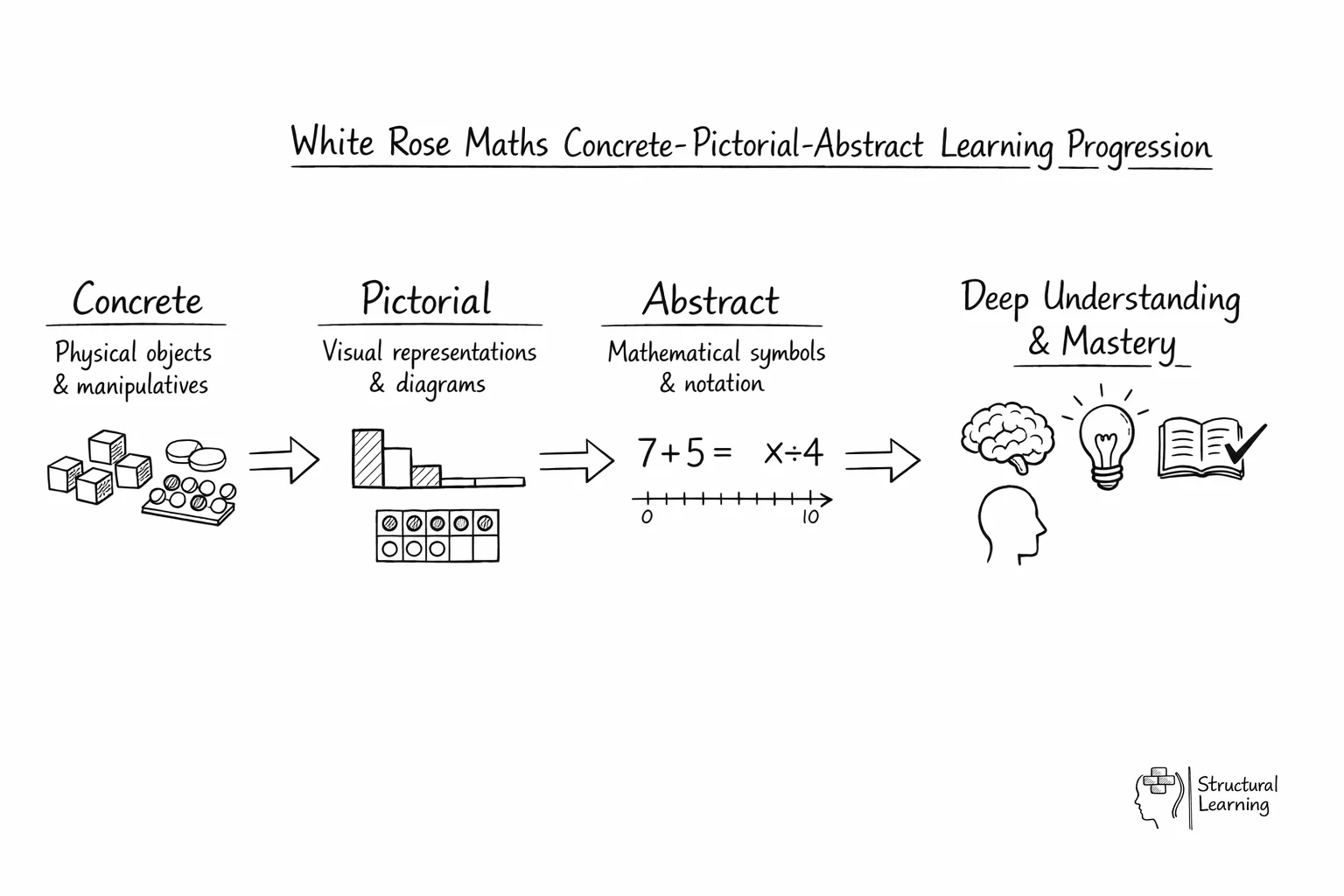
    White Rose Maths learning progression flow diagram: concrete to pictorial to abstract stages
    Flow diagram: White Rose Maths Concrete-Pictorial-Abstract Learning Progression

    Key Stage 2 introduces more complex topics whilst revisiting core concepts. Year 3 pupils encounter formal written methods after spending considerable time on mental strategies. The curriculum allocates approximately three weeks to multiplication and division in each term, recognising that distributed practise supports long-term retention. Year 6 dedicates substantial time to fractions, decimals and percentages; typically six weeks across the year, as research by the Education Endowment Foundation identifies these as crucial gateway topics for secondary mathematics.

    Secondary provision follows a five-year scheme from Years 7-11, with each block lasting 2-3 weeks. The spiral curriculum ensures topics like algebra appear multiple times with increasing complexity. Year 7 might spend two weeks on basic algebraic notation, whilst Year 9 extends this to quadratic expressions over three weeks. This structure allows teachers to address gaps whilst maintaining appropriate challenge for all pupils.

    Frequently Asked Questions

    How White Rose Differs from Traditional Teaching

    White Rose Maths is a mastery-based teaching approach that emphasises deep understanding of mathematical concepts through small, carefully sequenced steps rather than rote memorisation. It uses a concrete-pictorial-abstract progression where students work with physical objects first, then visual representations, and finally abstract mathematical symbols. Teachers report significant improvements in student problem-solving abilities and mathematical confidence using this approach.

    Age Group Curriculum Breakdown

    The curriculum spans ages 3-18, organised into Early Years (3-5), Primary (5-11), and Secondary (11-18) levels with content divided into three terms: Autumn, Spring, and Summer. Each term contains 3-6 sub-terms with up to 15 sessions each, following a coherent progression where topics are revisited and built upon throughout the academic year. The structure allows for flexibility in pacing whilst maintaining alignment with national standards.

    Key Benefits for Schools

    Schools using White Rose Maths report improved student engagement and problem-solving abilities. The approach builds mathematical confidence through mastery learning, develops fluency, reasoning, and problem-solving skills, and helps fill learning gaps that other curricula might miss. It transforms maths from memorisation to genuine understanding, making the subject more enjoyable and accessible for students.

    Free vs Premium Resources

    White Rose Maths offers both free and premium resources, with premium options costing £30-£72 depending on the level of access required. The resources include schemes, worksheets for each session, problem-solving questions, and randomly generated questions designed to stretch pupils' abilities. All materials can be downloaded directly from their website, making integration into existing teaching practices smooth.

    Concrete-Pictorial-Abstract Approach in Practise

    The concrete-pictorial-abstract progression begins with students using physical objects to explore mathematical concepts, then moves to visual representations, and finally to abstract mathematical symbols. For example, when teaching fractions in primary school, students might start with hands-on activities using real objects, progress to visual diagrams, and then work with fraction notation. This ensures students have a solid conceptual foundation before moving to more abstract thinking.

    Teacher Implementation Challenges

    The main challenge is that developing comprehensive maths learning materials requires significant time that many schools don't have available. However, White Rose Maths addresses this by providing well-sequenced resources that integrate easily with existing curricula. Teachers need to shift from acceleration-focused teaching to mastery-based approaches, which may require adjusting expectations about pacing through topics.

    Time-Saving Support for Busy Teachers

    White Rose Maths provides ready-made, well-sequenced learning resources that fill learning gaps without requiring teachers to develop materials from scratch. The small steps progression and comprehensive schemes reduce planning time whilst ensuring curriculum coverage. The availability of both schemes and supporting worksheets for each session means teachers have structured, ready-to-use materials that align with learning objectives across all year groups.

    Further Reading: Key Research Papers

    These peer-reviewed studies provide the research foundation for the strategies discussed in this article:

    Concrete-Pictorial-Abstract instruction: enhancing students' learning motivation and achievement in mathematics View study ↗
    3 citations

    Emmanuel Iyamuremye & Daniel Burns (2025)

    This large-scale study of 730 eighth-grade students in Rwanda demonstrates that the Concrete-Pictorial-Abstract approach significantly boosts both student motivation and achievement in mathematics, even in schools with limited resources. The research shows that starting with hands-on materials, moving to visual representations, and finally introducing abstract concepts helps students build deeper understanding and stay more engaged. For teachers working with diverse learners or limited materials, this study provides compelling evidence that structured, sequential instruction can make complex mathematical concepts more accessible and enjoyable.

    ENHANCING STUDENTS' ENGAGEMENT, SELF-EFFICACY, AND MATHEMATICS CONCEPT MASTERY THROUGH THE IMPLEMENTATION OF THE FLIPPED CLASSROOM MODEL AT QUIVER Centre ACADEMY View study ↗

    Gillian Tampi (2024)

    This research tackles the common challenge of passive, disengaged students in online mathematics classes by implementing a flipped classroom model where students learn content at home and practise during class time. The study found that this approach significantly improved student participation, confidence in their mathematical abilities, and mastery of key concepts. Teachers struggling with student engagement in hybrid or online learning environments will find practical insights on how restructuring lesson delivery can transform passive observers into active mathematical thinkers.

    Challenging mathematically gifted middle years students: A mastery learning model View study ↗

    Daren G. Mallett (2019)

    This case study reveals how adapting mastery learning principles can successfully challenge and engage mathematically gifted middle school students who often coast through standard curricula. The research shows that when gifted students are given appropriately challenging materials and allowed to progress at their own pace, they demonstrate increased achievement, interest, and engagement. Teachers working with high-achieving students will discover practical strategies for differentiating instruction that goes beyond simply giving more work, instead providing deeper and more meaningful mathematical challenges.

    ENHANCING MATHEMATICS AND SCIENCE LEARNING THROUGH IMPROVED READING COMPREHENSION: A SYSTEMATIC LITERATURE REVIEW View study ↗
    2 citations

    Jay L. Galimpin (2024)

    This comprehensive review reveals the critical but often overlooked connection between reading skills and success in mathematics and science, showing that students who struggle with reading comprehension often struggle with word problems and technical concepts. The research highlights how factors like socioeconomic background affect this relationship and identifies teaching strategies that address multiple learning styles simultaneously. Mathematics and science teachers will gain valuable insights into why some students struggle with seemingly simple problems and how incorporating reading comprehension strategies can unlock student potential across STEM subjects.

    Concrete-Pictorial-Abstract Approach in Developing Students' Understanding of Surface Area of Solids View study ↗

    Emerlyn Abrenica (2025)

    This study specifically examines how the Concrete-Pictorial-Abstract approach helps Grade 8 students overcome the notorious difficulty of understanding surface area, a topic that typically relies heavily on spatial visualization skills many students lack. The research demonstrates that students who work with physical models before moving to diagrams and finally formulas show significantly better understanding of these challenging geometric concepts. Geometry teachers will find this research particularly valuable for making abstract three-dimensional concepts tangible and accessible, especially for students who struggle with spatial reasoning.

Loading audit...

What is White Rose Maths?

White Rose Maths is a mastery-based teaching approach that focuses on deep understandingof mathematical concepts through small, carefully sequenced steps. It uses a concrete-pictorial-abstract progression where students first work with physical objects, then move to visual representations, and finally to abstract mathematical symbols. The programme provides comprehensive resources for ages 3-18, emphasising problem-solving skills over rote memorization.

White Rose Maths is a pioneering educational initiative that emphasises a comprehensive understanding of mathematics. It's a pedagogical approach that has been embraced by both primaryand secondary schools to enhance maths skills and problem-solving skills.

Key Takeaways

  1. Beyond Rote Learning: Discover how White Rose's mastery approach transforms maths from memorisation to deep understanding through carefully sequenced progression
  2. The Small Steps Revolution: Learn why White Rose's carefully sequenced progression fills learning gaps other curricula miss, without overwhelming time-pressed teachers
  3. Free vs Premium Decoded: Navigate White Rose's resource options: which free materials deliver impact and when the £30-£72 premium investment transforms outcomes
  4. Early Years to Post-16: See how one coherent approach spans ages 3-18, using concrete-pictorial-abstract progression that supports diverse learners

The core of White Rose Maths is the maths mastery approach, which focuses on depth rather than acceleration, ensuring that key concepts are fully grasped before moving on. This approach aligns with the Learning Objectivesof a range of school years, providing a coherent and connected curriculum.

For example, in primary schools, White Rose Maths might introduce fractions through visual representations and hands-on activities before progressing to more abstract concepts. This ensures that students have a concrete understanding before moving on.

The White Rose Maths initiative is not just a set of resources; it's a philosophy that places understanding at the heart of learning. It's about nurturing a love for mathematics and equipping students with the tools they need to succeed in a subject that is often seen as challenging. It's a fresh perspective that is reshaping how mathematics is taught and understood.

  • Maths Skills: White Rose Maths emphasises understanding over rote learning.
  • Problem-Solving Skills: The approach creates deep thinking and application.
  • Primary and Secondary Schools: It's applicable across a range of school years, focusing on mastery.
  • White Rose Maths Core Goals

    White Rose Maths aims to develop fluency, reasoning, and problem-solving skills by ensuring students fully understand each concept before progressing. The curriculum prioritises depth over speed, focusing on mastery learning rather than rushing through topics. Its core goal is building mathematical confidencethrough deep understanding of mathematical concepts.

    White Rose Maths aims to make teaching mathematics easier and more effective.

    The White Rose Maths curriculum is designed to provide students with a solid foundation in mathematics. Students will gain a deep understanding of mathematics and enjoy solving mathematical problems with this course. The primary curriculum puts a significant emphasis on mathematical skills, curriculum content has to be well sequenced in order to promote a depth of understanding.

    Many schools don't have the time to develop the learning resources to fill the learning gaps. Developing maths learning materials like any other subject requires a lot of time the schools don't always have. The White Rose resources are well suited to curriculum integration. The programme comes with a plethora of problem-solving questions and randomly generated questions that are designed to really stretch pupils abilities.

    This programme is not just about teaching maths, it is about developing mathematical thinking skills. The aim of this programme is to ensure that students are able to think mathematically and solve problems with confidence.

    "Our aim is for young mathematicians to become:

    • Confident and able to recall and apply mathematical knowledge in different contexts
    • Able to explain their methods and thinking processes and apply skills in context
    • Fluent in different areas of maths
    • Efficient in applying problem-solving and reasoning skills
    • Independent thinkers
    • Making number work fun Maths
    • Aware of the Maths/ concepts/ process they are doing"

    Traditional maths teaching has been criticised for being too abstract and difficult to grasp by many young learners. The mastery method is based on the idea that learning mathematics should be fun and enjoyable. It focuses on developing deep understanding rather than memorisation. This means that it helps children develop self-belief, persistence and resilience.

    White Rose Maths offers a 'small steps' progression and yearly frameworks, which allow children to learn at their ownpace while still achieving high standards.

    White Rose Maths helps children develop their conceptual understanding of mathematics by using concrete objects, pictorial representations and abstract thinking. This inclusive approach is based on the principles of cognitive psychology and child development.

    https://www.structural-learning.com/post/what-is-numicon-and-does-it-work
    Interactive White Rose Resources

    Year-by-Year Curriculum Structure

    White Rose Maths structures learning from ages 3-18 across Early Years Foundation Stage, Key Stages 1-4, and Post-16. Each year group follows carefully sequenced small steps that build upon previous learning. The programme ensures mathematical concepts progress logically through concrete, pictorial, and abstract representations.

    White Rose Maths organises content into small sequential steps across Early Years (ages 3-5), Primary (ages 5-11), and Secondary (ages 11-18) levels. Each year group follows a coherent progression with topics revisited and built upon throughout the academic year. The curriculum aligns with national standards while providing flexibility for teachers to adapt pacing to their students' needs.

    The White Rose Curriculum is ingeniously structured to cater to a wide spectrum of learners, ranging from Early Years (ages 3-5), Years 1-11, Post 16, and Mixed Age. This comprehensive approach is divided into three distinct terms: Autumn, Spring, and Summer, each reflecting a progression in complexity and depth.

    Focusing on the Early Years students, the curriculum's design is both intricate and thoughtful. Each term is further divided into three to six sub-terms, comprising up to 15 sessions each. These sessions are not merely a sequence of lessons but a carefully crafted process that begins with a scheme and is supported by worksheets for each session. The availability of both free and premium resources ensures accessibility while maintaining quality.

    White Rose Maths progression infographic showing three learning stages from concrete to abstract
    White Rose Progression

    For example, a sub-term might begin with a scheme focused on understanding shapes. The corresponding worksheets would then guide the students through various activities, from recognising basic shapes to understanding their properties, developing a deep and intuitive understanding of the concept.

    The White Rose Curriculum's structure is a testament to a complete approach to learning. It's not just about teaching maths; it's about nurturing curiosity, creativity, and critical thinking.

    The ability to download resources directly from their website adds a layer of convenience, allowing educators to integrate these materials smoothly into their teaching practices.

    the White Rose Curriculum's structure is a well-orchestrated blend of pedagogical insight and practical application. It's a model that recognises the multifaceted nature of learning and seeks to engage students in a meaningful and transformative educational experience.

    Key Insights and Important Facts:

    • Three Levels of Learning: Early Years (ages 3-5), Years 1-11, Post 16 and Mixed Age.
    • Three Terms: Autumn, Spring, and Summer, each with specific focus and progression.
    • Sub-Terms with Sessions: Each term is divided into sub-terms with up to 15 sessions, starting with a scheme and supported by worksheets.
    • Availability of Resources: Many sessions have free worksheets, and some are available as premium resources, downloadable directly from their website.
    • complete Approach: The curriculum creates curiosity, creativity, and critical thinking in mathematics.

    Premium Resources: Are They Worth It?

    White Rose Maths premium resources cost £30-£72 annually and provide detailed lesson plans, assessment materials, and differentiated activities. Premium subscriptions offer enhanced planning tools and additional practise materials beyond the free schemes of learning. Schools report improved outcomes with premium access.

    Premium resources (£30-£72 annually) include detailed lesson slides, differentiated worksheets, assessment materials, and intervention tools not available in free versions. Teachers report these resources save 3-5 hours of AI-assisted planning weekly and provide ready-made differentiation for diverse learners. The investment typically pays off through improved student outcomes and reduced teacher workload.

    White many White Rose Maths resources are offered completely free of charge, there are some resources that can be obtained for a nominal yearly access fee.

    Premium resources for each school year can be availed for £30 for one year of access. This is great for parents who have chosen to homeschool their children.

    Schools can buy the premium resources for their teachers in three bundles: Infant resources, Primary Maths resources and Secondary Maths resources. Each bundle is offered for £72 for a year's access.

    We recommend the whole year package. This is by far the best offer. You can purchase a full set of workbooks for each term in the primary scheme of learning, including the autumn, spring and summer terms.

    Each term has been designed to cover the same content and assessment requirements as the previous term. The workbooks are available in two formats, print and digital. Print books are delivered via post within 5 working days of ordering. Digital books are delivered instantly via email.

    CPD support through White Rose Hubs
    CPD support through White Rose Hubs

    Implementing White Rose in Your Classroom

    White Rose Maths implementation begins with downloading free schemes of learning and adapting lesson sequences to your class needs. Teachers introduce concrete manipulatives first, progress to pictorial representations, then abstract concepts. Training materials support the transition to mastery-based teaching approaches.

    Teachers should start by familiarizing themselves with the small steps progression and using the free scheme of learning to map their year. Implement the concrete-pictorial-abstract approach consistently, allowing students time to explore concepts with manipulatives before moving to abstract work. Use the built-in assessment checkpoints to identify gaps and adjust pacing rather than rushing to complete all content.

    The teachers notes are designed to help teachers address common misconceptions, vocabulary and commands, and prompt students to think critically about problems. The notes are available in English.

    Teachers can print the PDF files and use them with their students. Or they can order the more cost-effective printed workbooks.

    The workbooks contain all the required maths worksheets for the whole term. They come in a handy format so that you can easily carry them around. The worksheets are printed in full colour and are easy to read.

    The workbooks are designed to be used by both teachers and students. They contain exercises, lessons and activities that cover a wide range of mathematical topics, including fractions, decimals, algebra and more.

    Using our specially designed blocks to make Maths less abstract
    Using our specially designed blocks to make Maths less abstract

    White Rose Maths for Homeschooling Parents

    White Rose Maths provides free parent resources including video tutorials, worksheets, and guidance for home learning. Homeschooling families access age-appropriate materials through the official website. The structured approach supports parents with clear progression pathways and daily lesson plans.

    White Rose provides free home learning videos and worksheets aligned with each small step in the curriculum, making it accessible for parent educators. Parents can follow the structured sequence without needing extensive maths knowledge, as videos explain concepts clearly. The resources include answer keys and guidance notes to help parents support their children's mathematical development effectively.

    A lot of parents are wondering how to help their kids with their math education. There is a lot of information out there, and it can be difficult to know where to start. White Rose Maths has created a roadmap that will help you through the complicated learning steps and blocks of learning.

    White Rose Maths is an online resource for parents looking for advice on how to support their child's math education. The site provides a roadmap with all the crucial learning steps and blocks of learning so you can understand what your child should be doing at each stage in order to succeed in math.

    Homeschooling families have many challenges to face when trying to get their child(ren) ready for the first day of school. These challenges include finding suitable materials, getting organised and keeping up with the changing demands of the curriculum.

    With White Rose Maths, this is no longer an issue. You can simply download the relevant workbook for the current term and start using it straight away.

    Make Maths Visual
    Make Maths Visual

    White Rose Educational Theory Explained

    White Rose Maths bases its approach on Singapore-style mastery learning and Bruner's concrete-pictorial-abstract theory. The programme incorporates research from cognitive loadtheory and spaced practise principles. Mathematical concepts develop through careful sequencing that prevents cognitive overload whilst building deep understanding.

    White Rose Maths is built on mastery learning theory and cognitive load theory, emphasising deep understanding through carefully managed progression. The app roach draws from Singapore Math and Shanghai teaching methods, using variation theory to help students recognise patterns and connections. The methodology emphasises concrete-pictorial-abstract progression to support conceptual understanding.

    The White Rose Maths curriculum is not just a set of instructions; it's a philosophical approach that intertwines with various educational theories and concepts. Here's an expanded list of potential conceptual links:

    • Metacognitive Awareness: White Rose encourages students to think about their thinking, developing self-awareness and reflection. It aligns with the principles of metacognition, enabling students to understand their learning processes.
    • Retrieval Practise: Through consistent practise and review, students are encouraged to retrieve info rmation, reinforcing memory and understanding.
    • Dialogic Pedagogy: The curriculum promotes dialogue between teachers and students, developing a collaborative learning environment that echoes the principles of dialogic pedagogy.
    • Constructivist Approach: White Rose aligns with constructivist theories, encouraging students to build knowledge through exploration and inquiry.
    • Higher Order Thinking Skills: The curriculum promotes critical thinking and problem-solving, aligning with gestalt psychology's focus on understanding systems as a whole.
    • John Dewey Theory: Emphasising experiential learning, White Rose resonates with Dewey's emphasis on learning through doing.
    • Webb's Depth of Knowledge: The curriculum's complexity aligns with Webb's levels, guiding students from basic recall to higher-order thinking.
    • Schemes of Learning: White Rose's structured approach aligns with the national curriculum, providing a coherent framework for class teaching across a range of topics.
    • Subject Knowledge: The curriculum enhances teachers' subject knowledge, supporting effective instructional design.
    • Asynchronous Learning: White Rose's resources can be adapted for asynchronous learning, providing flexibility in teaching and learning.

    The White Rose Maths curriculum is a rich tapestry that weaves together various educational theories and practices. It's a dynamic approach that recognises the multifaceted nature of learning and offers a strong framework for engaging students in meaningful educational experiences.

    White Rose Maths Pricing 2025

    White Rose offers extensive free resources including schemes of learning and home learning materials, with premium subscriptions ranging from £30 for individual teachers to £72 for small schools annually. Larger schools pay based on student numbers, typically £150-£300 per year for full access. The premium subscription includes assessment tools, intervention resources, and ready-to-use lesson materials that free users cannot access.

    White Rose Maths offers both free and premium resources, making it accessible for schools of all budgets.

    Free Resources

    The White Rose Maths Scheme and structured small steps progression is free for all primary schools to use.

    Premium Subscription Pricing

    • School subscription: From £210 for 1-10 primary maths users (12 months)
    • Individual subscription: £42 (inc. VAT) for single year-group access (12 months)
    • Entry-level access: From £96 (inc. VAT) for basic 12-month access

    What Premium Includes

    • Teaching slides (fully adaptable)
    • End of block and end of term assessments
    • Home learning videos
    • Online CPD courses
    • High-quality maths worksheets

    Visit White Rose Education for current pricing based on your school size.

    Complementary Resources

    White Rose Global Usage Guide

    White Rose Maths operates in over 15 countries including Australia, New Zealand, and international British schools worldwide. The programme adapts to different curriculum requirements whilst maintaining its core mastery principles. International schools report significant improvements in mathematical achievement using White Rose approaches.

    White Rose Maths is used in over 70% of UK primary schools and has expanded to international schools across Europe, Asia, and the Middle East. The curriculum adapts well to different educational systems due to its focus on universal mathematical concepts and visual learning approaches. Schools report successful implementation regardless of local curriculum requirements, as the mastery approach translates across cultural and linguistic boundaries.

    Yes. White Rose Maths has been developed by a team of educational experts and teachers to be used in any country. Even if you follow a different scheme in your country or curriculum, you will still be able to use the same books.

    White Rose Maths is a flexible, standalone resource that can be used with any curriculum or teaching style. It can be used as additional support for teaching and learning, wherever you are in the world.

    The White Rose Maths workbooks have been developed to make it easier for children to learn maths at home, while still being able to use their school textbooks.

    White Rose Maths Pricing: Free vs Premium Resources 2025

    Understanding White Rose Maths pricing structure helps teachers maximise their department budgets whilst accessing quality resources. The programme offers a substantial collection of free materials alongside premium subscriptions, allowing schools to choose options that suit their financial constraints and teaching needs.

    The free resources include downloadable teaching slides, home learning videos, and basic planning documents for each year group. These materials cover the full curriculum and provide enough content for teachers to deliver complete lessons. For example, a Year 4 teacher can access free PowerPoints for teaching column multiplication, complete with visual representations and practise questions. The accompanying videos, originally created during lockdown, remain freely available and offer additional support for pupils who need reinforcement at home.

    Premium subscriptions range from £30 for individual teacher accounts to £72 for whole-school access, providing significant additional value. Premium members receive editable worksheets differentiated at three levels, detailed assessment materials, and ready-to-use intervention resources. A Year 6 teacher preparing for SATs, for instance, gains access to diagnostic assessments that identify specific gaps in understanding, plus targeted practise materials to address these areas. The premium package also includes parent workbooks and additional reasoning and problem-solving activities that extend learning beyond basic fluency.

    Many schools adopt a hybrid approach, using free resources for daily teaching whilst purchasing premium subscriptions for specific year groups or intervention programmes. This strategy proves particularly effective for schools with limited budgets; they might invest in premium resources for Years 2 and 6 where national assessments occur, whilst relying on free materials for other year groups. The cost per pupil typically works out between £0.50 and £2.00 annually, making it considerably more affordable than traditional textbook schemes.

    White Rose Maths Curriculum Structure by Year Group

    White Rose Maths organises its curriculum into distinct blocks across each year group, providing teachers with a clear progression path from Reception through to Year 13. Each academic year is divided into approximately 12-14 teaching blocks, with autumn, spring and summer terms carefully mapped to the National Curriculum requirements whilst allowing flexibility for school-specific needs.

    In Reception and Key Stage 1, the blocks focus on number sense and place value, taking up roughly 50% of teaching time. For instance, Year 1 autumn term begins with 'Place Value within 10', dedicating four weeks to ensure pupils develop secure foundations. This transitions into 'Addition and Subtraction within 10', where concrete resources like counters and ten frames support understanding. By Year 2, these concepts expand to numbers within 100, maintaining the same careful progression.

    White Rose Maths learning progression flow diagram: concrete to pictorial to abstract stages
    Flow diagram: White Rose Maths Concrete-Pictorial-Abstract Learning Progression

    Key Stage 2 introduces more complex topics whilst revisiting core concepts. Year 3 pupils encounter formal written methods after spending considerable time on mental strategies. The curriculum allocates approximately three weeks to multiplication and division in each term, recognising that distributed practise supports long-term retention. Year 6 dedicates substantial time to fractions, decimals and percentages; typically six weeks across the year, as research by the Education Endowment Foundation identifies these as crucial gateway topics for secondary mathematics.

    Secondary provision follows a five-year scheme from Years 7-11, with each block lasting 2-3 weeks. The spiral curriculum ensures topics like algebra appear multiple times with increasing complexity. Year 7 might spend two weeks on basic algebraic notation, whilst Year 9 extends this to quadratic expressions over three weeks. This structure allows teachers to address gaps whilst maintaining appropriate challenge for all pupils.

    Frequently Asked Questions

    How White Rose Differs from Traditional Teaching

    White Rose Maths is a mastery-based teaching approach that emphasises deep understanding of mathematical concepts through small, carefully sequenced steps rather than rote memorisation. It uses a concrete-pictorial-abstract progression where students work with physical objects first, then visual representations, and finally abstract mathematical symbols. Teachers report significant improvements in student problem-solving abilities and mathematical confidence using this approach.

    Age Group Curriculum Breakdown

    The curriculum spans ages 3-18, organised into Early Years (3-5), Primary (5-11), and Secondary (11-18) levels with content divided into three terms: Autumn, Spring, and Summer. Each term contains 3-6 sub-terms with up to 15 sessions each, following a coherent progression where topics are revisited and built upon throughout the academic year. The structure allows for flexibility in pacing whilst maintaining alignment with national standards.

    Key Benefits for Schools

    Schools using White Rose Maths report improved student engagement and problem-solving abilities. The approach builds mathematical confidence through mastery learning, develops fluency, reasoning, and problem-solving skills, and helps fill learning gaps that other curricula might miss. It transforms maths from memorisation to genuine understanding, making the subject more enjoyable and accessible for students.

    Free vs Premium Resources

    White Rose Maths offers both free and premium resources, with premium options costing £30-£72 depending on the level of access required. The resources include schemes, worksheets for each session, problem-solving questions, and randomly generated questions designed to stretch pupils' abilities. All materials can be downloaded directly from their website, making integration into existing teaching practices smooth.

    Concrete-Pictorial-Abstract Approach in Practise

    The concrete-pictorial-abstract progression begins with students using physical objects to explore mathematical concepts, then moves to visual representations, and finally to abstract mathematical symbols. For example, when teaching fractions in primary school, students might start with hands-on activities using real objects, progress to visual diagrams, and then work with fraction notation. This ensures students have a solid conceptual foundation before moving to more abstract thinking.

    Teacher Implementation Challenges

    The main challenge is that developing comprehensive maths learning materials requires significant time that many schools don't have available. However, White Rose Maths addresses this by providing well-sequenced resources that integrate easily with existing curricula. Teachers need to shift from acceleration-focused teaching to mastery-based approaches, which may require adjusting expectations about pacing through topics.

    Time-Saving Support for Busy Teachers

    White Rose Maths provides ready-made, well-sequenced learning resources that fill learning gaps without requiring teachers to develop materials from scratch. The small steps progression and comprehensive schemes reduce planning time whilst ensuring curriculum coverage. The availability of both schemes and supporting worksheets for each session means teachers have structured, ready-to-use materials that align with learning objectives across all year groups.

    Further Reading: Key Research Papers

    These peer-reviewed studies provide the research foundation for the strategies discussed in this article:

    Concrete-Pictorial-Abstract instruction: enhancing students' learning motivation and achievement in mathematics View study ↗
    3 citations

    Emmanuel Iyamuremye & Daniel Burns (2025)

    This large-scale study of 730 eighth-grade students in Rwanda demonstrates that the Concrete-Pictorial-Abstract approach significantly boosts both student motivation and achievement in mathematics, even in schools with limited resources. The research shows that starting with hands-on materials, moving to visual representations, and finally introducing abstract concepts helps students build deeper understanding and stay more engaged. For teachers working with diverse learners or limited materials, this study provides compelling evidence that structured, sequential instruction can make complex mathematical concepts more accessible and enjoyable.

    ENHANCING STUDENTS' ENGAGEMENT, SELF-EFFICACY, AND MATHEMATICS CONCEPT MASTERY THROUGH THE IMPLEMENTATION OF THE FLIPPED CLASSROOM MODEL AT QUIVER Centre ACADEMY View study ↗

    Gillian Tampi (2024)

    This research tackles the common challenge of passive, disengaged students in online mathematics classes by implementing a flipped classroom model where students learn content at home and practise during class time. The study found that this approach significantly improved student participation, confidence in their mathematical abilities, and mastery of key concepts. Teachers struggling with student engagement in hybrid or online learning environments will find practical insights on how restructuring lesson delivery can transform passive observers into active mathematical thinkers.

    Challenging mathematically gifted middle years students: A mastery learning model View study ↗

    Daren G. Mallett (2019)

    This case study reveals how adapting mastery learning principles can successfully challenge and engage mathematically gifted middle school students who often coast through standard curricula. The research shows that when gifted students are given appropriately challenging materials and allowed to progress at their own pace, they demonstrate increased achievement, interest, and engagement. Teachers working with high-achieving students will discover practical strategies for differentiating instruction that goes beyond simply giving more work, instead providing deeper and more meaningful mathematical challenges.

    ENHANCING MATHEMATICS AND SCIENCE LEARNING THROUGH IMPROVED READING COMPREHENSION: A SYSTEMATIC LITERATURE REVIEW View study ↗
    2 citations

    Jay L. Galimpin (2024)

    This comprehensive review reveals the critical but often overlooked connection between reading skills and success in mathematics and science, showing that students who struggle with reading comprehension often struggle with word problems and technical concepts. The research highlights how factors like socioeconomic background affect this relationship and identifies teaching strategies that address multiple learning styles simultaneously. Mathematics and science teachers will gain valuable insights into why some students struggle with seemingly simple problems and how incorporating reading comprehension strategies can unlock student potential across STEM subjects.

    Concrete-Pictorial-Abstract Approach in Developing Students' Understanding of Surface Area of Solids View study ↗

    Emerlyn Abrenica (2025)

    This study specifically examines how the Concrete-Pictorial-Abstract approach helps Grade 8 students overcome the notorious difficulty of understanding surface area, a topic that typically relies heavily on spatial visualization skills many students lack. The research demonstrates that students who work with physical models before moving to diagrams and finally formulas show significantly better understanding of these challenging geometric concepts. Geometry teachers will find this research particularly valuable for making abstract three-dimensional concepts tangible and accessible, especially for students who struggle with spatial reasoning.

Learning Tools

Back to Blog

{"@context":"https://schema.org","@graph":[{"@type":"Article","@id":"https://www.structural-learning.com/post/white-rose-maths-a-teachers-guide#article","headline":"White Rose Maths: An In-Depth Teacher Review","description":"Explore White Rose Maths for UK primary schools. Mastery approach with small steps to enhance classroom impact. Free and premium options available.","datePublished":"2022-03-03T19:37:07.262Z","dateModified":"2026-02-09T10:22:35.082Z","author":{"@type":"Person","name":"Paul Main","url":"https://www.structural-learning.com/team/paulmain","jobTitle":"Founder & Educational Consultant"},"publisher":{"@type":"Organization","name":"Structural Learning","url":"https://www.structural-learning.com","logo":{"@type":"ImageObject","url":"https://cdn.prod.website-files.com/5b69a01ba2e409e5d5e055c6/6040bf0426cb415ba2fc7882_newlogoblue.svg"}},"mainEntityOfPage":{"@type":"WebPage","@id":"https://www.structural-learning.com/post/white-rose-maths-a-teachers-guide"},"image":"https://cdn.prod.website-files.com/5b69a01ba2e409501de055d1/693feabcd78ae9a77a00587d_673237f54bbadca251247f29_62211655d02f35210ab9057d_Interactive%252520White%252520Rose%252520resources.jpeg","wordCount":4762},{"@type":"BreadcrumbList","@id":"https://www.structural-learning.com/post/white-rose-maths-a-teachers-guide#breadcrumb","itemListElement":[{"@type":"ListItem","position":1,"name":"Home","item":"https://www.structural-learning.com/"},{"@type":"ListItem","position":2,"name":"Blog","item":"https://www.structural-learning.com/blog"},{"@type":"ListItem","position":3,"name":"White Rose Maths: An In-Depth Teacher Review","item":"https://www.structural-learning.com/post/white-rose-maths-a-teachers-guide"}]}]}