Updated on
September 24, 2026
Autism in Schools: Practical Strategies for Every Classroom
Evidence-based classroom strategies for supporting autistic learners. Sensory needs, communication, routine and differentiation guidance for teachers.


Updated on
September 24, 2026
Evidence-based classroom strategies for supporting autistic learners. Sensory needs, communication, routine and differentiation guidance for teachers.
Autism in Schools: Practical Strategies for Every Classroom describes how teachers can support autistic learners. It focuses on predictable routines, sensory adjustments, clear communication and respectful collaboration with families. Autism is a neurodevelopmental difference that affects social communication, sensory processing, restricted or repetitive patterns and responses to change, as shown in the DSM-5-TR criteria (American Psychiatric Association, 2022). For teachers, the practical issue is access: a learner may understand a Year 6 science task but lose working-memory capacity when the room is noisy, instructions are verbal and the timetable changes without warning.
For practical social-understanding tools, see our guides to Comic Strip Conversations and Social Stories; they give teachers structured ways to explain situations, reduce anxiety and rehearse expected responses.
Start with the environment before judging behaviour. In a Year 8 English lesson, the teacher can show the task sequence, give one written instruction at a time, offer a quieter seat and agree a low-key exit card before group discussion begins. These adjustments keep expectations high while reducing avoidable stress, masking and school avoidance.
The DSM-5-TR describes autism spectrum disorder as a neurodevelopmental condition. This means it involves lasting differences in social communication and social interaction. It also includes restricted or repetitive patterns of behaviour, interests or sensory responses (American Psychiatric Association, 2022).
Wing and Gould (1979) described issues with "social communication" and "restricted behaviours". These patterns also include sensory behaviour, and they start early (APA, 2013). They can have a significant effect on a learner's daily life (WHO, 1992).
Milton (2012) challenged the idea that autistic people simply lack empathy. The double empathy problem says that communication difficulties between autistic and non-autistic people go both ways. This is especially important when one group has more power in the classroom. Staff training should teach adults and peers how autistic communication may work, rather than only training autistic learners to read neurotypical cues.
Cognitive Load Theory (Sweller, 1988) helps explain a common classroom problem. An autistic learner may understand a topic in a quiet 1:1 session but struggle in a busy classroom. The environment can create extraneous load, which means extra mental effort, through sensory input, social demands, and unpredictable transitions.
When working memory is used to process these demands, little space is left for learning. Reducing extraneous load means making the environment simpler, not the curriculum. See our cognitive load guide.
Historically, autism diagnosis focused on the "triad of impairment." This meant learners showed repetitive behaviours and struggled with social communication and interaction. Autism may involve learning and cognitive difficulties, which means difficulties with thinking, memory or learning tasks (APA, 2013; Baron-Cohen, 1988; Wing & Gould, 1979). It is often seen as a developmental condition.
Because autism is a spectrum, barriers to learning can vary greatly between learners. For example, one autistic learner may excel in mathematics but find group discussion exhausting. Another may have strong memory skills but find a changed seating plan distressing.
Bright fluorescent lights, chair legs scraping, crowded corridors or a last-minute cover lesson can all reduce access to learning. Effective classroom support starts by finding the specific barrier, then changing the environment or task.
The neurodiversity perspective changes teaching practice because it asks staff to notice strengths, identity, and barriers together (Wood et al., 2022). For example, a teacher can use a learner's interest in dinosaurs for reading comprehension, sorting evidence, or planning a short explanation, rather than treating it as a distraction. A preference for routine can also become an organisational strength when the learner helps check equipment, order tasks, or monitor the visual timetable. This approach supports learning and belonging without asking the learner to hide autistic ways of thinking.
The following language guidance is based on research into the preferences of autistic people, their families and professionals. If you are referring to a particular person or group, ask them how they would prefer to be described. Their preference should always take precedence over these recommendations.
Many autistic girls and high-masking learners are identified later because they hide autistic behaviours and copy neurotypical social scripts. Bargiela et al. (2016) found that autistic women described exhaustion from sustained masking, often followed by meltdowns at home after a successful school day.
Warning signs are often internal, such as anxiety, selective mutism, perfectionism, school refusal and intense friendship difficulty. Schools should take parent reports seriously when a learner seems fine in class but collapses at home. For demand avoidance guidance, see our PDA guide.
Autistic learners show uneven skill profiles (Happé, 1999). They may do very well academically but still struggle with sensory load, implied social rules, transitions or demand pressure (O'Nions et al., 2014). For learners with a PDA profile, direct commands, public correction and reward charts can increase anxiety because they feel like a loss of autonomy. Offer controlled choices, use low-demand language and agree the first step together before judging the behaviour.
Current autism practice has moved beyond the older "triad of impairment". It now looks more fully at communication, sensory processing, anxiety, interests, and support needs. Autistic learners often have a spiky profile: for example, a learner may read well above age expectations but find noisy group work, hidden social rules, or a sudden cover lesson overwhelming. The National Autistic Society therefore recommends looking beyond diagnostic labels to the learner's lived classroom experience.
The language used to discuss autism spectrum condition has changed in recent years. Autism is still widely recognised as a spectrum condition, but people used to see the spectrum as a straight line. At one end, high functioning aspects of autism were called "Asperger's syndrome", while the other end was seen as lower ability and called simply "autism", often in a stereotypical link with moderate or severe learning difficulties. These terms are now used less often, and "Autism/Autistic Spectrum Condition" is now more widely recognised.
Autism Spectrum Condition is also discussed within the neurodiversity movement, alongside attention deficit hyperactivity disorder. This view sees many labelled "conditions" as brain-based differences, not simply deficits. As more autistic learners join mainstream education, teachers need clear pedagogy, sensory adjustments and suitable provision. These help learners access the same curriculum.
Autism affects learning through sensory processing, communication, executive function, and anxiety. In England, the SEND and Alternative Provision Improvement Plan expects schools to spot and meet needs earlier through ordinary classroom provision and targeted support (Department for Education, 2023). A learner who refuses the hall, avoids PE, or misses Mondays may be showing environmental distress rather than low motivation. Track the trigger, adjust the demand, and involve the SENCO before absence becomes entrenched.
| Do Say | Avoid Saying |
|---|---|
| Autistic person, autistic adult/child/people. This is identity-first language, preferred by most autistic people because they see being autistic as integral to who they are, not something they "have." | Person with autism, adult/child/people with autism. Person-first language is not preferred by most autistic people, though some do use it. Always follow the individual's preference if known. |
| Is autistic, has an autism diagnosis. | Has autism, suffers from autism, is a victim of autism, living with autism. Some autistic people may use these terms themselves, but it is not appropriate to use them unless specifically requested. |
| Autism is understood as a spectrum because each autistic person has a unique combination of characteristics. | Everyone is on the spectrum somewhere, everyone is a little autistic. These statements are incorrect. The autism spectrum refers to autistic people specifically. These phrases are considered offensive because they dismiss autistic people's specific experience. |
| Autism is a form of neurodivergence. Autistic people are neurodivergent. Autistic self-advocates are central to the neurodiversity movement. Autism is a neurological difference. | Autism is a neurological disorder. Most autistic people (and many others) do not consider autism to be a disorder. |
| The terminology in the current medical manuals (DSM-5 and ICD-11) is "autism spectrum disorder." Avoid using "disorder" unless specifically referring to medical terminology. | Autism is a disorder, has autism spectrum disorder. Although "disorder" appears in medical terminology, most autistic people do not identify with the term and do not consider autism to be a disorder. |
| Non-autistic people, people who are not autistic, neurotypical people. | "Normal" people. The concept of "normal" is offensive because it implies there is only one "right" way of being. |
Sensory issues can make learning harder for autistic learners in schools. Learners may be over-sensitive or under-sensitive to light or noise. Grandin's research shows that a distracted learner may be overwhelmed (Grandin, n.d.). These sensory challenges can affect focus and processing, which makes accurate assessment harder.
Group work can fail when social expectations are implied rather than taught. The double empathy problem reframes this as a two-way communication mismatch, not a one-way autistic deficit. Instead of using group tasks to train autistic learners to mask, teach all learners how autistic communication may look: direct speech, reduced eye contact, processing pauses, strong topic focus or a need for written roles. Then use Rosenshine's principles of instruction (Rosenshine, 2012) to model the task, check understanding and give varied ways to show learning.
The table presents ASD traits and classroom strategies, based on research. It covers how communication, senses, emotions and interests affect learning. Teachers and SENCOs can quickly plan support for autistic learners using this guide (Attwood, 2006; Grandin, 2013).
Personalise strategies for each learner. Review them regularly with parents, the SENCO and relevant professionals. School leaders should also check that "warm-strict" behaviour routines do not override reasonable adjustments under the Equality Act 2010.
If a learner is repeatedly sanctioned for uniform, eye contact, movement, attendance or leaving noisy spaces, the issue may be policy fit, not attitude. In the current attendance climate, early support matters because autistic burnout and emotionally based school avoidance can escalate quickly (Children's Commissioner, 2025; Department for Education, 2024).
Creating a structured and predictable learning environment gives autistic learners more usable attention for learning. Research on autism education repeatedly supports visual schedules, clear routines and advance warning of changes (Parsons et al., 2011), but these tools work best when they reduce uncertainty rather than enforce compliance. In a Year 5 classroom, the teacher can show "read, sort, write, check" on the board, preview a fire drill and give a learner a written first step before independent work begins.
Sensory changes can help autistic learners without needing many resources. Sweller (1988) showed that unnecessary load can reduce learning because it uses up working-memory capacity. Headphones, alternative seats and quiet corners can improve access. They do this without lowering the curriculum or disturbing other learners.
Communication strategies should be explicit and concrete, but they should not become compliance training. Use direct instructions instead of figurative language. Break complex tasks into numbered steps, and give processing time after questions. When giving feedback, name the learning move: "Your introduction clearly states your main argument" instead of "Good work." Be cautious with interventions that reward eye contact, suppress stimming or require scripted social responses, because autistic adults have linked some compliance-based approaches with distress and trauma symptoms (Kupferstein, 2018).
Sensory differences affect many autistic learners (Grandin). Do not ignore them. Change the environment where you can, because sensory overload can stop learning completely, says Grandin. Lights, noise, and textures can cause distress, so learner behaviour may show sensory overload rather than defiance.
| Do Say | Avoid Saying |
|---|---|
| Like anyone, autistic people have a range of strengths and challenges. Some autistic people also have a learning disability and may need support with daily tasks. Other autistic people are in full-time work and may benefit from reasonable adjustments. | Autistic people need extra help with X, Y and Z. All autistic people are different. It is inaccurate to generalise about the support individuals may need. |
| Autistic person with high/low support needs. An autistic person with/without a learning disability. | High/low functioning autistic person, mild/severe autism. "Functioning" and "severity" labels are inaccurate and considered offensive. They fail to capture how a person's needs may vary across different situations and fluctuate over time. They refer to a person's visible ability rather than to societal or situational barriers. |
| Autism is a lifelong neurodivergence and disability. | Illness, disease, mental illness. Autism is none of these things. Also avoid: handicap (outdated language). |
| Disability. Note: some autistic people consider that they are disabled by society (the "social model"). Autistic people have legal protections because autism is a disability. | A difference. Also avoid: dysfunction, disorder, deficit. Note: autism is not a learning disability, but some autistic people also have a learning disability. |
| Support requirements/adjustments, access requirements/needs. For example: information in writing, help with steps, being able to wear ear defenders. | Treatments/cures. Autism is not an illness or a disease and it cannot be "treated" or "cured." Also avoid: special treatment, special needs (outdated language). |
| Autistic children grow up into autistic adults. | Any statement that implies only children are autistic, or that you can "grow out" of being autistic. |
Use natural light where possible, or desk lamps. Quiet zones will help learners in the classroom. Reduce visual clutter on displays and walls.
Use carpets and soft furnishings to manage sound. Explain noise level expectations clearly. Attwood's work shows small changes aid autistic learners.
Observe each learner's reactions to classroom factors for practical help. Give learners choices: seats, fidgets, or headphones for solo work.
Use routines and signals for needed sensory breaks. Sensory needs differ, (Grandin, 1995), so be flexible. Ongoing assessment is vital, (Bogdashina, 2003) for inclusive spaces.
Communicating with autistic learners means changing how you speak and use body language. Concrete language helps many autistic learners more than abstract ideas.
Say "finish the maths" instead of indirect phrases. Attwood's research shows processing delays mean learners need thinking time. Give 10-15 seconds after questions to boost participation.
Peer understanding works better than one-sided "social skills" training when the aim is belonging, not masking. The double empathy problem means communication can break down between different neurotypes, so non-autistic peers also need clear teaching about autistic communication. Teach the whole class that listening does not always mean eye contact, a pause may mean processing, and direct wording is not rudeness. This keeps responsibility for communication shared across the group.
Create regular opportunities for supported peer understanding within classroom routines. Use pair work with clear roles, structured group tasks with clear outcomes, and agreed communication norms to reduce ambiguity for everyone. Peer mentors should not police autistic behaviour. Instead, they should help the group share turns, respect processing time, and notice when a quieter or written response gives better access.
Bronfenbrenner's ecological systems theory (1979) shows why home and school need to work in the same direction. Autistic learners benefit when support is consistent. Talk with parents to understand interests, triggers and strategies that work at home. Specialist teams, including speech and language therapists and occupational therapists, can turn assessment findings into classroom routines.
Bronfenbrenner's ecological systems theory (1979) helps explain why autistic learners can experience each setting differently. The microsystem (classroom, teacher, TA) shapes daily life, while the mesosystem (home-school relationship) affects how consistent support is.
The exosystem (school policies, LA provision, NHS waits) sets the wider conditions around the learner. So, if a learner thrives with one teacher but struggles with another, the ecological model sees this as a change in environment, not a change in the learner. See our Bronfenbrenner guide.
Team communication keeps everyone updated on learner progress. A shared one-page profile, brief monthly review or secure online log helps staff record triggers, successful adjustments and changes in anxiety. Parents often know early warning signs before school sees them. Specialist advice is most useful when it becomes a classroom routine: where the learner sits, how instructions are given, how breaks are requested and how adults respond to overload.
Parents are equal partners, not passive recipients (Epstein, 2011). Ask what works at home, what fails after school and which signs show the learner is masking. Use that information to adjust routines, communication and sensory supports before problems become behaviour incidents or absence data.
Build a Section 504 accommodation plan by condition and need
This tool helps you select appropriate Section 504 accommodations based on the learner's condition and classroom needs. Filter by condition, category, and setting to build a comprehensive accommodation list.
(Section 504 of the Rehabilitation Act, 1973; OCR, 2020)
Step 1, Select a condition
Selected Accommodations

Recognising the difference between meltdowns and tantrums helps staff support autistic learners. Tantrums are often conscious choices to get something (Attwood, n.d.). Meltdowns, however, are involuntary responses to feeling overwhelmed (Attwood, n.d.). Research shows that coping mechanisms can become exhausted, which leads to loss of control (Attwood, n.d.).
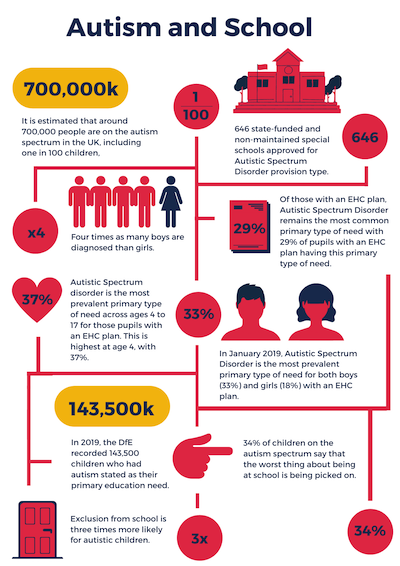
During a meltdown, the learner's fight-or-flight response is active. This means reasoning and negotiation are unlikely to work.
You may see crying, shouting, repetitive movements or withdrawal. Punishment or reasoning during a meltdown is counterproductive and may make the episode worse. The learner is not choosing these behaviours; they need fewer demands, safety and support rather than correction.
Your response should prioritise safety and de-escalation. Reduce environmental stressors by dimming lights, minimising noise and giving the learner space. Use calm, minimal language and avoid physical contact unless the learner specifically requests it.
Consider using a pre-arranged signal system so the learner can communicate their needs before reaching crisis point. This allows proactive support instead of reactive management.
These peer-reviewed sources underpin the evidence base for this article. Consensus.app links aggregate the paper with its journal DOI.
Evidence-Based Practices for Children, Youth, and Young Adults with Autism: Third Generation Review View study ↗
358 citations
Hume et al. (2021), Journal of Autism and Developmental Disorders
Foundational systematic review (358 citations) screening 31,779 articles down to 567 studies. Identifies 28 focused intervention practices that meet the criteria for evidence-based practice for autistic children and youth. The reference point for any school's autism CPD plan.
Interventions for Students With Autism in Inclusive Settings: A Best-Evidence Synthesis and Meta-Analysis View study ↗
89 citations
Watkins et al. (2019), Psychological Bulletin
Psychological Bulletin meta-analysis of 28 inclusive-setting studies. Function-based interventions, visual supports, self-monitoring strategies and peer-mediated interventions all produce mostly large effects. Teacher-delivered interventions outperform researcher-delivered ones,
Including students with autism in schools: a whole school approach to improve outcomes for students with autism View study ↗
79 citations
Roberts (2020), International Journal of Inclusive Education
Sets out the School-wide Autism Competency approach: building leader and staff capacity to create autism-friendly cultures alongside evidence-based classroom practice. The framework integrates leadership effectiveness research with autism-specific EBPs into a single whole-school
School-Based Interventions for Increasing Autistic Learners' Social Inclusion in Mainstream Schools: A Systematic Review View study ↗
Tsou et al. (2024), Review Journal of Autism and Developmental Disorders
Recent systematic review of 56 studies. Interventions improve access to school activities but rarely shift the reciprocity and friendship between autistic learners and their peers. Calls for a more joined-up strategy that moves beyond individual social-skills coaching to the wider c
Inclusivity in education for autism spectrum disorders: Experiences of support from the perspective of parent/carers, school teaching staff and young people on the autism spectrum View study ↗
41 citations
Hasson (2022), International Journal of Developmental Disabilities
Three-perspective UK study of mainstream autism inclusion: parents, SEN staff and autistic young people. Documents an 'overwhelmed' system held together by frontline SEN educators and parental advocacy. A clear policy-shift case for sustainable inclusion funding and accessible pr
| Category | Description | Classroom Strategies |
|---|---|---|
| Social Interaction Difficulties | Difficulty understanding social cues, challenges in making and keeping friends, lack of eye contact | Teach social skills explicitly, use social stories, encourage structured social activities |
| Communication Challenges | Delayed speech and language skills, difficulty holding conversations, echolalia | Use visual supports, employ speech and language therapy, encourage alternative communication methods such as sign language |
| Repetitive Behaviours | Engaging in repetitive motions or speech, insistence on sameness, rigid routines | Provide a structured routine, introduce changes gradually, use behaviour management techniques |
| Restricted Interests | Intense focus on specific topics, difficulty switching between activities | Integrate interests into learning, use them as motivational tools, gradually introduce new activities |
| Sensory Sensitivities | Over- or under-sensitivity to sounds, lights, textures or tastes | Create a sensory-friendly environment, use sensory integration therapy, provide sensory breaks |
| Difficulty with Changes | Anxiety or meltdowns when routines are disrupted | Prepare for transitions, use visual schedules, provide advance notice of changes |
| Unusual Eating or Sleeping Habits | Limited food preferences, difficulty sleeping | Create a consistent mealtime and bedtime routine, consult a dietician or sleep specialist |
| Emotional Regulation Challenges | Difficulty managing emotions, frequent meltdowns or shutdowns | Teach coping strategies, use calming techniques, create a safe space for self-regulation |
| Nonverbal Communication Issues | Limited use of gestures, facial expressions and body language | Encourage the use of nonverbal communication aids, model appropriate nonverbal cues |
| Intellectual Abilities | May range from intellectual disability to giftedness, uneven skill development | Provide tailored educational support, focus on strengths while supporting areas of difficulty |
| Understanding and Acceptance | Recognising ASD as a spectrum, showing empathy and understanding | Educate yourself about ASD, validate feelings, adopt an accepting attitude across the school |
| Consistent Routine | Need for predictability and routine | Maintain a consistent daily schedule, use visual timetables, prepare for changes in advance |
| Adapted Communication | Need for clear, concise communication | Use clear and straightforward language, visual supports and communication devices |
| Positive Reinforcement | Responding well to positive reinforcement | Use praise and rewards to encourage desired behaviours, implement a reward system |
| Professional Support | Importance of early intervention and ongoing support | Seek professional guidance, engage with therapists (speech, occupational, behavioural), involve educational support services |
| Family and Peer Education | Importance of educating family members and peers | Provide training for family members, educate peers to build understanding and acceptance |
Autism is a neurological difference. It affects how learners communicate, make sense of social information, and respond to sensory input. It is called a spectrum because each learner has a different pattern of strengths and support needs. One learner may excel in a specific subject while needing significant support with transitions, social interaction, or changes to routine.
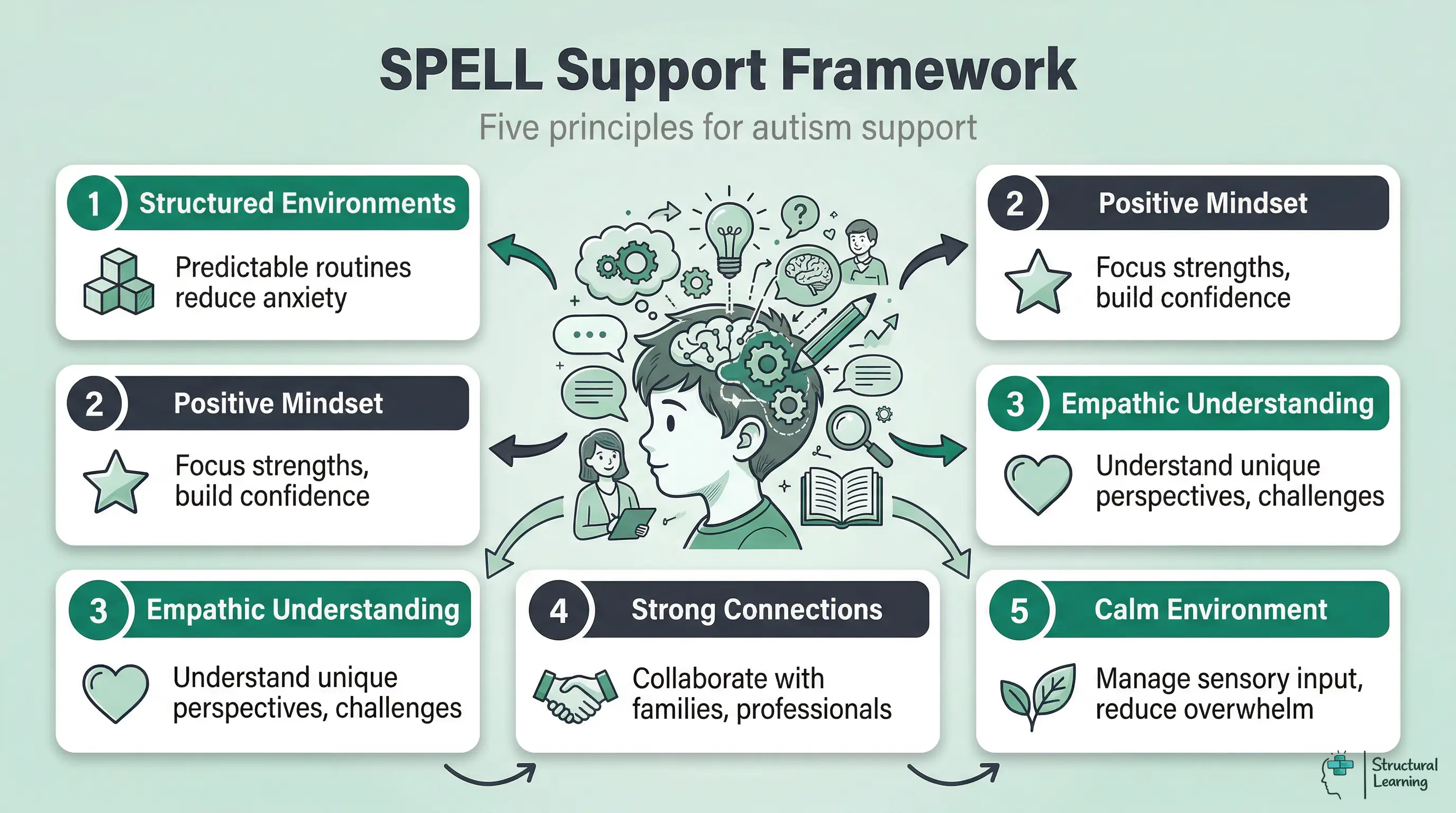
Teachers can use structured frameworks like the SPELL approach to create a predictable environment. Clear visual timetables, explicit task instructions and known sensory triggers can reduce uncertainty. These adjustments can lower anxiety. They also help learners focus on learning.
Building on a learner's specific interests can increase their engagement and support their self esteem. Using a passion for a particular topic can serve as a bridge to developing literacy or research skills while helping the learner feel a sense of belonging within the mainstream classroom.
Current research suggests that labels such as high functioning or low functioning are inaccurate and should be avoided. These terms fail to capture how a learner's needs fluctuate over time; they can also lead to incorrect assumptions about a child's actual support requirements in different situations.
One common mistake is assuming that a learner's visible behaviour shows their full understanding or potential. Teachers should also avoid treating the autism spectrum as a simple linear scale, because this overlooks the spiky profile of skills that many autistic learners have.
Signs of sensory overwhelm can include a learner covering their ears, becoming unusually quiet, or showing repetitive behaviours to self regulate. These signs may point to hidden triggers. When staff notice them early, they can offer a quiet space or a sensory break. This can help before the situation leads to a meltdown or shutdown.
Every autistic learner has their own sensory profile. This means they notice and react to sights, sounds, touch, and other sensory input in different ways. They also have their own triggers and communication style. This interactive tool asks four questions about one learner, then helps you build a personalised calming toolkit for immediate response, prevention, and recovery.