Singing in Schools

Updated on  

February 23, 2026

Singing in Schools

Discover how daily singing in primary schools boosts academic performance in maths, English and science while improving behaviour and building confidence at zero cost.

Course Enquiry
Copy citation

Hatcher, C (2022, March 22). Singing in Schools. Retrieved from https://www.structural-learning.com/post/singing-in-schools

What Are the Benefits of Daily Singing in Primary Schools?

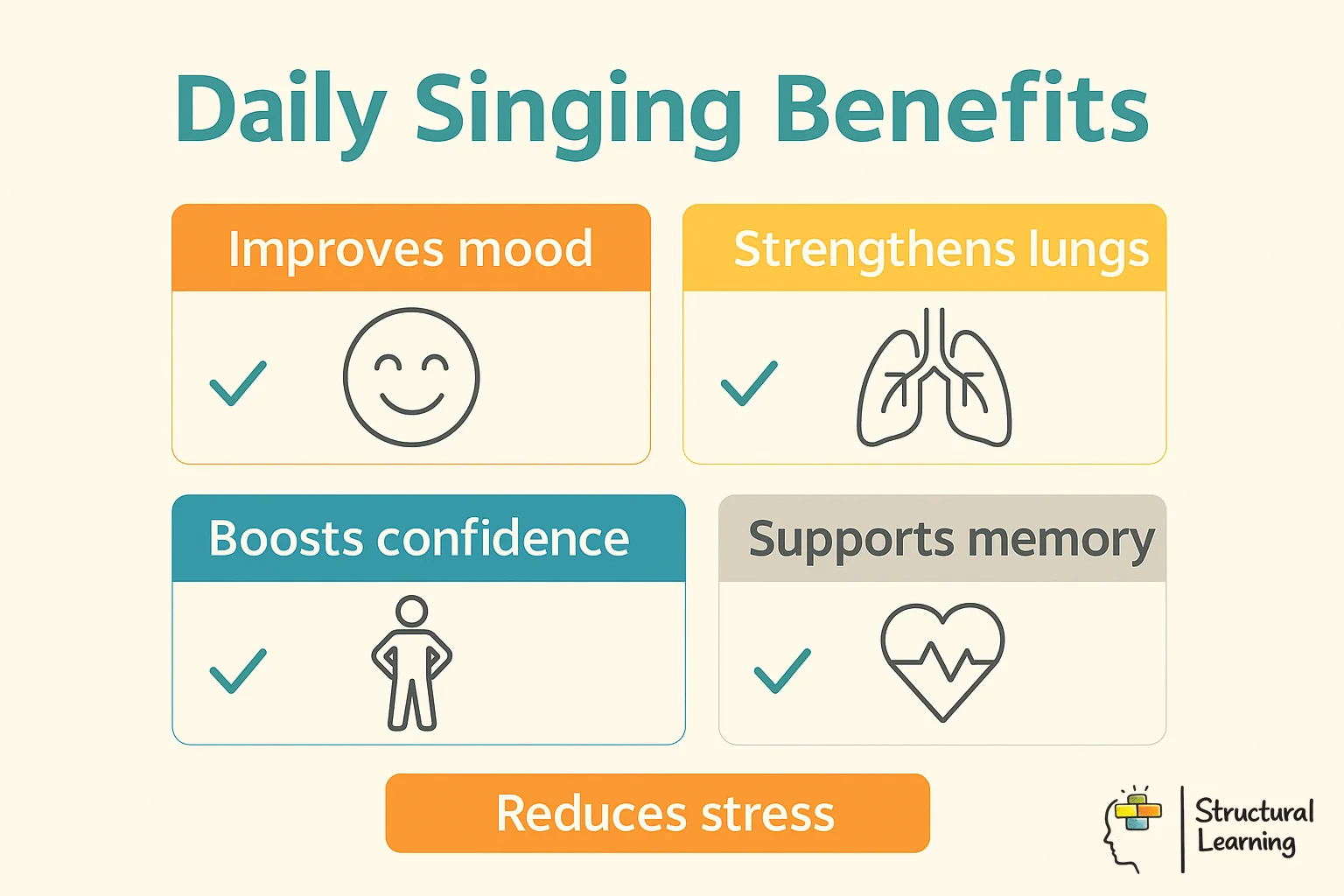
Daily singing in primary schools improves academic performance across subjects. Research shows children who regularly participate in music and singing activities can be several months ahead academically compared to non-participating peers, particularly in maths, English and science. Singing also develops emotional regulation, improves classroom behaviour management, and strengthens memory retention without requiring any special equipment or musical expertise. The practice builds confidence in both students and teachers while creating a positive school cultureat zero additional cost.

Infographic showing four categories of daily singing benefits in schools: academic, cognitive, social-emotional, and practical advantages
Daily Singing Benefits

There are many benefits to singing in school. First and foremost, singing is very accessible and practically universal. Almost every child has a voice, there are no equipment costs, and you can sing anywhere. School leaders have been interested in the positive implications of singing; choir performances and school shows are often the events that parents look forward to the most.

Age-Appropriate Singing Activities by Key Stage

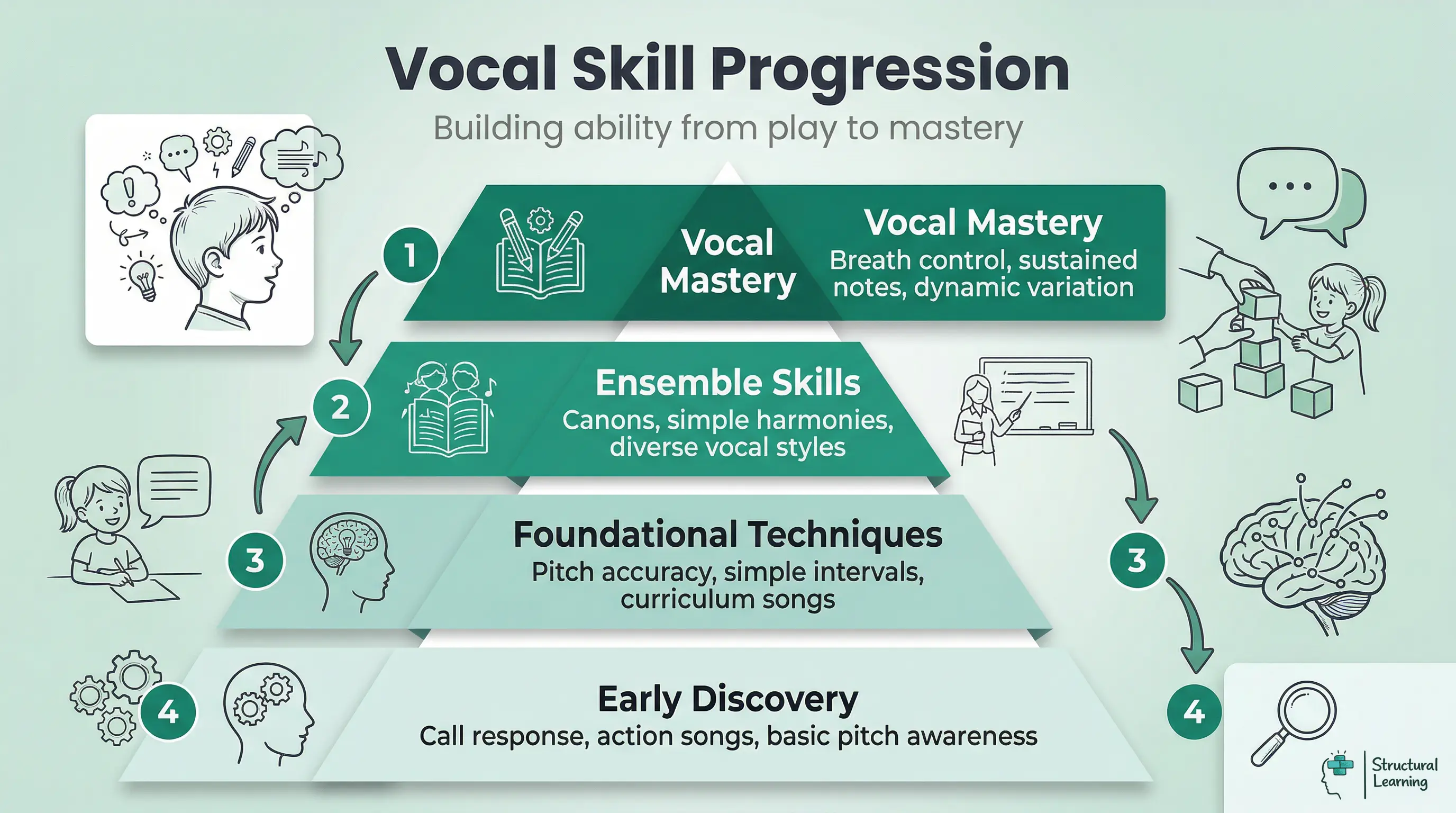
In the Early Years Foundation Stage, singing activities should focus on playful exploration and basic pitch awareness. Simple call-and-response songs like "Hello, How Are You?" help develop listening skills whilst encouraging vocal experimentation. Action songs such as "Head, Shoulders, Knees and Toes" combine movement with melody, supporting physical development alongside vocal skills. At this stage, children's vocal range is naturally higher, so activities should centre around their comfortable speaking pitch rather than forcing lower notes.

Key Stage 1 pupils benefit from structured singing games that develop pitch accuracy and rhythm. "Hot Cross Buns" remains excellent for introducing simple intervals, whilst rounds like "Frère Jacques" begin to challenge musical independence. Teachers should introduce concept-based songs that reinforce curriculum learning, such as number songs or phonics chants. Children aged 5-7 can typically manage a range of approximately one octave, and their voices are still developing strength, so sessions should be brief but frequent.

Key Stage 2 learners can tackle more sophisticated repertoire and vocal techniques. Part-singing becomes achievable through canons like "London's Burning" before progressing to simple harmonies. This age group responds well to contemporary songs alongside traditional material, and can begin exploring different vocal styles including folk traditions from various cultures. As voices strengthen and ranges extend, pupils can practise breath control through sustained notes and dynamic variation. Regular warm-ups become essential, incorporating tongue twisters and gentle vocal exercises to support the increasing demands of more complex repertoire.

Overcoming Common Challenges in School Singing

Reluctant singers often respond well to gentle, non-pressured approaches. Start with humming or vocal play rather than formal songs, and allow pupils to mime initially whilst listening to others. Create a 'vocal warm-up' routine using simple sounds like 'ooh' and 'ah' to build confidence gradually. For pupils who consistently refuse, offer alternative roles such as conducting, playing simple percussion, or operating recorded accompaniments. Research shows that peer modelling is highly effective - pairing reluctant singers with confident classmates can reduce anxiety significantly.

Managing large groups requires clear visual cues and strategic organisation. Use hand signals for dynamics, tempo, and starting/stopping, as verbal instructions often get lost. Arrange pupils in mixed-ability clusters rather than ability groups, which prevents weaker singers from becoming self-conscious. For classes with varied vocal abilities, employ layered approaches where different groups sing different parts - advanced singers might add harmonies whilst others maintain the melody. This inclusive strategy ensures everyone participates meaningfully without highlighting individual differences.

Cultural and religious considerations require sensitive dialogue with families and pupils. Some faiths restrict musical participation, so offer alternative creative roles like poetry recitation or rhythmic speaking. Respect cultural preferences by incorporating diverse musical traditions and allowing pupils to share songs from their heritage. Always discuss concerns privately with pupils and parents, demonstrating that participation can be adapted whilst maintaining educational value.

Assessment and Progression in School Singing

Effective assessment in school singing moves beyond simply enjoying musical activities to tracking genuine musical development. Observe pupils' pitch accuracy during familiar songs, noting who can maintain a steady pulse and match melodic contours. Create simple audio recordings monthly to capture progress in vocal control, breathing, and ensemble singing. These recordings become powerful evidence for parents and provide pupils with concrete examples of their improvement.

Align assessments with National Curriculum objectives by focusing on key skills: singing in tune, performing with control and expression, and developing ensemble awareness. Use visual tools like pitch ladders or hand signs to help pupils self-assess their accuracy. For progression tracking, establish clear milestones such as maintaining part in a round, controlling dynamics, or demonstrating improved diction. Year 3 pupils might focus on accurate pitch matching, whilst Year 6 pupils could tackle harmony singing and sophisticated breathing techniques.

Implement peer assessment opportunities where pupils listen constructively to each other's performances, developing critical listening skills alongside vocal development. Regular informal check-ins during rehearsals, combined with termly formal assessments, ensure purposeful progression whilst maintaining the joy and confidence that singing brings to school life.

Key Takeaways

  1. Beyond the Music Room: How regular singing activities support cognitive development and academic progress in maths, English and science, regardless of musical ability.
  2. The Hidden Communication Tool: How strategic singing transforms behaviour management, transitions and emotional regulation without adding to your workload.
  3. Breaking the Confidence Barrier: What happens when 'I can't sing' teachers discover the whole-school approach that makes musical expertise irrelevant.
  4. The Zero-Cost Intervention: Why singing delivers cognitive benefits equal to expensive programmes, using only the voice every child already has.

Beyond its accessibility, research shows that singing and engagement with music can have distinct benefits for children's learning, development, and personal skills. Like drama in schools, utilising the arts effectively brings with it wider positive implications for education. Enabling children to utilise their voices more effectively is a positive activity in schools. Neil Mercer's work on Oracy has helped us understand the importance of the spoken word. How school teachers can utilise singing in a school setting to form part of a balanced curriculum.

How Does Singing Support Children's Learning and Development?

Singing activates the same brain functions children use for key developmental milestones, particularly strengthening the shared processing systems between speech and music. Research demonstrates that regular singing enhances language perception, improves reading skills, and boosts cognitive development across all subject areas. These musical experiences directly impact academic achievement while developing social skills and emotional wellbeing.

  • Many of the brain functions used when taking part in music activities are also utilised by children to achieve key developmental milestones. Speech and music, for example, have several shared processing systems. Musical experiences can impact language perception, which in turn affects learning to read .(1) In fact, engaging with music may enhance cognitive functions that are key to children's learning, such as planning, working memory, inhibition, and flexibility.(2)
  • Studies have found that children who participate in music activities perform better in English, Maths and Science, regardless of their socioeconomic background and previous academic record. In some cases, the difference between children who do and do not participate in music activity can equate to several months' academic progress.(3)
  • Children who participate in long-term musical programmes have also been found to show higher empathy than similar children who do not .(4)  
    • Through music activity, children can share emotions and express themselves. Musical activities therefore create opportunities for children to be heard, and they may consequently improve children's self-esteem and confidence to express themselves in non-musical ways too.(5)
    • Music also provides educators, parents, and guardians with an additional form of communication. Adults can quickly and powerfully communicate instructions or set a mood by giving a musical signal or singing a particular song. As a result, they can use music to help children regulate their behaviour, calm their emotions, prepare to start or finish a specific activity, or coordinate a collective effort to achieve a task more efficiently. This can result in a more productive use of time, improved focus, and increased learning.(6)

    Primary schools using singing to promotechild development" width="auto" height="auto" id="">
    Primary schools using singing to promote child development

    Hub diagram showing daily singing at center with six benefit categories radiating outward
    Hub-and-spoke diagram: Benefits of Daily Singing in Primary Schools

    How Can Non-Musical Teachers Lead Singing Activities?

    Non-musical teachers can successfully lead singing by using simple call-and-response songs, action songs, and familiar tunes that require no instrumental accompaniment. Start with 5-minute sessions during transitions or morning meetings, focusing on participation rather than perfect pitch. Many schools report that teachers who initially said 'I can't sing' become confident leaders when following structured whole-school singing approaches.

    Facilitating singing in school can be daunting. You may feel that you're not a music specialist, have limited musical skills or knowledge.

    The good news is that it doesn't take much to begin singing in school. Firstly, you should not feel as though you must be a music expert. Many schools have reported that the teachers who initially stated, "I can't sing!" have become confident leaders once a structured whole-school singing approach is in place. This is likely due to the fact that they are fully supported by a wider structure and feel comfortable taking part in what is often a five-minute activity. Non-musical teachers can effectively lead singing activities by using simple call-and-response songs, action songs, and familiar tunes that require no instrumental accompaniment. Start with short sessions during transitions or morning meetings, focusing on participation rather than perfect pitch.

    • Call and response songs: The teacher or leader sings a phrase, and the children respond by singing the same phrase back. This is a simple and effective way to engage children and build confidence, as they only need to repeat what they hear.
    • Action Songs: Combine singing with physical movements. This can make singing more engaging and memorable for children.
    • Well-known Tunes: Use familiar tunes and adapt the lyrics to fit the curriculum or a specific lesson. This makes the songs easy to learn and sing.

    How Can Singing be Used in Schools?

    Singing can be smoothly integrated into various aspects of the school day, from transitions between lessons to reinforcing learning concepts across the curriculum. Use songs to teach phonics, times tables, historical facts, and even scientific concepts. By embedding singing into daily routines, you transform it from a standalone activity into a powerful educational tool.

    There are many different ways that singing can be used effectively in schools:

    • Transitions: Use singing to signal transitions between activities, such as moving from playtime to circle time or from one subject to another. This can help children stay focused and engaged during transitions, reducing disruptions and improving behaviour management.
    • Curriculum Reinforcement: Adapt existing songs or create new ones to reinforce learning concepts across the curriculum. Use songs to teach phonics, times tables, historical facts, and even scientific concepts.
    • Emotional Regulation: Use singing to help children regulate their emotions and manage stress. Singing can be a calming and therapeutic activity, and it can provide children with an outlet for expressing their feelings.

    By integrating singing into various aspects of the school day, teachers can create a more engaging, supportive, and effective learning environment for all students. Singing is a versatile and accessible tool that can be used to enhance children's learning, development, and wellbeing.

    Singing integrates smoothly across the curriculum, transforming learning experiences. In mathematics, children can learn times tables through rhythmic chants, whilst history lessons come alive with period songs like Victorian music hall numbers or wartime melodies. Science concepts become memorable through songs about the water cycle or planetary movements. Daily routines benefit enormously from musical transitions - a cleanup song signals tidying time, whilst register songs help settle morning classes. Whole-school approaches create powerful community bonds through weekly assemblies featuring house singing competitions or collaborative performances involving multiple year groups.

    Community engagement flourishes when schools organise intergenerational singing sessions with local care homes or invite parent volunteers to share cultural songs from their heritage. Seasonal celebrations provide natural opportunities for musical expression - harvest festivals, Christmas concerts, Diwali songs, or summer term performances. These events strengthen school identity whilst celebrating diversity, creating lasting memories and building confidence in young performers across all backgrounds and abilities.

    Conclusion

    Integrating daily singing into primary schools offers a wealth of benefits, from improving academic performance and cognitive development to developing social-emotional skills and creating a positive school culture. By embracing singing, schools can provide students with a powerful tool for learning, expression, and wellbeing, all without incurring additional costs or requiring specialised expertise.

    As educators, we have a unique opportunity to enable the potential of singing and transform our classrooms into vibrant, harmonious learning environments. By making singing a regular part of the school day, we can helps our students to thrive academically, socially, and emotionally, setting them on a path towards lifelong success.

    Further Reading

    Music education research

    Singing and child development

    Vocal music in schools

    1. Hallam, S. (2010). The power of music: Its impact on the intellectual, social and personal development of children and young people. *International Journal of Music Education, 28*(3), 269-289.
    2. Rickard, N. S., et al. (2018). The effect of singing on psychological wellbeing in adults: A systematic review and meta-analysis. *Journal of Health Psychology, 23*(5), 645-662.
    3. Butcher, C. J., Hoare, A. L., & Best, F. A. (2011). Evaluating the impact of a singing programme on pupils' behaviour and attitudes. *Pastoral Care in Education, 29*(1), 55-64.
    4. Miendlarzewska, E. A., & Trost, W. J. (2014). The effects of musical training and musical aptitude on cognitive development: A meta-analysis. *Frontiers in Neuroscience, 7*, 279.
    5. Welch, G. F. (2006). Singing and voice development. *The Oxford Handbook of Music Education, 1*, 147-164.

    Building confidence starts with simple vocal warm-ups that double as fun activities. Begin each session with gentle humming to familiar tunes like 'Twinkle, Twinkle, Little Star', then progress to 'mah-mah-mah' sounds on different pitches. For basic conducting, use clear gestures: raise your hand to signal the start, keep a steady beat with your arm, and bring your hands together to indicate the end. Choose songs within a comfortable range (middle C to G above) and familiar repertoire such as 'Yellow Submarine' or traditional rounds like 'London's Burning'. Always remind children to sing gently rather than shouting, and encourage drinking water regularly to protect their voices.

    Start with songs you know well yourself, even if you're not confident about your singing voice. Children respond to enthusiasm more than perfect pitch. Use call-and-response songs like 'Head, Shoulders, Knees and Toes' where you sing a line and they echo back. If a song feels too high or low, simply start on a different note that feels comfortable for your voice, and the children will naturally follow your lead.

Research from the University of Cambridge demonstrates that regular singing activates multiple brain regions simultaneously, strengthening neural pathways crucial for memory and language processing. When children sing nursery rhymes like "Hickory Dickory Dock," they develop phonemic awareness by breaking words into syllables and recognising rhyming patterns - foundational skills for reading fluency. Neuroscientist studies reveal that singing enhances dopamine production, improving focus and emotional regulation, whilst group singing builds oxytocin levels that creates classroom community and reduce anxiety.

Practically, teachers can integrate five-minute daily singing sessions focusing on phonics-based songs that reinforce letter sounds and blending. For instance, using "Old MacDonald" with literacy adaptations ("Old MacDonald heard a sound, /b/ /b/ /b/ /b/ /b/") strengthens sound-symbol connections. Social-emotional benefits emerge as shy pupils gain confidence through collective participation, whilst singing traditional songs from diverse cultures develops cultural awareness and inclusive classroom values, supporting both literacy development and broader educational outcomes.

Loading audit...

What Are the Benefits of Daily Singing in Primary Schools?

Daily singing in primary schools improves academic performance across subjects. Research shows children who regularly participate in music and singing activities can be several months ahead academically compared to non-participating peers, particularly in maths, English and science. Singing also develops emotional regulation, improves classroom behaviour management, and strengthens memory retention without requiring any special equipment or musical expertise. The practice builds confidence in both students and teachers while creating a positive school cultureat zero additional cost.

Infographic showing four categories of daily singing benefits in schools: academic, cognitive, social-emotional, and practical advantages
Daily Singing Benefits

There are many benefits to singing in school. First and foremost, singing is very accessible and practically universal. Almost every child has a voice, there are no equipment costs, and you can sing anywhere. School leaders have been interested in the positive implications of singing; choir performances and school shows are often the events that parents look forward to the most.

Age-Appropriate Singing Activities by Key Stage

In the Early Years Foundation Stage, singing activities should focus on playful exploration and basic pitch awareness. Simple call-and-response songs like "Hello, How Are You?" help develop listening skills whilst encouraging vocal experimentation. Action songs such as "Head, Shoulders, Knees and Toes" combine movement with melody, supporting physical development alongside vocal skills. At this stage, children's vocal range is naturally higher, so activities should centre around their comfortable speaking pitch rather than forcing lower notes.

Key Stage 1 pupils benefit from structured singing games that develop pitch accuracy and rhythm. "Hot Cross Buns" remains excellent for introducing simple intervals, whilst rounds like "Frère Jacques" begin to challenge musical independence. Teachers should introduce concept-based songs that reinforce curriculum learning, such as number songs or phonics chants. Children aged 5-7 can typically manage a range of approximately one octave, and their voices are still developing strength, so sessions should be brief but frequent.

Key Stage 2 learners can tackle more sophisticated repertoire and vocal techniques. Part-singing becomes achievable through canons like "London's Burning" before progressing to simple harmonies. This age group responds well to contemporary songs alongside traditional material, and can begin exploring different vocal styles including folk traditions from various cultures. As voices strengthen and ranges extend, pupils can practise breath control through sustained notes and dynamic variation. Regular warm-ups become essential, incorporating tongue twisters and gentle vocal exercises to support the increasing demands of more complex repertoire.

Overcoming Common Challenges in School Singing

Reluctant singers often respond well to gentle, non-pressured approaches. Start with humming or vocal play rather than formal songs, and allow pupils to mime initially whilst listening to others. Create a 'vocal warm-up' routine using simple sounds like 'ooh' and 'ah' to build confidence gradually. For pupils who consistently refuse, offer alternative roles such as conducting, playing simple percussion, or operating recorded accompaniments. Research shows that peer modelling is highly effective - pairing reluctant singers with confident classmates can reduce anxiety significantly.

Managing large groups requires clear visual cues and strategic organisation. Use hand signals for dynamics, tempo, and starting/stopping, as verbal instructions often get lost. Arrange pupils in mixed-ability clusters rather than ability groups, which prevents weaker singers from becoming self-conscious. For classes with varied vocal abilities, employ layered approaches where different groups sing different parts - advanced singers might add harmonies whilst others maintain the melody. This inclusive strategy ensures everyone participates meaningfully without highlighting individual differences.

Cultural and religious considerations require sensitive dialogue with families and pupils. Some faiths restrict musical participation, so offer alternative creative roles like poetry recitation or rhythmic speaking. Respect cultural preferences by incorporating diverse musical traditions and allowing pupils to share songs from their heritage. Always discuss concerns privately with pupils and parents, demonstrating that participation can be adapted whilst maintaining educational value.

Assessment and Progression in School Singing

Effective assessment in school singing moves beyond simply enjoying musical activities to tracking genuine musical development. Observe pupils' pitch accuracy during familiar songs, noting who can maintain a steady pulse and match melodic contours. Create simple audio recordings monthly to capture progress in vocal control, breathing, and ensemble singing. These recordings become powerful evidence for parents and provide pupils with concrete examples of their improvement.

Align assessments with National Curriculum objectives by focusing on key skills: singing in tune, performing with control and expression, and developing ensemble awareness. Use visual tools like pitch ladders or hand signs to help pupils self-assess their accuracy. For progression tracking, establish clear milestones such as maintaining part in a round, controlling dynamics, or demonstrating improved diction. Year 3 pupils might focus on accurate pitch matching, whilst Year 6 pupils could tackle harmony singing and sophisticated breathing techniques.

Implement peer assessment opportunities where pupils listen constructively to each other's performances, developing critical listening skills alongside vocal development. Regular informal check-ins during rehearsals, combined with termly formal assessments, ensure purposeful progression whilst maintaining the joy and confidence that singing brings to school life.

Key Takeaways

  1. Beyond the Music Room: How regular singing activities support cognitive development and academic progress in maths, English and science, regardless of musical ability.
  2. The Hidden Communication Tool: How strategic singing transforms behaviour management, transitions and emotional regulation without adding to your workload.
  3. Breaking the Confidence Barrier: What happens when 'I can't sing' teachers discover the whole-school approach that makes musical expertise irrelevant.
  4. The Zero-Cost Intervention: Why singing delivers cognitive benefits equal to expensive programmes, using only the voice every child already has.

Beyond its accessibility, research shows that singing and engagement with music can have distinct benefits for children's learning, development, and personal skills. Like drama in schools, utilising the arts effectively brings with it wider positive implications for education. Enabling children to utilise their voices more effectively is a positive activity in schools. Neil Mercer's work on Oracy has helped us understand the importance of the spoken word. How school teachers can utilise singing in a school setting to form part of a balanced curriculum.

How Does Singing Support Children's Learning and Development?

Singing activates the same brain functions children use for key developmental milestones, particularly strengthening the shared processing systems between speech and music. Research demonstrates that regular singing enhances language perception, improves reading skills, and boosts cognitive development across all subject areas. These musical experiences directly impact academic achievement while developing social skills and emotional wellbeing.

  • Many of the brain functions used when taking part in music activities are also utilised by children to achieve key developmental milestones. Speech and music, for example, have several shared processing systems. Musical experiences can impact language perception, which in turn affects learning to read .(1) In fact, engaging with music may enhance cognitive functions that are key to children's learning, such as planning, working memory, inhibition, and flexibility.(2)
  • Studies have found that children who participate in music activities perform better in English, Maths and Science, regardless of their socioeconomic background and previous academic record. In some cases, the difference between children who do and do not participate in music activity can equate to several months' academic progress.(3)
  • Children who participate in long-term musical programmes have also been found to show higher empathy than similar children who do not .(4)  
    • Through music activity, children can share emotions and express themselves. Musical activities therefore create opportunities for children to be heard, and they may consequently improve children's self-esteem and confidence to express themselves in non-musical ways too.(5)
    • Music also provides educators, parents, and guardians with an additional form of communication. Adults can quickly and powerfully communicate instructions or set a mood by giving a musical signal or singing a particular song. As a result, they can use music to help children regulate their behaviour, calm their emotions, prepare to start or finish a specific activity, or coordinate a collective effort to achieve a task more efficiently. This can result in a more productive use of time, improved focus, and increased learning.(6)

    Primary schools using singing to promotechild development" width="auto" height="auto" id="">
    Primary schools using singing to promote child development

    Hub diagram showing daily singing at center with six benefit categories radiating outward
    Hub-and-spoke diagram: Benefits of Daily Singing in Primary Schools

    How Can Non-Musical Teachers Lead Singing Activities?

    Non-musical teachers can successfully lead singing by using simple call-and-response songs, action songs, and familiar tunes that require no instrumental accompaniment. Start with 5-minute sessions during transitions or morning meetings, focusing on participation rather than perfect pitch. Many schools report that teachers who initially said 'I can't sing' become confident leaders when following structured whole-school singing approaches.

    Facilitating singing in school can be daunting. You may feel that you're not a music specialist, have limited musical skills or knowledge.

    The good news is that it doesn't take much to begin singing in school. Firstly, you should not feel as though you must be a music expert. Many schools have reported that the teachers who initially stated, "I can't sing!" have become confident leaders once a structured whole-school singing approach is in place. This is likely due to the fact that they are fully supported by a wider structure and feel comfortable taking part in what is often a five-minute activity. Non-musical teachers can effectively lead singing activities by using simple call-and-response songs, action songs, and familiar tunes that require no instrumental accompaniment. Start with short sessions during transitions or morning meetings, focusing on participation rather than perfect pitch.

    • Call and response songs: The teacher or leader sings a phrase, and the children respond by singing the same phrase back. This is a simple and effective way to engage children and build confidence, as they only need to repeat what they hear.
    • Action Songs: Combine singing with physical movements. This can make singing more engaging and memorable for children.
    • Well-known Tunes: Use familiar tunes and adapt the lyrics to fit the curriculum or a specific lesson. This makes the songs easy to learn and sing.

    How Can Singing be Used in Schools?

    Singing can be smoothly integrated into various aspects of the school day, from transitions between lessons to reinforcing learning concepts across the curriculum. Use songs to teach phonics, times tables, historical facts, and even scientific concepts. By embedding singing into daily routines, you transform it from a standalone activity into a powerful educational tool.

    There are many different ways that singing can be used effectively in schools:

    • Transitions: Use singing to signal transitions between activities, such as moving from playtime to circle time or from one subject to another. This can help children stay focused and engaged during transitions, reducing disruptions and improving behaviour management.
    • Curriculum Reinforcement: Adapt existing songs or create new ones to reinforce learning concepts across the curriculum. Use songs to teach phonics, times tables, historical facts, and even scientific concepts.
    • Emotional Regulation: Use singing to help children regulate their emotions and manage stress. Singing can be a calming and therapeutic activity, and it can provide children with an outlet for expressing their feelings.

    By integrating singing into various aspects of the school day, teachers can create a more engaging, supportive, and effective learning environment for all students. Singing is a versatile and accessible tool that can be used to enhance children's learning, development, and wellbeing.

    Singing integrates smoothly across the curriculum, transforming learning experiences. In mathematics, children can learn times tables through rhythmic chants, whilst history lessons come alive with period songs like Victorian music hall numbers or wartime melodies. Science concepts become memorable through songs about the water cycle or planetary movements. Daily routines benefit enormously from musical transitions - a cleanup song signals tidying time, whilst register songs help settle morning classes. Whole-school approaches create powerful community bonds through weekly assemblies featuring house singing competitions or collaborative performances involving multiple year groups.

    Community engagement flourishes when schools organise intergenerational singing sessions with local care homes or invite parent volunteers to share cultural songs from their heritage. Seasonal celebrations provide natural opportunities for musical expression - harvest festivals, Christmas concerts, Diwali songs, or summer term performances. These events strengthen school identity whilst celebrating diversity, creating lasting memories and building confidence in young performers across all backgrounds and abilities.

    Conclusion

    Integrating daily singing into primary schools offers a wealth of benefits, from improving academic performance and cognitive development to developing social-emotional skills and creating a positive school culture. By embracing singing, schools can provide students with a powerful tool for learning, expression, and wellbeing, all without incurring additional costs or requiring specialised expertise.

    As educators, we have a unique opportunity to enable the potential of singing and transform our classrooms into vibrant, harmonious learning environments. By making singing a regular part of the school day, we can helps our students to thrive academically, socially, and emotionally, setting them on a path towards lifelong success.

    Further Reading

    Music education research

    Singing and child development

    Vocal music in schools

    1. Hallam, S. (2010). The power of music: Its impact on the intellectual, social and personal development of children and young people. *International Journal of Music Education, 28*(3), 269-289.
    2. Rickard, N. S., et al. (2018). The effect of singing on psychological wellbeing in adults: A systematic review and meta-analysis. *Journal of Health Psychology, 23*(5), 645-662.
    3. Butcher, C. J., Hoare, A. L., & Best, F. A. (2011). Evaluating the impact of a singing programme on pupils' behaviour and attitudes. *Pastoral Care in Education, 29*(1), 55-64.
    4. Miendlarzewska, E. A., & Trost, W. J. (2014). The effects of musical training and musical aptitude on cognitive development: A meta-analysis. *Frontiers in Neuroscience, 7*, 279.
    5. Welch, G. F. (2006). Singing and voice development. *The Oxford Handbook of Music Education, 1*, 147-164.

    Building confidence starts with simple vocal warm-ups that double as fun activities. Begin each session with gentle humming to familiar tunes like 'Twinkle, Twinkle, Little Star', then progress to 'mah-mah-mah' sounds on different pitches. For basic conducting, use clear gestures: raise your hand to signal the start, keep a steady beat with your arm, and bring your hands together to indicate the end. Choose songs within a comfortable range (middle C to G above) and familiar repertoire such as 'Yellow Submarine' or traditional rounds like 'London's Burning'. Always remind children to sing gently rather than shouting, and encourage drinking water regularly to protect their voices.

    Start with songs you know well yourself, even if you're not confident about your singing voice. Children respond to enthusiasm more than perfect pitch. Use call-and-response songs like 'Head, Shoulders, Knees and Toes' where you sing a line and they echo back. If a song feels too high or low, simply start on a different note that feels comfortable for your voice, and the children will naturally follow your lead.

Research from the University of Cambridge demonstrates that regular singing activates multiple brain regions simultaneously, strengthening neural pathways crucial for memory and language processing. When children sing nursery rhymes like "Hickory Dickory Dock," they develop phonemic awareness by breaking words into syllables and recognising rhyming patterns - foundational skills for reading fluency. Neuroscientist studies reveal that singing enhances dopamine production, improving focus and emotional regulation, whilst group singing builds oxytocin levels that creates classroom community and reduce anxiety.

Practically, teachers can integrate five-minute daily singing sessions focusing on phonics-based songs that reinforce letter sounds and blending. For instance, using "Old MacDonald" with literacy adaptations ("Old MacDonald heard a sound, /b/ /b/ /b/ /b/ /b/") strengthens sound-symbol connections. Social-emotional benefits emerge as shy pupils gain confidence through collective participation, whilst singing traditional songs from diverse cultures develops cultural awareness and inclusive classroom values, supporting both literacy development and broader educational outcomes.

Curriculum

Back to Blog

{"@context":"https://schema.org","@graph":[{"@type":"Article","@id":"https://www.structural-learning.com/post/singing-in-schools#article","headline":"Singing in Schools","description":"How can singing bring a sense of belonging and advance child development outcomes in schools?","datePublished":"2022-03-22T16:15:08.955Z","dateModified":"2026-01-26T10:09:32.212Z","author":{"@type":"Person","name":"Paul Main","url":"https://www.structural-learning.com/team/paulmain","jobTitle":"Founder & Educational Consultant"},"publisher":{"@type":"Organization","name":"Structural Learning","url":"https://www.structural-learning.com","logo":{"@type":"ImageObject","url":"https://cdn.prod.website-files.com/5b69a01ba2e409e5d5e055c6/6040bf0426cb415ba2fc7882_newlogoblue.svg"}},"mainEntityOfPage":{"@type":"WebPage","@id":"https://www.structural-learning.com/post/singing-in-schools"},"image":"https://cdn.prod.website-files.com/5b69a01ba2e409501de055d1/696a5f35031594a1e19e202e_696a5f34bec2ee958f20b7c4_singing-in-schools-infographic.webp","wordCount":2335},{"@type":"BreadcrumbList","@id":"https://www.structural-learning.com/post/singing-in-schools#breadcrumb","itemListElement":[{"@type":"ListItem","position":1,"name":"Home","item":"https://www.structural-learning.com/"},{"@type":"ListItem","position":2,"name":"Blog","item":"https://www.structural-learning.com/blog"},{"@type":"ListItem","position":3,"name":"Singing in Schools","item":"https://www.structural-learning.com/post/singing-in-schools"}]},{"@type":"FAQPage","mainEntity":[{"@type":"Question","name":"What Are the Benefits of Daily Singing in Primary Schools?","acceptedAnswer":{"@type":"Answer","text":"Daily singing in primary schools improves academic performance across subjects. Research shows children who regularly participate in music and singing activities can be several months ahead academically compared to non-participating peers, particularly in maths, English and science. Singing also develops emotional regulation, improves classroom behaviour management, and strengthens memory retention without requiring any special equipment or musical expertise. The practice builds confidence in bo"}},{"@type":"Question","name":"How Does Singing Support Children's Learning and Development?","acceptedAnswer":{"@type":"Answer","text":"Singing activates the same brain functions children use for key developmental milestones, particularly strengthening the shared processing systems between speech and music. Research demonstrates that regular singing enhances language perception, improves reading skills, and boosts cognitive development across all subject areas. These musical experiences directly impact academic achievement while developing social skills and emotional wellbeing."}},{"@type":"Question","name":"How Can Singing be Used in Schools?","acceptedAnswer":{"@type":"Answer","text":"Singing can be smoothly integrated into various aspects of the school day, from transitions between lessons to reinforcing learning concepts across the curriculum. Use songs to teach phonics, times tables, historical facts, and even scientific concepts. By embedding singing into daily routines, you transform it from a standalone activity into a powerful educational tool."}}]}]}