Gifted and Talented: A Teacher's guide

Updated on  

January 30, 2026

Gifted and Talented: A Teacher's guide

Discover why labelling pupils 'gifted' may harm achievement and learn practical strategies to challenge all learners effectively in your classroom.


Course Enquiry
Copy citation

Benjamin, Z (2022, May 02). Gifted and Talented: A Teacher's guide. Retrieved from https://www.structural-learning.com/post/gifted-and-talented-a-teachers-guide

What is Gifted and Talented?

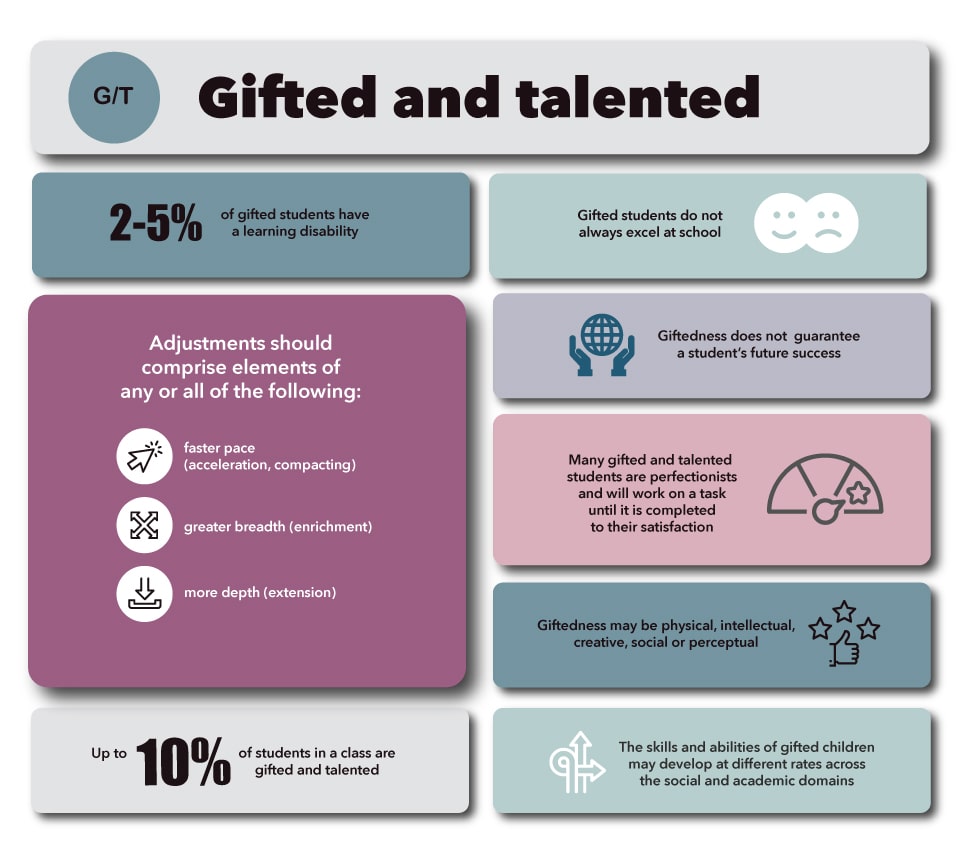
In the UK, schools historically defined gifted students as being in the top 5% for intellectual abilities. It is equally as important to cater for these students as it is to cater for the other 95%.

Key Takeaways

  1. Beyond the Label Trap: Why calling pupils 'gifted' may actually harm their achievement, and what to say instead to boost performance
  2. The 95% Question: Discover why 'How do you challenge your most able?' is the wrong question, and what to ask instead
  3. Depth Over Speed: Why accelerating bright students through content backfires, and how to challenge them without leaving others behind
  4. The Differentiation Myth: Stop creating extension tasks that limit learning: use formative assessment to naturally stretch all pupils

the issues associated with the concept of gifted and talented children, whether differentiation and enriched programs of study are fit for purpose, and practical ways that we can ensure all students are making excellent academic progress.

'How do you cater for your most able students?' 

If you are a teacher, I expect you have been asked this question many times in every year of your career.  There is probably a box dedicated to it on the lesson plan proforma that comes out each time you are observed. 

note that giftedness doesn't just refer to intellectual abilities, but also encompasses talents in other areas such as music, art, and athletics. Talented learners may not necessarily excel academically, but they have a natural aptitude and passion for a particular skill or subject.

As a teacher, recognise and nurture these talents as well, providing opportunities for these students to explore and develop their skills. By acknowledging and supporting gifted and talented learners, we can create a more inclusive and enriching learning environment for all students.

Common approaches to a gifted and talented education in schools, colleges and universities include: 

There is a lot of pressure on secondary schools and colleges to cater for their brightest students, but some of the strategies employed to do this can unintentionally jeopardize the academic successof those students not identified as gifted and talented.  

In the UK, schools historically defined gifted students as being in the top 5% for intellectual abilities.  It is equally as important to cater for these students as it is to cater for the other 95%.  the issues associated with the concept of gifted and talented children, whether differentiation and enriched programs of study are fit for purpose, and practical ways that we can ensure all students are making excellent academic progress.  

What Does Gifted and Talented Mean in UK Schools?

In the UK, schools historically defined gifted students as those in the top 5% for intellectual abilities, while talented refers to students with exceptional abilities in areas like music, art, or athletics. This distinction helps teachers identify different types of high-ability learners who may need specialised support. Understanding these terms is crucial for creating appropriate educational provisions for these students.

Shakespeare wrote: a rose by any other name would smell as sweet.  This is not always the case!

There are so many terms used for students who have a particularly high academic aptitude according to baseline cognitive ability tests:

  • Gifted Children
  • Talented Children
  • Enhanced Students 
  • Highly Able
  • More Able

Would a gifted and talented student by any other name achieve as much?  Probably not.  Research suggests that they would actually achieve more without any label.  

Mueller and Dweck (1998) found that performance on future tasks improves when teachers praise students' effort rather than their ability.  Labels such as 'gifted and talented' emphasise the role of innate or natural talent, which can be interpreted by pupils as diminishing the importance of effort.  This connects to growth mindset research, which shows these labels can decrease future academic success if pupils are aware of them.  

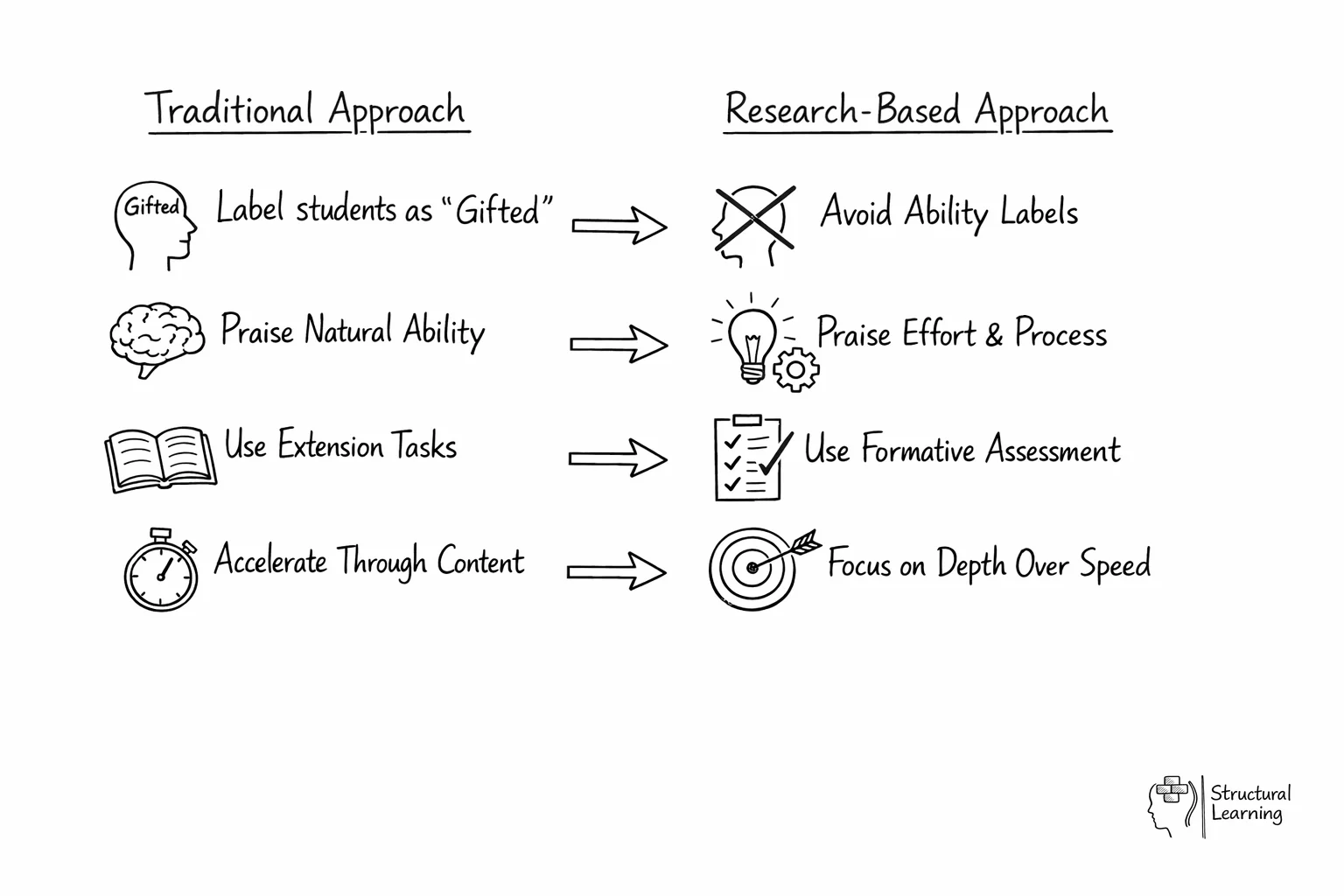
Comparison diagram showing traditional gifted education methods versus research-backed alternatives
Side-by-side comparison: Traditional vs Research-Based Approaches to Gifted Education

However, the reverse is true when the labels are only made available to teachers.  Rosenthal and Jacobson (1966) found that when teachers were told that they had a class of high achievers, the pupils made significantly more progress over a year compared to a control group with the same baseline data. 
What can we learn from these two studies? 

  • Avoid labeling students according to natural talent
  • It is better to say 'you know how to work hard' than 'you are smart'
  • Emphasize the importance of effort on achievement 
  • Hold high expectations of all students

Gifted and Talented Students

How Do Schools Identify Gifted and Talented Students?

Schools typically use a combination of standardised test scores, teacher observations, and performance data to identify gifted and talented students. Academic assessments focus on intellectual abilities, while talent identification looks at specific skills in creative or physical domains. Multiple measures are recommended rather than relying on a single test or assessment method.

We should be cautious about using tests to measure academic aptitude.  They may only consider one aspect of intelligence or not reflect the wide range of cognitive abilities. Effective identification often requires formative assessment approaches that can capture students' higher-order thinking skills and their ability to engage in critical thinking. Teachers should also consider students' metacognition abilities when identifying those who may benefit from advanced learning opportunities. Additionally, using adaptive teaching methods can help identify students who consistently exceed expectations, while ensuring all learners receive appropriate support regardless of their identified status.expectations.

Differentiation: Is It Enough?

Differentiation, the tailoring of instruction to meet individual needs, is a cornerstone of effective teaching. However, when it comes to gifted and talented students, differentiation alone might not suffice. While provide varied tasks and resources, the depth and complexity of the content must also be carefully considered.

Simply providing "more" work isn't the answer. Instead, focus on providing work that is different: tasks that challenge pupils to think critically, solve complex problems, and explore ideas in greater depth. This may involve adapting the curriculum to include more advanced concepts or providing opportunities for independent research and project-based learning. Thoughtful lesson planning, alongside assessment for learning, helps students to make academic progress.

The Problem with Extension Tasks

Too often, extension tasks for gifted and talented students are simply more of the same, offering little real challenge or opportunity for growth. These tasks can become a form of busywork, failing to engage students' intellectual curiosity or develop their higher-order thinking skills.

Instead of relying on generic extension tasks, teachers should design activities that allow pupils to pursue their interests, explore complex topics, and develop their unique talents. This could involve independent research projects, creative problem-solving activities, or opportunities to mentor other pupils. The key is to provide meaningful and challenging experiences that creates intellectual growth.

Practical Strategies for Supporting Gifted and Talented Learners

So, what are some practical strategies that teachers can use to effectively support gifted and talented learners?

  • Flexible Grouping: Organise pupils into small groups based on their learning needs and interests, allowing for targeted instruction and collaborative problem-solving.
  • Compacting the Curriculum: Allow pupils who have already mastered the core content to move on to more advanced material, freeing up time for enrichment activities.
  • Independent Study: Provide opportunities for students to pursue independent research projects, allowing them to examine deeper into topics that interest them.
  • Mentorship Programs: Connect pupils with mentors who can provide guidance, support, and inspiration in their areas of talent.
  • Real-World Applications: Engage pupils in projects that connect classroom learning to real-world problems and challenges, developing critical thinking and problem-solving skills.

Ultimately, supporting gifted and talented learners requires a shift in mindset, moving away from the idea of simply providing "more" work and towards creating learning experiences that are challenging, engaging, and meaningful. By embracing this approach, we can ensure that all students have the opportunity to reach their full potential.

the effective support of gifted and talented learners is not about labels or generic extension activities. It's about understanding individual needs, developing a growth mindset, and providing challenging, engaging learning experiences that allow all pupils to thrive. By focusing on depth over speed, encouraging effort over innate ability, and creating a supportive learning environment, teachers can helps gifted and talented students to reach their full potential, while simultaneously enriching the learning experience for all.

Remember, the goal is not to create an elite group of "gifted" students, but to cultivate a classroom environment where every pupil is challenged, supported, and inspired to achieve their best. This requires a commitment to differentiation, personalized learning, and a belief in the potential of every student, regardless of their perceived abilities. By embracing these principles, we can create a truly inclusive and enriching learning experience for all.

Further Reading

  • Coleman, M. R. (2005). *Differentiated instruction: A guide for elementary and middle school teachers*. Educational Resources Information Center (ERIC).
  • Dweck, C. S. (2006). *Mindset: The new psychology of success*. Random House.
  • Reis, S. M., & Renzulli, J. S. (2009). *Extending enrichment reading strategies for gifted learners*. Prufrock Press Inc.
  • Rosenthal, R., & Jacobson, L. (1968). *Pygmalion in the classroom*. Urban Psychologists Press.
  • Tomlinson, C. A. (2014). *The differentiated classroom: Responding to the needs of all learners*. Association for Supervision & Curriculum Development.
Loading audit...

What is Gifted and Talented?

In the UK, schools historically defined gifted students as being in the top 5% for intellectual abilities. It is equally as important to cater for these students as it is to cater for the other 95%.

Key Takeaways

  1. Beyond the Label Trap: Why calling pupils 'gifted' may actually harm their achievement, and what to say instead to boost performance
  2. The 95% Question: Discover why 'How do you challenge your most able?' is the wrong question, and what to ask instead
  3. Depth Over Speed: Why accelerating bright students through content backfires, and how to challenge them without leaving others behind
  4. The Differentiation Myth: Stop creating extension tasks that limit learning: use formative assessment to naturally stretch all pupils

the issues associated with the concept of gifted and talented children, whether differentiation and enriched programs of study are fit for purpose, and practical ways that we can ensure all students are making excellent academic progress.

'How do you cater for your most able students?' 

If you are a teacher, I expect you have been asked this question many times in every year of your career.  There is probably a box dedicated to it on the lesson plan proforma that comes out each time you are observed. 

note that giftedness doesn't just refer to intellectual abilities, but also encompasses talents in other areas such as music, art, and athletics. Talented learners may not necessarily excel academically, but they have a natural aptitude and passion for a particular skill or subject.

As a teacher, recognise and nurture these talents as well, providing opportunities for these students to explore and develop their skills. By acknowledging and supporting gifted and talented learners, we can create a more inclusive and enriching learning environment for all students.

Common approaches to a gifted and talented education in schools, colleges and universities include: 

There is a lot of pressure on secondary schools and colleges to cater for their brightest students, but some of the strategies employed to do this can unintentionally jeopardize the academic successof those students not identified as gifted and talented.  

In the UK, schools historically defined gifted students as being in the top 5% for intellectual abilities.  It is equally as important to cater for these students as it is to cater for the other 95%.  the issues associated with the concept of gifted and talented children, whether differentiation and enriched programs of study are fit for purpose, and practical ways that we can ensure all students are making excellent academic progress.  

What Does Gifted and Talented Mean in UK Schools?

In the UK, schools historically defined gifted students as those in the top 5% for intellectual abilities, while talented refers to students with exceptional abilities in areas like music, art, or athletics. This distinction helps teachers identify different types of high-ability learners who may need specialised support. Understanding these terms is crucial for creating appropriate educational provisions for these students.

Shakespeare wrote: a rose by any other name would smell as sweet.  This is not always the case!

There are so many terms used for students who have a particularly high academic aptitude according to baseline cognitive ability tests:

  • Gifted Children
  • Talented Children
  • Enhanced Students 
  • Highly Able
  • More Able

Would a gifted and talented student by any other name achieve as much?  Probably not.  Research suggests that they would actually achieve more without any label.  

Mueller and Dweck (1998) found that performance on future tasks improves when teachers praise students' effort rather than their ability.  Labels such as 'gifted and talented' emphasise the role of innate or natural talent, which can be interpreted by pupils as diminishing the importance of effort.  This connects to growth mindset research, which shows these labels can decrease future academic success if pupils are aware of them.  

Comparison diagram showing traditional gifted education methods versus research-backed alternatives
Side-by-side comparison: Traditional vs Research-Based Approaches to Gifted Education

However, the reverse is true when the labels are only made available to teachers.  Rosenthal and Jacobson (1966) found that when teachers were told that they had a class of high achievers, the pupils made significantly more progress over a year compared to a control group with the same baseline data. 

What can we learn from these two studies? 

  • Avoid labeling students according to natural talent
  • It is better to say 'you know how to work hard' than 'you are smart'
  • Emphasize the importance of effort on achievement 
  • Hold high expectations of all students

Gifted and Talented Students

How Do Schools Identify Gifted and Talented Students?

Schools typically use a combination of standardised test scores, teacher observations, and performance data to identify gifted and talented students. Academic assessments focus on intellectual abilities, while talent identification looks at specific skills in creative or physical domains. Multiple measures are recommended rather than relying on a single test or assessment method.

We should be cautious about using tests to measure academic aptitude.  They may only consider one aspect of intelligence or not reflect the wide range of cognitive abilities. Effective identification often requires formative assessment approaches that can capture students' higher-order thinking skills and their ability to engage in critical thinking. Teachers should also consider students' metacognition abilities when identifying those who may benefit from advanced learning opportunities. Additionally, using adaptive teaching methods can help identify students who consistently exceed expectations, while ensuring all learners receive appropriate support regardless of their identified status.expectations.

Differentiation: Is It Enough?

Differentiation, the tailoring of instruction to meet individual needs, is a cornerstone of effective teaching. However, when it comes to gifted and talented students, differentiation alone might not suffice. While provide varied tasks and resources, the depth and complexity of the content must also be carefully considered.

Simply providing "more" work isn't the answer. Instead, focus on providing work that is different: tasks that challenge pupils to think critically, solve complex problems, and explore ideas in greater depth. This may involve adapting the curriculum to include more advanced concepts or providing opportunities for independent research and project-based learning. Thoughtful lesson planning, alongside assessment for learning, helps students to make academic progress.

The Problem with Extension Tasks

Too often, extension tasks for gifted and talented students are simply more of the same, offering little real challenge or opportunity for growth. These tasks can become a form of busywork, failing to engage students' intellectual curiosity or develop their higher-order thinking skills.

Instead of relying on generic extension tasks, teachers should design activities that allow pupils to pursue their interests, explore complex topics, and develop their unique talents. This could involve independent research projects, creative problem-solving activities, or opportunities to mentor other pupils. The key is to provide meaningful and challenging experiences that creates intellectual growth.

Practical Strategies for Supporting Gifted and Talented Learners

So, what are some practical strategies that teachers can use to effectively support gifted and talented learners?

  • Flexible Grouping: Organise pupils into small groups based on their learning needs and interests, allowing for targeted instruction and collaborative problem-solving.
  • Compacting the Curriculum: Allow pupils who have already mastered the core content to move on to more advanced material, freeing up time for enrichment activities.
  • Independent Study: Provide opportunities for students to pursue independent research projects, allowing them to examine deeper into topics that interest them.
  • Mentorship Programs: Connect pupils with mentors who can provide guidance, support, and inspiration in their areas of talent.
  • Real-World Applications: Engage pupils in projects that connect classroom learning to real-world problems and challenges, developing critical thinking and problem-solving skills.

Ultimately, supporting gifted and talented learners requires a shift in mindset, moving away from the idea of simply providing "more" work and towards creating learning experiences that are challenging, engaging, and meaningful. By embracing this approach, we can ensure that all students have the opportunity to reach their full potential.

the effective support of gifted and talented learners is not about labels or generic extension activities. It's about understanding individual needs, developing a growth mindset, and providing challenging, engaging learning experiences that allow all pupils to thrive. By focusing on depth over speed, encouraging effort over innate ability, and creating a supportive learning environment, teachers can helps gifted and talented students to reach their full potential, while simultaneously enriching the learning experience for all.

Remember, the goal is not to create an elite group of "gifted" students, but to cultivate a classroom environment where every pupil is challenged, supported, and inspired to achieve their best. This requires a commitment to differentiation, personalized learning, and a belief in the potential of every student, regardless of their perceived abilities. By embracing these principles, we can create a truly inclusive and enriching learning experience for all.

Further Reading

  • Coleman, M. R. (2005). *Differentiated instruction: A guide for elementary and middle school teachers*. Educational Resources Information Center (ERIC).
  • Dweck, C. S. (2006). *Mindset: The new psychology of success*. Random House.
  • Reis, S. M., & Renzulli, J. S. (2009). *Extending enrichment reading strategies for gifted learners*. Prufrock Press Inc.
  • Rosenthal, R., & Jacobson, L. (1968). *Pygmalion in the classroom*. Urban Psychologists Press.
  • Tomlinson, C. A. (2014). *The differentiated classroom: Responding to the needs of all learners*. Association for Supervision & Curriculum Development.

Classroom Practice

Back to Blog

{"@context":"https://schema.org","@graph":[{"@type":"Article","@id":"https://www.structural-learning.com/post/gifted-and-talented-a-teachers-guide#article","headline":"Gifted and Talented: A Teacher's guide","description":"What are gifted and talented learners and should we be using such labels in our schools to group children?","datePublished":"2022-05-02T15:02:20.529Z","dateModified":"2026-01-26T10:09:32.212Z","author":{"@type":"Person","name":"Paul Main","url":"https://www.structural-learning.com/team/paulmain","jobTitle":"Founder & Educational Consultant"},"publisher":{"@type":"Organization","name":"Structural Learning","url":"https://www.structural-learning.com","logo":{"@type":"ImageObject","url":"https://cdn.prod.website-files.com/5b69a01ba2e409e5d5e055c6/6040bf0426cb415ba2fc7882_newlogoblue.svg"}},"mainEntityOfPage":{"@type":"WebPage","@id":"https://www.structural-learning.com/post/gifted-and-talented-a-teachers-guide"},"image":"https://cdn.prod.website-files.com/5b69a01ba2e409501de055d1/69441aaa749f4d9418d4003e_6489d01b8fec7a3e71c53d33_Gifted%2520and%2520Talented%2520Students.jpeg","wordCount":4067},{"@type":"BreadcrumbList","@id":"https://www.structural-learning.com/post/gifted-and-talented-a-teachers-guide#breadcrumb","itemListElement":[{"@type":"ListItem","position":1,"name":"Home","item":"https://www.structural-learning.com/"},{"@type":"ListItem","position":2,"name":"Blog","item":"https://www.structural-learning.com/blog"},{"@type":"ListItem","position":3,"name":"Gifted and Talented: A Teacher's guide","item":"https://www.structural-learning.com/post/gifted-and-talented-a-teachers-guide"}]},{"@type":"FAQPage","@id":"https://www.structural-learning.com/post/gifted-and-talented-a-teachers-guide#faq","mainEntity":[{"@type":"Question","name":"What is the difference between 'gifted' and 'talented' students in UK schools?","acceptedAnswer":{"@type":"Answer","text":"In the UK, gifted students are defined as those in the top 5% for intellectual abilities, whilst talented students have exceptional abilities in specific areas like music, art, or athletics. This distinction helps teachers identify different types of high-ability learners who may need specialised su"}},{"@type":"Question","name":"Why might labelling students as 'gifted and talented' actually harm their achievement?","acceptedAnswer":{"@type":"Answer","text":"Research by Mueller and Dweck found that labels emphasising natural talent can diminish the importance of effort in students' minds, leading to decreased future academic success. It's more effective to praise effort by saying 'you know how to work hard' rather than 'you are smart', as this encourage"}},{"@type":"Question","name":"How can teachers challenge all students without creating artificial divisions between gifted and other learners?","acceptedAnswer":{"@type":"Answer","text":"Teachers should focus on depth over speed, using formative assessment to naturally stretch all pupils rather than just accelerating gifted students through content. The key is asking 'How do you cater for the needs of all your students?' instead of only focusing on the most able, ensuring strategies"}},{"@type":"Question","name":"What methods do schools use to identify gifted and talented students, and what are the limitations?","acceptedAnswer":{"@type":"Answer","text":"Schools typically use standardised test scores, teacher observations, and performance data, though these may only consider one aspect of intelligence. Terman's research found that character traits like determination and persistence were better indicators of future success than intelligence measures,"}},{"@type":"Question","name":"What are some common but potentially problematic approaches to gifted and talented education?","acceptedAnswer":{"@type":"Answer","text":"Common approaches include differentiated curriculum, extension tasks, and enrichment programmes, but these can unintentionally jeopardise the academic success of students not identified as gifted. Strategies designed specifically for the brightest students can often be detrimental to the other 95% o"}}]}]}