Updated on
September 24, 2026
Positive Psychology: Meaning, Evidence and Schools
Positive psychology explained: its aims, PERMA, evidence limits and safe school use for teachers, SENCOs, leaders and education scholars.


Updated on
September 24, 2026
Positive psychology explained: its aims, PERMA, evidence limits and safe school use for teachers, SENCOs, leaders and education scholars.
What is positive psychology?
Positive psychology is the scientific study of the conditions and processes that help people, groups and institutions function well and experience wellbeing. It examines positive experiences, character strengths, relationships, meaning, accomplishment and supportive institutions. It complements research and care focused on distress; it does not mean ignoring difficulty, requiring happiness or replacing mental-health support.
Positive psychology is the scientific study of the conditions and processes that help people, groups and institutions function well and experience wellbeing. It looks at positive experiences, strengths, relationships, meaning, accomplishment and supportive institutions. It works alongside research and care that deals with distress, so it still takes harm and hardship seriously. It does not mean ignoring pain, demanding happiness or replacing mental-health support.
Seligman and Csikszentmihalyi (2000) helped shape the modern field. They called for research on positive experience, personal qualities and institutions. Yet these questions are older than the field's name.
The field includes several theories and measures. PERMA is one useful model, not the whole field. One review covered 39 adult studies and 6,139 people, but found small average gains (Bolier et al., 2013).
For schools, the key question is not, “Which happiness task should we copy?” Ask what need the school is trying to meet. Then ask which evidence fits the learner group and how staff will spot help, strain or harm. This guide explains the ideas, the research and a safe process for class and school use.
Positive psychology studies human wellbeing and good functioning. It asks what helps people and groups live well, use strengths and form sound ties. It also looks at meaning, useful action and the settings that help or hinder these parts of life.
The field gave psychology a wider set of questions. It did not make distress, disorder or unfairness less important. Pain and wellbeing can exist at the same time, so both need care. A school can support trust and meaning while it tackles fear, bullying, poverty or unsafe work.
The shortest useful distinction: positive psychology studies what helps people function well and feel well. Positive thinking is one way to read events. Toxic positivity puts pressure on people to hide or dismiss hard times. These three ideas are not the same.
The American Psychological Association definition covers positive states, personal traits and social institutions. The University of Pennsylvania Positive Psychology Center calls it the scientific study of factors that help people and groups flourish. Both accounts cover far more than mood.
The field studies positive experience, personal qualities, relationships and institutions. It also asks how people define, measure and try to change these parts of life. A construct is an idea we want to study, such as meaning. The construct, its measure and an intervention are three different things.
On a small screen, swipe the table horizontally to compare all columns.
| Layer | What it is | School example | What it cannot establish alone |
|---|---|---|---|
| Field | A broad area of psychology | Research on belonging, strengths, hope, meaning or a supportive school culture | That each idea in the field works |
| Theory or model | An account of how parts of wellbeing may link | PERMA or broaden-and-build | That a chosen task causes the proposed result |
| Measure | A way to record a construct | A tested wellbeing form used to review a group | A clinical diagnosis or the cause of one learner's score |
| Intervention | A set task that aims to change an outcome | A tested strengths lesson or gratitude task | That it works for each age, culture, need or setting |
| Positive education | Use of wellbeing research in education | Work across the curriculum, teaching, relationships, policy and staff practice | That a branded plan or one task has an effect |
This split matters when we read a claim. “Relationships help wellbeing” names a proposed part of wellbeing. “A weekly peer routine raised belonging in this trial” gives a result from an intervention. “Every class should keep a gratitude journal” is advice. It needs its own evidence and clear limits.
Positive psychology sits near other learning theories. Yet it is not mainly a theory of how people gain knowledge. Its use in education looks at wellbeing, drive, strengths, relationships and institutions. A claim about learning or grades also needs evidence about learning.
PERMA is Seligman's model of five proposed building blocks of wellbeing: positive emotion, engagement, relationships, meaning and accomplishment. Each can matter in its own right and be measured separately. The model organises questions about wellbeing. It is neither a diagnosis nor a full map of a person.
Pleasant states such as joy, interest, hope or contentment. A low score does not mean failure. People differ, and difficult emotions can provide valid information.
Deep involvement in an activity that uses attention and skill. Flow theory gives a related account of absorbed activity. It is not a synonym for all engagement.
Connection, care, trust and mutual support. At school, relationship quality rests on group norms and adult action. It does not rest on a learner's social skill alone.
A sense that an activity matters and links to something beyond the self. Schools should not prescribe one source of meaning. They should not ask learners for private disclosure.
Progress, mastery or achievement pursued in its own right. This can include small steps and collective work. It does not mean only grades or public awards.
Some extensions add physical health or vitality as V. This is not part of the original five-letter PERMA model. Extensions also differ in name and definition.
Seligman (2018) named health, vitality and responsibility as possible extra elements. He also called PERMA a work in progress. PERMA-V should therefore be labelled an extension. It is not one settled six-part model from 2011.
Measurement also poses a challenge. Goodman et al. (2018) surveyed 517 adults recruited through MTurk. Their PERMA and subjective-wellbeing measures had a latent correlation of .98. The authors said both measures captured very similar overall wellbeing.
Seligman (2018) replied that PERMA could still be useful as a set of practical building blocks. This debate concerns adult self-report measurement. It does not show whether a school activity works.
School use: PERMA can prompt a balanced conversation. It should not become five targets imposed on each learner. A class survey may miss culture, communication, disability, safety and material conditions. Use several sources of evidence, and seek suitable expertise before interpreting one person's score.
Positive psychology includes several constructs beyond PERMA. Character strengths describe valued ways of thinking, feeling and acting. Flow describes deep involvement when challenge and skill are well matched. Broaden-and-build proposes that some positive emotions widen short-term attention and action.
A strengths approach asks what capacity is already available and how it can help. It is most useful when linked to a specific task. “You showed fairness by hearing both explanations” points to evidence. “You are always fair” fixes a broad label to the child.
Strengths language should leave room for context, effort and change.
Flow does not mean making every task fun. Clear goals, timely feedback and manageable challenge can aid absorbed activity. A teacher can adjust the task, model a strategy or remove an access barrier. Read the guide to intrinsic motivation for why an activity may be valued in its own right.
Fredrickson (2001) proposed broaden-and-build theory. It says emotions such as interest and joy can broaden immediate thought and action. This may help resources develop over time. The theory does not say that positive emotion always improves learning.
Nor does the theory justify cheerfulness on demand. Anxiety, sadness and anger can signal threat, loss, unfairness or overload. These signs need attention, not forced positivity.
Classroom example: after a difficult group task, ask learners to identify one moment when options widened and one when they narrowed. They may answer through speech, writing or symbols. The aim is to notice attention and action. It is not to make each learner report a positive feeling.
A positive psychology intervention is a set task that aims to improve wellbeing or a linked outcome. Studies with varied groups have asked people to note good events, show thanks or use strengths in a new way. Some have tested acts of kindness or goals with meaning. The label alone does not show that a task works.
Ask three questions before you use research from one setting in another:
Gratitude shows why exact detail matters. A private note that is not required may help some learners spot care or growth. A public “three good things” task may add strain for a learner in grief. It may also reveal facts about home life.
Choice, privacy, timing and the adult's response can change the same task.
Strengths work also needs a clear aim. A learner can choose one skill to use in a real task, then check what it changed. No paid survey is needed. A strengths result must not limit access to a subject or role.
For a wider view, read the guide to character education.
Evidence suggests that some positive psychology interventions can produce small gains in wellbeing. Effects vary by activity, population, delivery, comparison and outcome. Most general intervention evidence comes from adults. The school evidence is smaller and more varied.
On a small screen, swipe the table horizontally to compare method, finding and limit.
| Source | Who and how | Finding | Inference limit |
|---|---|---|---|
| Bolier et al. (2013) | Meta-analysis of 39 randomised studies with 6,139 participants, mainly adults | Small post-intervention effects for subjective wellbeing, psychological wellbeing and depressive symptoms | Studies and activities were heterogeneous; study quality was often weak and publication bias was possible |
| Waters (2011) | Review of 12 evaluated school-based interventions | Reported links with wellbeing, relationships and some academic outcomes | Early, small and varied evidence base; not one programme or a single causal estimate |
| Seligman et al. (2009) | Review and programme account covering resilience and positive psychology curricula | Argued that wellbeing skills can be taught alongside academic learning | Programme-specific evidence; some authors declared a commercial interest |
| White and Kern (2018) | Critical review and school case study | Implementation needs pedagogy, whole-school strategy, culture and evaluation | Activity is not impact; poorly managed work may be ineffective or harmful |
| Waters and Loton (2021) | Long-term mapping of positive education publications | Learner samples dominated; staff, policy, culture and pedagogy received less attention | Maps the field's gaps; it does not estimate intervention effects |
Bolier et al. (2013) found small average effects, not a universal response. The review also found weaker study quality and possible publication bias. Published studies may therefore overstate the effect. Its mainly adult evidence cannot prove that a classroom exercise will improve children's wellbeing.
School reviews are encouraging, but they do not settle each decision. Waters (2011) drew together only 12 early interventions. These studies covered different ages, activities and outcomes. Seligman et al. (2009) described positive education and evidence from resilience and positive psychology programmes.
A result for one programme does not validate every activity with the same label. The school, population and form of delivery still matter.
Academic attainment needs a separate claim. Wellbeing and attainment may be linked because each affects the other. They may also share a cause. A school should not promise higher grades unless a suitable study tested that routine, population and outcome.
Positive education applies wellbeing science within teaching and school life. It aims to support academic learning and wellbeing together. A sound approach covers curriculum, relationships, routines, staff practice, inclusion, policy and evaluation. It does more than add isolated happiness exercises.
White and Kern (2018) warned that positive education can fail when pedagogy is ignored. They called for evidence-based content, strong teaching and whole-school planning. They also stressed evaluation and culture. Their key point is practical: activity is not impact.
Positive education should start with a school need. A school concerned about belonging should gather learner voice. It should examine routines, relationships and patterns of exclusion. It should not jump straight to gratitude.
A school concerned about task persistence should first inspect challenge, feedback and access. Telling learners to use grit may miss the cause.
Waters and Loton (2021) found learners in 96.5 per cent of the positive education samples they mapped. Teachers or staff appeared in 5.0 per cent. These categories could overlap. School culture, policy and pedagogy were also under-represented.
An individual exercise is easier to study than institutional change. Yet institutional conditions still shape wellbeing.
Leadership boundary: do not ask learners to regulate their way around unsafe behaviour, discrimination, inaccessible teaching or excessive workload. Individual practices must sit beside action on the setting that creates or maintains the problem.
A safe classroom approach has a named purpose, a small routine, genuine choice and a review point. It avoids compulsory disclosure and keeps subject teaching central. The teacher tests access and value rather than assuming a popular positive psychology label will guarantee impact.
Example: before independent work, learners choose one strength they can use, such as curiosity, care or persistence. The teacher models a task-linked action: “I will use curiosity by writing one question about the data.” Learners can write, point or pass.
After ten minutes, they record whether the action helped. The evidence concerns this task, not a fixed trait.
Autonomy also has limits. Meaningful choice can support motivation, but choice without enough knowledge or support can raise demand. Read self-determination theory for autonomy, competence and relatedness. The evidence-led growth mindset guide gives another useful idea that is often overclaimed.
Positive psychology is not a SEND intervention or a replacement for mental-health assessment and care. A learner can value meaning and relationships while needing speech and language support. They may also need explicit teaching, reasonable adjustments, safeguarding action or clinical help. Wellbeing practice must sit beside those duties.
A SENCO should ask how the activity can be accessed. Gratitude writing may add handwriting or language demands. Quiet reflection may be hard during sensory overload. Public strengths talk may increase social pressure.
Options can include symbols, a scribe, private recording, concrete choices and the right not to take part.
Culture and faith shape how people express emotion, relationships and meaning. Disability and neurodivergence shape communication, energy and participation. Poverty, racism and unsafe housing can constrain wellbeing. A fair review examines the setting and resources, not only a learner's response.
Use the guides to special educational needs, the SENCO role and inclusive education when planning provision. If a learner reports harm, hopelessness or risk, follow the school's safeguarding and mental-health routes. Do not turn the report into a reframing exercise.
Language rule: acknowledge the experience before inviting another view. “That sounds difficult. What support do you need?” is safer than, “What is the positive side?” Hope can be supported without denying what happened.
Use this check before you start or renew a wellbeing practice. It puts the aim, evidence, access and school duty in one record. The goal is a sound choice that others can review. It is not a positive psychology score.
The print audit below gives a two-page form for a team meeting. It has space for learner voice and a stop rule. Use it with real records. Do not fill it in before you have listened.
Positive psychology has widened research on wellbeing, but its concepts, measures and use have limits. The strongest response is neither dismissal nor promotion. It is to match each claim with its evidence and keep structural conditions in view.
These limits do not show that positive psychology is empty. They show why a framework should lead to a better question, not a universal recipe. Teachers and scholars should see what was studied, with whom and through which outcome. They should also see the degree of uncertainty.
These tools keep the field, models, evidence and school limits apart. Start with the study note to agree on key terms. Use the audit when a school must make a real choice. Use the cards to spot a claim, its method and its limits.
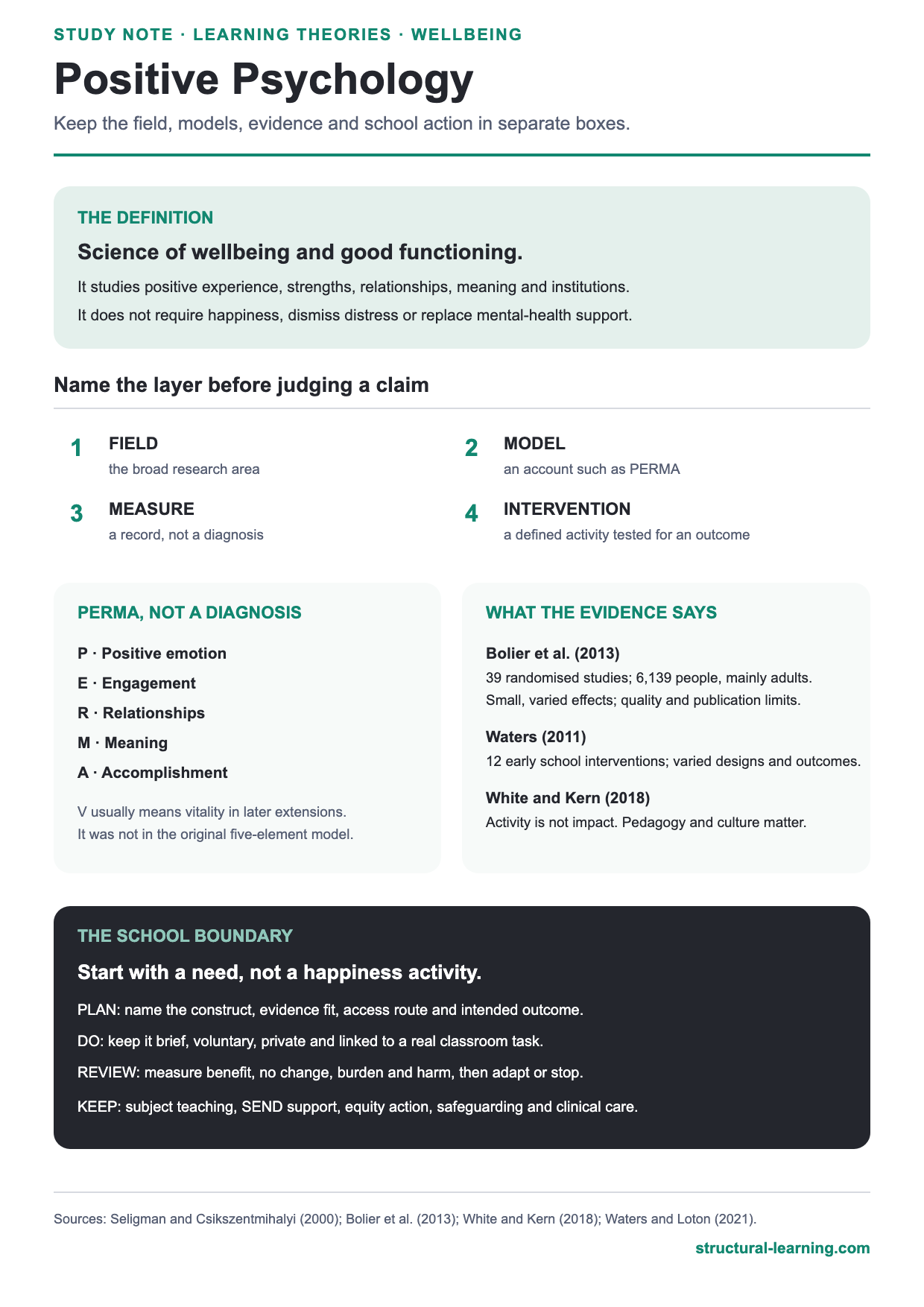
The note defines positive psychology as the study of what helps wellbeing and good functioning. It keeps the field apart from a model, measure, intervention and positive education. PERMA covers positive emotion, engagement, relationships, meaning and accomplishment. Some forms add health or vitality, but the first five-part model does not.
The evidence panel says adult meta-analysis found small and mixed effects from interventions. Early school reviews gave some grounds for interest, but the studies varied. Safe school use starts with one need, checks barriers, guards choice and privacy, and tracks help and strain. It also sets a stop rule.
Positive psychology does not replace subject teaching, SEND support, safeguarding, work on the setting or clinical care.
A one-page A4 note for teachers, SENCOs, leaders and scholars. It keeps key terms, PERMA, evidence and school duties apart.
A two-page print record for the need, route, evidence fit, access, choice, equity, safety, measures and review.
Twelve two-sided cards for staff learning or study. Each answer gives the term, the type of evidence and the limit on the claim.
Start with one claim or school routine. Name its layer and its evidence. Add the group and the limit. Then choose one access change or review measure.
Download the wellbeing-practice evidence and equity audit PDF.
Download the definition, evidence and boundary flashcards PDF.
These short answers cover the field, PERMA, evidence and school use. They keep help for wellbeing beside hardship, inclusion and safety. Read the full sections before you choose an intervention or judge a study.
Positive psychology is the scientific study of what helps people, groups and institutions feel and function well. It looks at good events, strengths, close ties, meaning and useful settings. It does not demand joy at all times or ignore distress.
No. Positive thinking is a hopeful or useful way to read an event. Positive psychology is a research field. It studies both good and hard events, the setting around people, and whether set tasks change measured outcomes.
PERMA stands for positive emotion, engagement, relationships, meaning and accomplishment. Seligman proposed them as parts of wellbeing that can be measured. They guide questions. They are not a full theory, a clinical diagnosis or a set profile for each learner.
V most often means vitality, though forms vary. It was not part of Seligman's first five-part PERMA model. Seligman later named health and vitality as possible extra parts. PERMA-V should therefore be called an extension, not the one true original model.
The evidence does not support a broad promise. Some school studies include school outcomes, but their programmes, methods and results vary. Wellbeing and grades may also share other causes. A claim about grades needs a sound study of that task, learner group and outcome.
They can use a short, private task that learners may choose for a clear aim. Learners need a right to pass and routes that need no writing or personal facts. Teachers should check help and strain, most of all in grief, hardship or unsafe home life.
A SENCO can help find access barriers, routes for speech, reasonable adjustments and risks. Positive psychology does not find or treat SEND. Each task must sit beside provision, safeguarding and clinical support. It must not make the learner fix a setting they cannot access.
There is no single main concern. Terms can overlap, and much work relies on self-report. Effects from interventions are small and mixed. Adult evidence may not fit schools.
Culture, institutions and living conditions can also be lost when the main focus is a task for one person.
These are the research sources used in this guide. They cover key theory, reviews of interventions and school work, a debate about measures, and a map of the field. Read the full paper when a choice rests on its method or sample.