Updated on
September 24, 2026
Multiple Intelligences: Gardner's 8 Types Explained
Gardner's eight intelligences explained for teachers, with classroom uses and an honest look at what the evidence does and does not support.


Updated on
September 24, 2026
Gardner's eight intelligences explained for teachers, with classroom uses and an honest look at what the evidence does and does not support.
What is Gardner’s theory of multiple intelligences?
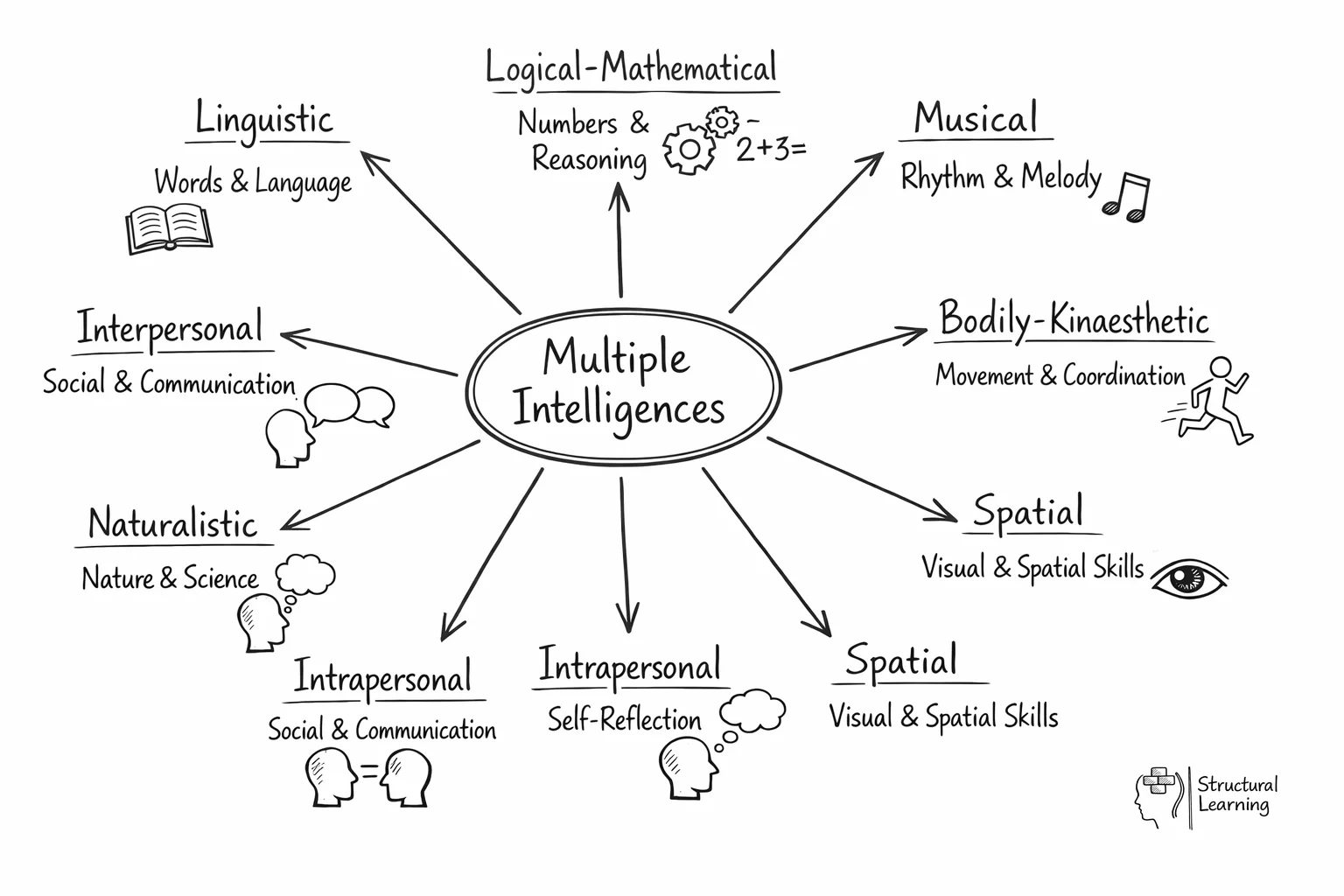
Howard Gardner's theory of multiple intelligences proposes that intelligence is not one fixed ability but several distinct ones, including linguistic, logical-mathematical, spatial, musical, bodily-kinaesthetic, interpersonal, intrapersonal, and naturalistic. For teachers, the useful idea is offering varied ways into a topic, though it should not be confused with the unevidenced learning-styles myth.
Multiple Intelligences: Gardner's Theory explains Howard Gardner's claim that human intelligence is not one fixed capacity. Instead, he saw it as a set of distinct abilities used to solve problems and create valued products in cultural contexts (Gardner, 1983). For teachers, the key question is not "which intelligence is this learner?". It is "which representation will make this knowledge clearer without overloading working memory?" The term describes a structured process for turning evidence into a classroom decision, not a label on its own.
This connects to the wider context of fundamental theories of learning in modern classroom practice.
In a Year 5 fractions lesson, a teacher can pair a number-line explanation with fraction strips, then ask learners to explain the same comparison in words. The theory remains influential in education, but it should be used as a planning lens rather than proof that learners have fixed learning styles, a distinction Gardner later made explicit (Gardner, 2013).
Gardner described intelligence as several fairly separate capacities, not just one IQ-style score. In practice, multiple intelligences theory asks teachers to present important knowledge in varied ways. Teachers still teach the same curriculum goal to all learners.
Gardner (1983) originally identified seven intelligences; he later added naturalist intelligence, bringing the list to eight. These include language, logic, music and naturalistic skills. His work changed teaching by showing that learners have varied strengths. Knowing your intelligences may support learning and development.
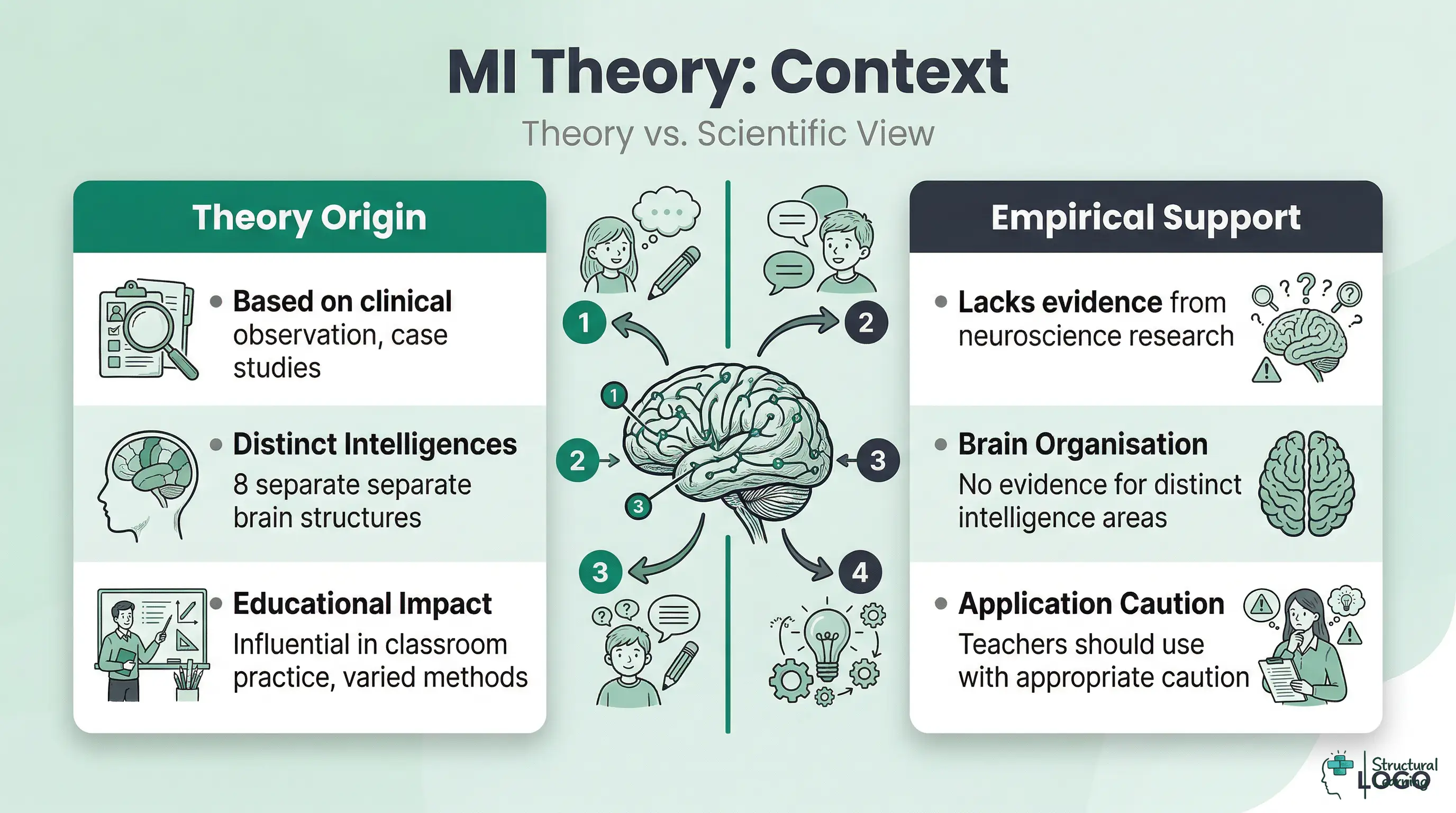
Gardner's MI theory began with observational and conceptual criteria. It was not an experimental model of brain systems.
Modern cognitive neuroscience has not backed the claim that the intelligences are separate. It treats strict MI modularity as a neuromyth. Mental tasks draw on overlapping brain networks and they correlate with general intelligence (Waterhouse, 2006; Howard-Jones, 2014; Visser, Ashton, & Vernon, 2006).
The evidence has hardened since those early reviews. Ferrero, Garaizar and Vadillo (2021) weighed the evidence for Gardner's modularity claims and found it thin. Newton and Salvi (2020) show how firmly the related learning styles neuromyth still sits in teacher belief around the world.
Neither finding makes varied teaching wrong. Both make the brain-based case for it indefensible.
Use MI classroom activities as varied representations. Do not treat them as evidence that each learner has a separate brain-based intelligence profile.
Gardner (1983) presented multiple intelligences theory in Frames of Mind. He thought single intelligence measurement was too limited for learners. Gardner used eight criteria, not intuition, to define each distinct intelligence (Gardner, 1983).
Gardner (1983) set out several criteria for an intelligence. One was isolation after brain damage, where one ability may change while others remain intact. Savants also show great skill despite other limits.
Learners move from novice to expert with practice. Each intelligence has core operations and ways of processing information. Evolution gives a possible reason for these skills, while experimental psychology tasks and psychometric findings offer backing. Encoding uses symbols, such as language.
Gardner first proposed seven intelligences, then later added naturalist intelligence. He has treated existential intelligence and pedagogical intelligence as possible extensions. He has not given them the same classroom status as linguistic, spatial or logical-mathematical intelligence (Gardner, 1999; Gardner, 2020). This matters because many school posters show nine or ten fixed types, while Gardner's own view is more cautious.
The framework rejects g, the general factor that ability tests keep throwing up. Gardner (1983) agreed that g shows up in the figures. He judged it empty in theory, a narrow by-product of testing rather than an account of how varied thinking really is.
The reply from test researchers does not rest on neuroscience at all. Carroll's (1993) three-stratum model, later folded into the Cattell-Horn-Carroll (CHC) framework, factor-analysed a wide set of ability measures. It showed that specific abilities group into a few broad factors, and those factors in turn load onto g.
Visser, Ashton and Vernon (2006) tested Gardner's categories head on, using several measures of each intelligence. The sub-scores correlated strongly with each other and with general cognitive ability. Independence failed on the theory's own terms.
The classroom message is narrower than it sounds. A learner who is strong in one area is more often than not strong in others. So plan varied routes into the same demanding content, rather than planning for eight separate capacities.
Multiple intelligences theory works best when it helps more learners reach the same important knowledge. Start with the main concept, then use two routes that work well together, such as an explanation and a diagram. This helps words and images support memory without adding extra working-memory load (Paivio, 1986; Sweller, 1988).
Effective lesson planning needs choice and restraint. For a history lesson, learners can read a short source, build a timeline and rehearse a brief oral explanation. Adding a song, drama or art task is only useful when that activity deepens the same disciplinary idea rather than distracts from it.
Assessment should still check the knowledge the teacher set out to teach. Portfolios, presentations, concept maps and journals can help learners show understanding. Even so, the teacher should look for accurate ideas, vocabulary and reasoning, not just proof that a preferred intelligence was used.
In UK schools, multiple intelligences theory should sit within a knowledge-rich curriculum, not replace it. Inspection still turns on curriculum intent, implementation and impact, but the policy ground has shifted underneath MI in a way few summaries mention. The initial teacher training and early career frameworks were rewritten to foreground cognitive science, explicit instruction and evidence-informed practice, drawing on the case that guided instruction outperforms minimally guided discovery for novices (Kirschner, Sweller and Clark, 2006). Multi-modal differentiation is no longer the planning default it was in 2010. A trainee who plans eight versions of one lesson is now working against the framework used to judge them. Leaders should not ask staff to produce eight differentiated versions of anything. Plan one clear objective, then use one or two representations that help the whole class reach it.
Assessment should track whether learners have understood the intended knowledge. In Year 5 science, for example, learners can use a diagram, a short explanation and a data table to show understanding of a fair test. Those formats support access, but the success criteria should remain tied to the science.
For headteachers there is a governance point beneath the workload one. Planning for every intelligence in every lesson costs real time. The bigger risk is what the labelling does to curriculum ambition.
Where intelligence-profile surveys feed into grouping, the learners sent down the practical, kinaesthetic or creative track are far more often the disadvantaged and the SEND cohort. That track is usually lighter on the core knowledge later qualifications assume.
That is a direct problem for Pupil Premium accountability. The spending is justified as personalised provision, yet it hands a narrower curriculum to the very learners it was meant to lift. Inspectors looking at a subject in depth ask what all learners are taught, not which activity types were on offer.
Use multiple intelligences to widen how learners meet an ambitious curriculum. Do not let it become the reason some of them meet less of it.
Gardner's theory forms part of a broader field of child development theories that help teachers understand the range of cognitive abilities learners bring to the classroom.
Year 4 teachers at Millfield Primary changed how they taught Victorian history. Bodily-kinaesthetic learners acted out street scene drama.
Musical learners wrote songs (Gardner, 1983). Visual-spatial learners drew cut-through plans of houses. Word-strong, or linguistic, learners kept diaries.
King Edward's School used MI theory in science lessons. Learners used naturalistic intelligence, which means noticing patterns in the natural world.
Logical-mathematical learners used spreadsheets to analyse the data. Interpersonal learners, who like to work with others, researched the impacts in teams. Intrapersonal learners, who prefer to work alone, wrote about responsibility.
MI-based teaching needs careful planning, not lots of resources. It should acknowledge different learner strengths. Curricula must keep high academic standards.
Gardner (1983) thought old tests missed key learner skills. He defined eight types of intelligence. Gardner (1999) then suggested learners may also have existential intelligence.
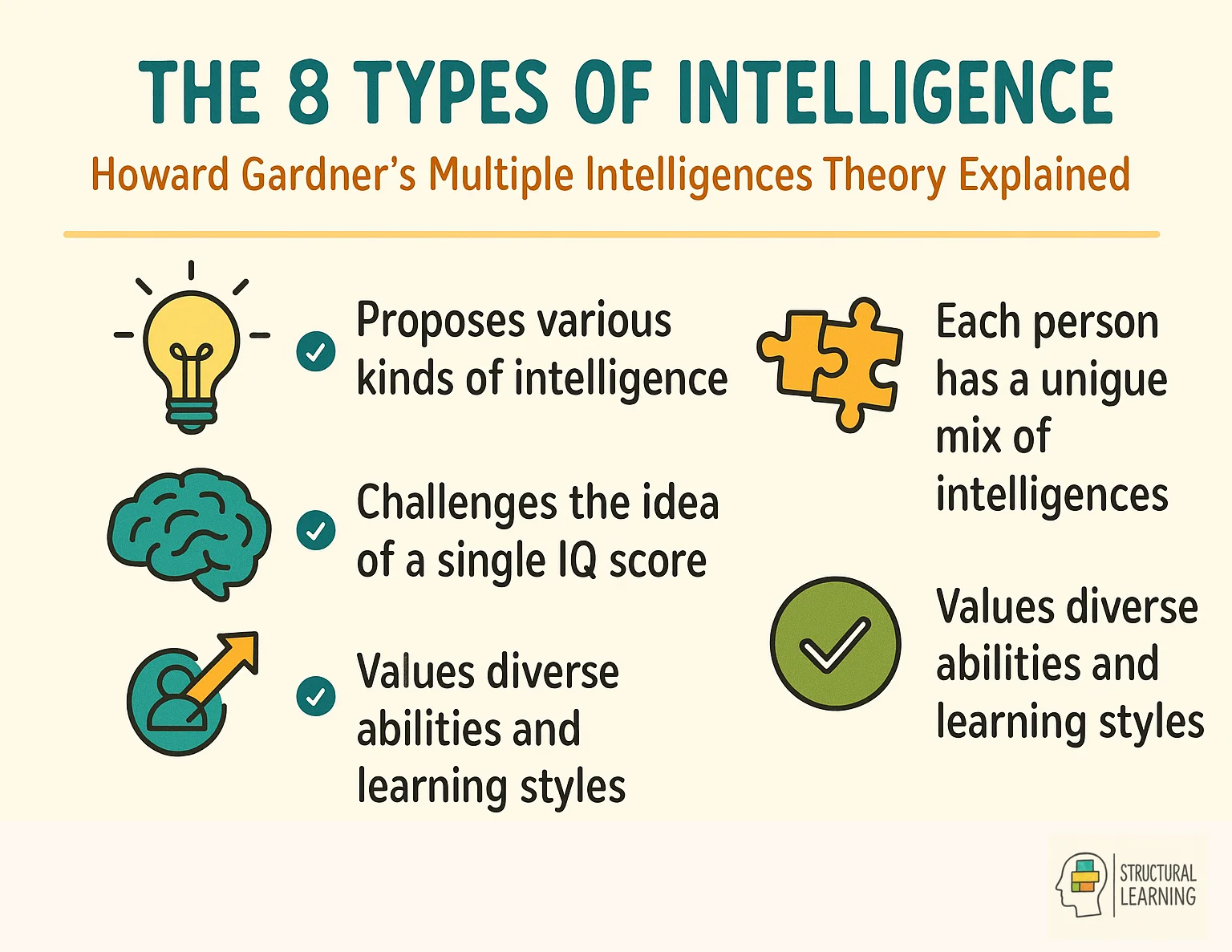
Gardner (1983) proposed the theory of multiple intelligences. Researchers have used this to inform teaching (Armstrong, 2009). Check Gardner's (2011) later work to deepen understanding. Gardner (1999) also explored intelligence reframed for the 21st century.
Goleman (1995) said emotional intelligence is very important. Salovey and Mayer (1990) defined its skills in simple terms. They showed that learners can understand and manage feelings well.
Gardner (1983) found tests limited, noting eight intelligences. Existential intelligence is a candidate intelligence Gardner has considered. He has not formally added it to the primary list (Gardner, 1999).
Gardner's (1983) multiple intelligences include skills such as planning ahead. Sternberg (1985) links intelligence to success in the real world, including solving problems. Thinking tasks can show which intelligence a learner leans on (Goleman, 1995).
Gardner (1983) found that learners have varied strengths. Interpersonal intelligence helps a learner read other people (Gardner, 1983).
Intrapersonal intelligence helps a learner know their own mind (Gardner, 1983). Learners use thinking skills to spot these differences (Gardner, 1983).
Gardner's (1983) theory says learning works best when it matches strengths. If teachers spot different intelligences, learners grasp information faster. Linguistic learners learn well through reading activities (Gardner, 1983).
Visual learners do better with pictures and visual tasks (Gardner, 1983). Adjust your lessons to suit each learner's various needs.
Offer varied resources that match learner intelligences. Musical learners can benefit from music in lessons. Interpersonal learners can gain from group work (Gardner, 1983). Different materials can improve inclusivity and learning for all (Gardner, 1983; Smith, 2002).
Gardner is one of several key education theorists. His work has shaped how schools think about ability, potential and the purpose of assessment.
Teachers often work from a list of eight intelligences. These are linguistic, logical-mathematical, visual-spatial, bodily-kinaesthetic, musical, interpersonal, intrapersonal and naturalist.
Treat the list as a starting point for staff discussion. Name the learner's current need, then gather evidence from more than one lesson. Agree the next classroom adjustment with the SENCO or the family.
Gardner's original 1983 account set out seven. Naturalist intelligence was added later, while existential intelligence remains a possible type rather than a settled ninth type (Gardner, 1983; Gardner, 1999).
Linguistic skills mean learners read, write, and use language well. Spatial skills mean learners solve problems through visual perception (Gardner, 1983).
Learners with bodily-kinaesthetic intelligence show good coordination (Gardner, 1983). They learn through movement and physical activity (Armstrong, 2009). These learners are often good at sports or dance (Hannaford, 2005). Consider practical tasks to engage this learning style (Willis, 2008).
Musical intelligence helps learners hear, make or sing music well. Gardner (1983) showed that learners use people skills, or interpersonal skills, to talk and work with others. He also found that inner skills, known as intrapersonal skills, help learners see what drives them (Gardner, 1983).
Gardner (1983) said learners have multiple intelligences. These include spatial-visual, linguistic, and interpersonal skills. He argued that intelligence is not one single measure. Instead, he believed learners have a wide range (Gardner, 1983).
A person can be particularly strong in a single area, like music, but he is most likely to hold a wide range of other skills such as naturalistic intelligence and verbal skills.
Visual-spatial intelligence helps learners visualise three-dimensional shapes. Learners with this skill may find graphic organisers and mind maps useful. This intelligence links to learning theories and helps learners with special needs.
Teachers can use visuals to focus attention and boost working memory. This links to dual coding theory (Paivio, 1971; Clark & Paivio, 1991). Integrate visuals to build critical thinking.
Use diagrams, charts and images. Let learners draw ideas. Colour-code key information.
Provide building blocks or puzzles. Use software to make virtual models.
Multiple intelligences sits within a wider debate about how we define and measure cognitive ability. For a broader view, see our guide to intelligence theories from Spearman's g factor to Sternberg's triarchic model.
Gardner's theory is popular in schools, but scientists have raised serious doubts. Waterhouse (2006) argued that the proof for separate intelligences is weak. Visser, Ashton and Vernon (2006) found strong links with general intelligence.
Howard-Jones (2014) went further. He put MI classroom claims alongside other educational neuromyths, the brain myths that spread widely in schools despite thin evidence.
The issue is not whether learners differ; they do. The issue is whether those differences are separate intelligences with independent brain systems.
Another criticism is that the theory is too broad. It does not give clear, measurable criteria for identifying and assessing each intelligence. This makes it hard to design and judge educational interventions based on the theory. Some also argue that it is not falsifiable, which means scientific research cannot test or disprove it.
Despite these criticisms, the theory of multiple intelligences has shaped education. It has encouraged teachers to value a wider range of learner strengths. Use this influence with care: varied teaching can improve access, but labelling learners as visual, musical or kinaesthetic can narrow expectations and weaken planning.
Gardner looked at types of intelligence. Piaget (1952) took a different route. He set out a stage theory, which describes the broad ways children's reasoning changes as they grow. Those changes happen whatever the learner's intelligence.
Gardner (1983) set out eight intelligences that shape how learners take in and work with information. Each one, on his account, solves problems and makes products a culture values. Teachers can use the list to notice strengths that reading and calculation alone would miss, then vary how a concept is presented without lowering what is taught.
Gardner (1983) said learners with linguistic intelligence use words well. Learners with strong logical-mathematical intelligence find maths problems easier.
Musical learners make music (Gardner, 1983). Bodily-kinaesthetic intelligence is body smarts. It helps learners move well and stay in control.
Gardner (1983) said spatial intelligence helps learners spot patterns. Interpersonal intelligence helps them read how other people feel (Gardner, 1983).
Intrapersonal intelligence helps learners know their own feelings (Gardner, 1983). In 1999, Gardner added one more. He called it naturalistic intelligence, the knack of telling plants and animals apart.
Learners show intelligences through their work. Language learners enjoy stories and word games. Spatial learners prefer diagrams (Gardner, 1983).
Use varied tasks for all. Learners can act (bodily-kinaesthetic), sing about history (musical), or classify in science (naturalistic). This shows skills tests miss.
Gardner's multiple intelligences theory is best used as a prompt for richer explanations, not as a claim that every learner has a fixed style. It can help teachers notice strengths beyond reading, writing and calculation, but the research base does not justify sorting learners into intelligence groups.
Use Multiple Intelligences as a base, not a fixed method. Teachers can use it with strategies to improve learning. Identify each learner's strengths and vary activities (Gardner, 1983).
This boosts academic results and learner growth (Armstrong, 2009). Don't pigeonhole learners by intelligence type (Christensen, 2000).
Multiple Intelligences can help teachers adapt lessons, but they should also use evidence. Avoid labelling learners. Instead, offer varied experiences to engage their thinking. This supports differentiation, so all learners can access the content (Gardner, 1983).
Gardner (1983) suggests that storytelling helps learners across subjects. They can build timelines from pictures (logical-mathematical, spatial). They can also write songs (musical).
For instance, learners build houses (spatial) when they study the Great Fire. They can also act out a play (interpersonal, linguistic). Making up chants (musical, logical-mathematical) pulls them in too.
Teachers can adapt these ideas within their own subjects. In science, a teacher could teach photosynthesis with diagrams and molecule role-play (bodily-kinaesthetic). Learners could then use reflection journals and pair talks. In mathematics, teachers can use natural patterns, physical objects, and group problem-solving to teach algebra (Gardner, 1983; Smith, 2008).
Tasks that involve movement can help kinaesthetic learners (Gardner, 1983). Watch your class at work and you will spot where their strengths lie (Armstrong, 2009).
Matching a task to a strength may lift how hard learners try (Christison, 1998). Weigh that up against the links in your own curriculum (Smagorinsky, 2011).
Multiple intelligences and learning styles are often conflated, but they make different claims. Gardner (2013) explicitly rejected the idea that visual, auditory or kinaesthetic learning styles are forms of intelligence, and Rousseau (2021) shows that this confusion still shapes teacher beliefs. Use multiple intelligences as a planning lens, not as a mandate to match instruction to a preferred learning style.
Learning styles suggest learners gain more from matched teaching (Pashler et al., 2008). Research found that matching instruction to learning style showed no real gains. This doesn't disprove all theory, but disproves tailoring content for each learner's perceived style.
Evidence-based alternatives give teachers a stronger route to inclusion. Dual coding combines words and visuals when the content is clearer with both (Paivio, 1986). Structured peer explanation can support language and reasoning when teachers guide the talk (Vygotsky, 1978).
Retrieval practice builds memory because learners keep pulling facts back to mind (Karpicke, 2008). Universal Design for Learning takes down barriers, and it does so without labelling any learner.
Kornhaber, Fierros and Veenema (2004) found improvements in test scores and behaviour in SUMIT schools. These schools used MI theory for over three years. Strong leadership and reflection were common, they noted.
Hattie's (2009) analysis showed small gains from cognitive style teaching. Feedback and formative assessment offer better results. Teachers can use MI to broaden activities, not as a cognitive map.
Gardner's (1983) theory faces criticism on three separate fronts. It helps to keep them apart. The first is about evidence from classroom studies. Those studies do not show that the eight intelligences exist as separate abilities.
The second front is the brain. No research programme has found a dedicated brain region for each category. Imaging work points instead to networks spread across the brain (Waterhouse, 2006; Howard-Jones, 2014).
The third front comes from testing, and it is the hardest to set aside. When researchers model ability tests statistically, the separate factors keep collapsing back towards general intelligence (Carroll, 1993; Deary, 2000; Visser, Ashton and Vernon, 2006). A theory can survive a thin set of classroom trials. It struggles to survive its own categories refusing to separate.
There is a problem with the definitions too. Gardner (1983) names each intelligence from behaviour he observed. He then treats that same behaviour as proof the intelligence is real. Waterhouse (2006) sets out this circular reasoning in detail.
Four decades on, no tested instrument measures the eight intelligences separately. Nor is there a body of trials showing that MI-organised teaching raises attainment beyond what varied, well-sequenced instruction achieves anyway.
This presents a distinct challenge for implementation. Most accounts treat multiple intelligences as a benign planning checklist, and that framing hides a real cost. Building eight parallel routes into one lesson does not merely take time. It fragments the material. Cognitive load theory predicts that when a novice must integrate a song, a movement task, a diagram and a written explanation before the underlying schema exists, split-attention and redundancy effects consume the working memory the learner needs for the content itself (Sweller, 1988). Kirschner and colleagues (2006) put the sharper version of the argument: minimally guided, discovery-flavoured activity is least effective precisely where prior knowledge is thinnest, which is exactly where MI carousels tend to be deployed. Sequence matters more than variety. Teach the core idea with strong guidance and one supporting representation, secure it, then widen the routes once learners have something to hang them on (Tomlinson, 2014).
The 2026 update runs in two directions. The second is a classroom problem rather than a theory one.
Network neuroscience has made a strictly modular view harder to defend. Connectome-based modelling ties fluid intelligence to spread-out, interacting brain networks, not to separate subject-specific modules (Wilcox & Barbey, 2023). Multimodal models show that language, vision, planning and spatial reasoning can all run inside one system.
The harder question is what generative tools now do with MI in schools. Ask a lesson-planning assistant to differentiate a topic and it returns eight modality-tagged worksheets in seconds. The request is easy to satisfy and the output looks thorough. Nobody plans that many versions by hand.
Automation has removed the friction that used to keep MI differentiation in proportion. The cost falls hardest on the learners least able to absorb it. Those with weak working memory, those with ADHD, and those who rely on the steady rhythm of whole-class teaching now meet broken-up parallel tasks, made at almost no cost.
The governance answer is dull but sound. Treat MI as a teaching vocabulary, not a map of separate minds. Before any AI-generated variant reaches a desk, ask for it to be justified against the same single learning objective.
Sternberg (1985) challenged intelligence measures, as Gardner did. His triarchic theory has three parts. Analytical intelligence lets learners evaluate things.
Creative intelligence helps learners make new ideas. Practical intelligence means learners use knowledge well. Sternberg said schools mainly value analytical skills, which leaves other learner strengths ignored.
Sternberg and Grigorenko (2004) described "successful intelligence". This means learners notice their strengths and weaknesses. They then use their strengths while working on areas that need support.
Teachers must help learners understand their thinking, not just learn facts. Unlike MI theory, Sternberg's idea has assessments tested against outcomes. Critics find that creative and practical intelligence still strongly relate to general intelligence.
Salovey and Mayer (1990) defined emotional intelligence as understanding and managing feelings. Goleman (1995) said it predicts life success. Waterhouse (2006) found weak evidence it differs from ability and personality. Common tests mix it with conscientiousness, like in the Big Five.
Cattell (1963) separated fluid (reasoning) and crystallised (knowledge) intelligence. Teachers can see why learners struggle with new problems despite knowing facts. Teach vocabulary directly and build knowledge to help learners succeed. Schools should value all abilities, like Gardner's, using frameworks based on evidence.
Enter a lesson topic to generate activity ideas across Gardner’s 8 intelligences.
Works for any subject or age group. Try a topic you teach this week.
Your activity ideas will appear here once you enter a topic and click Generate.
Observe learners during different activities and note their natural preferences and strengths. Create simple checklists for each intelligence type, watching for patterns such as whether learners gravitate towards group work, hands-on tasks or pattern recognition. Use informal surveys to ask learners about favourite activities, but do not turn the answers into fixed labels.
Gardner (1983) stated that word games support language learners. Puzzles improve maths skills, and drawing builds spatial awareness.
Songs help learners with a strong ear for music. Role-play suits bodily-kinaesthetic learners, who think best when they move. Nature walks help naturalistic learners (Gardner, 1983).
Needs differ. So the useful question is which way of showing the content removes a specific barrier. It is not which intelligence a learner 'is'. A learner with dyslexia may hold a sequence better through a diagram, or by saying it aloud, than through a dense paragraph.
A learner with ADHD may hold attention better through a short movement or hands-on task. The evidence here supports shorter, clearer, better-signposted instruction. It does not support the claim that ADHD maps onto bodily-kinaesthetic intelligence.
That difference matters. Multiple intelligences is often raised in ADHD discussions as if it named a learning type. It does not. Use it to widen access to the same objective (Gardner, 1983), and leave the diagnostic work to the graduated approach and the SENCO's assessment.
Do not try to cover all eight intelligences in one lesson. Begin with the key teaching objective, then choose two routes that fit the content, such as a verbal explanation and a diagram, or a worked example and partner rehearsal. Rotate wider choices across a sequence rather than crowding one lesson (Sweller, 1988; Paivio, 1986).
Gardner's (1983) theory needs more evidence. Some researchers think it describes skills, not intelligences. Critics worry that it could lower expectations. Teachers should use it with caution alongside the curriculum and evidence-based teaching.
Multiple intelligences research
Gardner's MI theory
Intelligence in education
Gardner's (1983) theory aids personalised learning, but it is theoretical. Use it to vary teaching, not label learners. Teach fractions using pie charts (spatial), objects (kinaesthetic), discussions (interpersonal), and rhythms (musical). Do not rigidly group learners (Gardner, 1983).
Use MI theory to add to your teaching, but keep to the curriculum. Check if different methods improve learner results, not just add interest. Cognitive science emphasises basic knowledge.
Critics such as Professor John White (Institute of Education) find little proof for Gardner's theory. Research points instead to one general intelligence factor, known as the g-factor. Brain studies and tests have not backed up Gardner's separate intelligences.
UK teachers find Gardner's framework useful for lesson planning. Use it to add varied activities, like visuals for spatial learners. Include movement for kinaesthetic learners too.
See multiple intelligences as a helpful concept, not a fixed model (Gardner). Be aware of its limits when creating inclusive classrooms.
Visual-spatial intelligence means learners think in 3D and visualise ideas. Learners with this strength are good at maps and charts (Gardner, 1983). They also create drawings and understand spaces.
Learners may excel in geometry, art and design technology. They think in pictures and navigate well. Learners can show talent for puzzles and model building (Hockney, 2001).
Architects like Norman Develop demonstrate this intelligence.
Use mind maps and diagrams in lessons for visual-spatial learners. Colour-code topics and provide building activities . Encourage drawings and charts to show learning.
Interactive whiteboards and geometry tools help . Group work using rearranged furniture aids learning .
Waterhouse (2006) found no brain evidence to support Gardner's theory. Willingham (2004) argued that the theory cannot be disproven. Do learners' skills challenge the idea of separate intelligences? Cognitive scientists continue to critique Gardner's theory.
Gardner rejects using visual, auditory, kinaesthetic (VAK) as multiple intelligences. He sees VAK as sensory channels, not intelligence forms. Pashler, McDaniel, Rohrer and Bjork (2008) found inadequate evidence to support matching instruction to learners' preferred learning styles. Mixing them with MI harms its valid points.
| Feature | Multiple Intelligences | Learning Styles (VAK) |
|---|---|---|
| What it describes | Forms of intelligence and ability | Preferred sensory input channels |
| Evidence base | Theoretical framework, limited empirical support | Comprehensively debunked (Pashler et al., 2008) |
| Classroom use | Recognise diverse strengths, not label learners | Match instruction to supposed preference |
| Gardner's view | Endorsed as a lens for understanding ability | Explicitly rejected by Gardner |
Gardner's (1983) MI theory recognises varied academic strengths. It moves beyond just linguistic and logical skills. The value is in creating tasks.
These tasks let diverse learner strengths contribute to learning (Gardner, 1983). Labelling learners is not the point.
Gardner, H. (1983). Frames of mind: The theory of multiple intelligences.
Karpicke, J. (2008). The critical importance of retrieval for learning.
Piaget, J. (1952). The origins of intelligence in children.
Vygotsky, L. (1978). Mind in society: The development of higher psychological processes.
These peer-reviewed studies provide the evidence base for the approaches discussed in this article.
Waterhouse (2006) notes multiple intelligences research faces issues. Intervention studies need stronger methods. This makes judging the theory tough. More high quality research is needed.
M. Ferrero et al. (2021)
Gardner's (1983) Multiple Intelligences theory lacks strong evidence. UK teachers should use MIT with caution (Gardner, 1983). Further research is needed to validate its impact on learner progress.
Howard Gardner's Theory of Multiple Intelligences 47 citations
Lynn Helding (2009)
The paper offers a summary of Gardner's (1983) Multiple Intelligences theory. UK teachers can find key principles and the various intelligences useful. Researchers like Gardner (1983) suggest diverse learners benefit from varied teaching.
Technology teaching can boost learning, according to Gardner's (1983) theory. It improves emotional and subject knowledge in technology and design (Kortenkamp & Shumaker, 2018). See how it affects learner performance.
J. Sánchez-Martín et al. (2017)
Gardner's (1983) theory can engage learners better in design and technology. Teachers could use Multiple Intelligences theory, from Gardner (1983), to help learners succeed.
Gardner's (1983) theory of multiple intelligences influences education. Recent research shows it shapes how learners' minds grow. Armstrong (2009) and Checkley (1997) give teachers useful advice.
Beatriz Berrios Aguayo et al. (2021)
Gardner's theory can guide teachers seeking to develop the whole learner. Teachers in the UK can use Multiple Intelligences Theory (MIT) to address educational gaps. This offers original pedagogies (Gardner, n.d.).
Gardner's (1983) theory helps learners understand themselves better. Research studies of Indonesian Islamic education exist (study cited). This review analyses teaching methods currently in use. Educators can use Gardner's ideas to improve learner results.
Salami Mahmud et al. (2024)
The review looks at Gardner's (1983) Multiple Intelligences theory in Indonesian Islamic education. UK teachers can learn from this, adapting it for various learners (Gardner, 1983).