Formative vs Summative Assessment: A Complete Guide for Teachers
Discover the key differences between formative and summative assessments. Learn practical strategies for effective feedback and balanced classroom evaluation.


Discover the key differences between formative and summative assessments. Learn practical strategies for effective feedback and balanced classroom evaluation.
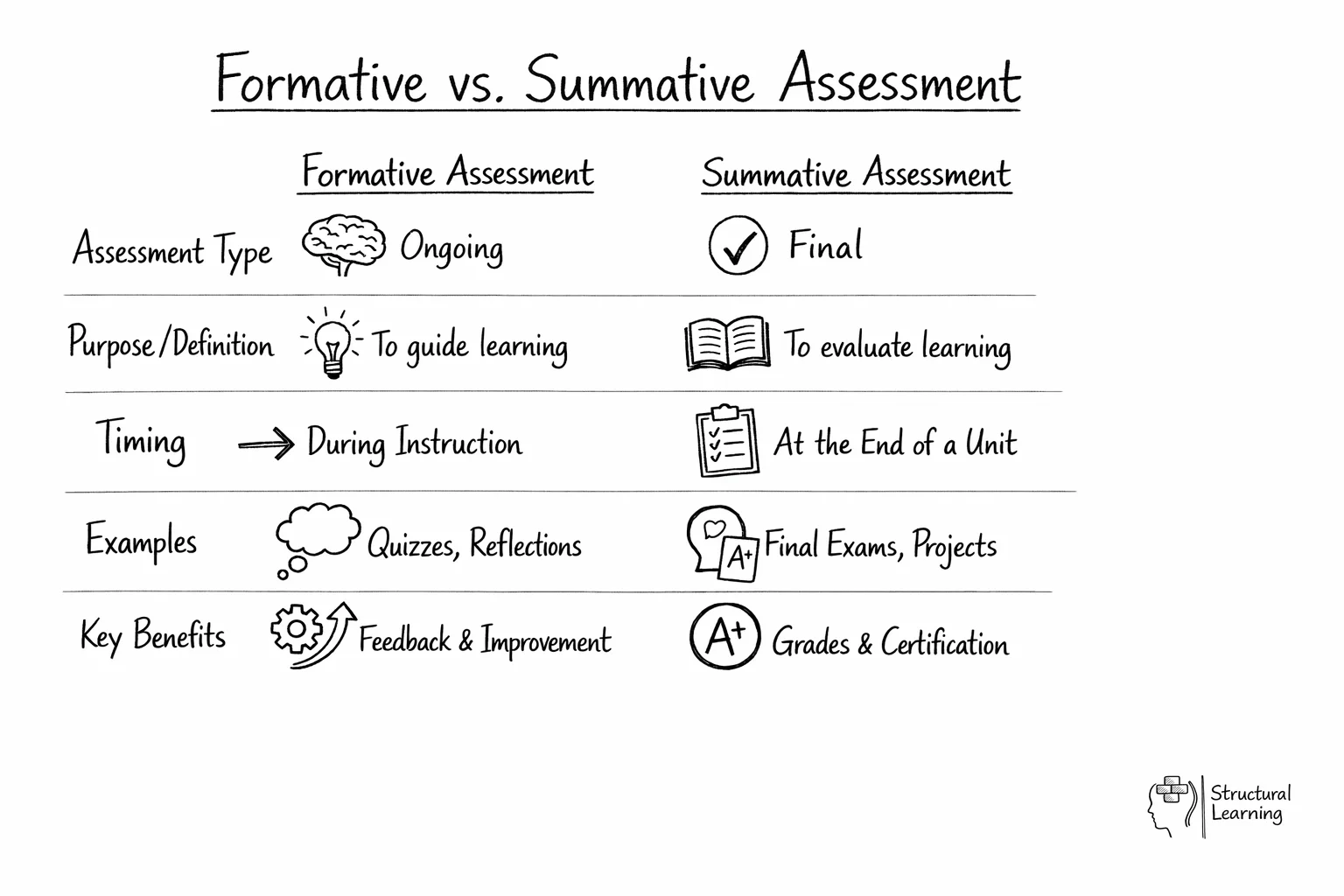
| Aspect | Formative Assessment | Summative Assessment | Best Practice |
|---|---|---|---|
| Purpose | Inform ongoing teaching | Evaluate final achievement | Use both strategically |
| Timing | During learning process | End of unit/course | Balance frequency |
| Feedback | Immediate, actionable | Final grade/score | Make summative feedback formative |
| Stakes | Low or no stakes | Higher stakes | Reduce anxiety where possible |
| Student Role | Active participant | Demonstrating learning | Build self-assessment skills |
Understanding formative vs summative assessment is essential for effective teaching. Formative assessment, often called assessment for learning, provides ongoing feedback during the learning process. Summative assessment measures achievement at the end o f a unit or course. Research by Black and Wiliam demonstrates that effective use of formative assessment can significantly improve student outcomes, particularly for lower-attaining pupils. This guide explores both approaches and provides practical strategies for implementing assessment for learningin your classroom.
| Aspect | Formative Assessment | Summative Assessment |
|---|---|---|
| Definition | Ongoing assessment that provides feedback during the learning process, also called assessment for learning | Assessment that measures achievement at the end of a unit or course, also called assessment of learning |
| Key Feature | Provides real-time insights and continuous feedback to adjust instruction and support self-regulated learning | Determines overall academic performance at a specific endpoint |
| Example | Diagnostic questions, exit tickets, quizzes, interactive tasks, modern assessment tools, key questions | End-of-unit tests, final exams, standardised tests, course grades |
| Classroom Use | Taken frequently during regular classes to monitor progress and identify knowledge gaps | Conducted at the end of learning periods to evaluate overall achievement |
| Best For | Supporting individual needs, improving lower-attaining pupils' progress, and guiding next steps in learning | Measuring final achievement, grading, and determining if learning objectives have been met |

While summative assessments are useful in determining overall academic performance, formative assessments offer real-time insights into student learning, allowing teachers to adjust their instruction and better support individual needs for continuous improvement.
Many people consider ‘assessment’ as a test. But, this term is wider than that. There are two main categories of assessment: formative assessment and summative assessment. These types of assessment are sometimes called A 'for' L and A 'of' L, respectively.
At some level, both types of appraisal are conducted in the classroom but they have two different purposes. To maximise the effectiveness of each type of classroom practice, understand the basic functions of these appraisals and how each of these assessment types contributes to the student motivation and learning process.
Providing comprehensive feedback for students is a fundamental part of lessons. This guide will demonstrate some engaging ways of going beyond the standard multiple-choice questions. Although plenary questions are a good way of gauging what students have understood, there are more interactive strategies that get to the essence of what pupil understanding.
Formative activities are taken more frequently and during regular classes for insightful purposes, allowing educators and students to assess pupil progress and attainment levels more often. Formative appraisals can start from diagnostic questions, demonstrating what gaps may exist in knowledge and what a student already knows. Knowing what has been learned to date, makes it easier for both the student and the teacher to plan the next stages of learning. As the learning proceeds, further appraisals specify whether instructional methods need to be modified to extend or reinforce students' current theoretical knowledge.
Formative tasks may be carried out through strategies such as key questions, exit tickets, quizzes, tasks, and many other types of formative review activities. Most of the formative appraisal activities are not recorded by the teachers, except possibly in the lesson plan drawn up to identify the next steps implied.
For formative tasks, the main functions of assessment include the monitoring of student theoretical knowledge and offering ongoing feedback to students and staff. Productive appraisal activities are the ongoing check of knowledge and skills. If designed properly, an ongoing assessment helps learners identify their weaknesses and strengths, and it can help students improve their self-regulating skills so that they gain their education properly. Constructive checks of understanding also provide information to the teachers about the lesson planning and subject matter learners are struggling with so that enough support can be provided through individual lessons.
Checks of understanding can be teacher-led, self or peer-assessment. These are usually low stakes assessments and mostly carry no grade, which may discourage the learners from completing or getting each of the individual pupils fully engaged with the task.

Summative exams can be used to assess pupil progress more formally, academic achievement and skill acquisition at the end of a specified instructional period, usually after completing a key stage, course, unit, project, program, semester or educational year.
External tests are usually used for summative purposes, what a student has learned at the end of a specific time, relative to the relevant national curriculum and learning objectives. The period of time allocated for exams or SATs will vary, depending upon what the education system wants to assess.
A summative task can be an observation, a cold written task, or a discussion. It can be recorded in a written format, in the form of photographs, through audio recording or any other visual media. Whichever way it is used, the insights can be used to indicate what has been learnt. Exams perform summative functions by providing a summary of what a student has attained at a specific point in time and may furnish cohort and individual data for informing stakeholders (such as parents or school leaders etc.) and tracking pupil progressagainst benchmark data or standardised tests.
These exams frequently have high stakes and learners tend to give priority to external tests over A4L activities. According to key figures in the world of education, feedback from both forms of appraisal should be used by the teachers and children to guide their activities and efforts in the upcoming courses.
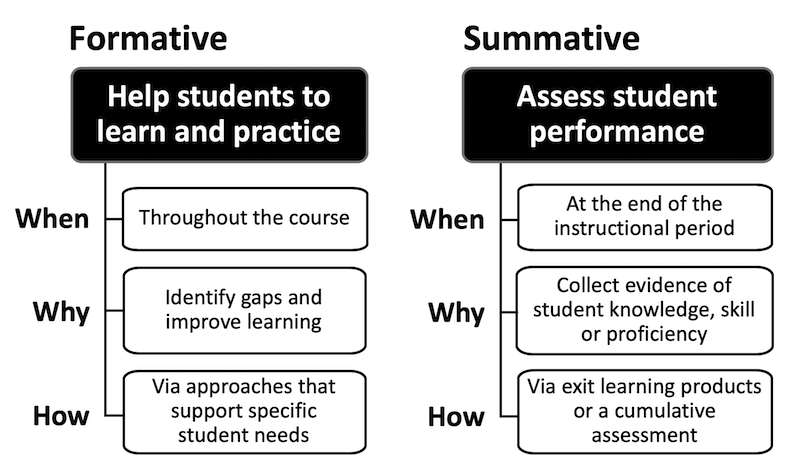
Understanding the difference between formative and summative assessment is crucial for effective teaching practice. Formative assessment provides ongoing feedback during learning, whilst summative assessment measures final end-of-unit attainment or course.
| Aspect | Formative Assessment | Summative Assessment |
|---|---|---|
| Definition | Ongoing assessment that provides feedback during the learning process (assessment for learning) | Assessment that measures final achievement in the unit or course (assessment of learning) |
| Purpose | Improve learning and guide instruction whilst teaching is happening | Evaluate and grade final learning outcomes after teaching is complete |
| Classroom Examples | Exit tickets, diagnostic questions, mini quizzes, interactive tasks, observation | End-of-unit tests, final exams, standardised tests, course grades |
| Teacher's Role | Adjust instruction immediately, provide feedback, identify knowledge gaps | Evaluate overall achievement, assign grades, measure learning objectives |
| Frequency | Frequent and ongoing throughout lessons and units | Infrequent, typically at the end of units or terms |
| Student Impact | Supports self-regulated learning and immediate improvement, especially for lower-attaining pupils | Provides accountability and measures final performance for reporting purposes |
| When to Use | During active learning to monitor progress and adapt teaching strategies | At completion points to determine if learning objectives have been achieved |
Both assessment types serve essential but different purposes in education. Formative assessment drives learning forward through continuous feedback, whilst summative assessment provides accountability and measures final achievement levels.
Education experts claim that an over-dependence on testing at the end of an element of study may help in achieving good grades, but offers very little response to students for improving performance before reaching the end of the programme/module. Thus maintaining a balance between summative and formative assessments is necessary.
student assessment methods" width="auto" height="auto" id="">
Formative assessment offers numerous benefits by enhancing the learning experience for both students and teachers. By providing continuous feedback, formative assessment supports long-term retention and cumulative knowledge acquisition, ensuring students grasp essential concepts.
Additionally, formative assessment informs curriculum planning by identifying areas where students require further assistance, allowing teachers to tailor their instruction to better meet individual needs.
In essence, formative assessment plays a vital role in developing a dynamic and responsive educational environment, which ultimately leads to improved student outcomes. For related approaches, explore Hinge Questions: A Teacher's Complete Guide to For.
To really advance school attainment, we need to build upon what a child already knows. When school leaders are engaged in national curriculum planning we are attempting to sequence a form of knowledge acquisition and skills progression. If a child has gaps in their understanding, this may hinder their progression.
Using critical questions and other mixed-assessment approaches helps us build a picture of the classes current understanding. These types of activities help us inform curriculum planning and ensure that we have achieved maximum coverage of the curriculum. The following are some of the most significant benefits of formative assessments:
Research-based evidence about student achievement shows that summative judgments play an important role in developing memory. Retrieval practice, a powerful learning strategy, aids in consolidating students' memory by actively recalling information from their minds.
This process strengthens neural connections, making it easier to access the information in the future. By frequently engaging in retrieval practice, students reinforce their memory and enhance long-term retention. Additionally, the process helps identify any gaps in understanding, allowing for targeted revision and improved comprehension.
retrieval practice supports the development of durable and efficient memory networks, promoting deeper learning and lasting knowledge acquisition.

It is possible to engage students in formative assessments by:
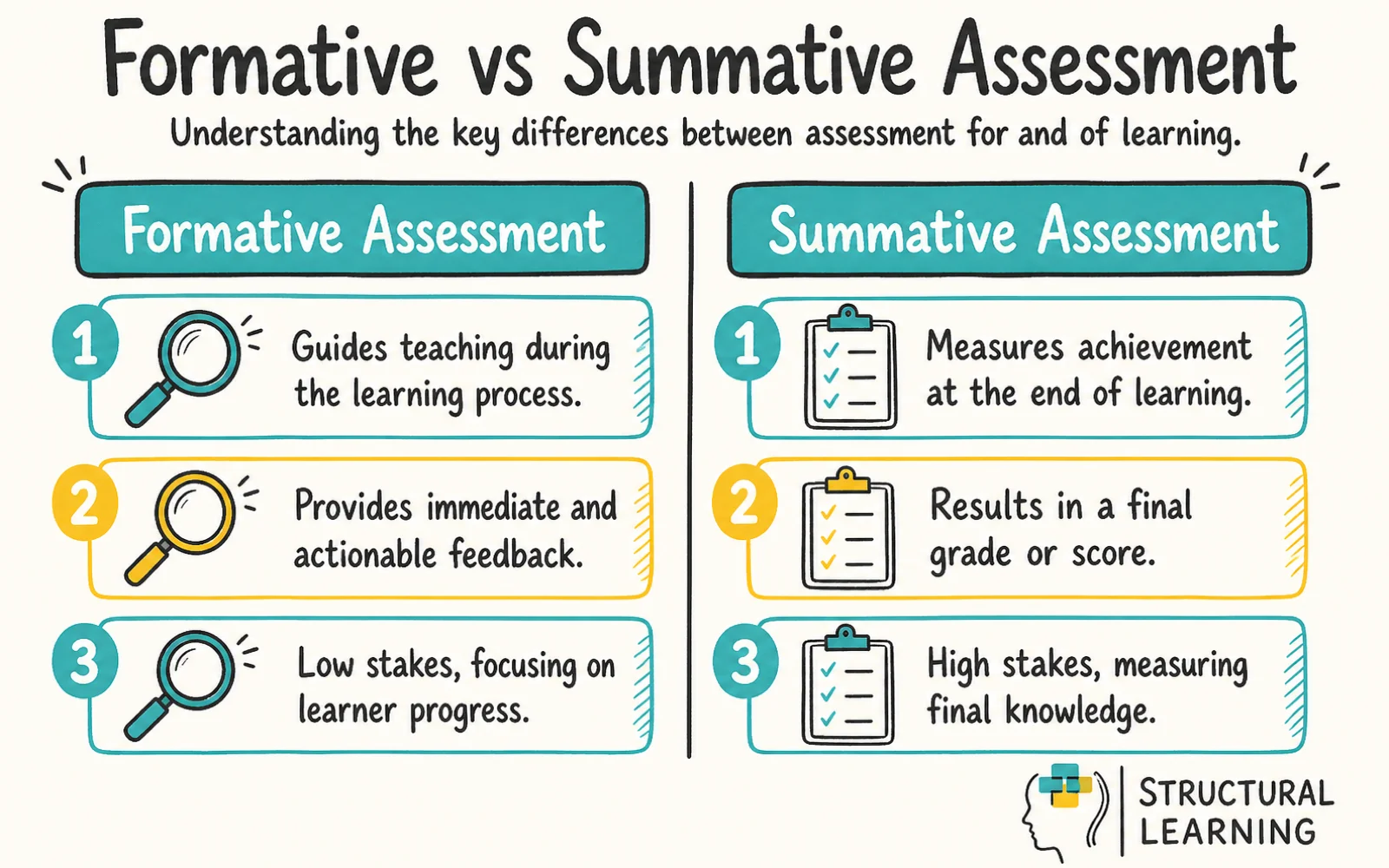
The process of designing and developing classroom-based checks can be a creative endeavour: what must be assessed, using summative or/ and formative assessment? What are the appropriate measures and functions of the assessment? And, are the assessments aligned with the course outline and learning outcomes?
Research-based evidence about student achievement shows that the assessment design and quality the quality of its outcomes, and ultimately, whether those outcomes are suited to make significant decisions. Classroom-based assessments serve as the key components of the national curriculum. At Structural Learning, we have seen many primary schools use the block building methodology to find out what children understand (build what you know). Using the toolkit creatively in interactive lessons allows educators to embed learning reviews into teaching methods.

Any form of evaluation, carried out through formal or informal procedures, helps secondary and primary school students learn. Performing a classroom assessment provides an opportunity for students to see how they are performing in a class. Both formative and summative strategies are usually carried out at an individual level but there is no reason why group work cannot be used to monitor progress. Hearing a student articulating their ideas and demonstrating situation-specific skills can give us a lot of information.
A teacher can assess students attainment levels by performing a straightforward test and use the results to inform learning and teaching methods (thus also having formative advantages). Many interactive lessons provide us with opportunities to gauge a pupils understanding. Whether you are asking critical questions or using a graphic organiser to help students communicate their understanding, you are figuring out the next steps a pupil has to take. It is also worth acknowledging how powerful feedback is as a classroom tool, the EEF toolkitwhich unpicks the best ways to advance school attainment consistently places this pedagogy high up the performance tables.
Formative assessment provides ongoing feedback during the learning process to help adjust instruction, whilst summative assessment measures unit conclusion accomplishment or course. Formative assessment is often called 'assessment for learning' and focuses on real-time insights, whereas summative assessment is 'assessment of learning' that determines overall academic performance at a specific endpoint.
Teachers can use interactive strategies such as diagnostic questioning, key questions, quizzes, and tasks that reveal deeper pupil understanding. These methods should focus on identifying knowledge gaps and providing real-time insights rather than simply checking surface-level comprehension through standard plenary questions.
Summative assessments are typically high stakes with grades attached, whilst formative assessments are usually low stakes and carry no grade. This creates an imbalance where pupils focus more on external tests rather than the ongoing learning activities that could actually improve their understanding and performance.
Research by Black and Wiliam shows that effective formative assessment can significantly improve outcomes for lower-attaining pupils more than any intervention programme. It helps identify individual weaknesses and strengths whilst supporting self-regulating skills, allowing teachers to provide targeted support through individual lessons.
Diagnostic questions reveal knowledge gaps that may secretly sabotage curriculum sequencing and future learning by showing what pupils already know and what they still need to learn. This information helps teachers plan the next stages of learning more effectively and modify instructional methods to reinforce or extend current knowledge.
Formative assessment tools include diagnostic questions, exit tickets, quizzes, interactive tasks, and ongoing observations during regular classes. Summative assessment examples are end-of-unit tests, final exams, standardised tests, SATs, and course grades that measure overall achievement at specific time points.
Teachers should use formative assessments frequently during regular lessons to monitor progress and provide ongoing feedback, whilst using summative assessments at appropriate endpoints to measure overall achievement. Education experts warn that over-dependence on end-of-unit testing may achieve good grades but offers little opportunity for students to improve performance before the programme concludes.
These peer-reviewed studies provide deeper insights into formative vs summative assessment: a complete guide for teachers and its application in educational settings.
Formative assessment and self‐regulated learning: a model and seven principles of good feedback practice View study ↗5124 citations
Nicol et al. (2006)
This paper presents a comprehensive model for effective feedback practice in formative assessment, outlining seven key principles that help students become self-regulated learners. It emphasises how good feedback should helps students to monitor and regulate their own learning rather than simply providing information about performance. Teachers will find this highly relevant as it provides practical principles for designing feedback that truly supports learning and helps students develop independence in their academic growth.
Assessment and Classroom Learning 7611 citations
Black et al. (1998)
This seminal research paper synthesizes evidence from over 250 studies to demonstrate that formative assessment practices can significantly raise student achievement when implemented effectively in classrooms. The authors identify key strategies that teachers can use to gather and respond to evidence of student learning during instruction, rather than only at the end of units. This foundational work is essential reading for teachers as it provides the research base proving that formative assessment is one of the most powerful tools for improving student outcomes.
The Next Black Box of Formative Assessment: A Model of the Internal Mechanisms of Feedback Processing 56 citations
Lui et al. (2022)
This theoretical paper examines how students internally process and respond to feedback, shifting focus from what teachers give to what students actually receive and do with assessment information. The authors propose a model explaining the internal mechanisms students use to interpret, accept, and act on feedback during formative assessment. Teachers will benefit from understanding these psychological processes as it helps explain why some feedback is effective while other feedback fails to improve student learning.
Research on formative assessment's role in learning202 citations (Author, Year) demonstrates that assessment practices must fundamentally prioritise student learning over measurement, establishing clear principles for educators to transform their evaluation approaches from summative judgement to continuous learning support.
Black et al. (2004)
Building on their earlier influential work, Black and Wiliam argue that assessment's primary purpose should be promoting learning rather than measuring achievement. They provide detailed guidance on how teachers can transform their assessment practices to make them truly formative, focusing on using evidence of learning to adjust instruction in real-time. This paper is valuable for teachers seeking practical strategies to implement research-based formative assessment techniques that put learning at the center of classroom practice.
Ariely et al. (2024)
This paper demonstrates how automated assessment tools can provide personalized, immediate feedback to students constructing scientific explanations in biology classrooms. The research shows how technology can support formative assessment by giving teachers and students rapid insights into learning progress without the time burden of manual grading. Teachers will find this relevant as it illustrates effective approaches to scaling formative assessment practices using digital tools while maintaining focus on meaningful learning outcomes.
| Aspect | Formative Assessment | Summative Assessment | Best Practice |
|---|---|---|---|
| Purpose | Inform ongoing teaching | Evaluate final achievement | Use both strategically |
| Timing | During learning process | End of unit/course | Balance frequency |
| Feedback | Immediate, actionable | Final grade/score | Make summative feedback formative |
| Stakes | Low or no stakes | Higher stakes | Reduce anxiety where possible |
| Student Role | Active participant | Demonstrating learning | Build self-assessment skills |
Understanding formative vs summative assessment is essential for effective teaching. Formative assessment, often called assessment for learning, provides ongoing feedback during the learning process. Summative assessment measures achievement at the end o f a unit or course. Research by Black and Wiliam demonstrates that effective use of formative assessment can significantly improve student outcomes, particularly for lower-attaining pupils. This guide explores both approaches and provides practical strategies for implementing assessment for learningin your classroom.
| Aspect | Formative Assessment | Summative Assessment |
|---|---|---|
| Definition | Ongoing assessment that provides feedback during the learning process, also called assessment for learning | Assessment that measures achievement at the end of a unit or course, also called assessment of learning |
| Key Feature | Provides real-time insights and continuous feedback to adjust instruction and support self-regulated learning | Determines overall academic performance at a specific endpoint |
| Example | Diagnostic questions, exit tickets, quizzes, interactive tasks, modern assessment tools, key questions | End-of-unit tests, final exams, standardised tests, course grades |
| Classroom Use | Taken frequently during regular classes to monitor progress and identify knowledge gaps | Conducted at the end of learning periods to evaluate overall achievement |
| Best For | Supporting individual needs, improving lower-attaining pupils' progress, and guiding next steps in learning | Measuring final achievement, grading, and determining if learning objectives have been met |

While summative assessments are useful in determining overall academic performance, formative assessments offer real-time insights into student learning, allowing teachers to adjust their instruction and better support individual needs for continuous improvement.
Many people consider ‘assessment’ as a test. But, this term is wider than that. There are two main categories of assessment: formative assessment and summative assessment. These types of assessment are sometimes called A 'for' L and A 'of' L, respectively.
At some level, both types of appraisal are conducted in the classroom but they have two different purposes. To maximise the effectiveness of each type of classroom practice, understand the basic functions of these appraisals and how each of these assessment types contributes to the student motivation and learning process.
Providing comprehensive feedback for students is a fundamental part of lessons. This guide will demonstrate some engaging ways of going beyond the standard multiple-choice questions. Although plenary questions are a good way of gauging what students have understood, there are more interactive strategies that get to the essence of what pupil understanding.
Formative activities are taken more frequently and during regular classes for insightful purposes, allowing educators and students to assess pupil progress and attainment levels more often. Formative appraisals can start from diagnostic questions, demonstrating what gaps may exist in knowledge and what a student already knows. Knowing what has been learned to date, makes it easier for both the student and the teacher to plan the next stages of learning. As the learning proceeds, further appraisals specify whether instructional methods need to be modified to extend or reinforce students' current theoretical knowledge.
Formative tasks may be carried out through strategies such as key questions, exit tickets, quizzes, tasks, and many other types of formative review activities. Most of the formative appraisal activities are not recorded by the teachers, except possibly in the lesson plan drawn up to identify the next steps implied.
For formative tasks, the main functions of assessment include the monitoring of student theoretical knowledge and offering ongoing feedback to students and staff. Productive appraisal activities are the ongoing check of knowledge and skills. If designed properly, an ongoing assessment helps learners identify their weaknesses and strengths, and it can help students improve their self-regulating skills so that they gain their education properly. Constructive checks of understanding also provide information to the teachers about the lesson planning and subject matter learners are struggling with so that enough support can be provided through individual lessons.
Checks of understanding can be teacher-led, self or peer-assessment. These are usually low stakes assessments and mostly carry no grade, which may discourage the learners from completing or getting each of the individual pupils fully engaged with the task.

Summative exams can be used to assess pupil progress more formally, academic achievement and skill acquisition at the end of a specified instructional period, usually after completing a key stage, course, unit, project, program, semester or educational year.
External tests are usually used for summative purposes, what a student has learned at the end of a specific time, relative to the relevant national curriculum and learning objectives. The period of time allocated for exams or SATs will vary, depending upon what the education system wants to assess.
A summative task can be an observation, a cold written task, or a discussion. It can be recorded in a written format, in the form of photographs, through audio recording or any other visual media. Whichever way it is used, the insights can be used to indicate what has been learnt. Exams perform summative functions by providing a summary of what a student has attained at a specific point in time and may furnish cohort and individual data for informing stakeholders (such as parents or school leaders etc.) and tracking pupil progressagainst benchmark data or standardised tests.
These exams frequently have high stakes and learners tend to give priority to external tests over A4L activities. According to key figures in the world of education, feedback from both forms of appraisal should be used by the teachers and children to guide their activities and efforts in the upcoming courses.
Understanding the difference between formative and summative assessment is crucial for effective teaching practice. Formative assessment provides ongoing feedback during learning, whilst summative assessment measures final end-of-unit attainment or course.
| Aspect | Formative Assessment | Summative Assessment |
|---|---|---|
| Definition | Ongoing assessment that provides feedback during the learning process (assessment for learning) | Assessment that measures final achievement in the unit or course (assessment of learning) |
| Purpose | Improve learning and guide instruction whilst teaching is happening | Evaluate and grade final learning outcomes after teaching is complete |
| Classroom Examples | Exit tickets, diagnostic questions, mini quizzes, interactive tasks, observation | End-of-unit tests, final exams, standardised tests, course grades |
| Teacher's Role | Adjust instruction immediately, provide feedback, identify knowledge gaps | Evaluate overall achievement, assign grades, measure learning objectives |
| Frequency | Frequent and ongoing throughout lessons and units | Infrequent, typically at the end of units or terms |
| Student Impact | Supports self-regulated learning and immediate improvement, especially for lower-attaining pupils | Provides accountability and measures final performance for reporting purposes |
| When to Use | During active learning to monitor progress and adapt teaching strategies | At completion points to determine if learning objectives have been achieved |
Both assessment types serve essential but different purposes in education. Formative assessment drives learning forward through continuous feedback, whilst summative assessment provides accountability and measures final achievement levels.
Education experts claim that an over-dependence on testing at the end of an element of study may help in achieving good grades, but offers very little response to students for improving performance before reaching the end of the programme/module. Thus maintaining a balance between summative and formative assessments is necessary.
student assessment methods" width="auto" height="auto" id="">
Formative assessment offers numerous benefits by enhancing the learning experience for both students and teachers. By providing continuous feedback, formative assessment supports long-term retention and cumulative knowledge acquisition, ensuring students grasp essential concepts.
Additionally, formative assessment informs curriculum planning by identifying areas where students require further assistance, allowing teachers to tailor their instruction to better meet individual needs.
In essence, formative assessment plays a vital role in developing a dynamic and responsive educational environment, which ultimately leads to improved student outcomes. For related approaches, explore Hinge Questions: A Teacher's Complete Guide to For.
To really advance school attainment, we need to build upon what a child already knows. When school leaders are engaged in national curriculum planning we are attempting to sequence a form of knowledge acquisition and skills progression. If a child has gaps in their understanding, this may hinder their progression.
Using critical questions and other mixed-assessment approaches helps us build a picture of the classes current understanding. These types of activities help us inform curriculum planning and ensure that we have achieved maximum coverage of the curriculum. The following are some of the most significant benefits of formative assessments:
Research-based evidence about student achievement shows that summative judgments play an important role in developing memory. Retrieval practice, a powerful learning strategy, aids in consolidating students' memory by actively recalling information from their minds.
This process strengthens neural connections, making it easier to access the information in the future. By frequently engaging in retrieval practice, students reinforce their memory and enhance long-term retention. Additionally, the process helps identify any gaps in understanding, allowing for targeted revision and improved comprehension.
retrieval practice supports the development of durable and efficient memory networks, promoting deeper learning and lasting knowledge acquisition.

It is possible to engage students in formative assessments by:
The process of designing and developing classroom-based checks can be a creative endeavour: what must be assessed, using summative or/ and formative assessment? What are the appropriate measures and functions of the assessment? And, are the assessments aligned with the course outline and learning outcomes?
Research-based evidence about student achievement shows that the assessment design and quality the quality of its outcomes, and ultimately, whether those outcomes are suited to make significant decisions. Classroom-based assessments serve as the key components of the national curriculum. At Structural Learning, we have seen many primary schools use the block building methodology to find out what children understand (build what you know). Using the toolkit creatively in interactive lessons allows educators to embed learning reviews into teaching methods.

Any form of evaluation, carried out through formal or informal procedures, helps secondary and primary school students learn. Performing a classroom assessment provides an opportunity for students to see how they are performing in a class. Both formative and summative strategies are usually carried out at an individual level but there is no reason why group work cannot be used to monitor progress. Hearing a student articulating their ideas and demonstrating situation-specific skills can give us a lot of information.
A teacher can assess students attainment levels by performing a straightforward test and use the results to inform learning and teaching methods (thus also having formative advantages). Many interactive lessons provide us with opportunities to gauge a pupils understanding. Whether you are asking critical questions or using a graphic organiser to help students communicate their understanding, you are figuring out the next steps a pupil has to take. It is also worth acknowledging how powerful feedback is as a classroom tool, the EEF toolkitwhich unpicks the best ways to advance school attainment consistently places this pedagogy high up the performance tables.
Formative assessment provides ongoing feedback during the learning process to help adjust instruction, whilst summative assessment measures unit conclusion accomplishment or course. Formative assessment is often called 'assessment for learning' and focuses on real-time insights, whereas summative assessment is 'assessment of learning' that determines overall academic performance at a specific endpoint.
Teachers can use interactive strategies such as diagnostic questioning, key questions, quizzes, and tasks that reveal deeper pupil understanding. These methods should focus on identifying knowledge gaps and providing real-time insights rather than simply checking surface-level comprehension through standard plenary questions.
Summative assessments are typically high stakes with grades attached, whilst formative assessments are usually low stakes and carry no grade. This creates an imbalance where pupils focus more on external tests rather than the ongoing learning activities that could actually improve their understanding and performance.
Research by Black and Wiliam shows that effective formative assessment can significantly improve outcomes for lower-attaining pupils more than any intervention programme. It helps identify individual weaknesses and strengths whilst supporting self-regulating skills, allowing teachers to provide targeted support through individual lessons.
Diagnostic questions reveal knowledge gaps that may secretly sabotage curriculum sequencing and future learning by showing what pupils already know and what they still need to learn. This information helps teachers plan the next stages of learning more effectively and modify instructional methods to reinforce or extend current knowledge.
Formative assessment tools include diagnostic questions, exit tickets, quizzes, interactive tasks, and ongoing observations during regular classes. Summative assessment examples are end-of-unit tests, final exams, standardised tests, SATs, and course grades that measure overall achievement at specific time points.
Teachers should use formative assessments frequently during regular lessons to monitor progress and provide ongoing feedback, whilst using summative assessments at appropriate endpoints to measure overall achievement. Education experts warn that over-dependence on end-of-unit testing may achieve good grades but offers little opportunity for students to improve performance before the programme concludes.
These peer-reviewed studies provide deeper insights into formative vs summative assessment: a complete guide for teachers and its application in educational settings.
Formative assessment and self‐regulated learning: a model and seven principles of good feedback practice View study ↗5124 citations
Nicol et al. (2006)
This paper presents a comprehensive model for effective feedback practice in formative assessment, outlining seven key principles that help students become self-regulated learners. It emphasises how good feedback should helps students to monitor and regulate their own learning rather than simply providing information about performance. Teachers will find this highly relevant as it provides practical principles for designing feedback that truly supports learning and helps students develop independence in their academic growth.
Assessment and Classroom Learning 7611 citations
Black et al. (1998)
This seminal research paper synthesizes evidence from over 250 studies to demonstrate that formative assessment practices can significantly raise student achievement when implemented effectively in classrooms. The authors identify key strategies that teachers can use to gather and respond to evidence of student learning during instruction, rather than only at the end of units. This foundational work is essential reading for teachers as it provides the research base proving that formative assessment is one of the most powerful tools for improving student outcomes.
The Next Black Box of Formative Assessment: A Model of the Internal Mechanisms of Feedback Processing 56 citations
Lui et al. (2022)
This theoretical paper examines how students internally process and respond to feedback, shifting focus from what teachers give to what students actually receive and do with assessment information. The authors propose a model explaining the internal mechanisms students use to interpret, accept, and act on feedback during formative assessment. Teachers will benefit from understanding these psychological processes as it helps explain why some feedback is effective while other feedback fails to improve student learning.
Research on formative assessment's role in learning202 citations (Author, Year) demonstrates that assessment practices must fundamentally prioritise student learning over measurement, establishing clear principles for educators to transform their evaluation approaches from summative judgement to continuous learning support.
Black et al. (2004)
Building on their earlier influential work, Black and Wiliam argue that assessment's primary purpose should be promoting learning rather than measuring achievement. They provide detailed guidance on how teachers can transform their assessment practices to make them truly formative, focusing on using evidence of learning to adjust instruction in real-time. This paper is valuable for teachers seeking practical strategies to implement research-based formative assessment techniques that put learning at the center of classroom practice.
Ariely et al. (2024)
This paper demonstrates how automated assessment tools can provide personalized, immediate feedback to students constructing scientific explanations in biology classrooms. The research shows how technology can support formative assessment by giving teachers and students rapid insights into learning progress without the time burden of manual grading. Teachers will find this relevant as it illustrates effective approaches to scaling formative assessment practices using digital tools while maintaining focus on meaningful learning outcomes.
{"@context":"https://schema.org","@graph":[{"@type":"Article","@id":"https://www.structural-learning.com/post/formative-and-summative-assessments-a-teachers-guide#article","headline":"Formative vs Summative Assessment: A Complete Guide for Teachers","description":"Understand the difference between formative and summative assessment. Learn practical strategies for assessment for learning, effective feedback, and how to...","datePublished":"2021-12-17T15:46:16.673Z","dateModified":"2026-01-26T10:09:32.212Z","author":{"@type":"Person","name":"Paul Main","url":"https://www.structural-learning.com/team/paulmain","jobTitle":"Founder & Educational Consultant"},"publisher":{"@type":"Organization","name":"Structural Learning","url":"https://www.structural-learning.com","logo":{"@type":"ImageObject","url":"https://cdn.prod.website-files.com/5b69a01ba2e409e5d5e055c6/6040bf0426cb415ba2fc7882_newlogoblue.svg"}},"mainEntityOfPage":{"@type":"WebPage","@id":"https://www.structural-learning.com/post/formative-and-summative-assessments-a-teachers-guide"},"image":"https://cdn.prod.website-files.com/5b69a01ba2e409501de055d1/696a12cd70b608ee06c2e145_696a12c76820960fc3164a0b_formative-and-summative-assessments-a-teachers-guide-illustration.webp","wordCount":2409},{"@type":"BreadcrumbList","@id":"https://www.structural-learning.com/post/formative-and-summative-assessments-a-teachers-guide#breadcrumb","itemListElement":[{"@type":"ListItem","position":1,"name":"Home","item":"https://www.structural-learning.com/"},{"@type":"ListItem","position":2,"name":"Blog","item":"https://www.structural-learning.com/blog"},{"@type":"ListItem","position":3,"name":"Formative vs Summative Assessment: A Complete Guide for Teachers","item":"https://www.structural-learning.com/post/formative-and-summative-assessments-a-teachers-guide"}]},{"@type":"FAQPage","@id":"https://www.structural-learning.com/post/formative-and-summative-assessments-a-teachers-guide#faq","mainEntity":[{"@type":"Question","name":"What is the key difference between formative and summative assessment?","acceptedAnswer":{"@type":"Answer","text":"Formative assessment provides ongoing feedback during the learning process to help adjust instruction, whilst summative assessment measures achievement at the end of a unit or course. Formative assessment is often called 'assessment for learning' and focuses on real-time insights, whereas summative "}},{"@type":"Question","name":"How can teachers move beyond standard exit tickets and multiple-choice questions for formative assessment?","acceptedAnswer":{"@type":"Answer","text":"Teachers can use interactive strategies such as diagnostic questioning, key questions, quizzes, and tasks that reveal deeper pupil understanding. These methods should focus on identifying knowledge gaps and providing real-time insights rather than simply checking surface-level comprehension through "}},{"@type":"Question","name":"Why do pupils tend to prioritise summative tests over formative learning activities?","acceptedAnswer":{"@type":"Answer","text":"Summative assessments are typically high stakes with grades attached, whilst formative assessments are usually low stakes and carry no grade. This creates an imbalance where pupils focus more on external tests rather than the ongoing learning activities that could actually improve their understandin"}},{"@type":"Question","name":"What specific benefits does formative assessment offer for lower-attaining pupils?","acceptedAnswer":{"@type":"Answer","text":"Research by Black and Wiliam shows that effective formative assessment can significantly improve outcomes for lower-attaining pupils more than any intervention programme. It helps identify individual weaknesses and strengths whilst supporting self-regulating skills, allowing teachers to provide targ"}},{"@type":"Question","name":"How can diagnostic questioning help with curriculum planning and sequencing?","acceptedAnswer":{"@type":"Answer","text":"Diagnostic questions reveal knowledge gaps that may secretly sabotage curriculum sequencing and future learning by showing what pupils already know and what they still need to learn. This information helps teachers plan the next stages of learning more effectively and modify instructional methods to"}}]}]}