Updated on
September 9, 2026
Developing critical thinking skills in the classroom
Discover how to teach, develop, and assess critical thinking skills in schools using structured tools and curriculum-wide strategies.


Updated on
September 9, 2026
Discover how to teach, develop, and assess critical thinking skills in schools using structured tools and curriculum-wide strategies.
Critical thinking is a core metacognitive skill that requires learners to evaluate evidence, identify assumptions, and reason logically. Learners don't just take in information, they question it, connect ideas, and explore problems from multiple angles. In a world that demands adaptability and discernment, nurturing critical (critical evaluation of AI outputs) thinking skills is no longer optional;. Yet, for many educators, the challenge isn't knowing why it matters, it's knowing how to teach it.
Critical thinking skills are more than a classroom skill. For more on this topic, see Enhancing critical thinking through classroom. It's a way of approaching the world with curiosity, care, and logic. It helps learners make sense of conflicting information, ask better questions, and develop reasoned responses. These habits aren't just useful for exams, they're vital for real-life decisions and thoughtful participation in society.
This article looks at both the "what" and the "how" of critical thinking. We explore its core components, consider practical strategies for teaching it across subjects, including critical evaluation of AI, and look at how schools can assess and support its development, including mathematical metacognition, over time. Whether you're a teacher, curriculum leader, or simply interested in what good thinking looks like in a modern classroom, this is your starting point for building a culture of reasoning and reflection.
For the bigger picture, see our thinking frameworks guide, which compares 42 models across four families.
Critical thinking links ideas logically. Kahneman (2011) distinguishes fast, intuitive System 1 thinking from slower, more deliberative System 2 thinking; careful evaluation of evidence relies especially on deliberate System 2 reasoning. Learners analyse information to form sound judgements. Metacognition helps them understand the thinking process. They move beyond basic comprehension.
At its core, critical thinking is thinking about our own thinking. It helps us recognise flaws in reasoning, question assumptions, and remain aware of our own cognitive biases. This reflective skill is essential in many fields because it supports ethical, informed decision-making and the ability to generate effective solutions to complex ideas.
Key components of critical thinking include:
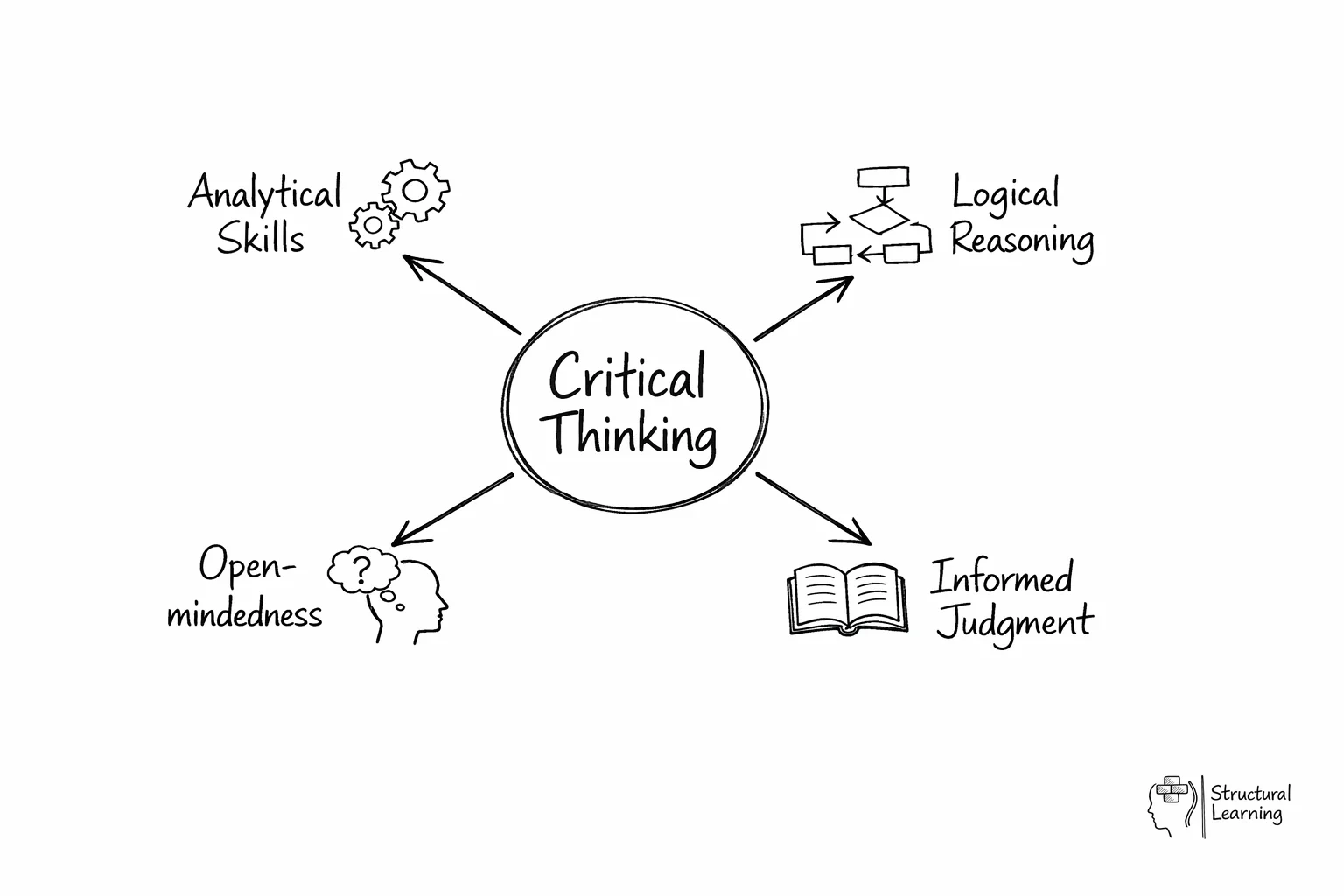
To begin developing stronger critical thinking skills, consider the following habits:
Facione's (1990) research suggests critical thinking is a key cognitive process. It lets learners thoughtfully handle challenges and discuss ideas well. They respond clearly, confidently, and ethically, as Paul and Elder (2008) suggest.
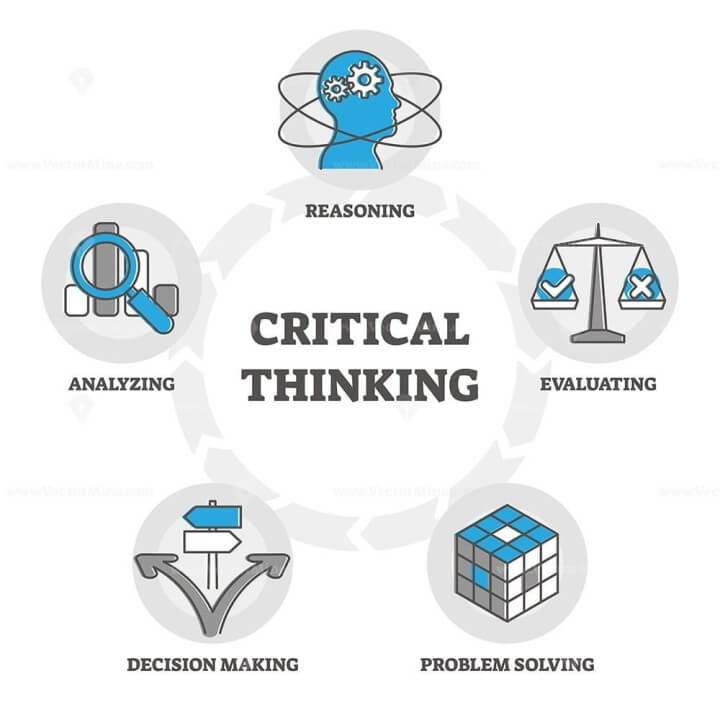
Critical thinking helps learners actively assess information and solve problems. This skill prepares them for real-world challenges. Employers increasingly value critical thinking and problem-solving as important workplace skills. Critical thinking skills are therefore vital for learner career success.
Critical thinking sits at the heart of meaningful learning. It moves learners beyond memorising content and into the field of higher-order thinking, where they explore ideas, make connections, and construct their own insights. In education, this isn't just an ideal, it's a necessity.
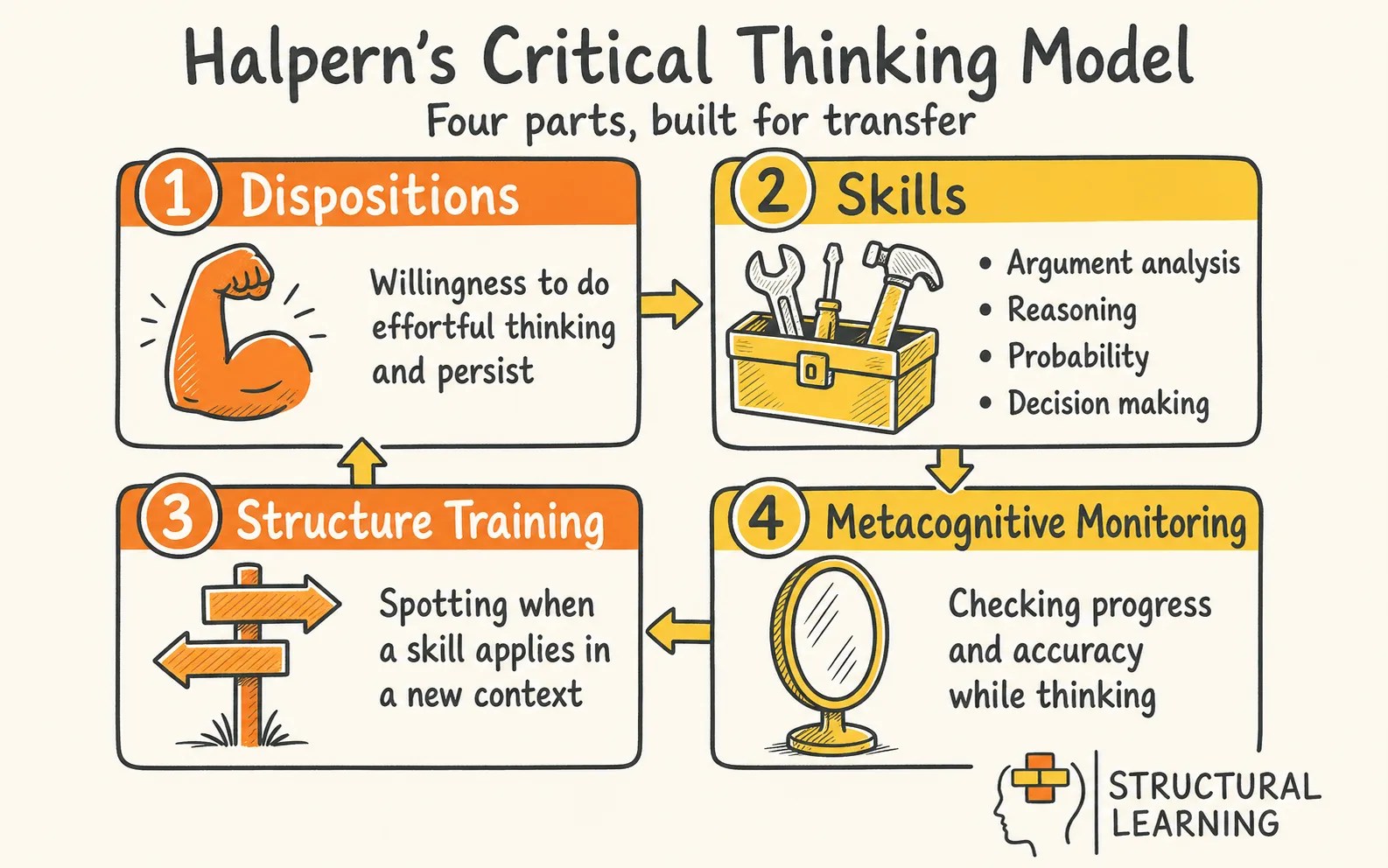
Critical thinking links learning to real-world use as classrooms change. It helps learners assess information and weigh evidence to form good conclusions. These habits support independent learning, communication, and informed choices (Facione, 1990; Halpern, 2003).
At Structural Learning, we're committed to embedding this kind of thinking into everyday classroom life. That means designing routines, visual tools, and physical resources that help make critical thinking visible, teachable, and sustainable. Our aim is not to bolt on thinking skills as an extra, it's to make them part of the fabric of how learning happens.
Critical thinking helps learners beyond school (Halpern, 2003). Employers want thinkers; it is prized over subject knowledge (Casner-Lotto & Barrington, 2006). Thinking skills build problem-solving capacity, plus adaptability (Lai, 2011).
Teachers develop learners' critical thinking by designing engaging activities. These activities move learners beyond simple memorisation. Classrooms should have open questions and respectful debates (Rosenshine, 2012). This helps learners explore varied views and solve tricky problems.
Flavell (1979) provided a foundational account of metacognition and cognitive monitoring; later pedagogical guidance translates these ideas into classroom strategies. John Hattie's work (2009) also informs learner self-awareness. These methods boost learner progress in lessons.
Dewey (1938), in Experience and Education, argued that educators should design experiences that support learner agency and growth. Teachers model critical thinking, showing how to assess evidence, challenge assumptions, and judge soundly. Paul (1992) also backed this approach.
This connects closely with research on theory of knowledge, which provides further classroom strategies for teachers.
Explicit teaching combined with active learning develops critical thinking. Teachers can use these strategies to build critical thinking, as identified by researchers like Paul (1990) and Facione (2011). Subject integration, as explored by Abrami et al. (2015), helps learners.
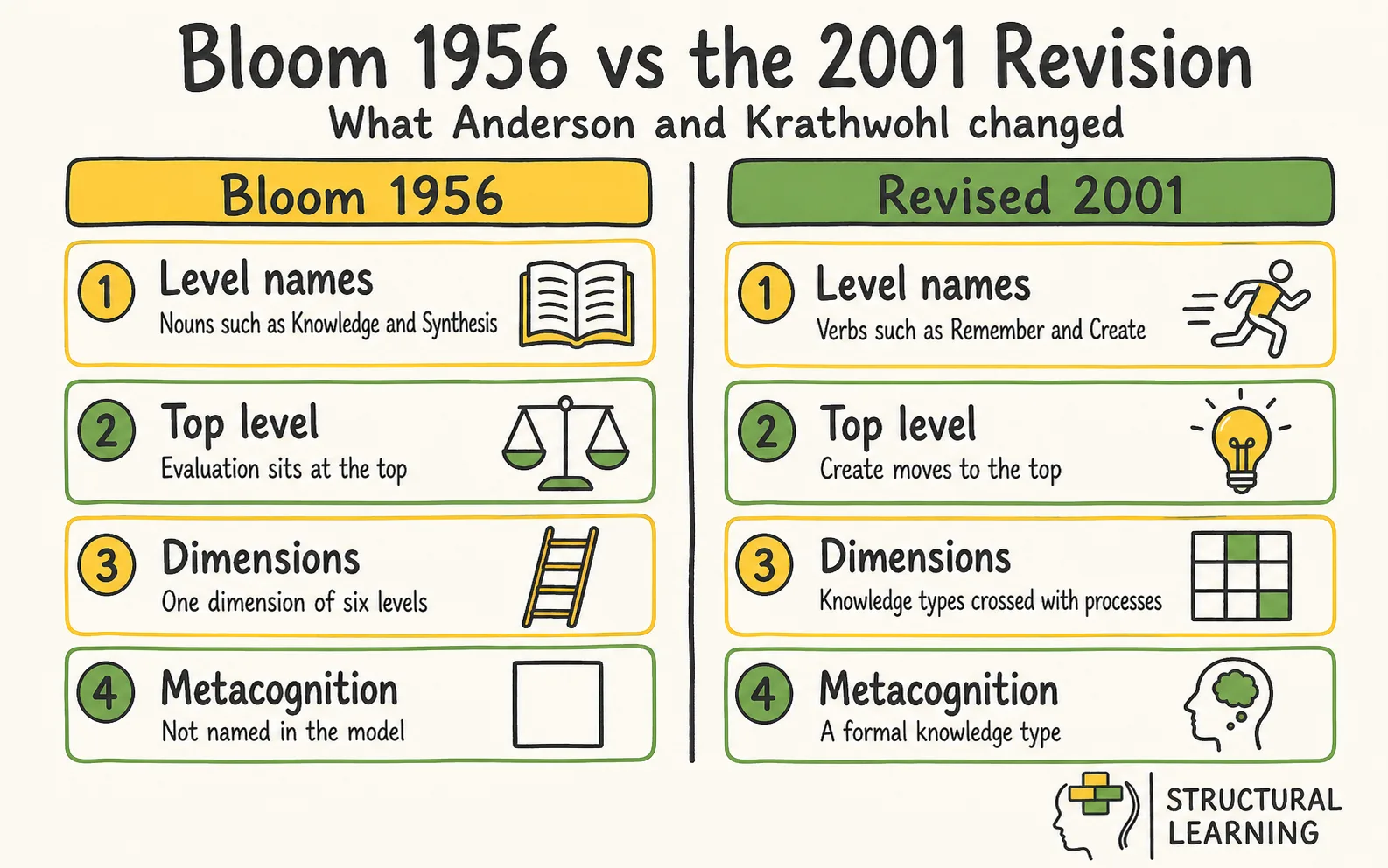
These strategies help teachers grow learners' critical thinking skills. Active learning frameworks encourage learners to question and reason (Ennis, 2018). Learners engage more deeply with subjects (Bloom, 1956; Piaget, 1936), developing arguments.
Critical thinking varies across subjects. Avoid teaching it as a general, transferable skill. Willingham (2007) said it requires subject knowledge. Learners need to understand photosynthesis to think critically about it. Subject application is key.
A Year 7 English teacher asks learners to read two newspaper articles about the same event. The task: "Identify three facts both articles agree on and two claims where they differ. For each differing claim, explain what evidence the author uses to support their position." This moves learners beyond opinion ("I liked this article better") into analytical comparison. The teacher models the first example, thinking aloud: "Both articles agree the protest happened on Tuesday. But this article says 500 people attended while this one says 200. I need to ask: who counted? What source is each using?"
In history, learners analyse primary sources using a structured protocol: Origin, Purpose, Content, Limitation. A Year 9 class examining a World War One recruitment poster works through each step. "Who created this? The government. Why? To persuade men to enlist. What does it show? A soldier pointing directly at the viewer. What does it leave out? The reality of trench warfare." The protocol makes the critical thinking process explicit and repeatable.
In science, critical thinking centres on evaluating evidence and methodology. A Year 8 class reviews a flawed experiment: "A learner claims that plants grow faster with music. They played music to one plant for a week and measured its growth." Learners identify the problems: no control group, sample size of one, no repeated measurements, multiple variables uncontrolled. The teacher does not tell them the experiment is flawed. They discover it through structured questioning.
In mathematics, critical thinking emerges through non-routine problems. Instead of "Calculate 15% of 80," present: "A shop advertises 15% off everything. Your friend says a jacket originally priced at 80 pounds is now 68 pounds. Are they right? How do you know?" This requires learners to check someone else's reasoning rather than simply perform a calculation. The metacognitive demand is higher because they must evaluate rather than execute.
Here is the rewritten paragraph: Mobile phones may be banned at breaks. The head wants learner views. Learners, in groups, identify stakeholders (learners, parents, teachers, staff). Gather evidence for and against the ban. Consider consequences and suggest a reasoned recommendation. This mirrors real-world decisions; (Dewey, 1938) and (Piaget, 1936) multiple views matter.
Measuring critical thinking is harder than measuring content knowledge. Multiple-choice tests capture recognition but miss the reasoning process. Three approaches work well in classroom contexts.
Written tasks should ask learners to evaluate claims, not just state facts. For example: "Does homework improve grades? Use class discussion and source materials to explain your position." Assess reasoning quality with a rubric. The rubric should score evidence, counterarguments, logic, and limitations.
Thinking routines as assessment evidence. Thinking routines from Harvard's Project Zero provide observable evidence of critical thinking. "Claim, Support, Question" asks learners to make a claim, support it with evidence, and raise a question that remains unanswered. A Year 5 learner studying the Romans writes: "Claim: The Romans improved life in Britain. Support: They built roads, baths, and aqueducts. Question: Did everyone benefit equally, or just wealthy Romans?" The question reveals the depth of their critical analysis.
Learners use a rubric to assess peer arguments. This develops critical thinking skills for both the evaluator and writer. Evaluators apply criteria, offering targeted feedback instead of general praise. Topping (2009) discusses peer assessment as a structured learning approach that can support analytical thinking.
Critical thinking cannot be taught in a single lesson or unit. It requires a classroom culture where questioning is valued, uncertainty is tolerated, and changing your mind based on evidence is seen as intellectual strength rather than weakness.
Normalise "I changed my mind because..." When a learner revises their position after hearing a counterargument, name it explicitly: "That is exactly what strong thinkers do. You heard new evidence and adjusted your conclusion." This signals that the classroom rewards reasoning, not stubbornness.
Use the language of thinking. Replace "What is the answer?" with "What is your reasoning?" Replace "Who agrees?" with "Who has a different interpretation of the same evidence?" The questions you ask shape the thinking learners produce. Questioning strategies that demand justification and evidence produce deeper engagement than those that accept one-word answers.
Model intellectual humility. When a learner asks a question you cannot immediately answer, say so: "That is an excellent question and I am not sure of the answer. Let me think about it and come back to you." This demonstrates that critical thinkers do not pretend to know everything. They acknowledge gaps and seek to fill them. Learners in classrooms where teachers model uncertainty are more likely to take intellectual risks themselves (Dweck, 2006).
Display thinking, not just outcomes. Create a "Thinking Wall" that shows the reasoning process behind conclusions, not just final answers. Pin up annotated examples, reasoning chains, and revised arguments. When learners see that thinking is valued as much as correctness, they invest more effort in the process.
AI's growth makes critical thinking vital. Learners must evaluate AI text, not accept it blindly. Critical thinking skills, such as evaluating sources, are increasingly important. We must teach learners to check claims (Ennis, 1993) and spot bias (Facione, 2011).
Teach learners to interrogate AI outputs with the same rigour they apply to any other source. "What evidence supports this claim? Could this be wrong? What perspective is missing? How would I verify this independently?" A Year 10 class compared an AI-generated essay on climate change with a peer-reviewed article. They identified three factual errors in the AI text, two instances of oversimplification, and one claim presented with false certainty. The exercise produced more sophisticated critical analysis than any traditional source evaluation lesson because the AI output was fluent and convincing, making the errors harder to detect.
This connects closely with research on learning to learn, which provides further classroom strategies for teachers.
Critical thinking is not threatened by AI. It is the skill that makes AI useful rather than dangerous. Learners who can evaluate, question, and verify will use AI as a tool. Learners who cannot will be used by it.
Critical thinking means learners question information instead of accepting it outright. This process uses logic and helps assess source credibility (Ennis, 1993). It also involves reflecting on personal biases (Halpern, 2003). Learners connect complex ideas and solve problems independently (Paul & Elder, 2008).
Structured questioning and fishbone diagrams help learners grasp abstract ideas. Exploring problems from different angles and debating respectfully builds thinking skills. Integrate these methods into lessons to make thinking routine (Fisher, 2008; Hyerle, 1996).
Adaptability helps learners face adult life challenges and future jobs. Employers value problem-solving skills over subject knowledge (Casner-Lotto & Barrington, 2006). This supports better decisions when navigating digital information and AI.
Researchers found thinking strategy instruction helps learners in many subjects. The Education Endowment Foundation showed metacognition works well for disadvantaged learners. Clear reasoning frameworks from teachers improve learner confidence and assessment results; research from the Education Endowment Foundation supports this for disadvantaged learners.
Thinking skills work best when part of lessons, not taught separately. Learners need guidance and practice; skills don't just appear (Fisher, 2008). Keep tasks simple; use basic questions before complex methods (Costa & Kallick, 2009).
Assessment can be carried out through observing how learners approach unfamiliar problems and the quality of their reasoned arguments. Written tasks that require learners to evaluate evidence and justify their conclusions provide clear evidence of progress over time. Using self assessment rubrics also helps learners recognise their own growth in logical reasoning and analytical skills.
Researchers like Dewey (1933) suggest teaching critical thinking. Educators can equip learners with tools to evaluate information. This helps them solve problems and make reasoned decisions (Ennis, 1985; Facione, 1990). Critical thinking helps learners navigate our complex world (Halpern, 1998).
Critical thinking is key as technology changes, say experts (Paul & Elder, 2007). Teaching critical thinking helps learners succeed at school and beyond. It readies them for engaged citizenship and problem-solving, research shows (Abrami et al., 2015).
These peer-reviewed studies form the evidence base for developing critical thinking skills in the classroom and its classroom applications. Each paper offers practical insights for teachers seeking to ground their practice in research.
Strategies for Teaching Students to Think Critically: A Meta-Analysis
Abrami, P. C., Bernard, R. M., Borokhovski, E., Waddington, D. I., Wade, C. A., & Persson, T. (2015)
This Review of Educational Research meta-analysis examined classroom interventions and their effects on learner critical-thinking skills and dispositions. Findings suggest that explicit instruction integrated into subject teaching is the most effective format. Teachers can model critical thinking in their subject area and use discussions and real problems to guide learners through reasoning.
An integrated critical thinking framework for the 21st century
Dwyer, C. P., Hogan, M. J., & Stewart, I (2014)
Critical thinking across the curriculum: A vision
Ennis, R. H (2018)
Thought and Knowledge: An Introduction to Critical Thinking, 3rd Ed. Diane F. Halpern. Lawrence Erlbaum Associates, Mahwah, NJ, 1996. No. of pages 430. ISBN 0-8058-1493-0 (hardback). ISBN 0-8058-1494-9 (paperback). Also, 205 page workbook. View study ↗
J. Shanteau, J. Pounds (1997)
Critical thinking involves teachable skills, not innate gifts (Abrami et al., 2015). Teachers should model problem-solving and ask learners to justify answers. Making thought processes visible helps learners independently apply skills to new challenges (Halpern, 1998).
Critical Thinking: A Literature Review Research Report
132 citations
Lai, E. R. (2011)