EPQ
Discover strategies for teachers to guide A-level students through the Extended Project Qualification (EPQ) for successful independent research


Discover strategies for teachers to guide A-level students through the Extended Project Qualification (EPQ) for successful independent research
The Extended Project Qualification (EPQ) is a vibrant opportunity for A-level students, offering them the chance to immerse themselves in a subject they are passionate about. This qualification is a testament to a student's ability to plan, research, and engage in independent learning, all of which are crucial skills in the academic world and beyond.
The EPQ is designed to cultivate students' critical thinking and transferable skills, equipping them for their future academic pursuits and career paths. It's a unique platform for students to examine into a topic that fascinates them, going beyond the confines of their regular A-level curriculum.
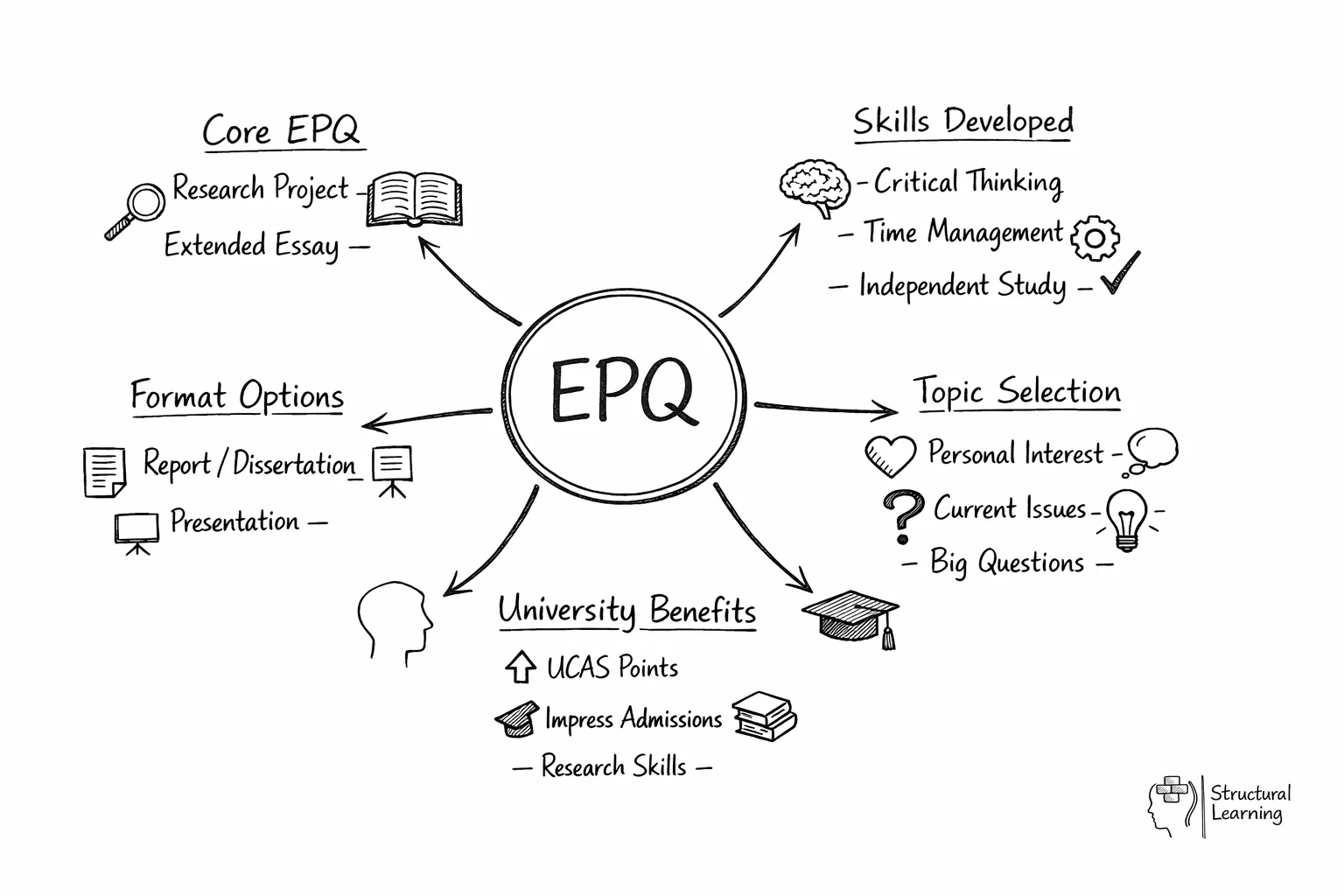
The EPQ is not a one-size-fits-all qualification. It offers flexibility in its format, allowing students to choose between a written report, a dissertation, or even a performance. This adaptability enables students to express their abilities and passion in a manner that aligns with their strengths.

The advantages of undertaking an EPQ are manifold. It creates the development of time management and project-based learning skills, as students are accountable for planning and executing their project independently. According to a study, such independent research skills are pivotal in shaping students' academic success.

For instance, consider a student who is passionate about environmental science. They could choose to do an EPQ on the impact of plastic waste on marine life.
This would not only allow them to examine deeper into a subject they are passionate about but also demonstrate their ability to conduct independent research, analyse data, and present findings, skills highly valued in higher education and the workplace.
Moreover, the EPQ is an excellent addition to a university application. It serves as evidence of a student's ability to undertake independent research and produce high-quality work.
In fact, some universities have started to include the EPQ as part of their entry requirements, recognising the valuable skills it imparts.
In essence, the EPQ is a remarkable opportunity for A-level students to become independent learners, developing skills that will be beneficial in their academic journey and future careers.
Key Insights:
The Extended Project Qualification (EPQ) is a fantastic opportunity for students to develop a range of important skills that will benefit them in their future academic and professional endeavors.
One skill that students will certainly enhance through the EPQ is time management. As the project is largely self-directed, students must learn to effectively plan and organise their time to ensure that they meet their deadlines and complete their work to a high standard.
Another key skill that the EPQ helps students improve is research. Throughout the project, students are required to conduct independent research, exploring a topic of personal interest in depth. This allows them to develop their research skills, such as gathering relevant information, evaluating sources, and synthesizing information to support their arguments.
Independent working is another area where students will see significant improvement. Throughout the EPQ process, students are encouraged to work independently, taking responsibility for their own learning. This helps them develop self-discipline, resilience, and the ability to work autonomously.
Problem-solving is another skill that students will develop through the EPQ. As they encounter challenges and obstacles during their project, they are required to think critically and find effective solutions to overcome them. This requires focused thinking skill development throughout the process.
Lastly, the EPQ provides students with an opportunity to enhance their writing and presentation skills. Whether it be presenting their findings in a written report, a dissertation, or even a performance, students learn how to effectively communicate their ideas and present their work in a clear and engaging manner.
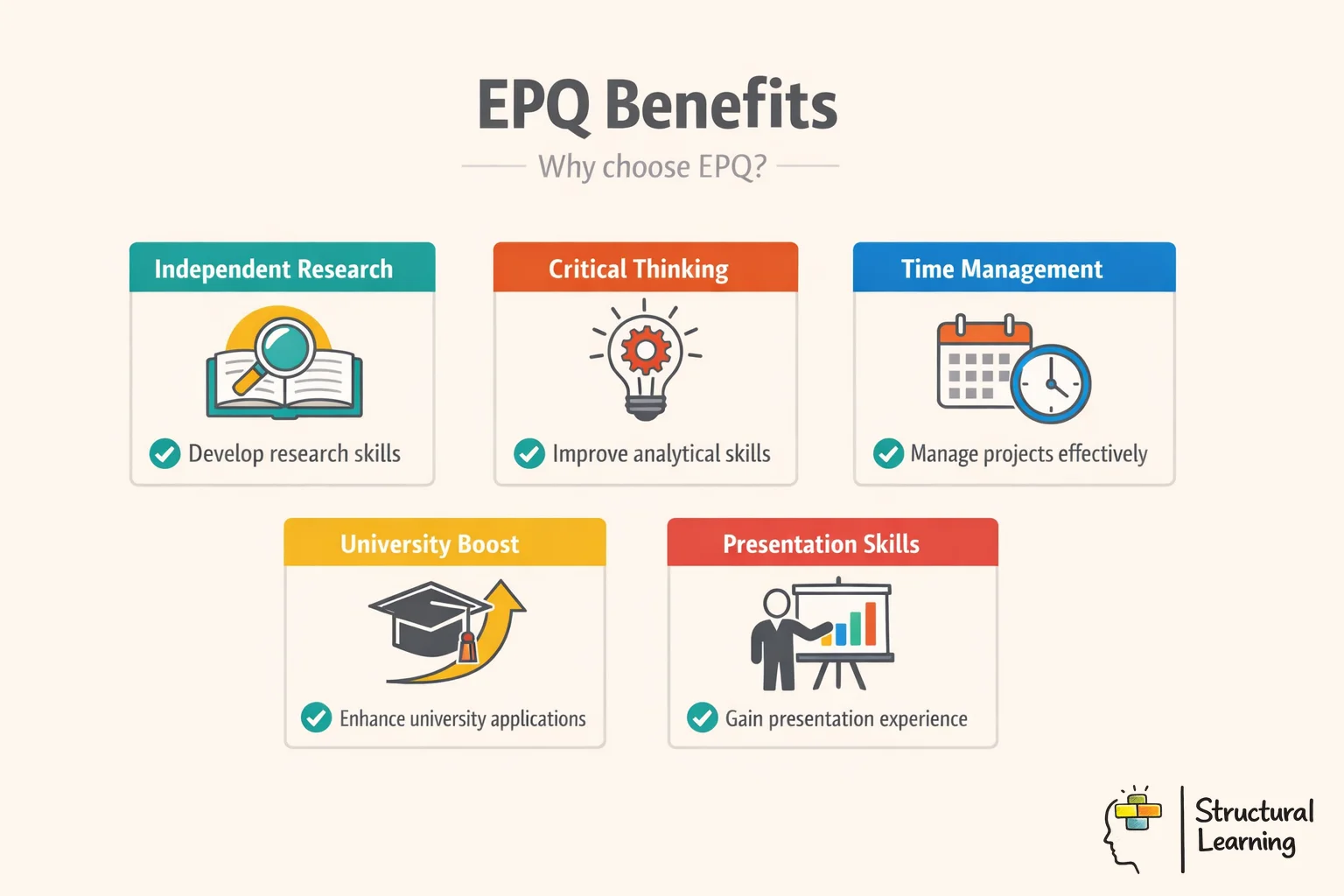
Overall, the EPQ offers students a chance to develop vital skills such as time management, research, independent working, problem-solving, and presentation skills. These skills not only improve engagement but will also benefit them in their future academic and professional pursuits. Students may need additional support based on their sen requirements, and regular feedback helps maintain their motivation throughout this challenging but rewarding process.
Students should choose EPQ topics based on their genuine interests and passions rather than what seems academically impressive. The best topics emerge from questions students naturally ask about subjects they enjoy, whether related to their A-levels or completely new areas of personal curiosity.
The topic selection process should begin with students reflecting on what genuinely excites them. This might be a current event that sparked their interest, a documentary that made them think differently, or a gap they've noticed in their existing subject knowledge. Teachers can facilitate this by encouraging students to keep a curiosity journal, noting down questions that arise during lessons or everyday life.
Once students have identified potential areas of interest, they need to ensure their chosen topic is sufficiently focused yet allows for substantial research. A topic like "climate change" is too broad, but "the effectiveness of carbon offset schemes in the UK aviation industry" provides clear boundaries while offering rich research opportunities.
Students should also consider the availability of resources and evidence. While original research is valuable, they need access to credible academic sources, expert opinions, and relevant data. Topics that rely solely on opinion or lack substantial evidence base will struggle to meet EPQ standards.
Another crucial factor is ensuring the topic allows for critical analysis rather than simple description. Students need to be able to evaluate different perspectives, weigh evidence, and form reasoned conclusions. Questions beginning with "How effective is.." "To what extent does.." or "What factors influence.." often provide better analytical opportunities than purely descriptive approaches.
Finally, students should consider their intended university course or career path. While the EPQ doesn't need to directly relate to their future plans, choosing a topic that demonstrates transferable skills or relevant knowledge can strengthen university applications and personal development.
The key is finding the sweet spot between personal passion and academic rigour. When students are genuinely interested in their topic, they're more likely to persevere through challenges, produce higher quality work, and develop meaningful insights that extend beyond the qualification itself.
The EPQ is assessed through a combination of the final product and the process portfolio, providing a comprehensive evaluation of student achievement. The final product, whether a written report, dissertation, or alternative format, accounts for 80% of the total marks, while the production log and supporting documentation contribute the remaining 20%.
Students are graded using the familiar A*-E scale, with marks distributed across four key assessment objectives: manage, use resources, develop and realise, and review. This structure ensures that both the quality of the final outcome and the rigour of the research process are recognised and rewarded.
The EPQ carries UCAS points equivalent to half an A-level, with an A* worth 28 points and grades scaling down accordingly. Many universities now recognise EPQ achievements in their offers, with some institutions reducing A-level grade requirements for students who achieve high EPQ grades.
Beyond formal assessment, the EPQ provides students with a substantial portfolio of evidence for university applications and future employment. The skills developed through independent research, project management, and critical analysis are highly valued by admissions tutors and employers alike.
The Extended Project Qualification represents a transformative opportunity for A-level students to develop essential skills while pursuing their intellectual passions. By developing independent learning, critical thinking, and project management capabilities, the EPQ bridges the gap between structured A-level study and the autonomous learning required in higher education.
For educators, supporting students through their EPQ journey requires a shift from traditional teaching to mentoring and facilitation. The rewards, however, are significant: watching students develop into confident, independent learners who can tackle complex questions with rigour and creativity.
As universities and employers increasingly recognise the value of skills developed through independent research and project management, the EPQ continues to grow in importance. Students who embrace this challenge not only enhance their academic credentials but also develop the transferable skills essential for success in our rapidly evolving world.
For educators seeking to deepen their understanding of project-based learning and independent research in secondary education, the following academic sources provide valuable insights:
The Extended Project Qualification (EPQ) is a vibrant opportunity for A-level students, offering them the chance to immerse themselves in a subject they are passionate about. This qualification is a testament to a student's ability to plan, research, and engage in independent learning, all of which are crucial skills in the academic world and beyond.
The EPQ is designed to cultivate students' critical thinking and transferable skills, equipping them for their future academic pursuits and career paths. It's a unique platform for students to examine into a topic that fascinates them, going beyond the confines of their regular A-level curriculum.
The EPQ is not a one-size-fits-all qualification. It offers flexibility in its format, allowing students to choose between a written report, a dissertation, or even a performance. This adaptability enables students to express their abilities and passion in a manner that aligns with their strengths.

The advantages of undertaking an EPQ are manifold. It creates the development of time management and project-based learning skills, as students are accountable for planning and executing their project independently. According to a study, such independent research skills are pivotal in shaping students' academic success.

For instance, consider a student who is passionate about environmental science. They could choose to do an EPQ on the impact of plastic waste on marine life.
This would not only allow them to examine deeper into a subject they are passionate about but also demonstrate their ability to conduct independent research, analyse data, and present findings, skills highly valued in higher education and the workplace.
Moreover, the EPQ is an excellent addition to a university application. It serves as evidence of a student's ability to undertake independent research and produce high-quality work.
In fact, some universities have started to include the EPQ as part of their entry requirements, recognising the valuable skills it imparts.
In essence, the EPQ is a remarkable opportunity for A-level students to become independent learners, developing skills that will be beneficial in their academic journey and future careers.
Key Insights:
The Extended Project Qualification (EPQ) is a fantastic opportunity for students to develop a range of important skills that will benefit them in their future academic and professional endeavors.
One skill that students will certainly enhance through the EPQ is time management. As the project is largely self-directed, students must learn to effectively plan and organise their time to ensure that they meet their deadlines and complete their work to a high standard.
Another key skill that the EPQ helps students improve is research. Throughout the project, students are required to conduct independent research, exploring a topic of personal interest in depth. This allows them to develop their research skills, such as gathering relevant information, evaluating sources, and synthesizing information to support their arguments.
Independent working is another area where students will see significant improvement. Throughout the EPQ process, students are encouraged to work independently, taking responsibility for their own learning. This helps them develop self-discipline, resilience, and the ability to work autonomously.
Problem-solving is another skill that students will develop through the EPQ. As they encounter challenges and obstacles during their project, they are required to think critically and find effective solutions to overcome them. This requires focused thinking skill development throughout the process.
Lastly, the EPQ provides students with an opportunity to enhance their writing and presentation skills. Whether it be presenting their findings in a written report, a dissertation, or even a performance, students learn how to effectively communicate their ideas and present their work in a clear and engaging manner.
Overall, the EPQ offers students a chance to develop vital skills such as time management, research, independent working, problem-solving, and presentation skills. These skills not only improve engagement but will also benefit them in their future academic and professional pursuits. Students may need additional support based on their sen requirements, and regular feedback helps maintain their motivation throughout this challenging but rewarding process.
Students should choose EPQ topics based on their genuine interests and passions rather than what seems academically impressive. The best topics emerge from questions students naturally ask about subjects they enjoy, whether related to their A-levels or completely new areas of personal curiosity.
The topic selection process should begin with students reflecting on what genuinely excites them. This might be a current event that sparked their interest, a documentary that made them think differently, or a gap they've noticed in their existing subject knowledge. Teachers can facilitate this by encouraging students to keep a curiosity journal, noting down questions that arise during lessons or everyday life.
Once students have identified potential areas of interest, they need to ensure their chosen topic is sufficiently focused yet allows for substantial research. A topic like "climate change" is too broad, but "the effectiveness of carbon offset schemes in the UK aviation industry" provides clear boundaries while offering rich research opportunities.
Students should also consider the availability of resources and evidence. While original research is valuable, they need access to credible academic sources, expert opinions, and relevant data. Topics that rely solely on opinion or lack substantial evidence base will struggle to meet EPQ standards.
Another crucial factor is ensuring the topic allows for critical analysis rather than simple description. Students need to be able to evaluate different perspectives, weigh evidence, and form reasoned conclusions. Questions beginning with "How effective is.." "To what extent does.." or "What factors influence.." often provide better analytical opportunities than purely descriptive approaches.
Finally, students should consider their intended university course or career path. While the EPQ doesn't need to directly relate to their future plans, choosing a topic that demonstrates transferable skills or relevant knowledge can strengthen university applications and personal development.
The key is finding the sweet spot between personal passion and academic rigour. When students are genuinely interested in their topic, they're more likely to persevere through challenges, produce higher quality work, and develop meaningful insights that extend beyond the qualification itself.
The EPQ is assessed through a combination of the final product and the process portfolio, providing a comprehensive evaluation of student achievement. The final product, whether a written report, dissertation, or alternative format, accounts for 80% of the total marks, while the production log and supporting documentation contribute the remaining 20%.
Students are graded using the familiar A*-E scale, with marks distributed across four key assessment objectives: manage, use resources, develop and realise, and review. This structure ensures that both the quality of the final outcome and the rigour of the research process are recognised and rewarded.
The EPQ carries UCAS points equivalent to half an A-level, with an A* worth 28 points and grades scaling down accordingly. Many universities now recognise EPQ achievements in their offers, with some institutions reducing A-level grade requirements for students who achieve high EPQ grades.
Beyond formal assessment, the EPQ provides students with a substantial portfolio of evidence for university applications and future employment. The skills developed through independent research, project management, and critical analysis are highly valued by admissions tutors and employers alike.
The Extended Project Qualification represents a transformative opportunity for A-level students to develop essential skills while pursuing their intellectual passions. By developing independent learning, critical thinking, and project management capabilities, the EPQ bridges the gap between structured A-level study and the autonomous learning required in higher education.
For educators, supporting students through their EPQ journey requires a shift from traditional teaching to mentoring and facilitation. The rewards, however, are significant: watching students develop into confident, independent learners who can tackle complex questions with rigour and creativity.
As universities and employers increasingly recognise the value of skills developed through independent research and project management, the EPQ continues to grow in importance. Students who embrace this challenge not only enhance their academic credentials but also develop the transferable skills essential for success in our rapidly evolving world.
For educators seeking to deepen their understanding of project-based learning and independent research in secondary education, the following academic sources provide valuable insights:
{"@context":"https://schema.org","@graph":[{"@type":"Article","@id":"https://www.structural-learning.com/post/epq#article","headline":"EPQ","description":"Discover strategies for teachers to guide A-level students through the Extended Project Qualification (EPQ) for successful independent research","datePublished":"2023-07-18T10:20:12.201Z","dateModified":"2026-01-26T10:09:32.212Z","author":{"@type":"Person","name":"Paul Main","url":"https://www.structural-learning.com/team/paulmain","jobTitle":"Founder & Educational Consultant"},"publisher":{"@type":"Organization","name":"Structural Learning","url":"https://www.structural-learning.com","logo":{"@type":"ImageObject","url":"https://cdn.prod.website-files.com/5b69a01ba2e409e5d5e055c6/6040bf0426cb415ba2fc7882_newlogoblue.svg"}},"mainEntityOfPage":{"@type":"WebPage","@id":"https://www.structural-learning.com/post/epq"},"image":"https://cdn.prod.website-files.com/5b69a01ba2e409501de055d1/696a3e6452828bce9dcbcfc5_696a3e5f4d3a37e4aaef40e6_epq-illustration.webp","wordCount":3416},{"@type":"BreadcrumbList","@id":"https://www.structural-learning.com/post/epq#breadcrumb","itemListElement":[{"@type":"ListItem","position":1,"name":"Home","item":"https://www.structural-learning.com/"},{"@type":"ListItem","position":2,"name":"Blog","item":"https://www.structural-learning.com/blog"},{"@type":"ListItem","position":3,"name":"EPQ","item":"https://www.structural-learning.com/post/epq"}]},{"@type":"FAQPage","@id":"https://www.structural-learning.com/post/epq#faq","mainEntity":[{"@type":"Question","name":"What exactly is an Extended Project Qualification and how does it differ from traditional A-levels?","acceptedAnswer":{"@type":"Answer","text":"The EPQ is an independent research qualification that allows A-level students to explore a topic of personal interest beyond their regular syllabus. Unlike traditional A-levels, it emphasises"}},{"@type":"Question","name":"How should teachers guide students in selecting an appropriate EPQ topic?","acceptedAnswer":{"@type":"Answer","text":"Teachers should encourage students to choose topics based on genuine passion and interest rather than what appears academically impressive. The topic should be specific enough for deep research but broad enough to sustain 5,000 words of analysis, and should emerge from questions students naturally a"}},{"@type":"Question","name":"What are the key benefits of implementing EPQ in our sixth form curriculum?","acceptedAnswer":{"@type":"Answer","text":"EPQ develops five crucial transferable skills that universities and employers value: time management, independent research, autonomous working, problem-solving, and presentation skills. It also provides students with a competitive advantage in university applications, with some universities now incl"}},{"@type":"Question","name":"What challenges might teachers face when supervising EPQ students and how can they address them?","acceptedAnswer":{"@type":"Answer","text":"The main challenge is balancing guidance with independence, as EPQ requires students to work autonomously whilst still needing teacher support. Teachers must help students develop self-discipline and resilience to overcome obstacles whilst avoiding over-directing the project process."}},{"@type":"Question","name":"Can you provide examples of successful EPQ presentation formats that go beyond traditional essays?","acceptedAnswer":{"@type":"Answer","text":"Successful EPQ presentations include documentary films analysing historical events, scientific experiments with original research, creative performances exploring literature themes, musical compositions, and design portfolios. The key is matching the presentation format to both the topic and the stu"}}]}]}