Updated on
September 24, 2026
The Curriculum for Wales
A comprehensive teacher's guide to the Curriculum for Wales: understand the revolutionary framework and transform your classroom with practical strategies.

Updated on
September 24, 2026
A comprehensive teacher's guide to the Curriculum for Wales: understand the revolutionary framework and transform your classroom with practical strategies.
The Curriculum for Wales is a revolutionary educational framework that fundamentally transforms how learning is delivered across Welsh schools, moving away from traditional subject-based teaching towards a more complete, skills-focussed approach. Introduced by the Welsh Government, this comprehensive curriculum emphasises four core purposes: developing ambitious and capable learners, enterprising and creative contributors, ethical and informed citizens, and healthy and confident individuals. Unlike previous curricula that focussed heavily on content coverage, the new framework prioritises deep learning through six Areas of Learning and Experience, giving schools greater flexibility to design learning experiences that truly engage learners. This shift represents the most significant change to Welsh education in decades, but what does it actually mean for teachers, learners, and parents on the ground?
We will argue that this ambitious education policy can bring life to your classrooms. There will need to be changes in the current assessment arrangements and we will need to rethink are we deliver the core learning experiences. However, we should welcome a move towards authentic learning experiences and with the curriculum design process, education for children in Wales can remain 'ahead of the curve'.
This blog post will provide you with some practical ideas for those making decisions in education authorities and classroom teachers alike. We will focus on the pedagogical side of this new 'Connected learning' and look at what this ambitious vision might look like in practice. As well as breaking some of the boundaries between subjects down, the advice for education systems throughout Wales is to focus on ' depth of learning'. The curriculum guidance doesn't always translate this into how practical classroom tasks.
We will breakdown some of the underlying themes and how they can be used to build a purpose-led curriculum. One of the universal criticisms of many other education policy makers is the continued delivery of a narrow curriculum. This curriculum philosophy is vastly different to anything we have seen before and like the international baccalaureate, it should be welcomed with open arms. In another article, we will go into more detail about the alignment of assessment criteria. This post outlines some of the global changes and how teaching theories should be adapted.
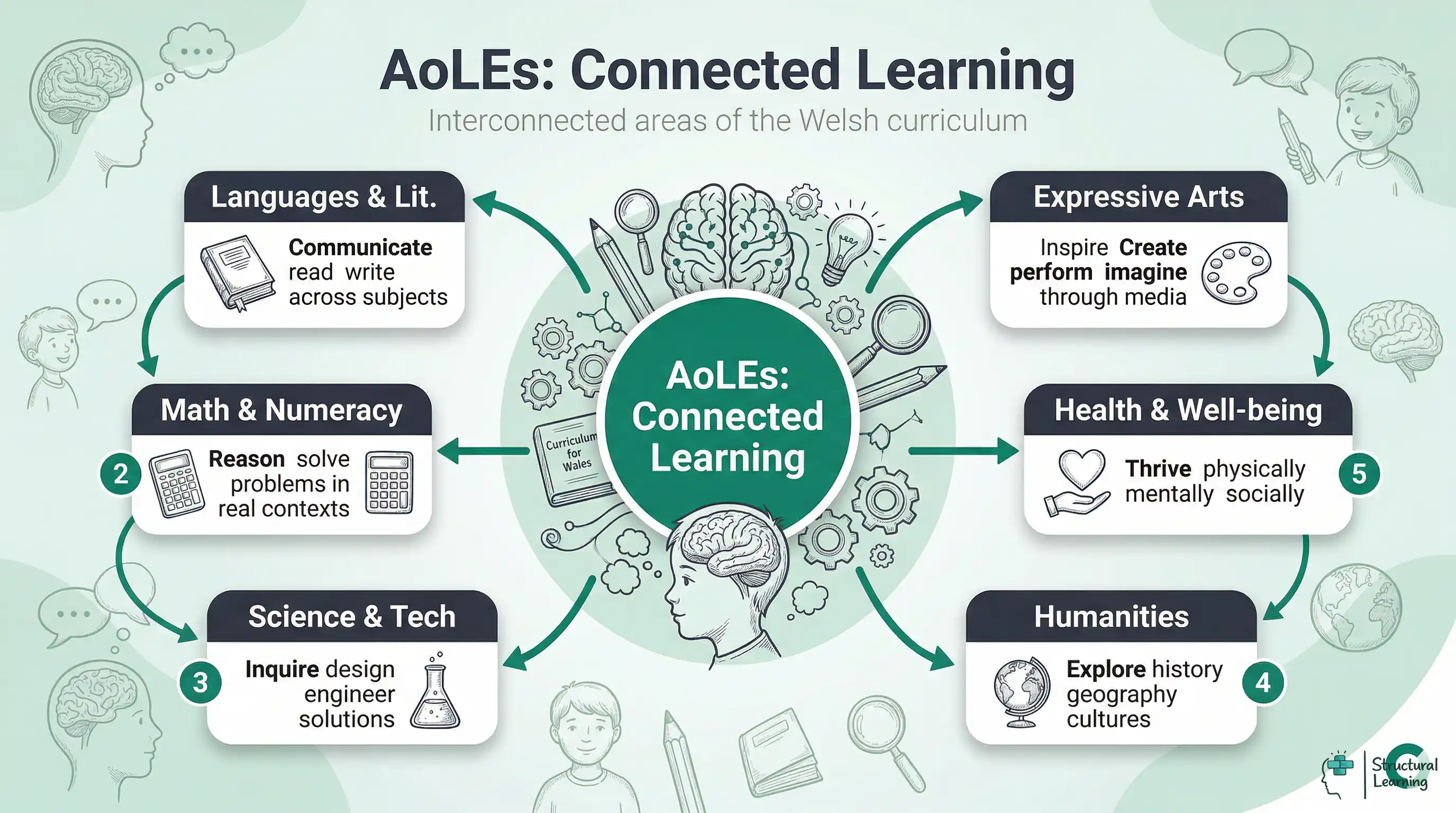
The Curriculum for Wales organises learning into six Areas of Learning and Experience (AoLEs), each designed to develop distinct yet interconnected knowledge, skills and experiences. Languages, Literacy and Communication encompasses Welsh, English and international languages, focusing on reading, writing, speaking and listening across all subjects. Mathematics and Numeracy develops mathematical reasoning and problem-solving skills applicable to real-world contexts. Science and Technology combines scientific inquiry with design thinking, computational skills and engineering principles. Humanities explores human experiences through history, geography, religious education and social studies. Health and Well-being addresses physical health, mental wellness, relationships and personal development. Finally, Expressive Arts encompasses art, music, drama, dance and creative expression across various media.
Cross-curricular learning is fundamental to the AoLEs' effectiveness, with subjects naturally connecting rather than existing in isolation. For example, a Year 7 project on climate change might see learners analysing temperature data graphs (Mathematics and Numeracy), researching historical weather patterns (Humanities), investigating renewable energy solutions (Science and Technology), debating environmental policies in Welsh (Languages, Literacy and Communication), creating awareness campaigns through digital art (Expressive Arts), and exploring how climate anxiety affects mental health (Health and Well-being). This integrated approach mirrors real-world problem-solving whilst developing transferable skills across disciplines.
In practice, teachers can implement cross-curricular learning through carefully planned learning experiences that draw upon multiple AoLEs. A primary school exploring 'Our Local Community' might involve learners interviewing elderly residents about local history (Humanities and Languages), measuring and mapping community spaces (Mathematics and Science), creating artistic interpretations of community stories (Expressive Arts), and discussing how communities support mental health and belonging (Health and Well-being). This approach ensures learners see connections between subjects whilst developing the four purposes: ambitious capable learners, enterprising creative contributors, ethical informed citizens, and healthy confident individuals. Success requires collaborative planning between teachers, shared assessment strategies, and flexible timetabling that allows for extended project work.
The Curriculum for Wales introduces a significant approach to assessment through progression steps, moving away from the rigid structure of National Curriculum levels. These five progression steps span from ages 3 to 16, allowing learners to progress at their own pace rather than being constrained by age-related expectations. Each step describes what learners can typically do, providing clear descriptors of knowledge, skills and experiences across all Areas of Learning and Experience. For example, in the Languages, Literacy and Communication AoLE, progression step 2 might see learners "expressing ideas clearly in speech and writing for different purposes", whilst progression step 4 demonstrates more sophisticated communication skills including "adapting language for different audiences and contexts".
Assessment principles within this framework emphasise formative assessment as the primary driver of learning, with summative assessment used sparingly and purposefully. Teachers utilise ongoing observation, peer assessment, and self-reflection to gauge progress, moving away from frequent testing towards meaningful dialogue about learning. In practice, this might involve learning journals where learners document their thinking processes, or regular learning conversations that help teachers understand conceptual development. The "assessment for learning" approach ensures that assessment directly informs next steps rather than simply measuring achievement at a fixed point in time.
Reporting to parents transforms accordingly, focusing on narrative descriptions of progress rather than numerical grades or levels. Schools are developing new reporting formats that celebrate individual achievement and growth, explaining what learners can do now and identifying next steps in their learning process. Many schools are introducing portfolio-based reporting, where examples of work demonstrate progression across different contexts. Parent consultations become collaborative discussions about supporting continued development, with teachers sharing specific evidence of progress within the relevant progression steps whilst acknowledging that learning is not always linear or predictable.
The Curriculum for Wales is a new education policy that shifts focus from content coverage to deep, connected educational processs. It was announced by the education minister as an ambitious reform to move Welsh education away from narrow curriculum delivery. The curriculum emphasises authentic classroom experiences and breaks down traditional boundaries between subjects.
The aim of the curriculum is to create informed citizens in Wales, ready for employment and in an age of democracy. It is designed to provide a balance between the explicit teaching of knowledge and skills, providing opportunities for learners to develop greater understanding, relevant experience and expertise. This will enable learners to become effective participants as informed citizens.
The new curriculum also focuses on developing confident individuals who are able to make decisions, set goals, and solve problems. It will also help learners to access further education and training, develop employability skills such as team work, communication, creativity and innovation. As well as intellectual ability, the curriculum will be designed to nurture qualities such as kindness, social responsibility and digital literacy.
The Welsh government has laid out a comprehensive plan for the new curriculum, acknowledging that it must be meaningful and relevant to learners. Improved digital skills are at the core of the plan, with a focus on embedding digital technologies within learning activities in terms of preparation, resources, tasks and assessment. The Welsh government will invest in the teaching quality and technological infrastructure required to ensure successful implementation of this nationwide education strategy.
Classroom teachers are always under pressure to 'get through' curriculum content. The new curriculum places an emphasis on the depth of understanding, this shift changes the way we think about learning objectives. If classroom teachers are well supported in developing new assessment frameworks that go beyond simply recall, then our learners will begin to value this change. The Universal Thinking Framework equips educators with knowledge frameworks and competency checklists. These can b e used for planning, delivering and assessing curriculum objectives.
The curriculum guidance focuses on depth of learning rather than breadth, requiring teachers to rethink assessment arrangements and core learning processes. It promotes a purpose-led curriculum design process that encourages connected learning across subject areas. While the guidance doesn't always provide specific classroom tasks, it outlines themes for building authentic educational experiences.
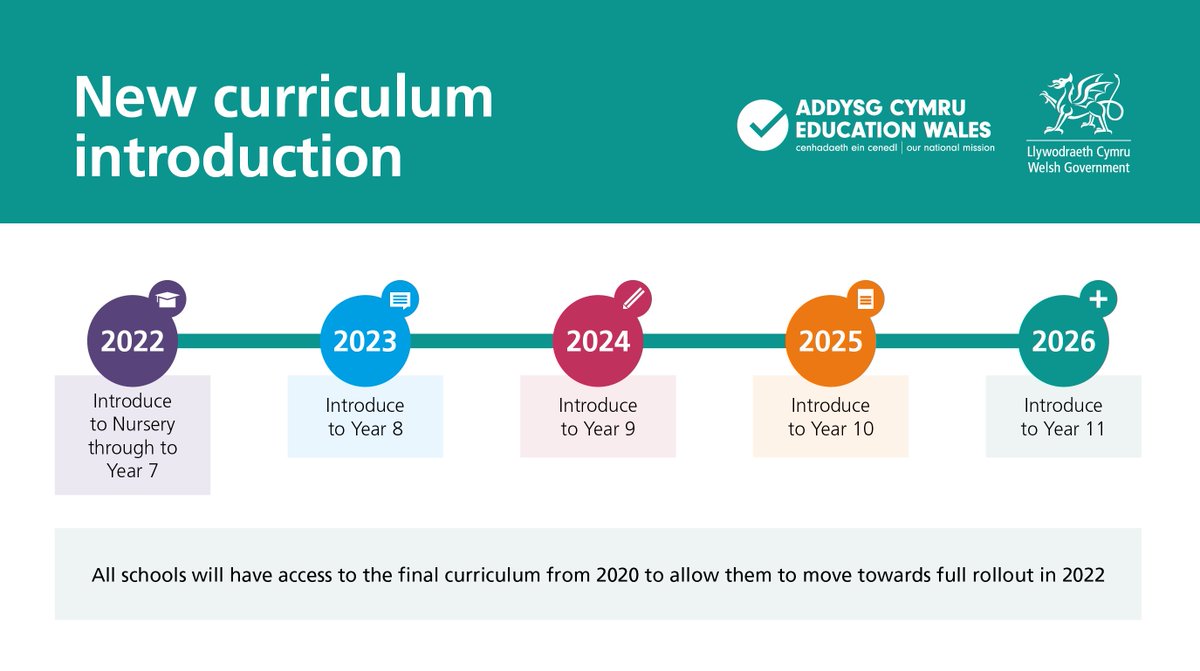
The implementation began in September 2022 for primary schools and Year 7, with full rollout by 2026 and all schools are encouraged to adopt the core principles of the curriculum and embed them into their own unique practise. This includes making sure that the curriculum is learner-centred, interdisciplinary, relevant and meaningful for each group of learners. During this transition period, each school will have access to resources to help them understand, plan and deliver the 21st century Curriculum for Wales.
The Curriculum for Wales framework is divided into six Areas of Learning and Experience (Adfeilion), each containing Progression Steps that describe the knowledge, skills and dispositions learners should demonstrate in each phase. The Adfeilion are Cymraeg, The Arts, Health and Wellbeing, Humanities, Maths and Science. To ensure consistency in teaching practice between schools, standardised formative assessment approaches will help develop critical thinking skills while supporting inclusive learning environments that meet diverse sen requirements. Teachers will benefit from lesson planning strategies that incorporate project-based learning experiences to enhance student motivation and develop sel competencies alongside academic attention to creates emotional intelligence skills.skills. This complete approach will help to prepare students for the complexities of the modern world.
Regional consortia across Wales have established comprehensive professional learning programmes to support the transition. Central South Consortium offers termly cluster meetings where teachers collaborate on designing authentic learning experiences, whilst North Wales consortium provides specialist workshops on progression step planning. Schools are restructuring their timetables to accommodate longer, cross-curricular blocks rather than traditional subject periods. Many primary schools now operate morning project sessions combining science, humanities, and literacy skills around real-world themes like local environmental challenges. Secondary schools are piloting integrated humanities departments where history, geography, and religious education teachers plan collaboratively.
The phased implementation timeline sees Foundation Phase schools fully operational by 2023, with Years 7 and 8 following in September 2022. Teachers are utilising digital planning templates that map learning across Areas of Learning and Experience, with many schools adopting collaborative planning software to track progression steps. Practical tools include assessment grids that capture both knowledge and skill development, whilst peer observation focuses on questioning techniques that develop learners' critical thinking rather than recall-based responses.
Like any significant educational reform, the Curriculum for Wales presents both challenges and opportunities. Successfully implementing this framework requires a shift in mindset, significant investment in professional development, and ongoing collaboration between schools, teachers, and policymakers.
One of the key challenges is providing teachers with the necessary training and resources to effectively deliver the new curriculum. This includes equipping them with the skills to design engaging, interdisciplinary learning experiences, assess student progress in a more complete way, and integrate digital technologies into their teaching practice. It also requires developing a culture of collaboration and shared learning among teachers, so they can learn from each other's experiences and develop best practises.
However, the opportunities presented by the Curriculum for Wales are immense. By prioritising deep learning, developing essential skills, and developing a learner-centred approach, this framework has the potential to transform education in Wales and prepare students for success in the 21st century. It can helps students to become active, engaged citizens who are equipped to make a positive contribution to their communities and the world.
Several Welsh schools have demonstrated successful implementation strategies that address common teacher concerns. Ysgol Gyfun Gwynllyw in Newport introduced cross-curricular project weeks, reducing individual subject planning whilst maintaining rigorous assessment standards. Their Year 7 "Local History and Environment" project saw learners make strong progress across multiple Areas of Learning and Experience. To manage workload concerns, the school implemented collaborative planning sessions where teachers share resources and co-design learning experiences. Staff report that initial planning investment has actually reduced long-term workload through integrated approaches. Similarly, Pencoed Primary School addressed training anxieties by establishing peer mentoring systems and regular reflection meetings, with teachers reporting increased confidence within two terms.
Parent communication has proven crucial for successful implementation. Schools like Bryn Celynnog Comprehensive have introduced monthly "Curriculum Cafés" where families experience hands-on learning activities, helping parents understand the shift from traditional subject silos to integrated learning. Parent feedback indicates improved understanding of their children's progress when schools explain how skills develop across different contexts. Many families initially worried about exam preparation, but schools successfully demonstrate how the four purposes framework actually enhances critical thinking and problem-solving abilities essential for academic success.
The Curriculum for Wales is a flexible framework based on four core purposes rather than fixed subject lists. It replaces rigid national curriculum levels with five progression steps that track a learner's development from ages 3 to 16. Schools now have the autonomy to design their own learning experiences based on local needs and the six Areas of Learning and Experience.
Teachers implement AoLEs by planning thematic projects that link different disciplines together; for example, a project on local history could combine Humanities and Languages. This approach requires collaborative planning between staff to ensure that specific skills are mapped across various activities. Successful delivery relies on moving away from isolated subject blocks and towards connected learning experiences.
Progression steps allow teachers to recognise student achievement at their own pace without the pressure of strict age-related targets. They provide detailed descriptors of what a child can do; this helps teachers identify specific gaps in knowledge and provide targeted support. This system supports a more personalised approach to education and reduces the focus on high-stakes testing.
Research suggests that integrated learning helps learners see the relevance of their studies and improves the retention of complex concepts. Evidence from educational studies indicates that connecting different subjects encourages learners to apply their skills in real-world contexts; this supports the development of critical thinking. These findings suggest that a connected approach prepares learners for the complexities of modern life.
A frequent mistake is attempting to map every single skill to every project; this often leads to a superficial coverage of content rather than deep understanding. Some schools also struggle by retaining old subject boundaries instead of fully embracing the integrated nature of the AoLEs. Overcomplicating assessment by creating too many sub-levels can also detract from the focus on meaningful learner progression.
Assessment should focus on formative practices that help learners understand their next steps in a continuous process. Teachers use the progression step descriptors to provide feedback on specific skills; this replaces the practice of assigning a single number or letter to a piece of work. This shift ensures that assessment is used as a tool for learning rather than just a method for data collection.
The Curriculum for Wales represents a bold vision for the future of education. It acknowledges the need to move beyond traditional, content-heavy approaches and embrace a more complete, skills-focussed model of learning. While the implementation of this framework will undoubtedly present challenges, the potential benefits for students and society as a whole are significant.
By prioritising deep learning, developing essential skills, and helping teachers to design engaging learning experiences, the Curriculum for Wales can help to create a generation of ambitious and capable learners, enterprising and creative contributors, ethical and informed citizens, and healthy and confident individuals. This new direction for Welsh education promises a brighter future for all.
External References: Teachers' Standards (DfE) | EEF: Evidence-Based Guidance Reports