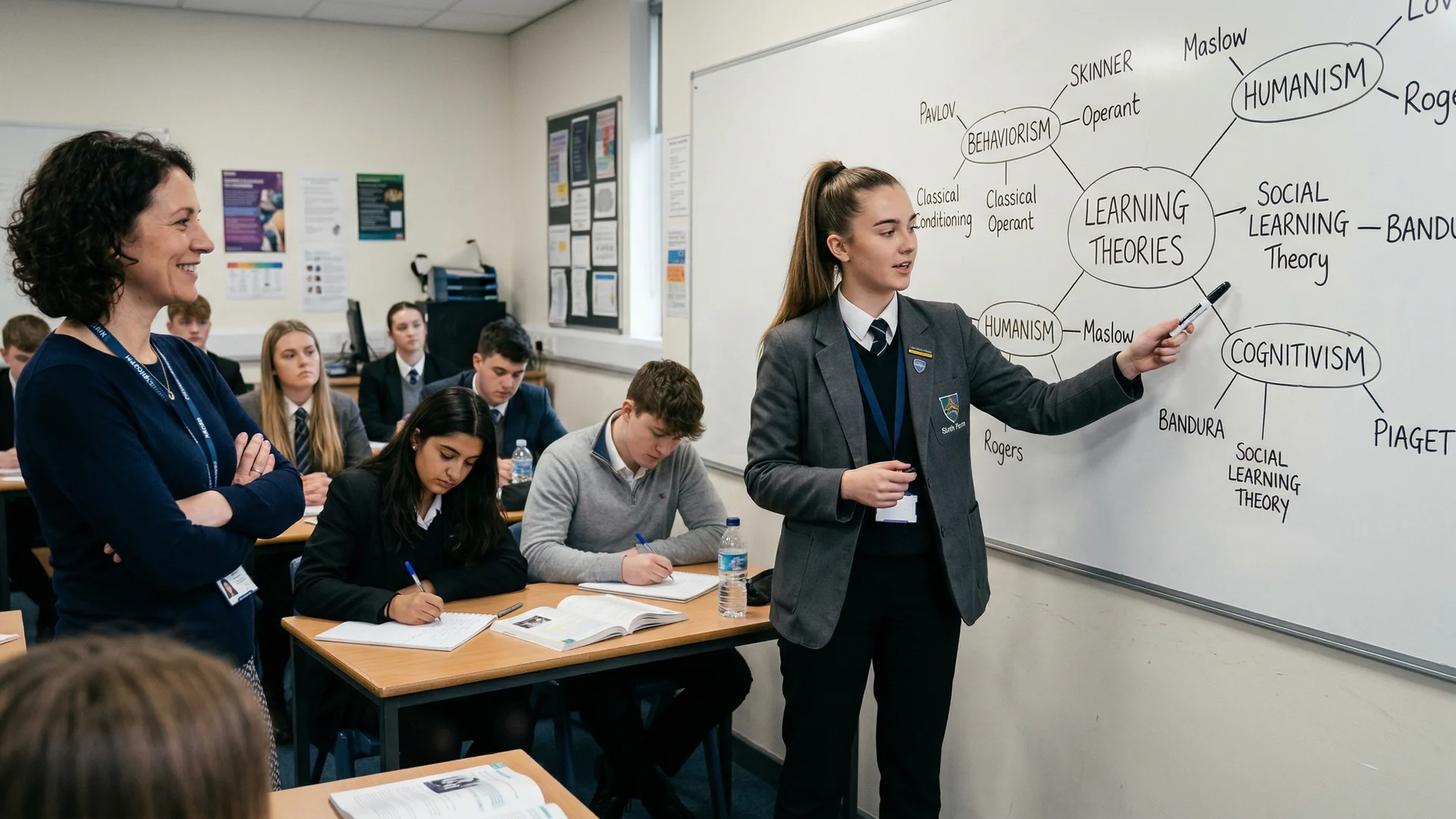
Understanding how people learn, think, and behave. Evidence-based educational psychology for the classroom. Updated for 2026.
Educational psychology is the study of how people learn, develop, and behave in educational settings. It draws on research from cognitive science, developmental psychology, and social psychology to explain why some teaching approaches work and others do not. Teachers who understand educational psychology do not just know what to do in the classroom; they understand why it works, which means they can adapt when things go wrong.
Consider a learner who says, "I'm rubbish at maths." That statement is attribution theory in action: the learner attributes failure to a fixed, internal cause (ability) rather than an unstable, controllable one (effort or strategy). Without understanding attribution theory, a teacher might simply reassure the learner. With it, the teacher can reframe the attribution directly: "You haven't mastered this yet. Let's find a strategy that works." Bandura (1977) showed that self-efficacy, a learner's belief in their ability to succeed at specific tasks, is one of the strongest predictors of academic performance. Dweck (2006) extended this with growth mindset research, demonstrating that beliefs about ability are malleable. Deci and Ryan (2000) added that intrinsic motivation, not reward or punishment, produces the deepest learning.
Start with Fundamental Theories of Learning for the essential foundations, then follow the learning pathway below.
| Concept | What It Studies | Teacher's Role | Classroom Example |
|---|---|---|---|
| Psychology | How individuals think, feel, learn, and behave. Covers development, motivation, social influence, and mental health. | Understand what drives learner behaviour. Use theory to inform responses. | Recognising that a learner's fixed mindset is an attribution problem, not a laziness problem. |
| Pedagogy | The methods, principles, and practice of teaching. How to structure, deliver, and sequence instruction. | Design lessons. Choose instructional strategies. Sequence content deliberately. | Using worked examples before problem-solving to reduce extraneous cognitive load. |
| Neuroscience | The biology of the brain: neural structures, memory consolidation, and how physical brain changes relate to learning. | Apply findings cautiously. Neuroscience confirms psychology; it rarely contradicts it. | Understanding that sleep consolidates memory, so cramming the night before a test is ineffective. |
| Philosophy of Education | The purposes, values, and ethical foundations of education. What schooling is for and who it serves. | Interrogate assumptions. Question why certain content or methods are privileged. | Asking whether a school's grading system rewards performance or learning. |
The essential overview. Behaviourism, constructivism, social learning, and humanist theory explained clearly.
Two of the most influential theories for classroom practice: modelling and the role of early relationships in learning.
Practical psychology for Monday morning: why learners disengage and what to say when they do.
The Structural Learning platform has CPD courses, interactive lesson planning tools, and a growing library of resources built on the research above. Open a free account to browse.
No credit card required.
About this hub. Articles are written by practising educators and reviewed against peer-reviewed research. Citations follow author-date format. New content added regularly. Get in touch if you cannot find what you need.
Start with the most-comprehensive guide in the list below. Look for titles that say A Teachers Guide those are flagship deep-dives. They link out to all the related concepts.
Every article cites peer-reviewed research and translates findings into classroom practice. Where research is contested, we say so. Where the evidence is strong, we explain why and what to do.
Each guide ends with practical next-lesson actions. You can also use our AI lesson planning tools which generate full lesson plans grounded in these methods.