Updated on
September 24, 2026
Bowlby's Attachment Theory: Key Ideas and Evidence
Bowlby's attachment theory explains the secure base, internal working models and attachment phases. Explore the evidence, limits and careful classroom use.


Updated on
September 24, 2026
Bowlby's attachment theory explains the secure base, internal working models and attachment phases. Explore the evidence, limits and careful classroom use.
What is Bowlby’s attachment theory?
Bowlby's attachment theory describes an evolved behavioural system that keeps infants close to caregivers for protection and supports exploration from a secure base. Bowlby proposed attachment behaviours, a hierarchy of attachments and internal working models. The familiar attachment classifications came from Mary Ainsworth's Strange Situation research, with the disorganised classification added later by Mary Main and Judith Solomon. Teachers cannot diagnose these patterns from classroom behaviour.
Bowlby's attachment theory describes an evolved behavioural system. It keeps infants close to caregivers for protection. It also supports exploration from a secure base. Bowlby (1969) proposed attachment behaviours, a hierarchy of attachments and internal working models.
The well-known classifications came from Mary Ainsworth's Strange Situation research. Mary Main and Judith Solomon later added the disorganised classification. Teachers cannot diagnose these patterns from classroom behaviour.
This distinction matters. Bowlby's theory, his attachment phases and the later classifications answer different questions. Combining them into four "Bowlby styles" is not accurate. It can also turn a research framework into a label for a learner.
John Bowlby developed attachment theory to explain why infants seek familiar caregivers. This need often grows when they feel frightened, tired, ill or apart from a caregiver. Bowlby argued that staying close to protection helped infants survive. He saw attachment as part of a behavioural system, not a dependency to train away.
The system balances two linked activities. A child is more likely to explore when they feel safe. When threat or distress grows, being close to a caregiver becomes more important.
This secure-base idea is central to Bowlby's theory. It helps explain how a sense of safety can support curiosity.
Our learning theories overview places attachment beside other major accounts of development and learning. The child development theories guide compares its role with other traditions.
An attachment behaviour is an action that we can see. Examples include crying, clinging, following or calling. The attachment behavioural system is the organised process behind these actions. It makes them more or less likely as a child's situation changes.
A child does not show the same behaviour all the time. Their age, setting and familiarity with a person all matter. So does their sense that care will be available.
Bowlby drew on animal behaviour, evolution and clinical observation. His account moved attention away from feeding as the main basis of attachment. It focused instead on protection, closeness and responsive relationships. A familiar caregiver can become the person a child seeks when under stress.
The system is not a personality type. Refusing help, becoming quiet or seeking comfort can have many causes. No single event can reveal an attachment classification.
A secure base supports exploration. A safe haven offers comfort or protection when distress grows. These terms describe two roles within a relationship. They do not mean that a child will always feel secure.
They also do not require a caregiver to remove every difficulty.
A young child may move away from a caregiver to explore toys. They may check where the caregiver is and return after a surprise. The balance shifts as the situation changes. Security supports exploration, but it does not remove all doubt.
Research on teacher-child relationships uses this idea with care. Verschueren and Koomen (2012) found that a teacher may sometimes provide secure-base and safe-haven functions. Most teacher-child relationships are not attachment bonds. The value for schools lies in sensitive, supportive relationships, not in judging a child's family bonds.
Bowlby used monotropy to describe the special place one attachment may hold within a hierarchy. It does not mean that an infant attaches to only one person. Children can form bonds with several familiar caregivers, and those relationships may differ.
Later research has looked more closely at networks of caregivers and cultural context. Bowlby gave the main attachment figure special importance in his theory. He also recognised other attachments. This remains an area of debate, not a rule for judging families.
Internal working models are expectations built through repeated relationship experiences. They concern whether help will be there and how other people may respond. They can include a person's sense of being worthy of care. These expectations may guide later attention and behaviour.
A "model" is not a fixed mental script. Development continues, relationships differ and later experiences can support change. A meta-analysis found moderate, not perfect, stability in early childhood (Opie et al., 2020). Stability does not make an outcome certain.
This point also guards against confirmation bias. An adult may decide that a learner is "avoidant" or "ambivalent". They may then read ordinary behaviour as proof of that label. Our guide to cognitive biases explains why we need visible evidence and other possible explanations.
Bowlby described four broad phases in the growth of attachment. They move from early social responses to a partnership shaped by shared goals. Between these points, infants develop a preference for familiar care and clear ways to seek closeness. These phases show change over time.
They are not the four later attachment classifications.
These phases describe how an attachment relationship develops. They are not the secure, avoidant, resistant and disorganised classifications.
Bowlby's theory, Ainsworth's classifications and Main and Solomon's later work must be kept separate. They describe related parts of attachment research, not four fixed styles that a teacher can identify from classroom behaviour.
Bowlby described an attachment system, a secure base, a hierarchy of attachments and internal working models. These ideas form a theory of relationships, not a diagnostic checklist. He did not create a four-style typology for use in classrooms.
Mary Ainsworth's observations and Strange Situation procedure gave researchers a way to study infant behaviour during separation and reunion. Ainsworth, Blehar, Waters and Wall (1978) described secure, avoidant and resistant classifications.
Mary Main and Judith Solomon later described the disorganised/disoriented classification. These classifications are research descriptions, not fixed identities or clinical diagnoses.
On a smaller screen, swipe across to read all columns.
| Contributor | Main contribution | Do not confuse with |
|---|---|---|
| John Bowlby | Attachment system, secure base, monotropy, internal working models and developmental phases | A four-style classroom typology |
| Mary Ainsworth and colleagues | Strange Situation and secure, avoidant and resistant classifications | A teacher checklist |
| Mary Main and Judith Solomon | Disorganised/disoriented classification | A fixed identity or diagnosis |
The classifications come from set research tasks and coding rules. They describe patterns in a given relationship under set conditions. They are not clinical diagnoses.
A teacher cannot infer one from a learner's classroom behaviour. For a wider comparison, use theories of attachment.
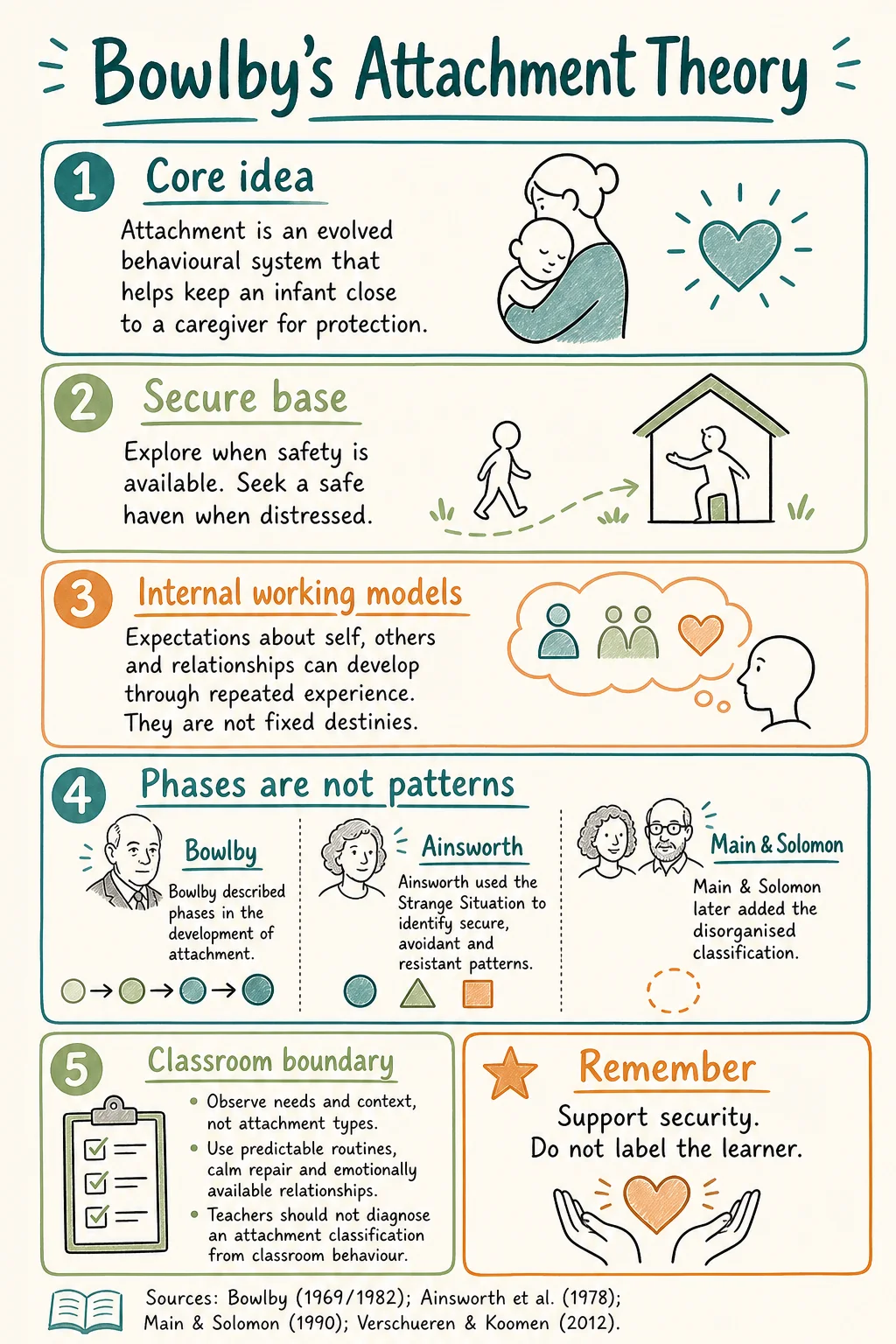
Bowlby's attachment theory describes an evolved behavioural system that helps keep an infant close to a caregiver for protection. A secure base supports exploration; a safe haven is sought when distressed. Internal working models are expectations about self, others and relationships that can develop through repeated experience, but they are not fixed destinies.
Phases are not patterns. Bowlby described phases in the development of attachment. Ainsworth used the Strange Situation to identify secure, avoidant and resistant patterns. Main and Solomon later added the disorganised classification.
Classroom boundary: observe needs and context, not attachment types. Use predictable routines, calm repair and emotionally available relationships. Teachers should not diagnose an attachment classification from classroom behaviour.
Remember: support security. Do not label the learner.
Sources: Bowlby (1969/1982); Ainsworth et al. (1978); Main and Solomon (1990); Verschueren and Koomen (2012).
Attachment theory has led to a large body of research. Its claims still need to remain separate. Seeking closeness or using a secure base does not prove that one early bond shapes a whole life. Links between findings do not prove a simple chain of cause and effect.
Waters and colleagues (2000) found continuity from infancy to early adulthood in one long-term sample. They also found change linked with major negative life events. A later meta-analysis found moderate stability and signs of publication bias. Together, these findings support both continuity and change.
Culture can shape care, experiences of separation and the meaning of behaviour in a research task. The classifications should not rank cultures or families. A careful account checks the sample, the method and local ways of giving care before drawing wider conclusions.
Bowlby's work on maternal deprivation is linked to attachment theory, but it is not the same theory. Later evidence has treated separation, loss and institutional deprivation as distinct issues. It has also considered caregiver quality and wider hardship. Broad historical claims should not be used to blame mothers or explain one learner.
The safest classroom use is broad and focused on relationships. Clear routines and available adults can help learning feel safer. Calm responses and repair after conflict can help too. These approaches support many learners and do not require an attachment label.
This article covers Bowlby's theory. The dedicated attachment theory in education guide looks at classroom use in more depth. Related guidance covers trauma-informed schools, self-regulated learning and social and emotional learning. Each topic has its own purpose and should not be folded into an attachment label.
These answers separate Bowlby's main ideas from the later attachment classifications. They also set a clear classroom boundary. Teachers can use the theory to think about safety, support and relationships. They cannot use everyday behaviour to assign an attachment style or make a diagnosis.
It says that infants have an evolved system for seeking protection from familiar caregivers. When a caregiver is available, they can offer a secure base for exploration. They can also provide a safe haven during distress.
No. Bowlby developed attachment theory and described phases in its development. Ainsworth and colleagues found secure, avoidant and resistant classifications through the Strange Situation. Main and Solomon later added the disorganised classification.
It is a set of expectations about the self, other people and relationships. These expectations grow through experience. They may affect later attention and behaviour, but they can change. They should not be treated as destiny.
Not from classroom behaviour. Attachment classifications depend on structured assessment and apply to a given relationship. Teachers should observe needs and offer support that helps all learners. They should follow referral or safeguarding routes when needed.
A teacher may offer temporary secure-base or safe-haven functions. This may be more likely for younger or vulnerable children. For most children, however, a teacher-child relationship is not an attachment bond in the same sense as a close caregiving relationship.
These readings cover the main classifications, their history, teacher-child relationships and change over time. They also show why Bowlby's theory should be kept distinct from later research tools. Use them to explore the evidence and key limits in more depth.
The references below support the theory, classifications, later reviews and classroom boundary discussed above. They include Bowlby's original account and the main research named in the article. The links lead to the same source records used throughout this guide.
Ainsworth, M. D. S., Blehar, M. C., Waters, E., & Wall, S. (1978). Patterns of attachment: A psychological study of the Strange Situation. Lawrence Erlbaum.
Bowlby, J. (1982). Attachment and loss: Volume 1, Attachment (2nd ed.). Basic Books. (Original work published 1969).
Duschinsky, R. (2015). The emergence of the disorganized/disoriented attachment classification, 1979-1982. History of Psychology, 18(1), 32-46.
Main, M., & Solomon, J. (1990). Procedures for identifying infants as disorganized/disoriented during the Ainsworth Strange Situation. In M. T. Greenberg, D. Cicchetti, & E. M. Cummings (Eds.), Attachment in the preschool years (pp. 121-160). University of Chicago Press.
Opie, J. E., McIntosh, J. E., Esler, T. B., Duschinsky, R., George, C., Schore, A., Kothe, E. J., Tan, E. S., Greenwood, C. J., & Olsson, C. A. (2020). Early childhood attachment stability and change: A meta-analysis. Attachment & Human Development. Advance online publication.
Verschueren, K., & Koomen, H. M. Y. (2012). Teacher-child relationships from an attachment perspective. Attachment & Human Development, 14(3), 205-211.
Waters, E., Merrick, S., Treboux, D., Crowell, J., & Albersheim, L. (2000). Attachment security in infancy and early adulthood: A twenty-year longitudinal study. Child Development, 71(3), 684-689.