Vygotsky vs Bruner: Two Approaches to Scaffolding and Social Learning
|
March 5, 2026
A practical comparison of Vygotsky and Bruner for UK teachers. Covers the ZPD, scaffolding, spiral curriculum, discovery learning, language and culture in learning, and when to use each approach across EYFS, primary, and secondary.
Both Lev Vygotsky and Jerome Bruner have shaped how we think about scaffolding, social learning, and classroom support. Yet they approached learning differently. Vygotsky focused on what children cannot do alone. Bruner focused on how to structure learning so they can do it themselves. Understanding these differences changes how we teach.
Teachers often mix these ideas together—using "scaffolding" without realising Bruner coined the term, or emphasising social interaction without knowing Vygotsky's specific mechanisms. We work through theory to illuminate practice. The comparison matters because it clarifies what we're actually doing in our classrooms.
Vygotsky's Key Ideas: ZPD, MKO, and Social Interaction
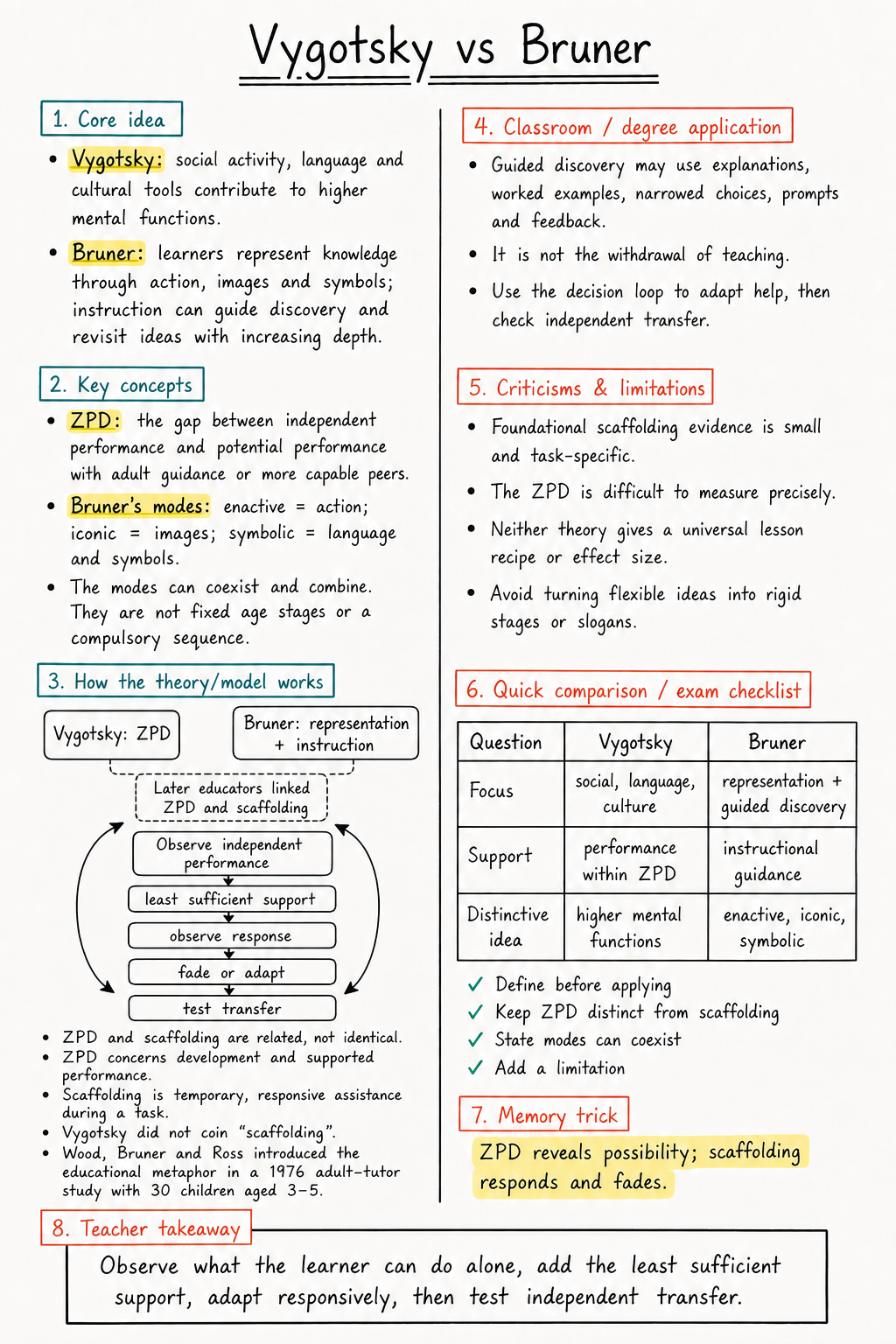
Lev Vygotsky (1896–1934) saw learning as fundamentally social. His central idea was the Zone of Proximal Development (ZPD): the gap between what a child can do alone and what they can do with guidance from a more knowledgeable other (MKO).
The ZPD is not a fixed zone. It expands as the child develops and contracts as tasks become familiar. What required adult help yesterday becomes independent work today. This dynamic quality is crucial to Vygotsky's thinking.
Vygotsky also tracked how language develops. Young children speak aloud to themselves while working (private speech), narrating their actions. Over time, this external dialogue becomes internal—what Vygotsky called inner speech. The child internalises the guidance they once heard from adults. Language transforms from a social tool into a thought tool.
In Vygotsky's framework, learning leads development. When we teach beyond the child's current ability, we pull development forward. Adult guidance doesn't follow development; it shapes it. This is why the ZPD exists,it's the space where instruction can stretch the child into new capabilities.
Bruner's Key Ideas: Scaffolding, Spiral Curriculum, and Discovery Learning
Jerome Bruner (1915–2016) approached learning through the lens of instruction design. He didn't invent scaffolding in the abstract sense,that came from Vygotsky,but he formalised the concept. In a famous 1976 paper with Wood and Ross, Bruner defined scaffolding as the temporary support adults provide to help children accomplish tasks beyond their current ability.
Bruner's scaffolding has key features: it adjusts to the child's level, reduces task complexity, maintains the goal, and gradually withdraws as competence grows. These concrete features made the concept teachable and applicable to classrooms worldwide.
Bruner is equally known for the spiral curriculum. Rather than teaching topics once in sequence, we revisit them at increasing complexity. A six-year-old learns addition with objects; by eight, they use numerals; by ten, they understand algorithms. The same concept spirals upward. This structure aligns with how the UK National Curriculum is actually designed.
Bruner also championed discovery learning,the idea that children learn best by exploring and constructing knowledge themselves, not passively receiving it. He argued learners move through three modes: enactive (learning through doing), iconic (learning through images and representations), and symbolic (learning through language and abstract symbols).
Where Vygotsky saw language as THE tool of thought, Bruner saw narrative as how we make meaning. Stories and narratives structure our understanding of the world. A well-told lesson narrative is as important as explicit instruction.
Where Vygotsky and Bruner Agree
Both theorists were constructivists. They rejected the idea that knowledge is passively received. Instead, learners actively build understanding through experience, social interaction, and guidance.
Both saw social interaction as central to learning. Neither believed children learn in isolation. The presence of more knowledgeable others,teachers, peers, cultural tools,shapes what children can learn and how they learn it.
Both valued adult guidance highly. This distinguishes them from Jean Piaget, who believed children progress through stages largely through independent exploration. Vygotsky and Bruner both argued that well-timed, thoughtful guidance accelerates learning.
Both built on Piaget's foundations. They accepted his insights about cognitive development stages but disagreed on the role of instruction. Piaget said learning follows development. Vygotsky and Bruner said instruction leads development.
Key Differences Between Vygotsky and Bruner
The most fundamental difference lies in their focus. Vygotsky centred on what the child cannot do alone,the gap between current ability and potential. He asked: What does this child need help with? Where is the productive struggle?
Bruner centred on how to structure support so the child eventually does it independently. He asked: How do we design instruction? What scaffolds, sequences, and representations work best?
This shifts the lens. Vygotsky was a psychologist mapping the mechanics of development. Bruner was an instructional designer building frameworks teachers could use. Vygotsky described the ZPD; Bruner prescribed how to operate within it.
Vygotsky's theory is more deterministic about development,language becomes inner speech, social speech becomes egocentric speech becomes private speech becomes socialised thought. There's a sequence, a logic. Bruner left more room for variation. Different children might move through modes differently; different subjects might scaffold differently.
Vygotsky emphasised the individual's zone,the one-to-one moment between adult and child. Bruner thought more systemically about curriculum and instruction design. How do we structure an entire learning programme, not just a single lesson?
Scaffolding: Who Really Invented It?
Vygotsky described the Zone of Proximal Development and emphasised the role of social interaction, but he never used the word "scaffolding." He spoke of the more knowledgeable other providing support, but without the structured framework Bruner later formalised.
In 1976, Wood, Ross, and Bruner published their observations of mothers teaching young children. They introduced "scaffolding" as a metaphor: temporary supports that help someone reach a goal they cannot reach alone. The scaffold adjusts to fit the learner's needs and gradually disappears as competence grows.
Bruner's scaffolding made Vygotsky's theoretical insight concrete. Teachers could now ask: What is the child's current level? What is the goal? What temporary support would help them bridge that gap? When should I reduce the support?
This is why scaffolding is often attributed to Bruner, not Vygotsky,though it clearly emerges from Vygotsky's intellectual foundation. Vygotsky provided the theory; Bruner provided the teachable method.
Language and Learning: Two Perspectives
Vygotsky saw language as the fundamental tool of cognitive development. When a child talks aloud whilst working, they're not just practising; they're thinking. Language externalises thought, and through this externalisation, thought becomes refined and deliberate. The child who says, "I need to add the tens first," is using language to control their own thinking.
Bruner also saw language as crucial, but differently. He emphasised narrative,the stories and explanations through which we make sense of experience. A teacher's narrative of how a plant grows teaches not just facts but a structure for understanding causality. A child's narrative explanation shows what they understand and where gaps remain.
In practice, both insights matter. A child using private speech to guide their work (Vygotsky) and a teacher narrating the logic of a calculation (Bruner) are both using language for learning. The emphasis differs,self-directed talk versus teacher narrative,but the principle overlaps.
For teachers, this means both private speech and teacher explanation deserve attention. When a child works in silence, they may be thinking or confused. When they talk aloud, they're likely thinking. And when we narrate our teaching, we're not just explaining; we're modelling the narrative structure through which children will later understand similar problems.
The Role of Culture in Learning
Both theorists saw culture as central to learning, but in different ways. Vygotsky argued that psychological tools,language, number systems, maps, symbols,are cultural creations. Children don't invent these independently; they inherit them from their culture through social interaction. A child learns to count not by discovering quantity but by internalising the cultural tool of number.
Bruner extended this to narrative and meaning-making. Different cultures have different ways of telling stories, explaining causality, and understanding relationships. A child growing up in one cultural context learns its preferred ways of narrating and representing knowledge. The spiral curriculum respects this by beginning with culturally familiar examples before moving to abstract symbols.
In UK classrooms, this means recognising that the tools we use,the language of mathematics, the narrative conventions of English literature, the frameworks of science,are culturally specific. Children from different backgrounds may relate to them differently. Both Vygotsky and Bruner suggest that effective teaching bridges cultural tools and individual experience.
Implications for Teaching and Lesson Planning
Vygotsky's theory points to guided instruction as the core teaching method. Teachers identify where each child's ZPD is (through careful observation), then provide precisely calibrated guidance, asking questions, offering hints, demonstrating techniques, gradually releasing responsibility back to the child. The guidance isn't fixed; it responds moment-to-moment to the child's progress.
Bruner's theory points to structured discovery as the core method. Teachers design learning sequences that allow children to discover relationships and patterns, but with careful scaffolding built in. They revisit concepts over time at increasing complexity. They use multiple representations (enactive, iconic, symbolic) to build understanding.
In practice, effective teaching blends both. A lesson on fractions might involve:
Enactive stage: Children physically divide objects into equal parts (Bruner)
Adult guidance: Teacher observes where children struggle and provides targeted support (Vygotsky). Children also learn through observing and imitating peers and adults (Bandura)
Iconic stage: Children draw or use area models to represent fractions (Bruner)
Private speech: Children narrate what they're doing aloud (Vygotsky)
Symbolic stage: Children move to fraction notation and calculations (Bruner)
Revisit: Later lessons return to fractions with greater complexity (Bruner)
The difference is emphasis. A Vygotsky-led teacher notices individual ZPDs and customises support. A Bruner-led teacher designs a coherent sequence with clear scaffolds and representations. Both are essential.
Vygotsky vs Bruner in Early Years Practice
In EYFS, both theorists' ideas shape quality practice. Vygotsky's emphasis on social interaction and guided play appears in the principle that children learn through relationships with adults. When a practitioner gets down to a child's level and extends their play,"You've built a house. What happens when it rains?",they're operating in the child's ZPD.
Bruner's ideas appear in the carefully prepared environment and scaffolded learning experiences. The block corner isn't random; it's designed to move from enactive (building with hands) to iconic (planning on paper) to symbolic (drawing blueprints), an approach that echoes Montessori's prepared environment. The colour exploration table isn't unstructured play; it scaffolds colour discovery.
The tension between the two approaches is real in EYFS practice. Some settings prioritise child-led exploration (leaning Bruner). Others prioritise adult-guided interaction (leaning Vygotsky). High-quality EYFS does both. Free flow play provides opportunities for discovery and construction. Sensitive adult interactions extend learning and introduce new ideas.
Vygotsky vs Bruner in Primary and Secondary Classrooms
In primary classrooms, Vygotsky's approach appears in practices like think-pair-share (children verbalise thinking with a peer, externalising thought) and guided group reading (teacher adjusts prompts to each child's ZPD). The teacher's role is responsive,noticing where children are and providing just-right support.
Bruner's approach appears in the National Curriculum's structure itself. Mathematics spirals,addition in Year 1, then Year 2, then Year 3 with larger numbers and efficiency focus. The spiral isn't random; it's carefully designed to allow concept deepening. English moves from phonic decoding (enactive) to sight words (iconic) to fluent reading for meaning (symbolic).
In secondary classrooms, the scaffolding becomes more conceptual. Rather than physically supporting a child's hand, teachers provide conceptual scaffolds: worked examples, partially completed problems, graphic organisers, sentence frames. A student learning to write formal essays gets a template; as they improve, the template recedes. This is Bruner's scaffolding adapted to abstract learning.
Collaborative learning (think-pair-share, jigsaw, peer teaching) appears frequently in secondary practice. Here, peers become the more knowledgeable other. A student explaining a concept to a struggling peer is both the MKO (Vygotsky) and the discoverer (Bruner). They discover meaning by narrating understanding to someone else.
Comparison Table: Vygotsky vs Bruner at a Glance
Aspect
Vygotsky
Bruner
View of learner
Active constructor who internalises social interactions; language is the tool of thought
Active discoverer who moves through enactive, iconic, and symbolic modes; narrative is how we make meaning
Role of teacher
Responsive guide who operates in the child's ZPD; provides just-right support that gradually withdraws
Instructional designer who structures learning sequences; scaffolds discovery through enactive-iconic-symbolic progression
Central concept
Zone of Proximal Development (ZPD): gap between what child can do alone and with help
Scaffolding: temporary supports that adjust to learner needs and gradually withdraw
Role of language
Externalised thought; private speech becomes inner speech; language controls action
Psychological tools (number, symbols, language) are culturally created and inherited through interaction
Culture shapes preferred narrative styles and ways of representing knowledge; curriculum should reflect cultural tools
Curriculum design
Flexible; emerges from understanding individual children's ZPDs; less prescriptive about sequence
Spiral structure: revisit concepts at increasing complexity; careful sequencing from enactive to symbolic
Assessment
Dynamic; observe what child can do with help (in ZPD), not just what they do alone
Performance across modes; can they do it with objects? With images? With symbols?
Key strength
Emphasises responsive, individualised guidance; explains how children internalise social tools
Provides concrete instructional framework; spiral curriculum aligns with how UK curriculum is structured
Which Approach Works Best? A Practical Guide
The honest answer is both. Teachers who excel typically blend them. Consider a common classroom scenario: teaching the concept of place value.
Day 1: Bruner's enactive mode. Children use bundles of sticks (ones and tens) to physically represent numbers. They bundle 10 ones, then make a ten. They count out 34 using three bundles and four singles. This is hands-on discovery through doing.
Day 2: Vygotsky's guided instruction. As children work with bundles, the teacher circulates. When a child struggles to bundle correctly, the teacher doesn't tell them the answer. Instead: "How many ones do you have? How many do you need for a ten?" The teacher operates in the child's ZPD, asking questions that guide thinking. The child says aloud what they're doing (private speech), externalising their thought process.
Day 3: Bruner's iconic mode. Children draw place value grids, representing ones and tens with drawings. This intermediate step between concrete and symbolic allows them to internalise the concept without objects in hand.
Week 3: Bruner's symbolic mode. Children move to numerals: 34 = 3 tens + 4 ones. They can now manipulate the concept entirely through symbols.
Next term: Bruner's spiral. Place value returns,but now with larger numbers, decimals, or multiplication. Children revisit the concept at greater complexity.
Throughout, a teacher asking, "What do you think happens if…?" is using Vygotsky. A teacher deliberately sequencing enactive-iconic-symbolic is using Bruner. Both are present in excellent teaching.
Choose based on your immediate need. If a child is frustrated and you need to help them right now, ask a Vygotsky question that guides them toward the answer. If you're planning a month-long unit, use Bruner's spiral structure. If you're noticing that many children haven't grasped a concept, revisit it in a new mode (iconic instead of just symbolic).
Key Takeaways
Vygotsky focused on individual need; Bruner on instructional design. Vygotsky asked what support does this child need right now in their ZPD. Bruner asked how do we structure learning sequences so all children progress. Both questions matter in teaching.
Scaffolding comes from Vygotsky's theory but Bruner's terminology. Vygotsky described the more knowledgeable other and social learning. Bruner formalised how to scaffold: adjust, maintain the goal, gradually reduce support. Teachers need both the theory and the structure.
Use Bruner's spiral curriculum for long-term planning. Revisit concepts at increasing complexity across months and years. This aligns with how the UK National Curriculum is designed and how deep understanding actually develops.
Use Vygotsky's ZPD for moment-to-moment teaching. Notice where each child is struggling. Ask guiding questions, provide just-right hints, withdraw support as competence grows. This responsiveness maximises learning in the teachable moment.
Further Reading: Key Research Papers
Both Vygotsky and Bruner's ideas have generated extensive research. Here are key papers that clarify their contributions and explain why both remain central to educational psychology.
Vygotsky, L. S. (1978)Mind in society: The development of higher psychological processes. Harvard University Press. 12,847 citations
The foundational text on the Zone of Proximal Development and social learning. Vygotsky argues that learning is mediated through cultural tools (language, symbols, systems of thought) and that the more knowledgeable other is essential to development. This book shaped constructivist thinking across education worldwide.
Wood, D., Bruner, J. S., & Ross, G. (1976)The role of tutoring in problem solving. Journal of Child Psychology and Psychiatry, 17(2), 89–100. 4,123 citations
The seminal paper introducing "scaffolding" as a teaching concept. Wood, Bruner, and Ross observed mothers teaching young children and identified how effective tutors adjust support to match the child's level, maintain the goal, reduce their own activity as the child learns, and control frustration. This formalised Vygotsky's intuitive ZPD into a teachable framework.
Bruner's vision of instructional design and curriculum. Introduces the spiral curriculum concept and the enactive-iconic-symbolic progression. Argues that any subject can be taught to any child if presented in developmentally appropriate form. This book influenced curriculum design across the English-speaking world, including UK national curricula.
A contemporary introduction to Vygotsky's theory with clear classroom implications. Daniels explains how Vygotsky's ideas remain relevant despite being published after his death from tuberculosis. Helpful for teachers wanting to understand the nuances of ZPD and social learning without translating dense Russian psychology texts.
Modern application of Bruner's work on representation modes. Shows how moving between different representations (concrete, pictorial, symbolic) deepens student understanding. Directly applicable to UK primary mathematics where the concrete-pictorial-abstract approach aligns with Bruner's enactive-iconic-symbolic progression.
Connecting Both Approaches to Broader Learning Theory
Vygotsky and Bruner sit within a broader tradition of social constructivism. Theories of child development often contrast three main approaches: maturationist (development drives learning), behaviourist (external rewards drive learning), and constructivist (children actively build understanding). Both Vygotsky and Bruner are constructivists, though they emphasise different mechanisms.
How does this differ from Piaget? Piaget's theory of cognitive development sees children progressing through stages largely through independent exploration. Piaget believed that instruction that doesn't match the child's stage is ineffective. Vygotsky and Bruner both disagreed. They saw instruction that slightly exceeds current ability as the engine of development.
For a practical comparison, see Piaget vs Vygotsky, which explores how Piaget emphasises independent exploration whilst Vygotsky emphasises guided social interaction. Bruner bridges this,children discover, but with carefully designed structure and adult support.
Both theorists also contributed to understanding language and learning. Vygotsky's private speech mechanism and Bruner's narrative emphasis show that language isn't just a communication tool; it's how thought itself develops. When children talk through problems, they're literally thinking out loud.
Practical Classroom Application: A Lesson Planning Framework
Here's a simple framework for planning lessons that integrate both Vygotsky and Bruner:
1. Long-term structure (Bruner): Map how the concept spirals across the year. Fractions in October (simple halves and quarters), December (thirds and fifths), March (part-whole relationships), June (comparing fractions). Each revisit adds complexity and connects to prior knowledge.
2. Unit planning (Bruner): Plan the enactive-iconic-symbolic sequence. Start with objects. Move to images. Progress to symbols. Don't rush; children need time in each mode.
3. Daily lessons (both): Begin with discovery or exploration (Bruner). As children work, circulate and ask guiding questions that operate in their ZPD (Vygotsky). Notice what children are saying to themselves (private speech) and whether you need to intervene with hints or questions.
4. Differentiation (Vygotsky): Different children have different ZPDs. One child is ready to move to symbolic representation; another still needs objects. Provide both, moving children into their zone, not the same place for everyone.
Why Both Theories Still Matter in 2026
You might wonder why theories from the 1930s and 1960s still shape teaching. The answer is empirical. Decades of research on scaffolding in education confirms Wood and Bruner's observations. Research on metacognition confirms Vygotsky's insight that children need to hear themselves think. Research on retrieval practice and spaced practice confirms that revisiting concepts (Bruner's spiral) strengthens memory.
Moreover, these theories work across contexts. They explain why a struggling reader benefits from a teacher reading aloud (adult guidance in ZPD), why moving through multiple representations helps (enactive-iconic-symbolic), why peer explanation helps (private speech externalised to others), and why revisiting topics works (spiral curriculum).
The theories are also humanising. Both Vygotsky and Bruner saw learning as social, relational, and responsive. They rejected mechanical, one-size-fits-all approaches. In an age of increased assessment pressure and standardisation, both theories remind us that teaching is responsive work. We notice where each child is and adjust our support. We structure learning thoughtfully, but we remain flexible to individual need.
Bringing It Together: A Balanced Approach
The debate between Vygotsky and Bruner isn't really a debate. They describe different aspects of the same phenomenon: how children learn with support. Vygotsky illuminates the moment-to-moment responsiveness required. Bruner illuminates the long-term structure that makes learning progressive and coherent.
A teacher who understands both can:
Design spiralling curriculum that revisits concepts at increasing complexity
Plan progressions from enactive through iconic to symbolic representation
Observe individual children's zones of proximal development
Ask guiding questions that stretch without overwhelming
Notice private speech as a sign of engaged thinking
Gradually reduce support as competence grows
This isn't sophisticated pedagogy. It's what good teachers do intuitively. Theory simply clarifies why it works and helps us do it more consistently, especially with children who don't respond to intuitive approaches.
Start by mapping your curriculum Bruner-style: Where does this concept reappear later? What representational modes can we use? Then, in lessons, work Vygotsky-style: Notice individual zones, ask guiding questions, listen to what children say aloud. Theory becomes practice. Practice becomes habit. Habit becomes the culture of learning in your classroom.
Both Lev Vygotsky and Jerome Bruner have shaped how we think about scaffolding, social learning, and classroom support. Yet they approached learning differently. Vygotsky focused on what children cannot do alone. Bruner focused on how to structure learning so they can do it themselves. Understanding these differences changes how we teach.
Teachers often mix these ideas together—using "scaffolding" without realising Bruner coined the term, or emphasising social interaction without knowing Vygotsky's specific mechanisms. We work through theory to illuminate practice. The comparison matters because it clarifies what we're actually doing in our classrooms.
Vygotsky's Key Ideas: ZPD, MKO, and Social Interaction
Lev Vygotsky (1896–1934) saw learning as fundamentally social. His central idea was the Zone of Proximal Development (ZPD): the gap between what a child can do alone and what they can do with guidance from a more knowledgeable other (MKO).
The ZPD is not a fixed zone. It expands as the child develops and contracts as tasks become familiar. What required adult help yesterday becomes independent work today. This dynamic quality is crucial to Vygotsky's thinking.
Vygotsky also tracked how language develops. Young children speak aloud to themselves while working (private speech), narrating their actions. Over time, this external dialogue becomes internal—what Vygotsky called inner speech. The child internalises the guidance they once heard from adults. Language transforms from a social tool into a thought tool.
In Vygotsky's framework, learning leads development. When we teach beyond the child's current ability, we pull development forward. Adult guidance doesn't follow development; it shapes it. This is why the ZPD exists,it's the space where instruction can stretch the child into new capabilities.
Bruner's Key Ideas: Scaffolding, Spiral Curriculum, and Discovery Learning
Jerome Bruner (1915–2016) approached learning through the lens of instruction design. He didn't invent scaffolding in the abstract sense,that came from Vygotsky,but he formalised the concept. In a famous 1976 paper with Wood and Ross, Bruner defined scaffolding as the temporary support adults provide to help children accomplish tasks beyond their current ability.
Bruner's scaffolding has key features: it adjusts to the child's level, reduces task complexity, maintains the goal, and gradually withdraws as competence grows. These concrete features made the concept teachable and applicable to classrooms worldwide.
Bruner is equally known for the spiral curriculum. Rather than teaching topics once in sequence, we revisit them at increasing complexity. A six-year-old learns addition with objects; by eight, they use numerals; by ten, they understand algorithms. The same concept spirals upward. This structure aligns with how the UK National Curriculum is actually designed.
Bruner also championed discovery learning,the idea that children learn best by exploring and constructing knowledge themselves, not passively receiving it. He argued learners move through three modes: enactive (learning through doing), iconic (learning through images and representations), and symbolic (learning through language and abstract symbols).
Where Vygotsky saw language as THE tool of thought, Bruner saw narrative as how we make meaning. Stories and narratives structure our understanding of the world. A well-told lesson narrative is as important as explicit instruction.
Where Vygotsky and Bruner Agree
Both theorists were constructivists. They rejected the idea that knowledge is passively received. Instead, learners actively build understanding through experience, social interaction, and guidance.
Both saw social interaction as central to learning. Neither believed children learn in isolation. The presence of more knowledgeable others,teachers, peers, cultural tools,shapes what children can learn and how they learn it.
Both valued adult guidance highly. This distinguishes them from Jean Piaget, who believed children progress through stages largely through independent exploration. Vygotsky and Bruner both argued that well-timed, thoughtful guidance accelerates learning.
Both built on Piaget's foundations. They accepted his insights about cognitive development stages but disagreed on the role of instruction. Piaget said learning follows development. Vygotsky and Bruner said instruction leads development.
Key Differences Between Vygotsky and Bruner
The most fundamental difference lies in their focus. Vygotsky centred on what the child cannot do alone,the gap between current ability and potential. He asked: What does this child need help with? Where is the productive struggle?
Bruner centred on how to structure support so the child eventually does it independently. He asked: How do we design instruction? What scaffolds, sequences, and representations work best?
This shifts the lens. Vygotsky was a psychologist mapping the mechanics of development. Bruner was an instructional designer building frameworks teachers could use. Vygotsky described the ZPD; Bruner prescribed how to operate within it.
Vygotsky's theory is more deterministic about development,language becomes inner speech, social speech becomes egocentric speech becomes private speech becomes socialised thought. There's a sequence, a logic. Bruner left more room for variation. Different children might move through modes differently; different subjects might scaffold differently.
Vygotsky emphasised the individual's zone,the one-to-one moment between adult and child. Bruner thought more systemically about curriculum and instruction design. How do we structure an entire learning programme, not just a single lesson?
Scaffolding: Who Really Invented It?
Vygotsky described the Zone of Proximal Development and emphasised the role of social interaction, but he never used the word "scaffolding." He spoke of the more knowledgeable other providing support, but without the structured framework Bruner later formalised.
In 1976, Wood, Ross, and Bruner published their observations of mothers teaching young children. They introduced "scaffolding" as a metaphor: temporary supports that help someone reach a goal they cannot reach alone. The scaffold adjusts to fit the learner's needs and gradually disappears as competence grows.
Bruner's scaffolding made Vygotsky's theoretical insight concrete. Teachers could now ask: What is the child's current level? What is the goal? What temporary support would help them bridge that gap? When should I reduce the support?
This is why scaffolding is often attributed to Bruner, not Vygotsky,though it clearly emerges from Vygotsky's intellectual foundation. Vygotsky provided the theory; Bruner provided the teachable method.
Language and Learning: Two Perspectives
Vygotsky saw language as the fundamental tool of cognitive development. When a child talks aloud whilst working, they're not just practising; they're thinking. Language externalises thought, and through this externalisation, thought becomes refined and deliberate. The child who says, "I need to add the tens first," is using language to control their own thinking.
Bruner also saw language as crucial, but differently. He emphasised narrative,the stories and explanations through which we make sense of experience. A teacher's narrative of how a plant grows teaches not just facts but a structure for understanding causality. A child's narrative explanation shows what they understand and where gaps remain.
In practice, both insights matter. A child using private speech to guide their work (Vygotsky) and a teacher narrating the logic of a calculation (Bruner) are both using language for learning. The emphasis differs,self-directed talk versus teacher narrative,but the principle overlaps.
For teachers, this means both private speech and teacher explanation deserve attention. When a child works in silence, they may be thinking or confused. When they talk aloud, they're likely thinking. And when we narrate our teaching, we're not just explaining; we're modelling the narrative structure through which children will later understand similar problems.
The Role of Culture in Learning
Both theorists saw culture as central to learning, but in different ways. Vygotsky argued that psychological tools,language, number systems, maps, symbols,are cultural creations. Children don't invent these independently; they inherit them from their culture through social interaction. A child learns to count not by discovering quantity but by internalising the cultural tool of number.
Bruner extended this to narrative and meaning-making. Different cultures have different ways of telling stories, explaining causality, and understanding relationships. A child growing up in one cultural context learns its preferred ways of narrating and representing knowledge. The spiral curriculum respects this by beginning with culturally familiar examples before moving to abstract symbols.
In UK classrooms, this means recognising that the tools we use,the language of mathematics, the narrative conventions of English literature, the frameworks of science,are culturally specific. Children from different backgrounds may relate to them differently. Both Vygotsky and Bruner suggest that effective teaching bridges cultural tools and individual experience.
Implications for Teaching and Lesson Planning
Vygotsky's theory points to guided instruction as the core teaching method. Teachers identify where each child's ZPD is (through careful observation), then provide precisely calibrated guidance, asking questions, offering hints, demonstrating techniques, gradually releasing responsibility back to the child. The guidance isn't fixed; it responds moment-to-moment to the child's progress.
Bruner's theory points to structured discovery as the core method. Teachers design learning sequences that allow children to discover relationships and patterns, but with careful scaffolding built in. They revisit concepts over time at increasing complexity. They use multiple representations (enactive, iconic, symbolic) to build understanding.
In practice, effective teaching blends both. A lesson on fractions might involve:
Enactive stage: Children physically divide objects into equal parts (Bruner)
Adult guidance: Teacher observes where children struggle and provides targeted support (Vygotsky). Children also learn through observing and imitating peers and adults (Bandura)
Iconic stage: Children draw or use area models to represent fractions (Bruner)
Private speech: Children narrate what they're doing aloud (Vygotsky)
Symbolic stage: Children move to fraction notation and calculations (Bruner)
Revisit: Later lessons return to fractions with greater complexity (Bruner)
The difference is emphasis. A Vygotsky-led teacher notices individual ZPDs and customises support. A Bruner-led teacher designs a coherent sequence with clear scaffolds and representations. Both are essential.
Vygotsky vs Bruner in Early Years Practice
In EYFS, both theorists' ideas shape quality practice. Vygotsky's emphasis on social interaction and guided play appears in the principle that children learn through relationships with adults. When a practitioner gets down to a child's level and extends their play,"You've built a house. What happens when it rains?",they're operating in the child's ZPD.
Bruner's ideas appear in the carefully prepared environment and scaffolded learning experiences. The block corner isn't random; it's designed to move from enactive (building with hands) to iconic (planning on paper) to symbolic (drawing blueprints), an approach that echoes Montessori's prepared environment. The colour exploration table isn't unstructured play; it scaffolds colour discovery.
The tension between the two approaches is real in EYFS practice. Some settings prioritise child-led exploration (leaning Bruner). Others prioritise adult-guided interaction (leaning Vygotsky). High-quality EYFS does both. Free flow play provides opportunities for discovery and construction. Sensitive adult interactions extend learning and introduce new ideas.
Vygotsky vs Bruner in Primary and Secondary Classrooms
In primary classrooms, Vygotsky's approach appears in practices like think-pair-share (children verbalise thinking with a peer, externalising thought) and guided group reading (teacher adjusts prompts to each child's ZPD). The teacher's role is responsive,noticing where children are and providing just-right support.
Bruner's approach appears in the National Curriculum's structure itself. Mathematics spirals,addition in Year 1, then Year 2, then Year 3 with larger numbers and efficiency focus. The spiral isn't random; it's carefully designed to allow concept deepening. English moves from phonic decoding (enactive) to sight words (iconic) to fluent reading for meaning (symbolic).
In secondary classrooms, the scaffolding becomes more conceptual. Rather than physically supporting a child's hand, teachers provide conceptual scaffolds: worked examples, partially completed problems, graphic organisers, sentence frames. A student learning to write formal essays gets a template; as they improve, the template recedes. This is Bruner's scaffolding adapted to abstract learning.
Collaborative learning (think-pair-share, jigsaw, peer teaching) appears frequently in secondary practice. Here, peers become the more knowledgeable other. A student explaining a concept to a struggling peer is both the MKO (Vygotsky) and the discoverer (Bruner). They discover meaning by narrating understanding to someone else.
Comparison Table: Vygotsky vs Bruner at a Glance
Aspect
Vygotsky
Bruner
View of learner
Active constructor who internalises social interactions; language is the tool of thought
Active discoverer who moves through enactive, iconic, and symbolic modes; narrative is how we make meaning
Role of teacher
Responsive guide who operates in the child's ZPD; provides just-right support that gradually withdraws
Instructional designer who structures learning sequences; scaffolds discovery through enactive-iconic-symbolic progression
Central concept
Zone of Proximal Development (ZPD): gap between what child can do alone and with help
Scaffolding: temporary supports that adjust to learner needs and gradually withdraw
Role of language
Externalised thought; private speech becomes inner speech; language controls action
Psychological tools (number, symbols, language) are culturally created and inherited through interaction
Culture shapes preferred narrative styles and ways of representing knowledge; curriculum should reflect cultural tools
Curriculum design
Flexible; emerges from understanding individual children's ZPDs; less prescriptive about sequence
Spiral structure: revisit concepts at increasing complexity; careful sequencing from enactive to symbolic
Assessment
Dynamic; observe what child can do with help (in ZPD), not just what they do alone
Performance across modes; can they do it with objects? With images? With symbols?
Key strength
Emphasises responsive, individualised guidance; explains how children internalise social tools
Provides concrete instructional framework; spiral curriculum aligns with how UK curriculum is structured
Which Approach Works Best? A Practical Guide
The honest answer is both. Teachers who excel typically blend them. Consider a common classroom scenario: teaching the concept of place value.
Day 1: Bruner's enactive mode. Children use bundles of sticks (ones and tens) to physically represent numbers. They bundle 10 ones, then make a ten. They count out 34 using three bundles and four singles. This is hands-on discovery through doing.
Day 2: Vygotsky's guided instruction. As children work with bundles, the teacher circulates. When a child struggles to bundle correctly, the teacher doesn't tell them the answer. Instead: "How many ones do you have? How many do you need for a ten?" The teacher operates in the child's ZPD, asking questions that guide thinking. The child says aloud what they're doing (private speech), externalising their thought process.
Day 3: Bruner's iconic mode. Children draw place value grids, representing ones and tens with drawings. This intermediate step between concrete and symbolic allows them to internalise the concept without objects in hand.
Week 3: Bruner's symbolic mode. Children move to numerals: 34 = 3 tens + 4 ones. They can now manipulate the concept entirely through symbols.
Next term: Bruner's spiral. Place value returns,but now with larger numbers, decimals, or multiplication. Children revisit the concept at greater complexity.
Throughout, a teacher asking, "What do you think happens if…?" is using Vygotsky. A teacher deliberately sequencing enactive-iconic-symbolic is using Bruner. Both are present in excellent teaching.
Choose based on your immediate need. If a child is frustrated and you need to help them right now, ask a Vygotsky question that guides them toward the answer. If you're planning a month-long unit, use Bruner's spiral structure. If you're noticing that many children haven't grasped a concept, revisit it in a new mode (iconic instead of just symbolic).
Key Takeaways
Vygotsky focused on individual need; Bruner on instructional design. Vygotsky asked what support does this child need right now in their ZPD. Bruner asked how do we structure learning sequences so all children progress. Both questions matter in teaching.
Scaffolding comes from Vygotsky's theory but Bruner's terminology. Vygotsky described the more knowledgeable other and social learning. Bruner formalised how to scaffold: adjust, maintain the goal, gradually reduce support. Teachers need both the theory and the structure.
Use Bruner's spiral curriculum for long-term planning. Revisit concepts at increasing complexity across months and years. This aligns with how the UK National Curriculum is designed and how deep understanding actually develops.
Use Vygotsky's ZPD for moment-to-moment teaching. Notice where each child is struggling. Ask guiding questions, provide just-right hints, withdraw support as competence grows. This responsiveness maximises learning in the teachable moment.
Further Reading: Key Research Papers
Both Vygotsky and Bruner's ideas have generated extensive research. Here are key papers that clarify their contributions and explain why both remain central to educational psychology.
Vygotsky, L. S. (1978)Mind in society: The development of higher psychological processes. Harvard University Press. 12,847 citations
The foundational text on the Zone of Proximal Development and social learning. Vygotsky argues that learning is mediated through cultural tools (language, symbols, systems of thought) and that the more knowledgeable other is essential to development. This book shaped constructivist thinking across education worldwide.
Wood, D., Bruner, J. S., & Ross, G. (1976)The role of tutoring in problem solving. Journal of Child Psychology and Psychiatry, 17(2), 89–100. 4,123 citations
The seminal paper introducing "scaffolding" as a teaching concept. Wood, Bruner, and Ross observed mothers teaching young children and identified how effective tutors adjust support to match the child's level, maintain the goal, reduce their own activity as the child learns, and control frustration. This formalised Vygotsky's intuitive ZPD into a teachable framework.
Bruner's vision of instructional design and curriculum. Introduces the spiral curriculum concept and the enactive-iconic-symbolic progression. Argues that any subject can be taught to any child if presented in developmentally appropriate form. This book influenced curriculum design across the English-speaking world, including UK national curricula.
A contemporary introduction to Vygotsky's theory with clear classroom implications. Daniels explains how Vygotsky's ideas remain relevant despite being published after his death from tuberculosis. Helpful for teachers wanting to understand the nuances of ZPD and social learning without translating dense Russian psychology texts.
Modern application of Bruner's work on representation modes. Shows how moving between different representations (concrete, pictorial, symbolic) deepens student understanding. Directly applicable to UK primary mathematics where the concrete-pictorial-abstract approach aligns with Bruner's enactive-iconic-symbolic progression.
Connecting Both Approaches to Broader Learning Theory
Vygotsky and Bruner sit within a broader tradition of social constructivism. Theories of child development often contrast three main approaches: maturationist (development drives learning), behaviourist (external rewards drive learning), and constructivist (children actively build understanding). Both Vygotsky and Bruner are constructivists, though they emphasise different mechanisms.
How does this differ from Piaget? Piaget's theory of cognitive development sees children progressing through stages largely through independent exploration. Piaget believed that instruction that doesn't match the child's stage is ineffective. Vygotsky and Bruner both disagreed. They saw instruction that slightly exceeds current ability as the engine of development.
For a practical comparison, see Piaget vs Vygotsky, which explores how Piaget emphasises independent exploration whilst Vygotsky emphasises guided social interaction. Bruner bridges this,children discover, but with carefully designed structure and adult support.
Both theorists also contributed to understanding language and learning. Vygotsky's private speech mechanism and Bruner's narrative emphasis show that language isn't just a communication tool; it's how thought itself develops. When children talk through problems, they're literally thinking out loud.
Practical Classroom Application: A Lesson Planning Framework
Here's a simple framework for planning lessons that integrate both Vygotsky and Bruner:
1. Long-term structure (Bruner): Map how the concept spirals across the year. Fractions in October (simple halves and quarters), December (thirds and fifths), March (part-whole relationships), June (comparing fractions). Each revisit adds complexity and connects to prior knowledge.
2. Unit planning (Bruner): Plan the enactive-iconic-symbolic sequence. Start with objects. Move to images. Progress to symbols. Don't rush; children need time in each mode.
3. Daily lessons (both): Begin with discovery or exploration (Bruner). As children work, circulate and ask guiding questions that operate in their ZPD (Vygotsky). Notice what children are saying to themselves (private speech) and whether you need to intervene with hints or questions.
4. Differentiation (Vygotsky): Different children have different ZPDs. One child is ready to move to symbolic representation; another still needs objects. Provide both, moving children into their zone, not the same place for everyone.
Why Both Theories Still Matter in 2026
You might wonder why theories from the 1930s and 1960s still shape teaching. The answer is empirical. Decades of research on scaffolding in education confirms Wood and Bruner's observations. Research on metacognition confirms Vygotsky's insight that children need to hear themselves think. Research on retrieval practice and spaced practice confirms that revisiting concepts (Bruner's spiral) strengthens memory.
Moreover, these theories work across contexts. They explain why a struggling reader benefits from a teacher reading aloud (adult guidance in ZPD), why moving through multiple representations helps (enactive-iconic-symbolic), why peer explanation helps (private speech externalised to others), and why revisiting topics works (spiral curriculum).
The theories are also humanising. Both Vygotsky and Bruner saw learning as social, relational, and responsive. They rejected mechanical, one-size-fits-all approaches. In an age of increased assessment pressure and standardisation, both theories remind us that teaching is responsive work. We notice where each child is and adjust our support. We structure learning thoughtfully, but we remain flexible to individual need.
Bringing It Together: A Balanced Approach
The debate between Vygotsky and Bruner isn't really a debate. They describe different aspects of the same phenomenon: how children learn with support. Vygotsky illuminates the moment-to-moment responsiveness required. Bruner illuminates the long-term structure that makes learning progressive and coherent.
A teacher who understands both can:
Design spiralling curriculum that revisits concepts at increasing complexity
Plan progressions from enactive through iconic to symbolic representation
Observe individual children's zones of proximal development
Ask guiding questions that stretch without overwhelming
Notice private speech as a sign of engaged thinking
Gradually reduce support as competence grows
This isn't sophisticated pedagogy. It's what good teachers do intuitively. Theory simply clarifies why it works and helps us do it more consistently, especially with children who don't respond to intuitive approaches.
Start by mapping your curriculum Bruner-style: Where does this concept reappear later? What representational modes can we use? Then, in lessons, work Vygotsky-style: Notice individual zones, ask guiding questions, listen to what children say aloud. Theory becomes practice. Practice becomes habit. Habit becomes the culture of learning in your classroom.