Updated on
November 5, 2026
Madeline Hunter Lesson Plan: Free Printable Template
Explore Hunter’s seven lesson-planning elements. Use the free printable template to plan a lesson, adapt it to learners and review what happened.

Updated on
November 5, 2026
Explore Hunter’s seven lesson-planning elements. Use the free printable template to plan a lesson, adapt it to learners and review what happened.
The Madeline Hunter lesson plan is a way of designing a lesson around seven elements: an anticipatory set, a statement of objective and purpose, input, modelling, checking for understanding, guided practice and independent practice. Hunter described it in 1984 as a template for designing a lesson, not a script for delivering one. Many teachers were trained to treat it as a fixed seven-step routine, and that is where most of the criticism starts.
The Hunter lesson plan at a glance
Use this print-ready planning sheet to record one decision for each element. Write a short note in each row, then mark any element you will leave out and explain why. To print it, open your browser's Print command and check the page preview before printing.
| Element | Write here | Keep or skip, and why |
|---|---|---|
| Anticipatory set | The opening question or task | |
| Objective and purpose | "Today you will ... because ..." | |
| Input | The two or three parts of the skill | |
| Modelling | Two examples and one non-example | |
| Checking for understanding | The question every learner answers | |
| Guided practice | The task and what I will watch for | |
| Independent practice | The task and the sign learners are ready |
For a wider view of lesson planning, see our lesson plan template guide, and Gagné's nine events of instruction, a related but separate framework.
It is a planning template for a lesson in which the teacher presents new knowledge or a skill and learners then practise it. Hunter, an American educational psychologist, set out the elements in a chapter called Knowing, Teaching, and Supervising (1984). She called it "a basic white sauce of teaching": a plain base that a creative cook adapts, rather than a finished dish.
Her own caution is worth quoting. Making the design explicit was "welcome news" to many educators, she wrote, but it "has unfortunately become a rigid measuring stick of 'correctness' in teaching. That was never its intent." She also named the commonest supervisory error as "the assumption that 'all good things must be in every lesson.'" Leaving an element out should be a professional decision, not an oversight.
The model is often called Instructional Theory into Practice, or ITIP. The seven elements below are the ones Hunter listed in that 1984 chapter. Other summaries add a closing element, so check which version a school means before you plan with it.
Takeaway: treat the seven elements as a checklist of decisions to make, not a sequence you must perform.
The seven elements run roughly in the order a direct-teaching lesson unfolds. Each one answers a question a learner would otherwise be left to guess at.

| Element | What the teacher decides | The learner's question |
|---|---|---|
| Anticipatory set | How to focus attention on what is about to be learned | What are we thinking about today? |
| Objective and purpose | What will be learned, and why it matters, in words learners understand | What am I learning, and why? |
| Input | Which knowledge or skill learners must acquire first | What do I need to know? |
| Modelling | Which examples or demonstrations show the process or product | What does good look like? |
| Checking for understanding | How to confirm learners know what to do before they do it | Have I got it? |
| Guided practice | How learners try the skill while the teacher watches | Can I try with help? |
| Independent practice | When learners are ready to work without support | Can I do it alone? |
This is the opening move that gets learners thinking about the topic. Hunter's own example was to put a paragraph on the board and ask, "What do you think might be the most important part to remember?" A good set can also give learners a little practice and give the teacher early information about what they already know. A Do Now task does the same job.
Hunter argued that learners learn more effectively when they know what they are meant to learn and why it matters to them, and that teachers teach more effectively with the same clarity. Say it in the learners' words, not the planning document's. Our guide to writing learning objectives shows how to keep it to one observable outcome.
Input is the knowledge, process or skill learners must acquire, however it arrives: telling, reading, discussion or observation. Hunter asked the teacher to break the final objective into its parts first, so a successful outcome becomes predictable. Modelling then shows the process or product. She advised several examples in most lessons so that learners do not simply copy one. This is the same logic as I do, we do, you do and sits inside explicit instruction.
Takeaway: if you cannot name the parts of the skill, you cannot decide what the input should be.
These three elements decide when a learner is left alone with the task. Hunter wanted that moment to arrive late, not early.
Checking for understanding comes before learners are asked to act. It confirms that they know what to do and have the minimum skills to do it. Her teacher-reported example was number cards: the class flashes answers and the teacher sees at once who is with them. Our guide to checking for understanding covers what the evidence supports, and hinge questions give a sharper version.
Guided practice is practice under direct supervision. Hunter's image was memorable: "New learning is like wet cement; it is easily damaged." An error at the start can set hard. Independent practice follows only when the teacher is "reasonably sure that students will not make serious errors." Hunter called unsupervised practice after a first lesson a pedagogical error.
| Signal during guided practice | What it suggests | A sensible move |
|---|---|---|
| Most learners finish the first problem correctly | The model landed | Release to independent practice for most, keep a small group |
| The same error appears across the room | The input or model was unclear | Stop, re-model with a new example, check again |
| A few learners cannot start | A prerequisite is missing | Pull a short group, teach the missing step |
This illustrative Year 5 design and technology lesson asks learners to make a folded paper beam stronger. It is an example of the template in use, not a recorded lesson.

Notice what is optional. If the whiteboard check shows everyone is secure, the teacher shortens guided practice. If it shows a split, the lesson stays on modelling a little longer. That is Hunter's point about professional decision making.
Takeaway: the plan is the same, the timings are not; the checking step decides where the minutes go.
The honest answer is that the evidence is weak and mixed, and almost all of it is about the training programme, not the template alone.
The best-known study followed two California schools over four years. Teachers in grades 1 to 4 were trained in Hunter's model, and their use of it was measured by observation. Stallings and Krasavage (1986) report that teacher implementation scores and student engagement rose from 1982 to 1984, and that 102 students who stayed for all four years gained significantly until 1984. In 1985, with minimal support from project staff, most teachers' scores fell, engagement fell, and reading achievement fell significantly. Matched control schools showed greater gains than the project schools from 1984 to 1985. The authors concluded that "evidence is not strong for a link between implementation of the Hunter model and student achievement." A related report by Stallings and colleagues (1986) comes from the same project.
Two cautions follow. This is one project in two schools, so it cannot settle the question. And the pattern suggests the model's effect depended on continued coaching, which is a finding about professional development as much as about lesson design.
Separate evidence supports some of the parts. A meta-analysis of Direct Instruction curricula by Stockard and colleagues (2018) found positive effects across 328 studies, but those are scripted published programmes and not the Hunter template, so they do not validate it. Rosenshine's (2012) review of research on instruction also stresses modelling, checking all learners' understanding and guided practice before independent work. The elements are defensible. The fixed seven-step ritual is not what the evidence supports.
Takeaway: use the elements as decisions; do not expect the template itself to raise attainment.
The elements stay the same, but what fills them changes with the subject. The table shows one skill from each of four subjects, so you can see where the real planning effort goes.
| Element | Maths: adding fractions | English: writing a topic sentence | Science: reading a thermometer |
|---|---|---|---|
| Anticipatory set | Half a pizza plus a quarter: how much? | Two paragraphs, one with no clear point | Is this water hot enough to drink? |
| Modelling | Convert to quarters, then add, thinking aloud | Draft, test and improve one sentence in front of the class | Read at eye level, naming each scale mark |
| Checking for understanding | Whiteboards: show the common denominator | Learners choose the stronger of two sentences | Hold up fingers for the reading shown |
| Guided practice | Three problems, teacher marks the first line | Pairs write one, teacher reads and responds | Pairs read three thermometers, teacher checks angle |
The pattern is that the model and the check are the parts to design most carefully. A vague model leaves learners guessing, and a vague check lets the teacher believe the class is ready when it is not.
| Framework | Shape | Best use |
|---|---|---|
| Hunter's seven elements | Seven decisions for a direct-teaching lesson | Planning a lesson that teaches one skill |
| Gagné's nine events | Nine events linked to internal learning processes | Longer lessons, with feedback and transfer built in |
| Rosenshine's principles | Ten research-based principles, not a sequence | Reviewing your teaching habits across a term |
| I do, we do, you do | Three stages of shifting responsibility | A quick frame when time is short |
None of these is proven better than the others. Choose the one your department will use consistently, because the benefit comes from practised habits, not from the label.
It sits comfortably beside Rosenshine's principles and direct instruction, which cover similar ground with a stronger research base.
Hunter's elements help a teacher remember useful planning questions, but the rows do not decide what learners need to learn or how long each part should take. Start with the intended learning and the evidence that would show it. Then choose the elements that help learners reach that point. A completed template is a record of decisions, not evidence that the lesson will work.
Keep the objective narrow enough to guide the lesson. If the intended learning is a complex outcome, identify the knowledge and smaller actions learners need first. That does not mean every part must become a separate objective. It means the teacher can see what to model, what to check and where a learner might get stuck. The learning objective guide gives examples of specific outcomes.
Plan the check before you plan the independent task. Ask every learner to show or explain the key step, using a response format that lets you scan the class quickly. A few volunteers can give a false picture of what the rest of the room understands. If the answers reveal a shared misunderstanding, return to the input or modelling. If only a small group needs another example, give that group more support while others continue with a task they can manage.
Do not treat guided practice as a fixed number of minutes. Its purpose is to let learners try while you can still notice and correct errors. The length depends on the skill, the examples and what learners show you. Some tasks need several supported attempts. Others need a short check and a prompt to begin independently. Record the evidence you will look for, such as choosing the right operation, explaining a word choice or setting up equipment safely.
The same planning questions can support different subjects, but the examples and checks must fit the discipline. A demonstration can make a physical process visible, while a worked example can expose decisions in a mathematical solution. In a discussion lesson, the important thinking may be how learners compare evidence or respond to a counter-argument. A seven-element template may be less useful there than a plan organised around questions, texts and discussion moves.
Make access part of the design. Consider whether learners need key vocabulary introduced, a visual model, more time to rehearse, an accessible response method or a smaller step between modelling and independent work. These choices should preserve the intended learning while removing unnecessary barriers. Do not assume that the same scaffold suits every learner, or that a learner who answers one check correctly is ready for every later task.
After the lesson, compare the plan with what happened. Which check changed your next move? Where did learners need another example? Did the independent task provide useful evidence, or did it ask for something that had not been taught? Use those answers to revise the next plan. This short review keeps the template connected to teaching decisions instead of turning it into a form that is completed once and filed away.
Three habits keep the model useful. First, plan with the elements but let the learners' responses decide the pace. Second, when observing, ask whether each element was needed and did its job, not whether it appeared. Third, make the checking step honest: if the check reveals confusion, change the lesson. A closing exit ticket and some retrieval practice in the next lesson tell you whether the learning lasted.
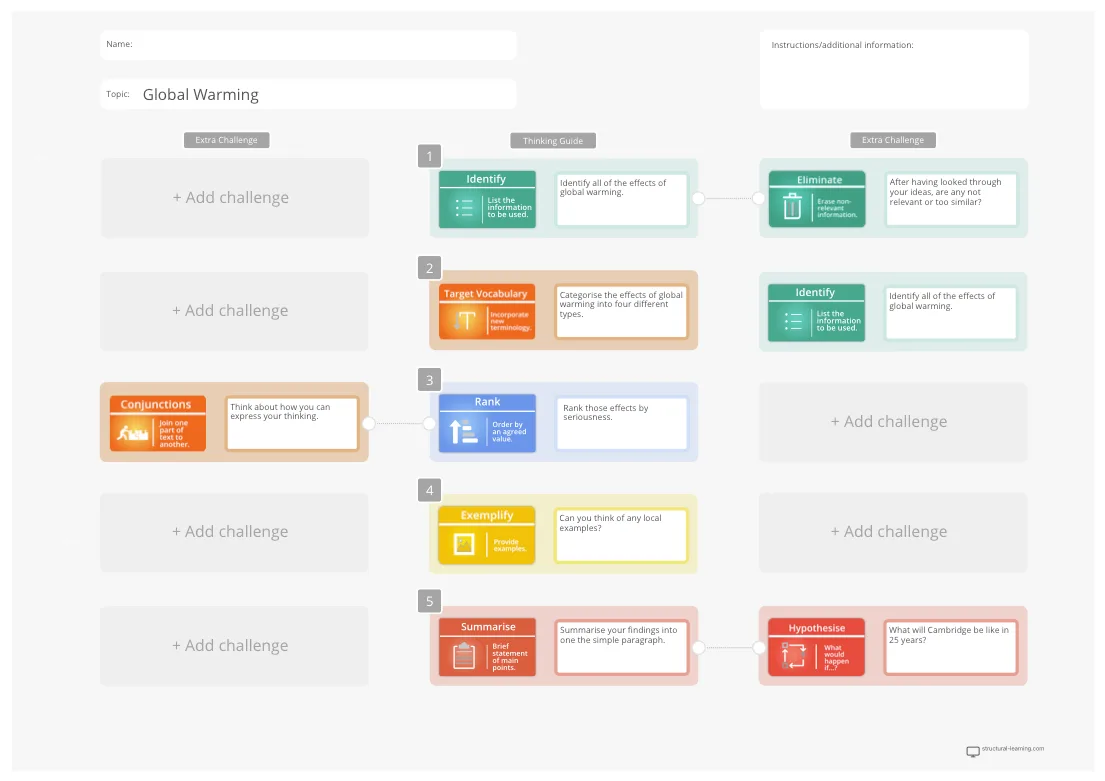
To plan the practice stage with the Thinking Framework, choose the card that matches the thinking you want from learners, and use it in guided practice before releasing them.
A planning model can make decisions visible, but it cannot make them for you. Begin with the learning you want learners to retain or be able to do. Identify the prior knowledge they need, the examples that will make the new idea clear, and the response that would show whether they are ready to practise. Then use the Hunter elements that help you answer those questions. If a lesson is mainly discussion, investigation or extended writing, another sequence may describe the work more clearly.
Use the anticipatory set to connect the lesson with relevant prior learning, rather than adding an entertaining opener that leads nowhere. A short retrieval question, a worked example with one deliberate gap, or a prediction can reveal what learners already understand. Explain the objective in language they can use. A broad statement such as “understand fractions” gives little guidance; a specific goal can show what learners should compare, represent or explain by the end.
During input and modelling, make the important decisions visible. For a calculation, narrate why each operation is chosen. For a piece of writing, compare a strong example with one that needs revision. Keep the explanation focused on the knowledge learners need for the task. If the model contains several unfamiliar ideas at once, pause and check one decision before moving on.
Plan a check for understanding before independent practice. Ask every learner to respond, using mini-whiteboards, a short written answer, a worked step or another method that lets you see the range of responses. A few volunteers cannot show whether the class is ready. Decide in advance what you will do if answers are mixed: model another example, change the prompt, or give a small group a supported attempt while others practise.
Guided practice is useful when learners need a chance to try while support is available. Reduce prompts as their responses become more accurate and considered. Move to independent work when the evidence supports that decision, not because a set number of minutes has passed. If errors persist, return to the relevant explanation or model. The sequence should respond to what learners show, rather than requiring the teacher to continue through every planned step.
Research on instructional routines needs careful interpretation. Hunter’s chapter describes a planning framework and warns against treating every element as compulsory. The four-year follow-through study by Stallings and Krasavage examines implementation under particular support conditions; it does not establish that every lesson using the template will produce the same result. Rosenshine’s review describes principles supported by a wider body of research, but those principles should not be presented as a direct test of Hunter’s named model. Keep these claims separate when explaining the evidence to colleagues.
After the lesson, compare the plan with learners’ work and responses. Note which check changed your next move, where another example was needed, and whether the independent task tested the intended learning. Use that evidence to adjust the next lesson. This review makes the template a record of professional decisions, rather than a form that is completed for its own sake.
In Hunter's 1984 chapter there are seven elements: anticipatory set, objective and purpose, input, modelling, checking for understanding, guided practice and independent practice. Some later summaries add closure.
Its elements live on in explicit instruction, I do, we do, you do, and many school lesson templates, often without Hunter's name attached.
No. Hunter said each element should be thought about and any exclusion should be a professional decision, not a default.
It is the opening activity or question that focuses learners on what they are about to learn and can give the teacher early information about what they already know.
No. Direct Instruction usually means scripted, published programmes. The Hunter template is a planning framework teachers adapt, though both rest on teacher-led teaching.
Yes, for lessons that teach a defined skill or procedure. It suits enquiry and discussion lessons less well.